Folded optimal transport
and its application to
separable quantum optimal transport
Thomas Borsoni*
under the supervision of Virginie Ehrlacher & Geneviève Dusson
Workshop Geometry, duality and convexity in new OT problems
November 19, 2025
*post-doc with Virginie Ehrlacher and Tony Lelièvre at CERMICS, ENPC (Champs-sur-Marne)
funded by the ERC starting grant HighLEAP (Virginie Ehrlacher)
pure states
pure states
mixed states
mixed states
classical
quantum
\(\bullet\) convex set \(C\)
\(\bullet\) extreme boundary \(E\)
How to extend a distance \(d\) from \(E\) to \(C\)?
d
D
d
D
\(\bullet\) convex set \(C\)
\(\bullet\) extreme boundary \(E\)
How to extend a distance \(d\) from \(E\) to \(C\)?
d
D
d
D
\(\bullet\) convex set \(C\)
\(\bullet\) extreme boundary \(E\)
Folded Wasserstein distance
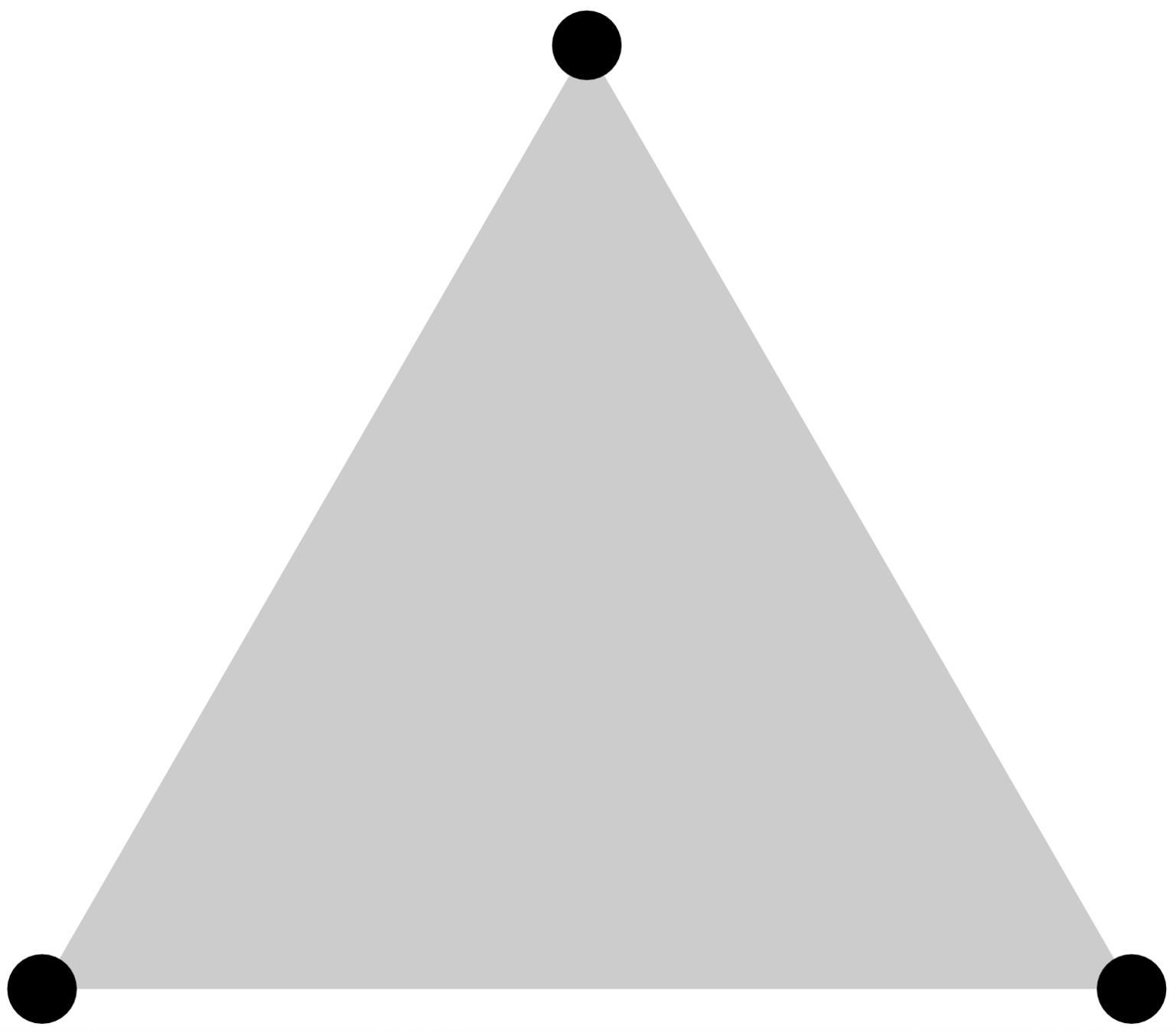
Simplex and set of probability measures
a
\mathcal{P}(\{a,b,c\})
probability measure
convex combination
b
c
\cong
\mathcal{P}(E_0)
\bm{\delta}_x
\bm{\delta}_y
E = \{\bm{\delta}_z\}_{z \in E_0} \cong E_0
Optimal transport answers
for the simplex
\mathcal{P}(E_0)
How to extend a distance from \(E\) to \(C\)?
- Let \((E_0,d)\) a compact Polish* space
* Polish = complete metric space with countable dense subset
- For \(p\geqslant 1\), the Wasserstein-\(p\) distance \(W_p\) is a distance on \(\mathcal{P}(E_0)\) such that
\(\forall x,y \in E_0\), \(W_p(\bm{\delta}_x, \bm{\delta}_y) = d(x,y)\)
\bm{\delta}_x
\bm{\delta}_y
E = \{\bm{\delta}_z\}_{z \in E_0} \cong E_0
\(W_p\) extends \(d\) from \(E \cong E_0\) to \(\mathcal{P}(E_0)\)
And for other convex sets?
Choquet theory
Representing every \(x \in C\) with convex combinations of points of \(E\)
C
E
\times
x
\bullet
\bullet
e_1
e_1'
- \(\mu_1 = \frac34 \bm{\delta}_{e_1} + \frac14 \bm{\delta}_{e'_1} \) represents \(x\)
(\(x\) is the barycenter associated with \(\mu_1\))
Representing every \(x \in C\) with probability measures \(\mu \in \mathcal{P}(E)\)
Choquet theory
Representing every \(x \in C\) with convex combinations of points of \(E\)
Representing every \(x \in C\) with probability measures \(\mu \in \mathcal{P}(E)\)
\times
x
\bullet
\bullet
e_2
e_2'
- \(\mu_1 = \frac34 \bm{\delta}_{e_1} + \frac14 \bm{\delta}_{e'_1} \) represents \(x\)
- \(\mu_2 = \frac12 \bm{\delta}_{e_2} + \frac12 \bm{\delta}_{e'_2} \) represents \(x\)
(\(x\) is the barycenter associated with \(\mu_1\))
(\(x\) is the barycenter associated with \(\mu_2\))
C
E
Choquet theory
Representing every \(x \in C\) with convex combinations of points of \(E\)
Representing every \(x \in C\) with probability measures \(\mu \in \mathcal{P}(E)\)
\times
x
\bullet
\bullet
e_3
e_3'
\bullet
e''_3
- \(\mu_3 = \frac14 \bm{\delta}_{e_3} + \frac14 \bm{\delta}_{e'_3} + \frac12 \bm{\delta}_{e''_3} \) represents \(x\)
- \(\mu_1 = \frac34 \bm{\delta}_{e_1} + \frac14 \bm{\delta}_{e'_1} \) represents \(x\)
- \(\mu_2 = \frac12 \bm{\delta}_{e_2} + \frac12 \bm{\delta}_{e'_2} \) represents \(x\)
(\(x\) is the barycenter associated with \(\mu_1\))
(\(x\) is the barycenter associated with \(\mu_2\))
(\(x\) is the barycenter associated with \(\mu_3\))
C
E
Choquet theory
Representing every \(x \in C\) with convex combinations of points of \(E\)
Representing every \(x \in C\) with probability measures \(\mu \in \mathcal{P}(E)\)
\times
x
- \(\mu_1 = \frac34 \bm{\delta}_{e_1} + \frac14 \bm{\delta}_{e'_1} \) represents \(x\)
- \(\mu_2 = \frac12 \bm{\delta}_{e_2} + \frac12 \bm{\delta}_{e'_2} \) represents \(x\)
- \(\mu_3 = \frac14 \bm{\delta}_{e_3} + \frac14 \bm{\delta}_{e'_3} + \frac12 \bm{\delta}_{e''_3} \) represents \(x\)
\dots
\bullet
\bullet
\bullet
\bullet
many \(\mu \in \mathcal{P}(E)\) represent \(x\) !
(\(x\) is the barycenter associated with many \(\mu \in \mathcal{P}(E)\))
C
E
\bullet
\bullet
\bullet
\times
x
- \(\mu_1 = \frac34 \bm{\delta}_{e_1} + \frac14 \bm{\delta}_{e'_1} \) represents \(x\)
- \(\mu_2 = \frac12 \bm{\delta}_{e_2} + \frac12 \bm{\delta}_{e'_2} \) represents \(x\)
\bullet
\bullet
\bullet
\bullet
- \(\nu = \frac23 \bm{\delta}_{g} + \frac13 \bm{\delta}_{g'}\) represents \(y \neq x\)
\times
y
\bullet
\bullet
e_1
e_1'
e_2
e_2'
g
g'
\(\mu_1\) \(\sim \) \(\mu_2\)
\(\mu_1\), \(\mu_2\) \(\nsim \) \(\nu\)
then
but
- Let \(\sim\) be the equivalence relation on \(\mathcal{P}(E)\):
\mu \sim \nu \qquad \iff \qquad
\(\mu\) and \(\nu\) represent the same \(x \in C\),
Choquet theory
Choquet-Bishop-DeLeeuw Theorem:
If \(C\) is convex and compact *, then
* and subset to a locally convex Hausdorff space
\forall x \in C,
(\(x\) is the barycenter associated with at least one \(\mu \in \mathcal{P}(E)\))
Since
\mu \sim \nu \qquad \iff \qquad
\(\mu\) and \(\nu\) represent the same \(x \in C\),
Choquet-Bishop-DeLeeuw
C \cong \mathcal{P}(E)/\sim
there exists at least one \(\mu \in \mathcal{P}(E)\) which represents \(x\)
C
E
Representing every \(x \in C\) with probability measures \(\mu \in \mathcal{P}(E)\)
Choquet theory
Folded Wasserstein
(\mathcal{P}(E)/\sim, \; W_p / \sim)
unfold
\mathcal{P}(E)
(E,d)
extend
(\mathcal{P}(E),W_p)
fold back
\cong
(optimal transport)
Folded Wasserstein distance on \(C\): \(D_p := W_p / \sim\)
(Choquet)
How to extend \(d\) from \(E\) to \(C\)?
?
?
C
(E,d)
(C,D_p)
(represent)
(quotient)
The quotient (pseudo-)distance
*pseudo-distance: would be a distance if it separated points
\widehat{D}_p([\mu],[\nu]) := \inf_{\mu' \sim \mu} \;
\inf_{\nu' \sim \nu} \;
W_p(\mu', \nu')
(\mathcal{P}(E),W_p)
[\mu]
\widehat{D}_p([\mu],[\nu])
a priori, fails the triangle inequality!
D_p([\mu],[\nu]) := \inf_{\gamma_1, \dots, \, \gamma_N} \{ \widehat{D}_p([\mu],[\gamma_1]) +
\widehat{D}_p([\gamma_1],[\gamma_2]) + \dots + \widehat{D}_p([\gamma_N],[\nu]) \}
W_p / \sim
D_p([\mu],[\nu])
- Candidate quotient distance:
- The actual quotient pseudo*-distance:
[\nu]
[\gamma]
W_p / \sim
?
\mathcal{P}(E) / \sim
on
The folded Wasserstein (pseudo-)distance
\widehat{D}_p(x,y) := \inf_{\mu \in \mathcal{P}(E) \text{ represents } x} \;
\inf_{\nu \in \mathcal{P}(E) \text{ represents } y} \;
W_p(\mu, \nu),
D_p(x,y) := \inf_{z_1, \dots, \, z_N \in C} \left\{ \widehat{D}_p(x,z_1) + \widehat{D}_p(z_1,z_2) + \dots + \widehat{D}_p(z_N,y) \right\}
d
D_p
C
E
An answer to: how to extend \(d\) from \(E\) to \(C\)?
For \(p \geqslant 1\), the folded Wasserstein-\(p\) (pseudo-)distance associated with \(d\) is
with
and
\(W_p\) is the standard Wasserstein distance on \(\mathcal{P}(E)\) associated with \(d\).
(\mathcal{P}(E),W_p)
unfold
fold back
extend
(E,d)
(E,d)
\mathcal{P}(E)
C
(C,D_p)
The folded Wasserstein metric space
Theorem
(C,D_p)
(E,d)
- \(C\) compact convex subset of \((X,\|\cdot\|)\) Banach
- \((E,d)\) compact Polish and \(d\) continuous w.r.t. \(\|\cdot\|\)
- For all \(x,y \in E\), \(d(x,y) \geqslant \|x-y\| \)
Assume:
Then:
- \(D_p\) is a distance on \(C\), and if* \(\mathrm{Ri}(C) \neq \emptyset\), is continuous w.r.t. \(\|\cdot\|\)
- For all \(x,y \in C\), \(D_p(x,y) \geqslant \|x-y\|\)
- \(D_p\) sub-extends \(d\), and if \(d = \|\cdot - \cdot\|\), \(D_p\) extends \(d\)
An answer to: how to extend \(d\) from \(E\) to \(C\)?
*\(\mathrm{Ri}(C)\) is the relative interior of \(C\). In finite dimension, \(C \neq \emptyset \implies \mathrm{Ri}(C) \neq \emptyset\).
\(\forall x,y \in E\), \(D_p(x,y) \leqslant d(x,y) \) \(\forall x,y \in E\), \(D_p(x,y) = d(x,y) \)
- If \((E,d)\) is geodesic and \(p>1\), then \((C,D_p)\) is geodesic
(X,\|\cdot\|)
(TB 2025)
Folded general optimal transport
C_2
E_1
C_1
E_2
c : E_1 \times E_2 \longrightarrow \R
How to extend \(c\) from \(E_1 \times E_2\) to \(C_1 \times C_2\)?
Optimal transport answers
for simplicies
\mathcal{P}(E_1)
How to extend \(c\) from \(E_1 \times E_2\) to \(C_1 \times C_2\)?
E_1
\mathcal{P}(E_2)
E_2
c : E_1 \times E_2 \longrightarrow \R
K_c : (\mu,\nu) \in \mathcal{P}(E_1) \times \mathcal{P}(E_2) \; \; \mapsto \; \; \inf_{\pi \in \mathcal{C}(\mu,\nu)} \iint_{E_1 \times E_2} c(e_1,e_2) \, \mathrm{d} \pi(e_1,e_2)
Kantorovitch cost associated with \(c\)
E_1
C_1
C_2
E_2
c : E_1 \times E_2 \longrightarrow \R
unfold
(represent)
E_1
E_2
\mathcal{P}(E_1)
\mathcal{P}(E_2)
c : E_1 \times E_2 \longrightarrow \R
extend
(Kantorovitch cost)
E_1
E_2
\mathcal{P}(E_1)
\mathcal{P}(E_2)
K_c : \mathcal{P}(E_1) \times \mathcal{P}(E_2) \longrightarrow \R
fold back
(quotient)
E_1
E_2
\mathcal{P}(E_1) / \sim
\mathcal{P}(E_2) / \sim
\overline{K}_c \equiv K_c / \sim : C_1 \times C_2 \longrightarrow \R
\cong
(Choquet)
folded Kantorovitch cost:
K_c / \sim
Folded Kantorovitch cost
Application to quantum optimal transport
Application to separable quantum optimal transport
C = S^+_1
E = \mathbf{P}_\mathcal{H}
C \subseteq (\mathcal{B}(\mathcal{H}), \|\cdot\|)
\(\mathcal{H}\) complex Hilbert of finite dimension
rank-one projectors on \(\mathcal{H}\)
pure states
self-ajoint semi-definite operators on \(\mathcal{H}\), with trace 1
mixed states
Quantum optimal transport: to define a distance on \(S^+_1\) from one on \(\mathbf{P}_{\mathcal{H}}\)
Some existing formulations
- Dynamic (Carlen-Maas)
- Nonseparable* static (Biane-Voilescu, Golse-Mouhot-Paul, DePalma-Trévisan,...)
- Separable static (Tóth-Pitrik, Beatty-Stilck França)
- Semiclassical (Golse-Paul)
*Includes entanglement
quantum folded optimal transport
classical OT
separable quantum OT
Conclusion (quantum)
folded optimal transport
classical OT
semiclassical OT
nonseparable quantum OT
To sum up
- Standard optimal transport answers
How to extend a cost from extreme boundaries to the whole convexes ?
in the case of the simplex
- Folded optimal transport answers (?)
How to extend a cost from extreme boundaries to the whole convexes ?
in the general case
- Quantum OT without entanglement is folded OT
- Folded OT is constructed from standard OT
is quantum without entanlement just classical?
TH
NK
Y
U
for your attention!
WorkshopOrsay
By Thomas Borsoni