How Go calculates code coverage
David Chou @ Golang Taiwan

CC-BY-SA-3.0-TW
@ Umbo Computer Vision 回家吃自己🏠
@ Golang Taiwan Co-organizer 🙋♂️
Software engineer, DevOps, and Gopher 👨💻


Go's coverage-based fuzzing
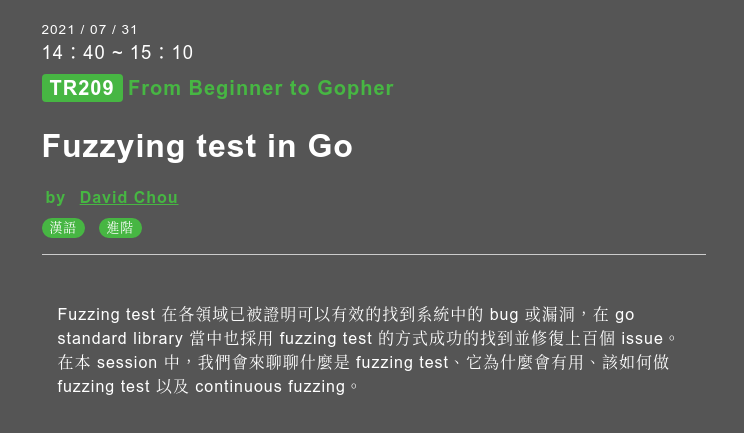
Fuzzing is the process of sending intentionally invalid data to a product in the hopes of triggering an error.
- H.D. Moore
What is fuzzing test?

Fuzzing test
-
Start from a set of initial inputs
-
Continuously manipulate inputs
-
Semi-random input from various mutation
-
Discover new code coverage based on instrumentation
Go's official fuzzing solution
-
Official proposal [link]
-
Coverage-based fuzzing
-
Write fuzz function just like test function
-
func FuzzFoo(f *testing.F)
-
-
Integrate with go command
-
go test -fuzz
-
-
Plan to land in 1.18
Code coverage in Go
go test -cover
go test -fuzz

A simple example
func CountAverage(num []byte) int {
	sum := byte(0)
	for _, v := range num {
		sum += v
	}
	return int(sum) / len(num)
}
func TestCountAverage(t *testing.T) {
tests := []struct {
name string
num []byte
want int
}{
{
num: []byte{1, 2, 3, 4, 5},
want: 3,
},
}
for _, tt := range tests {
t.Run(tt.name, func(t *testing.T) {
got := CountAverage(tt.num)
assert.EqualValues(t, tt.want, got)
})
}
}$ go test -cover
PASS
coverage: 100.0% of statementsGo test coverage
Coverage visualization
$ go test -coverprofile=coverage.out
$ go tool cover -html=coverage.out
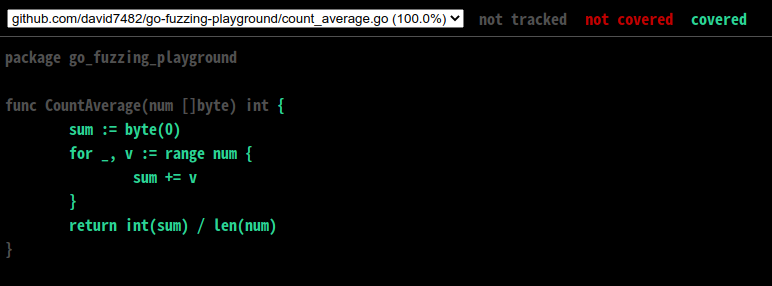
Go tool cover
$ go tool cover
Usage of 'go tool cover':
Given a coverage profile produced by 'go test':
go test -coverprofile=c.out
Open a web browser displaying annotated source code:
go tool cover -html=c.out
Write out an HTML file instead of launching a web browser:
go tool cover -html=c.out -o coverage.html
Display coverage percentages to stdout for each function:
go tool cover -func=c.out
Finally, to generate modified source code with coverage annotations
(what go test -cover does):
go tool cover -mode=set -var=CoverageVariableName program.go
package go_fuzzing_playground

func CountAverage(num []byte) int {GoCover.Count[0] = 1;
	sum := byte(0)
	for _, v := range num {GoCover.Count[2] = 1;
		sum += v
	}
	GoCover.Count[1] = 1;return int(sum) / len(num)
}

var GoCover = struct {
	Count     [3]uint32
	Pos       [3 * 3]uint32
	NumStmt   [3]uint16
} {
	Pos: [3 * 3]uint32{
		3, 5, 0x180023, // [0]
		8, 8, 0x1c0002, // [1]
		5, 7, 0x30018, // [2]
	},
	NumStmt: [3]uint16{
		2, // 0
		1, // 1
		1, // 2
	},
}
$ go tool cover -mode=set ./count_average.go
{StartLine, EndLine, ColumnInfo} [link]
Number of statements
package go_fuzzing_playground

func CountAverage(num []byte) int {GoCover.Count[0] = 1;
	sum := byte(0)
	for _, v := range num {GoCover.Count[2] = 1;
		sum += v
	}
	GoCover.Count[1] = 1;return int(sum) / len(num)
}

var GoCover = struct {
	Count     [3]uint32
	Pos       [3 * 3]uint32
	NumStmt   [3]uint16
} {
	Pos: [3 * 3]uint32{
		3, 5, 0x180023, // [0]
		8, 8, 0x1c0002, // [1]
		5, 7, 0x30018, // [2]
	},
	NumStmt: [3]uint16{
		2, // 0
		1, // 1
		1, // 2
	},
}
block0
block1
block2
$ go test ./ -coverprofile=coverage.out && cat coverage.out
ok            0.003s  coverage: 100.0% of statements
mode: set
count_average.go:3.35,5.24 2 1
count_average.go:8.2, 8.28 1 1
count_average.go:5.24,7.3  1 1
$ go test ./ -coverprofile=coverage.out && cat coverage.out
-
Coverage format:
-
name.go: Line.Column, Line.Column NumStmt Count
[link]
-
-
100% = (2x1 + 1x1 + 1x1) / (2 + 1 + 1)
Go test coverage
-
Source to source transform
-
Add instrument code before compiling
-
Basic block coverage
Basic block v.s. Branch coverage
block0
block1
block2
block0
block1
block2
Basic block: 100%
Branch coverage: 67%
package go_fuzzing_playground

func CountAverage(num []byte) int {GoCover.Count[0] = 1;
	sum := byte(0)
	for _, v := range num {GoCover.Count[2] = 1;
		sum += v
	}
	GoCover.Count[1] = 1;return int(sum) / len(num)
}
block0
block1
block2
How "go test -fuzz" works

Go fuzz coverage
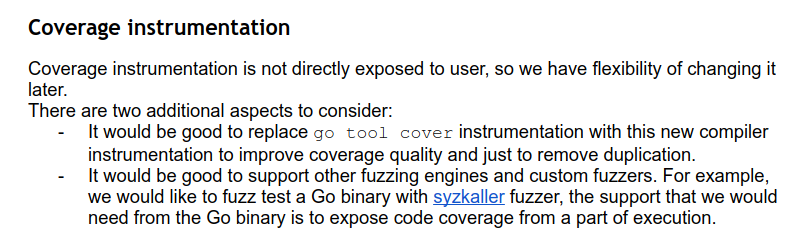
Go fuzz coverage
Compiler instrumentation
// edge inserts coverage instrumentation for libfuzzer.
func (o *orderState) edge() {
	// Create a new uint8 counter to be allocated in section
	// __libfuzzer_extra_counters.
	counter := staticinit.StaticName(types.Types[types.TUINT8])
	counter.SetLibfuzzerExtraCounter(true)

	// counter += 1
	incr := ir.NewAssignOpStmt(base.Pos, ir.OADD, counter, ir.NewInt(1))
	o.append(incr)
}
edge() inserts coverage instrumentation
func (o *orderState) stmt(n ir.Node) {
    switch n.Op() {
    ...
    case ir.OFOR:
        edge()
    case ir.OIF:
        edge()
    case ir.ORANGE:
        edge()
    case ir.OSELECT:
        edge()
    case ir.OSWITCH:
        edge()
    case OANDAND, OOROR:
        edge()
    ...
    }
}
compiler adds edge() into each edge
// _counters and _ecounters mark the start and end, respectively, of where
// the 8-bit coverage counters reside in memory. They're known to cmd/link,
// which specially assigns their addresses for this purpose.
var _counters, _ecounters [0]byte

func coverage() []byte {
	addr := unsafe.Pointer(&_counters)
	size := uintptr(unsafe.Pointer(&_ecounters)) - uintptr(addr)

	var res []byte
	*(*unsafeheader.Slice)(unsafe.Pointer(&res)) = unsafeheader.Slice{
		Data: addr,
		Len:  int(size),
		Cap:  int(size),
	}
	return res
}
coverage() returns the coverage counters
Go fuzz coverage
$ objdump go-fuzzing.test -h

go-fuzzing.test:     file format elf64-x86-64

Sections:
Idx Name          Size      VMA               LMA               File off  Algn
  0 .text         0027890e  0000000000401000  0000000000401000  00001000  2**5
                  CONTENTS, ALLOC, LOAD, READONLY, CODE
...
 19 .data         0000a550  0000000000883da0  0000000000883da0  00483da0  2**5
                  CONTENTS, ALLOC, LOAD, DATA
 20 .bss          00031708  000000000088e300  000000000088e300  0048e300  2**5
                  ALLOC
 21 .noptrbss     00006fc0  00000000008bfa20  00000000008bfa20  004bfa20  2**5
                  ALLOC
 22 __libfuzzer_extra_counters 000052a4  00000000008c69e0  00000000008c69e0  004c69e0  2**0
                  ALLOC
Bonus: libfuzzer_extra_counters
-
libfuzzer is a well-known LLVM fuzzy engine
-
It could take coverage number from libfuzzer_extra_counters variable
-
It means Go could use external fuzzy engine [link]
$ go build -gcflags=all=-d=fuzzing -buildmode=c-archive -o pngfuzz.a .
$ clang -o png.fuzzer pngfuzz.a -fsanitize=fuzzer
Bonus: libfuzzer_extra_counters
Compiler instrumentation
Source to source transform
-
Go test coverage
-
Add instrument code before compiling
-
Basic block coverage
-
Difficult to adopt branch coverage
-
Go fuzz coverage
-
Add instrument code during compiling
-
Basic block coverage
-
Easier to adopt branch coverage
-
Could expose code coverage during execution
Amazon CTO Dr. Werner Vogels
How Go calculates code coverage
By Ting-Li Chou