Oleksandr Rehush,
python developer

- I'm Oleksandr Rehush
- Have ~5 years experience in IT
- Full stack developer at bvblogic
- Key technologies: Python, React.js, React Navite
- I don't spend time on social networks surfing
- t.me/o_rehush
Bio
django
django-channels 1.x
django-channels 2.x
sync code
async code
sync server
async server
http
websockets
DEP 0009
...
What we will be talking about?
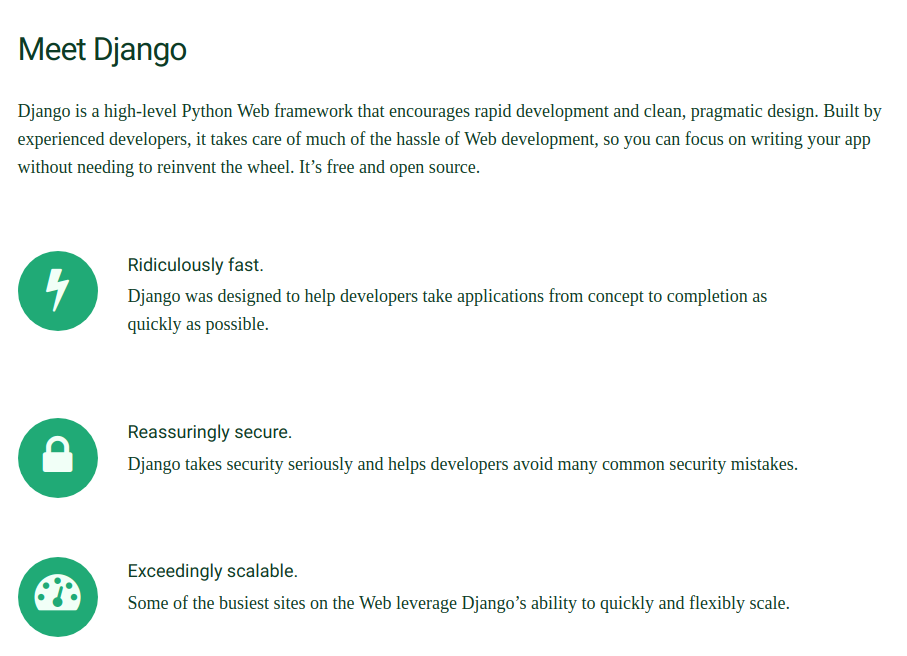
What is Django?
Django components
- Model layer (DB connections, ORM, migrations, etc)
- View layer (URL resolver, request/response classes, middlewares, views classes, etc)
- Template layer (templating, tags, filters)
- Forms
- Admin site
- Security
- i18n, l10n
- GeoDjango
- Authentication
- Caching
- Logging
- Paginations
- Sessions
- Sending emails
- Signals
- ...
What Is Django And Why Is It So Popular?
-
It is time-tested
-
You have access to enough Django packages
-
Django has wonderful documentation
-
The Django community is hugely supportive
-
Django advocates best practices for SEO
-
Scalability
-
Security
Source: https://medium.com/swlh/what-is-django-and-why-is-it-so-popular-2b225620cca0
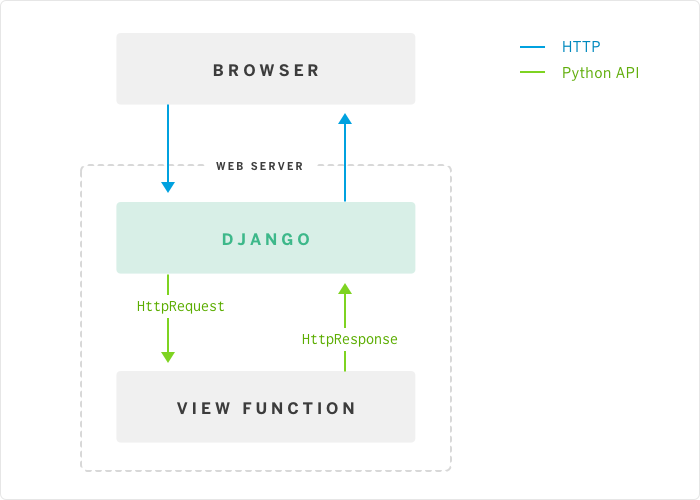
How django works?
Source: https://blog.heroku.com/in_deep_with_django_channels_the_future_of_real_time_apps_in_django
Django channels
Django Channels 1.0
Channels is a project to make Django able to handle more than just plain HTTP requests, including WebSockets and HTTP2, as well as the ability to run code after a response has been sent for things like thumbnailing or background calculation.
It’s an easy-to-understand extension of the Django view model, and easy to integrate and deploy.
How channels 1.0 works?
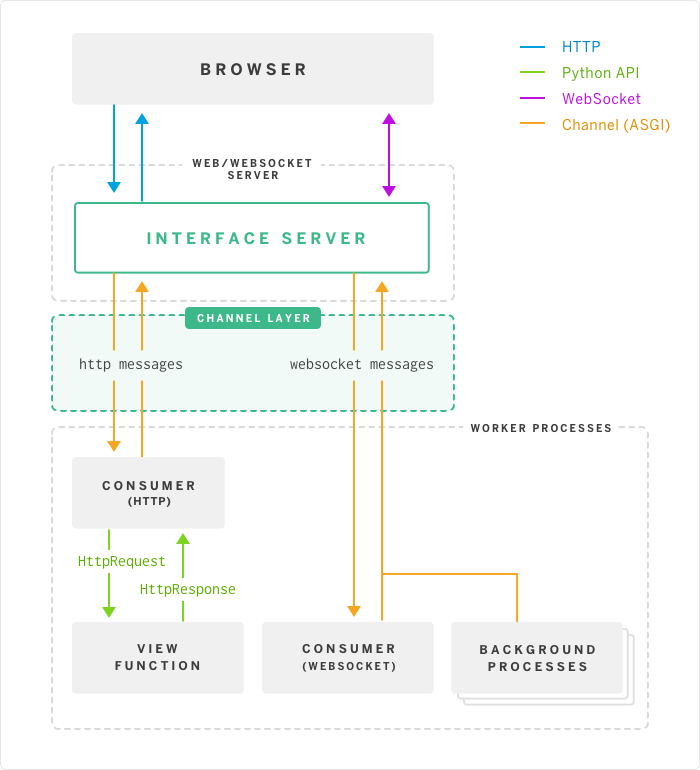
Source: https://blog.heroku.com/in_deep_with_django_channels_the_future_of_real_time_apps_in_django
Django Channels 2.0+
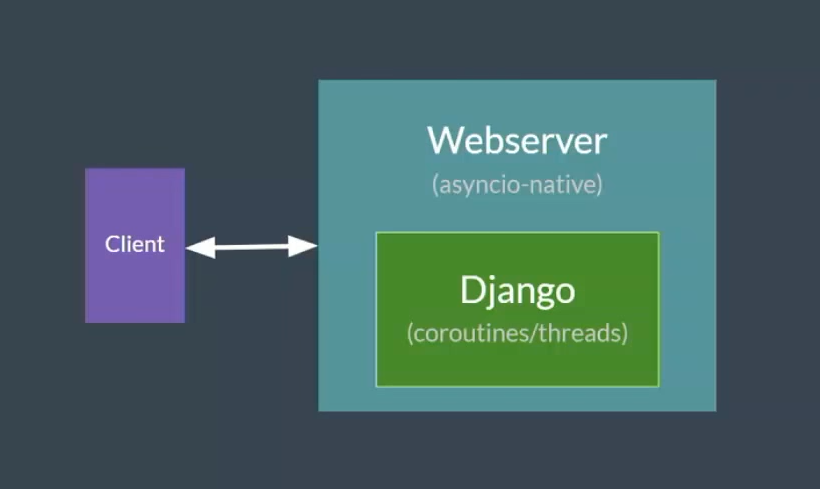
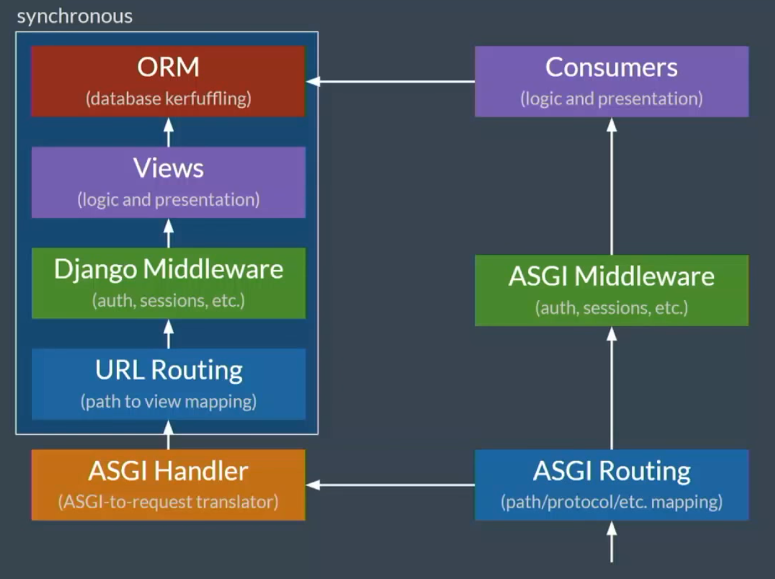
Channels is a project that takes Django and extends its abilities beyond HTTP - to handle WebSockets, chat protocols, IoT protocols, and more. It’s built on a Python specification called ASGI.
It does this by taking the core of Django and layering a fully asynchronous layer underneath, running Django itself in a synchronous mode but handling connections and sockets asynchronously, and giving you the choice to write in either style.
Channels is comprised of several packages:
- Channels, the Django integration layer
- Daphne, the HTTP and Websocket termination server
- asgiref, the base ASGI library
- channels_redis, the Redis channel layer backend (optional)
How channels 2.0 works?
How channels 2.0 works?
Sync / Async programming
| Sync programming | Async programming | |
|---|---|---|
| Sync threads |
Run synchronous code in synchronous threads | Run asynchronous code as synchronous blocking function |
| Async event loop |
Run synchronous code as coroutine in the event loop | Run asynchronous code in the event loop |
asgiref
sync_to_async
async_to_sync
Example 1. Real-time chat and notifications
routing.py
from channels.routing import ProtocolTypeRouter, URLRouter
from django.urls import path

from .middleware import TokenAuthMiddlewareStack
from .consumers import RoomConversationConsumer, NotificationConsumer

application = ProtocolTypeRouter({
    'websocket': TokenAuthMiddlewareStack(
        URLRouter([
            path('notifications', NotificationConsumer),
            path('conversations/<int:room_id>', RoomConversationConsumer),
        ])
    )
})
middleware.py
from channels.auth import UserLazyObject
from channels.db import database_sync_to_async
from channels.middleware import BaseMiddleware
from channels.sessions import SessionMiddlewareStack
from django.contrib.auth.models import AnonymousUser
from rest_framework_simplejwt.authentication import JWTAuthentication
from rest_framework_simplejwt.exceptions import TokenError, AuthenticationFailed


class TokenAuthMiddleware(BaseMiddleware):
    jwt_auth = JWTAuthentication()

    def populate_scope(self, scope):
        if "user" not in scope:
            scope["user"] = UserLazyObject()

    async def resolve_scope(self, scope):
        scope["user"]._wrapped = await self.get_user(scope)

    @database_sync_to_async
    def get_user(self, scope):
        token_key = self.get_token(scope)
        try:
            return self.jwt_auth.get_user(self.jwt_auth.get_validated_token(token_key))
        except (TokenError, AuthenticationFailed):
            pass
        return AnonymousUser()

TokenAuthMiddlewareStack = lambda inner: SessionMiddlewareStack(TokenAuthMiddleware(inner))
websocket/base.py
from channels.exceptions import AcceptConnection, DenyConnection
from channels.generic.websocket import AsyncJsonWebsocketConsumer


class AsyncBaseConsumer(AsyncJsonWebsocketConsumer):
    async def resolve_groups(self):
        self.groups = []

    async def connect(self):
        user = self.scope['user']
        if user.is_authenticated:
            raise AcceptConnection
        else:
            raise DenyConnection

    async def websocket_connect(self, message):
        await self.resolve_groups()
        await super(AsyncBaseConsumer, self).websocket_connect(message)
consumers.py
from channels.db import database_sync_to_async

from ..models import Room
from .base import AsyncBaseConsumer


class RoomConversationConsumer(AsyncBaseConsumer):
    async def resolve_groups(self):
        user = self.scope['user']
        room_id = self.scope['url_route']['kwargs']['room_id']
        room = await self.get_room(user, room_id)
        if room:
            self.groups.append('room_%s' % room_id)

    @database_sync_to_async
    def get_room(self, user, room_id):
        return Room.objects.filter(pk=room_id, members__id=user.id).first()


class NotificationConsumer(AsyncBaseConsumer):
    async def resolve_groups(self):
        user = self.scope['user']
        if user.is_authenticated:
            self.groups.append('notifications_%s' % user.pk)
signal_handlers.py
from django.db.models.signals import post_save
from django.dispatch import receiver
from djangorestframework_camel_case.util import camelize

from .serializers import NotificationSerializer, MessageDetailSerializer
from .models import Notification, Message
from .helpers import send_channel_notification, send_message_to_room, transaction_on_commit


@receiver(post_save, sender=Notification)
@transaction_on_commit
def send_notification_to_user(instance: Notification, created, **kwargs):
    if not created:
        return
    event = {
        'type': 'notification',
        'data': camelize(NotificationSerializer(instance=instance).data)
    }
    send_channel_notification(instance.user, event)

@receiver(post_save, sender=Message)
@transaction_on_commit
def send_message_to_channel(instance, created, **kwargs):
    if not created:
        return
    event = {
        'type': 'message',
        'data': camelize(MessageDetailSerializer(instance=instance).data)
    }
    send_message_to_room(instance.room_id, event)
helpers.py
from asgiref.sync import async_to_sync
from channels.layers import get_channel_layer


def send_channel_message(group_name, message):
    channel_layer = get_channel_layer()
    async_to_sync(channel_layer.group_send)(
        group_name, {
            'type': 'channel_message',
            'message': message
        }
    )


def send_channel_notification(user, notification):
    group_name = 'notifications_%s' % user.pk
    send_channel_message(group_name, notification)


def send_message_to_room(room_id, message):
    group_name = 'room_%s' % room_id
    send_channel_message(group_name, message)
Example 2. Async http
views.py
import requests
from django.http import JsonResponse
from .constants import BLOGS


def news_collector_sync_view(request):
    """
    Synchronous HTTP fetcher
    """
    data = {}
    # Go through each blog and fetch it using requests
    for name, link in BLOGS.items():
        response = requests.get(link)
        if response.status_code != 200:
            data[name] = 'Download error'
        else:
            data[name] = response.content.decode("utf-8")
    return JsonResponse(data)
consumers.py
import asyncio
import json
from aiohttp import ClientSession
from channels.generic.http import AsyncHttpConsumer
from .constants import BLOGS


class NewsCollectorAsyncConsumer(AsyncHttpConsumer):
    async def handle(self, body):
        async def fetch(url, session):
            async with session.get(url) as response:
                return await response.read()
        tasks = []
        loop = asyncio.get_event_loop()
        # aiohttp allows a ClientSession object to link all requests together
        async with ClientSession() as session:
            for name, url in BLOGS.items():
                # Launch a coroutine for each URL fetch
                task = loop.create_task(fetch(url, session))
                tasks.append(task)
            # Wait on, and then gather, all responses
            responses = await asyncio.gather(*tasks)

        data = dict(zip(BLOGS.keys(), [r.decode('utf-8') for r in responses]))
        text = json.dumps(data)

        await self.send_response(200,
            text.encode(),
            headers=[
                (b"Content-Type", b"application/json"),
            ]
        )
routing.py
from django.urls import path, re_path
from channels.http import AsgiHandler
from channels.routing import ProtocolTypeRouter, URLRouter
from collector.consumers import NewsCollectorAsyncConsumer


# By default, the ProtocolTypeRouter sets the "http" route to just be Django.
# This overrides it to send it to our asynchronous consumer for a single path,
# and to Django for all other pages.
application = ProtocolTypeRouter({
    "http": URLRouter([
        # Our async news fetcher
        path("collector/collect_news_async/", NewsCollectorAsyncConsumer),

        # AsgiHandler is "the rest of Django" - send things here to have Django
        # views handle them.
        re_path("^", AsgiHandler),
    ]),
})
tests.py
import pytest
from channels.testing import HttpCommunicator
from .consumers import NewsCollectorAsyncConsumer


@pytest.mark.django_db
@pytest.mark.asyncio
async def test_news_collector_consumer():
    communicator = HttpCommunicator(
        NewsCollectorAsyncConsumer,
        "GET",
        "/collector/collect_news_async/"
    )
    response = await communicator.get_response()
    assert response["status"] == 200
Result


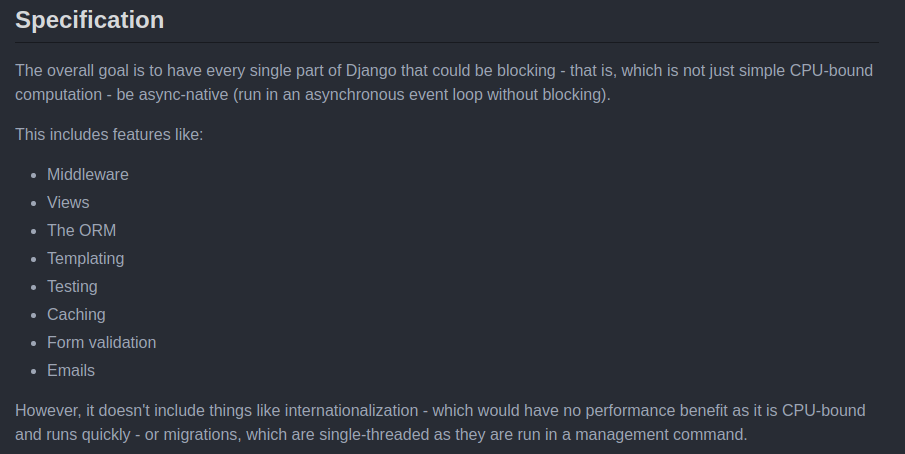
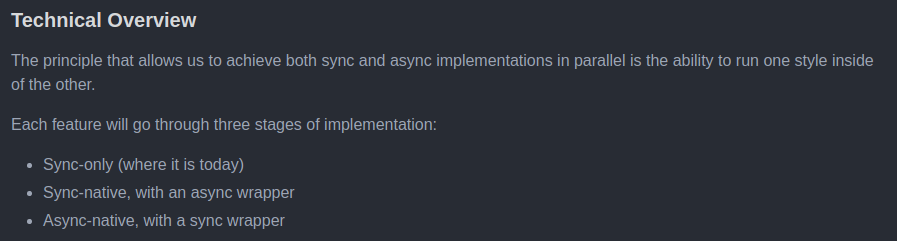
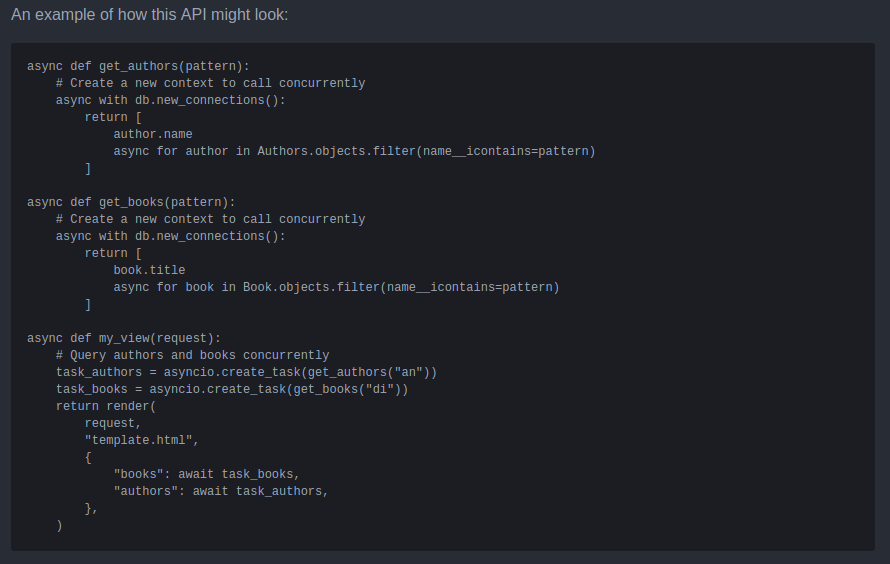
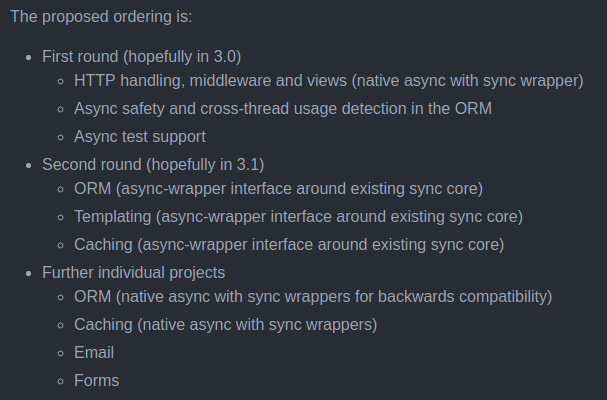
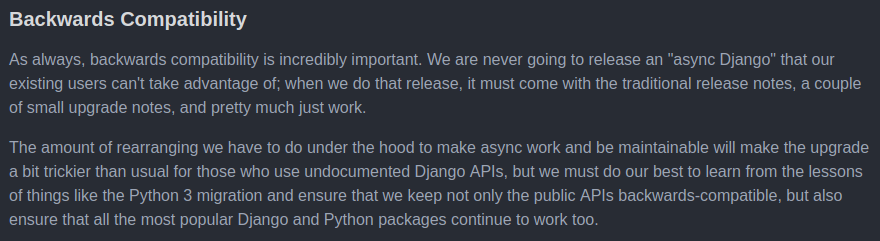
DEP 0009:
Async-capable Django
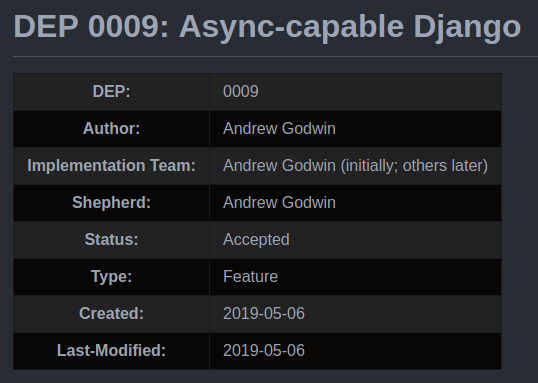
Django Enhancement Proposals (DEPs)
are a formal way of proposing large feature additions
to the Django Web framework
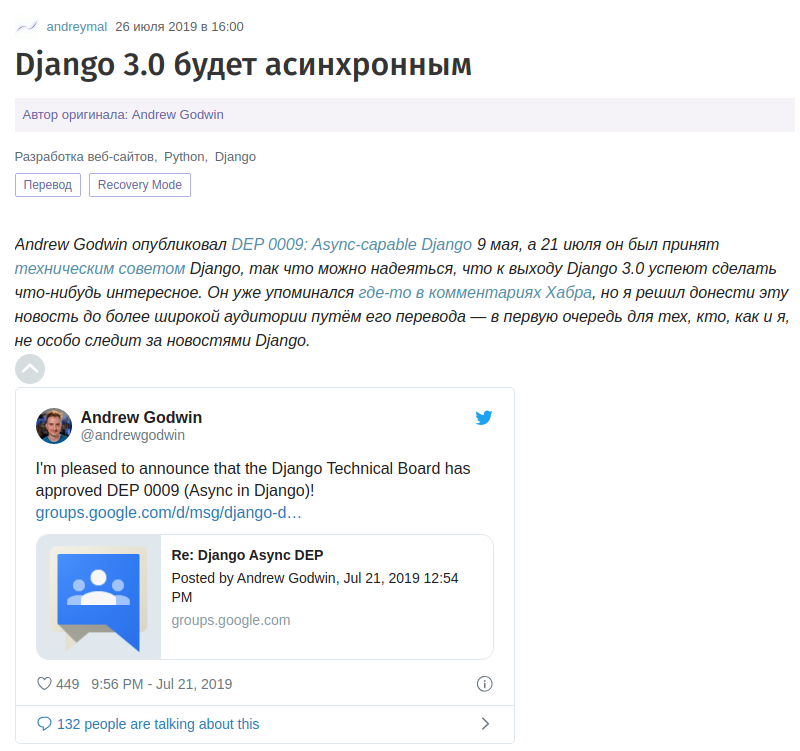
Sequencing

References
- https://docs.djangoproject.com/en/3.0/releases/3.0/
- https://asgi.readthedocs.io/en/latest/
- https://docs.djangoproject.com/en/3.0/howto/deployment/asgi/
- https://channels.readthedocs.io/en/latest/
- https://github.com/django/deps/blob/master/accepted/0009-async.rst
- https://habr.com/ru/post/461493/
Let's talk
How to use channels and can django die?
By Tutan Budok