NodeJS Web Framework
Express
Route
var express = require('express');
var app = express();

app.get('/', function(req, res) {
  res.send('hello world');
});
express.Router
var express = require('express');
var router = express.Router();

// define the about route
router.get('/about', function(req, res) {
  res.send('About birds');
});

module.exports = router;
var birds = require('./birds');
...
app.use('/birds', birds);birds.js
app.js
middleware
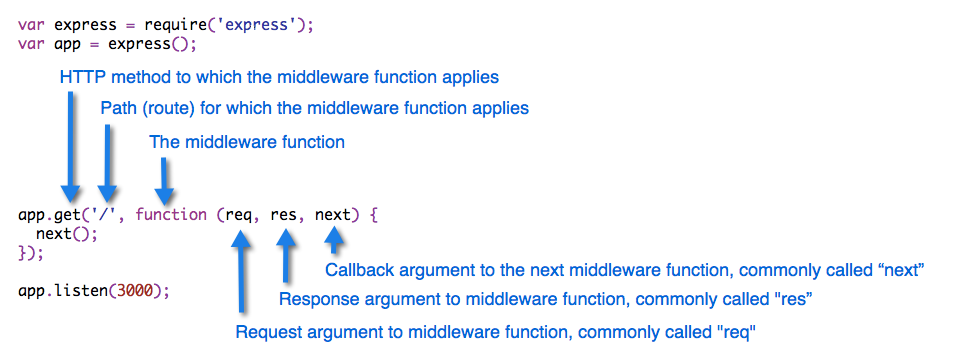
An Express application is essentially a series of middleware calls.
Middleware can:
- Execute any code.
- Make changes to the request and the response objects.
- End the request-response cycle.
- Call the next middleware in the stack.
middleware
var app = express();

// a middleware with no mount path; gets executed for
// every request to the app
app.use(function (req, res, next) {
  console.log('Time:', Date.now());
  next();
});

// a middleware mounted on /user/:id; will be executed for
// any type of HTTP request to /user/:id
app.use('/user/:id', function (req, res, next) {
  console.log('Request Type:', req.method);
  next();
});

// a route and its handler function (middleware system) which
// handles GET requests to /user/:id
app.get('/user/:id', function (req, res, next) {
  res.send('USER');
});var app = express();
var router = express.Router();
// a middleware with no mount path, gets executed for every request to the router
router.use(function (req, res, next) {
console.log('Time:', Date.now());
next();
});
// a middleware sub-stack shows request info for any type of HTTP request to /user/:id
router.use('/user/:id', function(req, res, next) {
console.log('Request URL:', req.originalUrl);
next();
}, function (req, res, next) {
console.log('Request Type:', req.method);
next();
});
// handler for /user/:id which renders a special page
router.get('/user/:id', function (req, res, next) {
console.log(req.params.id);
res.render('special');
});
// mount the router on the app
app.use('/', router);app.use(function(err, req, res, next) {
console.error(err.stack);
res.status(500).send('Something broke!');
});var options = {
dotfiles: 'ignore',
etag: false,
extensions: ['htm', 'html'],
index: false,
maxAge: '1d',
redirect: false,
setHeaders: function (res, path, stat) {
res.set('x-timestamp', Date.now());
}
}
app.use(express.static('public', options));$ npm install mysqlvar mysql = require('mysql');
var connection = mysql.createConnection({
host : 'localhost',
user : 'dbuser',
password : 's3kreee7'
});
connection.connect();
connection.query('SELECT 1 + 1 AS solution', function(err, rows, fields) {
if (err) throw err;
console.log('The solution is: ', rows[0].solution);
});
connection.end();DEMO
$ npm install express-generator -g
$ express myapp
$ cd myapp
$ npm install
$ DEBUG=myapp:* npm start
Koa
Koa is a new web framework designed by the team behind Express, which aims to be a smaller, more expressive, and more robust foundation for web applications and APIs.
middleware
Generator function
var compute = function* (a, b) {
  var sum = a + b;
  console.log(sum);
};
var generator = compute(4, 2);
generator.next();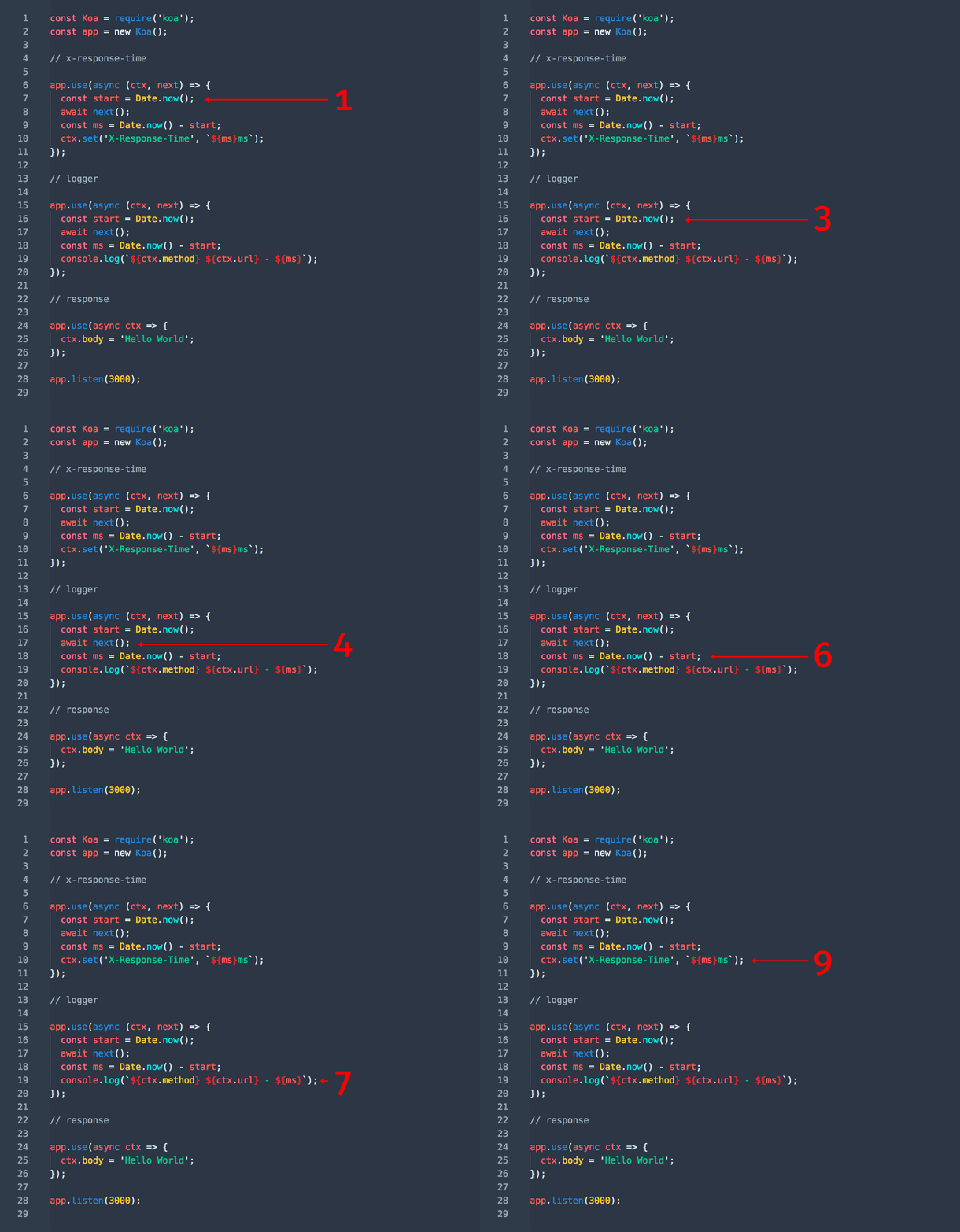
context
app.use(function *(){
  this; // is the Context
  this.request; // is a koa Request
  this.response; // is a koa Response
  this.req; // is a node Request
  this.res; // is a node Response
});
route
var app = require('koa')();
var router = require('koa-router')();

router.get('/', function *(next) {...});

app.use(router.routes());
reference
Express VS Koa
| Features | Koa | Express |
|---|---|---|
| Middleware Kernel | ✓ | ✓ |
| Routing | ✓ | |
| Templating | ✓ | |
| Sending Files | ✓ | |
| JSONP | ✓ |
-
Meteor
-
LoopBack
-
Sails
-
Hapi
-
Restify
END
NodeJS Web Framework
By xzhang