Looking for a Bargain(ing) at Auction
| Daniel Hermosillo |
Alistair Wilson |
| Behavioral Brownbag October 2025 |


Competitive bidding with a possibility of being the only competitor
Motivating Idea
- We call a contractor to come perform a renovation in our home:
- They provide a bid on the job
- We give them the job or not
- Does the bid given depend on how nice our house is?!

Motivating Idea
Well, it depends...
- If we called multiple contractors would typically model this as an auction
- Bids do not depend on the homeowners reservation
- If there's any chance we only called one contractor then bids will depend on homewner's reservation value
Model
\(\Longrightarrow\)
Nature
\(\mathcal{N}=\left\{1\right\}\)
\(\mathcal{N}=\left\{1,2\right\}\)
\(p\)
\(1-p\)
Each bidder:
- Draws cost \(c_i\in[\underline{c},\overline{c}]\)
- Chooses bid \(\beta(c)\)
- Contract awarded to lowest bidder
- so long as bid below reservation \(\omega>\overline{c}\)
Notation
- \(p\) - Probability only one bidder
- \(\omega\) - Reservation price for auction
- \(c\) - Agent's cost to provide the service
- \(\beta(c)\) - The equilibrium bid function
- \(\left[\underline{c},\overline{c}\right]\) - The support for bids
Model
Symmetric theoretical solution :
- Assume bid function \(\beta(c)\) is strictly increasing
- Bidders expected profit is given by:\[\pi(b|c)=\Pr\left\{b\text { lowest bid}\left|\beta\right.\right\}\cdot (b-c)\]
Model
First-order condition leads to a differential equation:
\[\frac{\beta(c)-c}{\overline{c}-\underline{c}}=\beta^\prime (c)\frac{\Pr\left\{\text{Lowest }c\right\} }{ \Pr\left\{\text{Not alone} \right\} }\]
- To solve this we need a boundary condition on the highest cost type:
- With \(p=0\) this is \(\beta(\overline{c})=\overline{c}\)
- With \(p>0\) this is \(\beta(\overline{c})=\omega\)
Stylized Data
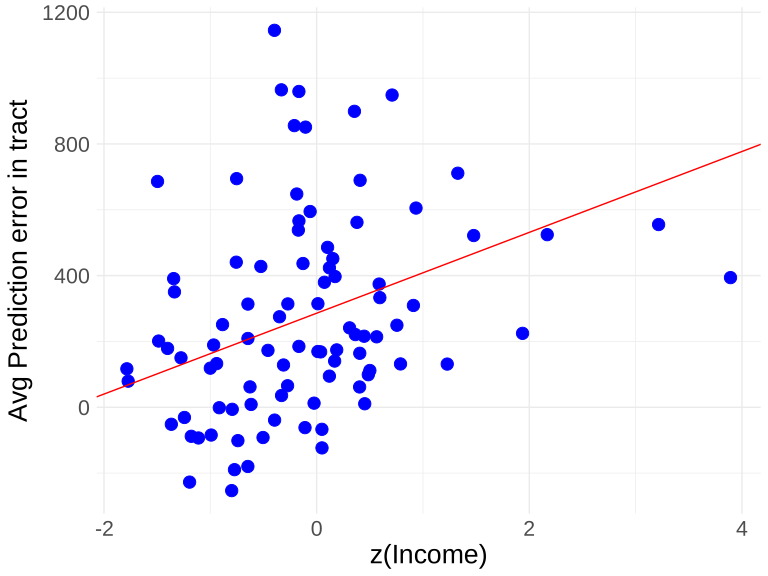
- Look at all permits in Allegheny Count
- Focus on electrical panel installations
- Common residential upgrade
- Minimize unobserved heterogeneity
- Lists size of the panel in Amperes
- Have 2,196 permit applications
Stylized Data
- Regress permit project value \(\log(\$V)\) on
| Variable | Coefficient | p-Val. |
|---|---|---|
| Intercept (100A panel in 2020) | $1260 | <0.001 |
| per 100A | 36% | <0.001 |
| z(Census income) | 5% | <0.001 |
| per year increase | 5.6% | <0.001 |
Stylized Data
Design Sketch
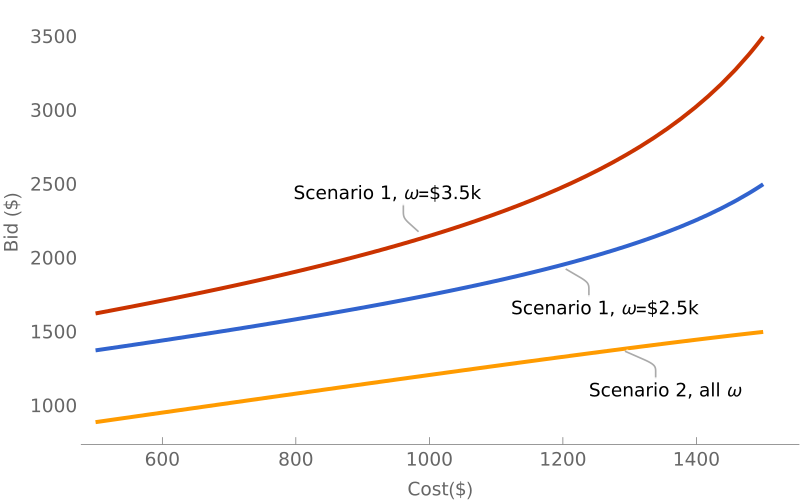
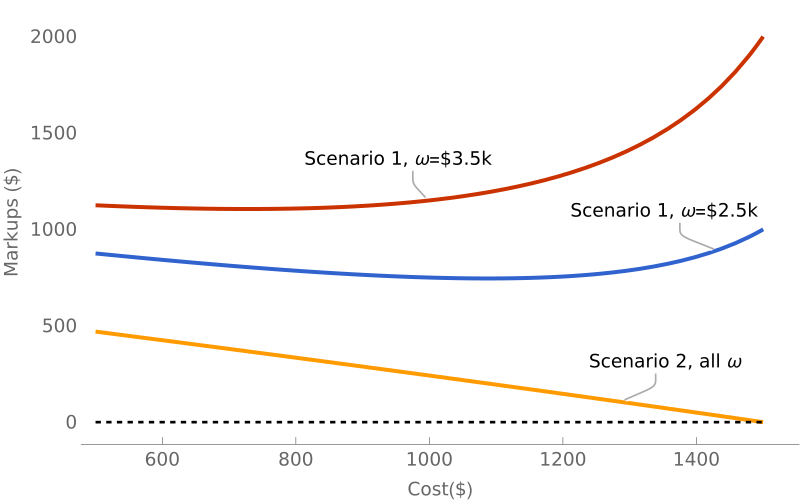
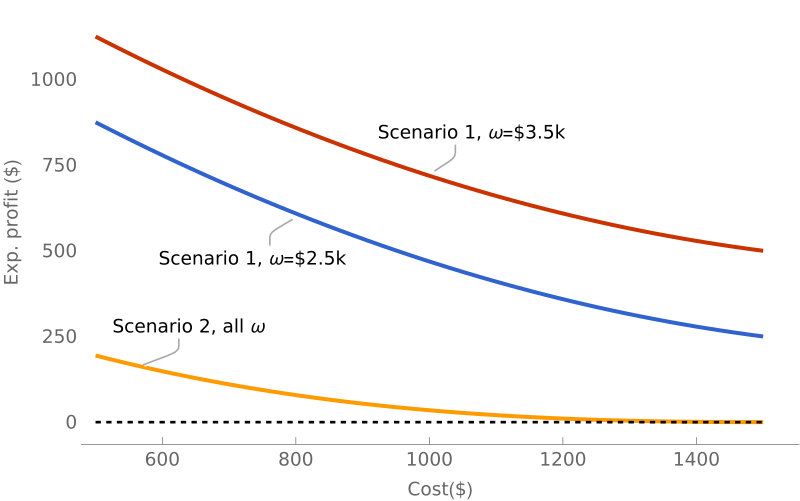
Costs drawn from \(U[\$500,\$1500]\) with \(2\times 2\) design over:
- Reservation of
- Low: \(\omega=\$2,500\)
- High: \(\omega=\$3,500\)
- Uncertainty over bidders
- Scenario 1: \( \tfrac{3}{4}\cdot 2\text{ bid} \oplus \tfrac{1}{4}\cdot 1\text{ bid}\)
- Scenario 2: \( \tfrac{3}{4}\cdot 2\text{ bid} \oplus \tfrac{1}{4}\cdot 3\text{ bid}\)
Design Sketch
Design Sketch
Design Sketch
Theory Hypotheses
- No response to reservation if \(\Pr(N=1)=0\)
- Response to reservation if \(\Pr(N=1)>0\)
- Reservation pricing only by the highest cost type
- Higher conditional markups for higher cost types
Behavioral Hypotheses
- Response to reservation even when \(\Pr(N=1)=0\)
- Pooling on reservation by many cost types
Questions
- Is this interesting?
- Auction research can be dull
- Are there elements missing?
- Robot/Human homeowner
- Additional elements:
- Contractor survey
- Homeowner survey
- Cleaning data
Thank You!
🙏
Copy of CostlyBelief-BSF
By Alistair Wilson