Asynchronous JavaScript
Synchronous EXECUTION
Particular case of an asynchronous execution, where the process waits for every single thing,
even if independent.
The synchronous case
- I want something
- I wait
- I get it
- I move to the next thing
- And it forces me to ask for one thing at a time
CPU Activity

Asynchronous Execution
It's not magic.

It's a "simple" queue
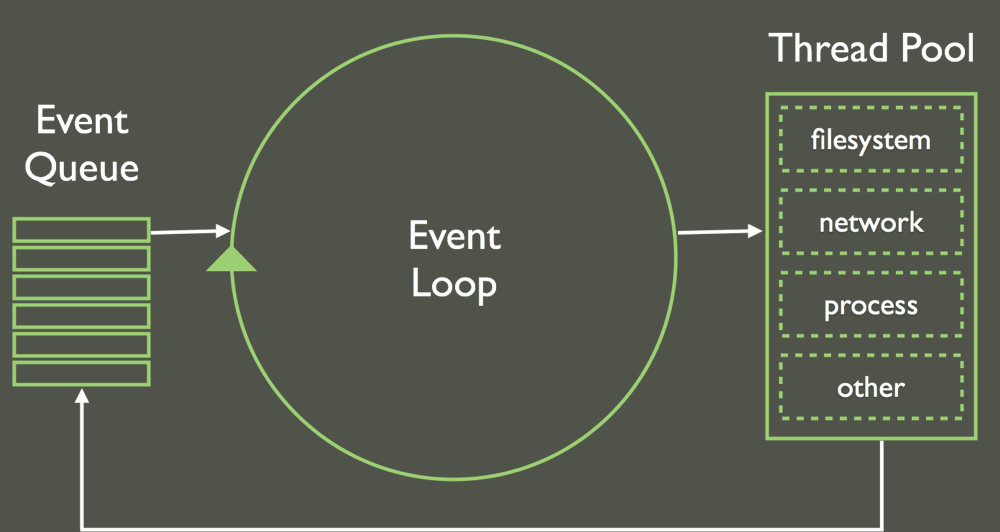
What you basically do
- You provide callbacks
- The synchronous part is only about pushing the callback as a reference in memory
- The bridge between now and the future is the set of closure variables and context retained by the provided callback
- Your callback will be called, or not
Is it mono threaded ?
- One event loop is mono threaded.
- Clusters are not
- But they do not share memory natively
(nevertheless you can send data process to process)
I - Basic use
- For now you don't chain anything
Event emitter
let ee = new EventEmitter();

ee.on('data', ({prop}) => {
    // ... do something with `prop`
});- Event emitters can emit things
Callback style
fs.readFile('path/to/file.ext', (err, data) => {
    // ... `err` not null means something went wrong
    // ... otherwise consider `data`
});- Emitted things can make a whole, that is eventually errored or completed
- The nodejs classical callback style can be used

Callback style
II - Advanced use
- You start chaining things and manipulating flows
- More generally, it's all about having
- consumers
- producers
- consumers of producers
- and things in between
Utilities for callbacks APIs
async provides a complete set of utilities for handling callbacks APIs
Promise
let promisify = (f) => (...args) => new Promise((resolve, reject) => {
    args.length = f.length - 1;
    f(...args, (err, data) => {
        err ? reject(err) : resolve(data);
    });
});

let readFile = promisify(fs.readFile);

readFile('path/to/file')
.then(
    (data) => {
        // ... do something with `data`
    },
    (err) => {
        // ... do something with `err`
    }
);- You can chain handlers on resolution or rejection
- Those handlers can return other promises or values
Promise
- Common pitfalls with promises:
https://pouchdb.com/2015/05/18/we-have-a-problem-with-promises.html
Streams
// readable stream
let r = fs.createReadStream('file.txt');

// writable stream
let w = fs.createWriteStream('file.txt.gz');

// duplex stream
let z = zlib.createGzip();

r.pipe(z).pipe(w);- Emitted things can be readable streams piped into writable streams
Streams
import {Transform} from 'stream';

class OddUpper extends Transform {
    _transform(chunk, enc, cb) {
        for (let i = 0, length = chunk.length; i < length; i += 2) {
            chunk.writeUInt8(chunk.readUInt8(i) - 32, i); // uppercase
        }
        this.push(chunk);
        cb();
    }
}

var oddUpper = new OddUpper();
oddUpper.pipe(process.stdout);
oddUpper.write('hello world\n');
oddUpper.write('another line');
oddUpper.end();

// output:
// HeLlO WoRlD
// AnOtHeR LiNe
- You can operate at the chunk buffer level
Streams
- Implement your own stream.Transform:
http://codewinds.com/blog/2013-08-20-nodejs-transform-streams.html
- Implement your own stream.Duplex:
http://codewinds.com/blog/2013-08-31-nodejs-duplex-streams.html
DISCRETE FRP WITH OBSERVABLES
let observable = Rx.Observable.create((observer) => {
    observer.next(1);
    observer.next(2);
    observer.next(3);
    setTimeout(() => {
        observer.next(4);
        observer.complete();
    }, 1000);
});

observable.subscribe({
    next: (x) => { /* ... work with `x` */ },
    error: (err) => { /* ... work with the error `err` */ },
    complete: () => { /* ... it has finished */ }
});- FRP stands for Functional Reactive Programming
- Emitting things is notifying an observer
- Subscribing to an observable lets the observer call your subscription methods
- Subscribing is active, subscription is passive
Discrete FRP with observables
Rx.Observable.fromEvent(input, 'input')
    .map(({target: { value }}) => value)  // extract the value
    .filter(({length}) => length > 2)     // filter by length
    .debounceTime(400)                    // debounce
    .distinctUntilChanged()               // produce only on change
    .switchMap(asyncSearch)               // switch producer on each consumption
    .subscribe(
        (results) => {
            // ... work with `results`
        },
        (err) => {
            // ... handle `err`
        }
    )
;- Implementations come with full sets of operators powerful when dealing with async flows
- Promises are only a particular case of it
Discrete FRP with observables
- Learn FRP with rx.js:
http://reactivex.io/documentation/operators.html
- See this reference for the latest API changes documentation for RxJS 5 beta versions:
http://reactivex.io/rxjs
- Play with interactive diagrams of Rx Observables
http://rxmarbles.com
- Other attempts:
http://jsbin.com/leziqoy/edit?html,js,output
- Netflix using RxJS:
http://fr.slideshare.net/RyanAnklam/rethink-async-with-rxjs
Discrete FRP with observables
- Principles of functional programming
https://github.com/iirvine/principles-of-reactive-programming
Synchronous Asynchronous JavaScript
- Synchronous syntax has the strengh to be surpriseless
- But most of the time you get things sequentially when you would have got them in parallel
- With the combination of generators and wrappers, you get the ability to await for asynchronous processes on demand (that can process in parallel)
Generators
- Known as asymmetric coroutines
- Wrappers can control output to resume input with asynchronous results
// `yield` and `return` in a generator create the single async I/O
// sequence between the iterator and the wrapper
let getMergedData = co.wrap(function* (...urls) {
    let data;

    try {
        // fetch in parallel
        data = yield urls.map(asyncFetch);
    } catch(err) {
        // ... handle `err`
    }

    return asyncDataMerge(...data);
});

getMergedData(url1, url2, url3).then((mergedData) => {
    // ... work with `mergedData`
});
Generators
- You can delegate generation natively
let sequentialFetch = function* (...urls) {
    let url;
    while (url = urls.pop()) {
        yield asyncFetch(url);
    }
};

let getMergedData = co.wrap(function* (...urls) {
    let data;

    try {
        // delegate to a waterfall fetcher
        data = yield* sequentialFetch(urls);
    } catch(err) {
        // ... handle `err`
    }

    return asyncDataMerge(...data);
});

getMergedData(url1, url2, url3).then((mergedData) => {
    // ... work with `mergedData`
});
Async/await
- An async function awaits other async executions
- It basically replaces generators when used with wrappers like co
// you get less control than with generators
// but it will eventually not depend on external lib
let getMergedData = async function(...urls) {
    let data;

    try {
        // fetch in parallel
        data = await* urls.map(asyncFetch);
    } catch(err) {
        // ... handle `err`
    }

    return await asyncDataMerge(...data);
});

getMergedData(url1, url2, url3).then((mergedData) => {
    // ... work with `mergedData`
});
CSP
- Stands for Communicating Sequential Processes
- Makes use of channels
- JS implementations try to mimic goroutines
function* player(name, table) {
    while (true) {
        var ball = yield csp.take(table);
        if (ball === csp.CLOSED) {
            console.log(name + ": table's gone");
            return;
        }
        ball.hits += 1;
        console.log(name + " " + ball.hits);
        yield csp.timeout(100);
        yield csp.put(table, ball);
    }
}

// goroutine power but in the same thread
csp.go(function* () {
    var table = csp.chan();

    csp.go(player, ["ping", table]);
    csp.go(player, ["pong", table]);

    yield csp.put(table, {hits: 0});
    yield csp.timeout(1000);
    table.close();
});
CSP
- Learn CSP with js-csp:
https://github.com/ubolonton/js-csp
http://jlongster.com/Taming-the-Asynchronous-Beast-with-CSP-in-JavaScript
- Learn CSP with golang:
http://talks.golang.org/2012/concurrency.slide
http://talks.golang.org/2013/advconc.slide
- Goroutine vs mono threaded CSP performance comparison:
https://www.npmjs.com/package/co-channel#differences-between-javascript-coroutine-and-goroutine
What should i use ?
- You need to implement a lifecycle made of logic piping relations: learn FRP and promises
- Those pipes are greatly optimizable when you consider chunks: learn streams
- You need to implement independant processes living concurrently: learn CSP
- You need to implement prodecural computations made of sync and async computations: learn wrapped generators or async/await and promises
- You need to do simple things on simple events: learn event emitters
- You need to sleep: go to bed
FRP vs CSP ?
- Both can separate
- producing
- consuming
- the medium in between
- CSP has this explicit way of saying: "go do this somewhere else, and, yeah, take those channels with you"
- Pure functions passed to FRP operators are also jobs that can be done somewhere else, also bringing an observable and an observer with it
- So again, prefer CSP for independant processes, FRP for logical pipes
- And why not combine them, with transducers and immutables (looks like the path to clojurescript)
III - Optimizing and decoupling your async code
Ensure lazy execution
- A synchronous collection lets you write transformation chains executed immediately
- An asynchronous collection forces you to think the transformations pipeline as a whole, which is executed lazily on consuming data
- This lazy execution can be used with synchronous collections to avoid looping over elements multiple times (better performances)
- Basically, even for synchronous collections, it's better to think "lazy first"
Decouple processes with transducers
- A transform chain is made of reducers
- Map, filter, etc. are actually made of reducers
- A transducer is about transforming reducers or transducers
- It's decoupled from input and output so that it can be used with sync and async collections (arrays, streams, observables, channels)
- A transducer is described by its init, step, and result methods
Transducers
- origins and how it works:
http://jlongster.com/Transducers.js--A-JavaScript-Library-for-Transformation-of-Data - benchmark:
http://jlongster.com/Transducers.js-Round-2-with-Benchmarks - transducers-js + RxJS:
https://github.com/Reactive-Extensions/RxJS/blob/master/doc/gettingstarted/transducers.md - RxJS transduce bridge:
https://github.com/Reactive-Extensions/RxJS/blob/master/src/core/linq/observable/transduce.js - "Transducers" by Rich Hickey:
https://www.youtube.com/watch?v=6mTbuzafcII
Asynchronous JavaScript
By Alexis Tondelier