Chris Liu
Math gradudate student at Colorado State University
These slides are a record keeping tool and will not be used at for any actual presentations, hence the tiny font size and color choices at times
Results from analyzing p+q=r equation are found here
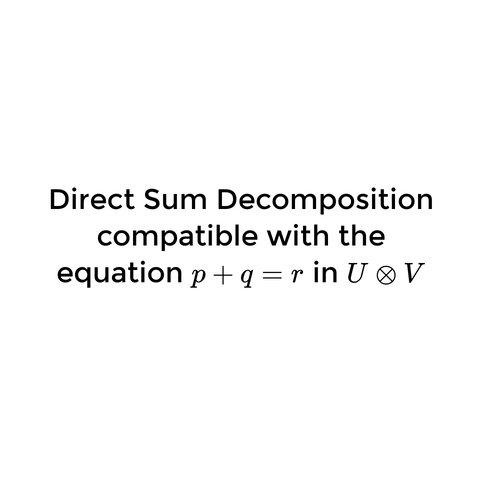
Given \(p+q=r \) equation in \(U \otimes V \)
Let \(A,B,C \leq U \) and \(X,Y,Z \leq V \) as subspaces
Each space of minimal dimension, satisfying \(p+q=r\)
One conclusion we may draw from the previous analysis is that there exists a compatible local decomposition for the equation \(p+q=r\)
This is the justification for being able to analyze \( p+q = r \) equations in a global-to-local fashion, such as the one arising from \(\text{Der}(s \otimes t) \) for \( s,t \) bimaps.
Summary of last time
Definition: [Compatible Local Decomposition] \((p,q,r)\) has a compatible local decomposition if there exists a \( n \in \mathbb{N} \), and subsets \( (a_i)_{i=1}^{n} \subset A\), \( (b_i) \subset B \), \( (c_i) \subset C \), \( (x_i) \subset X \), \( (y_i) \subset Y \), \( (z_i) \subset Z \) such that
I've implemented this decomposition in Magma when elements of \(U \otimes V \) are identified as matrices. Specifically,
Given a triple of matrices \( p,q,r \)
| V1 | V2 | V3 | V4 | V5 | V6 | |
| U1 | ||||||
| U2 | ||||||
| U3 | ||||||
| U4 | ||||||
| U5 | ||||||
| U6 |
| V1 | V2 | V3 | V4 | V5 | V6 | |
| U1 | ||||||
| U2 | ||||||
| U3 | ||||||
| U4 | ||||||
| U5 | ||||||
| U6 |
| V1 | V2 | V3 | V4 | V5 | V6 | |
| U1 | ||||||
| U2 | ||||||
| U3 | ||||||
| U4 | ||||||
| U5 | ||||||
| U6 |
=
+
p
q
r
Each color is a different region and each region admits rank 1 expansions \(a \otimes x + b \otimes y = c \otimes z\) where each term is in the correct spaces.
Example: To get rank 1 equalities for the orange region, we expand for each basis element of \(u \in U_1\) the corresponding nonzero columns in \(p,q,r\) in the \(V\) basis. Since \(u \in U_1\), \(u \in A \cap B \cap C\).
We get local equality \(u \otimes x + u \otimes y = u \otimes z\), where \(x = p_{12}v_2 + p_{13}v_3 + p_{15}v_5 \in X \), \(y = p_{12}v_2 + p_{14}v_4 + p_{16}v_6 \in Y \) and \(z = \sum_{i=2}^{6} p_{1i}v_i \in Z \)
Hence \(u \otimes x \in A \otimes X\), \(u \otimes y \in B \otimes Y\), and \(u \otimes z \in C \otimes Z\)
In the process of linking this to derivations of tensors in Magma - pretty close to complete
The upshot is that the existence of a compatible local decomposition implies for tensors \(s: U_2 \times U_1 \rightarrowtail U_0\) and \(t: V_2 \times V_1 \rightarrowtail V_0\), the deriviation algebra of the tensor \(s \otimes t: (U_2 \otimes V_2) \times (U_1 \otimes V_1) \rightarrowtail (U_0 \otimes V_0)\) has a derivation algebra that is completely characterized by algebraic invariants of the tensors \(s\) and \(t\).
In particular, knowledge of \(\text{Der}(s), \text{Der}(t), \text{Nuc}_{ij}(s), \text{Nuc}_{ij}(t)\) gives knowledge of \( \text{Der}(s \otimes t) \).
The proof is constructive, giving a decomposition of an arbitrary element in \( \text{Der}(s \otimes t)\) in terms of the individual pieces
Given \(p+q+r =s \) equation in \(U \otimes V \)
Let \(A,B,C,D \leq U \) and \(X,Y,Z,W \leq V \) as subspaces
Given elements
Each space of minimal dimension, satisfying \(p+q+r = s\)
Claim:
There exists a quadruple \( (p,q,r,s) \) satisfying \(p+q+r=s\) but not having a compatible local decomposition.
Definition: [Compatible Local Decomposition] \((p,q,r,s)\) has a compatible local decomposition if there exists \(n \in \mathbb{N}\), and subsets \( (a_i)_{i=1}^{n} \subset A, (b_i) \subset B, \ldots \) such that both of the following holds
Observation:
To have a compatible local decomposition we require the vector space \( (A \otimes X + B \otimes Y + C \otimes Z) \cap (D \otimes W) \eqqcolon H \) to contain nonzero rank one elements since the right hand side of a local equality \(a_i \otimes x_i + b_i \otimes y_i + c_i \otimes z_i = d_i \otimes w_i \) is rank 1.
Thus to show no valid decompositions exist, we will construct an example where the vector space \(H\) have only nonzero elements of rank greater than 1.
Below, we set up the spaces, \( A,B,C,D,X,Y,Z,W \), prove nonzero elements of \(H \) has rank greater than 1, and find a quadruple \( (p,q,r,s) \) in the appropriate spaces (\(A \otimes X\), \(B \otimes Y\), etc) satisfying \( p+q+r=s \)
Let \( k := \mathbb{F}_5 \), and \(U,V = k^4 \)
Let \( (e_1,\ldots,e_4)\) be the standard basis of \( U \) and \( (f_1,\ldots, f_4) \) be the standard basis of \( V \).
Below we'll produce some "magic constants" that have the desired properties, and then explain how we got them
\( D = \text{span}\{e_1,e_2\}, W = \text{span}\{f_1,f_2\} \)
\( A = \text{span}\{e_1 + e_3, e_2 + e_4 \}, B =\text{span}\{e_1 - e_3, e_2 - e_4 \}, C = \text{span}\{e_1 + e_4, e_2 + 4e_3+ 4e_4 \} \)
\( X = \text{span}\{f_1 + f_3, f_2 + f_4 \}, Y =\text{span}\{f_1 - f_3, f_2 - f_4 \}, Z = \text{span}\{f_1 + 4f_4, f_2 + f_3+ 4f_4 \} \)
As notation, we shall denote \(A = \text{span}\{e_1+e_3 \eqqcolon a_1, e_2+e_4 \eqqcolon a_2\}, B = \text{span}\{b_1,b_2\}\), and so on
View \(U\) as column vectors, \( V \) as row vectors, and \(U \otimes V \) as \(4 \times 4\) matrices where \(u \otimes v \) is the outer product of \(u\) and \(v\).
If \(\mathcal{U}\) is a basis of U and \(\mathcal{V}\) a basis of V, then \( \{u \otimes v | u \in \mathcal{U}, v \in \mathcal{V} \} \) is a basis of \(U \otimes V\)
As \(D =\text{span}\{e_1,e_2\}, W = \text{span}\{f_1,f_2\}\), we get \(D \otimes W = \text{span}\{e_1 \otimes f_1, e_1 \otimes f_2, e_2 \otimes f_1, e_2 \otimes f_2\}\), which is spanned by the below matrices
Recall \( A \otimes X = \text{span} \{ a_1 \otimes x_1, a_1 \otimes x_2, a_2 \otimes x_1, a_2 \otimes x_2 \} \), where \(a_1 = e_1 + e_3, a_2 = e_2 + e_4, x_1 = f_1 + f_3, x_2 = f_2 + f_4 \)
More concisely, \( p \in A \otimes X \) is of the form \( \begin{bmatrix} P & P \\ P & P \end{bmatrix} \) for \(P\) an arbitrary \(2 \times 2\) matrix
Similarly, \( q \in B \otimes Y \) is of the form \( \begin{bmatrix} Q & -Q \\ -Q & Q \end{bmatrix} \) for \(Q\) an arbitrary \(2 \times 2\) matrix
The calculation for \(r \in C \otimes Z \) is a bit more complicated. See next slide.
More concisely, \(s \in D \otimes W\) is of the form \( \begin{bmatrix}S & 0 \\ 0 & 0 \end{bmatrix}\) for \(S\) an arbitrary \(2 \times 2 \) matrix
Hence \(A \otimes X\) is spanned by
\( C \otimes Z = \text{span} \{ c_1 \otimes z_1, c_1 \otimes z_2, c_2 \otimes z_1, c_2 \otimes z_2 \} \), where \(c_1 = e_1 + e_4, c_2 = e_2 + 4e_3 + 4e_4 \)
and \(z_1 = f_1 + 4f_4, z_2 = f_2 + f_3 + 4f_4 \)
Let \( J = \begin{bmatrix}0 & 4 \\ 1 & 4\end{bmatrix} \) describe a linear map \(D \rightarrow D'\). Then \(c_1 = e_1 + e_4 = e_1 + J(e_1), c_2 = e_2 + 4e_3 + 4e_4 = e_2 + J(e_2)\).
Let \(K = J^T = \begin{bmatrix} 0 & 1 \\ 4 & 4\end {bmatrix}\) describe a linear map \(W \rightarrow W' \). Then \(z_1 = f_1 + K(f_1), z_2 = f_2 + K(f_2) \)
Recall, \(D = \text{span}\{e_1,e_2\} \), with complement \(D' = \text{span}\{e_3,e_4\}\), where \(U = D \oplus D' \)
Similarly, \(W = \text{span}\{f_1,f_2\}\), with complement \(W' = \text{span}\{f_3,f_4\} \).
Expanding \(c_1 \otimes z_1 = (e_1 + J(e_1)) \otimes (f_1 + K(f_1)) = e_1 \otimes f_1 + e_1 \otimes K(f_1) + J(e_1) \otimes f_1 + J(e_1) \otimes K(f_1) \).
The 4 terms are in 4 distinct regions in the block \(2 \times 2\) matrix with coordinates in \( \begin{bmatrix} D \otimes W & D \otimes W' \\ D' \otimes W & D' \otimes W' \end{bmatrix} \) because \(e_1 \otimes f_1 \in D \otimes W\), \(e_1 \otimes K(f_1) \in D \otimes W'\), \(J(e_1) \otimes f_1 \in D' \otimes W\), and \(J(e_1) \otimes K(f_1) \in D' \otimes W'\)
Converting to coordinates where \(e_i\) are column vectors and \(f_i\) are row vectors. Then \(J\) acts on the left, and \(K^T = J\) acts on the right (as \(K\) was originally defined with column vector conventions)
By linearity, the block configuration of an arbitrary element \(r \in C \otimes Z \) is \( \begin{bmatrix} R & RJ \\ JR & JRJ \end{bmatrix}\)
Explicitly, \(c_1 \otimes z_1\) is \( \begin{bmatrix} e_1 \otimes f_1 & e_1 \otimes K(f_1)\\ J(e_1) \otimes f_1 & J(e_1) \otimes K(f_1) \end{bmatrix} \)
Now an element in \(H := (A \otimes X + B \otimes Y + C \otimes Z) \cap (D \otimes W) \) must satisfy
With each of \(P,Q,R,S\) arbitrary \(2 \times 2\) matrices. This gives 4 equations, with unknowns \(P,Q,R,S\)
Next we solve for a \( (p,q,r,s) \) quadruple satisfying \(p+q+r=s\)
Translating back to elements of \(U \otimes V\), a valid \( p,q,r,s \) is the following:
This quadruple satisfies \(p+q+r = s\), with \(p \in A \otimes X, q \in B \otimes Y, r \in C \otimes Z, s \in D \otimes W \), and no local equality exists because any nonzero element of \((A \otimes X + B \otimes Y + C \otimes Z) \cap (D \otimes W)\) is rank 2.
Recall \(D \otimes W = \text{span}\{e_1 \otimes f_1, e_1 \otimes f_2, e_2 \otimes f_1, e_2 \otimes f_2\} \). We now solve for an element in \(H := (A \otimes X + B \otimes Y + C \otimes Z) \cap (D \otimes W) \) which gives the \( (p,q,r,s) \) counterexample.
Recall
Let \(S = e_1 \otimes f_1 + e_2 \otimes f_2 \) - it corresponds to \(I_2\). We solve for \(P,Q,R\)
What's proven: Unlike the equation \(p+q=r\) in \(U \otimes V\), the equation \(p+q+r=s\) need not admit a compatible local decomposition. We've given an explicit counterexample above.
By Chris Liu