Grating matching
Matching at the centres of the orders
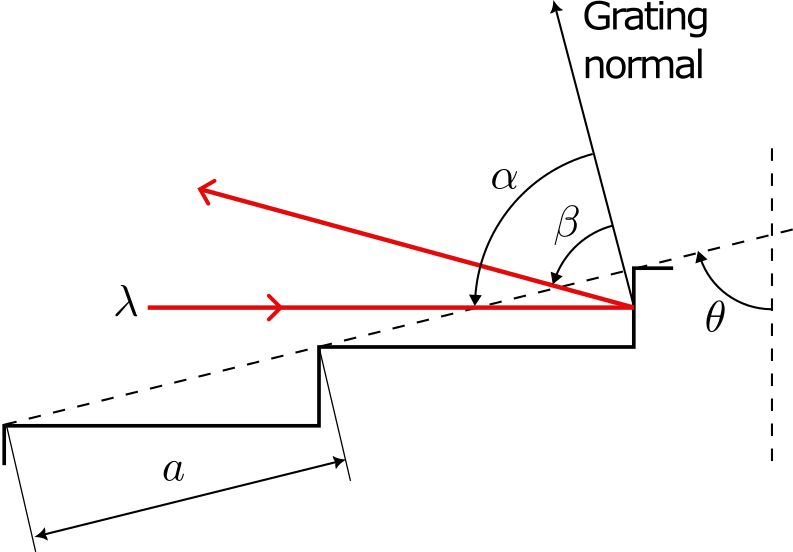
Grating equation:
$$m\lambda=a(\sin\alpha +\sin\beta)$$
Centre of order \(\alpha=\beta=\theta\):
$$\implies\lambda_m=2a\sin\theta/m$$
Can compensate for a mismatch in \(a\) with a change in angle of
$$\delta\theta=-\sec\theta\delta a/a$$
For 10ppm mismatch in an R4 grating then \[\delta\theta\sim 8\,\text{arcsec}\]
Matching at the edges of the orders
Need to have the angular dispersion $$G=\partial\beta/\partial\lambda=-m\sec\theta/a$$ matched to about 1 part in 4000 to match to better than a pixel at both edges of the order.
The dispersion is affected by the tilt used to compensate the wavelength mismatch of the centre of the order, giving
\[\frac{\delta G}{G}=\frac{\delta a}{a}(\sec\theta\tan\theta-1)\]
For an R4 grating \(\sec\theta\tan\theta\approx16.1\) so a 5ppm mismatch in \(\delta a/a\) would match the spectral peaks at the two edges of the order to \(\pm\)0.15 pixel or \(\pm\)0.06 of a spectral resolution element.
May not need to match peaks this well to achieve the ANDES science goals
Can we meet the 5ppm matching with Canon masters?
Takashi says they can do 0.5ppm matching:
``In our understanding, even if devices measured with the same stabilized laser are processed at different times over the course of a year, the pitch interval accuracy remains extremely high (less than 50 nm over a 100 mm total sum distance). Of course, if a physical linear encoder is used, it will be subject to physical changes in scale. However, in applications where this precision is critical, regular external calibration using laser measurement should prevent any issues from arising.''
The Invar manufacturers (Shinhokoku Material Corp) provide very low CTE (0.1ppm/K) and low aging (<0.05ppm/yr?) material (IC-DX)
What about angle?
Tino has expressed concern that
``CANON explicitly mentions that the interferometric control they use cannot disentangle the grating pitch from the grating angle.''
I think this concern is misplaced, and is perhaps based on Takashi saying that
``I think this is equivalent to measuring the diffraction angle very accurately, but keeping samples processed in different years with the same pitch is not due to tax-related prototype storage periods. The ghost measurement can measure the angle between orders within the pixel resolution range of the 2D detector in order to measure the ghost between orders."
This is referring to the ambiguity between \(\theta\) and \(\delta a/a\) derived earlier when measuring \(a\) using a spectrograph-like arrangement. Canon is not using such an arrangement in their interferometric control.
Other possible angle errors
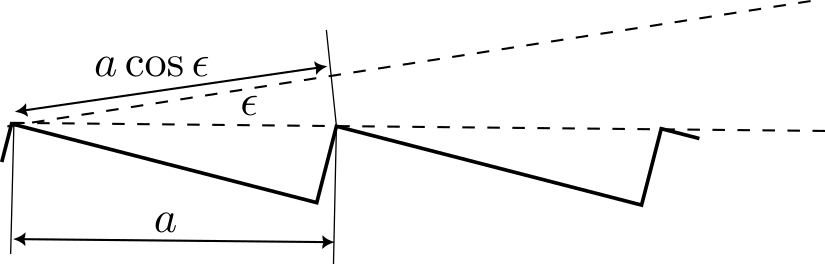
Misalignment \(\epsilon\) of measuring axis to grating needs to be better than 10 arcminutes to get 5ppm repeatability - this should be straightforward.
Blaze angle errors
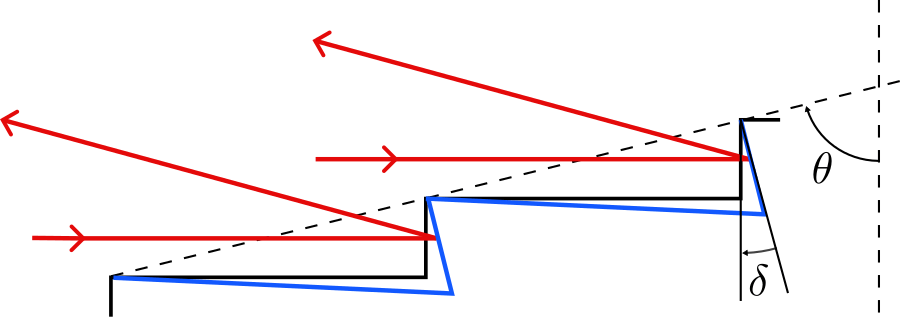
Angle of blaze needs to be matched better than a few degrees to match the locations of the peak efficiency.
Takashi claims 0.001 degree manufacturing capability.
Summary
- A groove pitch matching of 5ppm would easily match the science requirements
- It looks like Canon can meet these requirements
- Need to confirm with Canon that they meet the two angular requirements
Grating matching
By dbuscher
Grating matching
Presented at meeting 2025-09-09