Helpful Grammar and Punctuation tips!
By: Emma Tuss
-Use a period at the end of a declarative statement.
Example: I like snow cones.
Do not do: I like snow cones
Periods
-Place a period after an abbreviation.
-Example: Monday = Mon.
Do not do: Tues or Wed
-Use a period after initials.
Example: Dan S. Donovon
-Do not do: Dan s donovon
-Use a period after an imperative sentence.
Example: Pass the salt.
Do not do: Pass the salt
Apostrophes
-Use an apostrophe in a contraction to show where letters have been omitted.
Example: Can't = Cannot
Do not do: Cant
-Use an apostrophe when taking letters or words out of context (they will also be underlined).
Example: You need to cross your t's.
Do not do: You need to cross your Ts.
-Use an apostrophe when the first two digits are omitted.
from the number
Example: '84 = 1984
Do not do: 84
-Use a colon after the greeting of a business letter.
Example: Gentlemen:
Don't do: We need the following=
Colons
-Use a colon in writing the time.
Example: 9:00-11:23
Do not do: 900 - 1123
-Use a colon to set off lists.
Example: Groceries: Milk, bread, cookies.
Don't do: Groceries. milk bread and cookies.
-Use colon after divisions of topics in a writing.
Example: Rule 1:
Don't do: Rule 2=
Semi colons
-Use a semicolon (;) to join two independent clauses that are closely related.
Example: The rain stopped; the sun came out.
Don't do: The rain stopped the sun; came out
-Do not place and, but, or or after a semicolon.
Example: This scarf is pretty; I may buy it.
Don't do: This scarf is pretty I may buy it.
-If a word such as therefore or however appears after the semicolon, place a comma after it.
Example: You may go out to play; however, you must wear a jacket.
Do not do: You may go outside to play:However, you must wear a jacket.
Commas
-Use a comma to set off a noun of direct dress (a person spoke to).
Example: Louise, come here, please.
Don't do: Louise come here please.
-Use a comma to set off interrupters in a sentence.
Example: The answer, I think, is fifty-four.
Don't do: The answer I think is fifty-four.
-Use a comma to set off introductory words.
Example: No, I haven't seen it.
Don't do: No I haven't seen it.
-Use comma after the greeting of a friendly letter.
Example: Dear Kayla,
Don't do: Dear Kayla.
Commas
-Use a comma after the closing of any letter.
Example: Sincerely yours,
Don't do: sincerely yours.
-Use a comma to clarify a sentence.
Example: In the night, time was extremely important
Don't do: In the night time was extremely important.
-Use a comma to set off words or phrases in a series.
Example: Furniture, linens, and toys.
Don't do: Furniture and linens and toys.
-Use a comma between two or more descriptive adjectives.
Example: Bright, sparkling stars twinkled in the dark night.
Don't do: Bright sparkling starts twinkled in the dark night
Commas
-Use a comma to set off an appositive from the rest of the sentence.
Example: Ms. Reno, the bank president, spoke about loans.
Don't do: Ms. Reno the bank president spoke about loans.
-Use a comma after a month and year or day in a date
Example: February, 1980
Don't do: Feb 1980
-Use a comma between a city and state or country.
Example: Miami, Florida
Don't do: Miami Florida
-Use a comma at the end of most directed quotations.
Example: "I would like a hamburger," Kim said.
Don't do: "I would like a hamburger. Kim said."
Commas
-Use a comma to set off a title following a name.
Example: Gloria Kole, D.D.S., is opening a new office.
Don't do: Gloria kole dds is opening a new office
-Use a comma to invert a name.
Example: Dickinson, Emily is famous.
Don't do: Dickinson emily is famous.
-Use a comma after a dependent clause at the beginning of a sentence.
Example: After we ate lunch, we went to a movie.
Don't do: After we ate lunch we went to a movie
-Use a comma before the conjunction that joins two independent clauses (compound sentences).
Example: Our outing was fun, we are glad to return.
Don't do: Our outing was fun we are glad to return
Commas
-Use a comma after two introductory prepositional phrases or after a long prepositional phrase when a subject follows it.
Example: In the middle of the night, Frank boarded a plane for Japan.
Don't do: In the middle of the night. Frank boarded, a plane for Japan.
-Use a comma after two an introductory participial phrase.
Example: Jumping on the bed, the toddler giggled with delight.
Don't do: Jumping on the bed the toddler giggled with delight
-Use a comma to set off adjectives in apposition.
Example: Bright and shiny, the gem sparkled in the light
Example #2: The gem, bright and shiny, sparkled in the light.
Don't do: Bright and shiny the gem sparkled in the light
-Place a hyphen between fractions and certain numbers.
Example: Two-fifths
Hyphens
-Use a hyphen when dividing a word of two or more syllables at the end of a line. (You must have at least two letters on the first line and three on the following line.)
Example" Un-
happy.
Don't do: Un
happy.
-Use a hyphen to combine some prefixes with a base word.
Example: Ex-President
Don't do: Ex president.
Capitalization
-Capitalize the first letter of the first word in a sentence.
Example: Pearls are very elegant.
Don't do: pearls are very elegant
-Capitalize the pronoun I.
Example: I am very sad
Don't do: i am very sad
-Capitalize the first letter of the first word in most lines of property.
Example: Whose woods are these?
Don't do: Who's woods these are I think?
-Capitalize the first word, the last word, and all important words in any title also, capitalize verbs.
Example: Eight Is Enough.
Don't do: eight is enough
-Capitalize Roman numerals and the letters of the first major topics in an outline. Capitalize the first letter of the first word in an outline.
Example: III
Don't do: iii
Capitalization
-Capitalize the names of organizations.
Example: Boy Scouts of America.
Don't do: boy scouts of america,
-Capitalize business names.
Examples: Fanton Enterprises.
Don't do: fanton enterprises
-Capitalize government bodies and departments.
Example: Senate and Congress.
Don't do: senate, congress
-Capitalize historical events, periods of time, and historical documents.
Example: Ice Age.
Don't do: iceage
-Capitalize names of days, months, holidays, and special days.
Example: Saturday, Fourth of July, December.. etc etc
Don't do: christmas, monday, june
Capitalization
-Capitalize brand names but not products.
Example: Maryland muffins.
Don't do: Maryland Muffins.
-Capitalize religions, religious denominations, religious documents, names of churches, and names for a supreme being.
Example: Hindu religion, God, Torah, etc... etc..
Don't do: god hindu torah etc
-Capitalize languages.
Example: English, German, Spanish etc.. etc..
Don't do: english german spanish
-Capitalize names, initials, and titles appearing with names.
Example: Abe
Don't do: abe
Capitalizaton
-Capitalize President when it refers to the leader of the United States.
Example: President George Washington
Don't do: pres. george, washington
-Capitalize a specific, well known area or event.
Example: Did President Bush work late at the Oval office?
Don't do: Did president, bush work late at the oval office?
-Capitalize the first word of the greeting and closing of a letter.
Example: Dear Jane,
Don't do: dear jane
The End!
Hope this was helpful!
Sources:
- Youtube.com
- My grammar book
Grammar fails
Brought to you by: Youtube comments


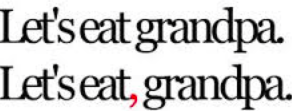
Stay in school kids.
deck
By emmaanntuss