fooshards
he came, he saw, he paid, he imaged, he left
Eric Fusciardi
Not the guy on the can of ravioli
You'll get the ohai thing later.
Pushing code up environments and validation has become commonplace, quick, and highly automated.
Works well because we have an ecosystem of tools and scripting setup to enable deployment to be a non-issue.
The creation of those envs and installation of the tools, upkeep of maintenance, and provisioning / configuring middleware is where problems tend to arise.
Things that exacerbate this:
Why not here?
Chef enables us to capture that flow the first time, validate it, and then run the same action in each environment at whatever time we want.
And it's just another act of "Deploying Code"
And we're good at that.
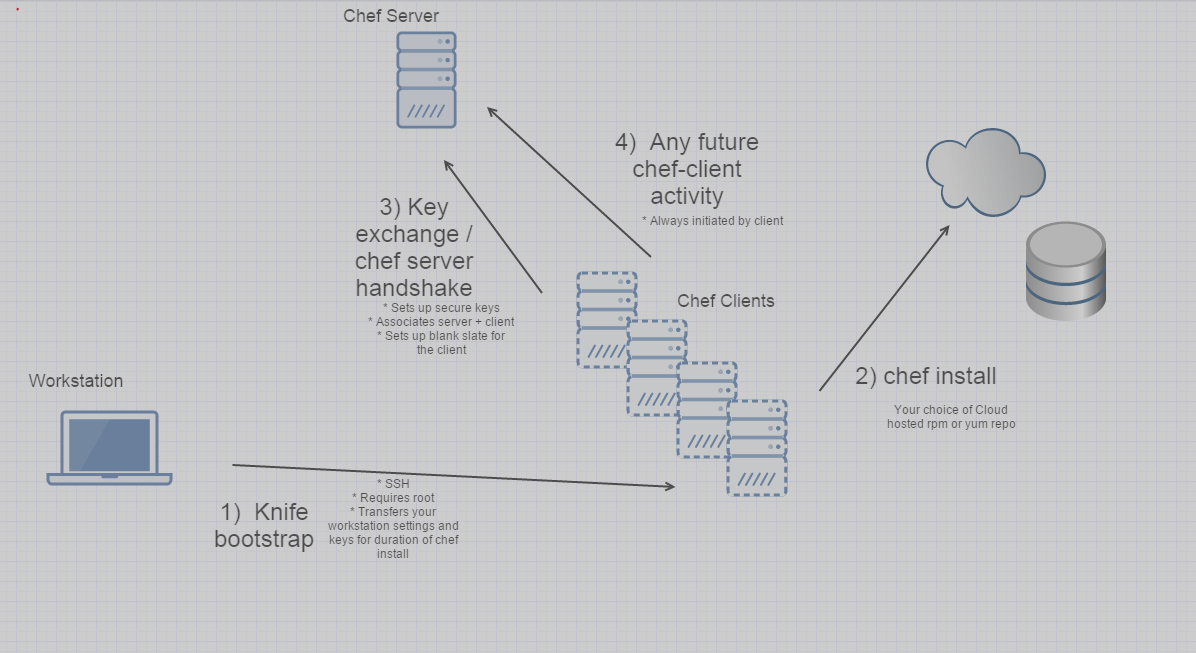
Chef Server - Hosts the chef process, acts as a repository and reporting of client activity
Chef Client - A machine that is associated with a Chef Server.
Chef Workstation - A machine that has ChefDK installed, and user keys set up so that you can issue commands / queries to the Chef Server.
Knife - Your command line utility.
Resource - A Ruby block that represents the desired configuration of some server configuration on the server.
Ex: Directory, User, Yum/Apt Package, A Script to run
Attributes - Variables that are interpreted at runtime based off a hierarchy of sources.
Recipe - A script that describes a server's desired state via resources
Cookbook - A collection of recipes + attributes that is versioned. Generally a vertical slice of config.
knife bootstrap 192.168.0.1 -x root -P password [other optional args]
ChefDK - https://downloads.chef.io
Vagrant - http://www.vagrantup.com
( Put bin on $PATH / %PATH% )
VirtualBox - https://www.virtualbox.org/
IDE / Multi-file text editor of your choice
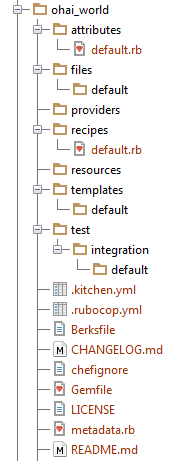
chef generate cookbook ohai_worldhttps://github.com/fooshards/chef-presentation
New things:
Resources - Custom resource declarations
Providers - Implementation of above
Files/Templates - Assets for cookbook
.kitchen.yml - Settings to run locally / run test cases
Berksfile - Dependency management (Think Maven)
metadata.rb - Versioning info of this cookbook + it's dependencies
File-type things:
File, Directory, Remote_File, Template, Symlinks
OS-type things:
Users, Groups, Cron, Packages, Services
More esoteric-type things:
Execute arbitrary stuff in Bash, Powershell, Python, Perl, Ruby
Recipe: ohai_world::default.rb
directory '/helloworld' do
  owner 'root'
  group 'root'
  mode 0755
  action :create
end

template '/helloworld/message' do
  owner 'root'
  group 'root'
  source 'message.erb'
  mode 0755
  action :create
end
Template: message.log.erb
Attributes:
default['ohai_world']['message'] = 'We have arrived!'<%= node['ohai_world']['message'] %> at <%= node['ipaddress'] %>cd ./ohai_world
kitchen converge
<output of stuff as it boots local vm, installs chef, runs recipe>
Running handlers complete
Chef Client finished, 2/2 resources updated in 1.120078901 seconds
Finished converging <default-centos-65> (0m13.02s).
Kitchen is finished. (0m56.61s)
kitchen login (or ssh localhost:2222 root/vagrant)
[root@default-centos-65 ~]# cd /helloworld
[root@default-centos-65 helloworld]# ls -l
-rwxr-xr-x. 1 root root 29 Jun 2 21:37 message
[root@default-centos-65 helloworld]# cat message
We have arrived! at 10.0.2.15cd ./ohai_world
kitchen converge
...
Recipe: ohai_world::default
(up to date)
(up to date)
Running handlers:
Running handlers complete
Chef Client finished, 0/2 resources updated in 0.927 seconds
Finished converging <default-centos-65> (0m4.29s).This enables MAINTENANCE of chef-provisioned servers!
Try doing that with VM images.
Wordpress... What makes it work?
Isolate components into their own cookbooks as much as possible / is reasonable to do, and use a cookbook to wrap them all up.
metadata.rb - What you want
Berksfile - How to fetch it (locally)
name 'wordpress'
# ...
version '0.1.0'

depends 'mysql'
depends 'php'
depends 'apache2', '2.0.0'   # <<<  Can lock to a specific version.
source "https://supermarket.chef.io" # <<< Like Maven Central,
# but for cookbooks
metadata
cookbook 'mysql', path: '../mysql'
cookbook 'php', path: '../php'
cookbook 'apache2' # <<< Will resolve from public repo
# since no local path specifiedRecipe: wordpress::default.rb
include_recipe 'mysql::default'
include_recipe 'php::default'
include_recipe 'apache2::default'

# Init wordpress database in mysql
# Add an apache virtual host
# Create some users to login to the box with
# etcServerspec tests
Suites declared in your .kitchen.yml and /test directories.
describe file('/helloworld/message') do
  it { should be_file }
  it { should contain /We have arrived/ }
end
cd ./ohai_world
kitchen converge
...
kitchen verify
...
       File "/helloworld/message"
         should be file
         should contain /We have arrived/

       Finished in 0.05042 seconds (files took 0.26159 seconds to load)
       2 examples, 0 failures

       Finished verifying <default-centos-65> (0m2.08s).
-----> Kitchen is finished. (0m4.05s)RTFM on the wiki and http://www.chef.io on setting up chef server, configuring your knife.rb
cd ./ohai_world
berks install   # Resolves dependencies
                # Also ermahgerd, cerkberks
berks uploadIn knife or chef server UI, assign recipe ohai_world::default to a client.
ssh root@thathost.domain
...
chef-client
...

   Running handlers:
   Running handlers complete
   Chef Client finished, 2/2 resources updated in 1.120078901 seconds
   Finished converging <thathost.domain> (0m13.02s).
>Attributes are overridable in many different ways.
ohai_world cookbook had this as the default.
default['ohai_world']['message'] = 'We have arrived!'This can be overridden at runtime of hosts in the following ways:
By fooshards
Deeper dive on some chef concepts and implementations.