Python Power

What we'll cover
- Basics
- Language Features
- Operator Overloading
- Duck Typing
- Multiple Inheritance
- Comprehensions
- PIP
- Popular applications of Python
- Pandas/numpy
- Django
The Basics: Numbers
# Dynamic typing means different number types based on syntax

my_num = 1    # integer
my_num = 1.0  # float (all floats are doubles)
my_num = 1.   # also float!

# Most conversion can be done automatically

>>> 1.1 * 2
2.2

# But some can be tricky

>>> 1/2
0

>>> 1./2
0.5- All floats are double percision
- In Python3, integers have no defined limit
The Basics: Strings
>>> "Hello world"[0] # iterable!
"H"

>>> "Hello world"[:5] # iterable!
"Hello"

>>> for letter in "yams": # iterable!
...    print letter.upper()
Y
A
M
S

# Most operators work with strings

>>> "wow" * 3
"wowwowwow"

>>> "hello " + "world"
"hello world"

# And unlike JavaScript, things make sense!
>>> "hello" + 2
Traceback (most recent call last):
  File "<stdin>", line 1, in <module>
TypeError: cannot concatenate 'str' and 'int' objects
The Basics: Functions
The Basics: Objects
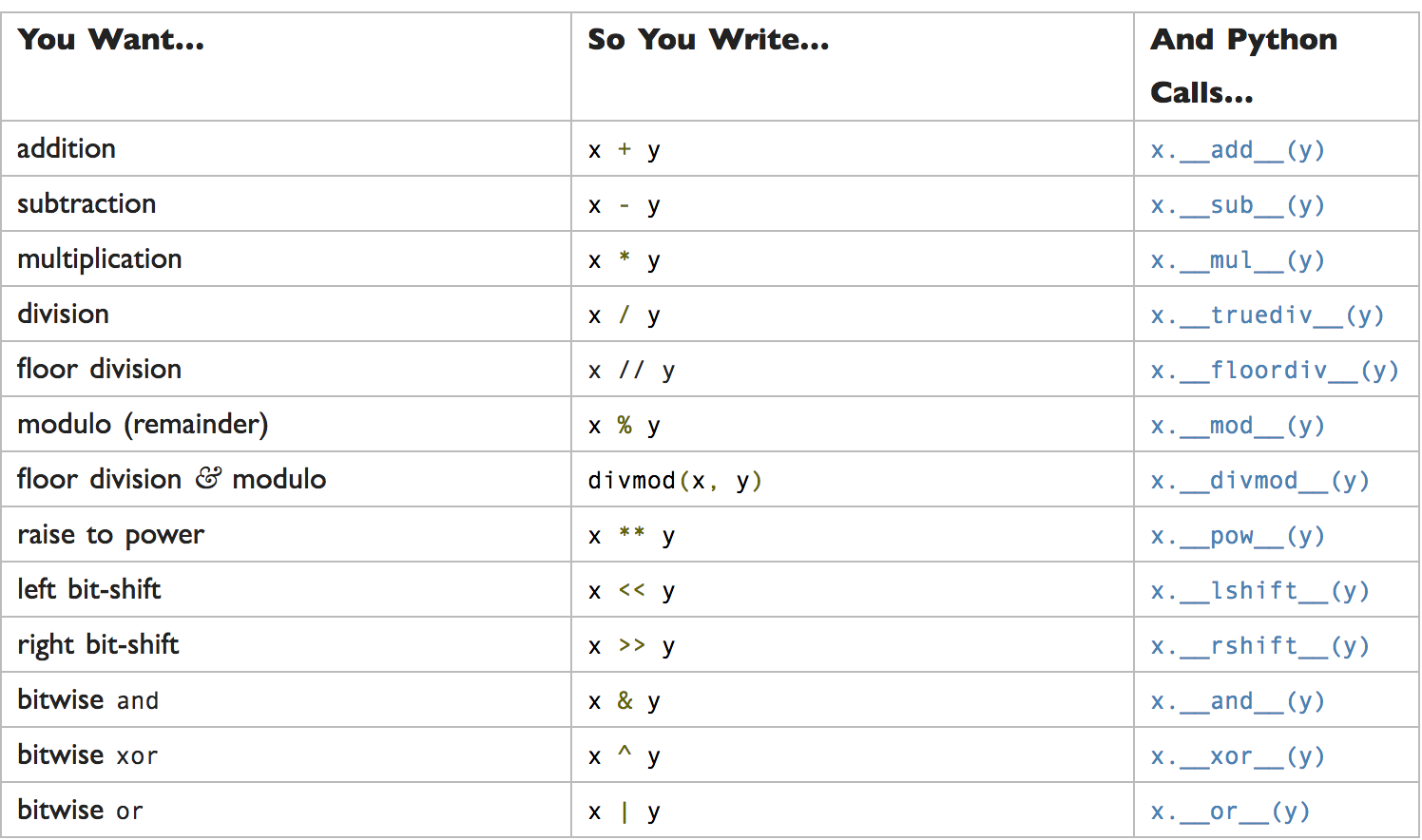
Operator Overloading
- Python has many magic methods and names
- Magic methods begin and end with two underscores
-
__init__, __add__, __name__
-
- We can override magic methods to change behaviour
Operator Overloading
Operator Overloading
Duck Typing
- Duck typing is almost the absence of actual typing
- Objects are typed based on their attributes
- If the attributes match, the types match
- An object is of any type until... it isn't
- Python uses duck typing, but objects still have types
-
You shouldn't care what type of object you have
-
Care if you can do the required action with your object
-
- If types don't match, a TypeError or AttributeError is raised

Duck Typing
>>> a = [0,1 2, 3]
>>> print a[0]
0
>>> b = {'a': 0, 'b': 1}
>>> print b['a']
0

# Is the same as

>>> a =  [0,1 2, 3]
>>> print list.__getitem__(a, 0)
0
>>> b = {'a': 0, 'b': 1}
>>> print dict._getitem__(b, 'a')
0


# Both lists and dictionaries are supported by this method:
def getit(item, key):
    return item[key]
Multiple Inheritance
Multiple Inheritance
Comprehensions
PIP
- the npm of Python
- dope
Pandas/NumPy
- Math!
- Popular in data science, ML
- Slower than something like C, but not if you include the time it takes to write it
- Loosely types languages are great for data science
- Python's built in number support helps power other libraries
- Fraction, Decimal types
- ints with no max size
- Simple syntax for integer operations
Django
- The most popular Python web framework
- Other include:
- Flask
- Twisted
- Highly pragmatic, convention based framework
- Built in admin panel for working with models
- Decent ORM
- Control all database migrations in Python, most autogenerated
thanks yo
Python Power
By Jamie Counsell