Testing Semantic Importance via Betting
Jeremias Sulam


Statistics of Trustworthy ML
@
2024 IMS International Conference on Statistics and Data Science (ICSDS)

Interpretability in Image Classification
\((X,Y) \in \mathcal X \times \mathcal Y\)
\((X,Y) \sim P_{X,Y}\)
\(\hat{Y} = f(X) : \mathcal X \to \mathcal Y\)
Setting:
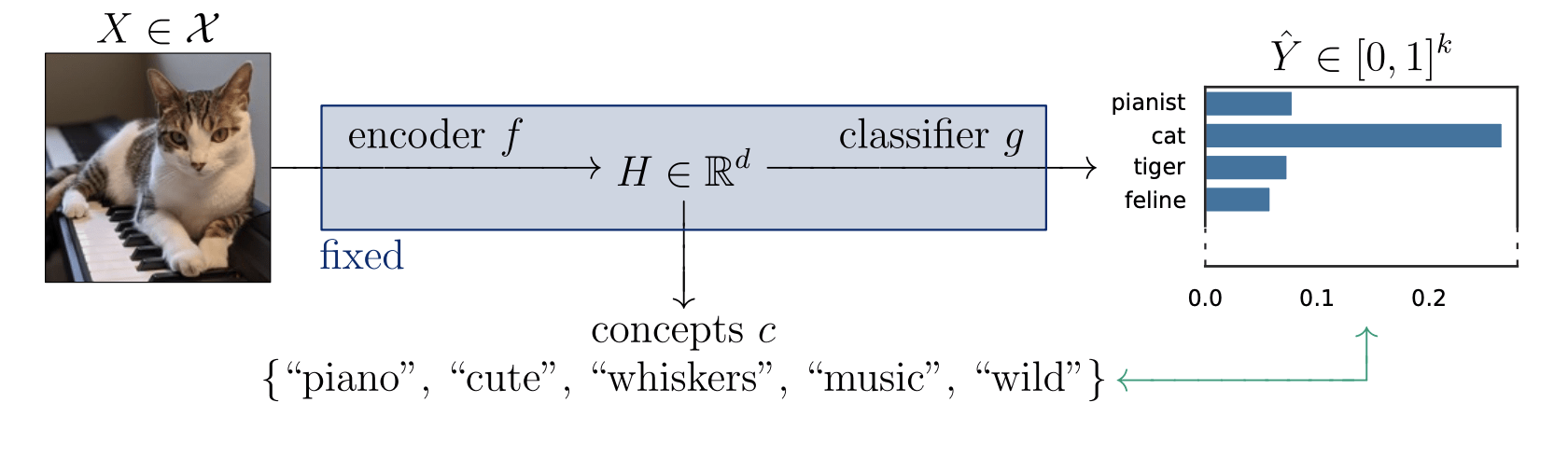

-
What features are important for this prediction?
-
What does importance mean, exactly?
Is the piano important for \(\hat Y = \text{cat}\)?
Semantic Interpretability of classifiers
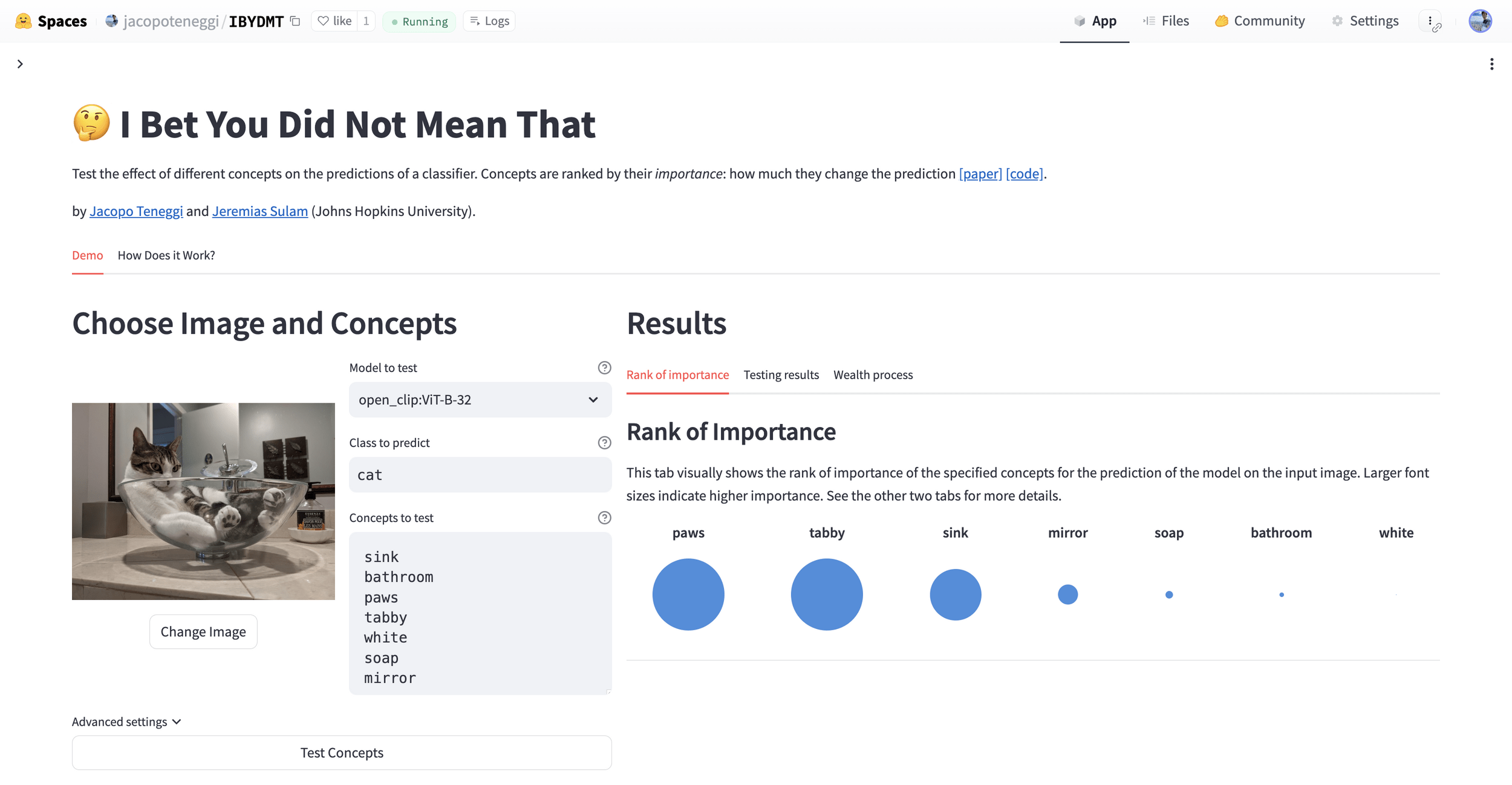
How can we explain black-box predictors with semantic features?
Is the piano important for \(\hat Y = \text{cat}\), given that there is a cute mammal in the image?
Is the piano important for \(\hat Y = \text{cat}\)?
Semantic Interpretability of classifiers
How can we explain black-box predictors with semantic features?
Is the piano important for \(\hat Y = \text{cat}\), given that there is a cute mammal in the image?
Post-hoc Interpretability Methods
Interpretable by
construction
Is the piano important for \(\hat Y = \text{cat}\)?
Semantic Interpretability of classifiers
How can we explain black-box predictors with semantic features?
Is the piano important for \(\hat Y = \text{cat}\), given that there is a cute mammal in the image?
Post-hoc Interpretability Methods
Interpretable by
construction
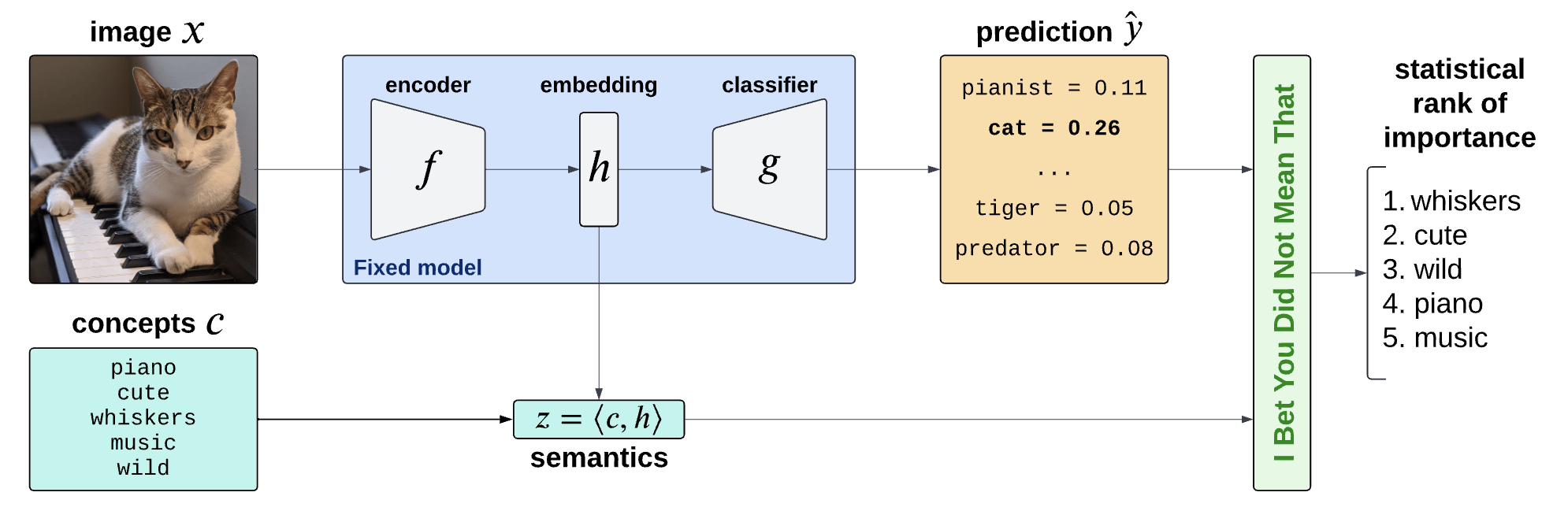
Semantic Interpretability of classifiers
Concept Bank: \(C = [c_1, c_2, \dots, c_m] \in \mathbb R^{d\times m}\)
Embeddings: \(H = f(X) \in \mathbb R^d\)
Semantics: \(Z = C^\top H \in R^m\)
Concept Bank: \(C = [c_1, c_2, \dots, c_m] \in \mathbb R^{d\times m}\)
Concept Activation Vectors
(Kim et al, 2018)
\(c_\text{cute}\)
Semantic Interpretability of classifiers
Vision-language models
(CLIP, BLIP, etc... )
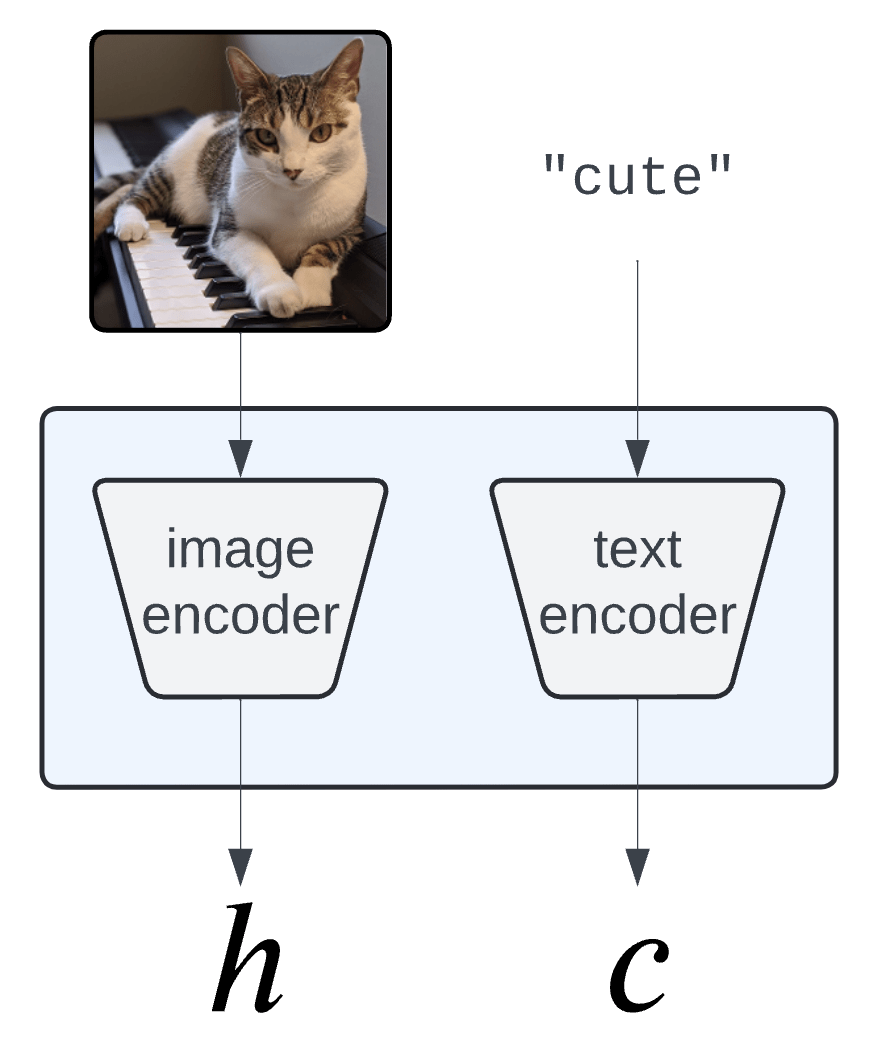
Concept Bank: \(C = [c_1, c_2, \dots, c_m] \in \mathbb R^{d\times m}\)
Semantic Interpretability of classifiers
Vision-language models
(training)
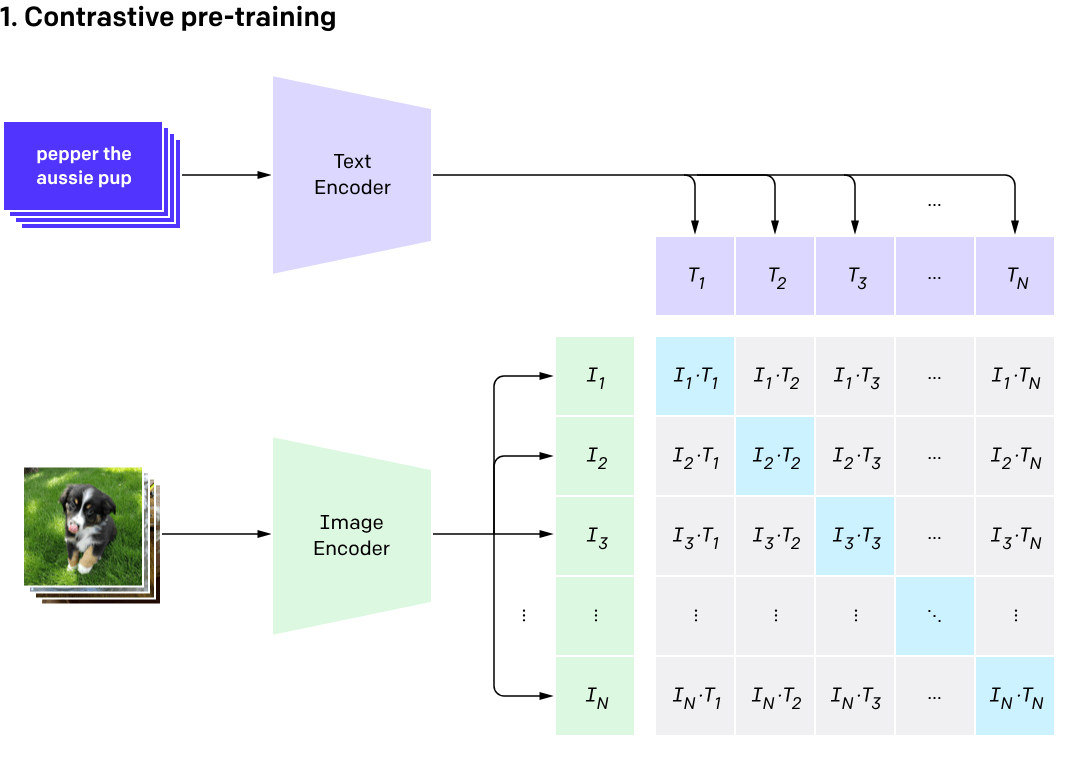
[Radford et al, 2021]
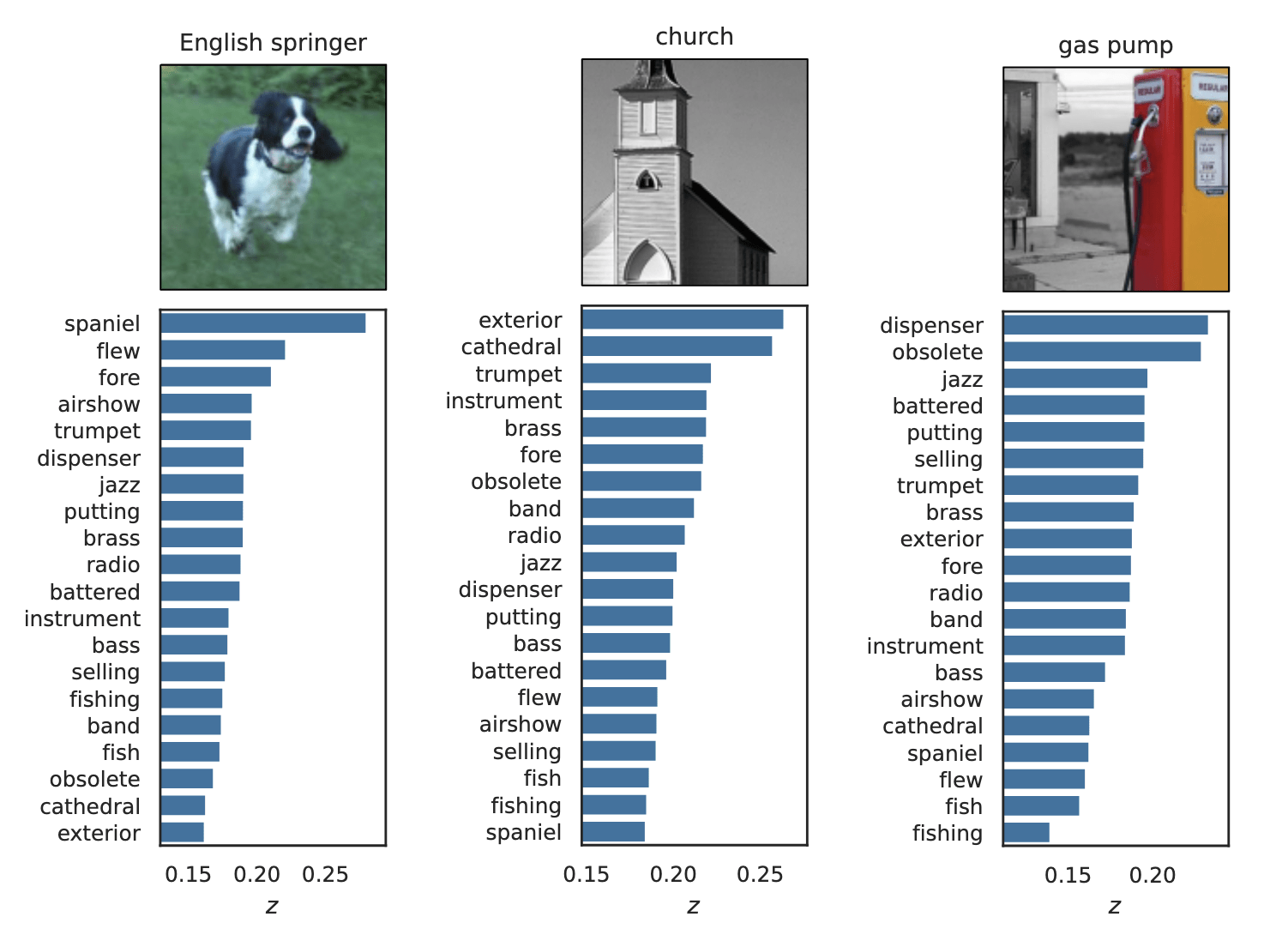
Semantic Interpretability of classifiers
[Bhalla et al, "Splice", 2024]
Concept Bottleneck Models (CMBs)
[Koh et al '20, Yang et al '23, Yuan et al '22 ]
- Need to engineer a (large) concept bank
- Performance hit w.r.t. original predictor
\(\tilde{Y} = \hat w^\top Z\)
\(\hat w_j\) is the importance of the \(j^{th}\) concept
Desiderata
- Fixed original predictor (post-hoc)
- Global and local importance notions
- Testing for any concepts (no need for large concept banks)
- Precise testing with guarantees (Type 1 error/FDR control)
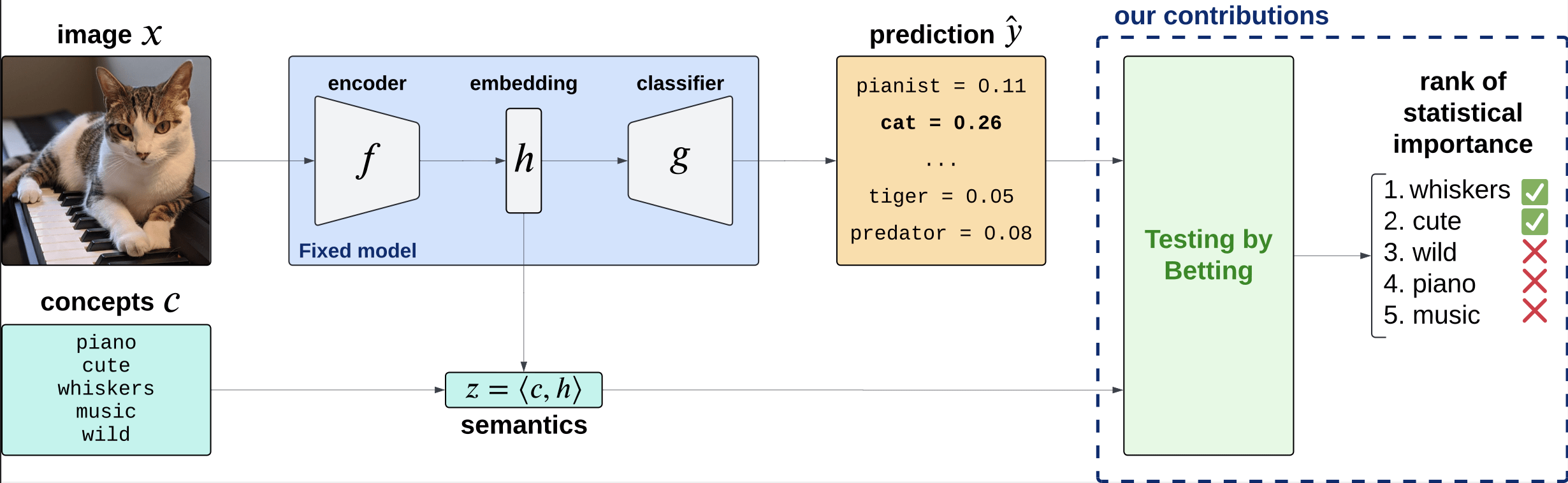
Precise notions of semantic importance
\(C = \{\text{``cute''}, \text{``whiskers''}, \dots \}\)
Global Importance
\(H^G_{0,j} : \hat{Y} \perp\!\!\!\perp Z_j \)
Global Conditional Importance
\(H^{GC}_{0,j} : \hat{Y} \perp\!\!\!\perp Z_j | Z_{-j}\)
Precise notions of semantic importance
Global Importance
\(C = \{\text{``cute''}, \text{``whiskers''}, \dots \}\)
\(H^G_{0,j} : g(f(X)) \perp\!\!\!\perp c_j^\top f(X) \)
Global Conditional Importance
\(H^{GC}_{0,j} : g(f(X)) \perp\!\!\!\perp c_j^\top f(X) | C_{-j}^\top f(X)\)
\(H^G_{0,j} : \hat{Y} \perp\!\!\!\perp Z_j \)
\(H^{GC}_{0,j} : \hat{Y} \perp\!\!\!\perp Z_j | Z_{-j}\)
Precise notions of semantic importance
"The classifier (its distribution) does not change if we condition
on concepts \(S\) vs on concepts \(S\cup\{j\} \)"
\(C = \{\text{``cute''}, \text{``whiskers''}, \dots \}\)
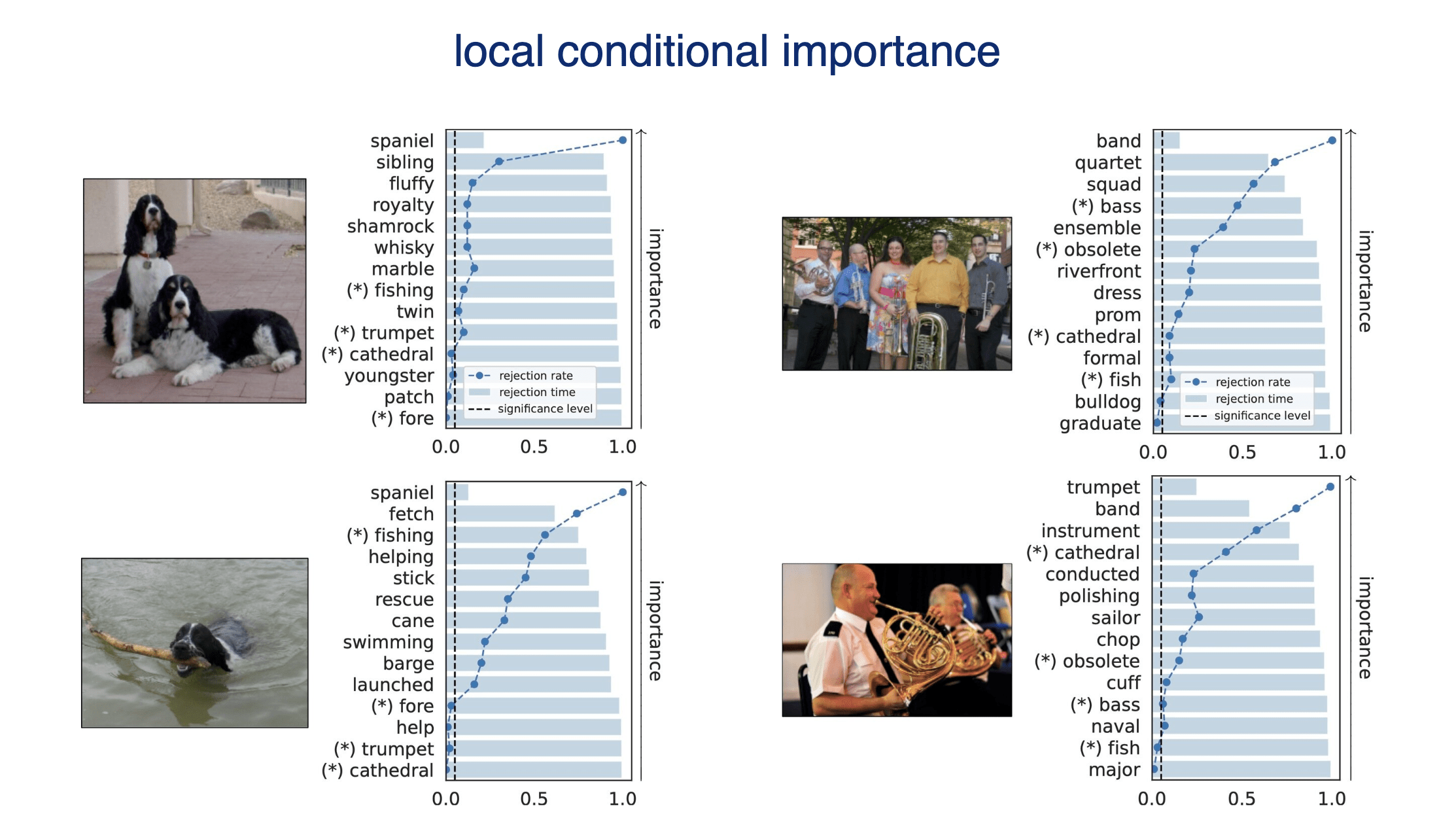
Local Conditional Importance
\[H^{j,S}_0:~ g({\tilde H_{S \cup \{j\}}}) \overset{d}{=} g(\tilde H_S), \qquad \tilde H_S \sim P_{H|Z_S = C_S^\top f(x)} \]
Tightly related to Shapley values
[Teneggi et al, The Shapley Value Meets Conditional Independence Testing, 2023]
Precise notions of semantic importance
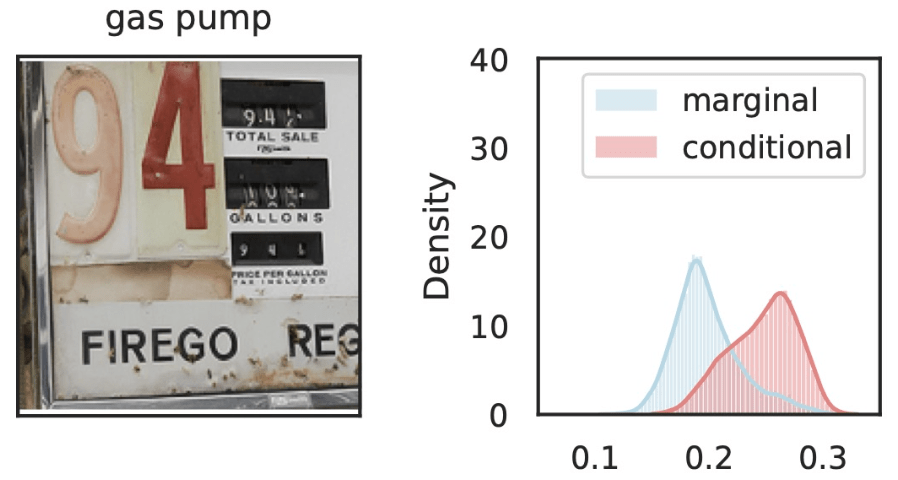
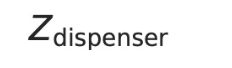
\(\hat{Y}_\text{gas pump}\)
\(Z_S\cup Z_{j}\)
\(Z_{S}\)
\(Z_j=\)
Local Conditional Importance
\[H^{j,S}_0:~ g({\tilde H_{S \cup \{j\}}}) \overset{d}{=} g(\tilde H_S), \qquad \tilde H_S \sim P_{H|Z_S = C_S^\top f(x)} \]
\(\tilde{Z}_S = [z_\text{text}, z_\text{old}, Z_\text{dispenser}, Z_\text{trumpet}, Z_\text{fire}, \dots ] \)
\(S\)

\(\tilde{Z}_{S\cup j} = [z_\text{text}, z_\text{old}, z_\text{dispenser}, Z_\text{trumpet}, Z_\text{Fire}, \dots ] \)
\(S\)
\(j\)
Precise notions of semantic importance
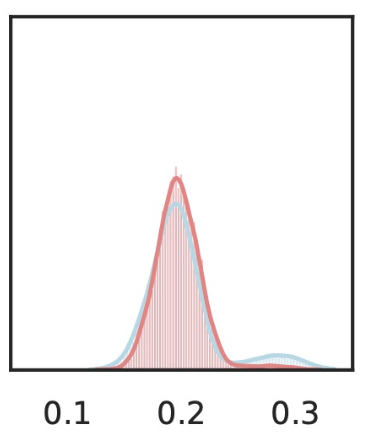

\(\hat{Y}_\text{gas pump}\)
\(\hat{Y}_\text{gas pump}\)
\(Z_S\cup Z_{j}\)
\(Z_{S}\)
\(Z_S\cup Z_{j}\)
\(Z_{S}\)
Local Conditional Importance
\(Z_j=\)
\(Z_j=\)
\[H^{j,S}_0:~ g({\tilde H_{S \cup \{j\}}}) \overset{d}{=} g(\tilde H_S), \qquad \tilde H_S \sim P_{H|Z_S = C_S^\top f(x)} \]
\(\tilde{Z}_S = [z_\text{text}, z_\text{old}, Z_\text{dispenser}, Z_\text{trumpet}, Z_\text{fire}, \dots ] \)
\(\tilde{Z}_{S\cup j} = [z_\text{text}, z_\text{old}, Z_\text{dispenser}, z_\text{trumpet}, Z_\text{Fire}, \dots ] \)
\(S\)
\(S\)
\(j\)
Testing by betting
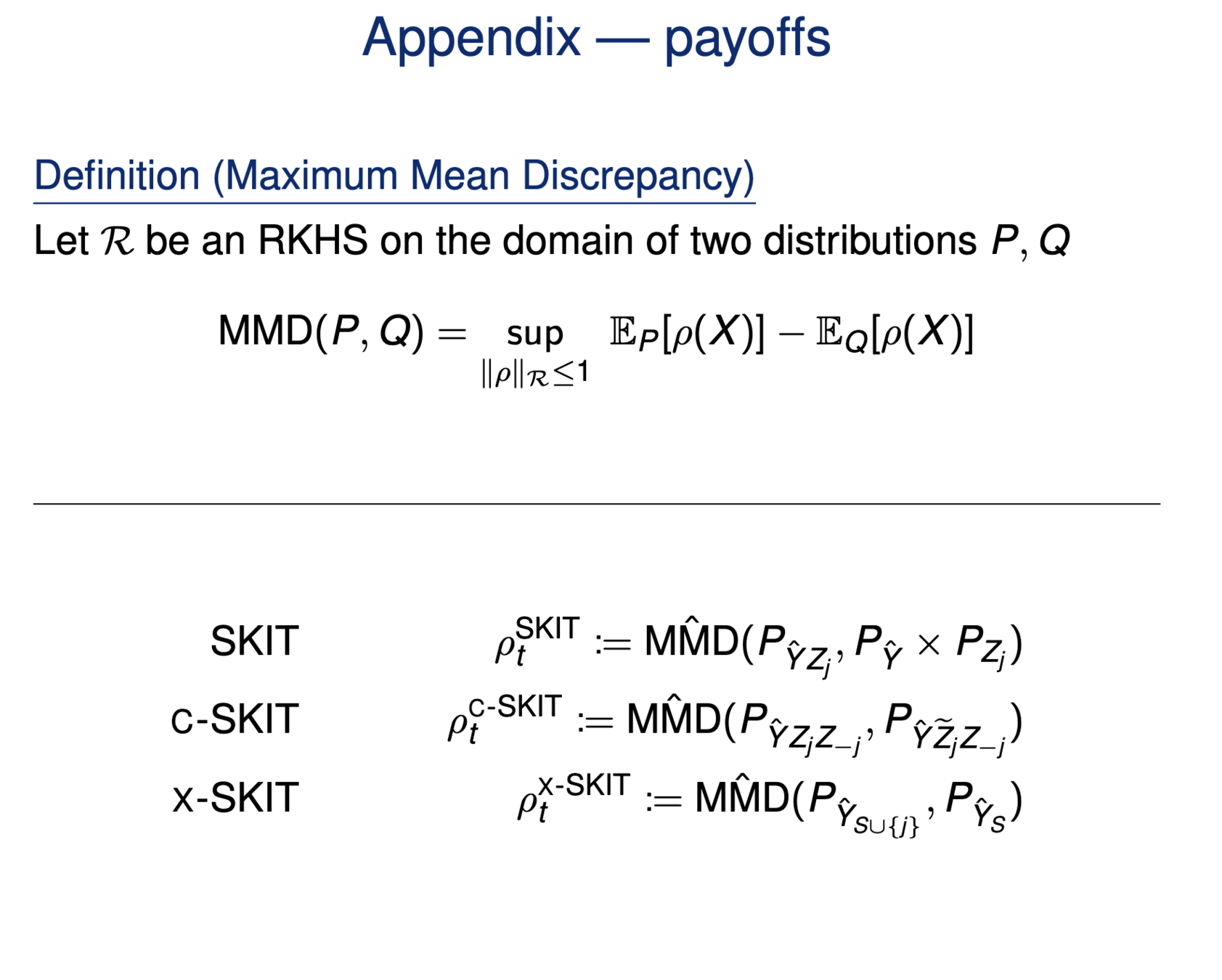
\(H^G_{0,j} : \hat{Y} \perp\!\!\!\perp Z_j \iff P_{\hat{Y},Z_j} = P_{\hat{Y}} \times P_{Z_j}\)
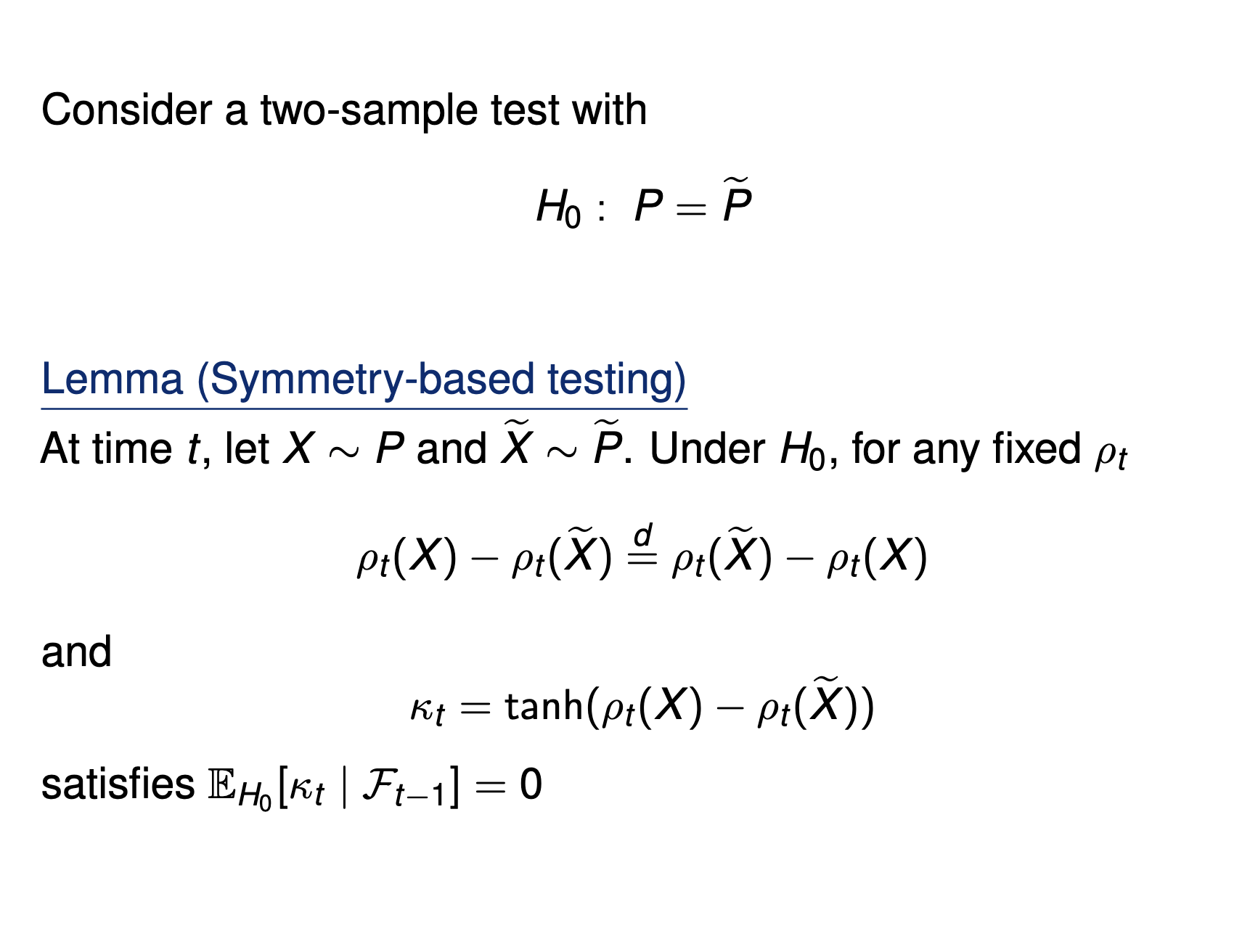
Testing importance via two-sample tests
\(H^{GC}_{0,j} : \hat{Y} \perp\!\!\!\perp Z_j | Z_{-j} \iff P_{\hat{Y}Z_jZ_{-j}} = P_{\hat{Y}\tilde{Z}_j{Z_{-j}}}\)
\(\tilde{Z_j} \sim P_{Z_j|Z_{-j}}\)
[Shaer et al, 2023]
[Teneggi et al, 2023]
\[H^{j,S}_0:~ g({\tilde H_{S \cup \{j\}}}) \overset{d}{=} g(\tilde H_S), \qquad \tilde H_S \sim P_{H|Z_S = C_S^\top f(x)} \]
Testing by betting
[Grünwald 2019, Shaer et al. 2023, Shekhar and Ramdas 2023]
Goal: Test a null hypothesis \(H_0\) at significance level \(\alpha\)
Standard testing by p-values
Collect data, then test, and reject if \(p \leq \alpha\)
Online testing by e-values
Any-time valid inference, monitor online and reject when \(e\geq 1/\alpha\)
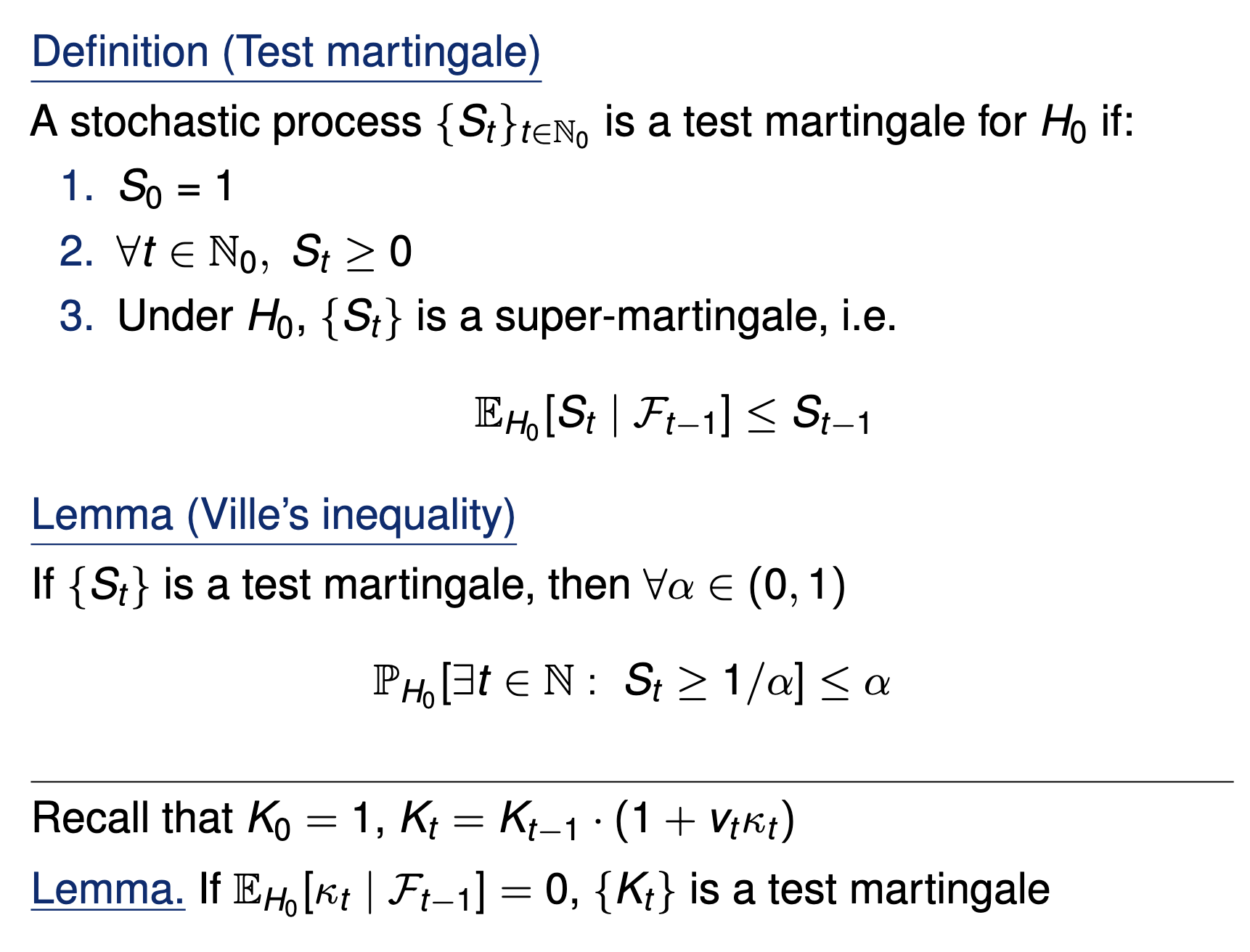
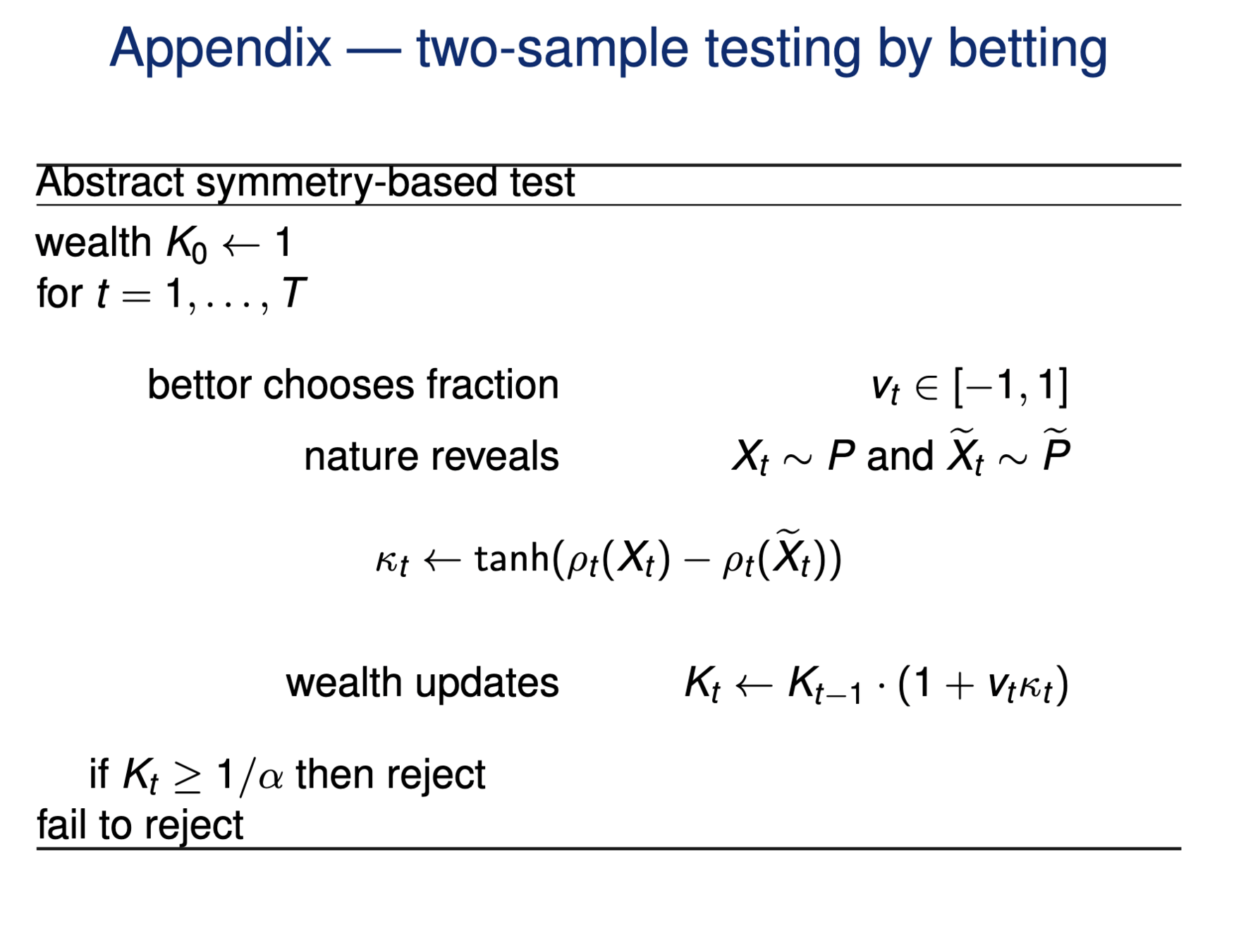
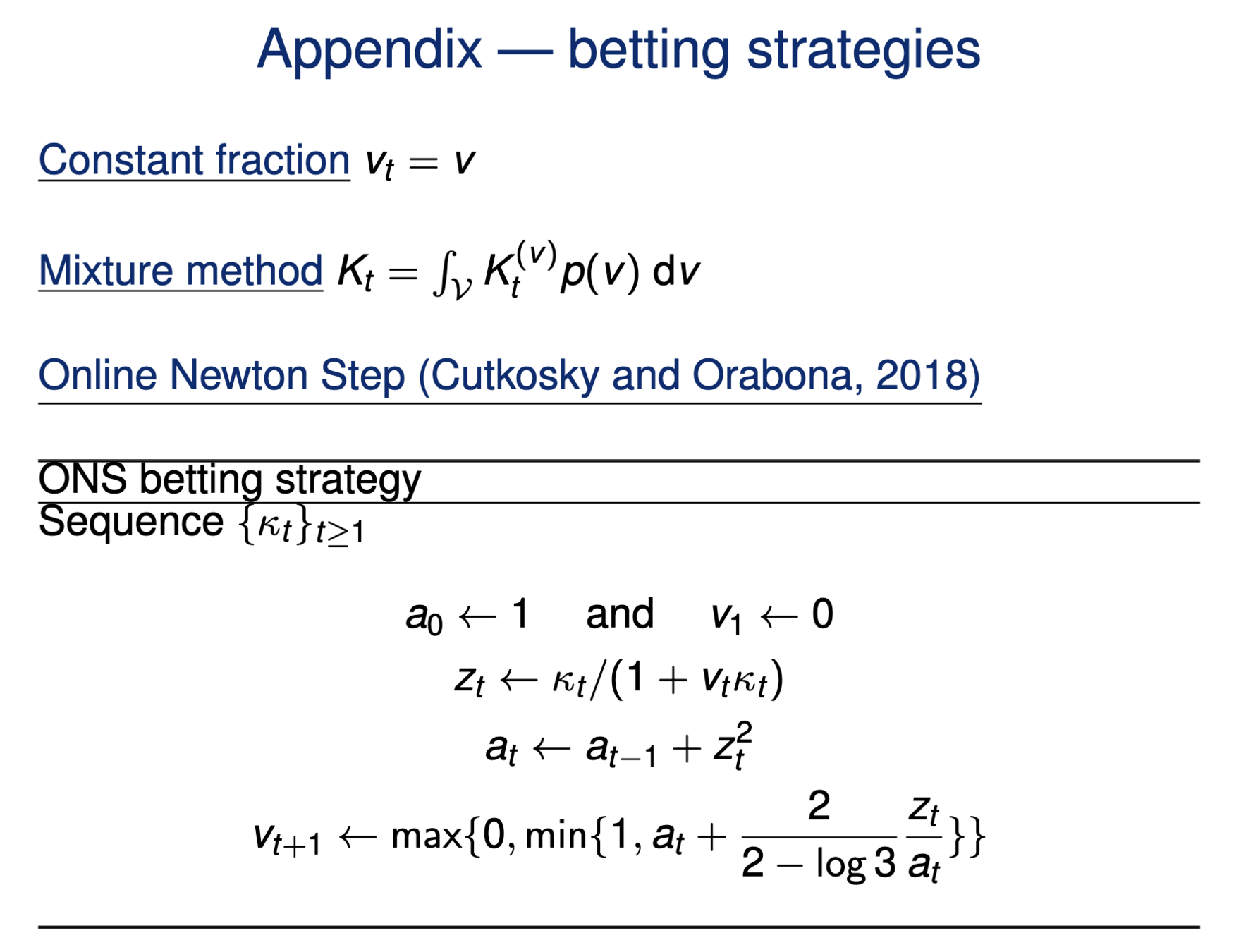
- Consider a wealth process
\(K_0 = 1;\)
\(\text{for}~ t = 1, \dots \\ \quad K_t = K_{t-1}(1+\kappa_t v_t)\)
\(\mathbb P_{H_0}[\exists t\in \mathbb N : K_t \geq 1/\alpha ] \leq \alpha \)
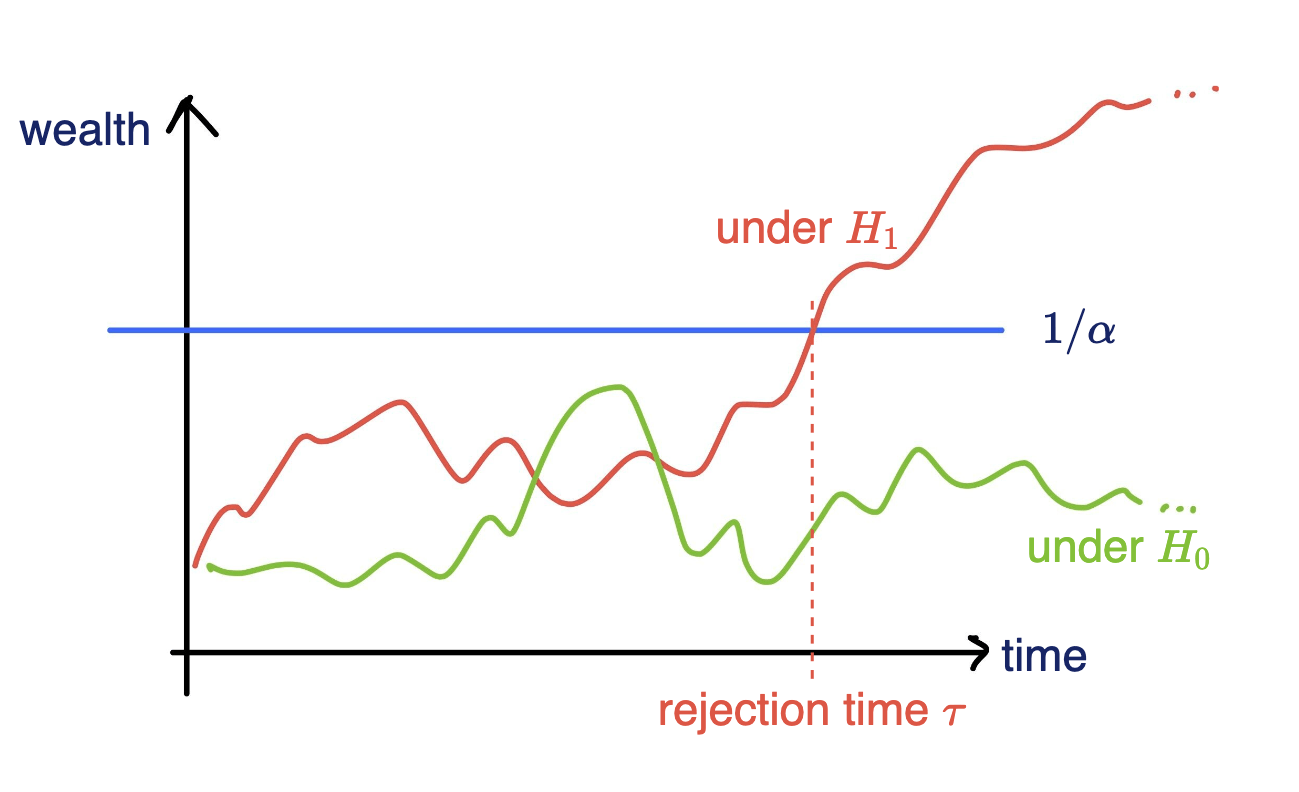
Online testing by e-values
[Shafer 2021, Shaer et al. 2023, Shekhar and Ramdas 2023 ]
Fair game (test martingale): \(~~\mathbb E_{H_0}[\kappa_t | \text{Everything seen}_{t-1}] = 0\)
\(v_t \in (0,1):\) betting fraction
\(\kappa_t \in [-1,1]\) payoff
Testing by betting via SKIT (Podkopaev et al., 2023)
Testing by betting via SKIT (Podkopaev et al., 2023)
Online testing by e-values
\(v_t \in (0,1):\) betting fraction
\(H_0: ~ P = Q\)
\(\kappa_t = \text{tanh}({\color{teal}\rho(X_t)} - {\color{teal}\rho(Y_t)})\)
Payoff function
\({\color{black}\text{MMD}(P,Q)} : \text{ Maximum Mean Discrepancy}\)
\({\color{teal}\rho} = \underset{\rho\in \mathcal R:\|\rho\|_\mathcal R\leq 1}{\arg\sup} ~\mathbb E_P [\rho(X)] - \mathbb E_Q[\rho(Y)]\)
\( K_t = K_{t-1}(1+\kappa_t v_t)\)
Data efficient
Rank induced by rejection time
\(X_t \sim P, Y_t \sim Q\)
Results: Local Testing
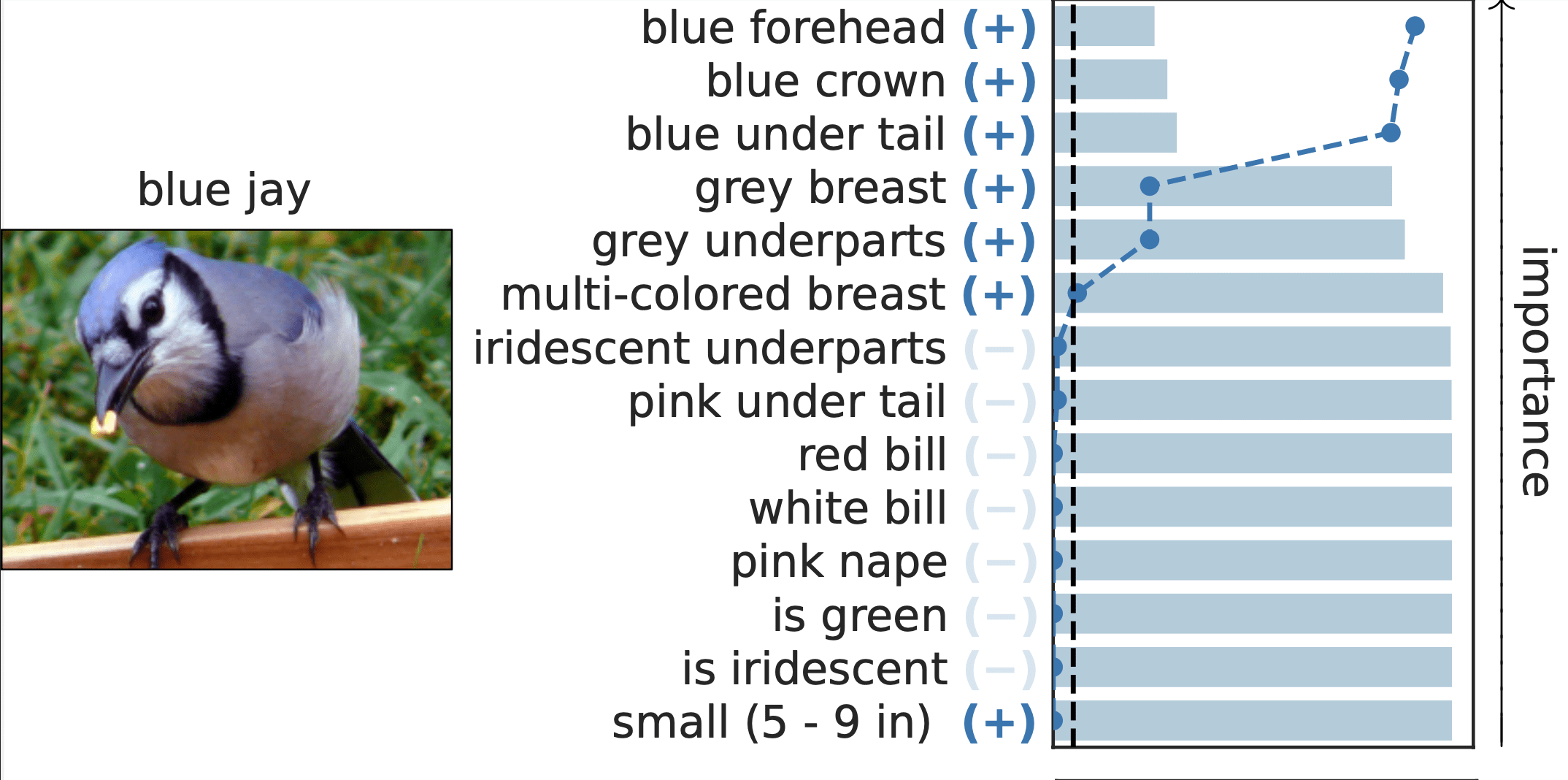
Important Semantic Concepts
(Reject \(H_0\))

Unimportant Semantic Concepts
(Fail to reject)
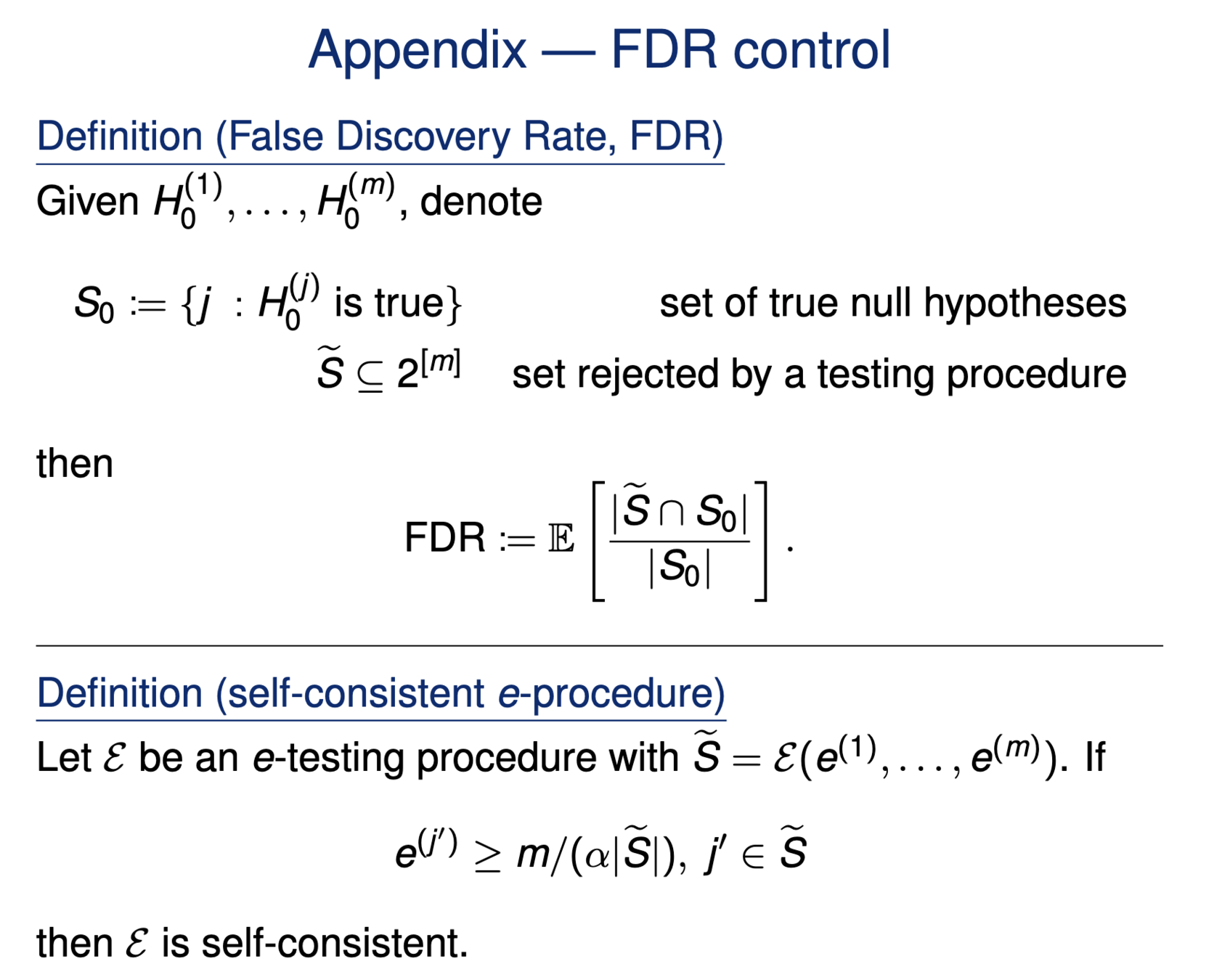
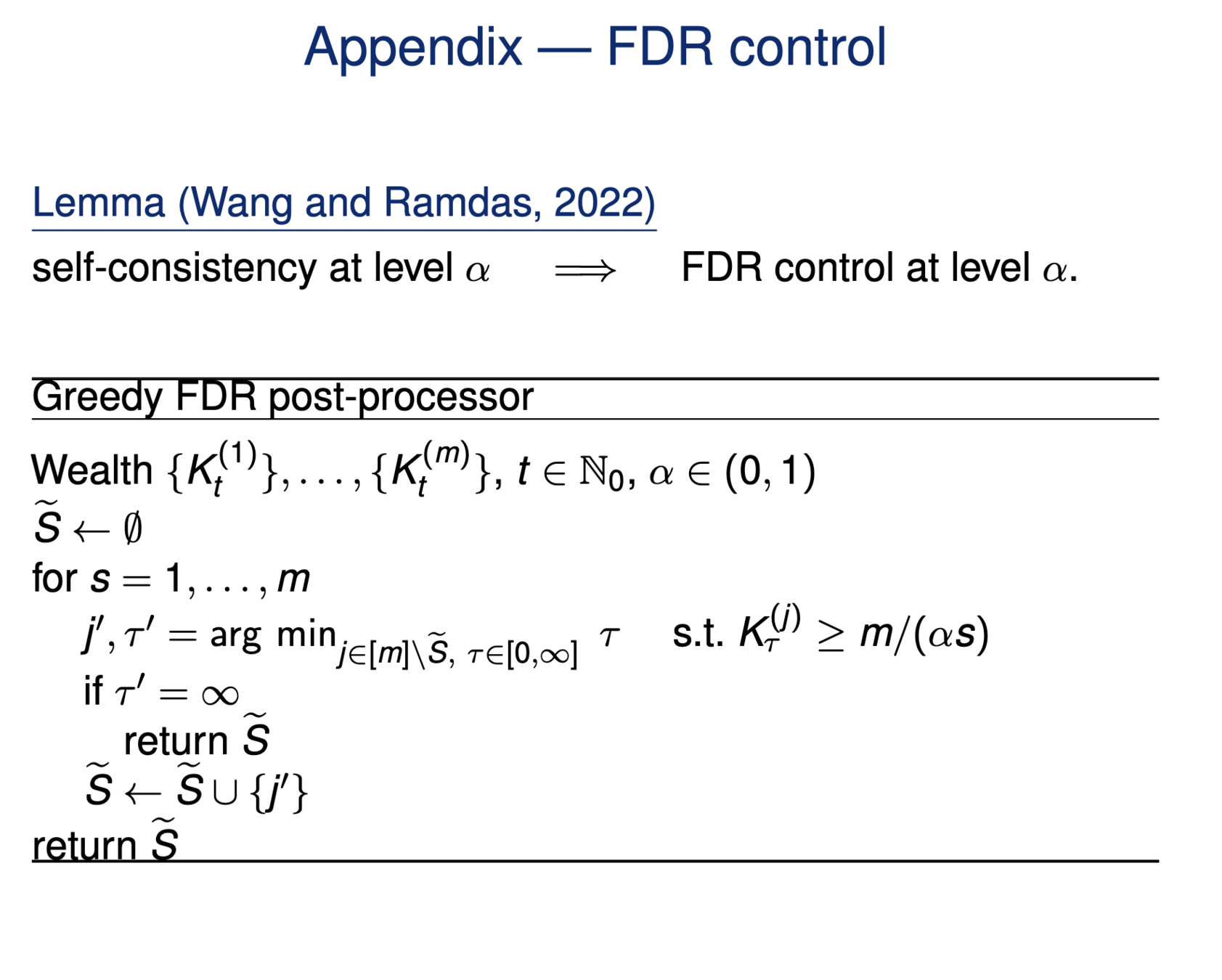
- Type 1 error control
- False discovery rate control
rejection time
rejection rate
0.0
1.0
Results: Local Testing
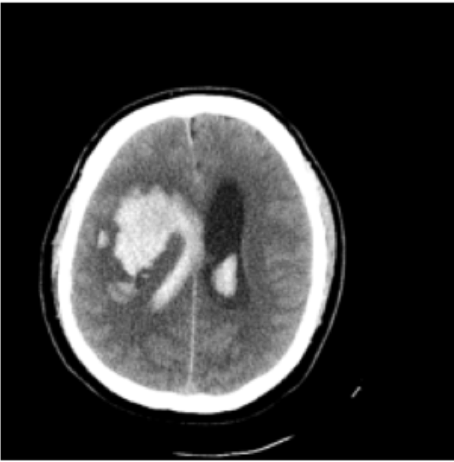
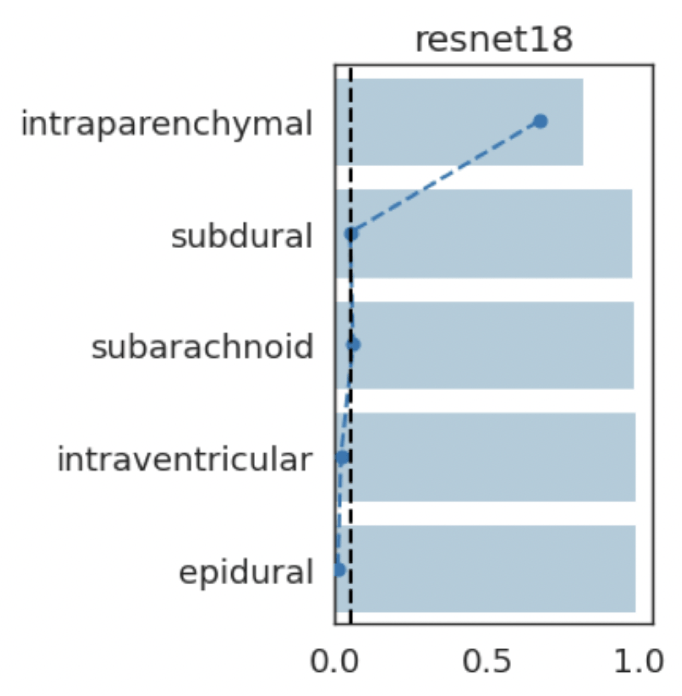
Results: RSNA Brain CT Hemorrhage Challenge
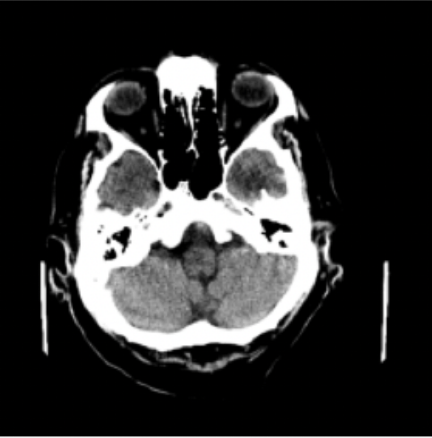
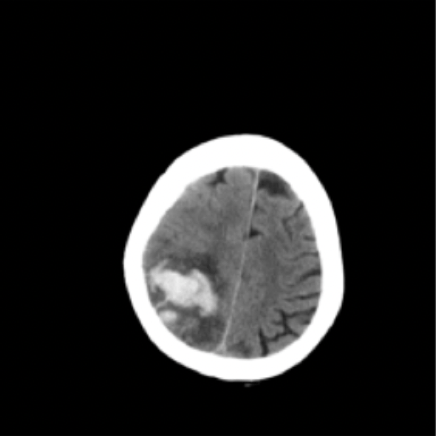
Hemorrhage
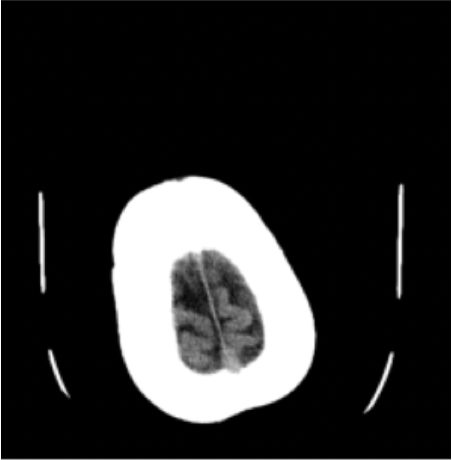
No Hemorrhage
Hemorrhage
Hemorrhage
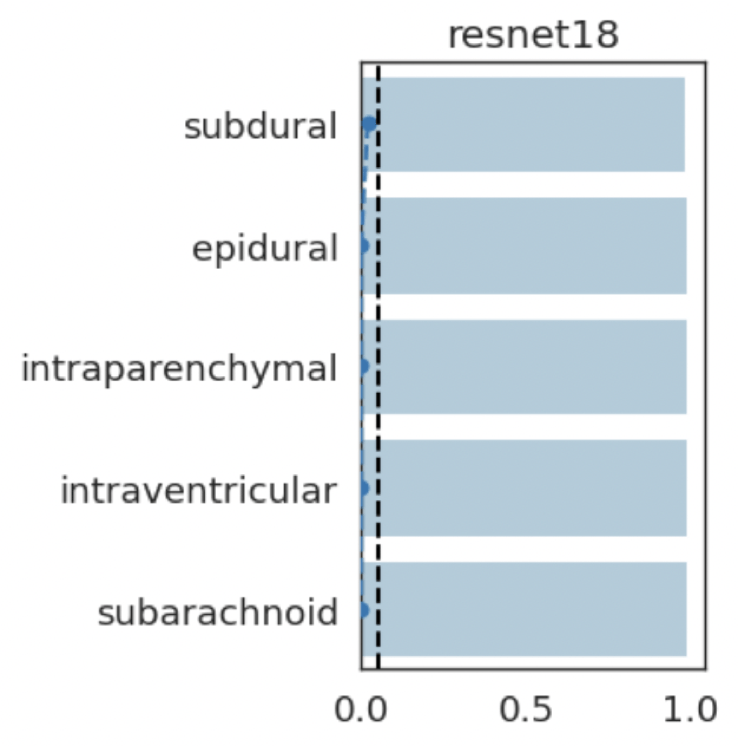
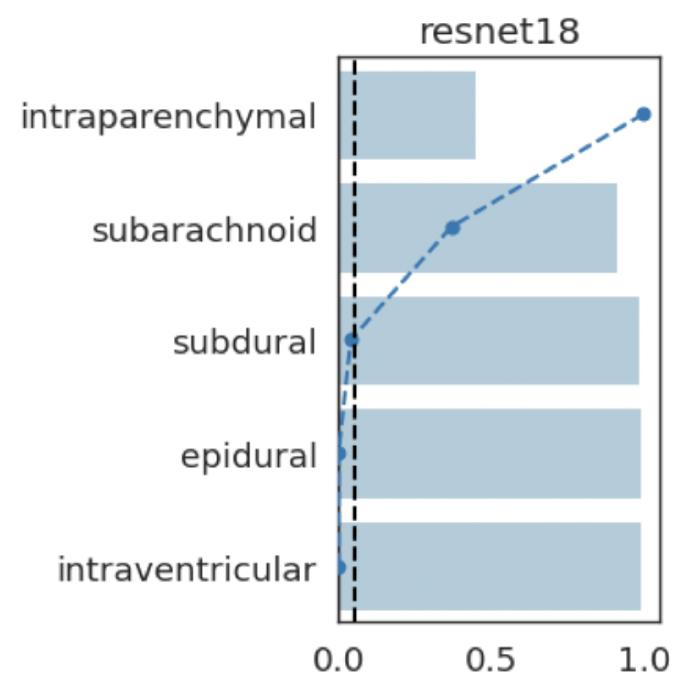
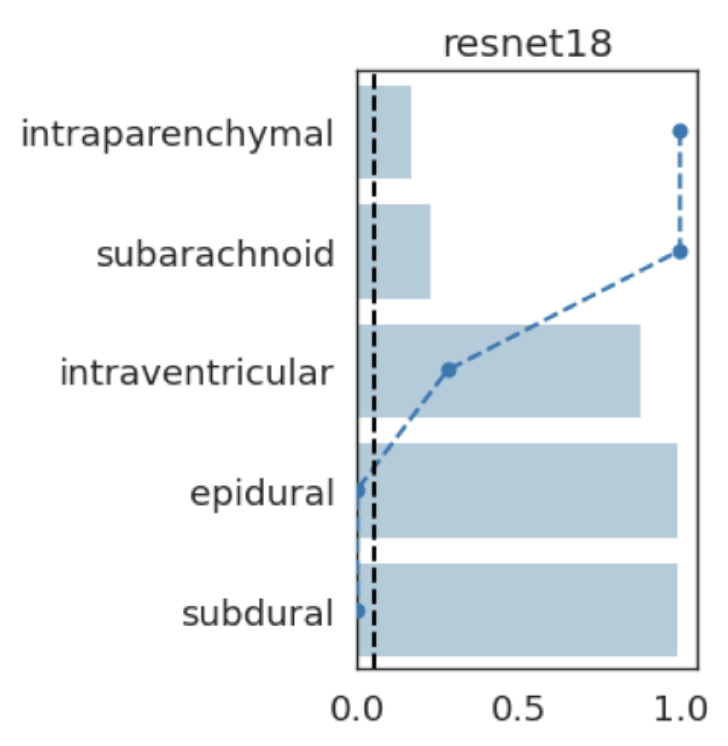
intraparenchymal
subdural
subarachnoid
intraventricular
epidural
intraparenchymal
subarachnoid
intraventricular
epidural
subdural
intraparenchymal
subarachnoid
subdural
epidural
intraventricular
intraparenchymal
subarachnoid
intraventricular
epidural
subdural
(+)
(-)
(-)
(-)
(-)
(+)
(-)
(+)
(-)
(-)
(+)
(+)
(-)
(-)
(-)
(-)
(-)
(-)
(-)
(-)
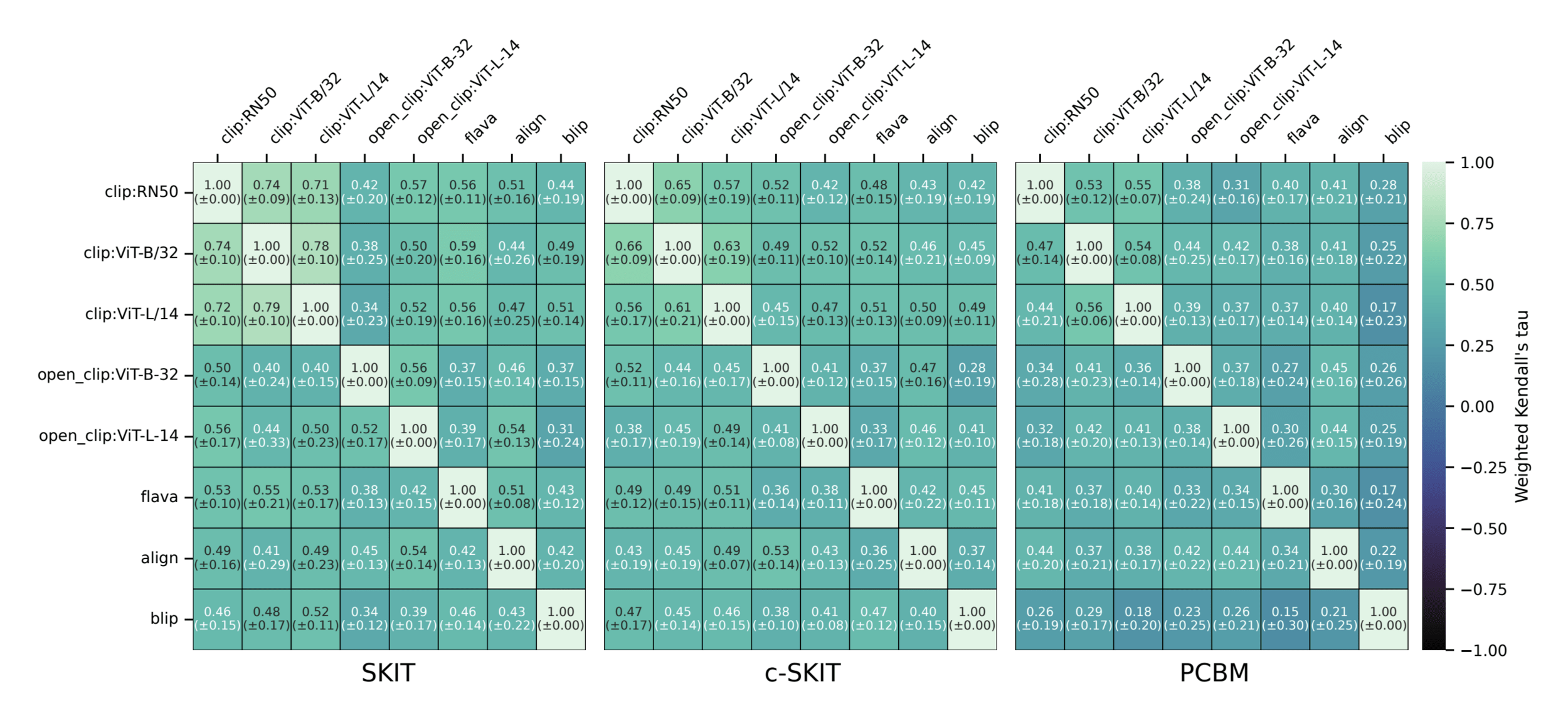
Results: Imagenette
Semantic comparison of vision-language models


...that's it!




Jacopo Teneggi
JHU

Appendix
Concept Bank: \(C = [c_1, c_2, \dots, c_m] \in \mathbb R^{d\times m}\)
Semantic Interpretability of classifiers
Vision-language models
(training)
[Radford et al, 2021]
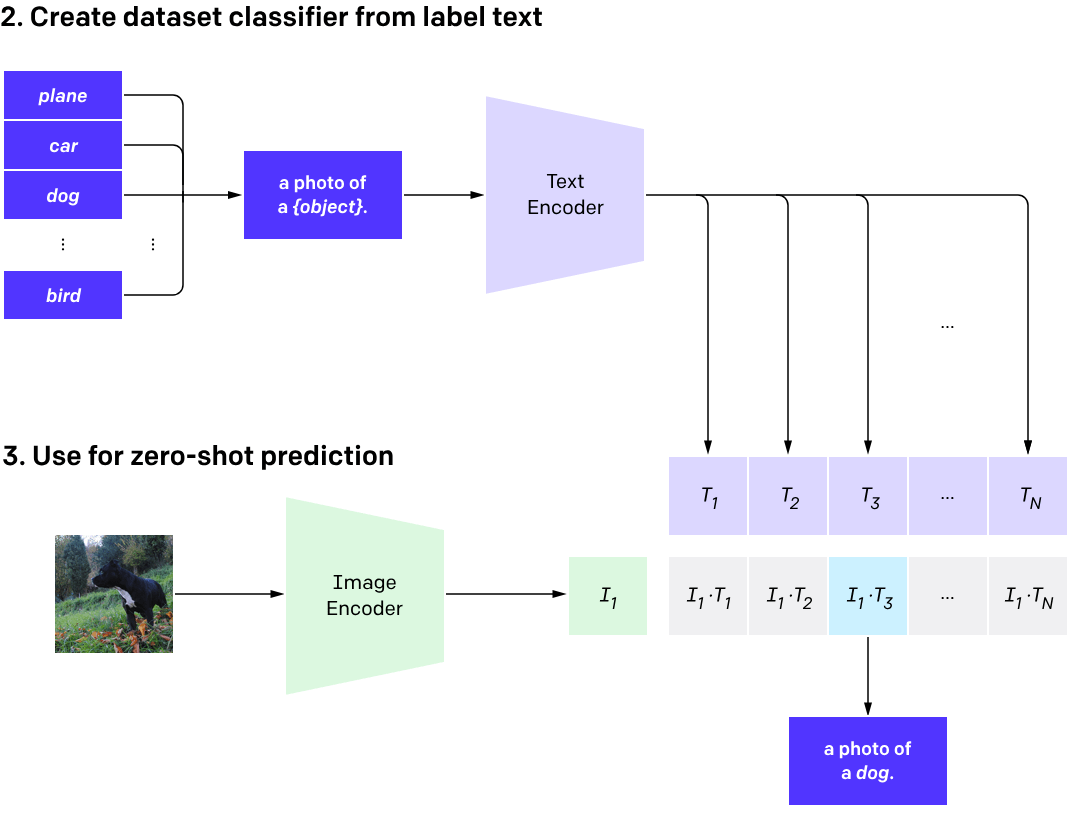
(inference)
Testing Semantic Importance via Betting, MDS24
By Jeremias Sulam