Integrating Research into Written Work
When in doubt: CITE IT.
In-line Citations
- Citation following each bit of source/research material
- Climate change connects to global justice through a reduced availability of fresh produce first affecting poor communities (Barrett 98) and by displacing marginalized communities who are most likely to live in areas affected by climate change (Vance 17).
- Caleb York writes that "free college education levels the playing field for marginalized communities" (3), but this paper that we need to address issues of institutional barriers as well.
In-line Citations
- Alan Adams advocates for divesting in companies that support hydraulic fracturing (18).
- One way to address climate change is to divest from companies that support hydraulic fracturing (Adams 18).
- Adams writes that divestment "eliminates the incentives for companies to engage in harmful behavior toward the climate" (19).
Quoting
Paraphrasing
Summarizing
Cite. All. Source. Material.
No matter if it's quoted, paraphrased, or summarized.
Don't do plagiarism.
Just don't.
I'm so serious, y'all.
Seriously.
Please don't make me cry about this.
And then have to be a mean teacher about it.
Quoting
- Using exact words of a source
- When to use:
- Idea might be inexact or imprecise w/ paraphrase or summary
- to enhance authority
- paraphrase or summary is longer than original
- memorable or inspiring language
- Avoid overuse of quoting—don't let a single source take over your essay
Quoting
- Never, ever use a floating quotation smdh
- Example: Alvarez disagrees. "Corporations are responsible for the majority of greenhouse emissions" (74).
- Better: Maria Alvarez disagrees that individuals are responsible for reversing climate change, citing that "[c]orporations are responsible for the majority of greenhouse emissions" (74).
- Use author's last name in citation if not mentioned in sentence
- Use a colon to avoid floating quotes: Alvarez assesses responsibility differently: "Corporations are responsible for the majority of greenhouse emissions" (74).
Quoting
- Use only the portions of quotes that are useful
- Use the ellipsis (...) to stand in for unused words
- Original: I am, I have to humbly admit, the Beast Incarnate (from a Brock Lesnar interview
- Use: Lesnar states: "I am...the Beast Incarnate" (21).
- Alter the quote in a limited way using brackets
- capitalization, verb tenses, etc.
Quoting
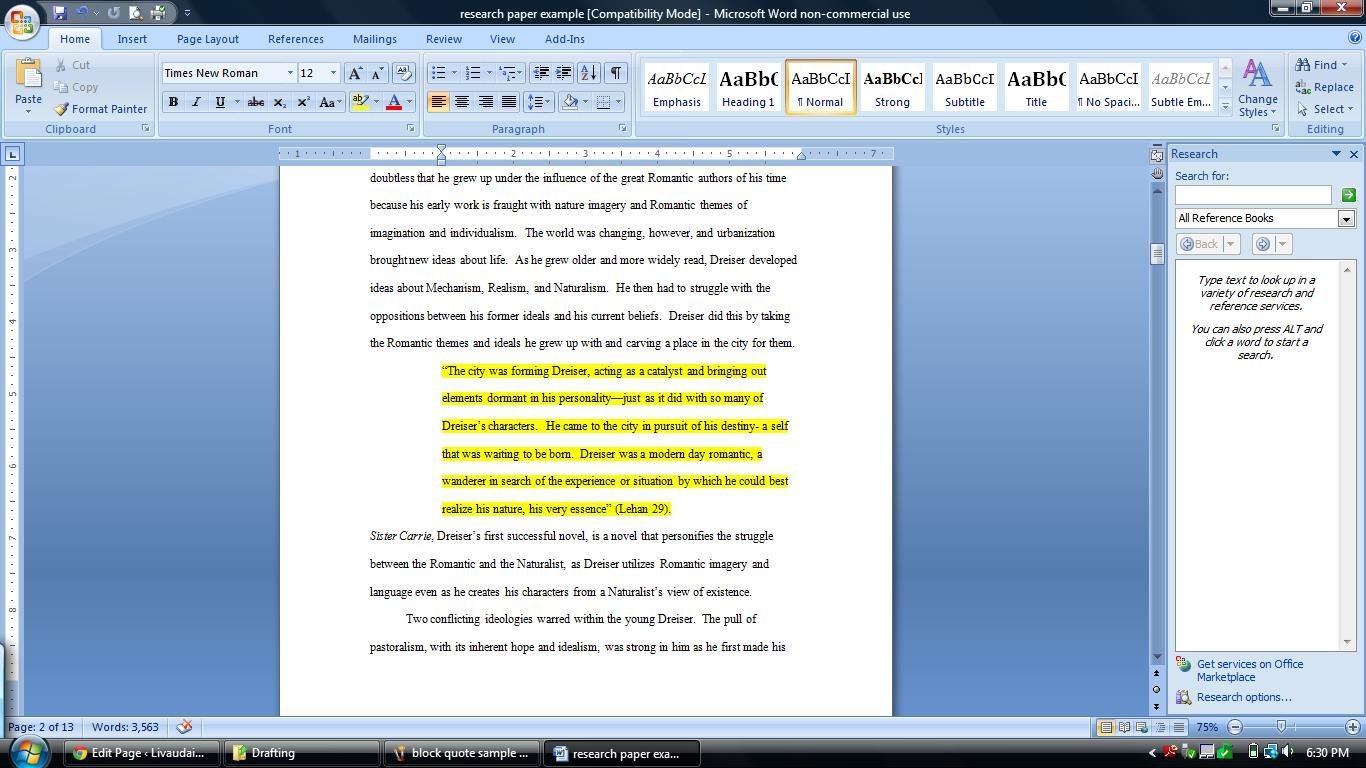
- When quoting material longer than four lines of prose, create a block quotation (two tabs in from the left margin
Paraphrasing
- Use when meaning is more important than wording
- May be more detailed & specific than summary
- When to use:
- to change order of ideas for emphasis
- to simplify material
- to clarify language for your audience
- Keep your ideas separate from paraphrase
- Vary sentence structure
Paraphrasing
- Avoid lazy paraphrasing—differentiate between source material and your own
- Place material in your own words—don't rewrite if you lose clarity or precision
- if retaining original phrasing, rewrite or quote
- Use signal phrases and words to denote source material (list of signals at end of presentation)
Summary
- Brief overviews of a text
- Include in-text citations to important summarized points
- When to use:
- to condense material (book into a few sentences)
- to omit extra material you do not need
- Do not let summary of arguments act as your argument
Structuring
Lead sections with your ideas. Each section, argumentative stance, and paragraph should introduce your ideas and utilize research to support your assertions.
Do not use research to make your arguments for you.
Structuring example
The issue of meat consumption may be looked at as a feminist concern. Adams has written that women and animals stand as absent referents (citation) and states, "________" (83). Explanation of quote. A study by Rothgerber, inspired by Adams, found...
...that women should be utilized as potential food activists (10) and that issues related to food should be reframed as masculine concerns to men (11). Further, Landrigan suggests __________________. Your own ideas explaining material & furthering argument.
Structure of argumentative section
- Provide claim in support of thesis
- Give reasons in support of the claim, based on:
- Evidence that provides factual support
- Acknowledgement of questions, objections, & alternatives and response to those concerns
- Use of warrants to bridge logical gap between claim and reason
Additional Notes
- Use citations for new information from research
- Include author/source citation for whenever new research is introduced
- Always introduce and explain research, especially quotes
- Do not open with quotes by themselves
- Always link research back to your own ideas
Signal Verbs
| acknowledges | concludes | emphasizes | replies |
| advises | concurs | expresses | reports |
| agrees | confirms | interprets | responds |
| allows | criticizes | lists | reveals |
| answers | declares | objects | says |
| asserts | describes | observes | states |
| believes | disagrees | offers | suggests |
| charges | discusses | opposes | thinks |
| claims | disputes | remarks | writes |
Integrating Research into Written Work
By Justin Daugherty