Discussion of

"Informed Liquidity Provision on Decentralized Exchanges"

by Olga Klein, Roman Kozhan, Ganesh Viswanath-Natraj, and Junxuan Wang


Discussant: Katya Malinova

DeGroote School of Business, McMaster University

SNB-CIF Conference on Cryptoassets and Financial Innovation 2026 — Zurich

Understanding DEX liquidity provision

Who provides liquidity? When & How stable is it? Who bears adverse selection?
Uniswap V2: Passive Pure pooled — all LPs share fees and risk pro-rata. Adverse selection from informed trades.
V3 (2021): Concentrated LPs choose ranges, can reposition. Heterogeneity emerges.
V4 (2025): Programmable Even more choice for LPs via hooks and custom pools.

Two channels of adverse selection: (1) trades and (2) better-informed LPs.

How do we compensate LPs? And do informed LPs actually exist?

This paper tackles the second question — for V3.

What the paper does

Broad research question: How does market design affect price discovery & who becomes informed?

Setting: Uniswap V3 ETH-USDC (5bp + 30bp pools) vs. Binance, May 2021 – July 2022 (includes Terra/Luna collapse, May 2022)

Headline: AMM LPs are informed. Near-price liquidity events predict returns. Sophisticated wallets most informative.

Three questions/comments:

1

Is the CEX (Binance) result really about uninformed LPs?

2

DEX LPs informed about what?

3

Who are the "wallets" — what do they actually do?

1. The Binance limit order result

  • Equity literature: limit orders informative about future returns
  • Same firms on Binance as in equity HFT (e.g., Jump Trading)

Paper's measure: change in top-50 depth, 12-second blocks

Expected sign (if LPs informed): positive Δ ask depth → sell interest  negative return

Actual finding: positive Δ ask depth → positive return

Read as evidence CEX  (Binance) LPs are uninformed. But what does the measure actually capture?

Aside: Hagströmer-Menkveld (2026) update Hasbrouck (1995) info shares. Off-exchange venues with sparse trading less informed than LOB in equities — opposite of the paper's DEX finding? Worth engaging.

What does the "limit" measure capture?

Traditional approach: signed quote-level events, each relative to the prevailing mid

Paper's measure: net liquidity added (Δ depth + trade volume), top 50 levels, per 12s block

Scenario Measured "limit" LPs informed?
React: buy trade hits, LPs refill ask depth at same or higher levels Positive
(Δdepth ≥ 0; trade > 0)
No
Reprice: LPs raise ask from $150 to $151 at new fair value, uninformed buyer trades, refill at $151 Positive
(Δdepth > 0; trade > 0)
Yes

Sign prediction drawn by analogy to DEX mints/burns — fits cancellation.
Equity LPs typically reprice — positive "limit" is not inconsistent with informed behavior.

2. Informed about what?

Hasbrouck, Rivera, Saleh (2025): V3 LP payoffs = covered call 

  • LP forgoes time premium in exchange for fees
  • Time premium increases in volatility
  • Equilibrium liquidity provision decreases in time premium

LPs must manage their vol exposure through mints and burns.

Volatility is a natural candidate alongside direction. Can the authors separate vol forecasting from directional prediction? Terra-Lune sub-sample?

Aside (Malinova & Park 2026, Learning from DeFi):

  • In a constant product setting (V2 in the paper), the zero-profit fee scales with return volatility.
  • Empirically, fees are fixed → LP profits must depend on volatility.

3. Who are these "wallets"? What do they actually do?

  • Wallet sophistication classification is inherently noisy (eg, multiple wallets, pooled funds)
  • Sample is pre-Merge, which helps somewhat — LP categories easier to classify
  • Suggestion:  Externally Owned Addresses vs smart-contract wallets? 

Several "Active Liquidity Managers" on V3 operational during sample, e.g.

  • Charm Alpha Vaults — rule-based (passive) rebalancing of pooled funds
  • Gamma (Visor) — — active, volatility-adjusted ranges

The strategies are public — read the smart contracts & the docs

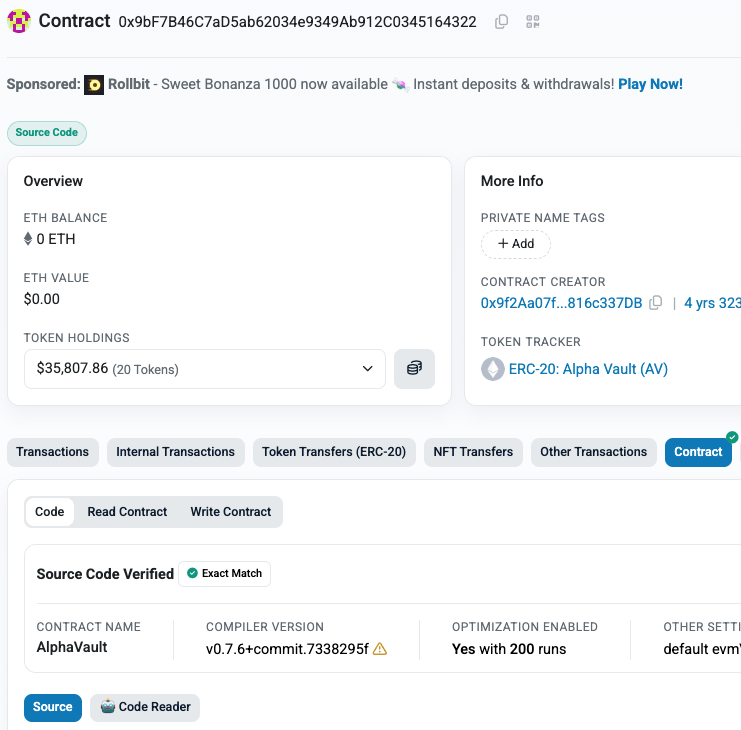
Example: Charm Alpha Vaults, deployed May 2021

  • Pools user capital, manages V3 position via rule-based rebalancing
  • Self-described: passive, no info edge
  • Source code on-chain, verified

Do contracts that say "we're passive" : Show up in the "sophisticated" bucket? Preedict Returns?

Minor comments: magnitudes

Liq events "30× larger" than trades info-wise — but per-$, swaps (aka trades) are more informative?

  • Paper compares 1-std events: mints 9.6 bp vs swaps 2.3 bp
  • But: 1-std mint ($7.4M) ≫ 1-std swap ($322K)
  • Per dollar: swaps 7.1 bp/$M vs near-price mints 1.3 bp/$M

"1-std" mint event is a tail event

  • Near-price mints: Median $1 — Mean $784K — Std $7.4M
  • "1-std" ≈ 95th-percentile event

Minor comments: interpretation

5bps vs 30bps pools

  • Paper: orders route to 5bps first → less adverse selection in 30bps
  • Glosten (1994) logic: orders route to 30bps last → "toxic exhaust" after 5bps skims uninformed
  • \(\to\) 30bps LPs may face more adverse selection per trade, compensated by higher fees

"Public" vs "private" information

  • Paper's "public" = only Binance CEX-DEX arbitrage
  • But arbitrage possible with many other CEX, Coinbase, Kraken, futures, ...
  • More broadly: what is "private info" (e.g., no expected cash flows)? Better processing of public? 

Great paper.

Go read it.

deck

By Katya Malinova

deck

  • 4