Topological superconductivity in the presence of correlations at the edge of topological insulators: a DMRG perspective
Department of Physics of Complex Systems, ELTE Eötvös Loránd University
MTA-BME Lendület Topology and Correlation Research Group, Budapest University of Technology and Economics








László Oroszlány
The team

Osváth Botond, ELTE
Barcza Gergely, Wigner FK
Special Thanks:
- András Pályi
- János Asbóth
- Balázs Dóra
- Miklós Werner
- Zoltán Zimborás
- Tibor Rakovsky
- Alberto Cortijo
Outline
-
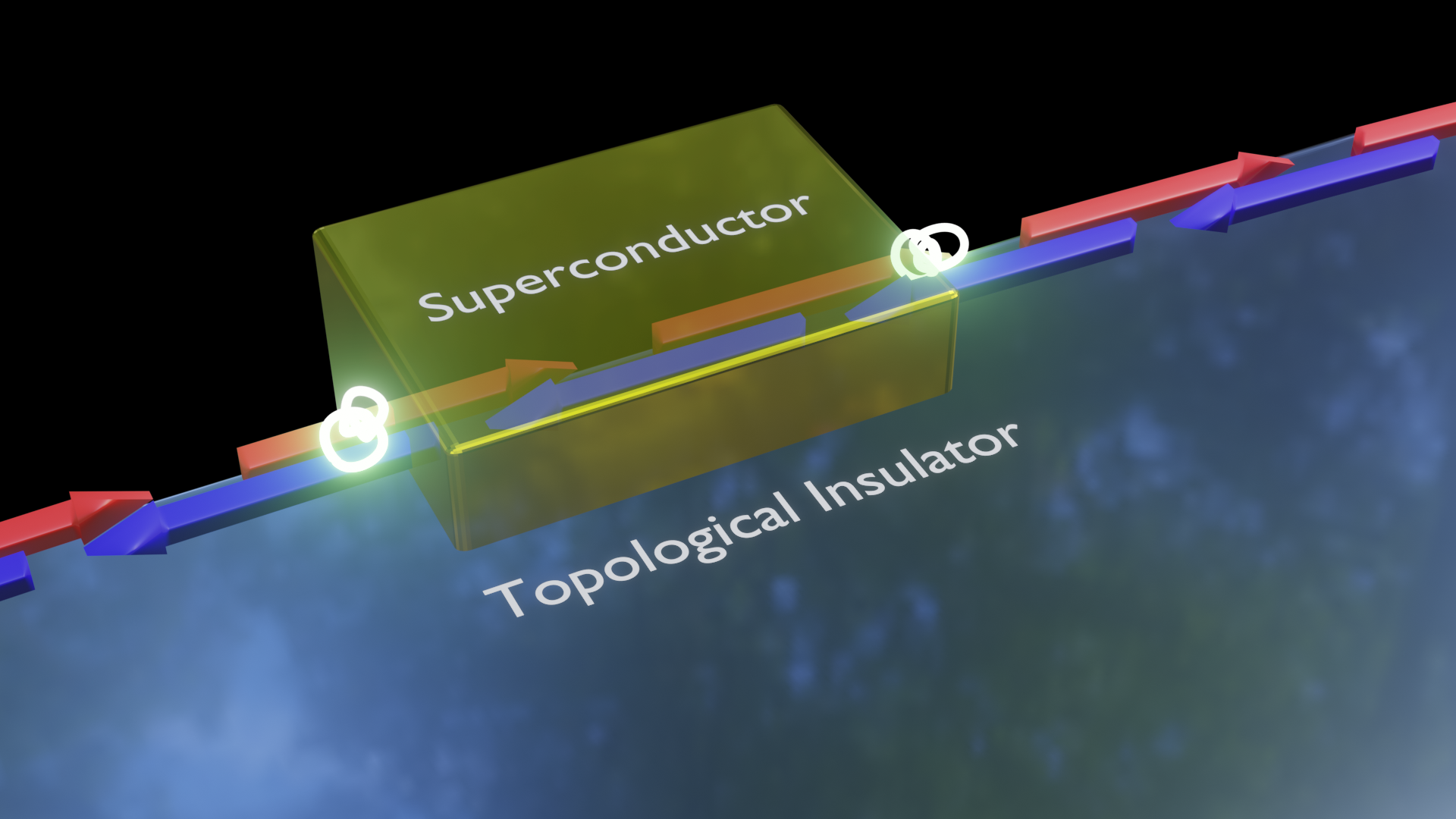
Majorana zero modes at TI edge and broken TRS
-
From Majoranas to parafermions
-
Microscopic model for TI edge and interactions with TRS
Ising / Majorana / Topological superconductor
\displaystyle H =-J\sum_{p=1}^{L-1}\hat{\sigma}_{p}^{z}\hat{\sigma}_{p+1}^{z}-f\sum_{p=1}^{L}\hat{\sigma}_{p}^{x}
\displaystyle H =-J\sum_{p=1}^{L-1}\text{i}\hat{\gamma}_{2p}\hat{\gamma}_{2p+1}-f\sum_{p=1}^{L}\text{i}\hat{\gamma}_{2p-1}\hat{\gamma}_{2p}
\Updownarrow
\displaystyle H=-J\sum_{p=1}^{L-1}\left(\hat{a}_{p}^{\dagger}\hat{a}_{p+1}^{\dagger}+\hat{a}_{p+1}^{\dagger}\hat{a}_{p}+\text{h. c.}\right)-f\sum_{p=1}^{L}\left(-2\hat{a}_{p}^{\dagger}\hat{a}_{p}+\hat{1}\right)\\
\Updownarrow
\displaystyle\hat{\gamma}_{2p-1} =\hat{\sigma}_{p}^{z}\prod_{q < p}\hat{\sigma}_{q}^x \\
\hat{\gamma}_{2p} =\text{i}\hat{\sigma}_{p}^{x}\hat{\sigma}_{p}^{z}\prod_{q < p}\hat{\sigma}_{q}^x
\hat{\gamma}^2_k=\hat{1},\hat{\gamma}_k^\dagger=\hat{\gamma}_k
\hat{\gamma}_k\hat{\gamma}_l=-\hat{\gamma}_k\hat{\gamma}_l
Jordan-Wigner
Majorana-fermion
"standard" fermion
\hat{\gamma}_{2p-1} =\hat{a}_{p}^{\dagger}+\hat{a}_{p} \\
\hat{\gamma}_{2p} =\frac{\hat{a}_{p}^{\dagger}-\hat{a}_{p}}{\text{i}} \\
\hat{a}_{p}^{\dagger}\hat{a}_{q}+\hat{a}_{q}\hat{a}_{p}^{\dagger}=\delta_{pq}
TSC
p-wave
\(\hat{\gamma}_0\), \(\hat{\gamma}_{2L+1}\) absent!!
1D "transvers filed" Ising model
Kitaev model
Majoranas at the edge of TIs
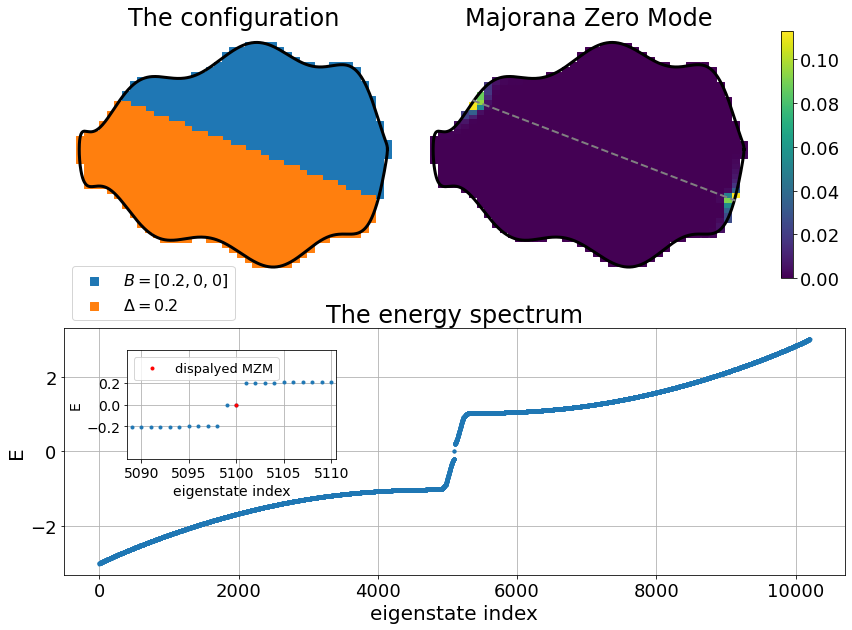
B_x
\Delta
B. A. Bernevig, T. L. Hughes, S.-Ch. Zhang Science, 314, 1757 (2006)
BHZ+\(B_x\)+\(\Delta\)
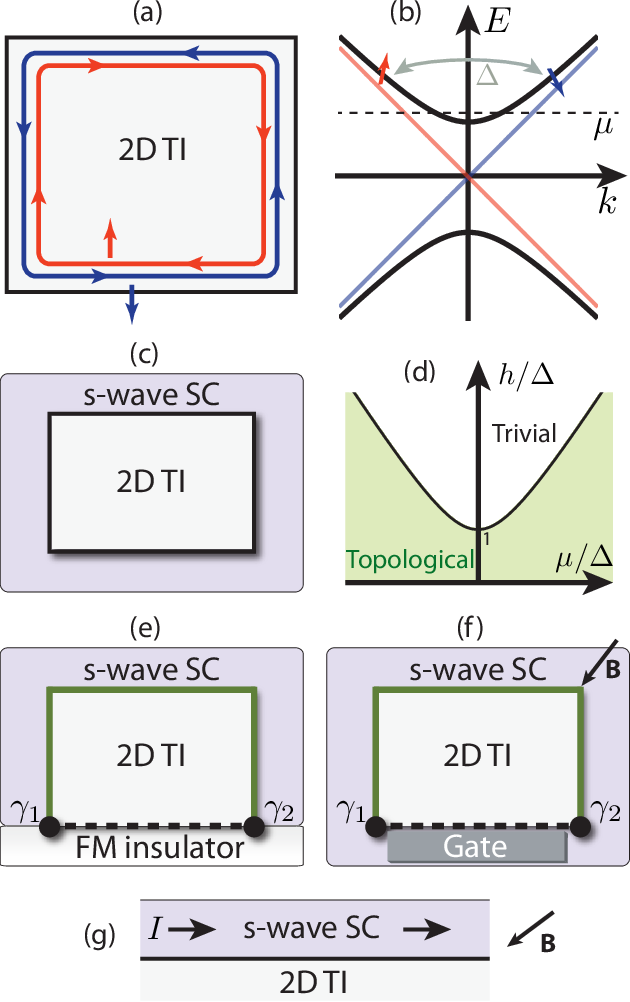
L.Fu and C. L. Kane Phys. Rev. Lett. 100, 096407 (2008)
J. Alicea Rep. Prog. Phys. 75, 076501 (2012)
Clock models and parafermions
\displaystyle H =-J\mathrm{e}^{\mathrm{i}\phi} \sum_{p=1}^{L-1}\omega\hat{\alpha}_{2p}^\dagger\hat{\alpha}_{2p+1}
-f\mathrm{e}^{\mathrm{i}\theta}\sum_{p=1}^{L} \omega\hat{\alpha}_{2p-1}^\dagger\hat{\alpha}_{2p}
\Updownarrow
\displaystyle H =-J\mathrm{e}^{\mathrm{i}\phi}\sum_{p=1}^{L-1}\hat{\sigma}_{p}^\dagger\hat{\sigma}_{p+1}-f\mathrm{e}^{\mathrm{i}\theta}\sum_{p=1}^{L}\hat{\tau}_{p}+\mathrm{h. c.}
\(f=0\rightarrow\) parafermions at the edg, \(\hat{\alpha}_1\) & \(\hat{\alpha}_{2L}\), absent form the Hamiltonian!
The missing two parafermions encode an N-fold degenerate subspace!
\sigma=\left(\begin{array}{ccc}
1 & 0 & 0\\
0 & \Omega & 0\\
0 & 0 & \Omega^{2}
\end{array}\right)\\
\tau=\left(\begin{array}{ccc}
0 & 0 & 1\\
1 & 0 & 0\\
0 & 1 & 0
\end{array}\right)\\
\Omega=\text{e}^{\text{i}2\pi/N}=\omega^2
N=3 Clock model
Jordan-Wigner
\displaystyle\hat{\alpha}_{2p-1} =\hat{\sigma}_{p}\prod_{q < p}\hat{\tau}_{q} \\
\hat{\alpha}_{2p} =-\omega\hat{\tau}_{p}\hat{\sigma}_{p}\prod_{q < p}\hat{\tau}_{q}\\
Parafermion
\hat{\alpha}^N_p=\hat{1},\hat{\alpha}_p^\dagger=\hat{\alpha}^{N-1}_p
\hat{\alpha}_p\hat{\alpha}_q=\Omega^{\mathrm{sign}(q-p)}\hat{\alpha}_q\hat{\alpha}_p
Majoranas vs. parafermions
- Majorana modes can be potentially realized in non-interacting systems. (i.e. mean-field description is sufficient)
- With braiding alone, Majorana modes can realize nontrivial unitary operations, but no entangling qbit gates.
- Parafermions need interaction. (i.e. mean-field description is not sufficient)
- \(\mathbb{Z}_{even}\) parafermions can realize entangling gates just with braiding!
- \(\mathbb{Z}_{odd}\) parafermions route to universality
A.Hutter, D. Loss Phys. Rev. B 93, 125105 (2016)
\(\mathbb{Z}_{4}\) parafermions from ordinary fermions
A. Calzona, T. Meng, M. Sassetti, T. L. Schmidt
Phys. Rev. B 98, 201110(R) (2018)
N=4 clock model/
parafermion chain
each site
has 4 states
spinful electron
in 1D wire
Hamiltonian in fermion language ...
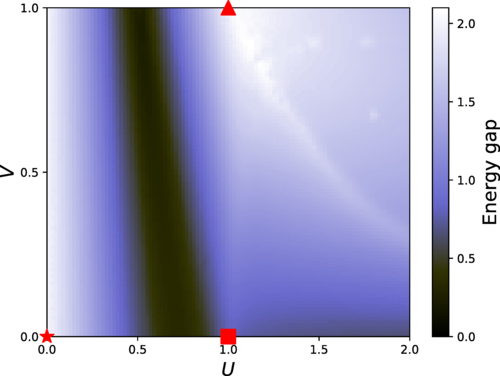
\bar H (U,V) = H^{(2)} + U \left[ V \left(H^{(4)} + H^{(6)} \right) + (1-V) \bar H^{(4)}\right]
\displaystyle \bar H^{(4)} = -J \sum_{\sigma,j} \Big[c_{\sigma,j}^\dagger c_{\sigma, j+1} \left(-n_{-\sigma,j}-n_{-\sigma,j+1}\right) \\ + c_{\sigma,j}^\dagger c_{\sigma,j+1}^\dagger \left(n_{-\sigma,j}-n_{-\sigma,j+1}\right)\Big] +h.c.
\displaystyle
\begin{aligned}
H&=H^{(2)}+H^{(4)}+H^{(6)}\\
H^{(2)}&=- J \sum_{\sigma,j} \left[c_{\sigma,j}^\dagger c_{\sigma, j+1} -i \;c_{-\sigma,j}^\dagger c^\dagger_{\sigma,j+1} \right] +h.c.\,,\\
H^{(4)}&= -J\sum_{\sigma,j} \Big[ c_{\sigma,j}^\dagger c_{\sigma, j+1} \left(- n_{-\sigma,j}-n_{-\sigma,j+1}\right)\\
&+ c_{\sigma,j}^\dagger c_{-\sigma, j+1}\; i \left( n_{-\sigma,j} + n_{\sigma,j+1} \right) \\
&+ c_{-\sigma,j}^\dagger c^\dagger_{\sigma,j+1}\; i \left(n_{\sigma,j}+n_{-\sigma,j+1}\right) \\
&+ c_{\sigma,j}^\dagger c^\dagger_{\sigma,j+1} \left(n_{-\sigma,j}-n_{-\sigma,j+1}\right)\Big] + h.c.\,, \\
H^{(6)}&= - J \sum_j \Big[ - 2 i\, c_{\sigma,j}^\dagger c_{-\sigma, j+1} \left( n_{-\sigma,j} n_{\sigma,j+1}\right) \\
\qquad \qquad &- 2i \, c_{-\sigma,j}^\dagger c^\dagger_{\sigma,j+1} \left(n_{\sigma,j} n_{-\sigma,j+1}\right) \Big] +h.c.
\end{aligned}
... is complicated with 3 body interactions encoded in the \(H^{(6)}\) term
Possible experimental blueprints
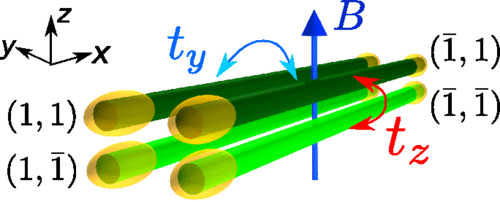
J. Klinovaja and D. Loss
Phys. Rev. Lett. 112, 246403 (2014)
Phys. Rev. B 90, 045118 (2014)
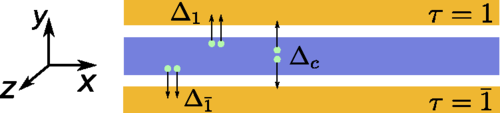
J. Alicea, P. Fendley
Annu. Rev. Condens. Matter Phys. 7,119 (2016.)
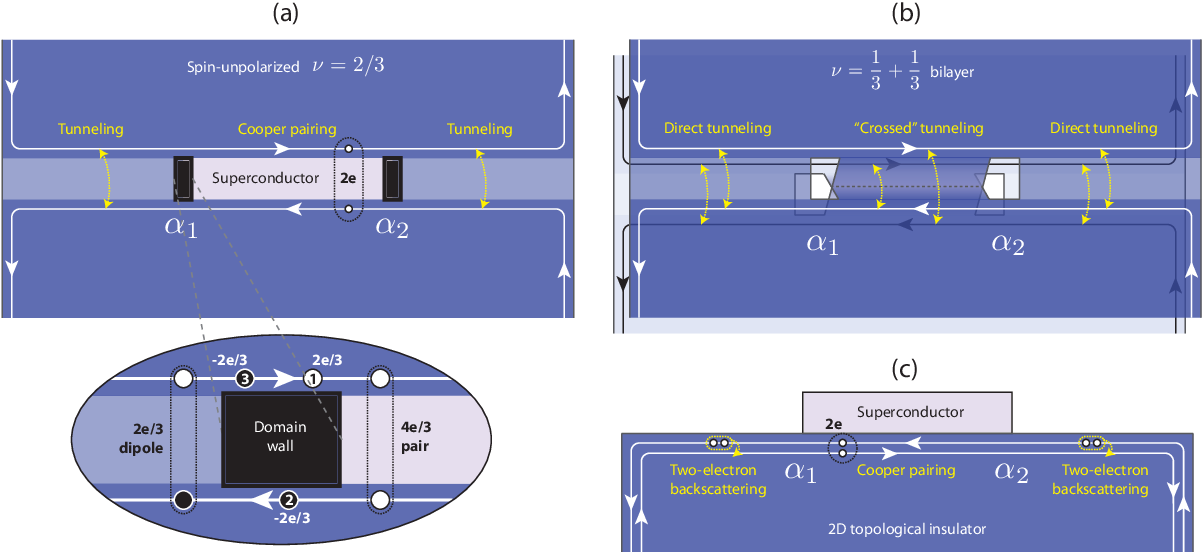
Parafermions at TI edge
F. Zhang, C. L. Kane, Phys. Rev. Lett., 113, 036401 (2014).
C. P. Orth et al. Phys. Rev. B, 91, 081406 (2015).
J. Alicea, P. Fendley Annu. Rev. Condens. Matter Phys. 7,119 (2016.)
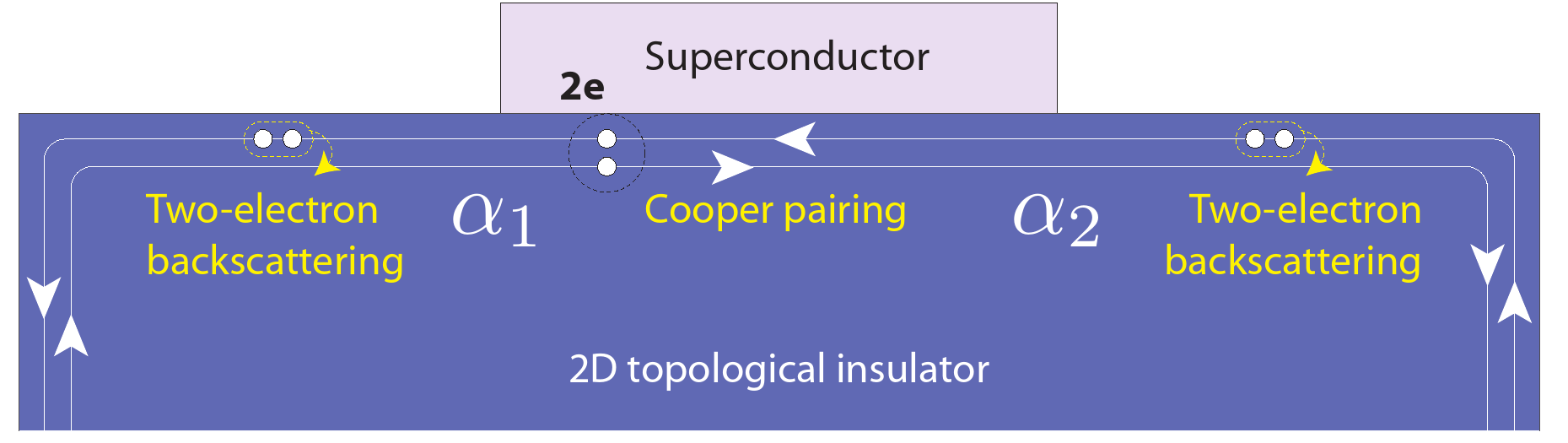
goal: microscopic model + DMRG
bosonised models
DMRG bootcamp

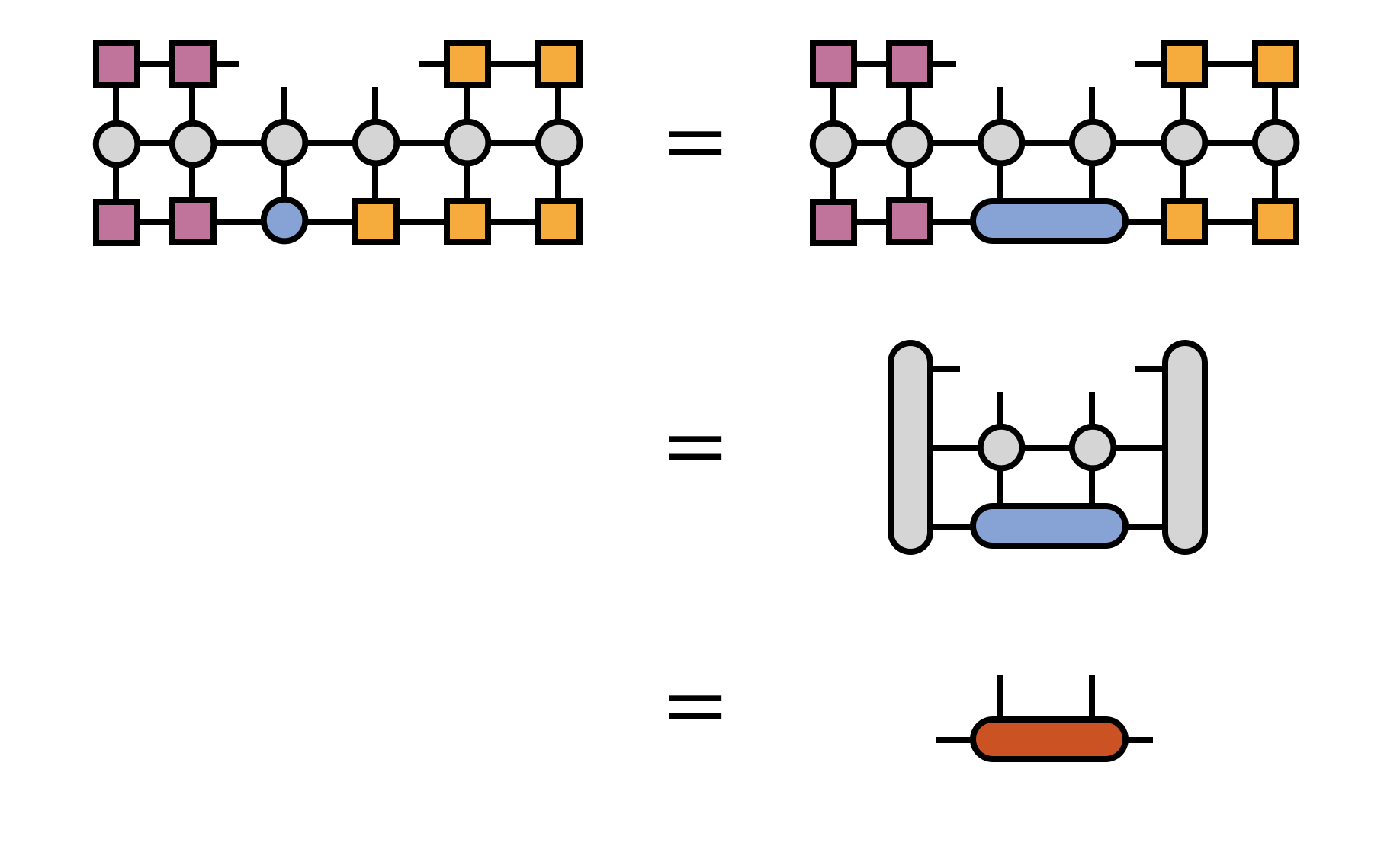

S. R. White, Phys. Rev. Lett. 69, 2863 (1992)
U. Schollwoeck, Annals of Physics 326, 96 (2011)

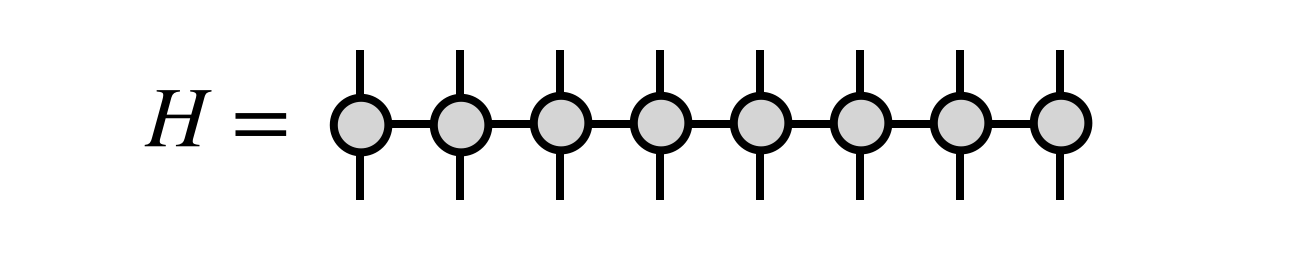
\left|\Psi\right\rangle =\displaystyle\sum_{p_{1}p_{2}\dots p_{N}}\Psi_{p_{1}p_{2}\dots p_{N}}\left|p_{1}\right\rangle \left|p_{2}\right\rangle \cdots\left|p_{N}\right\rangle
H\left|\Psi\right\rangle =E\left|\Psi\right\rangle
MPS Ansatz!
E_{GS}=\min\frac{\left\langle \Psi\right|H\left|\Psi\right\rangle }{\left\langle \Psi\right.\left|\Psi\right\rangle }
state of the art for 1D systems
higher dimensions are tricky
\Psi_{p_1p_2\dots p_N}=\mathrm{Tr}[A_{p_1}A_{p_2}\dots A_{p_N}]
Results obtained with:
Budapest DMRG & ITensor codes

A model for 2DTI that can be digested by DMRG?

The model
- two "disconnected edges" \(\zeta = {L,R}\)
- explicit superconductivity and interactions
- time reversal symmetry
\displaystyle H_k=\sum_{m\sigma}\left(\begin{array}{cc}
c_{mL\sigma}^{\dagger} & c_{mR\sigma}^{\dagger}\end{array}\right)\left(\begin{array}{cc}
-\mu & t\\
t & -\mu
\end{array}\right)\left(\begin{array}{c}
c_{mL\sigma}\\
c_{mR\sigma}
\end{array}\right)\quad\quad\quad \quad \\
-\frac{t}{2}\sum_{m\sigma}\left[\left(\begin{array}{cc}
c_{m+1L\sigma}^{\dagger} & c_{m+1R\sigma}^{\dagger}\end{array}\right)\left(\begin{array}{cc}
\text{i}\sigma & 1\\
1 & -\text{i}\sigma
\end{array}\right)\left(\begin{array}{c}
c_{mL\sigma}\\
c_{mR\sigma}
\end{array}\right)+\text{h.c.}\right]
H=H_k+H_{sc}+H_{int}
\displaystyle
H_{sc} =\sum_{m\zeta}\Delta_{m\zeta}\left[c_{m\zeta\uparrow}^{\dagger}c_{m\zeta\downarrow}^{\dagger}+\text{h.c.}\right]
\quad \quad \quad \quad \quad \quad
\\
H_{int}=\sum_{m\zeta}U_{m\zeta}\left [c^\dagger_{m\zeta\uparrow}c_{m\zeta\downarrow}c^\dagger_{(m+1)\zeta\downarrow}c_{(m+1)\zeta\uparrow}+\text{h.c.}\right]
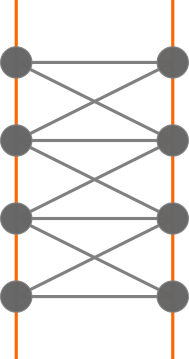
L
R
\color{gray} t
{\color{gray} -t/2}\\
{\color{orange} -it\sigma_z/2}
H_k\approx p\sigma_z\zeta_z
L
R
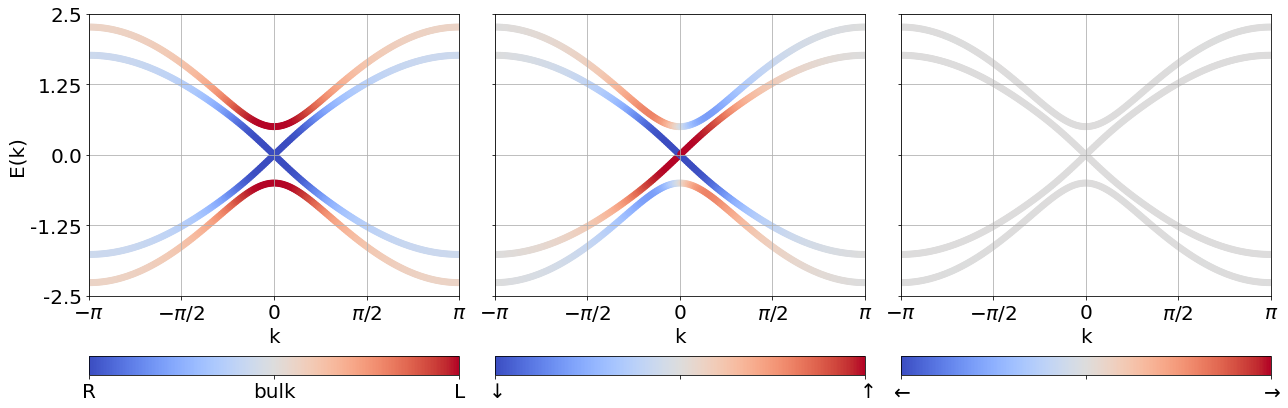
Single particle spectrum
small \(B_y\) on the left for better visibility
B_{y}\neq 0
L
R
We still have Majoranas !
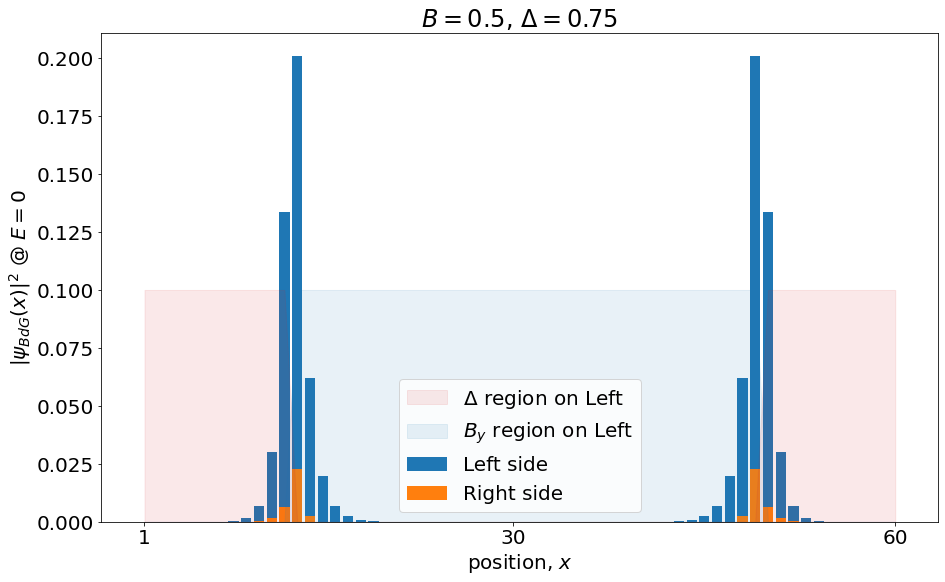
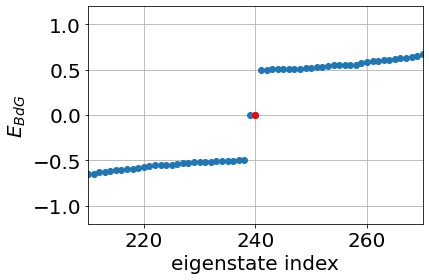
B_{y}\neq 0
L
R
\Delta\neq 0
U=0
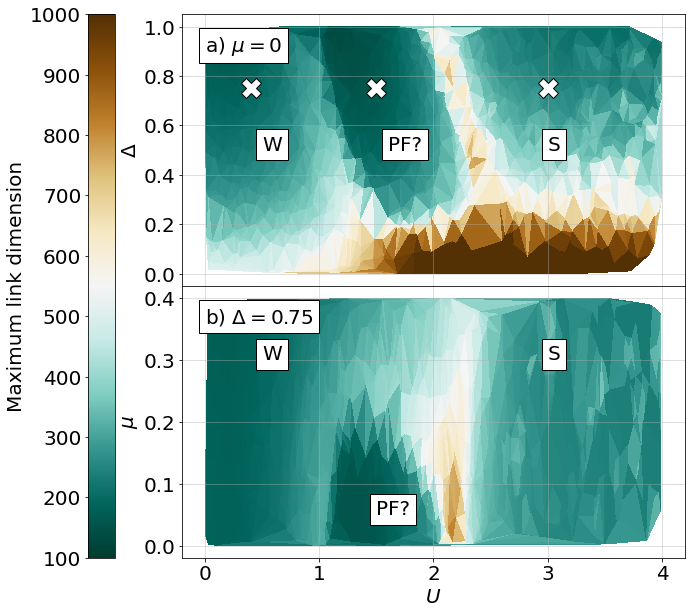
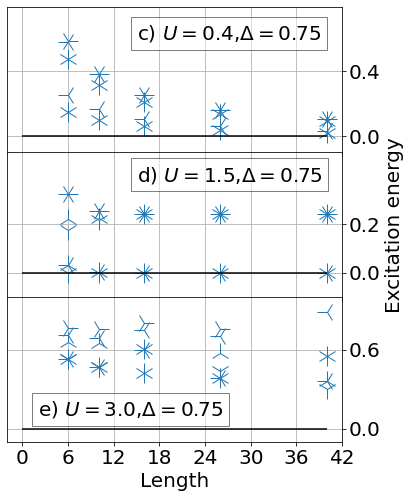
Finite size DMRG calculations: phase diagram
\mu
\mu
U\neq 0
\Delta\neq 0
Properties of the degenerate ground state
\( \langle GS_p | n_i | GS_q \rangle \propto \delta_{pq} \)
\langle S_z\rangle
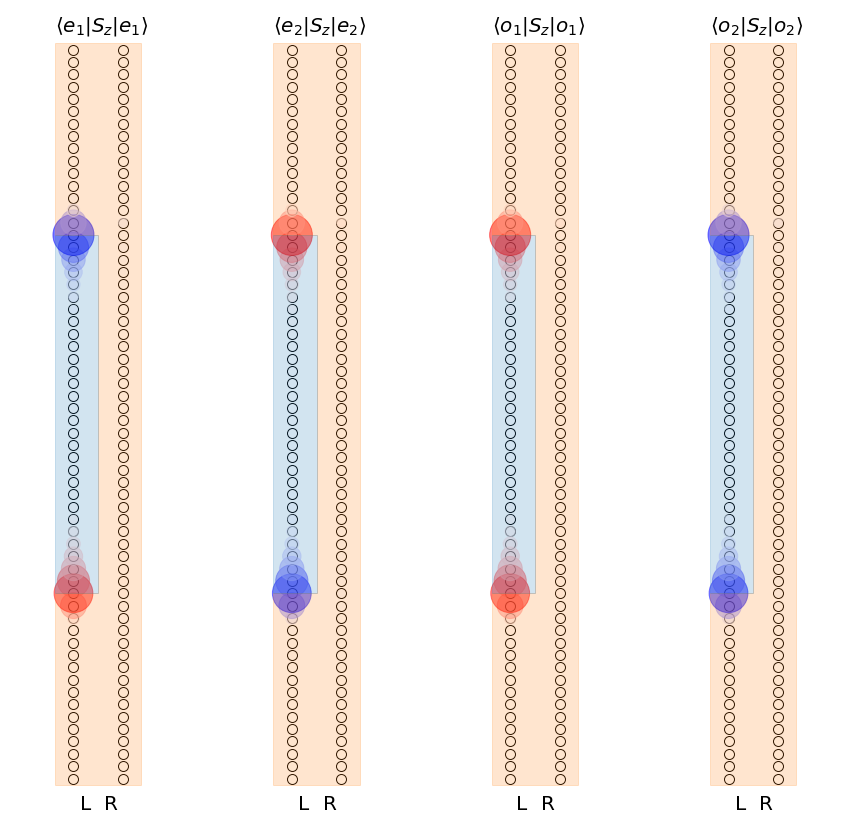
\displaystyle \sum_{\sigma}|\langle c_{p\sigma}\rangle|^2
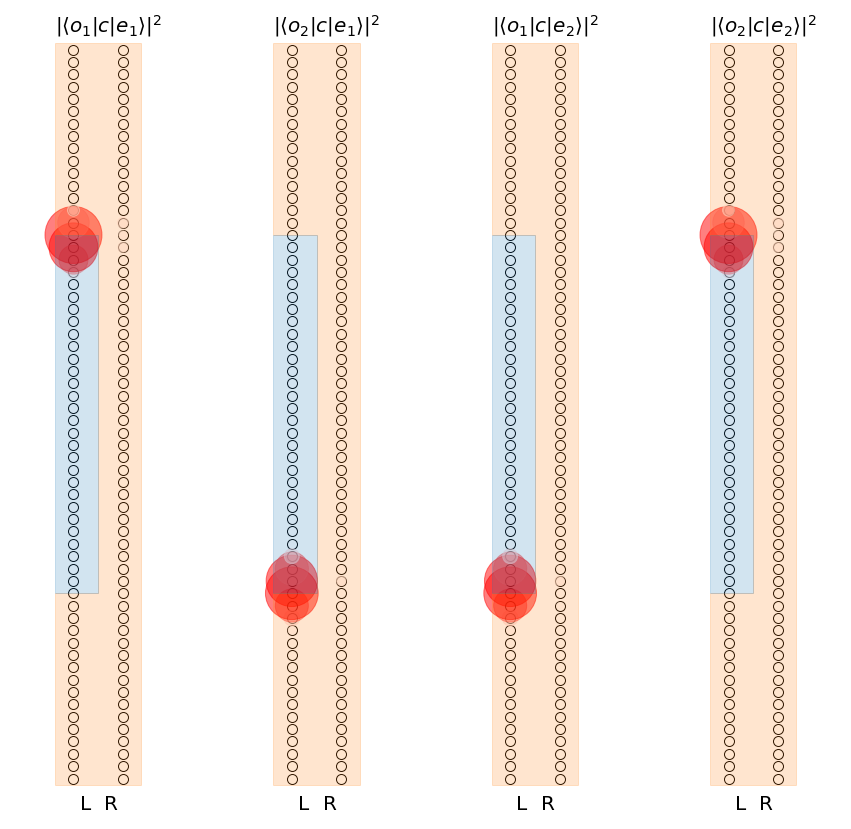
Phase diagram
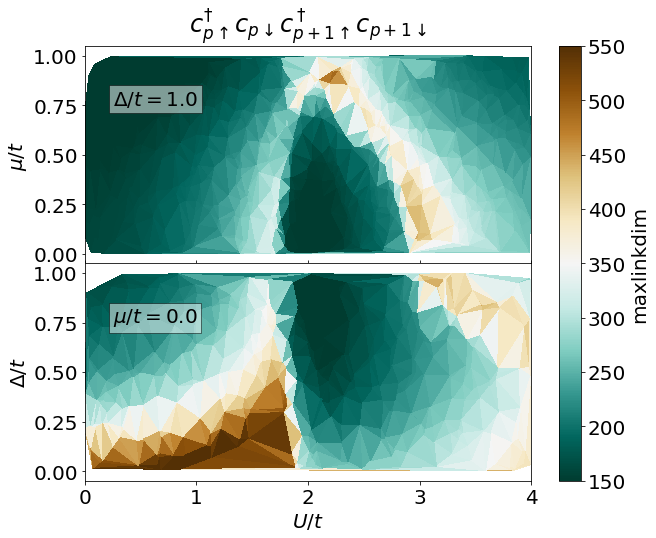
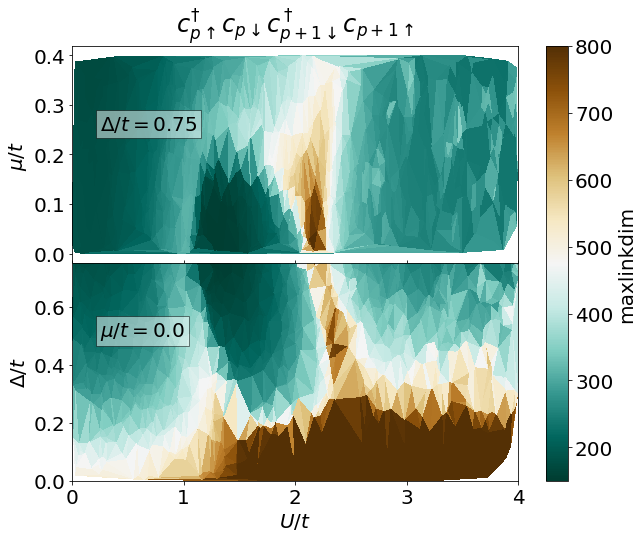
4x deg GS !!
4x deg GS !!
\( \langle GS_p | n_i | GS_q \rangle \propto \delta_{pq} \)
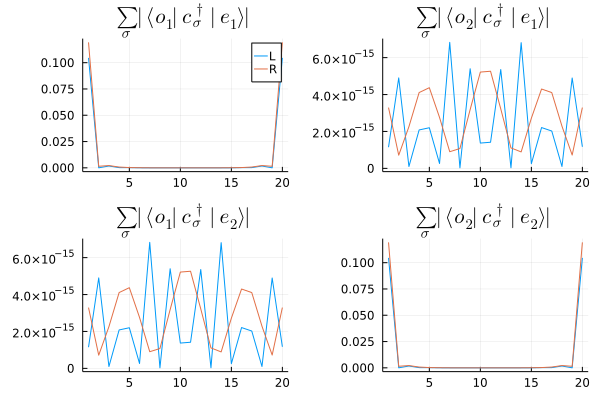
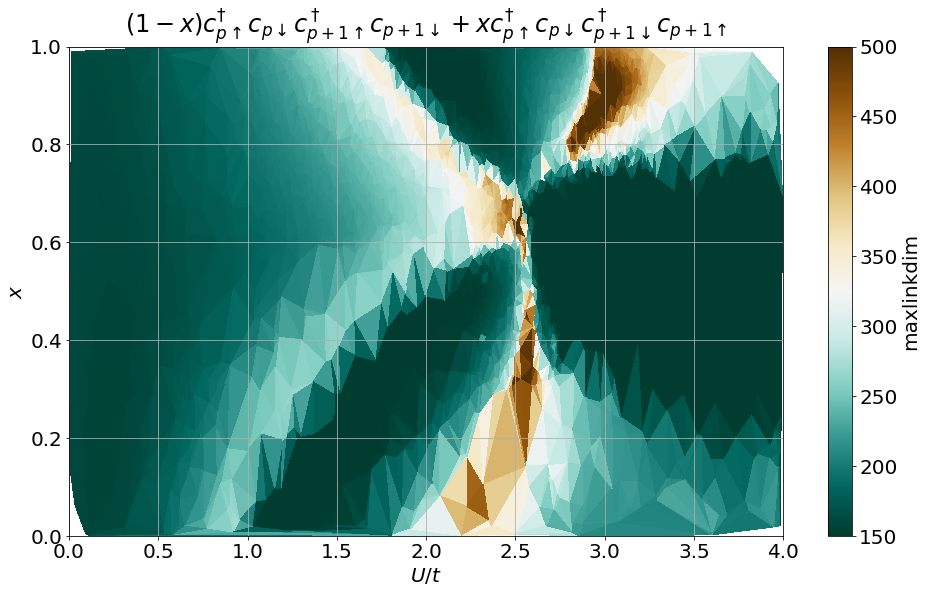
4x deg GS
4x deg GS
2x deg GS
Conclusions and outlook
- We introduced a ladder model capable to capture physics at a single edge of a TI.
- DMRG calculations show that in a hybrid superconducting - interacting system fourfold degeneracy and localized interface states can be realized.
-
Explored different interaction terms.
-
The existence of parafermions in the investigated system is still inconclusive.
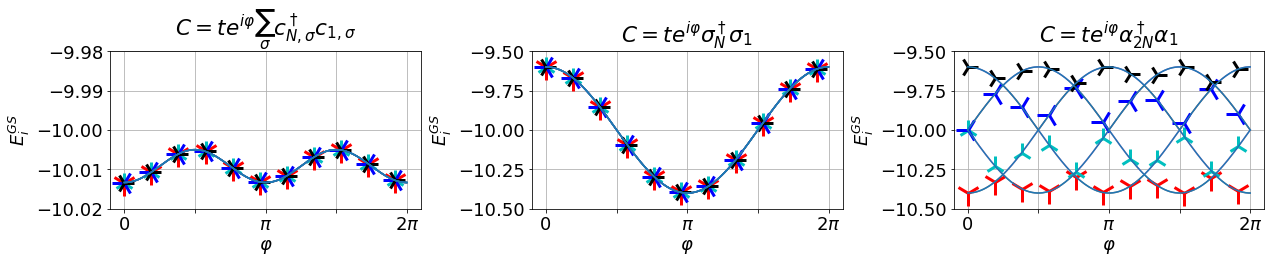
- Characterize groundstate through Josephson periodicity (counting \(\pi\)-s).
Threading a flux and Josephson
\displaystyle H_0=\sum_{m=1}^{L-1}\sigma_m^\dagger\sigma_{m+1} + \mathrm{h.c.}, \quad
H=H_0+C e^{i\varphi}+C^\dagger e^{-i\varphi}
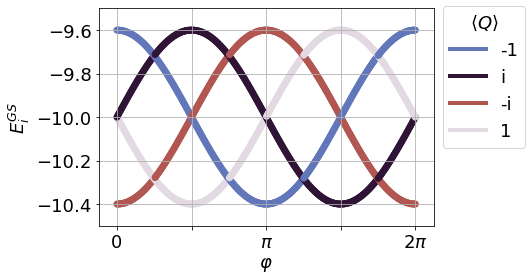
\displaystyle Q=\prod_m \tau_m
parafermion charge
threading a flux method depends on the coupling...
Topological superconductivity in the presence of correlations at the edge of topological insulators: a DMRG perspective
By László Oroszlány