Trans-medial Narratives and Gamification
New Audience, New Stakeholders
Information Society
Bodies of technology in content
Form and function
Convergence Cultures
New Audience, New Stakeholders
Contextualising gender within convergence culture
New conceptions of gender
New narrative expectations
Transmedial cultures: enabling/disabling dichotomy
Are the issues different? Gamergate
New Audience, New Stakeholders
Tropes vs Women in Video Games
Notions of toxicity
From Barbie to Mortal Kombat
Rise of participatory culture: User generated content
Technological imagination of cyberfeminism
Worldbuilding
Magic Circle
Designing Culture
Technological Imagination (Balsamo, 2011): mindset that enables people to think with technology, to transform what is known into what is possible. Performative imagination
How people engage with the materiality of the world and imagine future possibilities
Active engagement between human beings and technological elements, culture too is reworked through the development of new narratives, new myths, new rituals, new modes of expression, and new knowledges that make the innovations meaningful
Hermeneutics of technology: Locating work and play within culture - Gamification
Transmedial Storytelling
|
Traditional Campaign |
Transmedial Campaign |
|
Product centric: Promotional campaign focused on creating brand awareness |
Experience centric: Campaign shifts to creating rich customer experience |
|
Traditional Channels |
Multiple Coordinated Channels |
|
Risk of Inefficiencies: Higher CPM, less fresh, less insight into the storyworld |
Increased Effectiveness |
|
Limited Audience Engagement |
Enhanced Audience Engagement |
Transmedial Storytelling
One-way vs Multi-way Interactions: Audience interaction in marketing campaigns is typically one-way and the communication is top-down.
Transmedia campaigns use multi-way interactions and audience participation. Creating a conversation around a product
Broadcasting vs Narrowcasting: Individuals vs communities. Choice to target individuals vs leveraging an impassioned fan base to create communities online. (Pop culture: Army/Tribe etc) Associating values and emotions with a brand. Connecting individual stories with the larger story
Transmedial Storytelling
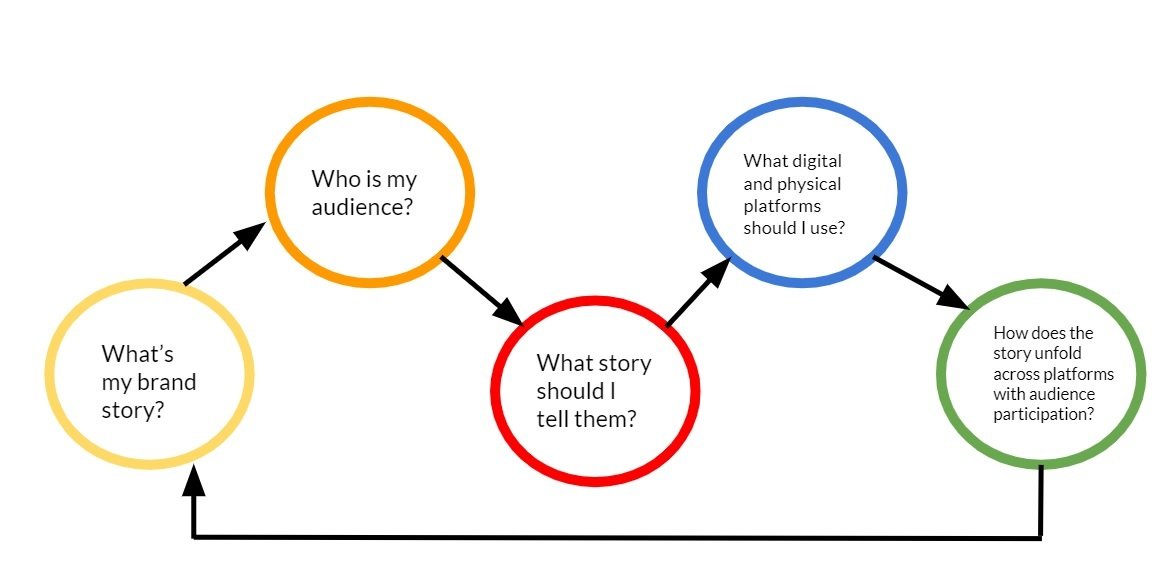
Defined as a coordinated storytelling experience across multiple media platforms. Marketers solicit the active participation of the audience and attempt to spread the narrative with the help of viral marketing practices. Using the core fan base to share the narrative to a larger audience.
Henry Jenkins (2011): “A process where integral elements of a fiction get dispersed systematically across multiple delivery channels for the purpose of creating a unified and coordinated entertainment experience. Ideally, each medium makes its own unique contribution to the unfolding of the story.”
Transmedial Storytelling
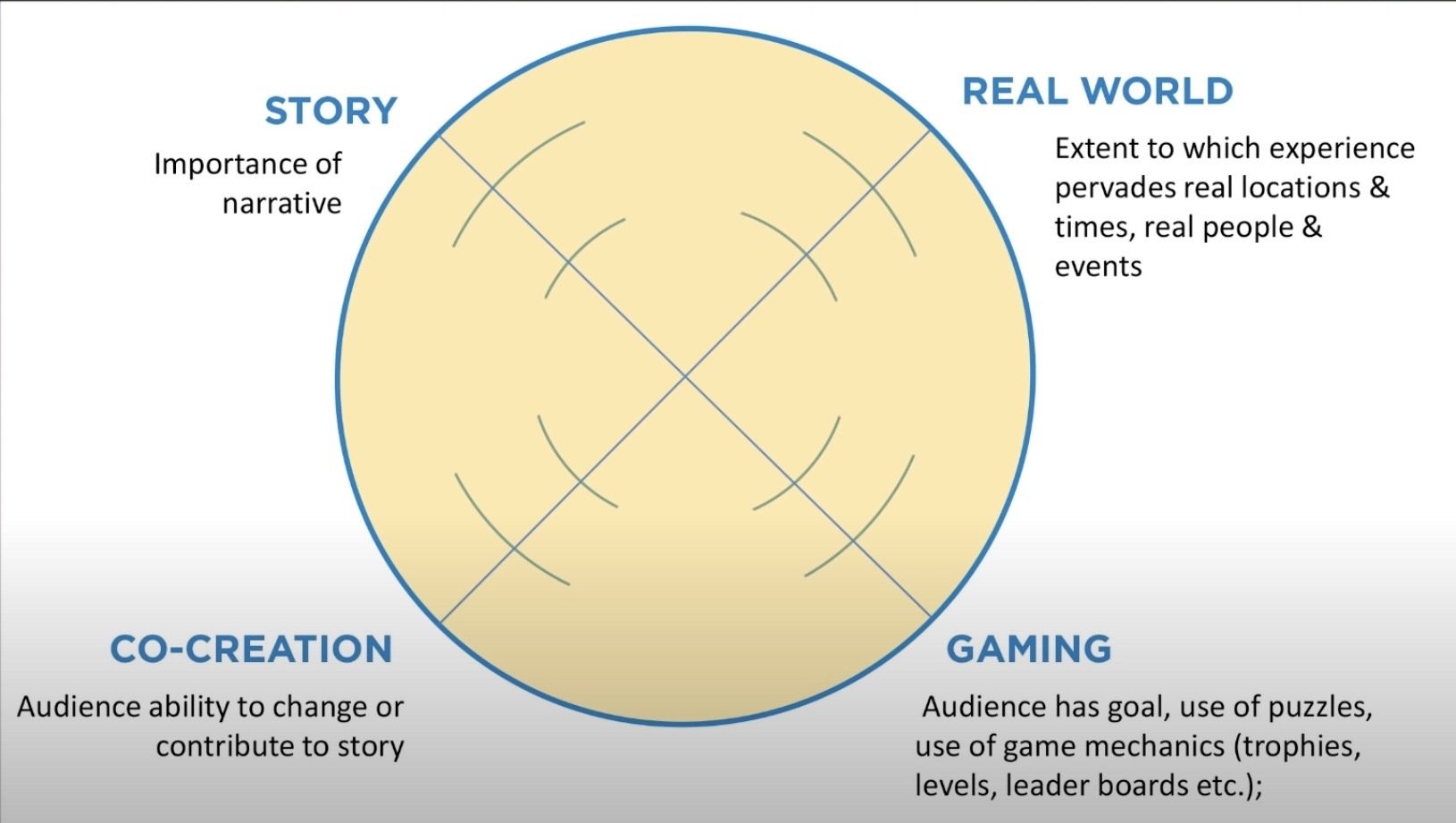
Persistent
Pervasive
Personalised
Participatory
Transmedial Storytelling
Toshiba: https://www.youtube.com/watch?v=qyMQIMeSCVY
Infinit: https://www.youtube.com/watch?v=cIZUUpKzFF8
Hunger Games: https://www.youtube.com/watch?v=jL9Ndsc0LKo
Bear: https://bear71vr.nfb.ca/
Subaru: https://www.youtube.com/watch?v=hRa94Gmx-Ms
Coca Cola: https://www.youtube.com/watch?v=koY5Ml9lSzY ; https://www.youtube.com/watch?v=X_JsOrH5cOM
Collider: https://www.youtube.com/watch?v=Yz-NWKpWSJM&list=PLEInLPvSp6cQpNvSuQpWGzQ0R3xnV5UEX
Batman: https://www.youtube.com/watch?v=VpuC7HhCPWA&list=PLEInLPvSp6cQpNvSuQpWGzQ0R3xnV5UEX&index=8
Dexter: https://www.youtube.com/watch?v=oxpded6Wvu4&list=PLEInLPvSp6cQpNvSuQpWGzQ0R3xnV5UEX&index=13
Burberry: https://www.youtube.com/watch?v=krQG2Hceov4&t=2s
Transmedial Storytelling
Work/Play in Transmedial Cultures
New stakeholders: work/play?
But what is play?
Work/Play in Transmedial Cultures
What is good game design?
All good game elements can still make a bad game!
Instead of elements, what do you want the player to feel?
The Magic Circle
"All play moves and has its being within a play-ground marked off beforehand either materially or ideally, deliberately or as a matter of course. Just as there is no formal difference between play and ritual, so the 'consecrated spot' cannot be formally distinguished from the play-ground. The arena, the card-table, the magic circle, the temple, the stage, the screen, the tennis court, the court of justice, etc, are all in form and function play-grounds, i.e. forbidden spots, isolated, hedged round, hallowed, within which special rules obtain. All are temporary worlds within the ordinary world, dedicated to the performance of an act apart."
The Magic Circle
How do Markets, Politics, Culture and Law operate within the Magic Circle?
A sense of 'Synthetic Worlds' :
Rules/Rituals/Meaning and Immersion/Breaking the Circle
Rules of Social Media:
The like button, algorithms, and follower counts shape interactions.
Inside the circle, likes and shares become currency, defining success and influence. Outside, these metrics are meaningless.
Rituals of Engagement:
Posting photos, engaging in trends, and tagging friends are rituals that give life to the platform.
Memes and hashtags act as shared symbols, binding users within the circle’s rules.
The Magic Circle
How do Markets, Politics, Culture and Law operate within the Magic Circle?
Rules/Rituals/Meaning and Immersion/Breaking the Circle
Meaning and Immersion:
Within social media, users construct identities, perform roles, and engage in narratives (e.g., influencers as storytellers).
However, this immersion can blur the boundary between play and reality—creating issues like performative activism or influencer burnout.
Breaking the Circle:
When users ignore or challenge the platform's implicit rules (e.g., by critiquing algorithms or rejecting engagement culture), the circle's magic can break.
Example: Movements like #DeleteFacebook push back against the rules of engagement, challenging the platform’s influence
The Magic Circle
The Illusion of Consent: Do we really know which magic circles we are a part of?
The Fragility of Meaning: Self worth, notions of narratives, ideas of 'making it'
Transparency and Accountability: Are rules and boundaries clear?
LEGO and The Magic Circle
Build a LEGO representation of a magic circle.
Define its key elements:
- Boundary: What keeps users inside?
- Rules: What governs behavior?
- Rituals: How do users engage?
- Rewards: What motivates users to stay?
How does this platform cater to Achievers, Explorers, Socializers, or Killers?
LEGO and The Magic Circle
- Achievers: Motivated by rewards and accomplishments.
- Explorers: Driven by discovery and learning.
- Socializers: Engaged through interaction and community.
- Killers: Seek competition and dominance.
LEGO and The Magic Circle: Prompts
-
For the Boundary:
- “What keeps users engaged and inside your magic circle? Is it rewards, social interaction, or something else?”
- “What happens if someone tries to leave? How does the circle encourage them to stay?”
-
For the Rules:
- “What are the explicit rules users must follow? Are there unspoken rules too?”
- “How do these rules differ from real-world norms?”
LEGO and The Magic Circle: Prompts
-
For the Rituals:
- “What actions define engagement in this space? Are there daily habits or special events that stand out?”
- “How do rituals create a sense of meaning or belonging?”
-
For the Rewards:
- “What do users get out of engaging in your circle? Points, badges, knowledge, relationships?”
- “Do these rewards favor certain types of users, like Achievers or Socializers?”
What is Gamification
Gamification is bullshit?*
Repeatable approaches which prefers facility, not benefit, honour or aesthetics
This rhetorical power derives from the “-ification” rather than from the “game”. -ification involves simple, repeatable, proven techniques or devices: you can purify, beautify, falsify, terrify, and so forth. -ification is always easy and repeatable
Game developers and players have critiqued gamification on the grounds that it gets games wrong, mistaking incidental properties like points and levels for primary features like interactions with behavioral complexity.
*http://bogost.com/writing/blog/gamification_is_bullshit/
What is Gamification
But it is sticky, playful, retentive, and cuts through the noise.
More user engagement
Millennials and Gen Z: Need to create + need to escape - Gamify
The core idea behind the commercial viability of gamification is that consumers, when interacting with game-like elements, will also display behavior that is associated with gameplay (Huotari and Hamari, 2012).
What is Gamification
Agency and engagement
Stakes of the game
Play as a magic circle
Immersion
VR/AR Gamification
Applications
Apps
Health/Finance/Marketing
Advergames
(NikeFuel, Mazda, Chipotle Love Story)
https://www.gamify.com/gamified-marketing/gamification-examples-case-studies?hsLang=en-au
deck
By nandita roy