Trans-medial Narratives
New Audience, New Stakeholders
Information Society
Bodies of technology in content
Form and function
Convergence Cultures
New Audience, New Stakeholders
Contextualising gender within convergence culture
New conceptions of gender
New narrative expectations
Transmedial cultures: enabling/disabling dichotomy
Are the issues different? Gamergate
New Audience, New Stakeholders
Tropes vs Women in Video Games
Notions of toxicity
From Barbie to Mortal Kombat
Rise of participatory culture: User generated content
Technological imagination of cyberfeminism
Worldbuilding
Magic Circle
Designing Culture
Technological Imagination (Balsamo, 2011): mindset that enables people to think with technology, to transform what is known into what is possible. Performative imagination
How people engage with the materiality of the world and imagine future possibilities
Active engagement between human beings and technological elements, culture too is reworked through the development of new narratives, new myths, new rituals, new modes of expression, and new knowledges that make the innovations meaningful
Hermeneutics of technology: Locating work and play within culture - Gamification
Transmedial Storytelling
|
Traditional Campaign |
Transmedial Campaign |
|
Product centric: Promotional campaign focused on creating brand awareness |
Experience centric: Campaign shifts to creating rich customer experience |
|
Traditional Channels |
Multiple Coordinated Channels |
|
Risk of Inefficiencies: Higher CPM, less fresh, less insight into the storyworld |
Increased Effectiveness |
|
Limited Audience Engagement |
Enhanced Audience Engagement |
Transmedial Storytelling
One-way vs Multi-way Interactions: Audience interaction in marketing campaigns is typically one-way and the communication is top-down.
Transmedia campaigns use multi-way interactions and audience participation. Creating a conversation around a product
Broadcasting vs Narrowcasting: Individuals vs communities. Choice to target individuals vs leveraging an impassioned fan base to create communities online. (Pop culture: Army/Tribe etc) Associating values and emotions with a brand. Connecting individual stories with the larger story
Transmedial Storytelling
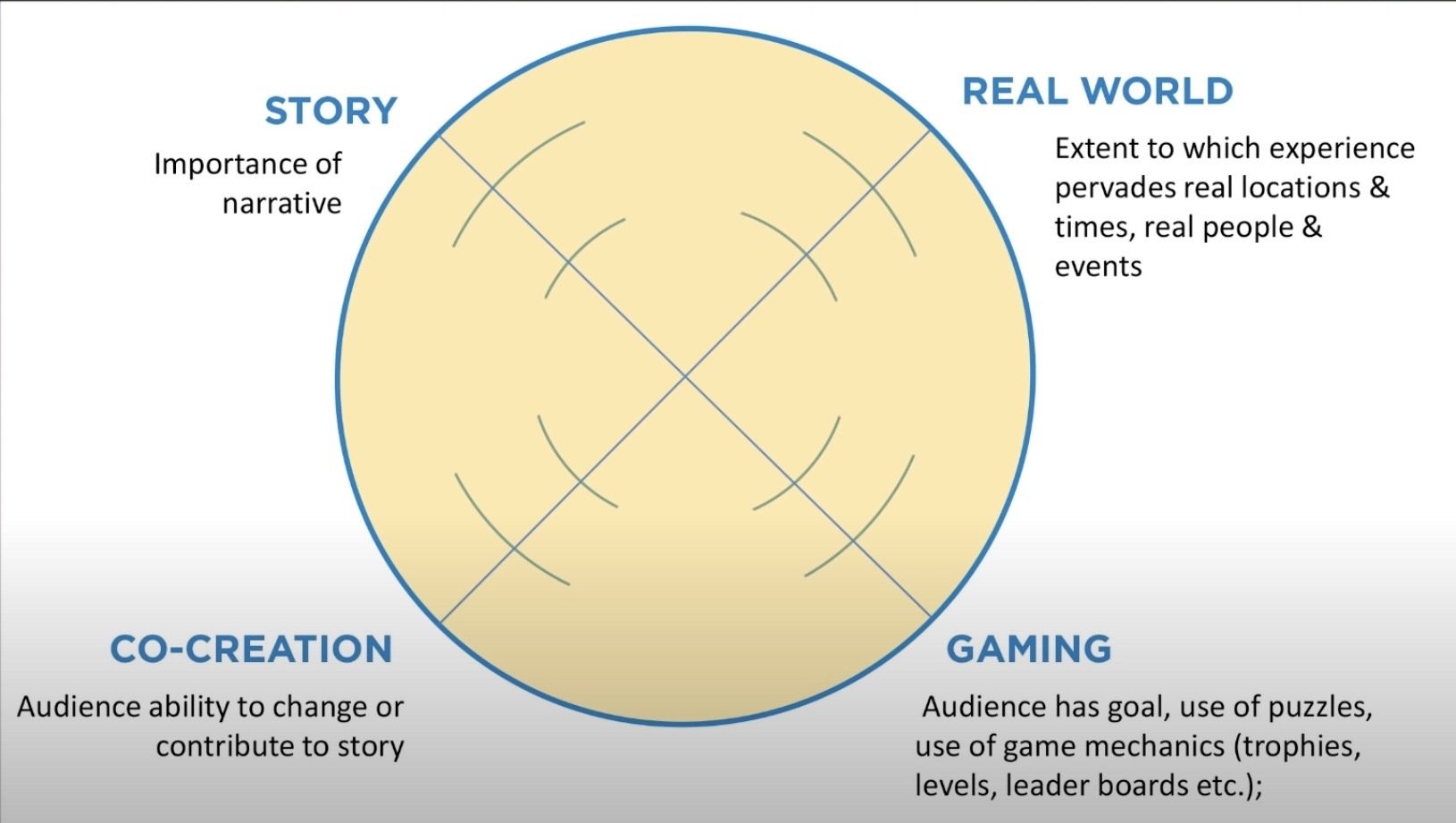
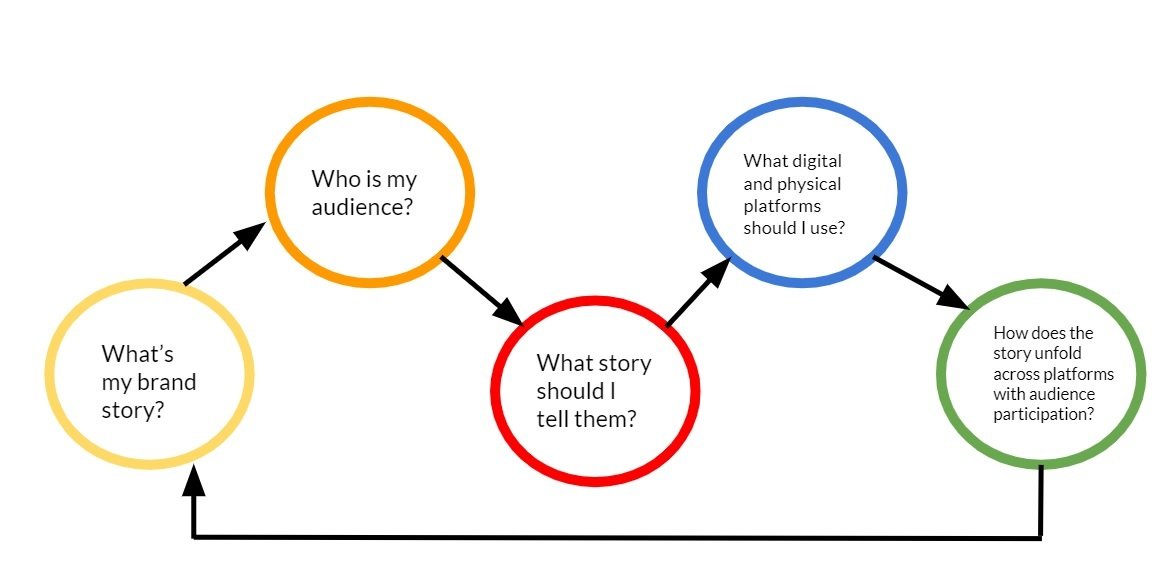
Defined as a coordinated storytelling experience across multiple media platforms. Marketers solicit the active participation of the audience and attempt to spread the narrative with the help of viral marketing practices. Using the core fan base to share the narrative to a larger audience.
Henry Jenkins (2011): “A process where integral elements of a fiction get dispersed systematically across multiple delivery channels for the purpose of creating a unified and coordinated entertainment experience. Ideally, each medium makes its own unique contribution to the unfolding of the story.”
Transmedial Storytelling
Persistent
Pervasive
Personalised
Participatory
Transmedial Storytelling
Toshiba: https://www.youtube.com/watch?v=qyMQIMeSCVY
Infinit: https://www.youtube.com/watch?v=cIZUUpKzFF8
Hunger Games: https://www.youtube.com/watch?v=jL9Ndsc0LKo
Bear: https://bear71vr.nfb.ca/
Subaru: https://www.youtube.com/watch?v=hRa94Gmx-Ms
Coca Cola: https://www.youtube.com/watch?v=koY5Ml9lSzY ; https://www.youtube.com/watch?v=X_JsOrH5cOM
Collider: https://www.youtube.com/watch?v=Yz-NWKpWSJM&list=PLEInLPvSp6cQpNvSuQpWGzQ0R3xnV5UEX
Batman: https://www.youtube.com/watch?v=VpuC7HhCPWA&list=PLEInLPvSp6cQpNvSuQpWGzQ0R3xnV5UEX&index=8
Dexter: https://www.youtube.com/watch?v=oxpded6Wvu4&list=PLEInLPvSp6cQpNvSuQpWGzQ0R3xnV5UEX&index=13
Burberry: https://www.youtube.com/watch?v=krQG2Hceov4&t=2s
Transmedial Storytelling
Work/Play in Transmedial Cultures
New stakeholders: work/play?
But what is play?
Work/Play in Transmedial Cultures
What is good game design?
All good game elements can still make a bad game!
Instead of elements, what do you want the player to feel?
What is Gamification
Gamification is bullshit?*
Repeatable approaches which prefers facility, not benefit, honour or aesthetics
This rhetorical power derives from the “-ification” rather than from the “game”. -ification involves simple, repeatable, proven techniques or devices: you can purify, beautify, falsify, terrify, and so forth. -ification is always easy and repeatable
Game developers and players have critiqued gamification on the grounds that it gets games wrong, mistaking incidental properties like points and levels for primary features like interactions with behavioral complexity.
*http://bogost.com/writing/blog/gamification_is_bullshit/
What is Gamification
But it is sticky, playful, retentive, and cuts through the noise.
More user engagement
Millennials and Gen Z: Need to create + need to escape - Gamify
The core idea behind the commercial viability of gamification is that consumers, when interacting with game-like elements, will also display behavior that is associated with gameplay (Huotari and Hamari, 2012).
What is Gamification
Agency and engagement
Stakes of the game
Play as a magic circle
Immersion
VR/AR Gamification
What is Gamification
Play as a form of social construction
Play is closed within itself; it is an act, which stands true for itself as long as the participants are pretending that it is true.
Play requires the voluntary participation of individuals who are willing to suspend their notions of reality within a fixed time and space – it is only then that play is possible. Play exists as an interruption in our ordinary, real lives.
Applications
Apps
Health/Finance/Marketing
Advergames
(NikeFuel, Mazda, Chipotle Love Story)
https://www.gamify.com/gamified-marketing/gamification-examples-case-studies?hsLang=en-au
Insights for the Future
Accessibility
Reach
Gamification as intrinsic motivation
Better game mechanics
Gamified Narratives
Loss aversion
Level Up!
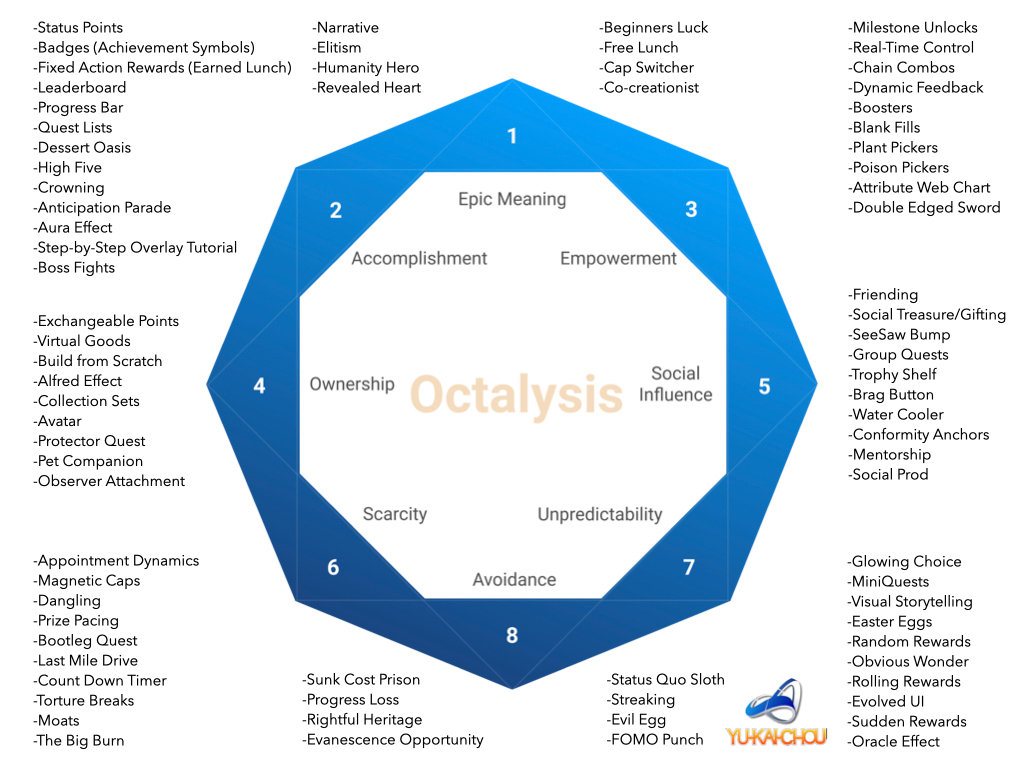
Gamification Techniques
Extrinsic Motivation: Badges, Leaderboards. But value of reward diminishes over time (ergo less inclined to play Candy Crush)
Intrinsic Motivation: Why are games fun? (Huizinga)
Self Determination Theory: Autonomy (Interest), Competence (Challenge), Relatedness (Narrative Transportation)
How Video Games Work
Flow and Immersion: Concentration, Control
Goal and Progress: Balancing challenge and reward
Rule Systems and Narrative Systems
Human focused design (motivation and engagement) vs Function focused design
Epic Meaning and Calling: Wiki, Subreddits (Gamestop) - Narrative focused
Development and Accomplishment: Challenge vs badge/trophy
Creativity and Feedback: System engagement
Ownership: Customisable characters
Gamification Techniques
Social Influence and Relatedness: Friending, social treasure, gifting, group quests
Scarcity and Impatience: From Software/ Appointment Dynamics/ Resource scarcity
Unpredictability: Easter eggs, mini quests, NPC Interactions
Loss and Avoidance: Progress Loss, FOMO
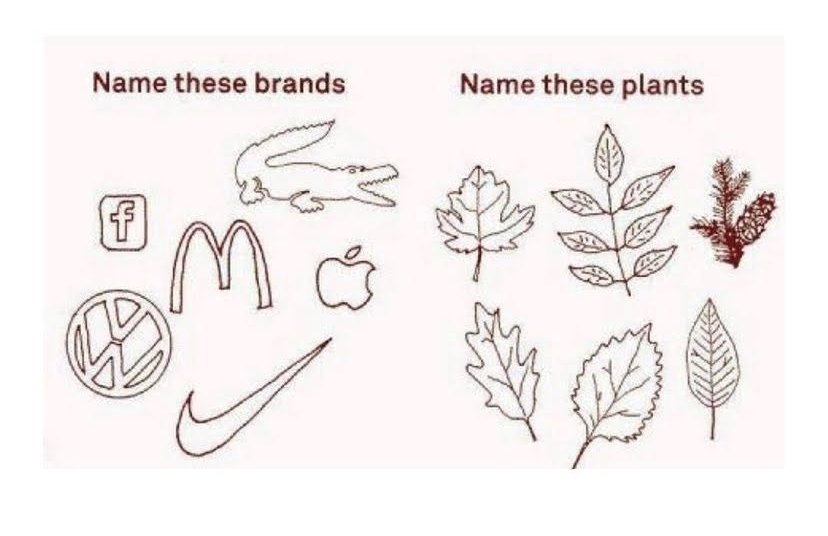
VIDEO GAMES
What happens when you play? Non-linguistic learning. A language of video games
Murray: Procedural, Participatory, Spatial, Encyclopaedic
Procedurality: computer’s “defining ability to execute a series of rules.”
Activity Theory - Horizon Zero Dawn
Ludo-hermeneutics - Witcher III
Procedurality refers to the practice of encapsulating specific real-world behaviors into programmatic representations.
Ludo-Hermeneutics
Components:
1. Heuristic spiral of gameplay
2. Heuristic spiral of narrative
3. Hermeneutic spiral
Three spirals as connected, but discretionary: only the inclusion of gameplay is necessary, while both the narrative and hermeneutic spirals are optional
" While the interpretation of a literary or filmatic [cinematic] work will require certain analytical skills, the game requires analysis practiced as performance, with direct feedback from the system. This is a dynamic, real-time hermeneutics that lacks a corresponding structure in film or literature.Reading a book or viewing a film does not provide direct feedback, in the sense that our performance is evaluated in real time." (Aarseth, 2003)
Ludo-Hermeneutics
"The interpretations a player makes during the game influence his or her actions, and subsequently, success in the game. For example, if one interprets the Koopa Troopa-turtles in Super Mario Bros. (Nintendo Creative Department 1985) as friendly and tries to hug them, it will probably result in the plumber-protagonist Mario losing his life. In this case, we can say that it is the wrong interpretation to make. This does not mean that there is only one possible correct interpretation of the game itself, but that the game supports some and opposes some interpretations." (Arjoranta, 2011, p. 6)
Ludo-Hermeneutics: Gameplay Condition
Given that I desire to play, […] the materiality of the game artefact imposes on me a freedom of choice of which I am responsible in my choices. This is what we could refer to as the gameplay condition. An account of how the gameplay condition is implemented in a particular game would be […] a list of the principles according to which the non-human agency operates in a particular game as regulating what is it possible for the player to do, and also, more importantly, defining what the player needs to do in order to retain the possibility of choosing to [sic] anything in the game. (Leino, 2010, pp. 133-34)
Ludo-Hermeneutics: Gameplay Condition
Given that I desire to play, […] the materiality of the game artefact imposes on me a freedom of choice of which I am responsible in my choices. This is what we could refer to as the gameplay condition. An account of how the gameplay condition is implemented in a particular game would be […] a list of the principles according to which the non-human agency operates in a particular game as regulating what is it possible for the player to do, and also, more importantly, defining what the player needs to do in order to retain the possibility of choosing to [sic] anything in the game. (Leino, 2010, pp. 133-34)
Real time hermeneutics: Bloodborne/Uncharted
Ludo-Hermeneutics in the Market
Notions of interpretation of a cultural artifact - what is art? Duchamp's fountain/Pac-Man MoMA
Prejudices and preconceptions - Real time hermeneutics inflecting it?
"Fusion of horizons" - method to successfully combine your prejudices with the cultural context of the object of interpretation, not allowing either to overshadow the other.
Ludo-hermeneutic framework to understand market cultures: why do some games work?
And extending it to: what does that tell us about contemporary consumer culture?
Ludo-Hermeneutics in the Market
Why do some games work?
Ludo-narrative dissonance: Conflict between ludic and narrative elements
Bioshock: Objectivism and Free Will: Self-interest (gameplay) vs selflessness (narrative): Creating aesthetic distance (alienation)
Mass Effect (Renegade vs Paragon: Still hero!); Uncharted; Plague's Tale; Last of Us...
Incentive vs Directive
A way to unsettle the player - 'emersion' as opposed to 'immersion'. Disruptive storytelling strategy - forcing thought in interactivity.
Ludonarrative consistency (Bloodborne, Dead Space, Persona 5)
Ludo-Narrative Dissonance
Gamification and Ludo-narrative dissonance?
Balance tilted towards ludic elements - without heuristic narrative spiral
Storytelling industry: Shifting towards Ludo-narrative
Applications: Still caught in ludic imagination
Framework for market analysis: Ludo-narrative dissonances in products (sustainability - juice box) - How does one plug it? Shock value: Guerrilla marketing?
Consumer/Prosumer: Use vs Story/Object vs Subject (Activity Theory)
Transmedial Narratives and Gamification
By nandita roy