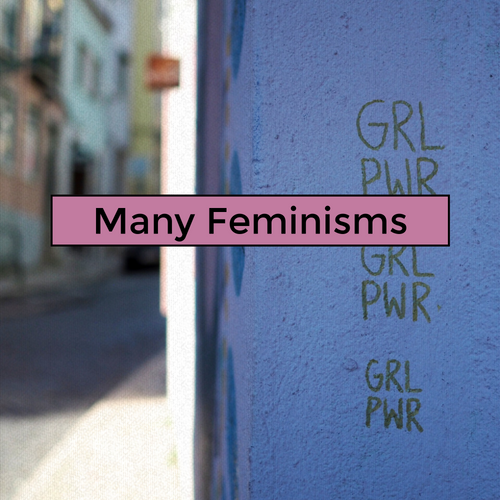
Many Feminisms
What is a Woman?
How do you constitute your identity?
Responses and Discussion
histories/herstories
Mary Wollstonecraft: A Vindication of the Rights of Woman (1792) - ur-document of modern liberal feminism. Rational education, role of men, sensibility, desire. Codification of equality feminism. Enlightenment - Rousseau
Ladies of Langham Place (1850s): Focus on education, employment and marital law. Barbara Leigh Smith, Bessie Rayner Parkes and Anna Jameson. Queen's College and Bedford College began offering education to women from 1848.
Married Women's Property Act (1882)
Fight to repeal the Contagious Diseases Acts of 1864, 1866, 1869
Early Origins: The First Wave
19th and Early 20th Century: Women's Suffrage
Custody of Infants Act 1839 - Women did not have rights over their children
Representation of the People Act (1918): Women who were 30 years old and had property. 1928 - women over 21, on an equal basis with men.
Inequality, Racism: Ain't I a Woman?
Videos:
https://www.youtube.com/watch?v=056FI2Pq9RY
https://www.youtube.com/watch?v=NL5s9dk9U4w
https://www.youtube.com/watch?v=Ry_i8w2rdQY
The First Wave
First World War: Women's entry into the labour market.
'Nationalisation of Women'
1929: Virginia Woolf 'A Room of One's Own'
Negative connotation of 'feminism' - women discouraged from self-identifying
Woolf: "I myself have never been able to find out precisely what feminism is: I only know that people call me a feminist whenever I express sentiments that differentiate me from a doormat."
Economic Recession: Women emerged as the most vulnerable part of workforce
Returning soldiers.
The First Wave
Attempt to bring equality in the public sphere.
Right to go out, to work, to vote
But critical inequalities remained in the private sphere
Need for more dialogue about the private sphere
Rise of the Second Wave
Rise of the Second Wave
Renewed domestication of women post WWII
1949: Simone de Beauvoir's The Second Sex - male centred ideology. Woman as Other.
1963: Betty Friedan's The Feminine Mystique - The problem that has no name. Images of perfect family. The woman in the American Dream.
Liberal feminism - Advocation for federal legislation, public sphere, professional lives and personal lives
Consciousness raising among middle class women in America
Viewing root cause of women's oppression in legal systems
Sex/Gender
Biological/Social
Countering biological determinism
Simone de Beauvoir - Becoming a woman. "Social discrimination produces in women moral and intellectual effects so profound that they appear to be caused by nature". (1972)
Cultural practices and social expectations constitute gender roles
The Second Wave
Radical Feminism: Call for social re-ordering
Patriarchy (transhistorical) as oppressive and dominant - abolishment
Private sphere
Issues of objectification, violence against women
Need to challenge existing social norms
Reproductive rights
Changing organizational sexual culture
Emerging critiques of heteronormativity
Need for the Third Wave
Emphasis on diversity, individualism
Theories of intersectionality, ecofeminism, transfeminism etc.
Women experience layers of oppression - gender, race, class, geographies
Emphasis on personal narratives
Post-structuralist interpretation of gender and sexuality
Deconstructing binaries
Critiquing first two waves' focus on white, middle class cisgender women
Many Feminisms
Objections to Wave Constuct
Re-examining the category of the woman
From liberal feminism - terms 'gender studies', 'women's studies'
Critique of developmental feminism
Recognition of many feminisms
Social media and the construct of the woman - #metoo
https://www.youtube.com/watch?v=mtfsfsBNgiw
https://www.youtube.com/watch?v=LyBims8OkSY
Post feminist constructs
Ideas
Importance of structural changes
Postfeminism
Equality as sameness
Different but equal?
Leaning in, becoming: Contemporary ideas of women and leadership
Sandberg: https://www.youtube.com/watch?v=18uDutylDa4&t=3s
Generation Equality: https://www.youtube.com/watch?v=m_UjYOfmkn8
Looking at it from the lens of history: how are constructs created and dismantled?
Femvertising
Media and Women: Airtel TVC, Titan TVC - What do you think of equality?
From pinkwashing to queerwashing
Ideas
Constructs of femininity and masculinity
Hegemonic masculinity
Alternatives and Fluidity discourse
Sexuality Framing
Women's Leadership
Transactional leadership - accepts goals, cultures and structures of existing organisations based on motivation, reward, punishment, compliance. Change achieved incrementally, motivators extrinsic
Transformational leadership - Achieves social change—changes modes of work and organisational cultures and structures as well as of society
Women's Leadership
What is:
Women's Leadership
Feminist Leadership
Feminine Leadership
Feminine vs Feminist Leadership
Feminine leadership - Recognising women bring different qualities to leadership - nurturing, conflict resolving, non-aggressive, collective decision making and relationship building. Within accepted gendered roles of women.
Difference between feminine and feminist leadership - former does not seek to change gender power structures and women’s lack of access to positions of authority—tries to “accommodate” women within existing structures.
Understanding Feminist Leadership
Mostly work emanating from North America
1970s-80s - Second Wave Feminism
Within discussions of power and alternative non patriarchal, non hierarchical structures of organisations.
Southern feminists less focussed on leadership per se but engaged in experiments with alternative structures and analysis of gendered power in social, economic and political realm - women’s exclusion from power in public realm and advocating women’s greater access to political power for more representation in leadership in government, business and civil society
Feminist Approaches to Leadership
Products of women’s struggles to examine their relationship to and practice of power
Advancing gender equality in power positions in public and private sector
Creating alternative feminist structures. Not replicating patriarchy - alternative ways of using power, leading, non hierarchical
Attending not only to gender but other systemic forms of oppression and privilege
Attending to intersectionalities - ethnicity, race, class, gender
Definitions of Feminist Leadership
“Society has tended to mystify leadership skills as belonging only to a few people who are then seen as better than everybody else. But if we view leadership skills as something that many people have in varying degrees - skills that can be supported and enhanced… not in order to make one person superior but because they are needed in the world. We are not interested in leadership for leadership’s sake. We are interested in bringing women’s talents to bear in addressing economic, social and political concerns.”
Mary S Hartmann
“The question is not whether we should have leaders but how we develop all women as leaders… Leadership as a function of growth is also the process of building confidence, not only so that others will follow but also so that others will attempt leadership themselves.”
Flora Carter
“The point is that wherever we are as women, wherever we are situated in our lives, we can advance a feminist agenda. If we stop thinking about how to be leaders and think rather about how to be doers, how to be agents if you move on or go away. To me that has always been the measure of leadership.”
Gerda Lerner
Definitions of Feminist Leadership
“Feminist leadership is a different arrangement of the human order: Redistribution of power and responsibilities, fighting inequalities, changing socio-economic structures, psychic structures, bridging personal freedom with collective freedom, aiming at cooperation instead of competition… Equality, mutuality and absence of sex role behaviour...Emotionality and the values of relationships.”
Admira Toolkit
“In modern leadership theory, the leader plays a start role, all others become bit players, supporting actors and extras...modern leadership is by definition a hierarchical, male and phallic spectacle. Feminist leadership is more circular and bottom up”
David M. Boie
Goals of Feminist Leadership
Addresses the arrangement of power for greater equity
Attempts Inclusive, participatory, empowering, consensus building, valuing relationships
Experiments with alternative models of power and leadership to achieve more effective social change.
Self reflective: introspects on feminists’ own use and practice of power
LIMITS OF THE APPROACH
Gender inequality is today being transformed by a shift from dyadic relations of mastery and subjection to more impersonal structural mechanisms that are lived through more fluid cultural forms (patriarchy)
In order to understand women’s subordination in contemporary societies, feminists will have to move beyond the master/subject model
https://www.youtube.com/watch?v=D-6vm1hpPHo
https://www.youtube.com/watch?v=8QDlv8kfwIM
Sites of Power
Public (visible) - power of government, military, police, judiciary, corporations
Private - private institutions, family, marriage, tribe, friendships
Intimate - Power and powerlessness within self. Self confidence, self esteem, control over body
Women’s lives most affected by private and intimate sites.
Question of agency - power within us
Goals of Feminist Leadership
To challenge visible, hidden and invisible power and how such power reinforces women’s subordination and furthers sexism
To construct alternative models of power that amplifies visible power and eliminates hidden and invisible power
Feminist leadership seeks to make power visible, democratic, legible and accountable
Leadership and Power
Intrinsic Power
Extrinsic Power
Expressions of Power
Power To
Power Over
Power With
Expressions of Power
Power Within
Power Under
Feminist Leadership
Feminist leadership must:
Understand workings of power
Build alternative models of power
Rights based approach
Challenging all oppressions
Affirmative vision of change
Sites of Feminist Leadership
Family, Caste, Clan, Tribe, Community
State
Market and Corporations
Civil society, women’s movements and social movements
Cultural and religious institutions
WLP Gender Thingy
By nandita roy
WLP Gender Thingy
- 1,240