HCI Presentation
CSE 839
Group Members
- Muksitul M. Tanim Hasan ( BSSE 0301)
- Md. Shibbir Hossain( BSSE 0317 )
- Sheikh Mohammad Sadid Khan ( BSSE 0328 )
Paper name
"BUILD-IT: an intuitive design tool based on direct
object manipulation"
Authors
Morten Fjeld, Martin Bichsel & Matthias Rauterber
Swiss Federal Institute of Technology (ETH)
Clausiusstrasse 25, CH-8092 Zurich, SWITZERLAND
Abstract
-
a method that goes beyond the established approaches of human-computer interaction
- Proposed Natural User Interface (NUI)
- built on video image based interaction and supports
construction and plant layout
Motivation
-
Non existence of proper gesture based interaction with real world objects
-
Establish a bridge between virtual and real world objects through augmented reality
Definitions
Natural Interaction: human actions in the real world with other humans and/or with real world objects
Natural User Interaction: AR approach and the basic constraints of natural interaction
continued
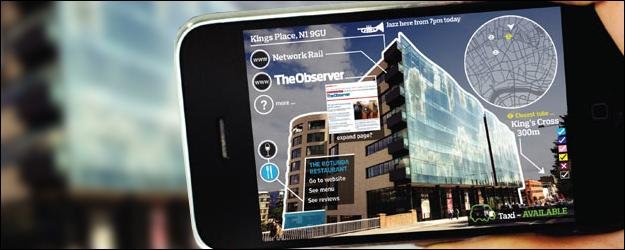
Augmented Reality: live direct or indirect view of a physical, real-world environment whose elements are supplemented by computer-generated sensory input such as sound, video, graphics or GPS data.
Continued
Virtual Reality: computer-simulated environment that can simulate physical presence in places in the real world or imagined world
Related Work
Fitzmaurice, Ishii and Buxton a grasp-based user interface has the following
advantages:
• it encourages two handed interactions
• it allows for more parallel input specification by the user
• it leverages off of our well developed skills for physical object manipulations
• it facilitates interactions by making interface elements
more 'direct' and more 'manipulable' by using physical
artifacts
• it affords multi-person, collaborative use.
Proposed System
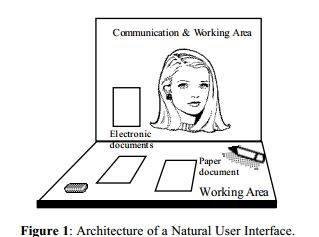
Natural User Interfaces (NUI)
- supports the fusion of real and virtual objects
- understands visual, acoustic and other human input forms
- also recognizes physical objects and human actions like speech and hand writing in a natural
way
Framework
continued
- working area is basically horizontal, the user can place real objects onto its surface
- spatial position of the user is monitored by one or more cameras
- Speech and sound are recorded by several microphones, enabling the system to maintain an internal 3D user model
Implementation
- Prototype system "Build-it"
- users grouped around a table, to interact in a space
of virtual and real world objects
Design Room
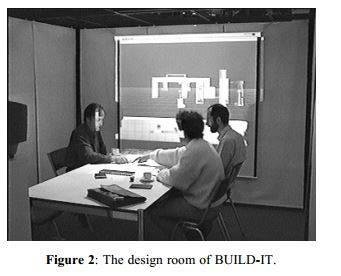
Components
The hardware comprises seven components:
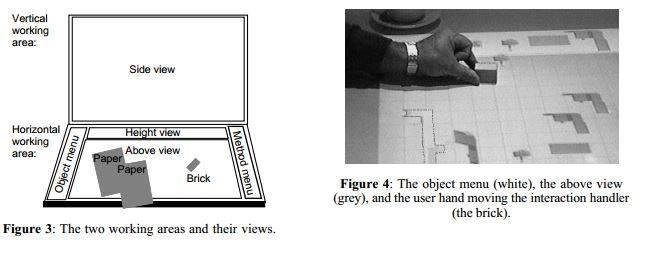
- A table with a white surface is used as horizontal working area.
- A white projection screen provides the vertical working area.
- An ASK 960 high resolution LCD projector projects the horizontal views vertically onto the table.
- An ASK 860 high resolution LCD projector projects the vertical view horizontally onto the projection screen.
- A CCD camera with a resolution of 752(H) by 582(V) pixels looks vertically down to the table.
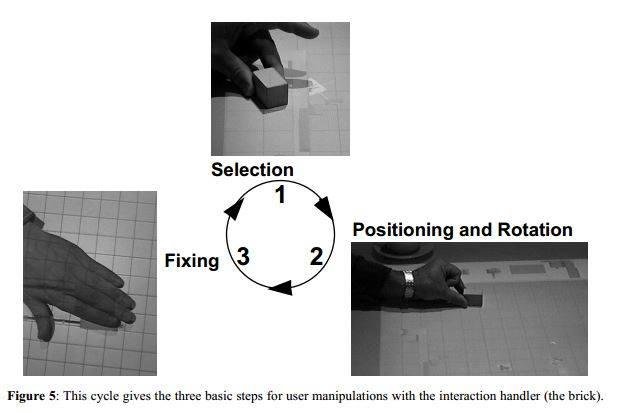
- A brick, size 3 cm x 2 cm x 2 cm, is the physical interaction device (the universal interaction handler).
- A low-cost Silicon Graphics Indy (IP22 R4600 133MHz processor and standard Audio-Video Board) provides the computing power for digitising the video signal coming from the camera, analyzing the user interactions on the table, and rendering the interaction result in the two views
Empirical Evaluation
- empirically tested with managers and engineers from companies producing assembly lines and plants
- Most persons were able to assemble virtual plants after only 30 seconds of introduction to the system
Reference
[1] Ackermann P: Developing Object-Oriented Multimedia Software Based on the MET++
Application Framework. Heidelberg: dpunkt Verlag für digitale Technologie, 1996.
[2] AESOP GmbH: SIMPLE++ for modelling, simulation and visualisation, 1997.
[3] Aicher O: analog und digital, ernst & sohn, 1991, pp 19-21, 28.
[4] Buckminster Fuller R: On Education, The University of Massachusetts Press, Amherst,
1979, p. 46.
[5] Campbell J: Training design for performance improvement. In J. Campbell & R. Campbell
(Eds.), Productivity in organisations (pp. 177-216). San Francisco: Jossey-Bass, 1988.
[6] CyberTouch, Virtual Technologies Inc., 2175 Park Boulevard, Palo Alto, CA 94306,
http://www.virtex.com/
deck
By Shibbir Hossain