Talking About Talking Maths in Public
(and some other stuff)
Simone Ramello (simoneramello.it) - MM Connect - 22.09.2023
Let’s talk about Science Communication!
a few remarks/warnings
- Many of the things we will talk about apply both to science communication going outwards -- i.e. "outreach", talking "to the public" or non-mathematicians --, and science communication going inwards -- i.e. talking to other mathematicians.
- Many things will seem obvious. But they aren't!
A definition
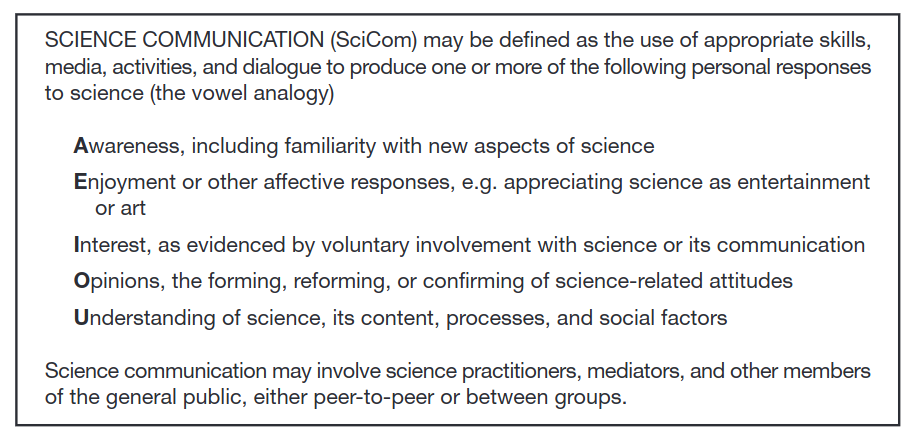
T. W. Burns, D. J. O'Connor and S. M. Stocklmayer, Science Communication: A Contemporary Definition
Science & its communication is an inherently political process:
- it is performed by political actors, with prestige and public recognition,
- it is performed for political actors (citizens, stakeholders...), which have political impact by voting,
- scientists influence policy, both on research and technologies.
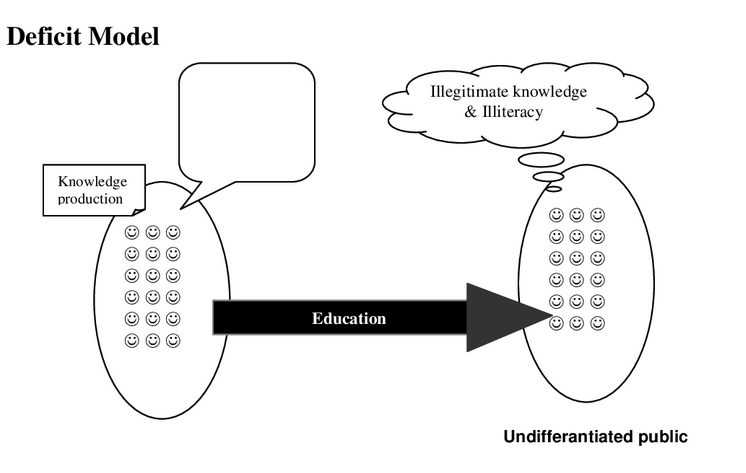
"[...] science communication as a matter of (successfully) transmitting information about science from scientific experts to the public. The most prominent views assume that the transmission is to be effectuated through education in a formal school setting or (re)education through mass media [...]"
― Klemens Kappel, Sebastian Jon Holmen, Why Science Communication, and Does It Work? A Taxonomy of Science Communication Aims and a Survey of the Empirical Evidence
The deficit/dissemination model
"I would like to add the idea that all science is local. [...] For a long time in Nigeria it was not acceptable to use traditional birth attendants. The modern healthcare system is what you should go for. But for many Indigenous people, that just doesn’t work – at least partly because public health services in many African countries find it difficult to reproduce the high levels of trust that communities have in the traditional systems that have served them for centuries. So, it’s not just about science, it’s about the values that go along with the way of life. It’s about the element of trust, which is not easily replicable. You can’t manufacture that."
― Inga Dreyer interviewing Ayodele Ibiyemi and Temilade Sesan for wissenschaftskommunikation.de, “It’s not just about science, it’s about the values”
What counts as illegitimate knowledge?
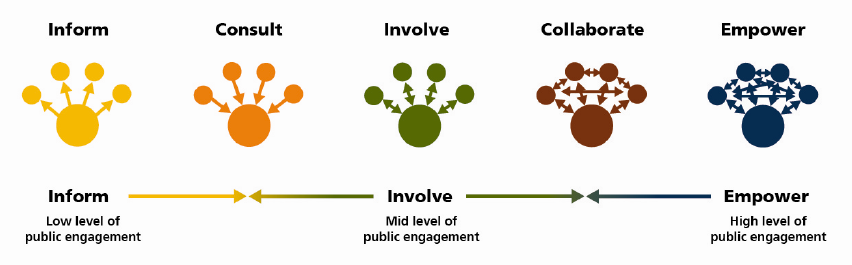
"The focus for most models of science communication in the public participation paradigm is on facilitating two-way communication, that is, dialogue and (sometimes) deliberation between the public, experts and policy-makers [...]"
― Klemens Kappel, Sebastian Jon Holmen, Why Science Communication, and Does It Work? A Taxonomy of Science Communication Aims and a Survey of the Empirical Evidence
The public participation model
There is no such thing as a "general public".
THE PROBLEM OF "THE PUBLIC"
- Communication requires a specific target, a specific audience it must be tailored for.
- When we say "general public", "general audience", etc. we are lumping together very different categories and audiences that have specific needs and goals when they listen to us.
- This goes for both outreach (e.g. demographics are important!) & scientific presentations (what are the backgrounds of the people in the audience?).
For example, "the experts in the field" is a meaningless category.
“Because stories are important.
People think that stories are shaped by people. In fact, it's the other way around. Stories exist independently of their players.”
― Terry Pratchett, Witches Abroad
The role of stories
“There's always a story. It's all stories, really. The sun coming up every day is a story. Everything's got a story in it.
Change the story, change the world.”
― Terry Pratchett, A Hat Full of Sky
“All right," said Susan. "I'm not stupid. You're saying humans need... fantasies to make life bearable."
REALLY? AS IF IT WAS SOME KIND OF PINK PILL? NO. HUMANS NEED FANTASY TO BE HUMAN. TO BE THE PLACE WHERE THE FALLING ANGEL MEETS THE RISING APE.
The role of stories, take 2
"Tooth fairies? Hogfathers? Little—"
YES. AS PRACTICE. YOU HAVE TO START OUT LEARNING TO BELIEVE THE LITTLE LIES.
"So we can believe the big ones?"
YES. JUSTICE. MERCY. DUTY. THAT SORT OF THING.
"They're not the same at all!"
YOU THINK SO? THEN TAKE THE UNIVERSE AND GRIND IT DOWN TO THE FINEST POWDER AND SIEVE IT THROUGH THE FINEST SIEVE AND THEN SHOW ME ONE ATOM OF JUSTICE, ONE MOLECULE OF MERCY. AND YET—Death waved a hand. AND YET YOU ACT AS IF THERE IS SOME IDEAL ORDER IN THE WORLD, AS IF THERE IS SOME...SOME RIGHTNESS IN THE UNIVERSE BY WHICH IT MAY BE JUDGED.
"Yes, but people have got to believe that, or what's the point—"
MY POINT EXACTLY.”
― Terry Pratchett, Hogfather
If you need to make a fool of yourself,
do it.
What about
mathematics?
A little experiment!
A little experiment!
Go to slido.com
Code: #1824115
The pay-off versus process gap
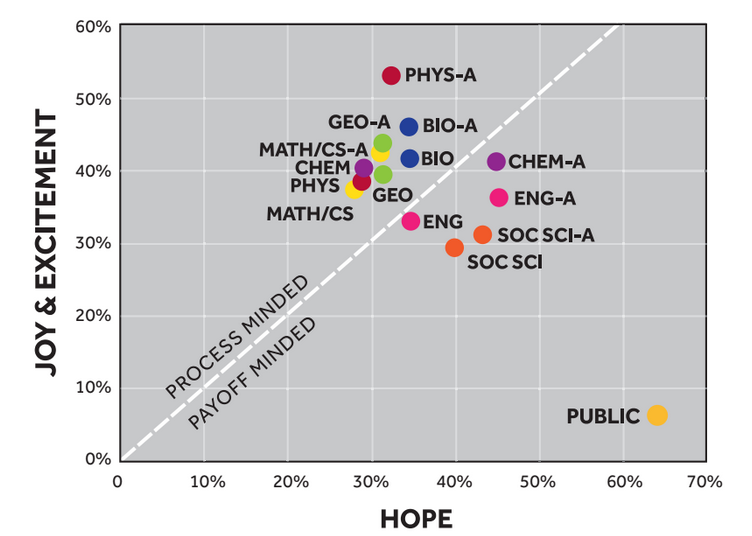
ScienceCounts & Alen Alda Center for Communicating Science,
Assessing Scientists’ Willingness to Engage in Science Communication
Bridging this gap
- People often approach mathematics with the baggage of traumatic experiences in their past, bad teachers, the fear of feeling stupid, etc. Both the non-mathematicians and the mathematicians!
- Parallel to reading: when suggesting a book to somebody who hasn’t read in a long time, you should not suggest some random classical book just because “it is an important one”.
- Guessing what the right book for someone is must start by removing all forms of judgement and prejudice.
- The same is true for maths.
- The participation/dialogue model is about meeting the audience where they are.
- This goes for both outreach & scientific presentations, talks, writing, etc.
- Communication needs a clear target, which should be explicitly identified.
Mathematics communication as a cultural activity
- We often - almost exclusively - think and plan outreach activities for kids and students. We (rightly!) assume that by changing their views and attitudes towards maths, we will change the future.
- But what about the adults? Those who exist right now, spend money, vote, etc.
- Some ideas:
- parallel activities for kids & their parents,
- evening lectures, theatre plays,
- forums, discussion rounds on hot topics...
Mathematics as a tool of democracy
“The math-powered applications powering the data economy were based on choices made by fallible human beings. [...] Like gods, these mathematical models were opaque, their workings invisible to all but the highest priests in their domain: mathematicians and computer scientists. Their verdicts, even when wrong or harmful, were beyond dispute or appeal. And they tended to punish the poor and the oppressed in our society, while making the rich richer.”
― Weapons of Math Destruction
Embracing vulnerability, beyond competition
-
When we sit in the audience of a scientific talk, we often expect that the talk will be completely inaccessible.
-
It is often assumed, and accepted, that the proper mode of communication is a display of strength and confidence, weaving together obscure mathematics and concise exposition to make sure that the audience knows that you are, indeed, very smart and brilliant (and possibly hireable).
-
Similarly when we talk to the "public".
There is prestige in being the holders of obscure knowledge. There is power in being able to get close to this horrid black hole that many people are afraid.
Embracing vulnerability, beyond competition
-
A lot of the time, none of this is done on purpose, or maliciously. It is a combination of the job market, our own insecurities and a culture that prizes those who can project confidence.
-
The effects of these narratives ripple throughout society. It would be unacceptable for a politician to be ignorant in language or even basic science. But it is fine to not understand any mathematics at all.
-
We have to stop treating mathematics like something that must hurt. We have to put our foot down and decide, consciously, that mathematics is not a contest of confidence, bravado, a way to display how smart we are to others.
Embracing vulnerability, beyond competition
Mathematics, and mathematics communication, cannot happen without a space where:
- people feel comfortable asking the “stupid” questions,
- explanations are tailored to the audience to make sense to them,
- accessibility and clarity is favoured over stunning displays of ability,
- nobody is judged for what they know, or they don’t.
Thank you!
Because we are not mathematical machines. We live, we breathe, we feel, we bleed. If your students are struggling, and you don’t acknowledge it, their education becomes disconnected and irrelevant. Why should anyone care about mathematics if it doesn’t connect deeply to some human desire: to play, seek truth, pursue beauty, fight for justice? You can be that connection.
Francis Su, Mathematics for Human Flourishing
Talking about Talking Maths in Public
By Simone Ramello