






Scalability & Delivery

COMP63301 Data Engineering Concepts


Stian Soiland-Reyes

Intended Learning Outcomes

  1. Understand scaling challenges of batch-based data processing
  2. Explain how cloud computing is used in data processing
  3. Describe fundamentals of streaming data processing
  4. Recognise how streaming may impact data reliability and concurrency
  5. Relate choice of processing architecture to transformation queries and serving

Scaling beyond

batch jobs

Data generation
🛒📲

Ingestion

🧺

👩🏻‍💻🛠️

Transformation

Serving

🍲🥘🍛

Analytics

👨🏻‍💻📈📊

Traditional data

processing use batch computing and relational databases

  1. Centralised approach lends itself to a monolithic architecture
  2. Reduced technology choice simplifies maintenance and debugging
  3. Databases are well understood, any SQL tooling can be plugged in
  4. Batch jobs with transactions are reliable
  5. Re-executable when requirements change

Database

Database

Database

Database

"Stakeholders"

👩🏻‍🦰👱🏻‍♀️👨🏻‍💼

👧🏽👦🏻👧🏾

Consumers and users

🧑🏾‍💼💰🤵🏼‍♂️

Data generation
🛒📲

Ingestion

🧺

👩🏻‍💻🛠️

Transformation

Serving

🍲🥘🍛

Analytics

👨🏻‍💻📈📊

Traditional data

processing use batch computing and relational databases

  1. Monoliths react slowly to change
    release cycles, separate test systems
  2. Danger of single point of failure
    redundant systems, monitoring
  3. Challenging to scale
    ⟶ bigger machines! (Vertical scaling)
  4. Processing can be slow
    .. just wait till next batch job!

Database

Database

Database

Database

"Stakeholders"

👩🏻‍🦰👱🏻‍♀️👨🏻‍💼

👧🏽👦🏻👧🏾

Consumers and users

🧑🏾‍💼💰🤵🏼‍♂️

Data generation
🛒📲

Ingestion

🧺

Serving

🍲🥘🍛

Analytics

👨🏻‍💻📈📊

Embarrassingly

parallel

Database

Database

Database

👩🏻‍🦰👱🏻‍♀️👨🏻‍💼

👧🏽👦🏻👧🏾

🧑🏾‍💼💰🤵🏼‍♂️

👩🏻‍💻🛠️

Transformation

Serving

🍲🥘🍛

More production lines

Can we scale up by processing each "file" separately and in parallel?

Database

Database

Database

Database

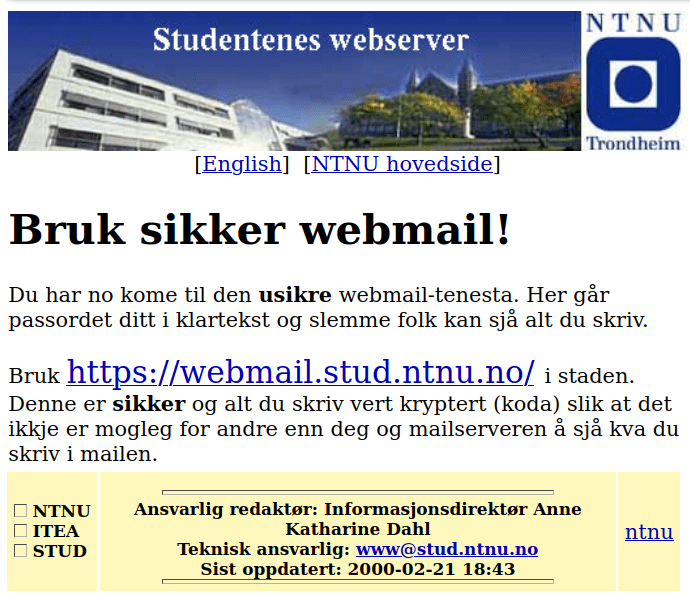
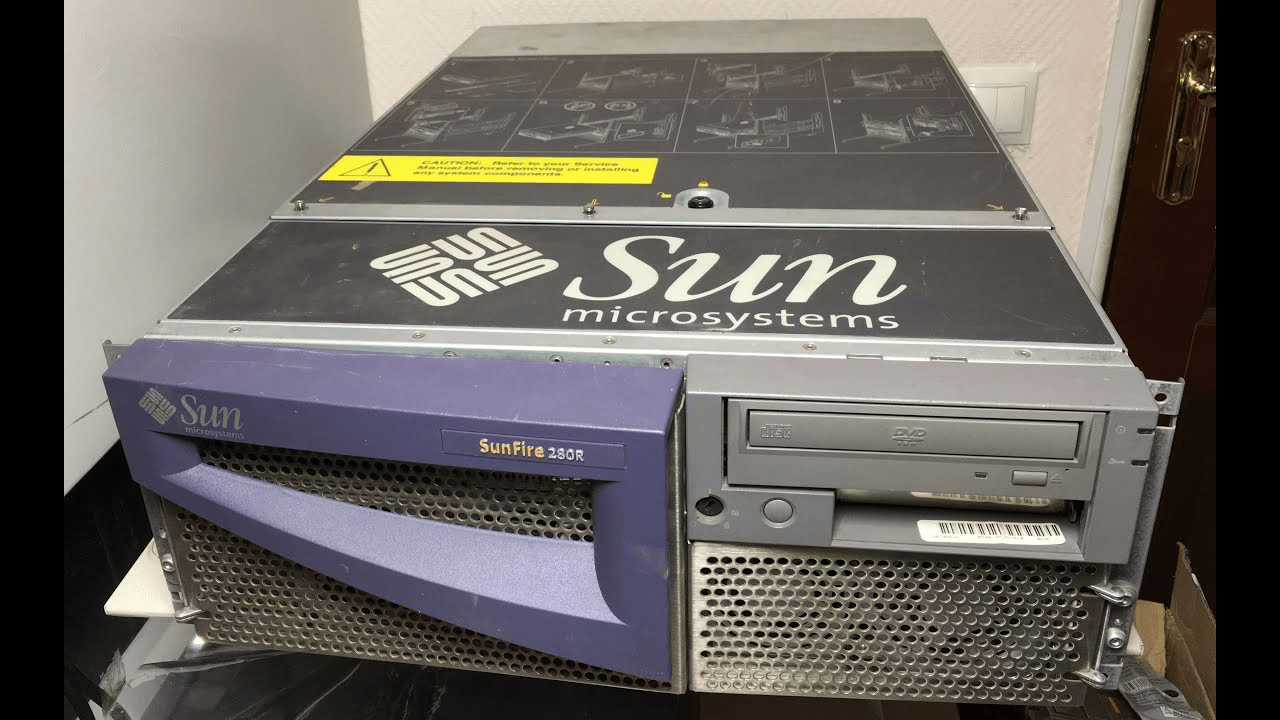
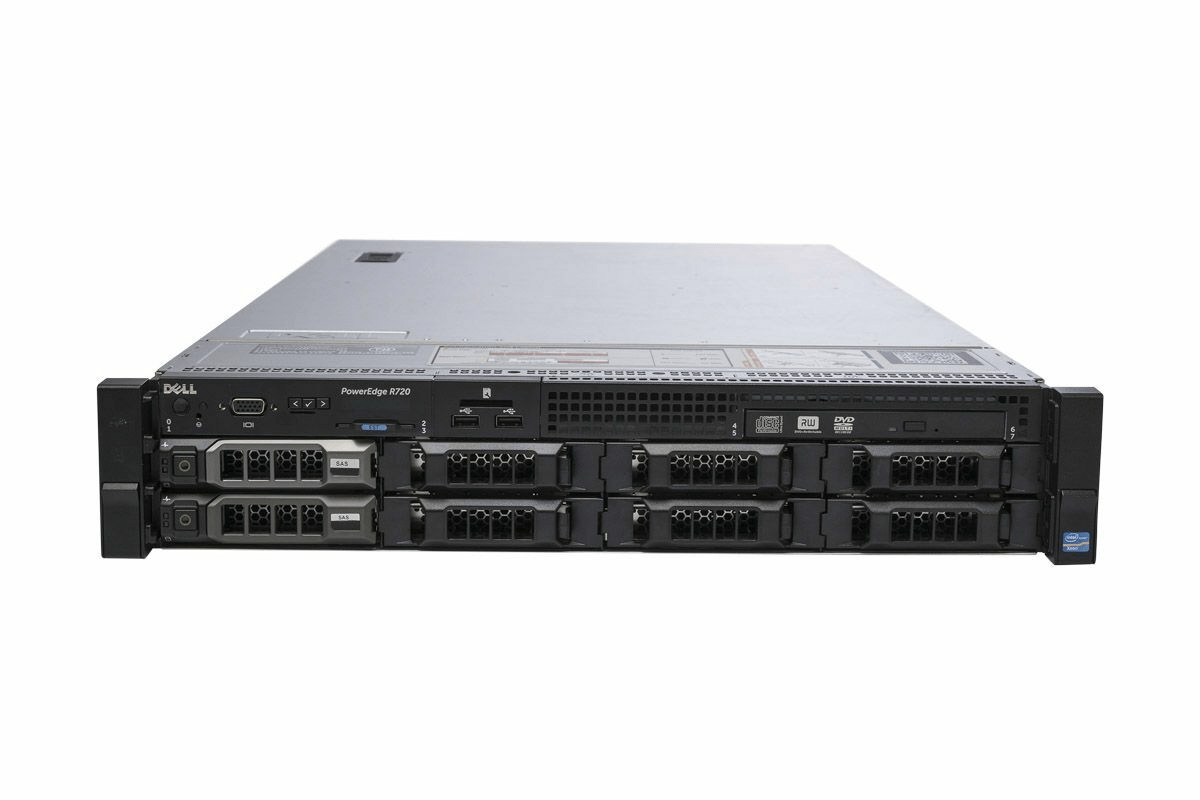
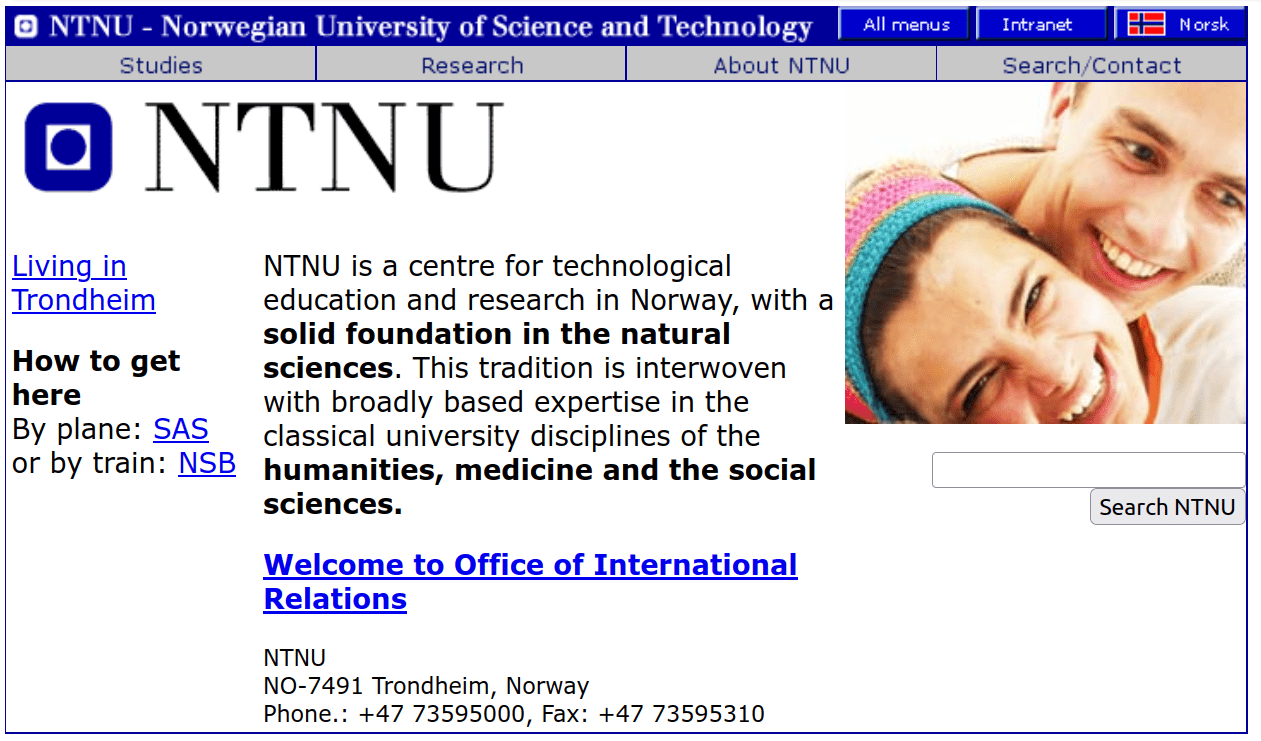
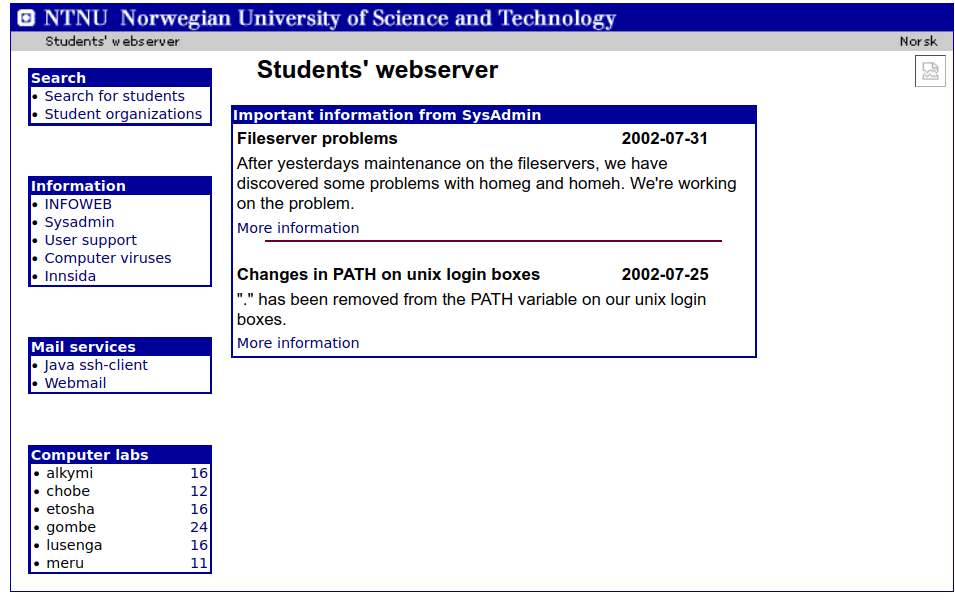
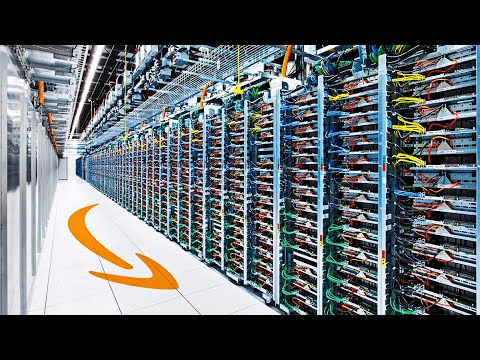
How did we ever manage before cloud? Case: Scaling Web servers in 2002

/home/a

/web

www.ntnu.no

webmail.ntnu.no

email

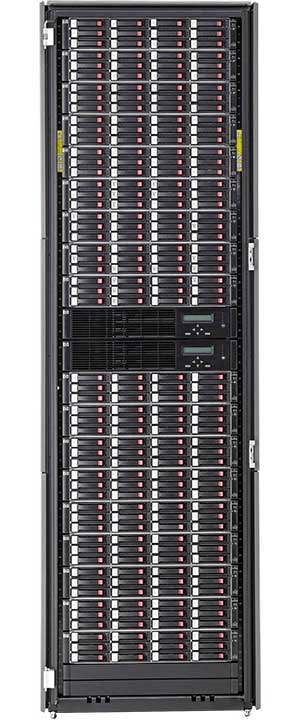
SAN
Storage Area Network

/home/b

Infrastructure as a Service

vm5241

16 GB

vm5719

16 GB

vm6532

32 GB

host8121

machine images

machine images

machine images

www.example.com

Public IP

15.197.159.59

IaAS APIs

dataset

results

dataset

dataset

dataset

dataset

dataset

Horizontal scaling
Splitting tasks for cloud computing, 2002 style!

ingest1.example.com

ingest2

transform1

transform2

transform3

transform4

aggregate1

aggregate2

aggregate3

serve1

db.example.com

  1. Use redundancy support where available
  2. Estimate how many tasks fit in a virtual machine
  3. Set up and manage cloud nodes
  4. Assign tasks to cloud nodes

Below is a clear, structured overview of the most typical cloud services across AWS, Azure, Google Cloud (GCP), and other major cloud providers. They are grouped into common cloud service categories, with the closest equivalents placed side-by-side for easy comparison.

🌩️ 1. Compute Services

Virtual Machines (IaaS) EC2 Virtual Machines Compute Engine Oracle OCI Compute, IBM Cloud Virtual Servers
Autoscaling Auto Scaling VM Scale Sets Instance Groups All major providers have autoscaling variants
Serverless Functions Lambda Azure Functions Cloud Functions Cloudflare Workers, IBM Cloud Functions
Container Orchestration (Managed Kubernetes) EKS AKS GKE IBM Cloud Kubernetes Service, Oracle OKE
Container Execution / Serverless Containers Fargate Container Apps Cloud Run Cloudflare Workers, DigitalOcean App Platform
Bare Metal EC2 Bare Metal Azure BareMetal Bare Metal Solution IBM Bare Metal Servers, OCI Bare Metal

📦 2. Storage Services

Object Storage S3 Blob Storage Cloud Storage DigitalOcean Spaces, Backblaze B2
Block Storage EBS Managed Disks Persistent Disks OCI Block Storage
File Storage (NFS/SMB) EFS, FSx Azure Files Filestore IBM File Storage
Archival Storage Glacier Archive Storage Coldline/Archive Backblaze B2, Wasabi

🗄️ 3. Database Services

Managed Relational DBs RDS (MySQL, PostgreSQL, etc.) Azure SQL, PostgreSQL/MySQL Flexible Server Cloud SQL Oracle Autonomous DB, IBM Db2
Cloud-Native Distributed SQL Aurora Azure Cosmos DB (multi-model) Spanner CockroachCloud
NoSQL Key-Value / Document DynamoDB Cosmos DB Firestore, Cloud Bigtable MongoDB Atlas
Data Warehousing Redshift Azure Synapse Analytics BigQuery Snowflake (cloud-agnostic)
In-Memory Caches ElastiCache Azure Cache for Redis Memorystore Redis Enterprise Cloud

🔌 4. Networking Services

Virtual Networks VPC Virtual Network VPC OCI Virtual Cloud Network
Load Balancers ALB, NLB, CLB Azure Load Balancer, App Gateway Cloud Load Balancing F5 Cloud, HAProxy Cloud
CDN CloudFront Azure CDN Cloud CDN Cloudflare, Akamai
DNS Route 53 Azure DNS Cloud DNS Cloudflare DNS
VPN / Direct Connect Site-to-Site VPN, Direct Connect VPN Gateway, ExpressRoute Cloud VPN, Interconnect Oracle FastConnect

🧠 5. AI & Machine Learning

ML Platforms SageMaker Azure Machine Learning Vertex AI IBM Watson Studio
Generative AI APIs Bedrock Azure OpenAI Gemini Anthropic, OpenAI APIs
Vision / Speech APIs Rekognition, Polly Cognitive Services Cloud Vision, Speech-to-Text Clarifai
Conversational AI Lex Bot Service Dialogflow Rasa (cloud-hosted)

🛠️ 6. Developer / Application Services

CI/CD CodePipeline, CodeBuild Azure DevOps, GitHub Actions (Microsoft) Cloud Build GitLab CI, CircleCI
API Gateways API Gateway API Management API Gateway Kong Cloud, Apigee
Event Bus / Messaging EventBridge, SNS, SQS Event Grid, Service Bus Pub/Sub RabbitMQ Cloud, Kafka Confluent Cloud

🔐 7. Security & Identity

Identity & Access IAM Azure AD / Entra ID Cloud IAM Okta
Secrets Management Secrets Manager Key Vault Secret Manager HashiCorp Vault
Key Management KMS Key Vault Cloud KMS Thales CipherTrust

📊 8. Monitoring, Logging & Observability

Metrics & Monitoring CloudWatch Azure Monitor Cloud Monitoring Datadog, New Relic
Logging CloudWatch Logs Azure Log Analytics Cloud Logging Splunk, ELK Stack
Trace & APM X-Ray Application Insights Cloud Trace Datadog APM

🏗️ 9. DevOps & Infrastructure Management

Infrastructure as Code CloudFormation ARM/Bicep Deployment Manager Terraform (all clouds)
Config Management Systems Manager Automation Config Connector Puppet, Ansible, Chef
Container Registry ECR ACR Artifact Registry Docker Hub, GitHub Container Registry

💼 10. Enterprise & Business Applications

Directory Services Directory Service Active Directory Domain Services Managed AD IBM Cloud Directory
ERP / SaaS Platforms Dynamics 365 Salesforce, SAP Cloud

Can you list and categorise the most typical cloud services used from AWS, Azure, GCP, and other cloud computing providers?

dataset

results

dataset

dataset

dataset

dataset

dataset

scalability

Handle parallelization:

  • execute for tens to thousands of datasets
  • efficiently use any computing platform

automation

Workflow systems can scale batch executions

vm5241

16 GB

vm6532

32 GB

Scheduling containerized jobs to virtualized worker nodes via cloud batch APIs

Queued jobs

Dependent jobs

Container images

https://www.ibm.com/history/time-sharing

IBM VM/CMS 1972

Scheduling batch jobs to virtual machines via mainframe APIs

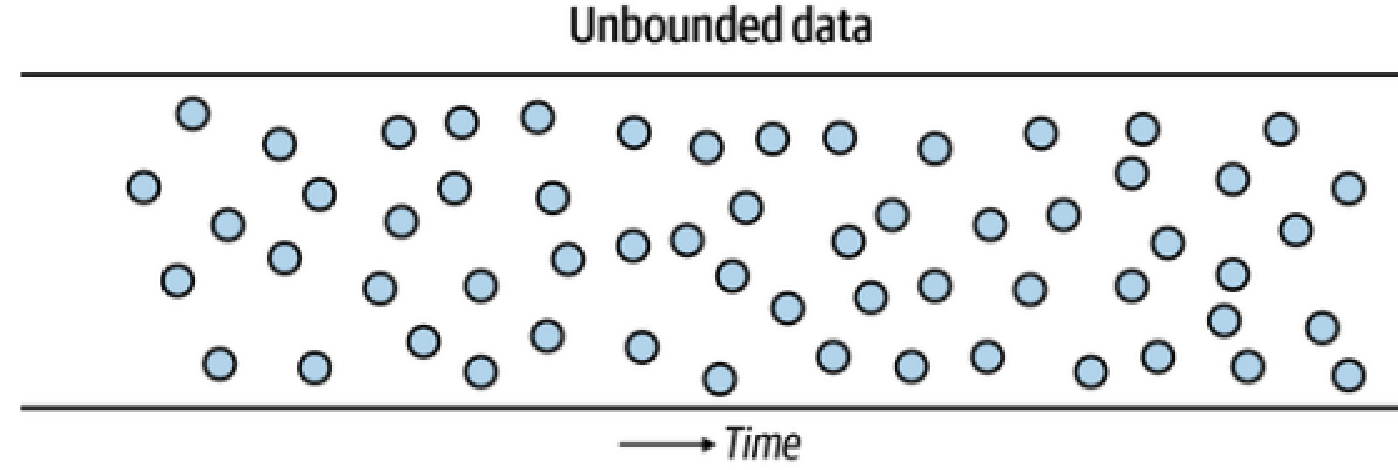
Bounded and unbounded data

Adopted from Figure 7.3, Fundamentals of Data Engineering

Data sources are mostly unbounded, new items arrive semi-continuously to be ingested into a computer system

What kind of data items?
Sale transaction, temperature measurement, login attempt, ad view, parcel tracking, ...

Irregularity: Data will arrive depending on external factors, e.g. when customers chose to visit the store

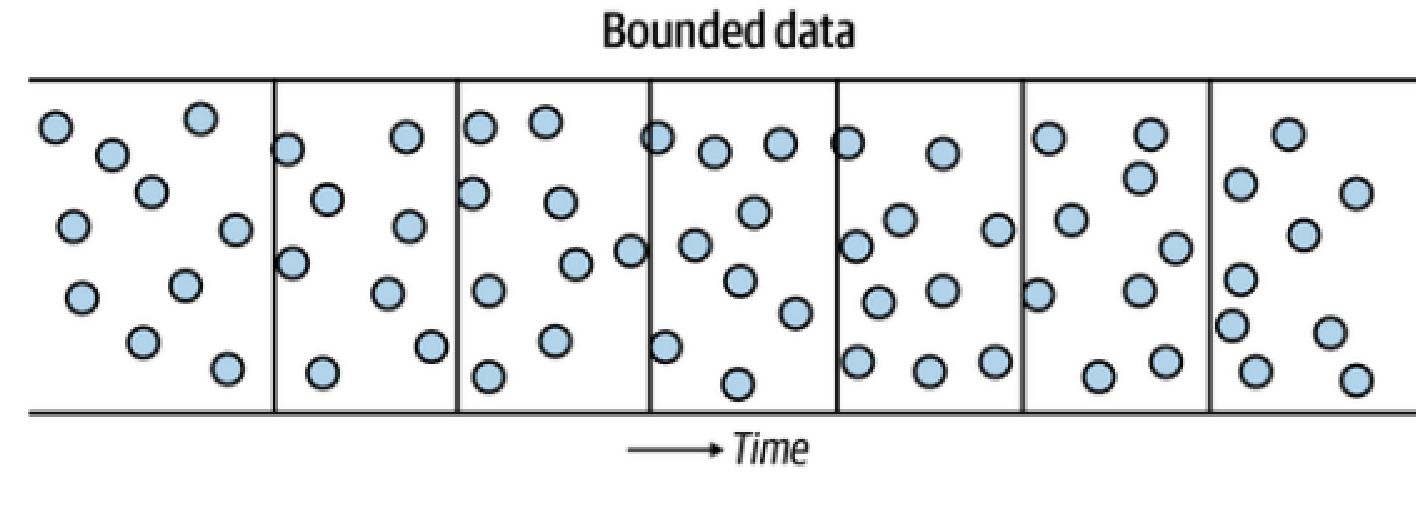
Adopted from Figure 7.3, Fundamentals of Data Engineering

Forming Bounded data allows processing in manageable chunks (batch processing)


by frequency: Weekly, daily, hourly, every 5 minutes

by volume: 100, 1000, 10k, 100k items
by size: kilobytes, megabytes, gigabytes

Streaming

Smaller batches, fresh produce

Streaming data reduces latency


Processing in micro-batches (e.g. 10 items) or real-time (e.g. 1 item) means data is integrated immediately for impacting business action


Cloud computing is needed to scale for varying data volumes (e.g. more processing nodes during "rush hour")


Message queues

Adopted from Figure 5.9, Fundamentals of Data Engineering

Asynchronous sending of messages

Publish–Subscribe model

Messages are buffered in queue, until processed by subscriber

Queue system can be distributed to have handle many concurrent producers and subscribers

Events &

topics

Adopted from Figure 5.10, Fundamentals of Data Engineering

Topic-based queues with multiple subscribers

Can dispatch to many sides e.g. analytics, operations

{
 "Type": "Web Order",
 "Key": "Order #12345",
 "Value": "SKU 123, purchase price of $100",
 "Timestamp": "2023-01-02 06:01:00"
}

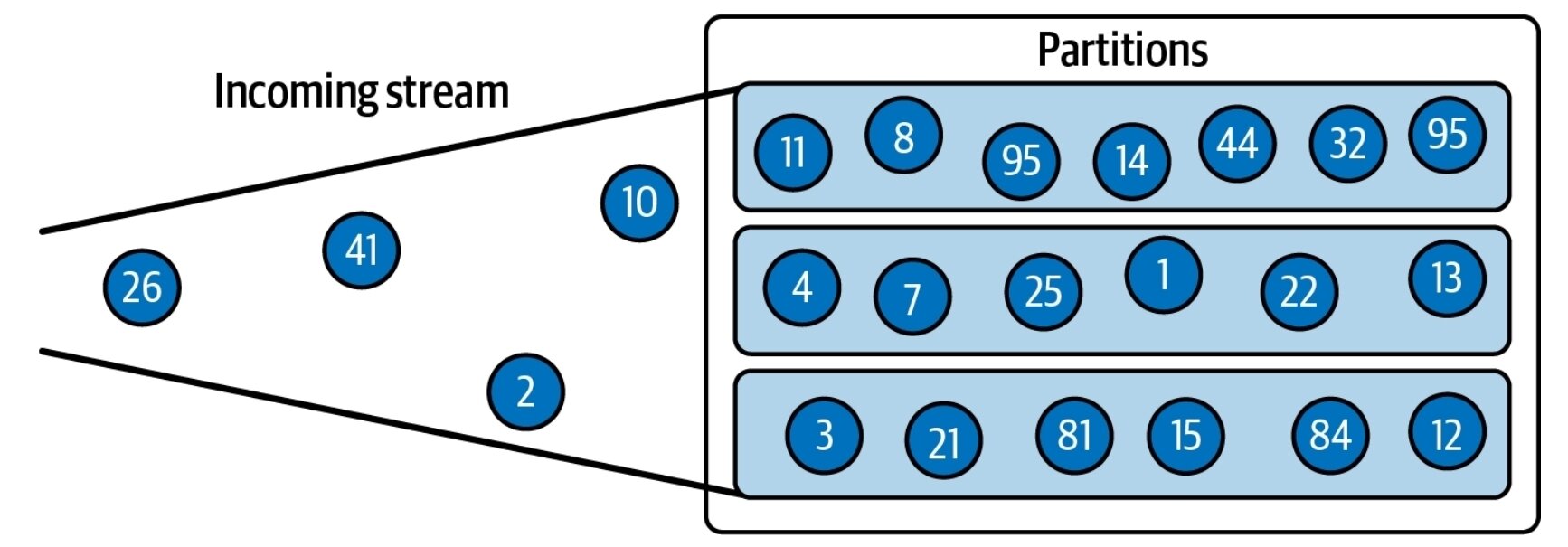
Stream partitions

Adopted from Figure 5.11, Fundamentals of Data Engineering

Streams can be partitioned by the partition key of each event

e.g. using hashing or modulo: 11 mod 3 = 2

Simple way to divide the work across compute nodes

Map-reduce

Many data items (e.g. streaming)

Splitting into partitions

λ(

)=

λ(

)=

λ(

)=

λ(

)=

def λ(order):
	return (order.amount * 
            order.item.price)

Mapping

Shuffling

Reducing

Σ(

)=

Σ(

)=

def Σ(a,b):
	return a+b

Σ(

)=

Σ(

)=

Result

The map-reduce computational model splits work across distributed (cloud) nodes, each running the same algorithm for mapping across the data items, shuffled to reducing nodes that then combine (e.g. sum) to the final result.

Reliability challenges

Batch reliability

Scheduled batches may be delayed/missed by concurrent system load or connectivity issues (Don't run everything at 00:00!)

A batch may take too long to process, and block/conflict other batch jobs.

Errors may cause the rest of the batch to fail, but use of transactions can keep the databases in clean state

Batches are clearly defined and logged, and can be rerun if anything fails.

Streaming reliability

Streaming can dynamically scale (e.g. add more nodes) for increased compute loads.

Events are processed in near real-time, but may arrive out of order.

Queues are ephemeral, events may be lost if errors occur (e.g. cloud node unavailable)

Errors isolated to individual events or microbatches, but not as easily rolled back.

Harder to rerun (but Kappa architecture use a longer retention period to allow replay)

Streaming architecture choices

Impact from architecture choice

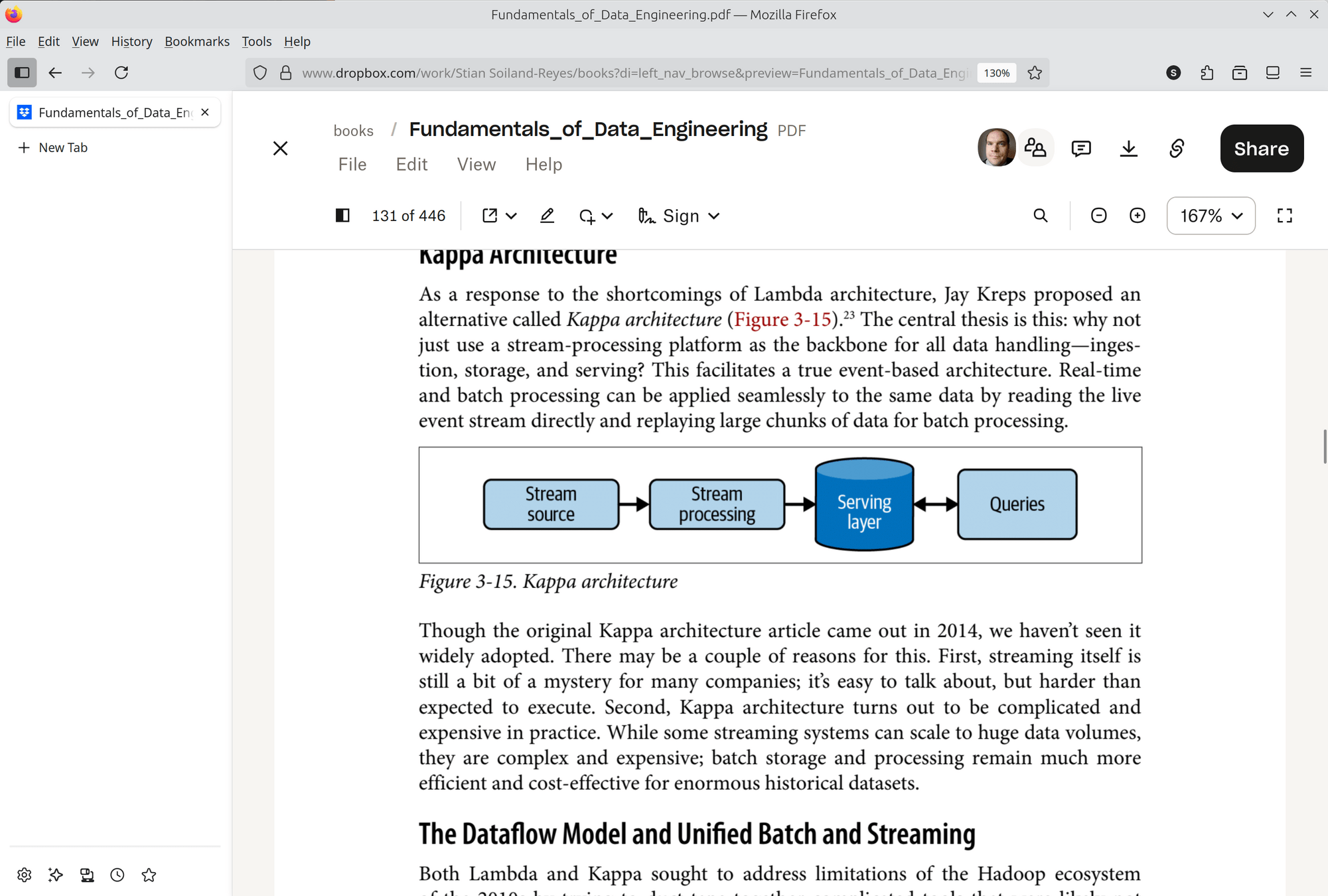
  • Kappa architecture serves all data as if it was streamed, any relational databases are treated like a streaming source, some of their relational nature is lost.

Figure 3.4, 3.5 from Fundamentals of Data Engineering

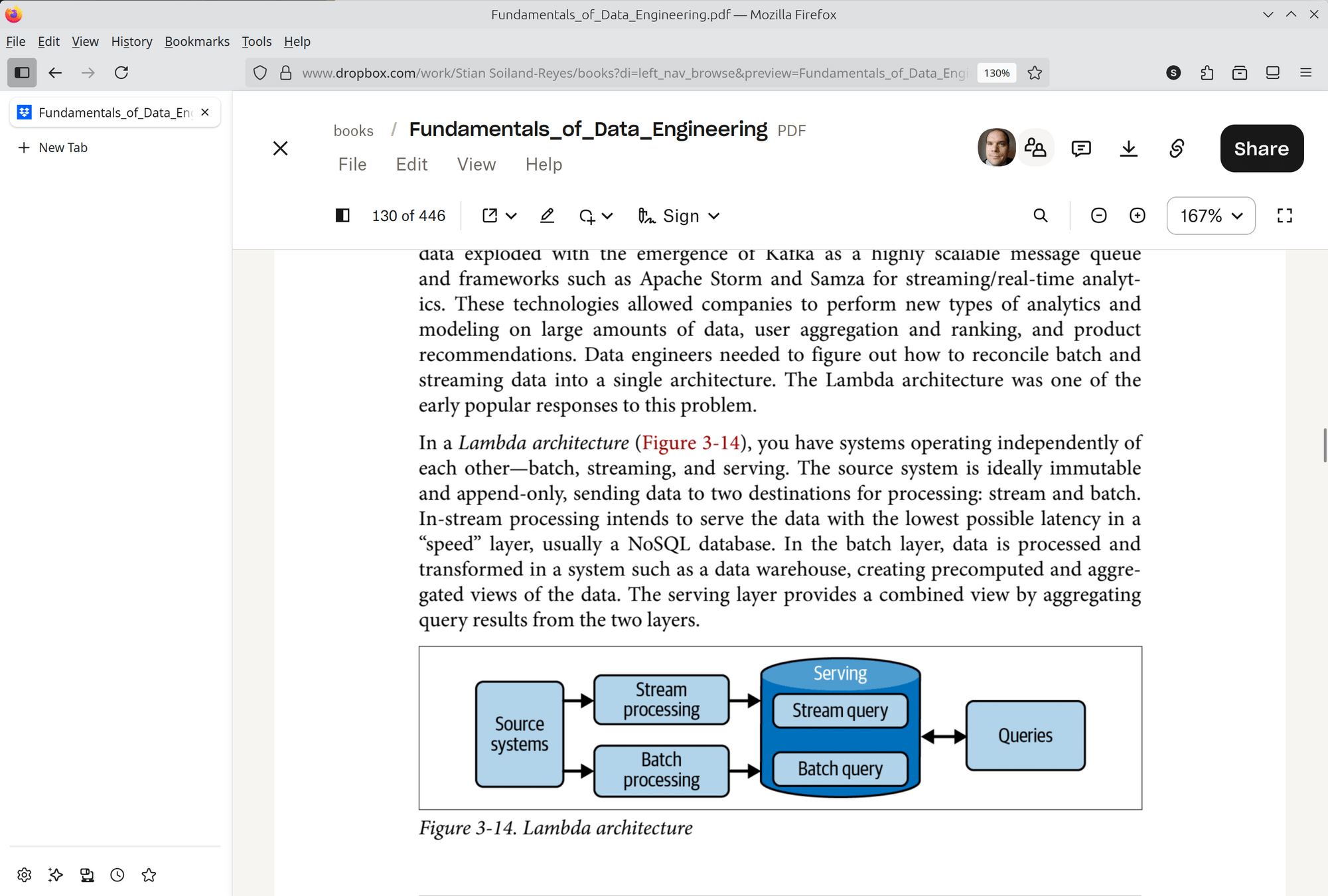
  • Lambda architecture combines stream and batch processing, but with some code duplication (may lead to inconsistencies). Serving layer has two ways to query.

Architecture affects serving

Batch processing can stay close to relational database thinking
Online analytical processing (OLAP)

Stream processing may at first seem to complicate serving for end users
Need to write Spark code rather than SQL queries

But.. streams can be queried with SQL. Streams can populate OLAPs. Streams can co-exist with batch.

COMP63301 Scalability & Delivery

By Stian Soiland-Reyes

COMP63301 Scalability & Delivery

Lecture in COMP63301 Data Engineering Concepts at The University of Manchester.

  • 18