Optimising Sumcheck
December 10, 2025
Sumcheck: The new bottleneck
- Binius enables efficient SNARKs over binary fields
- Fast commitment scheme + sumcheck based IOPs
- Commitment part is so fast that sumcheck becomes the bottleneck
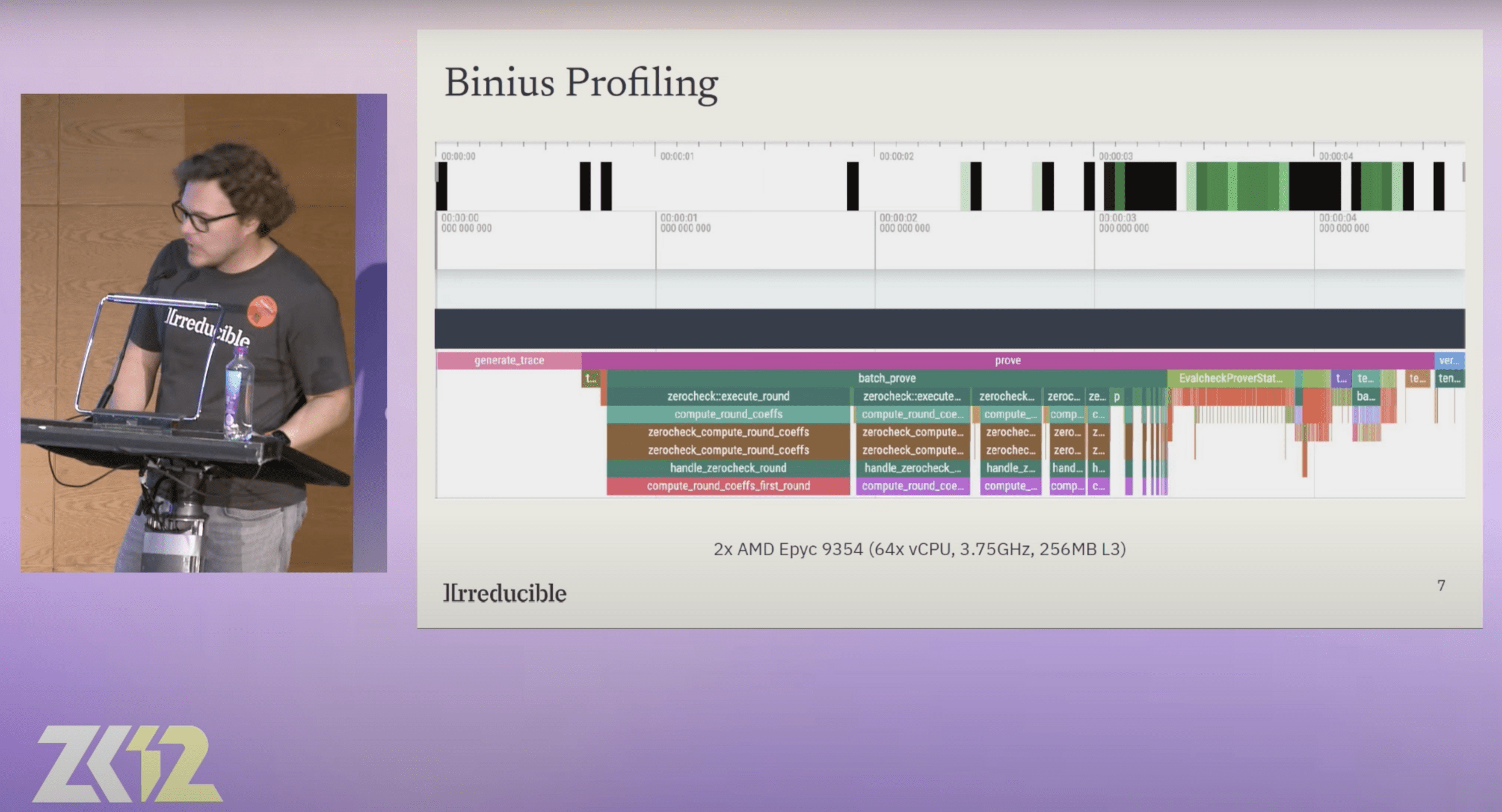
Credit: Radi Cojbasic's talk at zk summit 12.
Sumcheck: The new bottleneck
- Binius enables efficient SNARKs over binary fields
- Fast commitment scheme + sumcheck based IOPs
- Commitment part is so fast that sumcheck becomes the bottleneck
- Aim: speed-up first few rounds of sumcheck
Product Sumcheck
p(x) := p_1(x) \cdot p_2(x) \cdots p_d(x)
- We need sumcheck to prove (multilinear) polynomial relations like
- Sumcheck round polynomial in round \(i\)
s_i(c) := \sum_{x \in \{0, 1\}^{\ell - i}} p(\textcolor{FireBrick}{r_1}, \textcolor{FireBrick}{r_2}, \dots, \textcolor{FireBrick}{r_{i - 1}}, c, x)
= \sum_{x \in \{0, 1\}^{\ell - i}} \prod_{j=1}^{d} p_j
(\textcolor{FireBrick}{r_1}, \textcolor{FireBrick}{r_2}, \dots, \textcolor{FireBrick}{r_{i - 1}}, c, x)
Product of extension-field elements
- In Binius, polynomials \(p_1(x), \dots, p_d(x)\) are defined over \(\textsf{GF}(2)\)
- Round challenges \((\textcolor{FireBrick}{r_1}, \textcolor{FireBrick}{r_2}, \dots, \textcolor{FireBrick}{r_{i - 1}})\) are from \(\textsf{GF}(2^{128})\)
Product Sumcheck
- Sumcheck round polynomial in round \(i\)
s_i(c) := \sum_{x \in \{0, 1\}^{\ell - i}} p(\textcolor{FireBrick}{r_1}, \textcolor{FireBrick}{r_2}, \dots, \textcolor{FireBrick}{r_{i - 1}}, c, x)
= \sum_{x \in \{0, 1\}^{\ell - i}} \prod_{j=1}^{d} p_j
(\textcolor{FireBrick}{r_1}, \textcolor{FireBrick}{r_2}, \dots, \textcolor{FireBrick}{r_{i - 1}}, c, x)
Product of extension-field elements
- In Binius, polynomials \(p_1(x), \dots, p_d(x)\) are defined over \(\textsf{GF}(2)\)
- Round challenges \((\textcolor{FireBrick}{r_1}, \textcolor{FireBrick}{r_2}, \dots, \textcolor{FireBrick}{r_{i - 1}})\) are from \(\textsf{GF}(2^{128})\)
\newcommand{\arraystretch}{1.3}
\begin{array}{|c|c|c|c|}
\hline
\textsf{Base field} & \textsf{Extension field} & \textsf{Degree of extension} & \text{\textbf{$t_{\text{ee}} / t_{\text{bb}}$}} \\[1ex]
\hline
\textsf{GF}[2] & \textsf{GF}[2^{128}] & 128 & 145 \times 10^2 \\[1ex]
\hline
\textsf{GF}[2^2] & \textsf{GF}[2^{128}] & 64 & 2.5 \times 10^2 \\[1ex]
\hline
\textsf{GF}[2^4] & \textsf{GF}[2^{128}] & 32 & 0.5 \times 10^2 \\[1ex]
\hline
\end{array}
Product Sumcheck
- Sumcheck round polynomial in round \(i\)
s_i(c) := \sum_{x \in \{0, 1\}^{\ell - i}} p(\textcolor{FireBrick}{r_1}, \textcolor{FireBrick}{r_2}, \dots, \textcolor{FireBrick}{r_{i - 1}}, c, x)
= \sum_{x \in \{0, 1\}^{\ell - i}} \prod_{j=1}^{d} p_j
(\textcolor{FireBrick}{r_1}, \textcolor{FireBrick}{r_2}, \dots, \textcolor{FireBrick}{r_{i - 1}}, c, x)
\begin{equation*}
p_j(\textcolor{FireBrick}{r_1}, \dots, \textcolor{FireBrick}{r_{i-1}}, c, \mathbf{x}) = \
\overbrace{
\begin{aligned}
& \color{FireBrick}{(1-r_1) \cdots (1-r_{i-2})(1-r_{i-1})} \cdot \\
& \color{FireBrick}{(1-r_1) \cdots (1-r_{i-2}) \cdot r_{i-1}} \cdot \\
& \color{FireBrick}{(1-r_1) \cdots r_{i-2} \cdot (1-r_{i-1})} \cdot \\
& \color{FireBrick}{(1-r_1) \cdots r_{i-2} \cdot r_{i-1}} \cdot \\
& \vdots \\
& \color{FireBrick}{r_1 \cdots r_{i-2} \cdot r_{i-1}} \cdot
\end{aligned}
}^{\textsf{challenge-terms}}
\quad
\overbrace{
\begin{aligned}
& p_j(0, \dots, 0, c, \mathbf{x}) \\
& p_j(0, \dots, 0, 1, c, \mathbf{x}) \\
& p_j(0, \dots, 1, 0, c, \mathbf{x}) \\
& p_j(0, \dots, 1, 1, c, \mathbf{x}) \\
& \vdots \\
& p_j(1, \dots, 1, c, \mathbf{x}).
\end{aligned}
}^{\textsf{witness-terms}}
\quad
\begin{aligned}
+ \\
+ \\
+ \\
+ \\
& \\[8pt]
\\
\end{aligned}
\end{equation*}
Products in Round \(1\)
\begin{equation*}
p_j(\textcolor{grey}{x}) :=
(1-\textcolor{grey}{x}) \cdot \textcolor{skyblue}{\alpha_j} +
\textcolor{grey}{x} \cdot \textcolor{lightgreen}{\beta_j}.
\end{equation*}
- In the first round, \(p_1, p_2, \dots, p_d\) are linear polynomials:
- Trick 1: separate out witness and challenge terms
\begin{equation*}
p(\textcolor{grey}{x})
=
\prod_{j=1}^{d}p_j(\textcolor{grey}{x}) :=
\prod_{j=1}^{d}
\left(
(1-\textcolor{grey}{x}) \cdot \textcolor{skyblue}{\alpha_j} +
\textcolor{FireBrickk}{x} \cdot \textcolor{lightgreen}{\beta_j}
\right)
\end{equation*}
\begin{alignedat}{5}
&\;\textcolor{grey}{(1-x)^d} \cdot \textcolor{grey}{x^0}
&\quad&
(\textcolor{SkyBlue}{\alpha_1}\cdot\textcolor{SkyBlue}{\alpha_2}\cdots
\textcolor{SkyBlue}{\alpha_{d-1}}\cdot\textcolor{SkyBlue}{\alpha_d})
&\quad& +
&\quad&
\\
&\;
\textcolor{grey}{(1-x)^{d-1}} \cdot \textcolor{grey}{x^1}
&&
(\textcolor{SkyBlue}{\alpha_1}\cdot\textcolor{SkyBlue}{\alpha_2}\cdots
\textcolor{SkyBlue}{\alpha_{d-1}}\cdot\textcolor{LightGreen}{\beta_d})
&& +
&
\\
&\;
\textcolor{grey}{(1-x)^{d-2}} \cdot \textcolor{grey}{x^1}
&&
(\textcolor{SkyBlue}{\alpha_1}\cdot\textcolor{SkyBlue}{\alpha_2}\cdots
\textcolor{LightGreen}{\beta_{d-1}}\cdot\textcolor{SkyBlue}{\alpha_d})
&& +
&
\\
&\;
\textcolor{grey}{(1-x)^{d-3}} \cdot \textcolor{grey}{x^2}
&&
(\textcolor{SkyBlue}{\alpha_1}\cdot\textcolor{SkyBlue}{\alpha_2}\cdots
\textcolor{LightGreen}{\beta_{d-1}}\cdot\textcolor{LightGreen}{\beta_d})
&& +
&
\\
&\;\vdots
&& \vdots
&& +
&
\\
&\;
\textcolor{grey}{(1-x)^{1}} \cdot \textcolor{grey}{x^{d-1}}
&&
(\textcolor{LightGreen}{\beta_1}\cdot\textcolor{LightGreen}{\beta_2}\cdots
\textcolor{LightGreen}{\beta_{d-1}}\cdot\textcolor{SkyBlue}{\alpha_d})
&& +
&
\\
&\;
\textcolor{grey}{(1-x)^{0}} \cdot \textcolor{grey}{x^d}
&&
(\textcolor{LightGreen}{\beta_1}\cdot\textcolor{LightGreen}{\beta_2}\cdots
\textcolor{LightGreen}{\beta_{d-1}}\cdot\textcolor{LightGreen}{\beta_d})
&&
&
\end{alignedat}
=
Variable-products
Coefficient-products
bb mults
(d-1)\cdot 2^d
Products in Round \(1\)
\begin{equation*}
p(\textcolor{grey}{x})
=
\prod_{j=1}^{d}p_j(\textcolor{grey}{x}) :=
\prod_{j=1}^{d}
\left(
(1-\textcolor{grey}{x}) \cdot \textcolor{skyblue}{\alpha_j} +
\textcolor{FireBrickk}{x} \cdot \textcolor{lightgreen}{\beta_j}
\right)
\end{equation*}
- We can do better: evaluate \(p\) in evaluation form!
- Evaluate each \(p_j\) on \((d + 1)\) points \(\{e_0, e_1, \dots, e_d\}\)
- Compute point-wise multiplication on all \(d\) points to get \([p(e_0), \dots, p(e_d)]\)
Products in Round \(1\)
\begin{equation*}
p(\textcolor{grey}{x})
=
\prod_{j=1}^{d}p_j(\textcolor{grey}{x}) :=
\prod_{j=1}^{d}
\left(
(1-\textcolor{grey}{x}) \cdot \textcolor{skyblue}{\alpha_j} +
\textcolor{FireBrickk}{x} \cdot \textcolor{lightgreen}{\beta_j}
\right)
\end{equation*}
- We can do better: compute \(p\) in evaluation form!
- Evaluate each \(p_j\) on \((d + 1)\) points \(\{e_0, e_1, \dots, e_d\}\)
- Compute point-wise multiplication on all \(d\) points to get \([p(e_0), \dots, p(e_d)]\)
\begin{equation*}
\left[
\begin{array}{c}
p(\textcolor{gray}{e_0}) \\[4pt]
p(\textcolor{gray}{e_1}) \\[4pt]
\vdots \\[4pt]
p(\textcolor{gray}{e_d})
\end{array}
\right]
=
\underbrace{
\left[
\begin{array}{ccccc}
1 & \textcolor{gray}{e_0} & \textcolor{gray}{e_0}^{\textcolor{gray}{2}} & \cdots & \textcolor{gray}{e_0}^{\textcolor{gray}{d}} \\[4pt]
1 & \textcolor{gray}{e_1} & \textcolor{gray}{e_1}^{\textcolor{gray}{2}} & \cdots & \textcolor{gray}{e_1}^{\textcolor{gray}{d}} \\[4pt]
\vdots & \vdots & \vdots & \ddots & \vdots \\[4pt]
1 & \textcolor{gray}{e_d} & \textcolor{gray}{e_d}^{\textcolor{gray}{2}} & \cdots & \textcolor{gray}{e_d}^{\textcolor{gray}{d}}
\end{array}
\right]
}_{\text{evaluation matrix } V}
\left[
\begin{array}{c}
c_0 \\[4pt]
c_1 \\[4pt]
\vdots \\[4pt]
c_d
\end{array}
\right]
\end{equation*}
\implies
\begin{equation*}
\left[
\begin{array}{c}
c_0 \\[4pt]
c_1 \\[4pt]
\vdots \\[4pt]
c_d
\end{array}
\right]
=
\underbrace{
\left[
\begin{array}{ccccc}
1 & \textcolor{gray}{e_0} & \textcolor{gray}{e_0}^{\textcolor{gray}{2}} & \cdots & \textcolor{gray}{e_0}^{\textcolor{gray}{d}} \\[4pt]
1 & \textcolor{gray}{e_1} & \textcolor{gray}{e_1}^{\textcolor{gray}{2}} & \cdots & \textcolor{gray}{e_1}^{\textcolor{gray}{d}} \\[4pt]
\vdots & \vdots & \vdots & \ddots & \vdots \\[4pt]
1 & \textcolor{gray}{e_d} & \textcolor{gray}{e_d}^{\textcolor{gray}{2}} & \cdots & \textcolor{gray}{e_d}^{\textcolor{gray}{d}}
\end{array}
\right]^{-1}
}_{\text{interpolation matrix } I := V^{-1}}
\left[
\begin{array}{c}
p(\textcolor{gray}{e_0}) \\[4pt]
p(\textcolor{gray}{e_1}) \\[4pt]
\vdots \\[4pt]
p(\textcolor{gray}{e_d})
\end{array}
\right]
\end{equation*}
Products in Round \(1\)
\begin{equation*}
p(\textcolor{grey}{x})
=
\prod_{j=1}^{d}p_j(\textcolor{grey}{x}) :=
\prod_{j=1}^{d}
\left(
(1-\textcolor{grey}{x}) \cdot \textcolor{skyblue}{\alpha_j} +
\textcolor{FireBrickk}{x} \cdot \textcolor{lightgreen}{\beta_j}
\right)
\end{equation*}
- We can do better: compute \(p\) in evaluation form!
- Evaluate each \(p_j\) on \((d + 1)\) points \(\{e_0, e_1, \dots, e_d\}\)
- Compute point-wise multiplication on all \(d\) points to get \([p(e_0), \dots, p(e_d)]\)
\implies
\begin{equation*}
\left[
\begin{array}{c}
c_0 \\[4pt]
c_1 \\[4pt]
\vdots \\[4pt]
c_d
\end{array}
\right]
=
\underbrace{
\left[
\begin{array}{ccccc}
1 & \textcolor{gray}{e_0} & \textcolor{gray}{e_0}^{\textcolor{gray}{2}} & \cdots & \textcolor{gray}{e_0}^{\textcolor{gray}{d}} \\[4pt]
1 & \textcolor{gray}{e_1} & \textcolor{gray}{e_1}^{\textcolor{gray}{2}} & \cdots & \textcolor{gray}{e_1}^{\textcolor{gray}{d}} \\[4pt]
\vdots & \vdots & \vdots & \ddots & \vdots \\[4pt]
1 & \textcolor{gray}{e_d} & \textcolor{gray}{e_d}^{\textcolor{gray}{2}} & \cdots & \textcolor{gray}{e_d}^{\textcolor{gray}{d}}
\end{array}
\right]^{-1}
}_{\text{interpolation matrix } I := V^{-1}}
\left[
\begin{array}{c}
p(\textcolor{gray}{e_0}) \\[4pt]
p(\textcolor{gray}{e_1}) \\[4pt]
\vdots \\[4pt]
p(\textcolor{gray}{e_d})
\end{array}
\right]
\end{equation*}
bb mults
(d-1) (d+1)
Products of Linear Polynomials
\begin{equation*}
p(\textcolor{grey}{x}) \ = \
\end{equation*}
\begin{alignedat}{5}
&\;\textcolor{grey}{(1-x)^d} \cdot \textcolor{grey}{x^0}
&\quad&
(\textcolor{SkyBlue}{\alpha_1}\cdot\textcolor{SkyBlue}{\alpha_2}\cdots
\textcolor{SkyBlue}{\alpha_{d-1}}\cdot\textcolor{SkyBlue}{\alpha_d})
&\quad& +
&\quad&
\\
&\;
\textcolor{grey}{(1-x)^{d-1}} \cdot \textcolor{grey}{x^1}
&&
(\textcolor{SkyBlue}{\alpha_1}\cdot\textcolor{SkyBlue}{\alpha_2}\cdots
\textcolor{SkyBlue}{\alpha_{d-1}}\cdot\textcolor{LightGreen}{\beta_d})
&& +
&
\\
&\;
\textcolor{grey}{(1-x)^{d-2}} \cdot \textcolor{grey}{x^1}
&&
(\textcolor{SkyBlue}{\alpha_1}\cdot\textcolor{SkyBlue}{\alpha_2}\cdots
\textcolor{LightGreen}{\beta_{d-1}}\cdot\textcolor{SkyBlue}{\alpha_d})
&& +
&
\\
&\;
\textcolor{grey}{(1-x)^{d-3}} \cdot \textcolor{grey}{x^2}
&&
(\textcolor{SkyBlue}{\alpha_1}\cdot\textcolor{SkyBlue}{\alpha_2}\cdots
\textcolor{LightGreen}{\beta_{d-1}}\cdot\textcolor{LightGreen}{\beta_d})
&& +
&
\\
&\;\vdots
&& \vdots
&& +
&
\\
&\;
\textcolor{grey}{(1-x)^{1}} \cdot \textcolor{grey}{x^{d-1}}
&&
(\textcolor{LightGreen}{\beta_1}\cdot\textcolor{LightGreen}{\beta_2}\cdots
\textcolor{LightGreen}{\beta_{d-1}}\cdot\textcolor{SkyBlue}{\alpha_d})
&& +
&
\\
&\;
\textcolor{grey}{(1-x)^{0}} \cdot \textcolor{grey}{x^d}
&&
(\textcolor{LightGreen}{\beta_1}\cdot\textcolor{LightGreen}{\beta_2}\cdots
\textcolor{LightGreen}{\beta_{d-1}}\cdot\textcolor{LightGreen}{\beta_d})
&&
&
\end{alignedat}
- Schoolbook multiplication
- Toom-cook multiplication
\begin{equation*}
p(x) =
\left[
\textcolor{gray}{1} \quad \textcolor{gray}{x} \quad \cdots \quad \textcolor{gray}{x^d}
\right]
\left[
\begin{array}{ccccc}
1 & \textcolor{gray}{e_0} & \textcolor{gray}{e_0}^{\textcolor{gray}{2}} & \cdots & \textcolor{gray}{e_0}^{\textcolor{gray}{d}} \\[4pt]
1 & \textcolor{gray}{e_1} & \textcolor{gray}{e_1}^{\textcolor{gray}{2}} & \cdots & \textcolor{gray}{e_1}^{\textcolor{gray}{d}} \\[4pt]
\vdots & \vdots & \vdots & \ddots & \vdots \\[4pt]
1 & \textcolor{gray}{e_d} & \textcolor{gray}{e_d}^{\textcolor{gray}{2}} & \cdots & \textcolor{gray}{e_d}^{\textcolor{gray}{d}}
\end{array}
\right]^{-1}
\left[
\begin{array}{c}
p(\textcolor{gray}{e_0}) \\[4pt]
p(\textcolor{gray}{e_1}) \\[4pt]
\vdots \\[4pt]
p(\textcolor{gray}{e_d})
\end{array}
\right]
\end{equation*}
\implies (d - 1) \cdot (d + 1) \ \textsf{bb}
\implies (d - 1) \cdot 2^d \ \textsf{bb}
Products of Linear Polynomials
- Schoolbook multiplication
- Toom-cook multiplication
\newcommand{\arraystretch}{2}
\begin{array}{|l|c|c|}
\hline
& \textsf{Schoolbook} & \textsf{Toom-Cook} \\
\hline
\textsf{Range } M
& 2^{d}-1
& d \\
\hline
\textsf{Variable term } V_k(\textcolor{FireBrick}{x})
& (1-\textcolor{FireBrick}{x})^{d-H(k)} \cdot \textcolor{FireBrick}{x}^{H(k)}
& L_k(\textcolor{FireBrick}{x})\ \textsf{(interpolation map)} \\
\hline
\textsf{Evaluation point } \epsilon_k
& b_j(k) \in \{0,1\}
& e_k \in E \\
\hline
\end{array}
p(\textcolor{FireBrick}{x}) :=
\sum_{k=0}^{M} V_k(\textcolor{FireBrick}{x})
\cdot
\prod_{j=1}^{d}
\bigl( (1-\textcolor{grey}{\epsilon_k})\cdot \textcolor{skyblue}{\alpha_j}
\;+\;
\textcolor{grey}{\epsilon_k} \cdot \textcolor{LightGreen}{\beta_j} \bigr).
Back to Sumcheck
s_i(c) = \sum_{x \in \{0, 1\}^{\ell - i}} \prod_{j=1}^{d} p_j(\textcolor{FireBrick}{r_1}, \textcolor{FireBrick}{r_2}, \dots, \textcolor{FireBrick}{r_{i-1}}, c, x)
- Round polynomial expression:
\sum_{k_1=0}^{M} V_{k_1}(\textcolor{FireBrick}{r_1})
\cdot
\prod_{j=1}^{d}
\bigl( (1-\textcolor{grey}{\epsilon_{k_1}})\cdot \textcolor{skyblue}{\alpha_j}
\;+\;
\textcolor{grey}{\epsilon_{k_1}} \cdot \textcolor{LightGreen}{\beta_j} \bigr)
\sum_{k_1=0}^{M} V_{k_1}(\textcolor{FireBrick}{r_1})
\cdot
\prod_{j=1}^{d}
\bigl( (1-\textcolor{grey}{\epsilon_{k_1}})\cdot
\textcolor{skyblue}{p_j(\textcolor{skyblue}{0}, \textcolor{FireBrick}{r_2, \dots, r_{i-1}}, c, x)}
\;+\;
\textcolor{grey}{\epsilon_{k_1}} \cdot
\textcolor{LightGreen}{p_j(1, \textcolor{FireBrick}{r_2, \dots, r_{i-1}}, c, x)}
\bigr)
Product of linear polynomials in \(\textcolor{FireBrick}{r_1}\)
Back to Sumcheck
s_i(c) = \sum_{x \in \{0, 1\}^{\ell - i}} \prod_{j=1}^{d} p_j(\textcolor{FireBrick}{r_1}, \textcolor{FireBrick}{r_2}, \dots, \textcolor{FireBrick}{r_{i-1}}, c, x)
- Round polynomial expression:
\sum_{k_1=0}^{M} V_{k_1}(\textcolor{FireBrick}{r_1})
\cdot
\prod_{j=1}^{d}
\bigl( (1-\textcolor{grey}{\epsilon_{k_1}})\cdot \textcolor{skyblue}{\alpha_j}
\;+\;
\textcolor{grey}{\epsilon_{k_1}} \cdot \textcolor{LightGreen}{\beta_j} \bigr)
\sum_{k_1=0}^{M} V_{k_1}(\textcolor{FireBrick}{r_1})
\cdot
\prod_{j=1}^{d}
\bigl( (1-\textcolor{grey}{\epsilon_{k_1}})\cdot
\textcolor{skyblue}{p_j(\textcolor{skyblue}{0}, \textcolor{FireBrick}{r_2, \dots, r_{i-1}}, c, x)}
\;+\;
\textcolor{grey}{\epsilon_{k_1}} \cdot
\textcolor{LightGreen}{p_j(1, \textcolor{FireBrick}{r_2, \dots, r_{i-1}}, c, x)}
\bigr)
\sum_{k_1=0}^{M} V_{k_1}(\textcolor{FireBrick}{r_1})
\cdot
\prod_{j=1}^{d}
p_j(\textcolor{grey}{\epsilon_{k_1}}, \textcolor{FireBrick}{r_2, \dots, r_{i-1}}, c, x)
Product of linear polynomials in \(\textcolor{FireBrick}{r_1}\)
Back to Sumcheck
s_i(c) = \sum_{x \in \{0, 1\}^{\ell - i}} \prod_{j=1}^{d} p_j(\textcolor{FireBrick}{r_1}, \textcolor{FireBrick}{r_2}, \dots, \textcolor{FireBrick}{r_{i-1}}, c, x)
- Round polynomial expression:
\sum_{k_1=0}^{M} V_{k_1}(\textcolor{FireBrick}{r_1})
\cdot
\prod_{j=1}^{d}
p_j(\textcolor{grey}{\epsilon_{k_1}}, \textcolor{FireBrick}{r_2, \dots, r_{i-1}}, c, x)
Product of linear polynomials in \(\textcolor{FireBrick}{r_1}\)
Product of linear polynomials in \(\textcolor{FireBrick}{r_2}\)
\sum_{k_2=0}^{M} V_{k_2}(\textcolor{FireBrick}{r_2})
\cdot
\prod_{j=1}^{d}
p_j(\textcolor{grey}{\epsilon_{k_1}}, \textcolor{grey}{\epsilon_{k_2}}, \textcolor{FireBrick}{r_3, \dots, r_{i-1}}, c, x)
s_i(c)
=
\sum_{x \in \{0, 1\}^{\ell - i}}
\sum_{k_{1}=0}^{M} V_{k_{1}}(\textcolor{FireBrick}{r_1})\;
\sum_{k_{2}=0}^{M} V_{k_{2}}(\textcolor{FireBrick}{r_2})\;
\sum_{k_{2}=0}^{M} V_{k_{2}}(\textcolor{FireBrick}{r_3})
\;\cdot\;
\prod_{j=1}^{d}
p_j\!\left(\textcolor{grey}{\epsilon_{k_1}, \epsilon_{k_2}, \epsilon_{k_3}},\, \ldots, c,\, x\right)
- After processing 3 challenges
Results
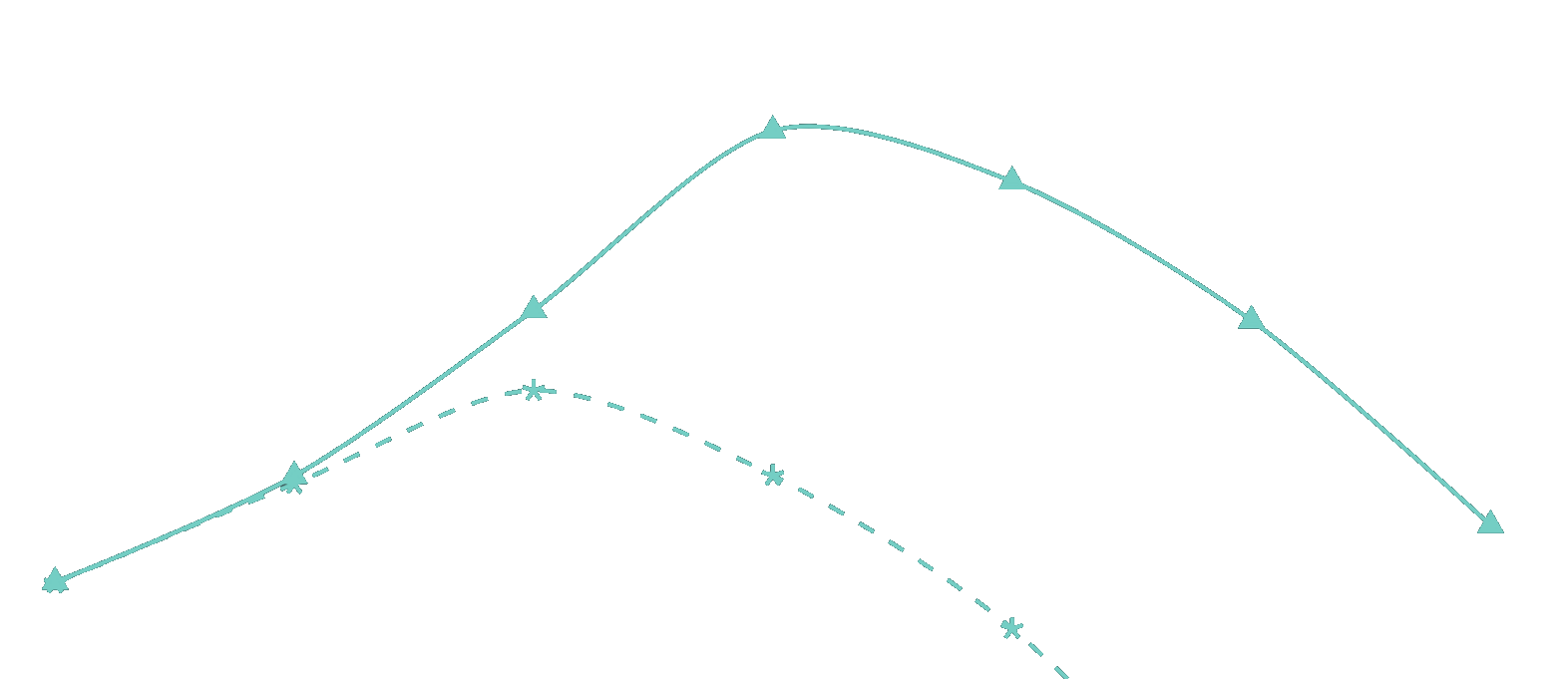
d=2
d=3
Toom-cook
Schoolbook
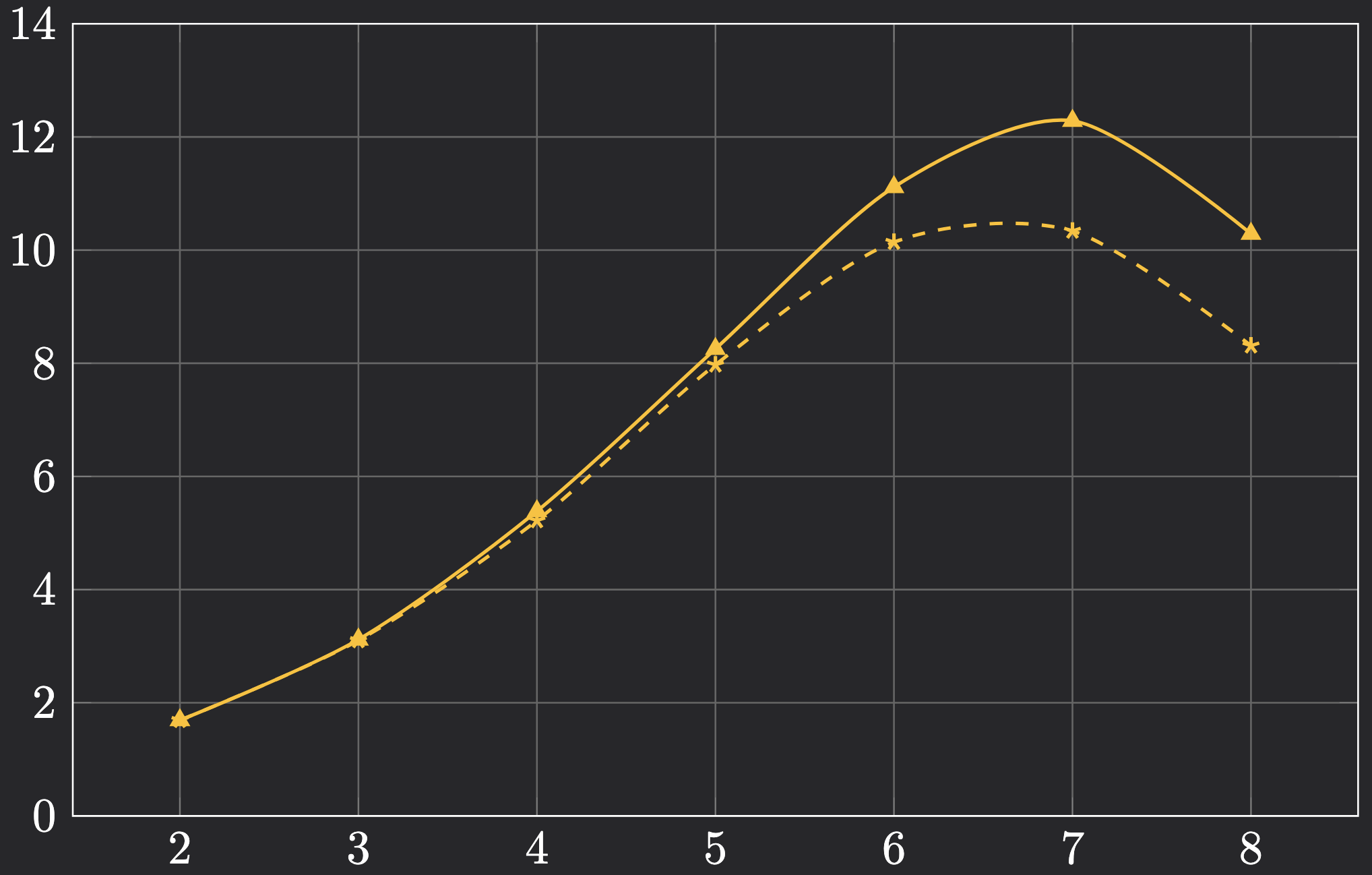
Switchover round \(t\)
Factor improvement \((t_{\textsf{naive}} / t_{\textsf{algo}})\) for \(n=20\)
0.6 \text{ MB}
84 \text{ MB}
Results in Spartan Sumcheck
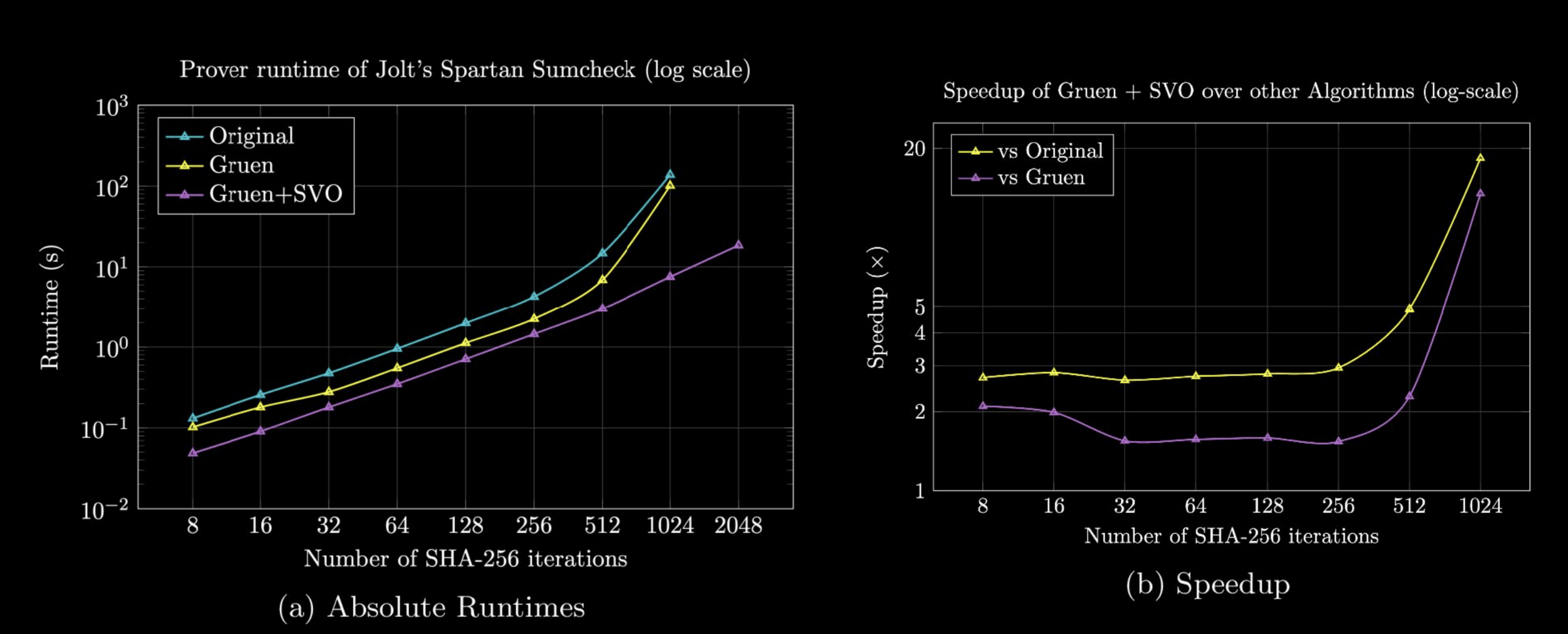
2-3× speedups for proving the first sum-check of Spartan within Jolt
Optimising Sumcheck
By Suyash Bagad