Language Variation

What is Language Variation?
- Difference between and within languages.
- Internal variation: Different ways for the same language to express the same thing.
Varieties, Dialects & Idiolects
- Variety (Lect): A specific form of a language
- Dialect: A variety of a language spoken by a certain group of people
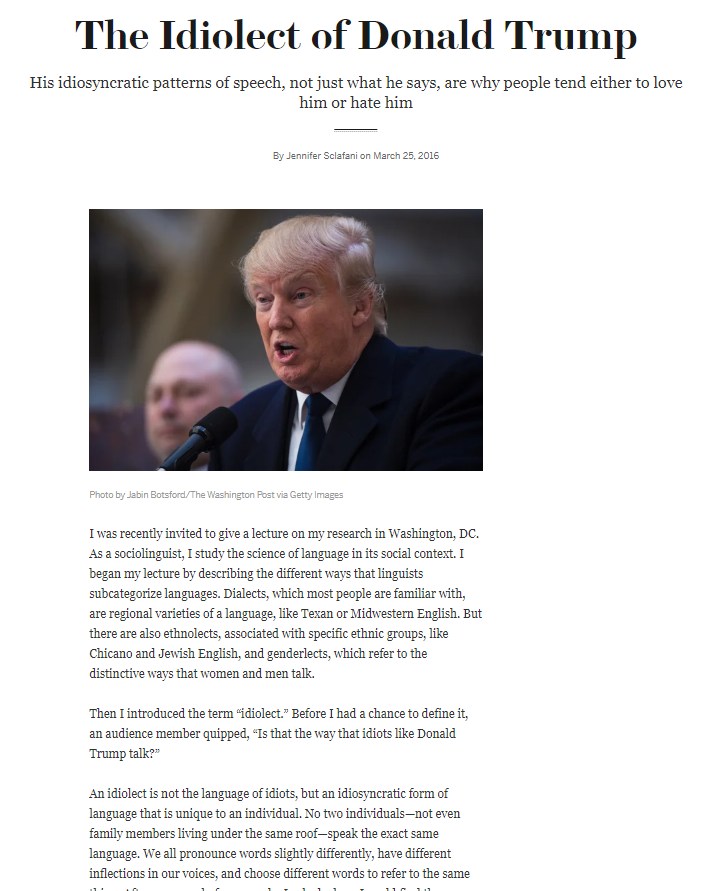
- Idiolect: A variety of a language spoken by a single person
Types of Language Variation
Phonetic
- American English uses [ɻ], Scottish English uses [ɾ] e.g. track
Phonological
- Standard British English does not allow sequences of V-[ɻ]-C, e.g. park the car
These two aspects of language variation create different accents!
Semantic Variation
"biscuit"
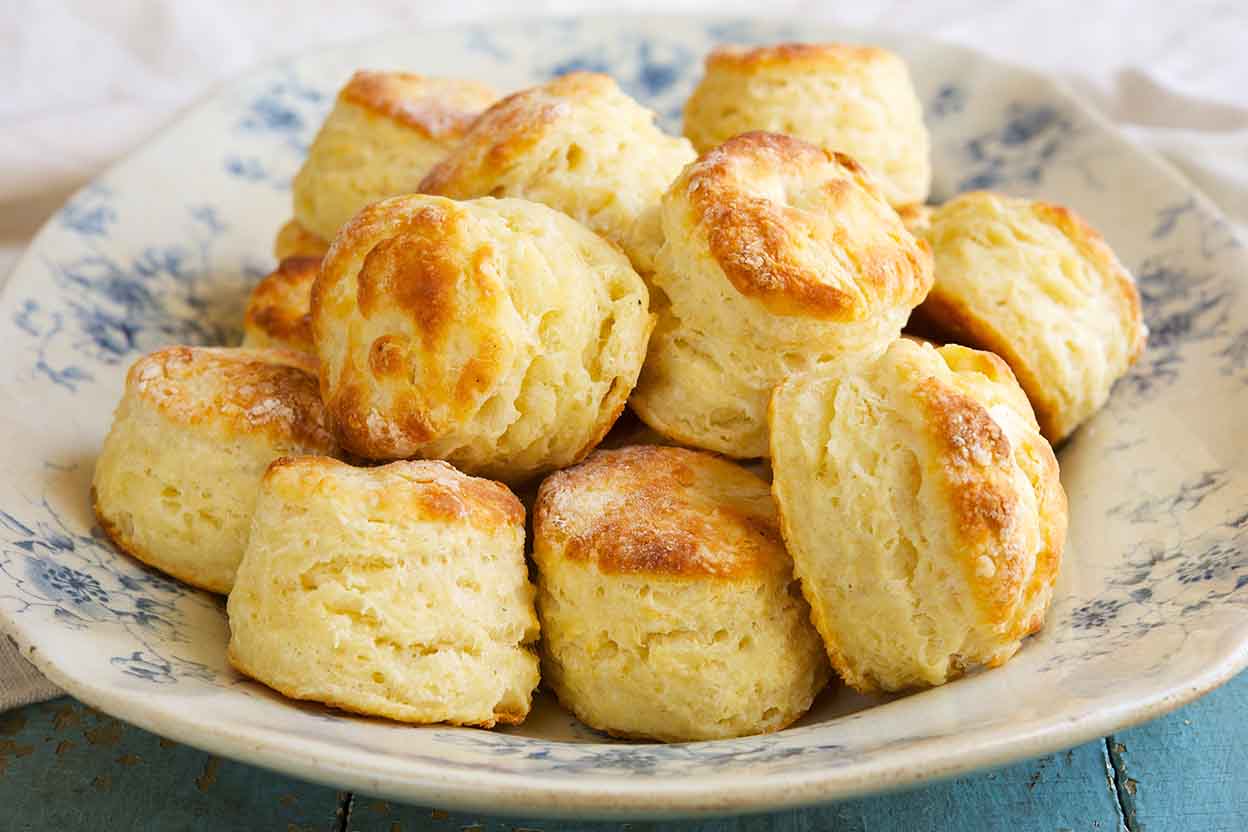

"elevator"

"lift"
-
Syntactic Variation
-
Morphological Variation
When does a dialect become a separate language?
Mutual Intelligibility
- Two language varieties are mutually intelligible if speakers of the two varieties can understand each other without prior familiarity or special effort.
"Two language varieties are dialects if and only if they are mutually intelligible."
Separate languages that are mutually intelligible
- Hindi/Urdu
- Norwegian/Danish
- Croatian/Serbian/Bosnian
- Portuguese/Galician


Dialects of the same language that are mutually unintelligible
- Chinese dialects

Dialect Continua
- A dialect continuum is continuous dialects where neighboring dialects differ slightly, but differences accumulate over distance so that widely separated varieties are not mutually intelligible.
- Portuguese - South Italian Dialects
- German - Dutch
Ulster Scots
In conclusion
- Dialect/language is debated by linguists
- "A language is a dialect with an army and navy." - Max Weinreich
Should there be a "better" or "more correct" dialect in a language?
Prestige
- Prestige is the level of regard normally accorded a specific language or dialect within a speech community, relative to other languages or dialects.
- British English over "Singlish"
- English over Irish (Gaelic)
- UK: Received Pronunciation (RP)
- USA: Standard American English (SAE)
- Contemporary linguistics: Varieties of varying prestige should be treated with equal merit.
Standard language/dialect
- Usually has fixed rules
- Important for communication between different dialect speakers (e.g. commerce, government).
- Mandarin: Initially formed as a standard language
- Usually a prestige language/dialect
- Egypt: Egyptian Arabic (standard), Standard Arabic (prestige)
African American Vernacular English / Ebonics
Oakland School Board Resolution
- December 1996
- Declared Ebonics a language and planned to raise its prestige by teaching with it in public schools
- Met with controversy
Are AAVE varieties systematic and rule-governed just like all other language varieties?
Habitual "be"
- Verb tense used in AAVE, not present in SAE.
- Used to express habituality (always, usually)
| SAE | AAVE |
|---|---|
| The coffee is always cold. | The coffee (always) be cold. |
| Sometimes she is angry. | Sometimes she be angry. |
| The coffee is cold. | #The coffee be cold. |
The line between dialects and languages can be vague.
Dialects with less prestige, such as "Black English", are not inferior to those with more prestige, such as SAE.
Standard dialects are important for communication between speakers of different dialects and language.
wj3ng.github.io/uniling
UniLing 5: Language Variation
By Willie Jeng