The Birds and the Bees

What is a language?
Features of a language
Hockett's design features
1. A Mode of Communication
- The means by which messages are transmitted
- Examples of different modes
- vocal-auditory
- tactile-visual
- chemical-olfactory
2. Semanticity
- Signals used in communication carry meaning
3. Pragmatic Function
- The main purpose of the communication system is to communicate, and not a side effect of other functions
4. Interchangeability
- The ability for individuals to both send and receive messages
- Communication systems that don't display interchangeability:
- Silkworm moths: only females can secrete chemicals when ready to mate

5. Cultural Transmission
- Some aspect of a communication system has to be learned (i.e. not innate or genetic)
- Animals that do not exhibit cultural transmission:
- Fireflies
-
Communication systems that exhibit some cultural transmission:
- Certain bird songs
- Chimpanzee signals


6. Arbitrariness
- Having signals that are not logically related to its meaning
- The word cat is not related to an actual cat
- Communication systems that lack arbitrariness:
- A dog baring its teeth, indicating that it is ready to attack

7. Discreteness
- Having complex messages made up of smaller parts
- A sentence is made up of words, which are made up of individual sounds
- Communication systems lacking discreteness:
- Parrots imitating human speech
:max_bytes(150000):strip_icc()/close-up-of-gold-and-blue-macaw-perching-on-tree-962288862-5b50073e46e0fb0037c23c23.jpg)
8. Displacement
- The ability to communicate about things that are not present in space or time
- Talking about the color red when we are not seeing it
- Talking about an event in the future
- No animal communication system appears to display this feature
9. Productivity
- Open-endedness
- The ability to produce and understand messages that have never been expressed before
- All animal communication systems are fixed systems (not open-ended systems)
The birds
The European robin

Songs of the European Robin
- Complicated, with specific meanings for songs
- Rival robins only paid attention to the alternation between high-pitched and low-pitched notes
- Although the robin is creative in singing in different ways, it is unable to create different meanings by rearranging notes
- Lack of discreetness, productivity
The bees
The honeybee
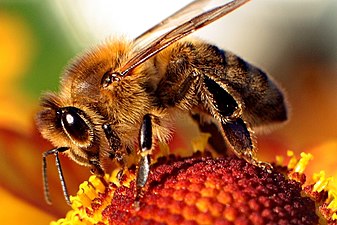
The Honeybee Dance
- Used to communicate information about a source of food
- Patterns: round, sickle, and waggle
- Round: location within twenty feet of the hive
- Sickle: 20 to 60 feet
- Waggle: More than 60 feet

Factors of a Honeybee Dance
- Round dance
- Number of repetitions: distance
- Vivacity: quality of the food
- Sickle dance
- Angle: The same angle as the food is to the sun
- Waggle dance:
- Repetitions per minute: precise distance
Why it's still not a language
- Exhibits arbitrariness
- Vivacity and quality of food are not related
- Exhibits some signs of displacement
- Can be used to describe food that is not present
- Does not exhibit productivity
- Can only be used for a single subject, no creativity
Primates and
human language

Early experiments
- 1930s: Gua the chimp
- Raised along with scientist's son
- Experiment failed after nine months
- 1950s: Viki the chimp
- Tried to teach Viki to speak
- Scientists determine that chimps are not physically able to make human sounds
- 1960s: Washoe the chimp
- Taught ASL
- Acquired 132 signs by age five
- Made her own word combinations, such as dirty Roger and water bird
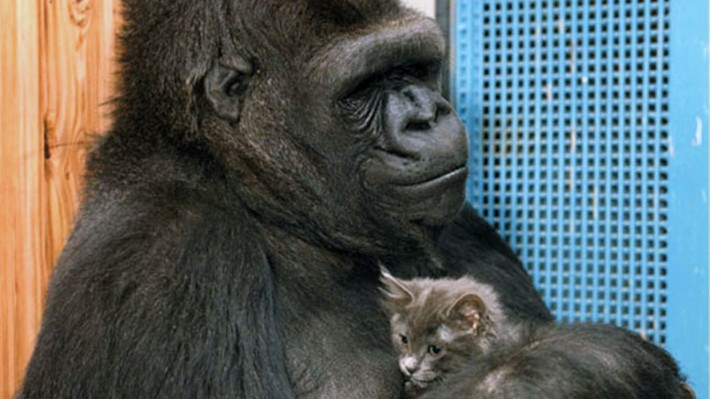
Koko the Gorilla
- 1971-2018
- Knew several hundred signs and invented her own signs
- Understood spoken English
- Used signs of homonyms when she could not think of the sign
- Made up insults for people and things she didn't like
- Called Patterson a "dirty toilet devil"
Criticisms
- Noah Chomsky: claimed animals could not be taught human language
- Primates had no concept of grammar
- Only signed separate vocabulary
- Few utterances beyond two-word combinations
- Animals suspected to have been cued by their trainers, only imitating the trainers' signs
wj3ng.github.io/uniling
UniLing 7: The Birds and the Bees
By Willie Jeng