Beginner's guide to Substorms
Substorms - Historical perspective
- Early studies [Akasofu, 1964] suggested the concept of auroral substorm by studying auroral observations - ASI, mag?
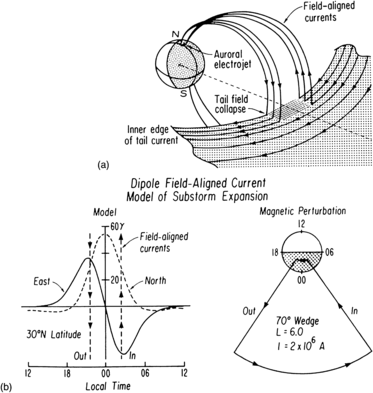
- McPherron [1972], McPherron et al., [1973], Horning et al., [1974] deduced the large scale current pattern associated with auroral displays - SCW [Pytte et al., 1976].
- Qualitative picture of SCW remained the same since then.
Substorms - Historical perspective
- McPherron [1972], McPherron et al., [1973] noted correlation between magnetometer obs on ground and geosynchronous orbit (ATS-1 satellite).
- McPherron et al., [1973] suggested tail-current short circuited into the ionosphere.
- Mid-lat mag. field singatures of SCW. H-comp is positive and symmetric about the central meridian of the wedge. D-comp is antisymmetric about central meridian.
- Similar variations in the D-comp of geosynchronous spacecraft.
Solarwind-Magnetosphere-Ionosphere coupling
- Magnetic reconnection [Dungey, 1961] and Viscous drag [Axford and Hines, 1961] are two important modes of energy transfer in to the magnetosphere.
- Magnetosphere transports and processes this energy through different modes of response, sporadically leading to reconfiguration of nightside magnetosphere and flow bursts in the tail.
- Psuedobreakups, magnetospheric substorms, steady magnetospheric convection intervals, sawtooth events and geomagnetic storms.
- These modes share some common properties. However, they occur on different temporal and spatial scales and have several distinct characteristics.
- SCW is observed during each of these modes. However, there are differences in location, extent and intensity of SCW.
Substorm models - controversy
-
Near Earth Neutral Line (NENL)/ Outside In Model : Substorms triggered by tail reconnection, generating BBFs which cause current disruption.
-
Near Earth Current Disruption (NECD)/Inside Out Model : Current disruption occurs first, sending refractive waves tailward driving reconnection.
- THEMIS observations show NENL model is probably the correct one [Angelopoulos, 2008]
Magnetospheric substorm
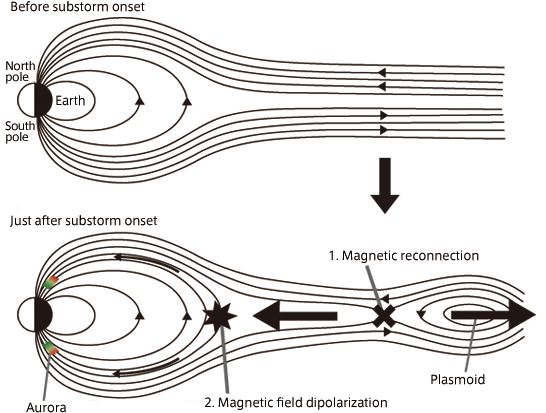
- Phases - growth, onset/expansion, recovery.
- Growth - increase in open magnetic flux after dayside reconnection. Thin and stretched magnetotail.
- Onset/Expansion - Reconnection in the tail, fast flows earthward and tailward, dipolarization. Formation and expansion of SCW
- Recovery : Magnetosphere recovers
Auroral substorm
- Begins as a localized brightening near the equatorward boundary of auroral prec ~ 23 MLT. Maps to near-Earth transition region.
- Brightening expands azimuthally, exhibiting folds and beads during breakup. Then expands poleward within few minutes.
- The poleward expansion transforms into a WTS.
- SCW links dynamical changes in the near-Earth transition region with the ionosphere.
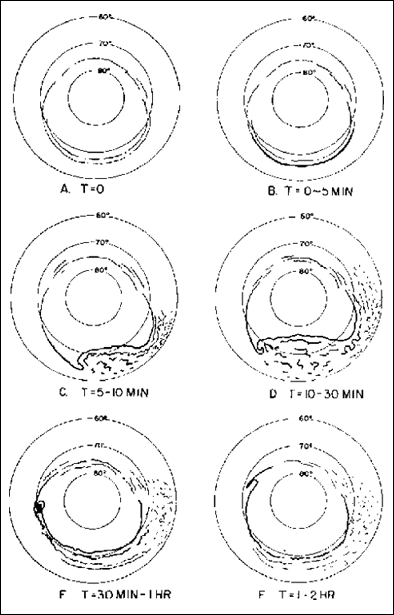
Substorm Current Wedge
- Flow burst transports magnetic flux, changing magnetic configuration in a limited sector from stretched to dipolar.
- Magnetic shear is generated as regions outside remain stretched (towards dawn and dusk).
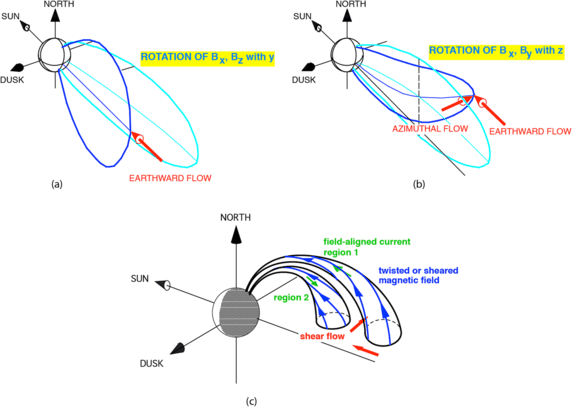
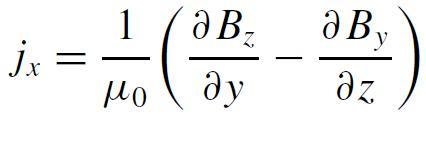
Substorm Current Wedge
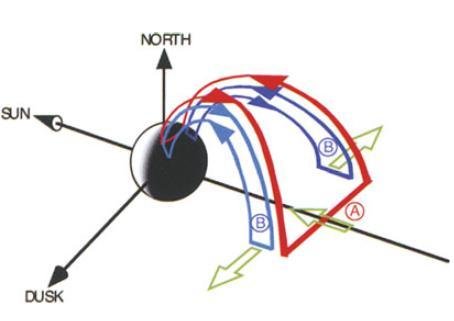
- 2-loop SCW was postulated as early as 1964 and simulated in 1999.
- I think observations were presented in 2013.
- NOTE : Can't be observed in ground magnetomters - Fukushima theorem.
Westward Traveling Surge
-
Well defined feature of the auroral substorm.
-
Bulge of discrete aurora that represents westward and poleward expansion.
- In a simplistic view, it is a visual manifestation of upward current at the duskward edge of SCW.
Conclusions
- Substorms are complicated!
- Can someone talk about pi2 pulsations, auroral streamers, poleward boundary intensifications, flow bursts etc.
substorms
By Bharat Kunduri