Corentin Cadiou
CNRS Researcher
Filaments @ Kavli IPMU | 2026
What flows from the cosmic web into galaxies?


Cosmic web: a multiscale structure
Mpc to galactic scales


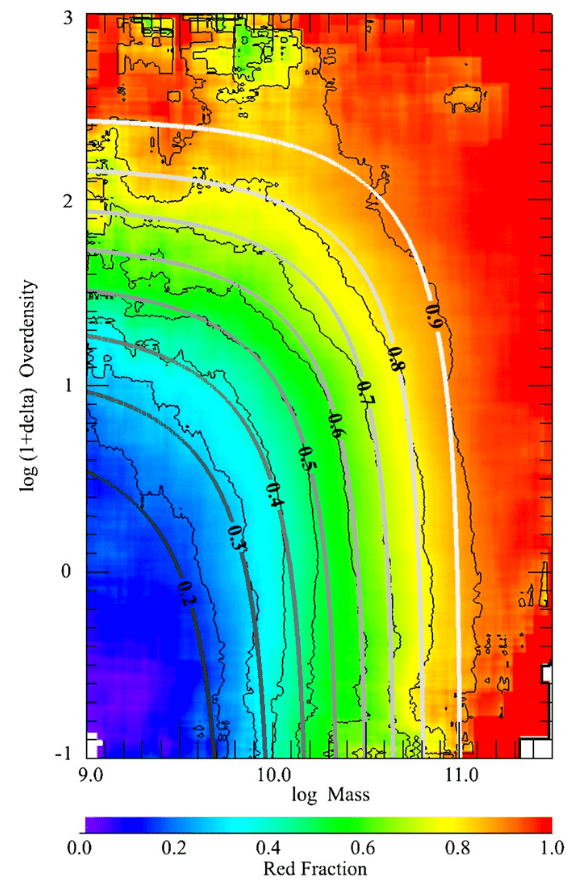
“Environmental” quenching
Higher density | high mass \(\rightarrow\) redder galaxies
⚠️ cannot explain morphology/orientations!
Cluster-like
Void-like
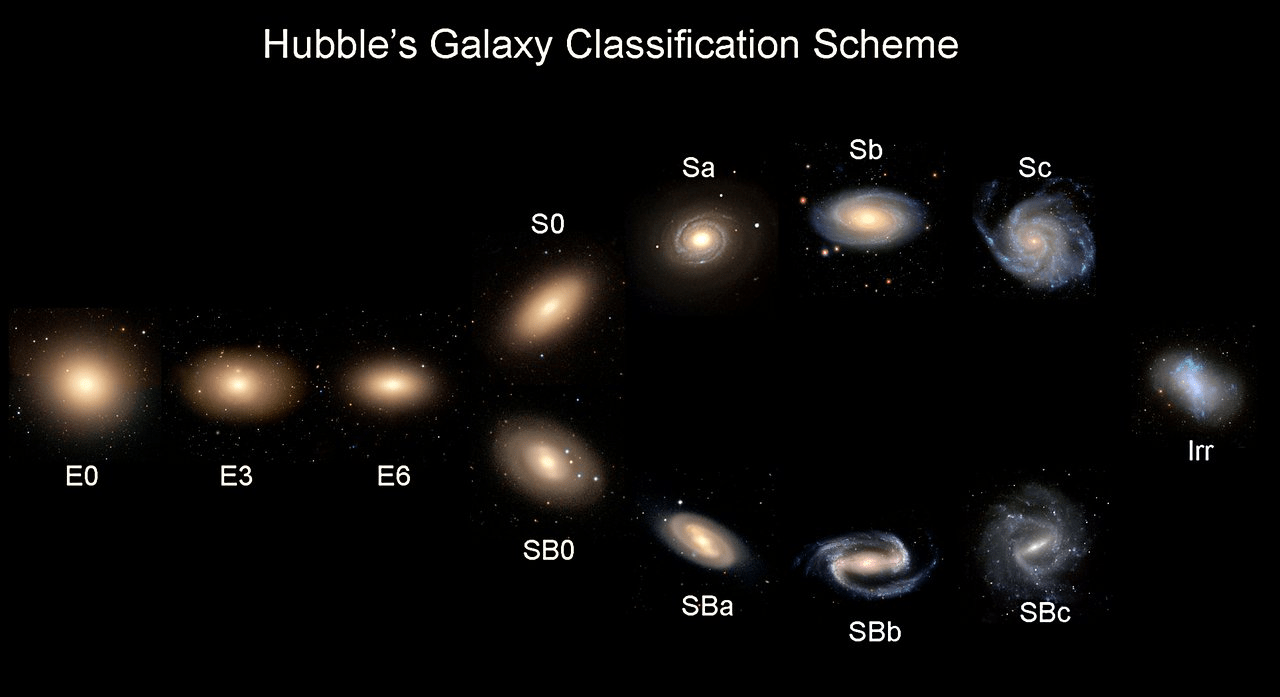
Right: Peng+10 · Left: Romanowsky & Fall 12
“Environmental” quenching
Higher density | high mass \(\rightarrow\) redder galaxies
⚠️ cannot explain angular momentum!
Cluster-like
Void-like

Related: Cadiou+22a (controlled stellar AM)
Cosmic web: effects on scalar galaxy properties
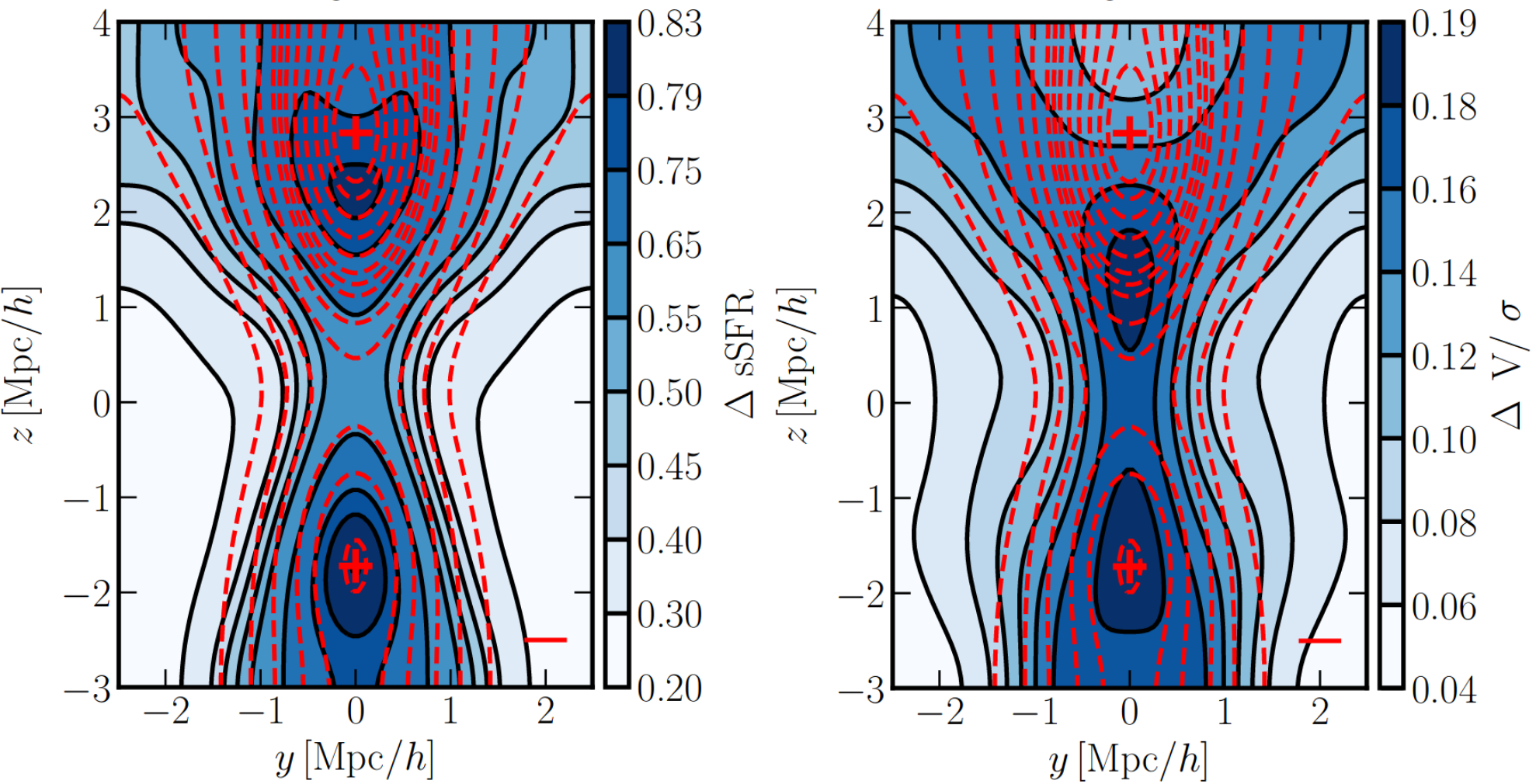
Distance to filament changes
- color & sSFR
- rotational support (\(v/\sigma\))
Left: Laigle+18 (COSMOS)
Right: Kraljic, … CC+19 (Horizon-AGN)
See also: Kraljic, … CC+18 (GAMA)
Farhan's talk yesterday
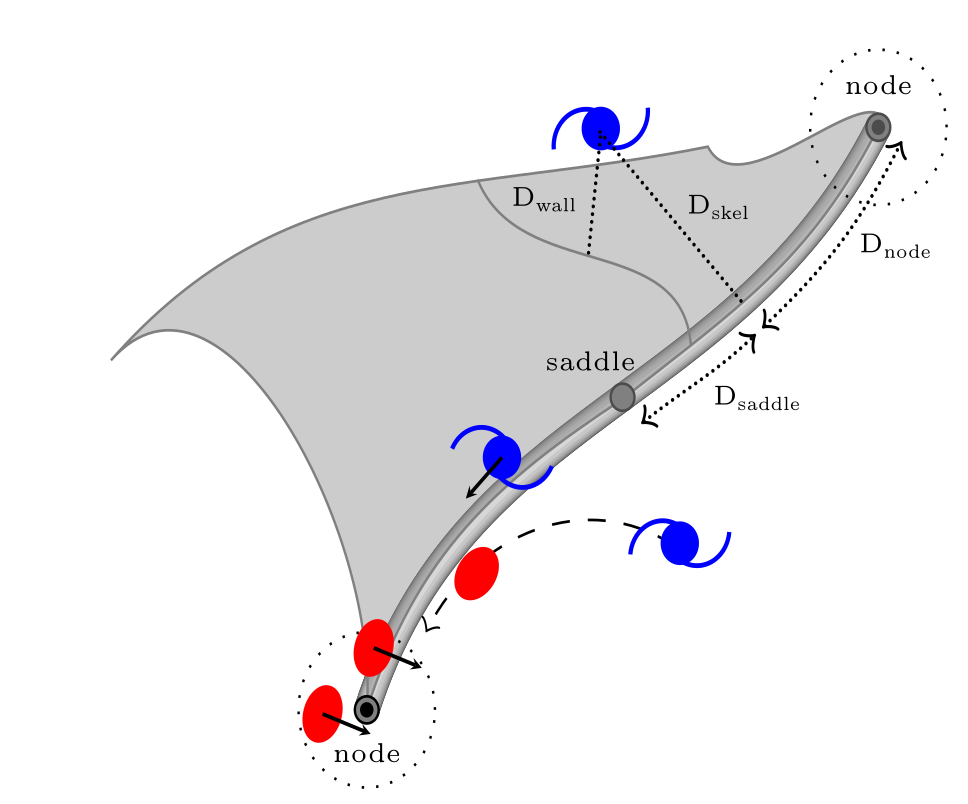

Triple effect:
- Halo assembly bias
- Feedback
- Accretion
Cosmic web: effects on halo vector properties
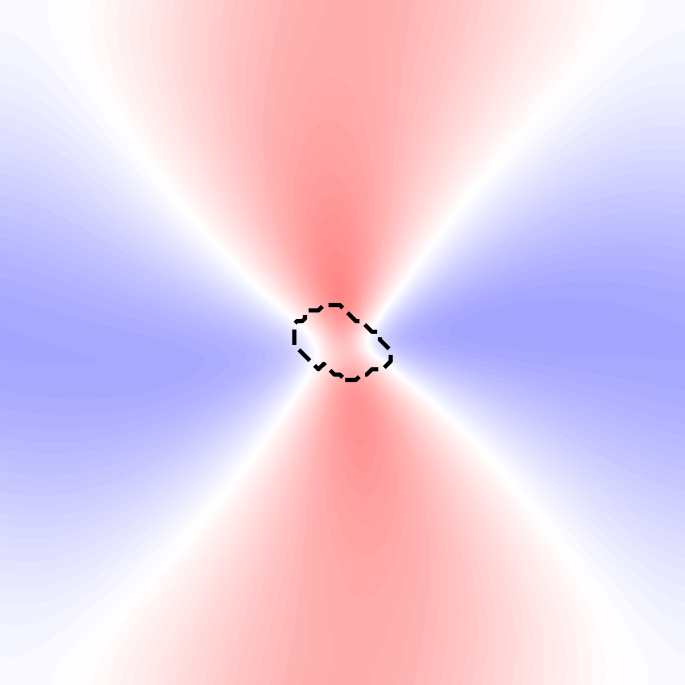
Small \(\perp\) alignment of halo spin/shape with filament axis

\(\perp\) filament
// filament

Interim takeaway 1/3 Cosmic web drives 1%-level effects?
Cosmic web: effects on halo vector properties
How can we study this?
Sample \(M\) at fixed cosmic web
or sample cosmic web at fixed \(M\)
\( \pm 20\% \)!
Interim takeaway 2/3 Local cosmic web drives 20%-level effects (DM halos)


More in Anatole Storck’s Thursday talk
Cosmic web: effects on galactic
vector properties
Cosmic-web-scale information trickles to galactic scale
\(\Rightarrow\) what's the messenger?
Interim takeaway 3/3 Local cosmic web drives 20%-level effects (galaxies)


to \(<10\,\mathrm{kpc}\)
@ \( z\approx 2\)
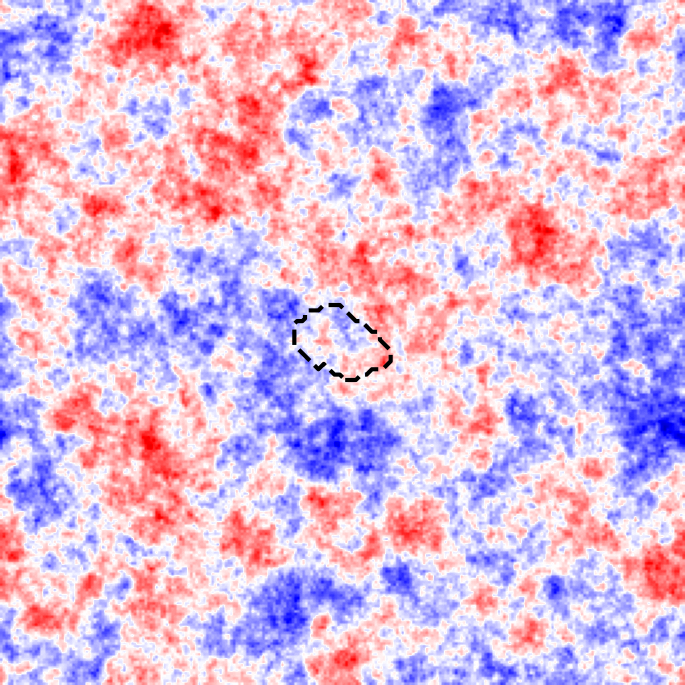
\(+\alpha\)
From \(50\,\mathrm{Mpc}\) @ \( z\approx \infty\)
through \(100\,\mathrm{kpc}\) @ \( z\rightarrow 2\)
How strongly does the cosmic web affect galaxy formation?
\(\ll 1\%\) or \(\gg 20\%\)?
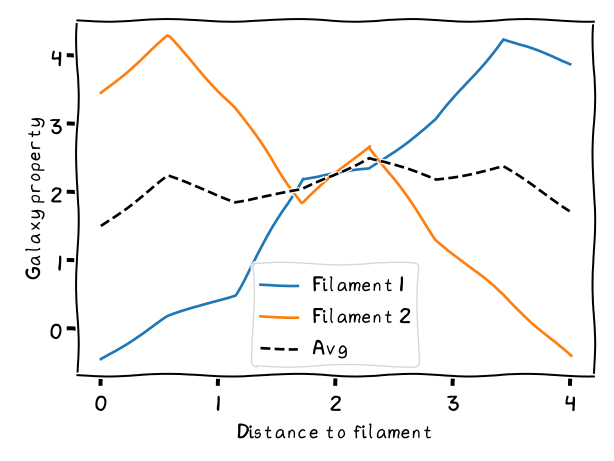
How strongly does the cosmic web affect galaxy formation?
\(\ll 1\%\) or \(\gg 20\%\)?
Sabri Errachdi
PhD work in progress
More in his Wednesday talk

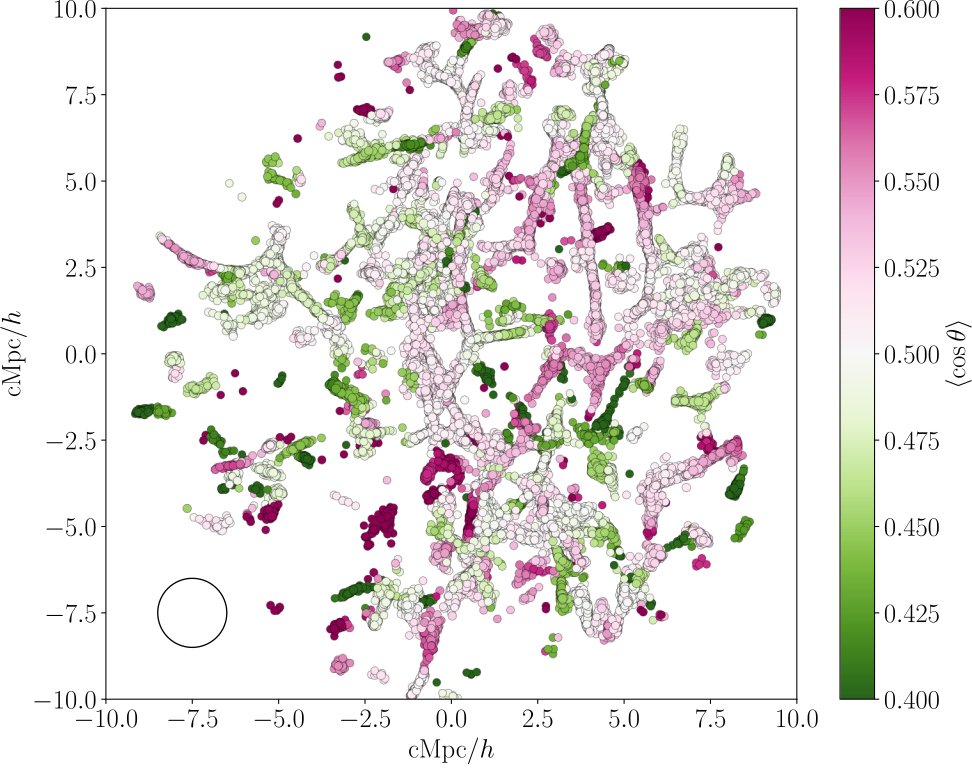
Related methods: Aragón-Calvo 16 · Storck, CC+25

The local cosmic web \(<1\,\mathrm{Mpc}\): theory
2-3 “Cold flows” embedded in local cosmic web pancakes, feeding the galaxy
\( z=2.5, M_\mathrm{halo}=10^{12}\,M_\odot \) ; Danovich+12
Related: Dekel+09 · Danovich+15 · Ramsøy+21
CGM emission: how far can we see?
\(R\) = radius · \(L\) = total span / filament length · selected systems and stacks
| Observable | Instrument / sample | \(z_\mathrm{obs}\) | Reach [physical kpc] | Reference |
|---|---|---|---|---|
| Ly\(\alpha\) — QSO pair | MUSE: QSO pair | \(3.22\) | \(R_\mathrm{t}\approx110;\ L\approx700\) | Tornotti+25a |
| Ly\(\alpha\) — web | MUSE: LAE overdensity | \(\sim4\) | \(L\approx1000\) | Tornotti+25b |
| Ly\(\alpha\) — stack | MUSE: LAEs | \(3\text{–}4\) | \(R\approx60\) | Guo+24 |
| Ly\(\alpha\) — stack | HETDEX: LAEs | \(1.9\text{–}3.5\) | \(R\approx160\) | Lujan Niemeyer+22 |
| C IV, He II, C III] | MUSE: QSO stack | \(\sim3\) | \(R\approx45\) | Guo+20 |
| Ly\(\alpha\), He II, C IV | KCWI: MAMMOTH-1 | \(2.3\) | \(R\approx100\) | Zhang+23 (recycling) |
| [O II] | MUSE: quasar + filament | \(1.13\) | \(R\approx50;\ L\approx120\) | Johnson+22 |
| [O III] | JWST: QSO / starburst | \(2.808\) | \(R\approx60;\ L\approx100\) | Peng+25 |
| Balmer / optical | KCWI: IRAS 08339+6517 | \(0.019\) | \(R\approx30\) | Nielsen+24 |
| H\(\alpha\), [O III] | JWST: quasars | \(\sim6\) | \(R_{\mathrm{H}\alpha}\approx4\text{–}11{+}\) | Ďurovčíková+25 |
| Mg II | MUSE: galaxy group | \(1.31\) | \(L\approx70\) | Leclercq+22 |
| [C I] | ALMA: radio galaxy | \(3.792\) | \(L\approx100\) | Emonts+23 |
| CO(4–3) | ALMA+ACA: radio QSO | \(2.222\) | \(L\approx100\) | Li+21 |
| [C II] \(158\,\mu\mathrm{m}\) | ALMA: galaxy stack | \(5.2\text{–}7.1\) | \(\sim10\)-kpc-scale haloes | Fujimoto+19 |
| [C II] \(158\,\mu\mathrm{m}\) | ALMA: interacting pair | \(5.54\) | \(R\approx10\) | Posses+25 |
| O VI | HST: starburst | \(0.235\) | \(R\approx23\) | Hayes+16 |
| Diffuse X-rays | eROSITA: galaxy stacks | \(0.01\text{–}0.20\) | \(R\approx R_\mathrm{500c}\) | Zhang+25 |
| PAHs / warm dust | JWST: Makani wind | \(0.459\) | \(R\approx35\) | Veilleux+25 |
Authors’ interpretation: accretion claimed (incl. recycling) feedback / interactions favoured no firm inflow claim
\(R_\mathrm{t}\): CGM–IGM transition. Colours describe the listed gas; they do not establish or exclude concurrent accretion.
From ionised filaments to cold gas
Three complementary views · projected physical scales
Lyα · MUSE

Tornotti+25a · \(z\simeq3.2\)
See also Herwig+24; Gallego+18
\(L \approx 700\,\mathrm{kpc}\)
CGM–IGM transition: \(R \approx 100\,\mathrm{kpc}\)
[O III] · JWST

Peng+25 · \(z=2.8\)
\(L \approx 100\,\mathrm{kpc}\)
Enriched filaments; feedback
[C I] · ALMA
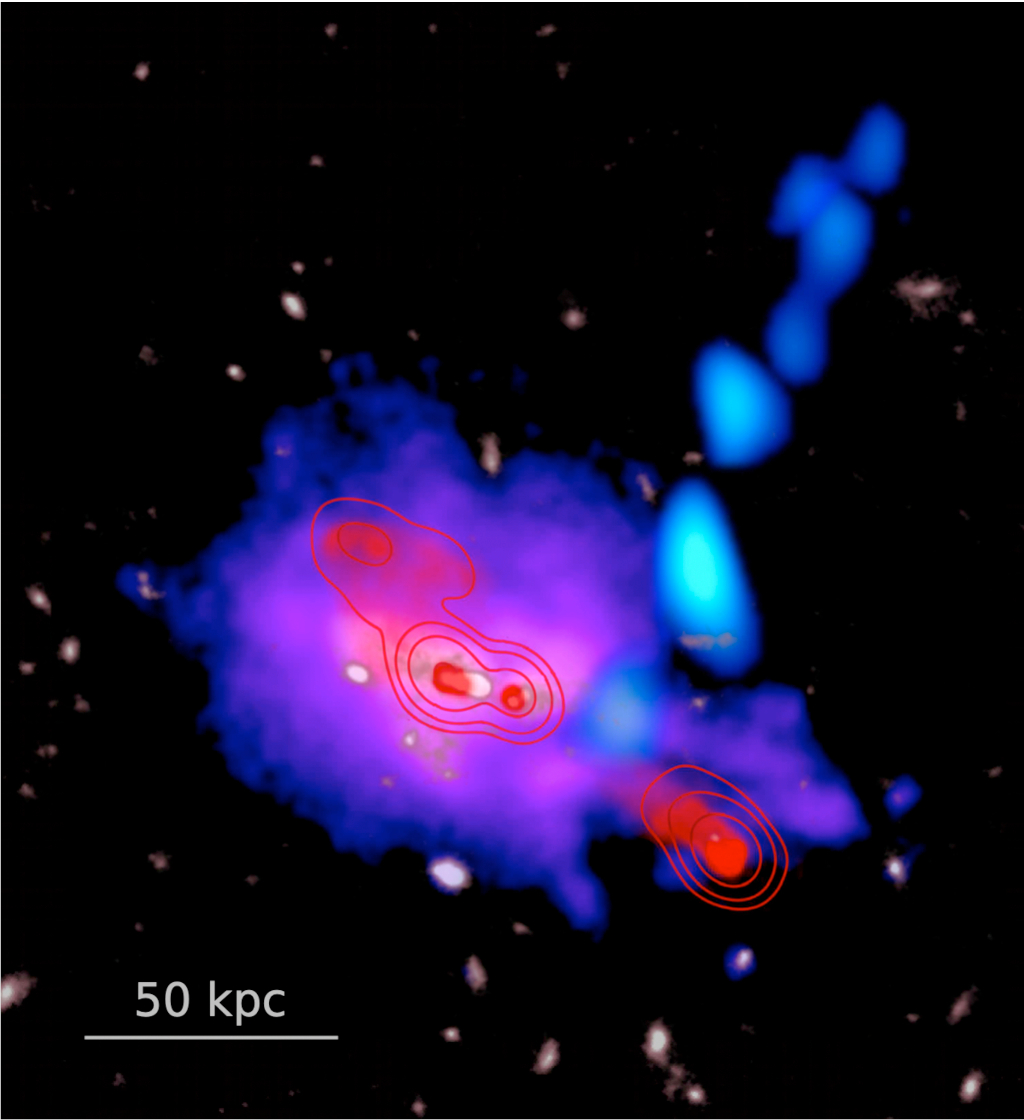
Emonts+23 · \(z=3.8\)
Stream \(L \approx 100\,\mathrm{kpc}\)
Cold-gas stream; inflow candidate
Related accretion diagnostics: Zhang+23 · Johnson+22
The CGM cosmic web \(\lessapprox 100\,\mathrm{kpc}\): theory
Ly\(\alpha\) is hard to interpret, but what about other lines?
- not so simple geometry,
- are we even getting the right predictions?
Movies / NEq: Megatron simulations CC+26 · Related NEq with AGN: Segers+17 · See Nir + Isabel + Zhiyuan's talk
H\(\alpha\) recomb. only
[CIV] 1548Å
HeII 1640Å
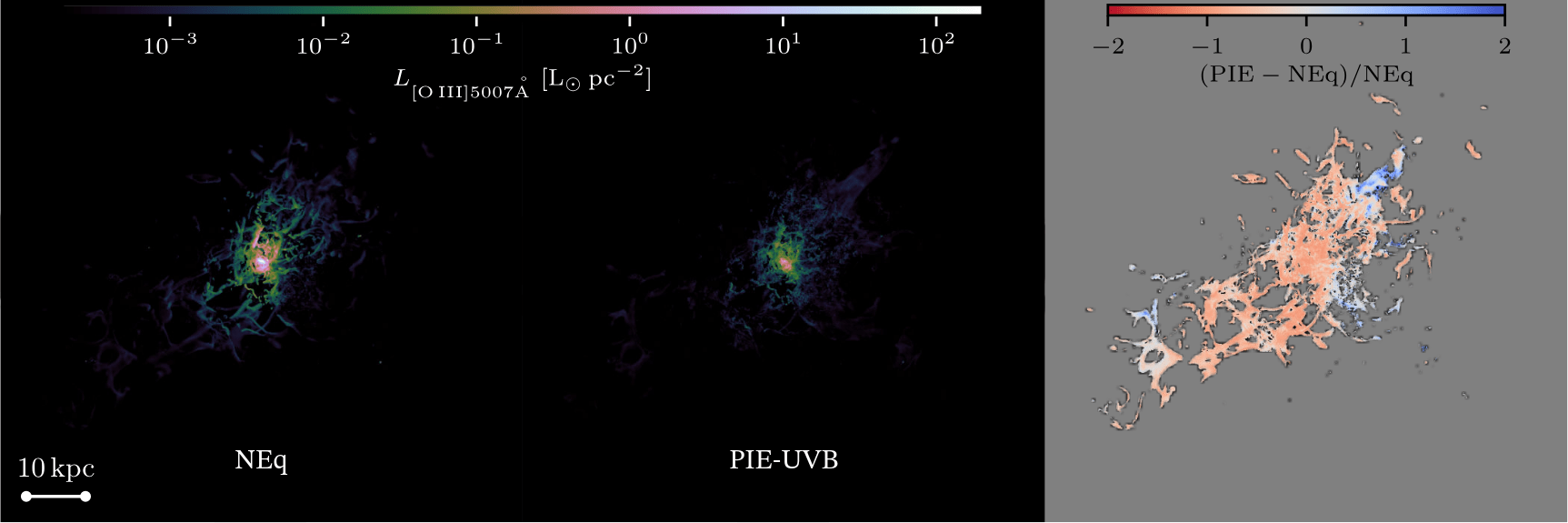
Interim takeaway Predictions and interpretation of CGM-CW observations may not yet be mature.
⚠️ This also applies to the IGM
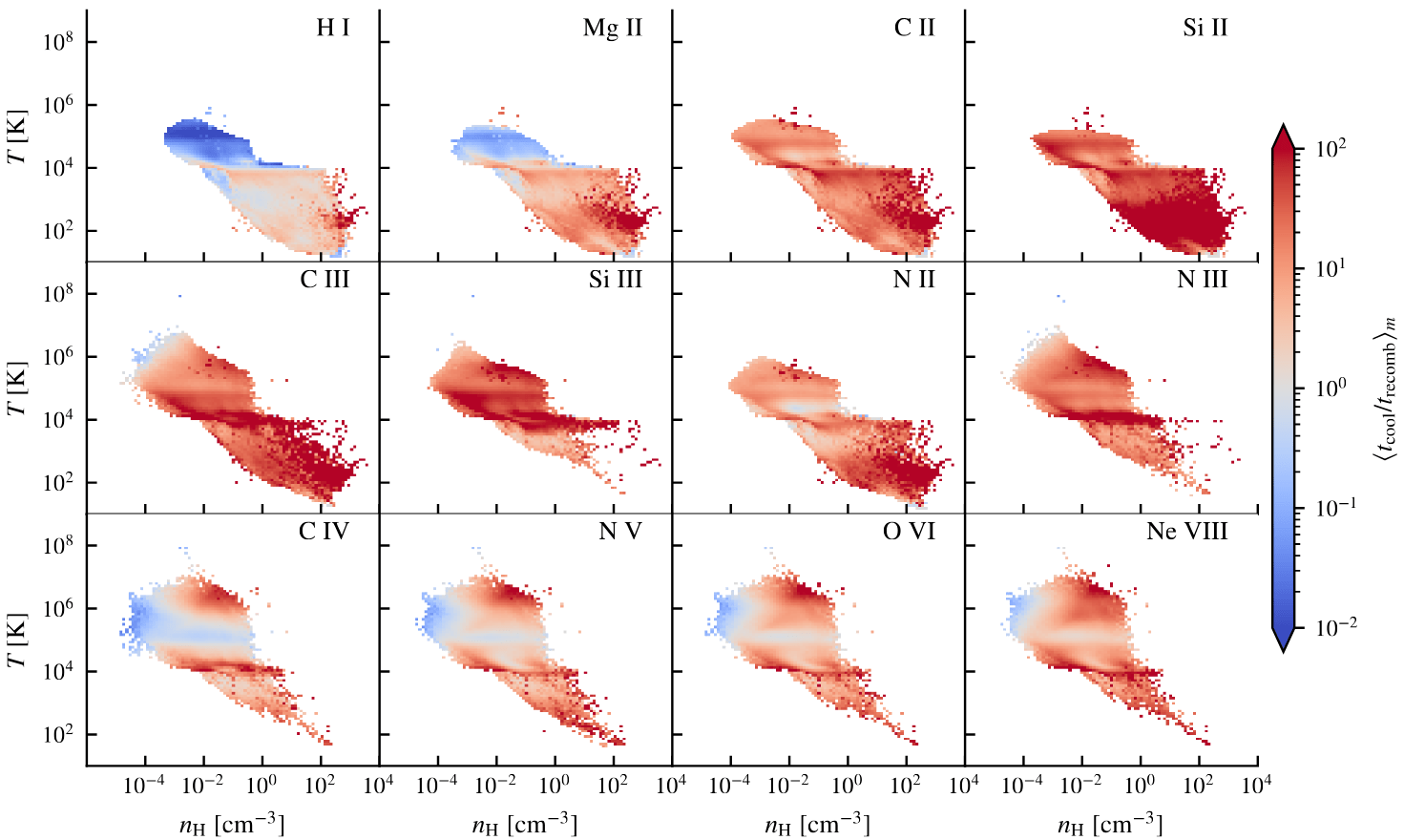
Connecting the cosmic web through the CGM
Effects of cosmic web on galaxies at \(>\mathrm{Mpc}\) well established, but likely massively underestimated.
How these effects reach galaxies is less clear. Uncertainties on:
- Structure of CGM,
- Survival of cold flows,
- Observational interpretations,
- How much do galaxies remember? [baryon effects]
My take home:
- we need more controlled experiments to become quantitative & predictive field,
- we need better simulations to bridge small-scale accretion to observations
Corentin Cadiou · cadiou@iap.fr
Megatron
\(\displaystyle \begin{aligned} \frac{\mathrm{d}n_i}{\mathrm{d}t} &=\underbrace{n_{i+1}\left[n_e\alpha_{i+1}(T)+n_e\alpha_{\mathrm{dust},i+1}(T,Z,N_{j,\mathrm{rad}})+\sum_k^{\mathrm{species}}n_k\xi_{i+1}(T)\right]}_{\text{Creation by recombination from state }i+1} +\underbrace{n_{i-1}\left[n_e\beta_{i-1}(T)+\Gamma_{i-1}(n,N_{j,\mathrm{rad}})+\zeta_{i-1}+\sum_k^{\mathrm{species}}n_k\chi_{i-1}(T)\right]}_{\text{Creation by ionisation from state }i-1}\\[4pt] &\quad-\underbrace{n_i\left[n_e\alpha_i(T)+n_e\alpha_{\mathrm{dust},i}(T,Z,N_{j,\mathrm{rad}})+\sum_k^{\mathrm{species}}n_k\xi_i(T)\right]}_{\text{Destruction by recombination to state }i-1} -\underbrace{n_i\left[n_e\beta_i(T)+\Gamma_i(n,N_{j,\mathrm{rad}})+\zeta_i+\sum_k^{\mathrm{species}}n_k\chi_i(T)\right]}_{\text{Destruction by ionisation to state }i+1},\\[7pt] \frac{\mathrm{d}n_{\mathrm{CO}}}{\mathrm{d}t} &=k_0n_{\mathrm{C\,II}}n_{\mathrm{H_2}}\beta-\Gamma_{\mathrm{CO}}n_{\mathrm{CO}}, \quad\text{with}\quad \beta=\frac{k_1n_{\mathrm{O}}/n_{\mathrm{H}}}{k_1n_{\mathrm{O}}/n_{\mathrm{H}}+\Gamma_{\mathrm{CH_x}}/n_{\mathrm{H}}},\\[7pt] \frac{\mathrm{d}n_{\mathrm{H_2}}}{\mathrm{d}t} &=-C_{\mathrm{coll}}n_{\mathrm{H_2}}-(k_{\mathrm{UV}}+k_{\mathrm{LW}})n_{\mathrm{H_2}}+(R_{\mathrm{d}}+R_{\mathrm{p}})\,n\,n_{\mathrm{H\,I}},\\[7pt] \frac{\mathrm{d}E}{\mathrm{d}t} &=\underbrace{\sum_k^{\mathrm{processes}}\sum_i^{\mathrm{species}}n_iH_k(T,n,N_{j,\mathrm{rad}})}_{\text{Total heating}} -\underbrace{\sum_k^{\mathrm{processes}}\sum_i^{\mathrm{species}}\sum_j^{\mathrm{species}}n_in_jC_k(T,n,N_{j,\mathrm{rad}})}_{\text{Total cooling}},\\[7pt] \frac{\mathrm{d}N_{j,\mathrm{rad}}}{\mathrm{d}t} &=-\underbrace{cN_{j,\mathrm{rad}}\sum_i^{\mathrm{species}}n_i\overline{\sigma}_{i,j}}_{\text{Absorption rate}},\\[5pt] \frac{\mathrm{d}\boldsymbol{F}_{j,\mathrm{rad}}}{\mathrm{d}t} &=-c\boldsymbol{F}_{j,\mathrm{rad}}\sum_i^{\mathrm{species}}n_i\overline{\sigma}_{i,j},\\[5pt] \text{with}\quad n_e &=\sum_i^{\mathrm{species}}n_i\times N_{\text{positive charges on species }i}. \end{aligned}\)
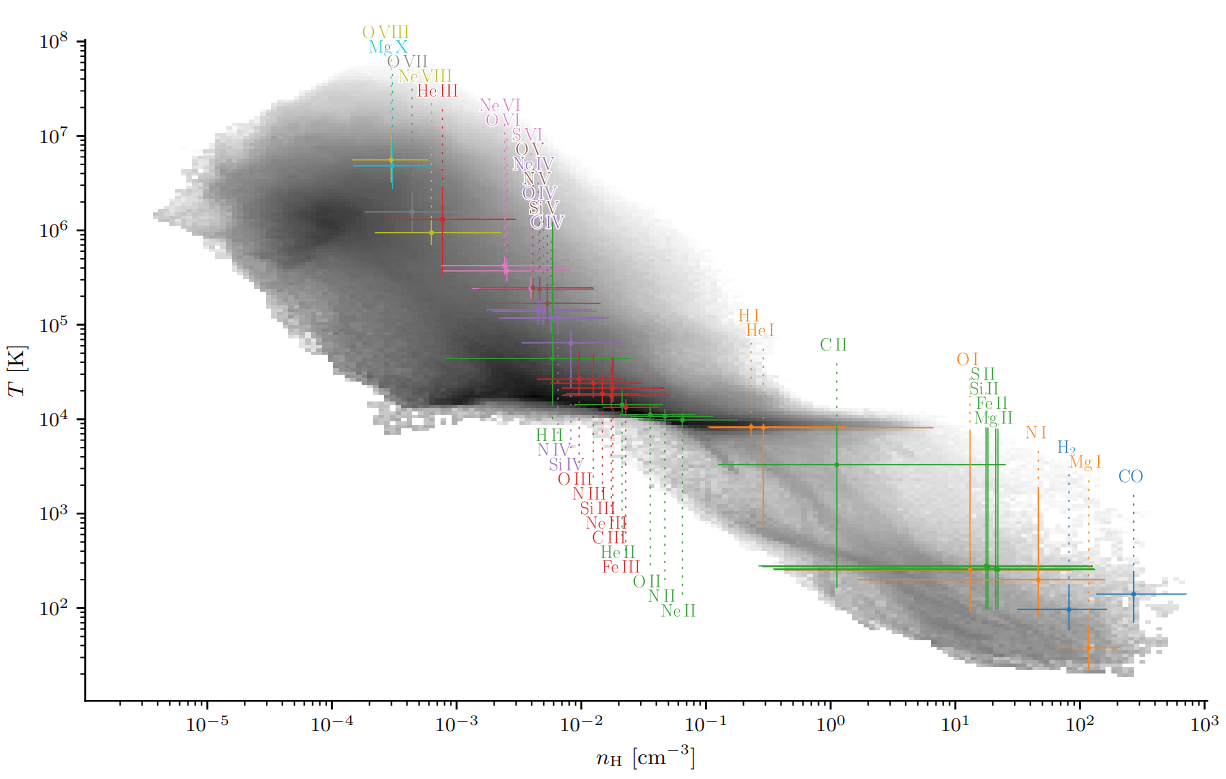
What flows from the CW into galaxies @ IPMU
By Corentin Cadiou