



Chris Liu
Math gradudate student at Colorado State University
Chris Liu
Dissertation Defense
May 8, 2026
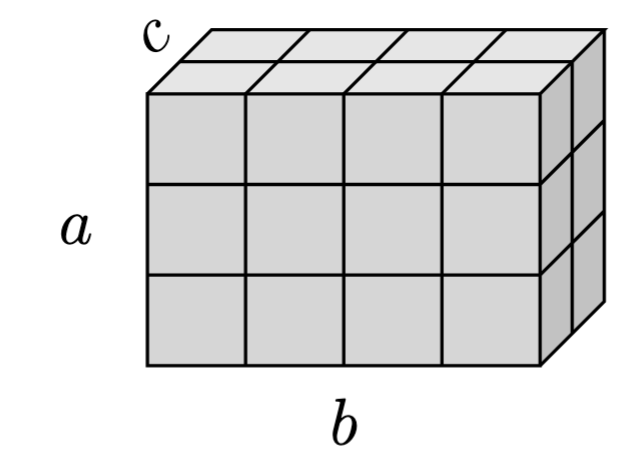
\( T \) is \( (a \times b \times c) \) grid of numbers
Tensors are multiway grids of numbers with a multilinear interpretation
As a bilinear map
\[ \tau: \mathbb{R}^a \times \mathbb{R}^b \rightarrowtail \mathbb{R}^c \]
As a trilinear form
\[ t: \mathbb{R}^a \times \mathbb{R}^b \times \mathbb{R}^c \rightarrowtail \mathbb{R}\]
\[t \left(\sum_i u_i e_i, \sum_j u_je_j, \sum_k u_ke_k \right) = \sum_{ijk} T_{ijk} u_iv_jw_k\]
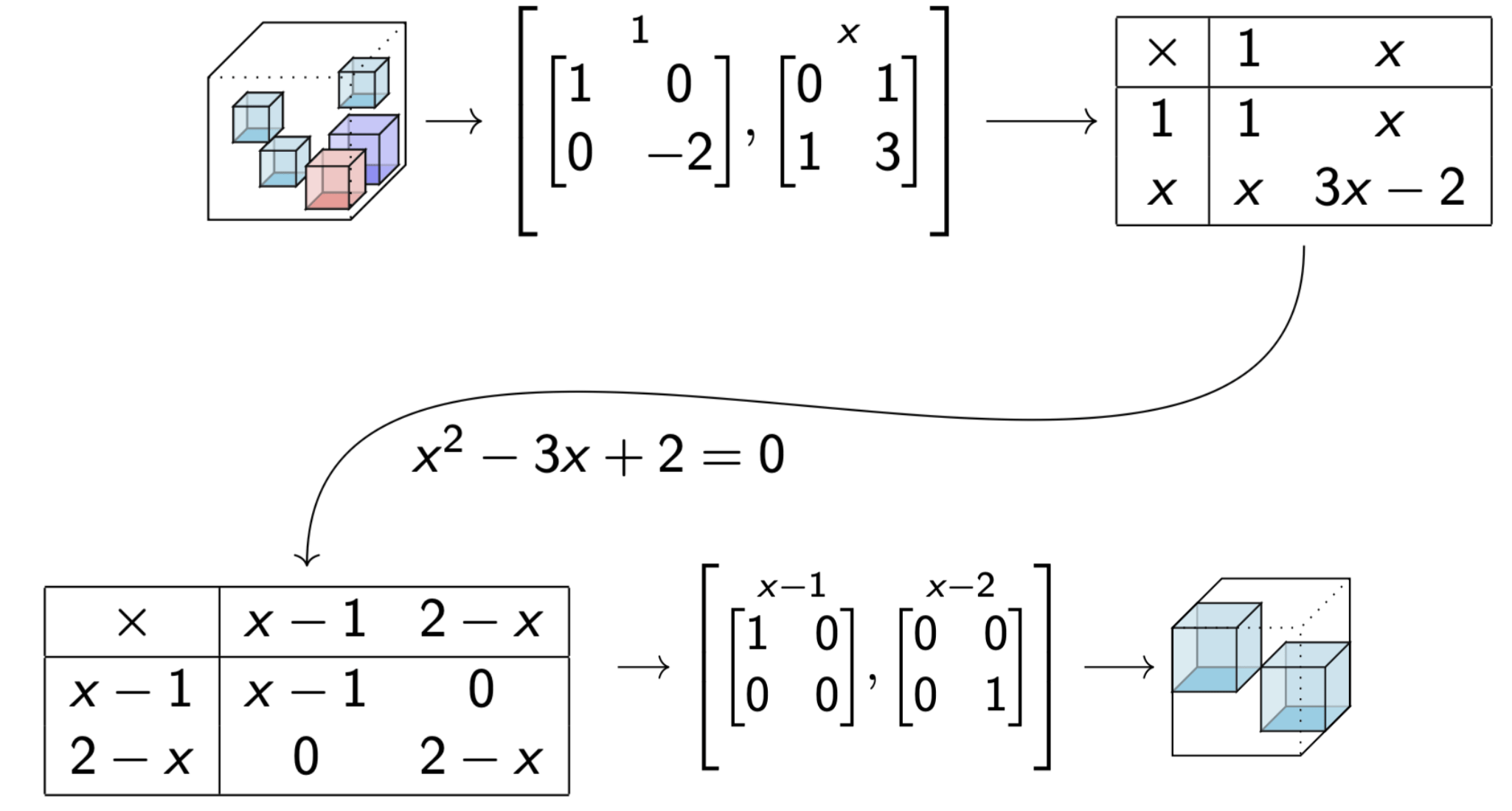
Let \( A \) be a \(\mathbb{F}\)-vector space with bilinear multiplication \( \mu: A \times A \rightarrowtail A \) (\(\mathbb{F}\)-algebra)
For ordered basis \( (e_1,\ldots, e_n )\) of \(A\), coordinatize \(\mu\) by a \( (n \times n \times n) \) grid of numbers \(T\) satisfying \( \mu(e_i,e_j) = \sum_k T_{ijk}e_k \).
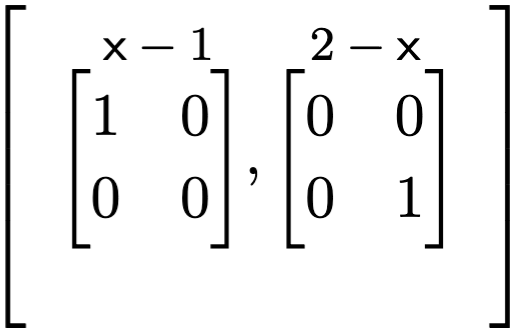
For \(A = \frac{\mathbb{F}[x]}{x^2-3x+2} \)
Change of bases
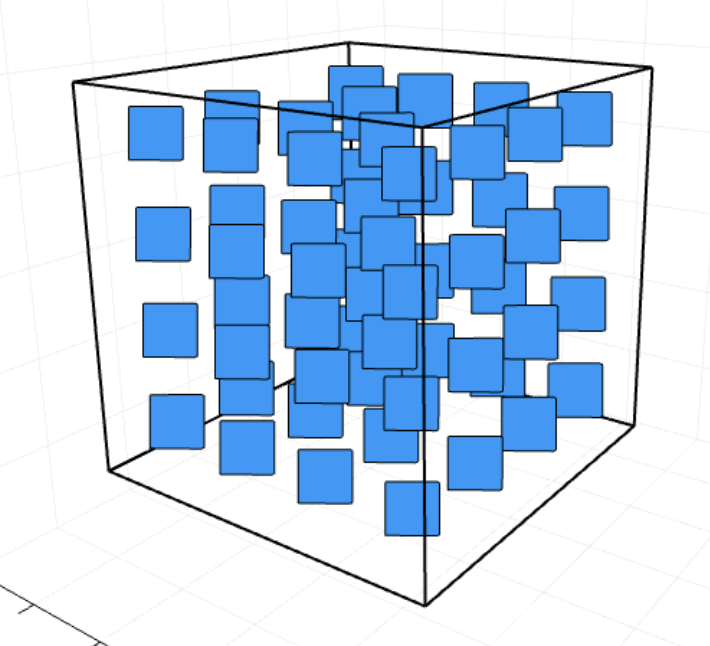
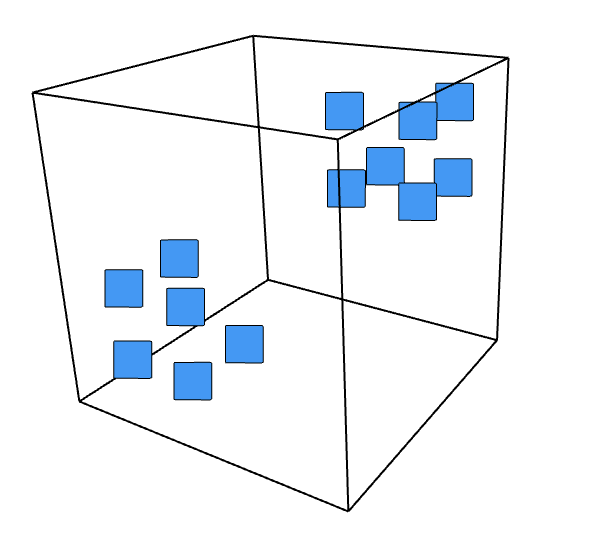
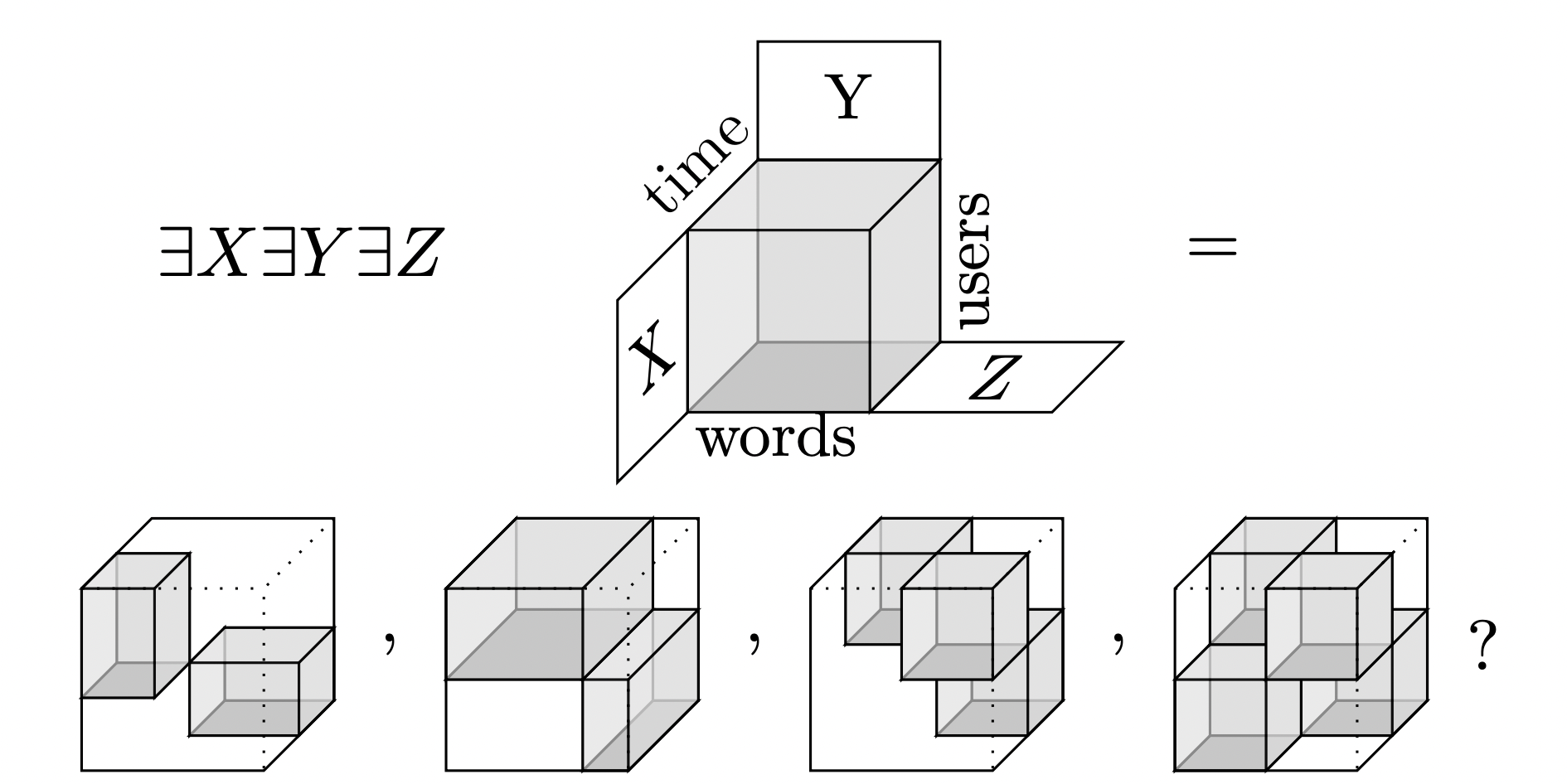
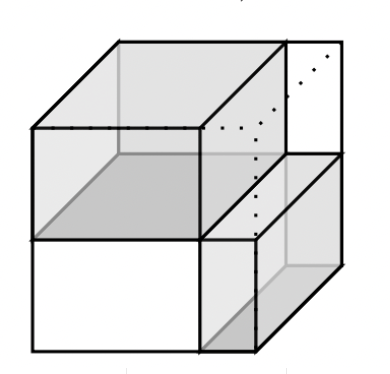
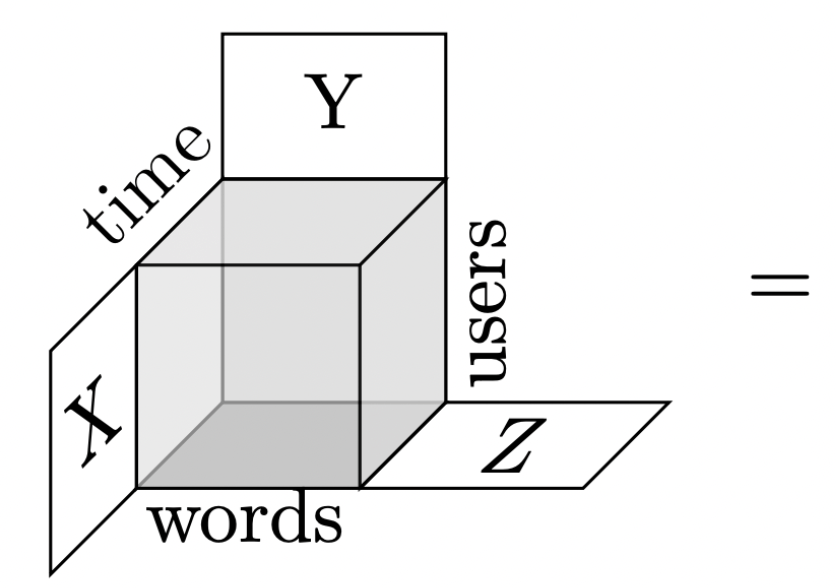
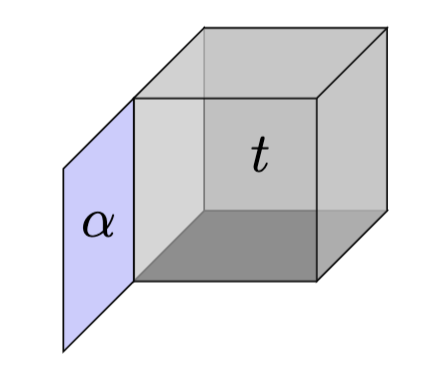
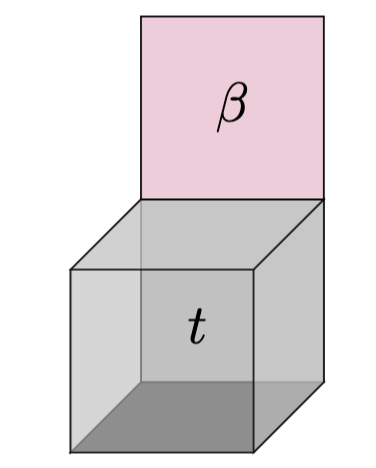
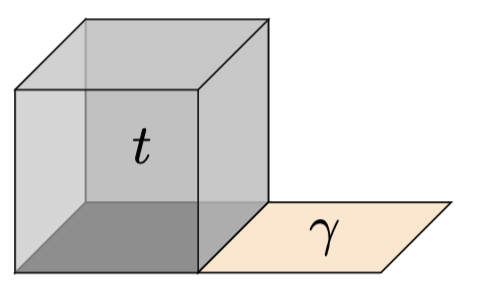
A cube of numbers, where \( (i,j,k) \) is the number of times word \(i\) was said by user \(j\) at time \(k\) in a Discord chatroom
\( \text{Users} = \{ \text{Andrea}, \text{Bob}, \text{Chris}, \text{Dave}, \text{Eve}, \ldots \} \)
\( \text{Days of the week} = \{\text{Monday}, \text{Tuesday}, \ldots \} \)
\( \text{Words} = \{\text{apple}, \text{break}, \text{colorado},\text{dog}, \ldots \} \)
\( \text{Groups} = \{ \alpha_1 \cdot \text{Chris} + \alpha_2 \cdot \text{Dave} + \alpha_3 \cdot \text{Eve}, \ldots \} \)
\( \text{Time clusters} = \{\beta_1 \cdot \text{Saturday} + \beta_2 \cdot \text{Sunday}, \ldots \} \)
\( \text{Themes} = \{ \gamma_1\cdot \text{hockey} + \gamma_2 \cdot \text{puck} + \gamma_3 \cdot \text{goalie}, \ldots \} \)
Linear combinations
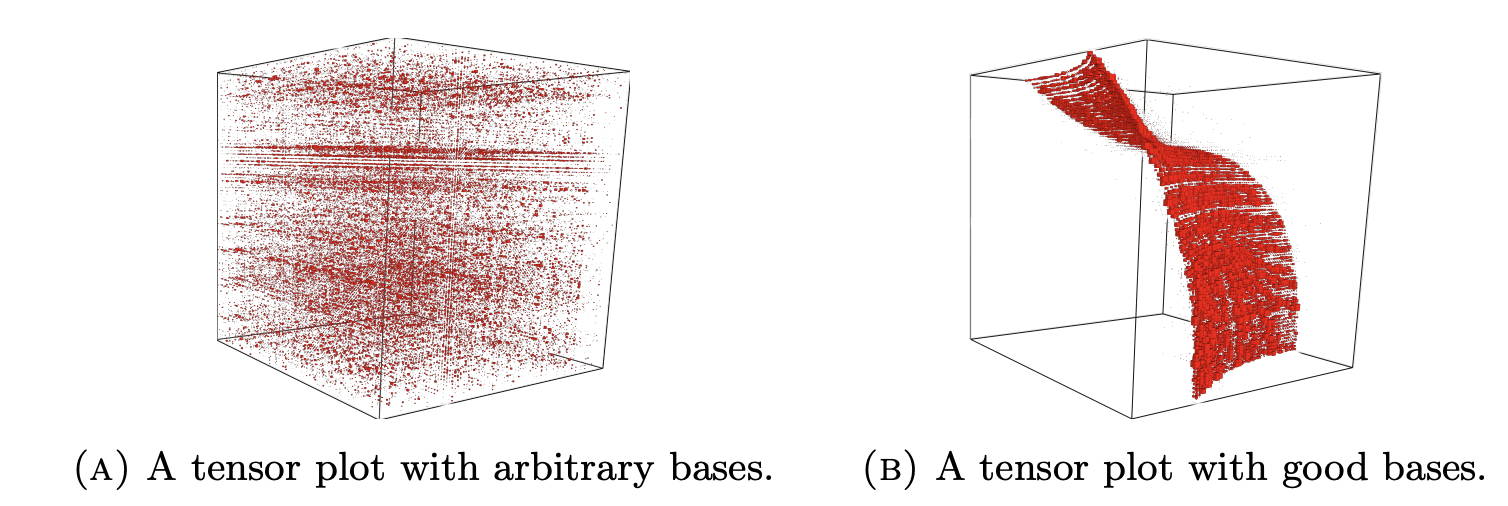
Data mining algorithm
Source: Optimal Search Spaces for Tensor Problems, Figure 1.1
Given \( t: U \times V \rightarrowtail W \)
$$\operatorname{Adj}(t) = \{(X,Y) \mid (\forall u,v) \;\; t(Xu,v) = t(u,Yv) \}$$
Analogy: Given a bilinear form \( \langle \cdot \mid \cdot \rangle : V \times V \rightarrowtail \mathbb{F} \) and \(A \in \operatorname{End}(V)\), its adjoint \( A^{\ast} \) satisfies \( \langle Au \mid v \rangle = \langle u \mid A^{\ast} v \rangle \)
(transpose for the dot product)
Myasnikov '90, Wilson '08 and others use the algebra, i.e
Theorem
Exists \(\mathcal{E} = \{e_1,\ldots, e_n \} \subset \text{Adj}(t) \),
\( \sum_i e_i = 1\), and \(e_ie_j = e_i \) if \( i = j \), otherwise \(0\)
if and only if
Exists \(\perp\)-decomposition, \(U := \bigoplus_i U_i\) and \(V := \bigoplus_i V_i \),
\[ t(U_i, V_j) = t(U_i,V_i) \quad \text{if } i = j, \text{otherwise } 0 \]
Theorem (Brooksbank, Kassabov, Wilson '24)
For \( (u,v,w) \) eigenvectors of \( (X,Y,Z) \) in \( \text{Der}(t) \) with eigenvalues \( (\kappa , \lambda, \rho) \),
\[w^{\dagger}Z(t(u,v)) = w^{\dagger}(t(Xu,v) + t(u,Yv))\]
\[ \rho w^{\dagger}(t(u,v))-w^{\dagger}(\kappa t(u,v) - \lambda t(u, v)) = 0\]
By distributive property,
\[ (\rho - \kappa - \lambda) (w^{\dagger}(t(u,v))) = 0 \]
Source: Detecting cluster patterns in tensor data, Figure 3
Given \( t: U \times V \rightarrowtail W \)
$$\operatorname{Der}(t) = \{(X,Y,Z) \mid (\forall u,v) \; Z(t(u,v)) = t(Xu,v) + t(u,Yv) \}$$
Analogy: The product rule in Calculus to understand multiplication. The derivative \( \frac{d}{dx}(fg) = (\frac{d}{dx}f)g + f(\frac{d}{dx}g) \)
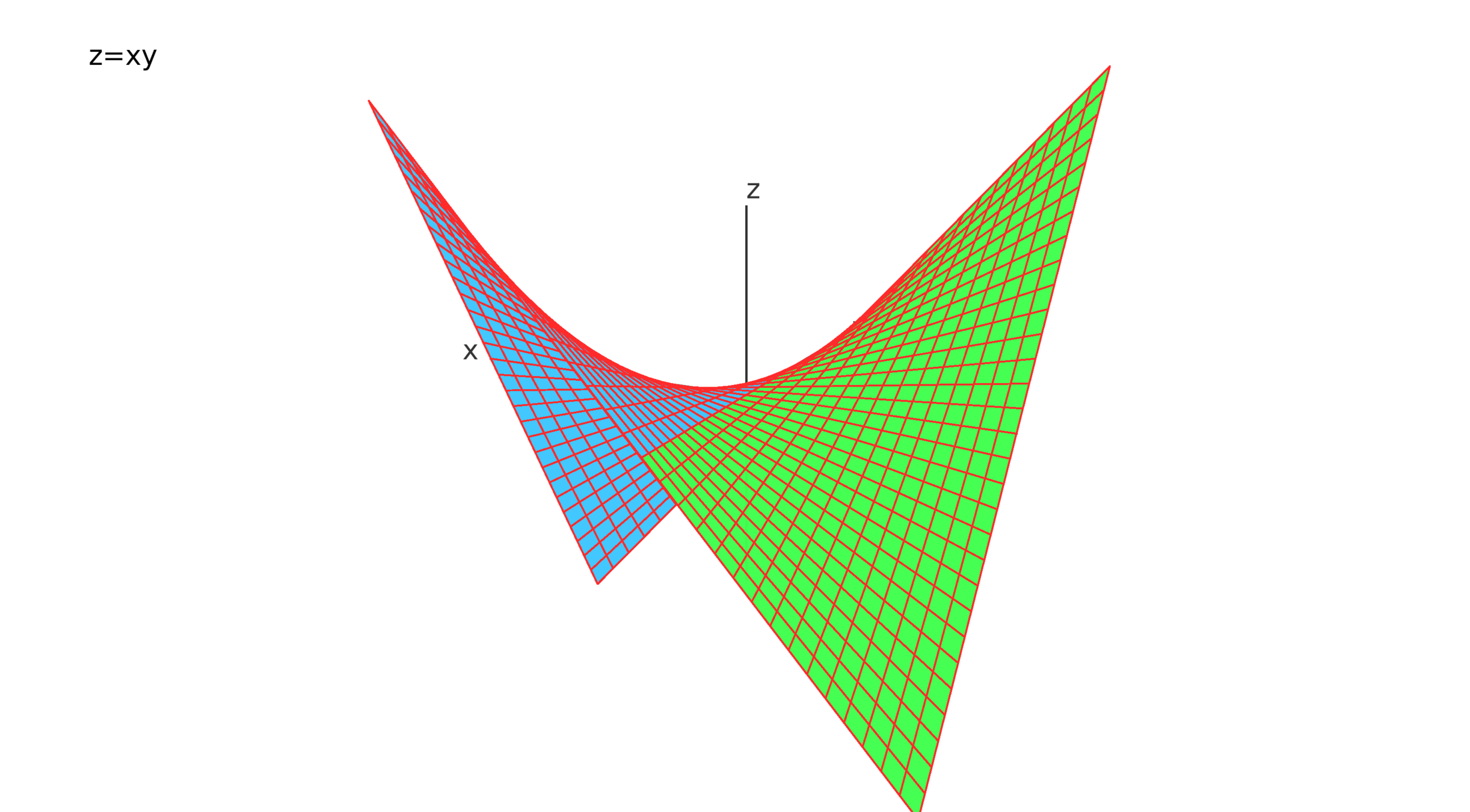
The surface \(z=xy\)
Eigenbasis gives cluster patterns
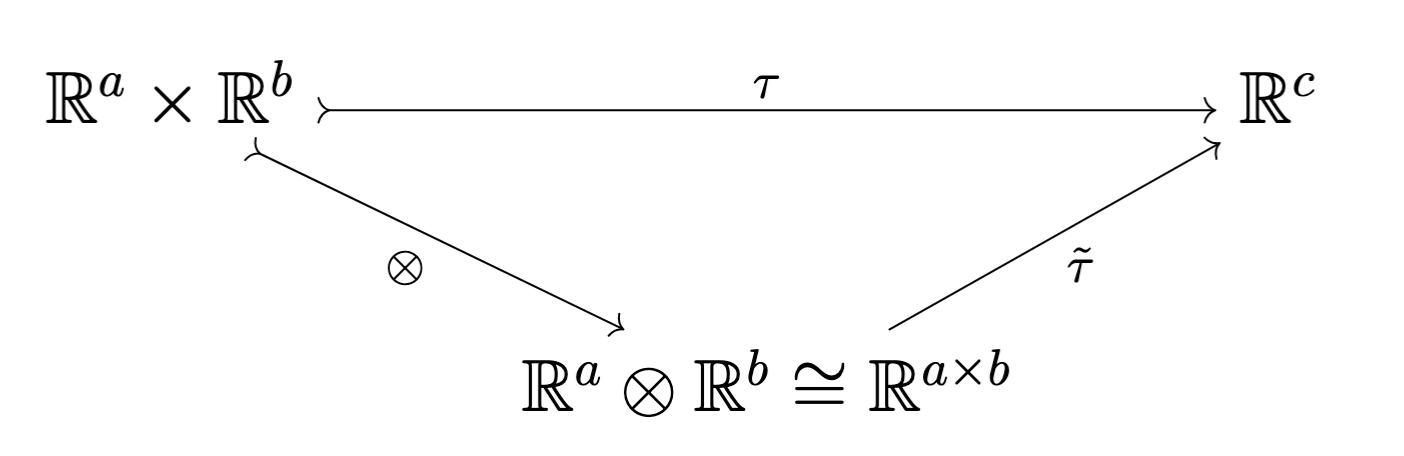
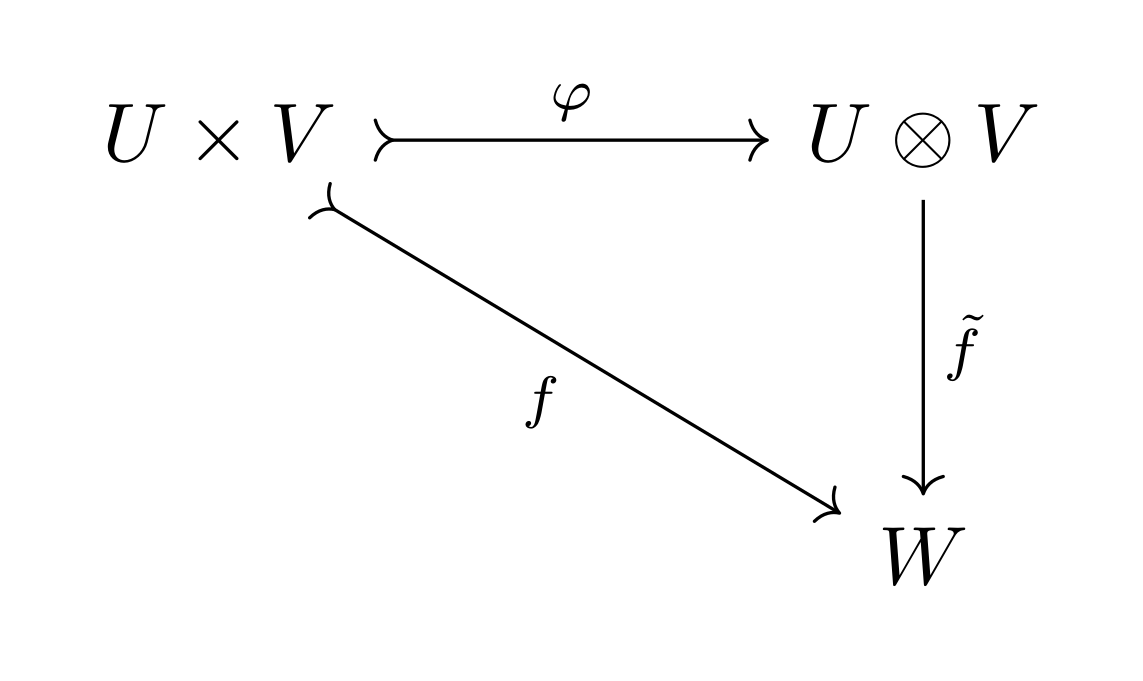
Given \(U,V\) vector spaces, the tensor product space is \( (U \otimes V, \varphi: U \times V \rightarrowtail U \otimes V) \)
such that for all bilinear maps \(f: U \times V \rightarrowtail W\), there exists unique induced linear map \(\tilde{f}: U \otimes V \rightarrow W\) such that \(f(u,v) = \tilde{f}(\varphi(u,v))\).
"Theorem" (L.)
Faster algorithms to compute the adjoint and derivation algebra of tensors
Three step algorithm
Let \(A \in \mathbb{F}^{a \times b \times c} \)
\( (R,S,T) = (A,-A, 0) \) gives adjoint
(Joint with James B. Wilson, Joshua Maglione)
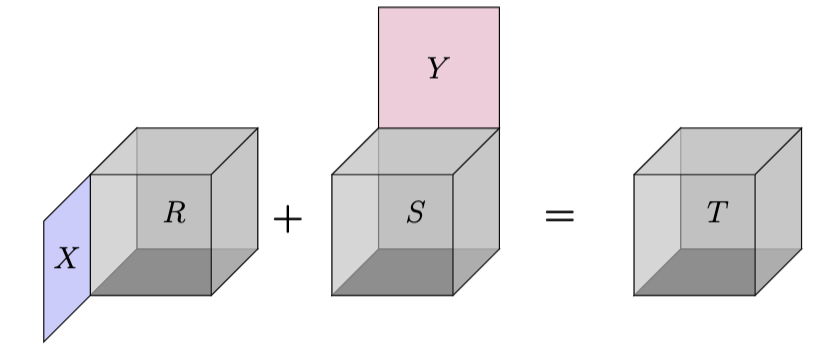
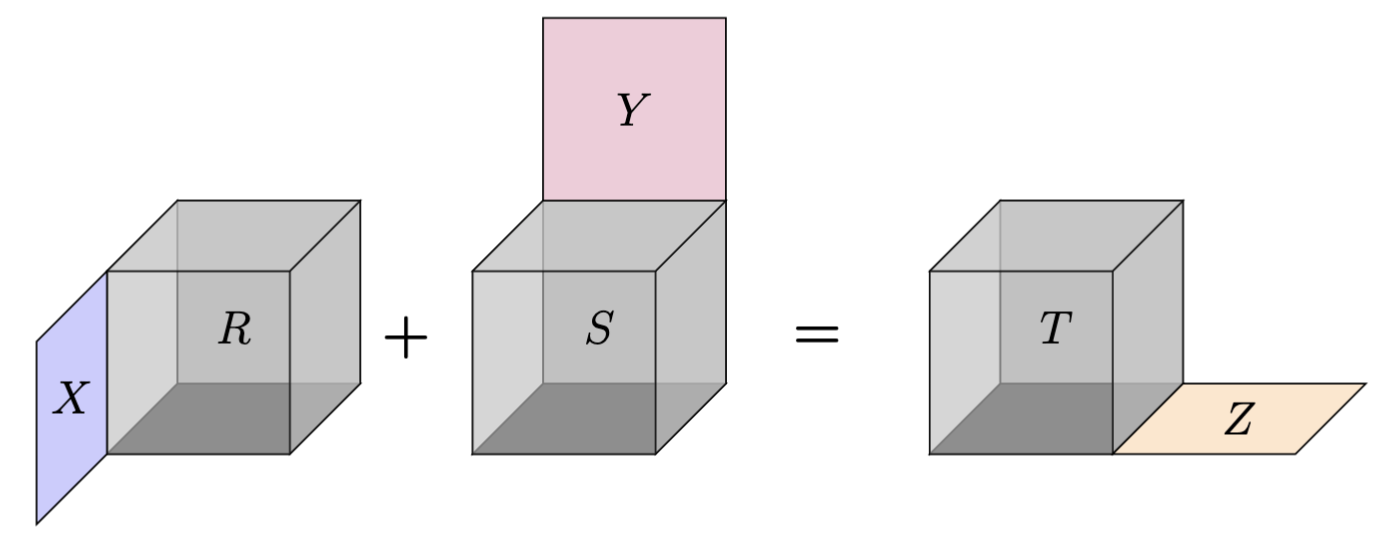
Given
Find
Such that
Recall given \( t: \mathbb{F}^{a} \times \mathbb{F}^{b} \rightarrowtail \mathbb{F}^{c} \) $$\operatorname{Adj}(t) = \{(X,Y) \mid (\forall u,v)\;\; t(Xu,v) = t(u,Yv)\}$$
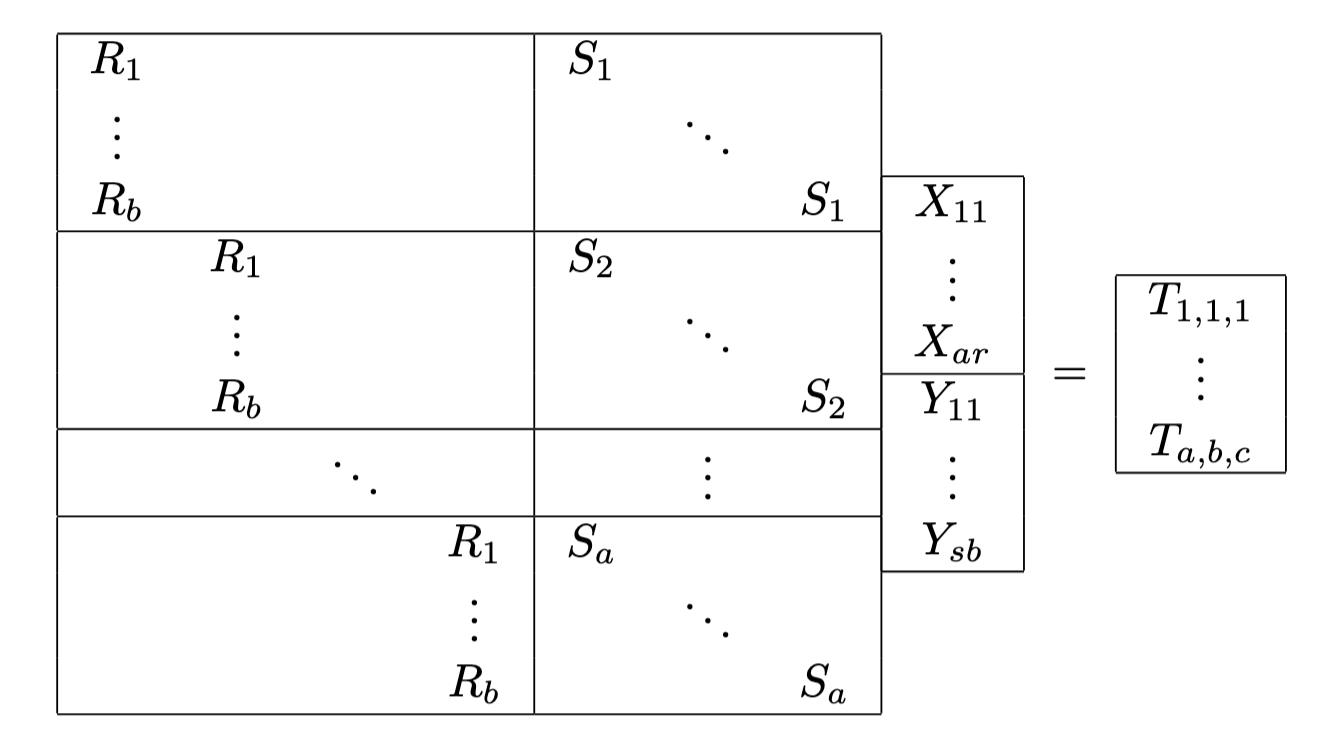
Corresponding linear system
(LMW) Idea: Avoid big linear system altogether with a solve-lift-check approach
Linear system given by matrix of size \( (abc) \times (ar + bs) \) is \(O(n^7) \) to solve
(complexity statements made with respect to \(n = a+b+c+r+s \) )
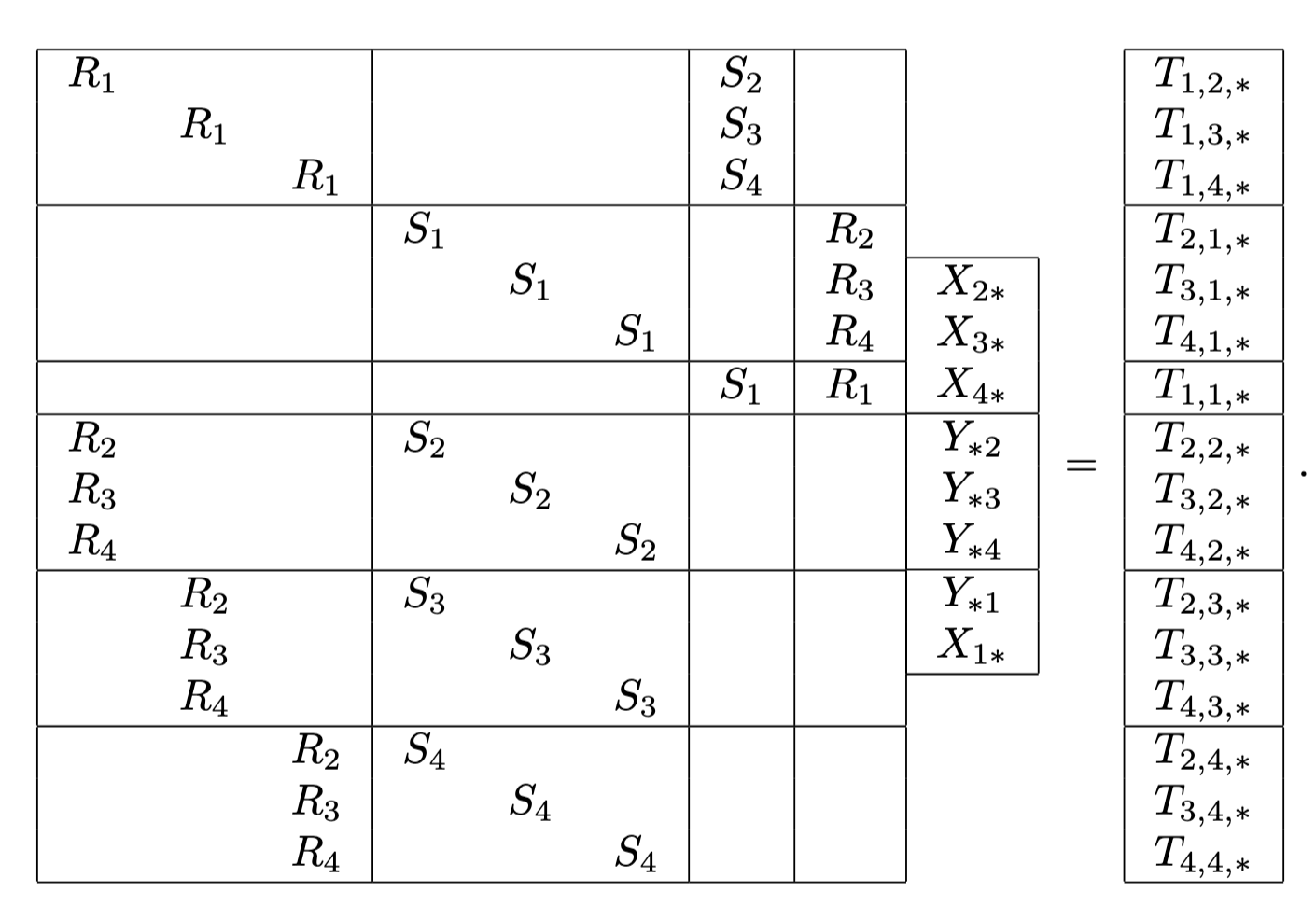
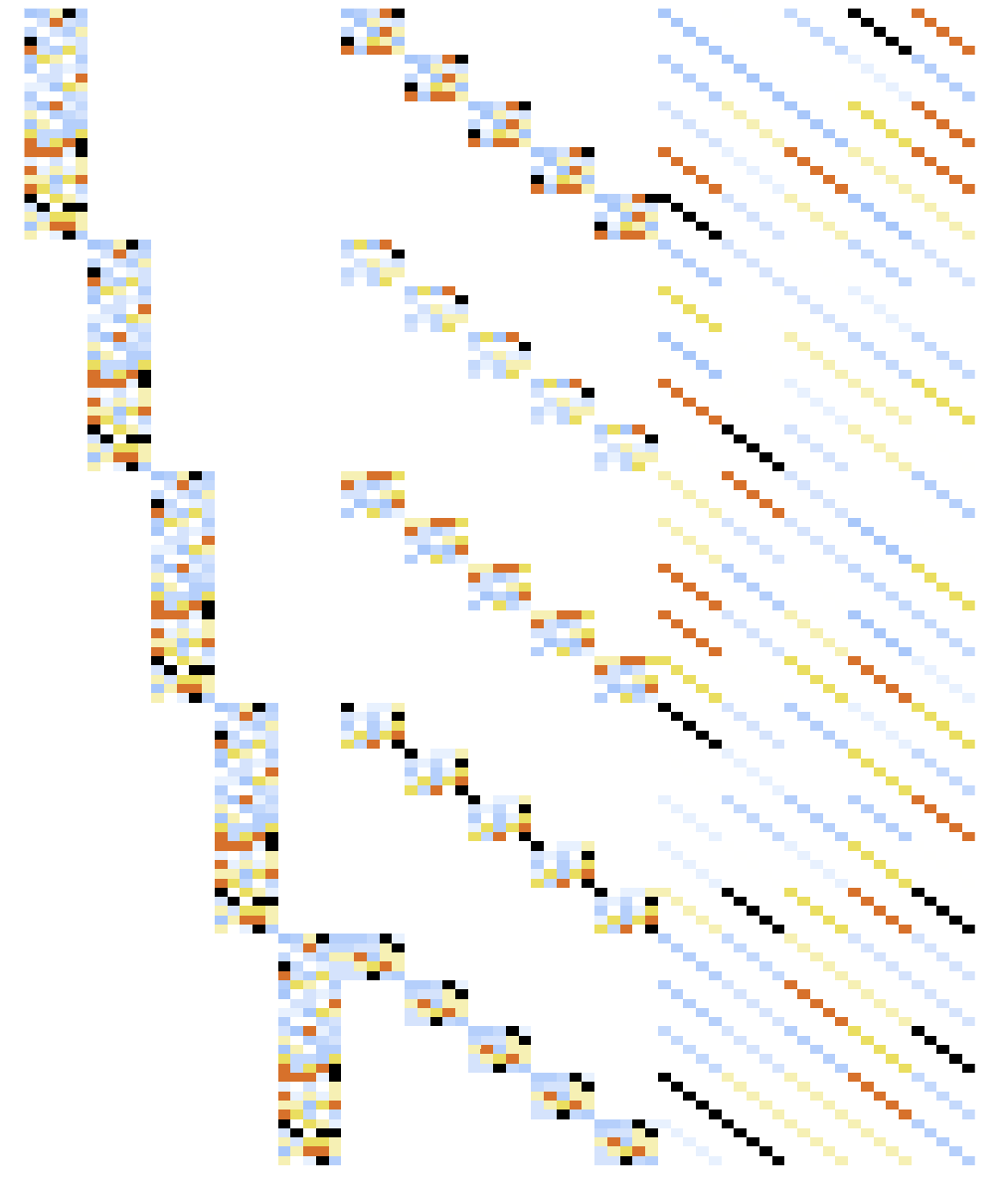
Permute rows & columns
Idea: solve-lift-check approach
\( I \)
\( J \)
\( M_R \)
\( M_S \)
(L.) Distill to
Given \(M \in \mathbb{F}^{m \times n} \), and \( N: \Theta \rightarrow \mathbb{F}^{m \times \ell} \) affine map, solve for \(X \in \mathbb{F}^{n \times \ell} \)
Given matrices \(A,B\) and constants \( \alpha, \beta\), solve for all pairs \( (u,v) \)
regular family of instances
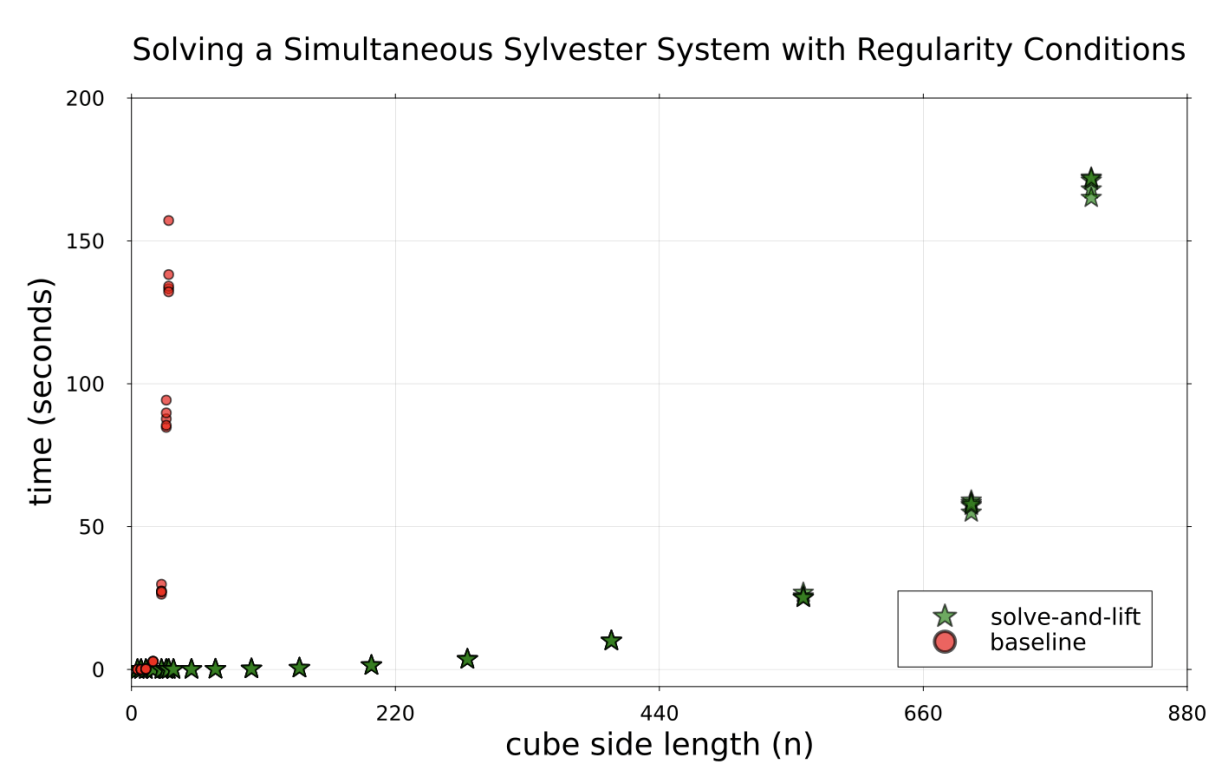
Theorem A (L.)
Given a regular family, and a black-box algorithm for \( (I,J) \), the solve-and-lift approach takes \(O(n^4)\) arithmetic operations for deterministic solutions.
Remark - The black-box restriction algorithm is to prove determinstic runtimes. \( \exists \) randomized algorithms.
\( I \)
\( J \)
\( M_R \)
\( M_S \)
Recall backsub \( M_R X = N_R(Y_{DR}) \), \( M_S Y = N_S(X_{DR}) \)
Assumption is reasonable for natural classes of instances (e.g generic cubic tensors with overdetermined restricted system)
Let \(A \in \mathbb{F}^{a \times b \times c} \)
\( (R,S,T) = (A,A, A) \) gives derivation
Recall given \( t: \mathbb{F}^{a} \times \mathbb{F}^{b} \rightarrowtail \mathbb{F}^c \)
$$\operatorname{Der}(t) = \{(X,Y,Z) \mid (\forall u,v) \; Z(t(u,v)) = t(Xu,v) + t(u,Yv) \}$$
Given
Find
Such that
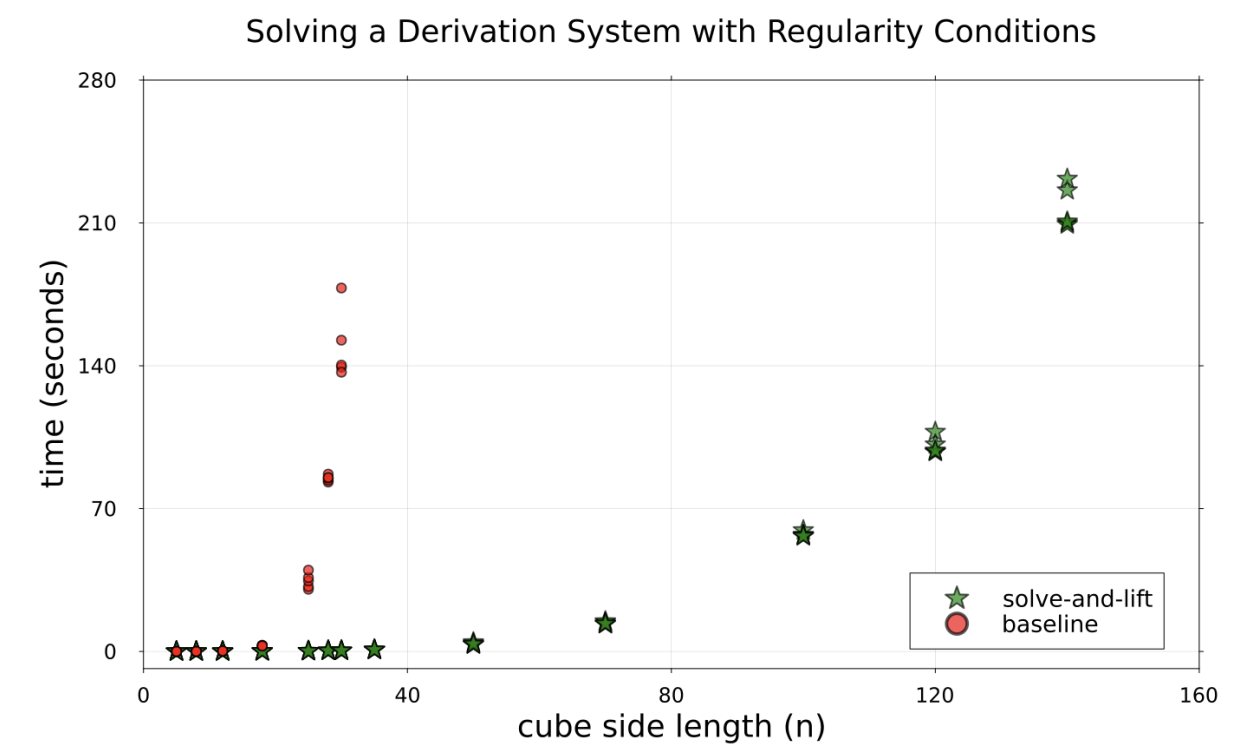
Theorem B (L.)
Given a regular family, and a black-box algorithm for \( (I,J,K) \), the solve-and-lift approach takes \(O(n^{4.5})\) arithmetic operations for deterministic solutions.
Analogous derivation regular family ensure the bounded dimension, and unique lifting property
Remark - Extra \( n^{0.5} \) factor is due to the triple restricted system needing to solve a linear system of \( O(n^{1.5})\) variables
\( \text{Der}(t) \) is nullspace of
Extras cut for time
Remark - As \(O(n^4)\) cost is needed to determinstically verify a solution, this is the best complexity for a determinstic solution we can expect.
"Theorem" (L.)
Decomposing the algebraic invariants of the product of tensors
Let \( A, B \) be unital associative \( \mathbb{F} \)-algebras
\( A \otimes B \) is a unital associative \(\mathbb{F}\)-algebra, with multiplication
\[ (a \otimes b)(c \otimes d) = ac \otimes bd \]
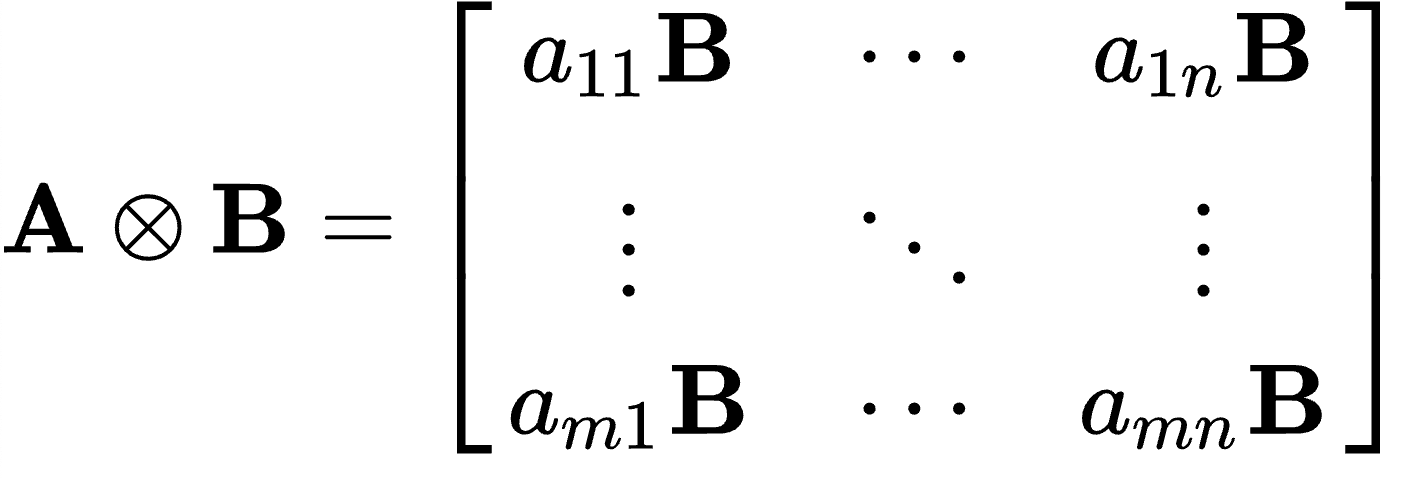
Example: Kronecker product of matricies
Example: Extending scalars (Recall \( \mathbb{H} \) are the Quaternions)
\( u = i_{\mathbb{H}} \otimes i_{\mathbb{C}} \) satisfies \( u^2 = 1 \), so the idempotent \(\frac{1+u}{2} \) splits the algebra
\[ 1 \otimes 1 \mapsto \begin{bmatrix}1 & 0 \\ 0 & 1\end{bmatrix}, i \otimes 1 \mapsto \begin{bmatrix}i & 0\\ 0 & -i\end{bmatrix}, j \otimes 1 \mapsto \begin{bmatrix}0 & 1\\-1 & 0\end{bmatrix}, k \otimes 1 \mapsto \begin{bmatrix}0 & i \\ i & 0\end{bmatrix}\]
Define on multiplication tables
\(\frac{\mathbb{F}[y]}{y^2+5y+10} \)
\( \mathbb{F}[\sqrt{-1}] \)
Let \( s: U \times V \rightarrowtail W \) and \(t: X \times Y \rightarrowtail Z \)
Define \( s \otimes t: (U \otimes X) \times (V \otimes Y) \rightarrowtail (W \otimes Z) \) as
\[ (s \otimes t)(u\otimes x, v \otimes y) = s(u,v) \otimes t(x,y) \]
Let \(s: \mathbb{F}^2 \times \mathbb{F} \rightarrowtail \mathbb{F}^2 \) and \( t: \mathbb{F} \times \mathbb{F}^3 \rightarrowtail \mathbb{F}^3 \) both be bilinear maps corresponding to scaling by \( \mathbb{F} \)
\( s \otimes t \) is a bilinear map from \( (\mathbb{F}^2 \otimes \mathbb{F}) \times (\mathbb{F} \otimes \mathbb{F}^3)\) to \((\mathbb{F}^2 \otimes \mathbb{F}^3) \)
\( s \otimes t \cong r \), for \(r: \mathbb{F}^2 \times \mathbb{F}^3 \rightarrowtail \mathbb{F}^6 \) the outer product tensor
Example
Let \(t: U \times V \rightarrowtail W\). For \(\alpha \in \operatorname{End}(U), \beta \in \operatorname{End}(V), \gamma \in \operatorname{End}(W)\), axis actions are
$$\mathcal{L}(t) = \{(\alpha, \gamma) : t \bullet_2 \alpha = t \bullet_0 \gamma \}$$
$$\mathcal{M}(t) = \{(\alpha, \beta) : t \bullet_2 \alpha = t \bullet_1 \beta \}$$
$$\mathcal{R}(t) = \{(\beta, \gamma) : t \bullet_1 \beta = t \bullet_0 \gamma \}$$
$$\mathcal{C}(t) = \{(\alpha, \beta, \gamma) : t \bullet_2 \alpha = t \bullet_1 \beta = t \bullet_0 \gamma \}$$
$$\operatorname{Der}(t) = \{(\alpha, \beta, \gamma) : t \bullet_2 \alpha + t \bullet_1 \beta = t \bullet_0 \gamma \}$$
left nucleus
mid nucleus (adjoint)
right nucleus
centroid
derivation
Theorem C (L.)
Let \(s: U_2 \times U_1 \rightarrowtail U_0\) and \(t: V_2 \times V_1 \rightarrowtail V_0 \) be fully non-degenerate bilinear maps. Then
$$\mathcal{L}(s \otimes t) = \mathcal{L}(s) \boxtimes \mathcal{L}(t)$$
$$\mathcal{M}(s \otimes t) = \mathcal{M}(s) \boxtimes \mathcal{M}(t)$$
$$\mathcal{R}(s \otimes t) = \mathcal{R}(s) \boxtimes \mathcal{R}(t)$$
Definition (\( \boxtimes \))
Let \(a = (\alpha_2, \alpha_1, \alpha_0) \), and \(b = (f_2, f_1, f_0) \), where \( \alpha_i \in \operatorname{End}(U_i) \), and \(f_i \in \operatorname{End}(V_i) \)
Corollary (Wilson Propositions 7.8 and 7.9, "Decomposing \(p\)-groups via Jordan Algebras")
Let \(d: U \times U \rightarrowtail C\) be a nondegenerate Hermitian \(C\)-form and \(b: V \times V \rightarrowtail W \) a \(k\)-bilinear map. Then \( \operatorname{Adj}(d \otimes b) = \operatorname{Adj}(d) \otimes \operatorname{Adj}(b) \).
Define \(a \boxtimes b \coloneqq (\alpha_2 \otimes f_2, \alpha_1 \otimes f_1, \alpha_0 \otimes f_0) \), where \(\alpha_i \otimes f_i \in \operatorname{End}(U_i \otimes V_i) \)
Suppose \( (x,y) \in \mathcal{M}(s \otimes t) \), meaning \( (s \otimes t) \bullet_2 x = (s \otimes t) \bullet_1 y \)
Powered by isomorphism \(\operatorname{Bil}(U_2 \otimes V_2, U_1 \otimes V_1; U_0 \otimes V_0) \cong \operatorname{Bil}(U_2, U_1; U_0) \otimes \operatorname{Bil}(V_2, V_1; V_0) \)
Decompose \( x = \alpha_1 \otimes f_1 + \alpha_2 \otimes f_2 \) and \( y = \beta_1 \otimes g_1 + \beta_2 \otimes g_2 \)
\( (\tilde{\alpha}_i, \beta_i) \in \mathcal{M}(s) \)
\( (\tilde{f}_i, g_i) \in \mathcal{M}(t) \)
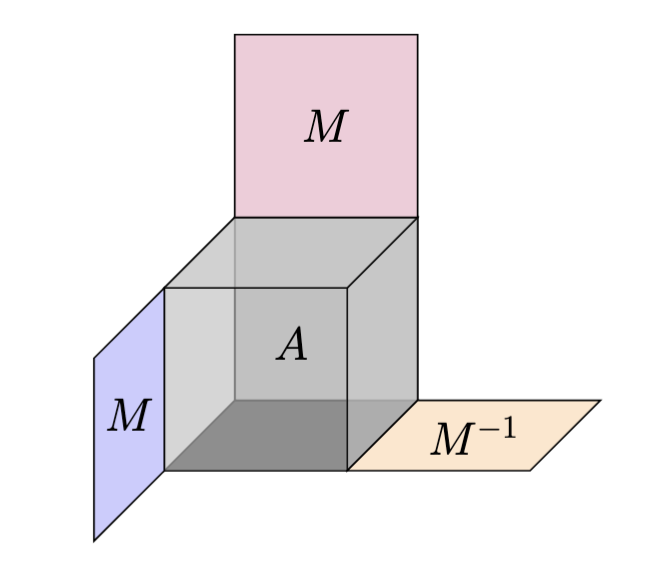
\(\exists M\) where \(AM = B\) and \(M^{-1}X = Y\)
\(AX = BY \) minimal rank factorizations
Upshot: global equality leads to local equalities
Field is \( \mathbb{F}_5 \)
\( \operatorname{col}(A)=\operatorname{col}(AX)=\operatorname{col}(BY)=\operatorname{col}(B) \)
If all nonzero, then up to scalars, either
$$a=b=c \text{ and } x+y=z$$
or
$$a+b=c \text{ and } x=y=z$$
(Grad student's dream)
\( \operatorname{Der}(s \otimes t) = \operatorname{Der}(s) \boxtimes \operatorname{Der}(t) \)
But alas, not the case.
Consider \(a \otimes x + b \otimes y = c \otimes z\), a triple in \( \operatorname{Der}(s \otimes t) \)
In \( \operatorname{Der}(s) \boxtimes \operatorname{Der}(t) \) means that both
Why?
Must have shared factor for sum of two pure tensors to be rank 1
Instead, term in either \( \mathcal{C}(s) \boxtimes \operatorname{Der}(t) \) or \( \operatorname{Der}(s) \boxtimes \mathcal{C}(t) \)
The nuclei case applies when one term is zero
Theorem D (L.)
Let \(s: U_2 \times U_1 \rightarrowtail U_0\) and \(t: V_2 \times V_1 \rightarrowtail V_0 \) be fully non-degenerate bilinear maps.
Then
Corollary (Benkart-Osborn, Corollary 4.9, Derivations and Automorphisms of Nonassociative Matrix Algebras)
Let \(A\) be a unital algebra. Then \( \operatorname{Der}(\mathbb{M}_n(A)) = I_n \otimes \operatorname{Der}(A) + \operatorname{ad}(\mathbb{M}_n(\operatorname{Nuc}(A))) \)
Recall for \(u \in \operatorname{End}(A)\), the adjoint action \(\operatorname{ad}(u) \in \operatorname{Der}(A) \) is \( x \mapsto ux - xu \)
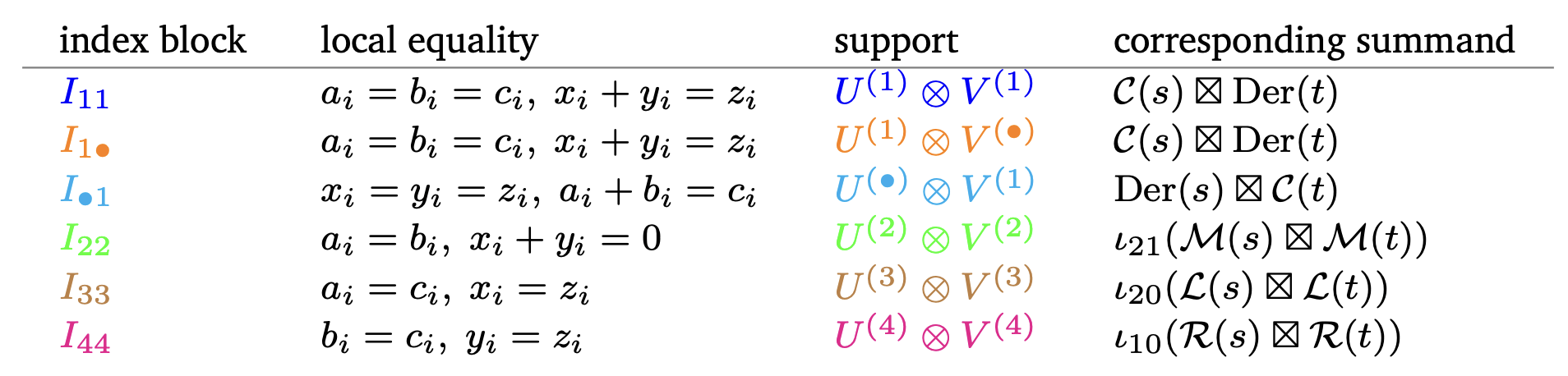
A Locally Independent Unified (LIU)-decomposition of \( (p,q,r) \) consists of a natural number \(n\) and vectors \(a_i \in A, x_i \in X, b_i \in B, y_i \in Y, c_i \in C, z_i \in Z\) such that
Example
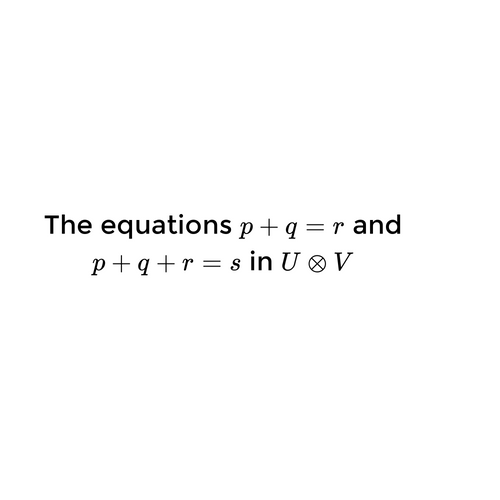
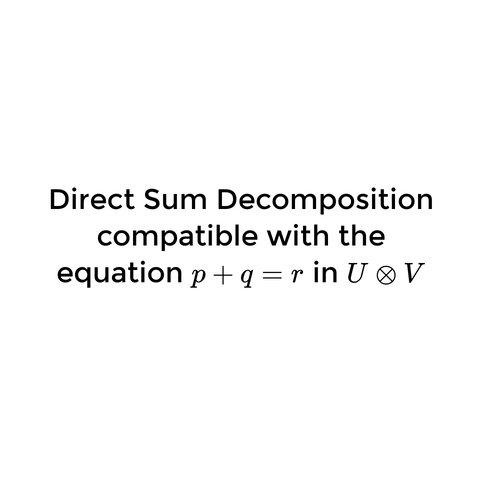
\(p+q=r\), with
Local equalities:
Definition
Let \(p \in A \otimes X \leq U \otimes V\), \(q \in B \otimes Y \leq U \otimes V\), and \(r \in C \otimes Z \leq U \otimes V\) satisfy \(p+q=r\).
Lemma: Let \( (p,q,r) \) be a triple satisfying \(p+q=r\). Then \( (p,q,r) \) has a LIU-decomposition.
Idea: Decompose \(U = \bigoplus_{i=1}^{6} U^{(i)} \) and \(V = \bigoplus_{i=1}^{6} V^{(i)} \)
in aligned basis
\(p+q=r\) over \( \mathbb{F}_{997} \)
Fix to Grad Student's Dream
Theorem: There exists examples for \(p \in A \otimes X \leq U \otimes V\), \(q \in B \otimes Y \leq U \otimes V\), \(r \in C \otimes Z \leq U \otimes V\), and \(s \in D \otimes W \leq U \otimes V\) satisfying \(p+q+r\) without a LIU-decomposition.
Proof:
Work over \( \mathbb{F} = \mathbb{F}_5 \), and let \(U,V = \mathbb{F}^4 \), with standard bases
\( D = \text{span}\{e_1,e_2\} \leq U, W = \text{span}\{f_1,f_2\} \leq V \)
\( A = \text{span}\{e_1 + e_3, e_2 + e_4 \}, B =\text{span}\{e_1 - e_3, e_2 - e_4 \}, C = \text{span}\{e_1 + e_4, e_2 + 4e_3+ 4e_4 \} \)
\( X = \text{span}\{f_1 + f_3, f_2 + f_4 \}, Y =\text{span}\{f_1 - f_3, f_2 - f_4 \}, Z = \text{span}\{f_1 + 4f_4, f_2 + f_3+ 4f_4 \} \)
As notation, we shall denote \(A = \text{span}\{e_1+e_3 \eqqcolon a_1, e_2+e_4 \eqqcolon a_2\}, B = \text{span}\{b_1,b_2\}\), and so on
Then let
This quadruple satisfies \(p+q+r = s\), with \(p \in A \otimes X, q \in B \otimes Y, r \in C \otimes Z, s \in D \otimes W \), and no local equality exists because any nonzero element of \((A \otimes X + B \otimes Y + C \otimes Z) \cap (D \otimes W)\) is rank 2. (Magma calculation)
This example was created so elements in the intersection has to satisfy
And choosing \(J\) such that \(S \in \mathbb{F}[J] \) is invertible
SKIP DUE TO TIME
If \((x,y) \in \mathcal{M}(s \otimes t) \), the equation \( (s \otimes t)\bullet_2 x = (s \otimes t) \bullet_1 y \) is matrix equality by \( (*) \)
For \(AX = (s \otimes t) \bullet_2 x = (s \otimes t) \bullet_1 y = BY\) minimal rank factorizations, each column of \(A\) is in \(\operatorname{CS}(B) \), and each row of \(X\) is in \(\operatorname{RS}(Y)\)
Extras that I cut
Corollary (Brešar, Theorem 3.1, Derivations of Tensor Products of Nonassociative Algebras)
Let \(R\) and \(S\) be non-associative algebras.
Then every derivation of \(R \otimes S\) can be written as \(d = \operatorname{ad}(u) + \sum_{j=1}^{p} \lambda_{z_j} \otimes f_j + \sum_{i=1}^{q} g_i \otimes \lambda_{w_i} \), where \(u \in \operatorname{Nuc}(R) \otimes \operatorname{Nuc}(S) \), \(z_j \in Z(R)\), \(f_j \in \operatorname{Der}(S) \), and \(g_i \in \operatorname{Der}(R) \)
Corollary - \( \mathcal{C}(s \otimes t) = \mathcal{C}(s) \boxtimes \mathcal{C}(t) \)
\( I \)
\( J \)
\( M_R \)
\( M_S \)
By Chris Liu