Strategic Environments
Christopher Makler
Stanford University Department of Economics
Econ 51: Lecture 7
pollev.com/chrismakler
Name a company.
- Motivation: why game theory?
- Components of a game
- Describing a static game
- Dominant strategies and the prisoners' dilemma
- Weakly dominant strategies
Today's Agenda
- Up until now: agents only (really) interact with "the market" via prices
- In real life, people, firms, countries ("players") interact with each other.
- Our economic lives are interconnected: our well-being doesn't depend only on our own actions, but on the actions taken by others
- Questions:
- OPTMIZATION: How do you operate in a world like this?
- EQUILIBRIUM: What is our notion of "equilibrium" in a world like this, and how is it different from competitive equilibrium?
- POLICY: Given how people behave in strategic settings, how can we design "mechanisms" to achieve policy goals?
Motivation
- The branch of economics that studies strategic interactions between economic agents.
- Everyone's payoffs depend on the actions chosen by all agents
- To "play the game," each agent thinks strategically about how the other agents are playing
Game Theory
-
Industrial organization: situations where a few firms dominate the market,
and each firm's decisions affect others -
Political economy: campaigning, governing, international diplomacy,
provision of public goods - Contract negotiations: incentive structures, credible threats, negotiating over price
- Interpersonal relationships: team dynamics, division of chores within a family
Applications
- Weeks 4-5: Static Games
- Lecture 7: When your best move doesn't depend on the other player
- Lecture 8: When it does, how do you best respond?
- Lecture 9: Best-response (Nash) equilibrium
- Week 6: Dynamic games
- Lecture 10: Dynamic games & subgame perfection
- Lecture 10: Repeated games
- Wednesday Eveing of Week 7: Checkpoint II
Next Three Weeks:
Games of Complete & Perfect Information
- Players: who is playing the game?
- Actions: what can the players do at different points in the game?
- Information: what do the players know when they act?
- Outcomes: what happens, as a function of all players' choices?
- Payoffs: what are players' preferences over outcomes?
Components of a Game
- Outcomes: what happens, as a function of all players' choices?
- Payoffs: what are players' preferences over outcomes?
1
2
2.5
2.5
,
2
3.5
,
3
3
,
3.5
2
,
E
N
E
N
1
2
E
N
E
N
Outcomes (Grades)
"Did all the extra credit, then got graded on a curve"
Payoffs (utils)
B
B
,
C
A
,
B
B
,
A
C
,
Notation
Strategy for player \(i\):
Strategy space for player \(i\):
S_1 = \{E,N\}
s_1 = E
Strategy profile:
s_i
S_i
(s_1, s_2, ..., s_n)
S_2 = \{E,N\}
s_2 = N
(\ \ \ ,\ \ \ \ )
E
N
(a complete, contingent plan for how player \(i\) will move)
(set of all possible strategies for player \(i\))
(list of strategies chosen by each player \(i = 1,2,...,n\))
Definition: Normal-Form Game
List of players: \(i = 1, 2, ..., N\)
Strategy spaces for each player, \(S_i = \{S_1, S_2,...S_N\}\)
Payoff functions for each player \(i: u_i(s)\),
where \(s = (s_1, s_2, ..., s_N)\) is a strategy profile
listing every player's chosen strategy.
i = \text{Player }i
-i = \text{Player(s) other than }i
\text{Example: Consider a strategy profile for four players }s = (s_1, s_2, s_3, s_4)
\text{If we consider player 2, then }s_i = s_2 \text{ and } s_{-i}=(s_1, s_3, s_4)
u_i(s_i,s_{-i}) = \text{Player $i$'s utility from playing $s_i$ when others play $s_{-i}$}
Notation Convention
Applications of Game Theory:
Strategic Interactions between Small Numbers of Agents
- Very realistic - lots of examples, from families to international diplomacy
- Models of oligopoly
- 1838: Cournot
- 1883: Bertrand
- 1929: Hotelling
- 1934: Stackelberg
- Mid-20th century: John Nash formalized and generalized the notion of strategic equilibrium among small numbers of agents


If you're interested in this stuff..


Cournot Duopoly
- Two firms ("duo" in duopoly)
- Each chooses how much to produce (quantity competition)
- Market price depends on the total amount produced
- Each firm faces a residual demand curve
based on the other firm's choice
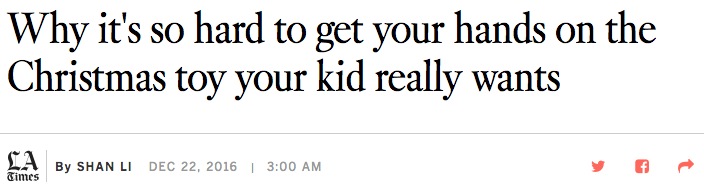
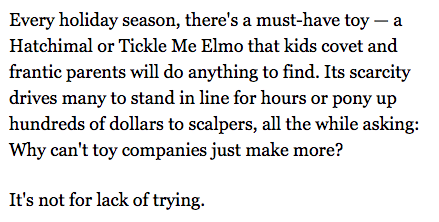
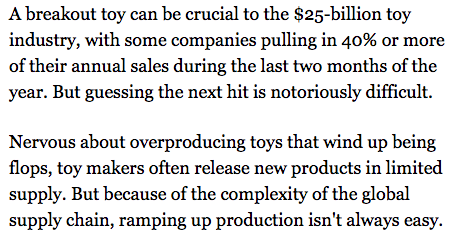
Simple case: linear demand, constant MC, no fixed costs
\text{No fixed costs }\Rightarrow MC = AC = 2
P(q_1,q_2) = 14 - (q_1+q_2)
c_i(q_i) = 2q_i
P(q_1,q_2) = 14 - (q_1+q_2)
c_i(q_i) = 2q_i
\pi_i(q_i,q_{-i}) = P(q_i,q_{-i})q_i - c_i(q_i)
= (14 - q_i - q_{-i})q_i - 2q_i
\text{total revenue}
2
$/unit
P(q_i|q_{-i}) = 14 - q_i - q_{-i}
MC = 2
"Firm \(i\)'s Residual Demand Curve"
Total Revenue
q_i
Units produced by firm \(i\)
P
P(q_1,q_2) = 14 - (q_1+q_2)
c_i(q_i) = 2q_i
\pi_i(q_i,q_{-i}) = P(q_i,q_{-i})q_i - c_i(q_i)
= (14 - q_i - q_{-i})q_i - 2q_i
\text{total revenue}
\text{total cost}
2
P(q_i|q_{-i}) = 14 - q_i - q_{-i}
MC = 2
"Firm \(i\)'s Residual Demand Curve"
Profit
q_i
P
TOTAL COST
$/unit
Units produced by firm \(i\)
Dominant Strategies and the Prisoners' Dilemma
Strict Dominance
One strategy strictly dominates another strategy
if it always yields a strictly higher payoff
no matter what the other players do.
Top strictly dominates Bottom.
1
2
Top
Bottom
Left
Right
2
5
,
1
0
,
4
1
,
5
5
,
pollev.com/chrismakler
Which strategy strictly dominates another one for a player?
Formal Definition: Strict Dominance
\text{We say strategy }s_{i}\text{ \textbf{strictly dominates} strategy }s_i^\prime \text{ for player }i\text{ if}
u_i(s_i,s_{-i}) > u_i(s'_i,s_{-i})
\text{ for every possible strategy played by the other player(s) }s_{-i} \in S_{-i}
In plain English: my utility from playing strategy \(s_i\)
is strictly greater than my utility from playing strategy \(s_i^\prime\),
no matter what the other players(s) are doing.
\text{ player }i\text{'s payoff from }s_i
\text{ player }i\text{'s payoff from }s'_i
- Players: prisoners being interrogated in separate rooms.
- Strategies: "confess" or "deny"
- Payoffs:
- If they both deny, the prosecutor doesn't have much to go on, so they each get a light sentence.
- If they confess while the other denies, they go free.
- If they both confess, they both go to jail for a long time.
Prisoners' Dilemma
1
2
Confess
Deny
Confess
Deny
-5
-5
,
-10
0
,
-1
-1
,
0
-10
,
If you believe the other person will confess,
what is your best response?
If you believe the other person will deny, what is your best response?
Confess
Confess
Because Confess aways results in a
strictly higher payoff than Deny,
Confess strictly dominates Deny.
Prisoners' Dilemma
(D,D) pareto dominates (C,C)
(C,C) is a dominant strategy equilibrium
The First Strategic Dilemma:
Everyone doing what's best for themselves can lead to a group loss.
1
2
Confess
Deny
Confess
Deny
-5
-5
,
-10
0
,
-1
-1
,
0
-10
,


The First Strategic Tension:
Everyone doing what's best for themselves can lead to a group loss.
Golden Balls
Split
Split
Steve
Tracy
Steal
Steal
20K
20K
40K
0
0
40K
0
0
Two players earn money over multiple rounds; in the final round, they each have to choose "split" or "steal."
If they each choose split, they split the money.
If one chooses split and the other chooses steal, the one who steals gets it all.
If they both choose steal, they both go away with nothing.
Weak Domination
Dominance
One strategy weakly dominates another strategy
if it never yields a strictly lower payoff but sometimes yields a higher payoff,
no matter what the other players do.
Top strictly dominates Bottom.
1
2
Top
Bottom
Left
Right
2
5
,
1
0
,
4
1
,
5
5
,
pollev.com/chrismakler
Which strategy weakly dominates another one for a player?
Formal Definition: Weak Dominance
\text{We say strategy }s_{i}\text{ \textbf{weakly dominates} strategy }s_i^\prime \text{ for player }i\text{ if}
u_i(s_i,s_{-i}) \ge u_i(s'_i,s_{-i})
\text{ for every possible strategy played by the other player(s) }s_{-i} \in S_{-i}
In plain English: my utility from playing strategy \(s_i\)
is greater than or equal to my utility from playing strategy \(s_i^\prime\),
no matter what the other players(s) are doing.
\text{ player }i\text{'s payoff from }s_i
\text{ player }i\text{'s payoff from }s'_i
Auctions
Private-Value Auctions
A single object is being auctioned off. Rules of the auction:
- each player \(i\) submits bid \(b_i\)
- a rule determines who gets the object, and how much they pay,
as a function of the vector of bids \(b = (b_1, b_2, \cdots, b_n)\) - examples of rules:
-
who gets the object?
- today: always the highest bidder
-
sealed-bid vs. open bid: are bids public information?
- today: sealed bid, so the game is a simultaneous game
-
first-price vs. second-price: what does the winner pay, based on the bids?
- first-price: the winner pays their own bid
- second-price: the winner pays the second-highest bid
-
who gets the object?
Auction Payoffs
u_i(v_i,b) = v_i - b
Each player \(i\) knows their own valuation of the object, \(v_i\).
(We can think of this as a move by nature that occurs before the game begins.)
If you win the auction and pay some amount \(b\), your payoff is
If you lose, your payoff is zero.
We assume there is no additional emotional payoff from the fact that you won or lost.
Second-Price, Sealed-Bid Auction
Bidders simultaneously submit secret bids.
The highest bidder pays the amount of the second highest bid.
What is an optimal bidding strategy?
Nature reveals private valuations \(v_i\),
uniformly distributed along [0, 100].
0
100
v_i
Second-Price, Sealed-Bid Auction
Bidders simultaneously submit secret bids.
The highest bidder pays the amount of the second highest bid.
v_i
0
100
Suppose your valuation is \(v_i = 80\). Let's make a payoff matrix based on your bid and the highest bid other than yours.
Your bid
Highest bid other than yours
80
b_i
90
b_{-i}
65
90
65
15
If you bid 90 and the highest other bid is 65, you win the object and pay 65; payoff is 80 - 65 = 15
Second-Price, Sealed-Bid Auction
Bidders simultaneously submit secret bids.
The highest bidder pays the amount of the second highest bid.
v_i
0
100
Suppose your valuation is \(v_i = 80\). Let's make a payoff matrix based on your bid and the highest bid other than yours.
Your bid
Highest bid other than yours
80
b_i
90
b_{-i}
65
90
65
15
Second-Price, Sealed-Bid Auction
Bidders simultaneously submit secret bids.
The highest bidder pays the amount of the second highest bid.
v_i
0
100
Suppose your valuation is \(v_i = 80\). Let's make a payoff matrix based on your bid and the highest bid other than yours.
Your bid
Highest bid other than yours
80
b_i
90
b_{-i}
75
90
65
15
75
5
Second-Price, Sealed-Bid Auction
Bidders simultaneously submit secret bids.
The highest bidder pays the amount of the second highest bid.
v_i
0
100
Suppose your valuation is \(v_i = 80\). Let's make a payoff matrix based on your bid and the highest bid other than yours.
Your bid
Highest bid other than yours
80
b_i
90
b_{-i}
85
90
65
15
75
5
85
-5
If you bid 90 and the highest other bid is 85, you win the object and pay 85; payoff is 80 - 85 = -5
Second-Price, Sealed-Bid Auction
Bidders simultaneously submit secret bids.
The highest bidder pays the amount of the second highest bid.
v_i
0
100
Suppose your valuation is \(v_i = 80\). Let's make a payoff matrix based on your bid and the highest bid other than yours.
Your bid
Highest bid other than yours
80
b_i
90
b_{-i}
95
90
65
15
75
5
85
-5
95
0
If you bid 90 and the highest other bid is 95, you don't win the object and your payoff is 0.
Second-Price, Sealed-Bid Auction
Bidders simultaneously submit secret bids.
The highest bidder pays the amount of the second highest bid.
v_i
0
100
Suppose your valuation is \(v_i = 80\). Let's make a payoff matrix based on your bid and the highest bid other than yours.
Your bid
Highest bid other than yours
80
b_i
70
b_{-i}
95
90
65
15
75
5
85
-5
95
0
70
0
Second-Price, Sealed-Bid Auction
Bidders simultaneously submit secret bids.
The highest bidder pays the amount of the second highest bid.
v_i
0
100
Suppose your valuation is \(v_i = 80\). Let's make a payoff matrix based on your bid and the highest bid other than yours.
Your bid
Highest bid other than yours
80
b_i
70
b_{-i}
85
90
65
15
75
5
85
-5
95
0
70
0
0
Second-Price, Sealed-Bid Auction
Bidders simultaneously submit secret bids.
The highest bidder pays the amount of the second highest bid.
v_i
0
100
Suppose your valuation is \(v_i = 80\). Let's make a payoff matrix based on your bid and the highest bid other than yours.
Your bid
Highest bid other than yours
80
b_i
70
b_{-i}
75
90
65
15
75
5
85
-5
95
0
70
0
0
0
Second-Price, Sealed-Bid Auction
Bidders simultaneously submit secret bids.
The highest bidder pays the amount of the second highest bid.
v_i
0
100
Suppose your valuation is \(v_i = 80\). Let's make a payoff matrix based on your bid and the highest bid other than yours.
Your bid
Highest bid other than yours
80
b_i
70
b_{-i}
65
90
65
15
75
5
85
-5
95
0
70
0
0
0
15
Second-Price, Sealed-Bid Auction
Bidders simultaneously submit secret bids.
The highest bidder pays the amount of the second highest bid.
b_i=v_i
0
100
Suppose your valuation is \(v_i = 80\). Let's make a payoff matrix based on your bid and the highest bid other than yours.
Your bid
Highest bid other than yours
80
b_{-i}
65
90
65
15
75
5
85
-5
95
0
70
0
0
0
15
80
15
Second-Price, Sealed-Bid Auction
Bidders simultaneously submit secret bids.
The highest bidder pays the amount of the second highest bid.
b_i=v_i
0
100
Suppose your valuation is \(v_i = 80\). Let's make a payoff matrix based on your bid and the highest bid other than yours.
Your bid
Highest bid other than yours
80
b_{-i}
75
90
65
15
75
5
85
-5
95
0
70
0
0
0
15
80
15
5
Second-Price, Sealed-Bid Auction
Bidders simultaneously submit secret bids.
The highest bidder pays the amount of the second highest bid.
b_i=v_i
0
100
Suppose your valuation is \(v_i = 80\). Let's make a payoff matrix based on your bid and the highest bid other than yours.
Your bid
Highest bid other than yours
80
b_{-i}
85
90
65
15
75
5
85
-5
95
0
70
0
0
0
15
80
15
5
0
Second-Price, Sealed-Bid Auction
Bidders simultaneously submit secret bids.
The highest bidder pays the amount of the second highest bid.
b_i=v_i
0
100
Suppose your valuation is \(v_i = 80\). Let's make a payoff matrix based on your bid and the highest bid other than yours.
Your bid
Highest bid other than yours
80
b_{-i}
95
90
65
15
75
5
85
-5
95
0
70
0
0
0
15
80
15
5
0
0
Second-Price, Sealed-Bid Auction
Bidders simultaneously submit secret bids.
The highest bidder pays the amount of the second highest bid.
v_i
0
100
Your bid
Highest bid other than yours
80
90
65
15
75
5
85
-5
95
0
70
0
0
0
15
80
15
5
0
0
Bidding your true valuation is sometimes
better than underbidding, and never worse
Bidding your true valuation is sometimes better than overbidding, and never worse.
Bidding your true valuation is a
weakly dominant strategy!

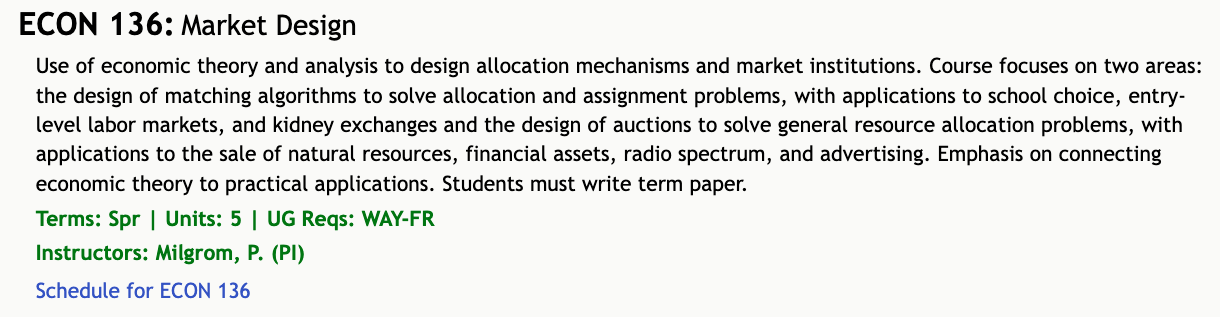
If you're interested in auctions, definitely take Paul Milgrom's Econ 136 class!
Summary
- Today: dominant strategies; your best option doesn't depend on what the other player(s) do
- Next week: best responding to other players
Econ 51 | 07 | Strategic Environments
By Chris Makler
Econ 51 | 07 | Strategic Environments
Notation and definitions