Putting Yourself in Your Opponent's Cleats
Christopher Makler
Stanford University Department of Economics
Econ 51: Lecture 8
Keynesian Beauty Contest (70% Game)
Everyone chooses an integer between 0 and 100.
The closest person to 70% of the average guess wins.
0
100
pollev.com/chrismakler

- Beliefs and Mixed Strategies
- Best Responses to Beliefs
- Best Responses to Strategies
- Dominated Strategies: Never a Best Response
- Iterated Deletion of Strictly Dominated Strategies
Today's Agenda
Mixed Strategies, Beliefs, and Expected Payoffs
(Watson, Chapter 4)
Mixed Strategy
- Play one element of your strategy space
with probability 1, others with probability 0 - Example: "Play heads" or "play tails"
Pure Strategy
- Place positive probability on more than one element of your strategy space
- Example: "Flip a coin and play whatever comes up on top."
Equilibria with mixed strategies are sometimes the only equilibrium!
Penalty Kicks Game
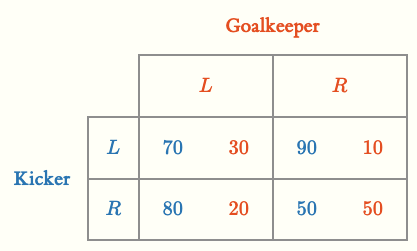
Pure strategy: always choose left or right
Mixed strategy: mix it up!
- Your probability distribution over another player's strategies
- Represents the probability you believe they'll play each strategy (for whatever reason)
Beliefs
- Your probability distribution over your own strategies.
- Represents the probability with which you intend to play each strategy
Mixed Strategies
Mixed strategy for Kicker:
probability distribution
over {Kick Left, Kick Right}
Beliefs for Kicker:
probability distribution
over {Defend Left, Defend Right}
Mixed strategy for Keeper:
probability distribution
over {Defend Left, Defend Right}
Beliefs for Keeper:
probability distribution
over {Kick Left, Kick Right}
2
Expected Payoffs
\({1 \over 6}\)
\({1 \over 3}\)
\({1 \over 2}\)
\(0\)
Player 1's beliefs
\({1 \over 6} \times 6 + {1 \over 3} \times 3 + {1 \over 2} \times 2 + 0 \times 7\)
\(=3\)
Player 1's expected payoffs from each of their strategies
\(X\)
\(A\)
1
\(B\)
\(C\)
\(D\)
\(Y\)
\(Z\)
6
6
,
3
6
,
2
8
,
7
0
,
12
6
,
6
3
,
0
2
,
5
0
,
6
0
,
0
9
,
6
8
,
11
4
,
Your expected payoff from playing one of your strategies
is the weighted average of the payoffs, weighted by your beliefs about what the other person is playing
2
\({1 \over 6}\)
\({1 \over 3}\)
\({1 \over 2}\)
\(0\)
Player 1's beliefs
\(X\)
\(A\)
1
\(B\)
\(C\)
\(D\)
\(Y\)
\(Z\)
6
6
,
3
6
,
2
8
,
7
0
,
12
6
,
6
3
,
0
2
,
5
0
,
6
0
,
0
9
,
6
8
,
11
4
,
pollev.com/chrismakler
Given these beliefs, what is player 1's expected payoff from playing Y?
Expected Payoffs
2
Your expected payoff from playing one of your strategies
is the weighted average of the payoffs, weighted by your beliefs about what the other person is playing
Expected Payoffs
\({1 \over 6}\)
\({1 \over 3}\)
\({1 \over 2}\)
\(0\)
Player 1's beliefs
\({1 \over 6} \times 6 + {1 \over 3} \times 3 + {1 \over 2} \times 2 + 0 \times 7\)
\(=3\)
\({1 \over 6} \times 12 + {1 \over 3} \times 6 + {1 \over 2} \times 0 + 0 \times 5\)
\(=4\)
\({1 \over 6} \times 6 + {1 \over 3} \times 0 + {1 \over 2} \times 6 + 0 \times 11\)
\(=4\)
Player 1's expected payoffs from each of their strategies
\(X\)
\(A\)
1
\(B\)
\(C\)
\(D\)
\(Y\)
\(Z\)
6
6
,
3
6
,
2
8
,
7
0
,
12
6
,
6
3
,
0
2
,
5
0
,
6
0
,
0
9
,
6
8
,
11
4
,
Best Responses
to Beliefs
Domination vs. Best Response
-
Dominant strategy: the best strategy to play
no matter what you believe the other players will do -
Best response: the best strategy (or strategies) to play
given specific beliefs about what the other players will do
Beliefs for Kicker:
probability distribution
over {Defend Left, Defend Right}
Suppose the kicker believed there was a 50% chance the keeper chooses Defend Left.
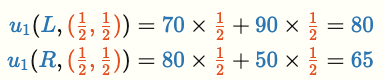
What is her best response?
Kick Left (because 80 > 65)
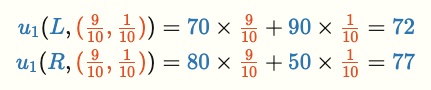
What if she believed there was a 90% chance the keeper chooses Defend Left.
What is her best response?
Kick Right (because 80 > 65)
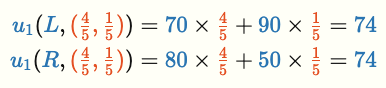
What if she believes that there is an 80% chance the keeper chooses Defend Left?
What is her best response?
Either one!
Suppose the kicker believed there was a 50% chance the keeper chooses Defend Left.
What is her best response?
Kick Left (because 80 > 65)
What if she believed there was a 90% chance the keeper chooses Defend Left.
What is her best response?
Kick Right (because 80 > 65)
What if she believes that there is an 80% chance the keeper chooses Defend Left?
What is her best response?
Either one!
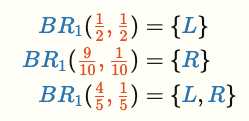
The best response to a belief is the set of strategies
which yield the highest payoffs, given those beliefs.
Definition: Best Response
\text{Let }\theta_{-i}\text{ be player }i\text{'s beliefs about the strategies}
\text{We say }s_{i}\text{ is a \textbf{best response} given }\theta_{-i}\text{ if}
u_i(s_i,\theta_{-i}) \ge u_i(s'_i,\theta_{-i})
\text{ for every available strategy }s'_i \in S_i
In plain English: given my beliefs about what the other player(s) are doing, a strategy is my "best response"
if there is no other strategy available to me
that would give me a higher payoff.
\text{ player }i\text{'s payoff from }s_i
\text{ player }i\text{'s payoff from }s'_i
\text{being played by all players other than player }i
Best Responses to Strategies
Golden Balls
Split
Split
Ibrahim
Nick
Steal
Steal
6.8
6.8
13.6
0
0
13.6
0
0
Two players earn money over multiple rounds; in the final round, they each have to choose "split" or "steal."
If they each choose split, they split the money.
If one chooses split and the other chooses steal, the one who steals gets it all.
If they both choose steal, they both go away with nothing.
Best Response under Strategic Certainty
\text{Let }s_{-i}\text{ be the strategies being played by all players other than player }i
\text{We say }s_{i}^*\text{ is a \textbf{best response} to }s_{-i}\text{ if}
u_i(s_i^*,s_{-i}) \ge u_i(s'_i,s_{-i})
\text{ for every available strategy }s'_i \in S_i
In plain English: given the strategies chosen by the other player(s),
a strategy is my "best response"
if there is no other strategy available to me
that would give me a higher payoff.
\text{ player }i\text{'s payoff from }s_i^*
\text{ player }i\text{'s payoff from }s'_i
Continuous Strategies:
Best Response Functions
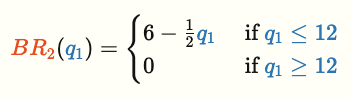
What is firm 2's best response function?
P(q_1,q_2) = 14 - (q_1+q_2)
c_2(q_2) = 2q_2
\pi_2(q_2) = P(q_1,q_2)q_2 - c_2(q_2)
= (14 - q_1 - q_2)q_2 - 2q_2
= 14q_2 - q_1q_2 - q_2^2 - 2q_2
\pi'_2(q_2) = 14-q_1 - 2q_2 - 2 = 0
q_2^*(q_1) = 6-\frac{1}{2}q_1
\text{total revenue}
\text{total cost}
\text{marginal revenue}
\text{marginal cost}
2
P
P(q_2|q_1) = 14-q_1 - q_2
MR(Q) = 14-q_1 - 2q_2
MC(q_2) = 2
6-\frac{1}{2}q_1
14-q_1
q_2
"Firm 2's Residual Demand Curve"
Firm 2's "best response function"
(note: zero if \(q_1 \ge 12\)!)
Best Responses to Mixed Strategies:
Same idea as best responding to beliefs,
but under strategic certainty.
Suppose the kicker believed there was a 50% chance the keeper chooses Defend Left.
What is her best response?
Kick Left (because 80 > 65)
What if she believed there was a 90% chance the keeper chooses Defend Left.
What is her best response?
Kick Right (because 80 > 65)
What if she believes that there is an 80% chance the keeper chooses Defend Left?
What is her best response?
Either one!
The best response to a belief is the set of strategies
which yield the highest payoffs, given those beliefs.
The best response to a belief is the set of strategies
which yield the highest payoffs, given those beliefs.
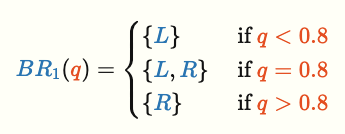
If the keeper is playing the mixed strategy
\sigma_2 = (q,1-q)
(defend left with probability \(q\), the kicker's best response to that strategy is
Dominated Strategies
Never a best response!
Dominance
One strategy strictly dominates another strategy
if it always yields a strictly higher payoff
no matter what the other players do.
A pure strategy is dominated for a player if
there’s some other strategy that that player could choose
which would give them a higher payoff
no matter what the other players are doing.
One strategy weakly dominates another strategy
if it never yields a strictly lower payoff
no matter what the other players do,
and sometimes yields a strictly higher payoff.
Right weakly dominates Left.
Top strictly dominates Bottom.
1
2
Top
Bottom
Left
Right
2
5
,
1
0
,
4
1
,
5
5
,
pollev.com/chrismakler
Which strategies are dominated?


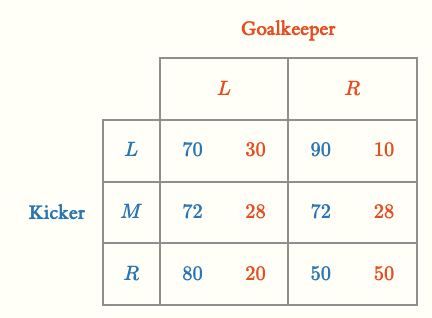
Suppose the kicker has a third option: kicking down the middle.
Is this dominated by a pure strategy?
Does it seem like it should be dominated by something?

Iterated Deletion of Strictly Dominated Strategies
Iterated Deletion of Dominated Strategies
(a.k.a. “Iterated Dominance")
- Suppose it is common knowledge that all players are rational,
so they will never choose a strictly dominated strategy. -
We can remove from the game any strictly dominated strategies
(by either a pure or mixed strategy). -
Removal may create new dominated strategies, remove them too…
-
The set of strategies that’s left at the end of that process
is the set of rationalizable strategies.-
turns out to be independent of the order
in which dominated strategies are removed
-
Which strategy or strategies is strictly dominated for a player?
1
2
1
2
,
4
3
,
1
4
,
1
1
,
Top
Middle
Left
Center
Bottom
Right
3
0
,
2
1
,
3
2
,
8
0
,
8
0
,
Center strictly dominates Right.
If we know that player 2 will never play Right, is any strategy now dominated for player 1?
Bottom strictly dominates Top.
And with that off the board...
Bottom strictly dominates Middle.
Can we eliminate anything else?
Center strictly dominates Left.
Keynesian Beauty Contest (70% Game)
Everyone chooses an integer between 0 and 100.
The closest person to 70% of the average guess wins.
0
100
70
DOMINATED BY 70
Keynesian Beauty Contest (70% Game)
Everyone chooses an integer between 0 and 100.
The closest person to 70% of the average guess wins.
0
100
70
49
DOMINATED BY 70
DOMINATED
BY 49
Keynesian Beauty Contest (70% Game)
Everyone chooses an integer between 0 and 100.
The closest person to 70% of the average guess wins.
0
100
70
49
34.3
DOMINATED
BY 49
DOM'D
BY 34.3
DOMINATED BY 70
Keynesian Beauty Contest (70% Game)
Everyone chooses an integer between 0 and 100.
The closest person to 70% of the average guess wins.
0
100
70
49
34.3
24
DOM'D
BY 34.3
DOM'D
BY 24
DOMINATED
BY 49
DOMINATED BY 70
Keynesian Beauty Contest (70% Game)
Everyone chooses an integer between 0 and 100.
The closest person to 70% of the average guess wins.
0
100
Iterated deletion of strictly dominated strategies tells us the only rationalizable strategy is 0.
Why didn't everyone choose 0?
q_1
q_2
q_1^*(\hat q_2) = 6 - {1 \over 2}\hat q_2
q_2^*(\hat q_1) = 6 - {1 \over 2}\hat q_1
Another way of thinking about this:
if everyone knows everything about this model (and everyone knows that everyone knows everything about this model), what do each of the firms know about the other firm's beliefs?
Each firm knows the other
will never produce more than 6.
Because \(6 - {1 \over 2}6 = 3\),
this means each firm knows the other
will never produce less than 3.
Because \(6 - {1 \over 2}3 = 4.5\),
this means each firm knows the other
will never produce more than 4.5.
The only set of quantities that survives this is (4,4).
Next Time
Solving for best response equilibrium.
Econ 51 | 08 | Putting Yourself in Your Opponent's Cleats
By Chris Makler
Econ 51 | 08 | Putting Yourself in Your Opponent's Cleats
Notation and definitions