Non-Committal Dating &
Mate Selection
PSYC 315
Dominic Charley-Roy
dominic.charley-roy @ mail.mcgill.ca
Mate Selection Recap
- Matching hypothesis: attempt to explain why people become attracted to their partner.
- Kalick & Hamilton propose the mate selection simulation to simulate this hypothesis.
- Compares various motives for mating to determine which is more human-like.
Mate Selection Basics
- Each individual has an attractiveness level.
- Proposed motives:
- Try to maximize partner's attractiveness.
- Try to get a partner with similar attractiveness.
- Combine first two motives.
- Each individual knows their own attractiveness level.
Is
This
Realistic?
In reality...
- Attractiveness is subjective!
- You may perceive yourself differently (either better or worse)
- Murstein (1976) shows that the correlation between our objective attractiveness (actual) and subjective attractiveness (believed) is very low.
- 0.24 for women, 0.33 for men
- Montoya (2008) shows that beleived attractiveness affects who we select as mates.
Dating as a candidate?
- In real life, individuals aren't always looking for a mate - casual dating!
- Dating experience can impact your self-esteem and therefore affect how you perceive yourself!
Modifiying Individuals
- Each individual has two levels of attractiveness:
- Objective - Their "real" attractiveness. This is visible to everyone except the individual.
- Subjective - The "believed" attractiveness. This is visible to the individual.
Overview of Changes
- We introduce a dating phase which takes place before mate selection.
- Perceived attractiveness is formed in this dating phase.
- The motives in mate selection are modified to use your own believed attractiveness and the candidate's real attractiveness.
Let's go on a date...
- Specify a number of dating cycles, ie. number of dates to go on.
- For a date, you are randomly paired with someone.
- Think of these like one-time only blind dates.
- If your date is successful, it will increase your believed attractiveness.
When is a date successful?
- Open to interpretation!☺
- For our purposes, a date is successful if your blind date would accept you using the mate selection motives.
Forming our Belief
- Two proposed formulas for guessing attractiveness:
- B1 = (successful dates / total dates) * 10
- Assume that the more successful dates we have, the more attractive we are.
- B2 = (A of accepted dates / # accepted dates)
- Assume that our attractiveness level tends to be similar to the people who accept us.
- B1 = (successful dates / total dates) * 10
- If you have no successful dates, your belief is 0.
Correlating Belief and Reality
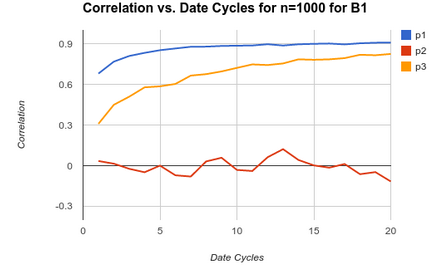
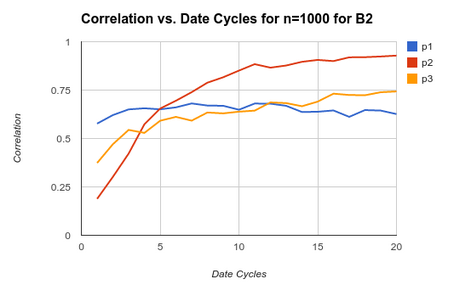
For both B1 and B2, we calculate the correlation based on the motive used to determine successful dates.
Modifying Mate Selection
- Recall:
- P1 = Maximize partner attractiveness
- P2 = Maximize similarity between partner and own attractiveness
- P3 = P1 and P2 combined
- We modify P2 to get similarity between partner's real attractiveness and our believed attractiveness.
Results
For 1000 couples, 20 dating cycles, and 50 mate selection cycles, we correlate male-female attractiveness:
B1 is good for P1!
B2 is good for P2 and P1!
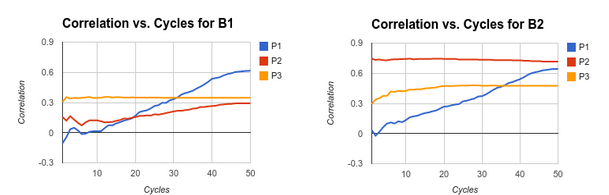
Effect on Average Cycle
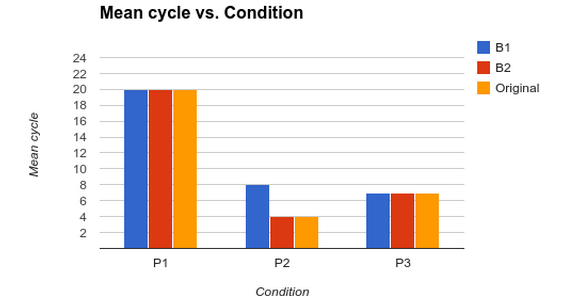
Performance is more or less the same except for B1 with P2!
Conclusion
- Separating attractiveness into a real and a believed level helps account for the poor correlation proposed by Murstein.
- B1 and B2 perform particularly well for specific mating motives, but not for combined.
- Both B1 and B2 attain reasonably high correlation after 5 dating cycles!
- Results agree with Montoya, who proposes that perceived attractiveness can affect our mate selection success as well as who we would accept.
Potential Extensions
- Integrating a notion of self-esteem
- Is this modelled by our believed attractiveness?
- Have some individuals use B1, others use B2
- Have some individuals date for longer than others
Questions?
( ͡° ͜ʖ ͡°)
References
-
Kalick, S. & Hamilton, T. (1986). The matching hypothesis reexamined. Journal of Personality and Social Psychology, 51, 673-682.
-
Montoya, R. M. (2008). I'm hot, so i'd say you're not: the influence of objective physical attractiveness on mate selection. Personality & Social Psychology Bulletin, 34, 10, 1315-31.
-
Murstein, B.I. & Christy, P. (1976). Physical Attractiveness and Marriage Adjustment in Middle-aged Couples. Journal of Personality and Social Psychology, 34, 537-542
deck
By dominiccharleyroy