
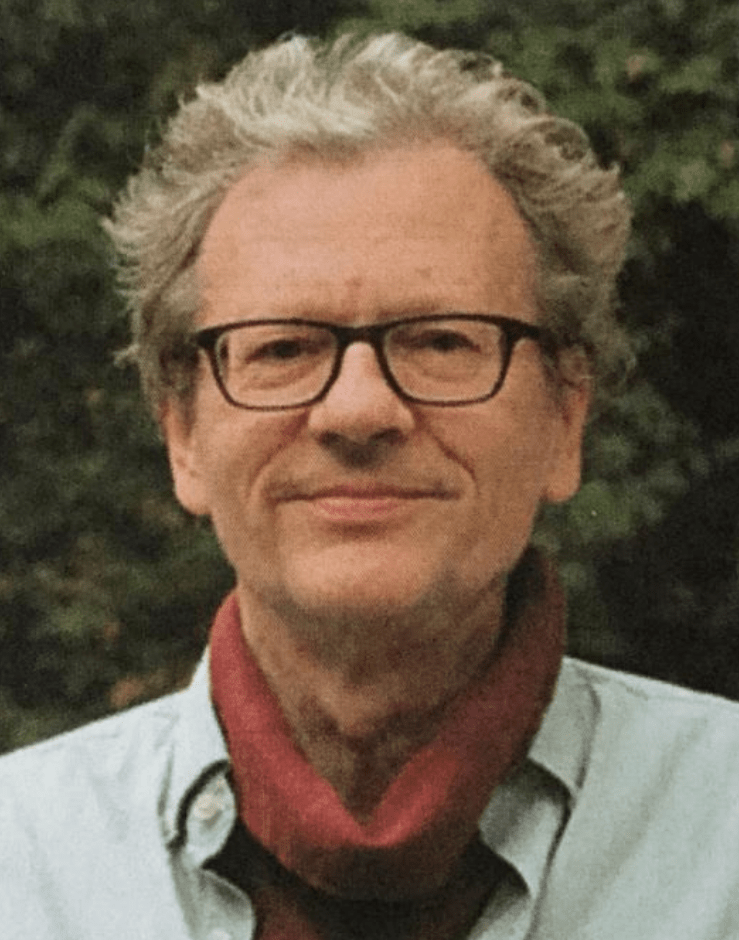
Klas Modin PRO
Mathematician at Chalmers University of Technology and the University of Gothenburg
Chalmers, Sweden
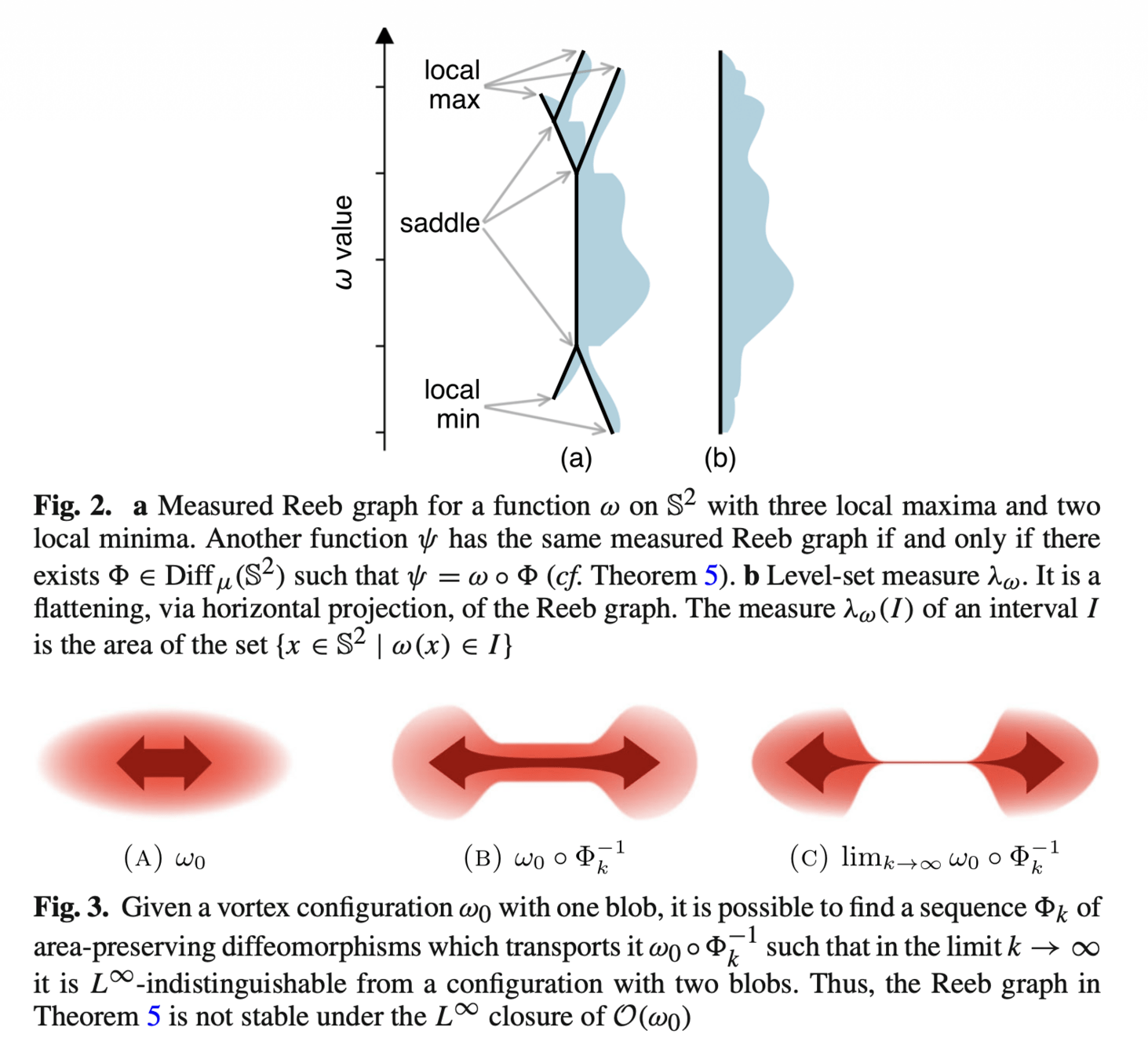
A continuous medium deprived of its physical properties (elasticity, thermal and electrical conductivity, and so on) still retains a definite position in space and still interacts through the mutual pressure of its parts due to Aristotle’s principle that two bodies cannot occupy the same space. Amazingly, it is these elementary interactions that cause the most intricate behavior, including turbulence.
initial
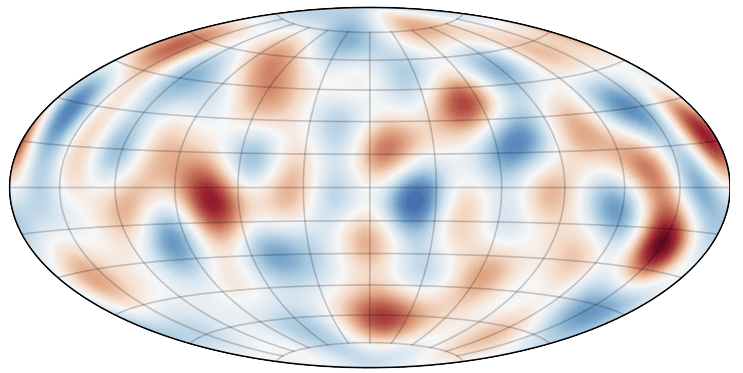
mixing
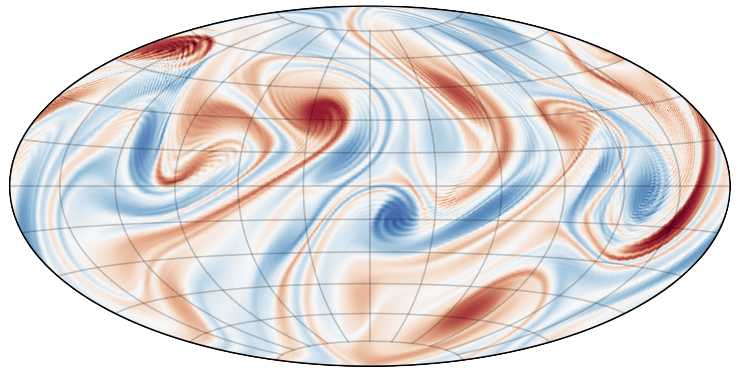
long-time
Euler's equations describe Riemannian geodesics on
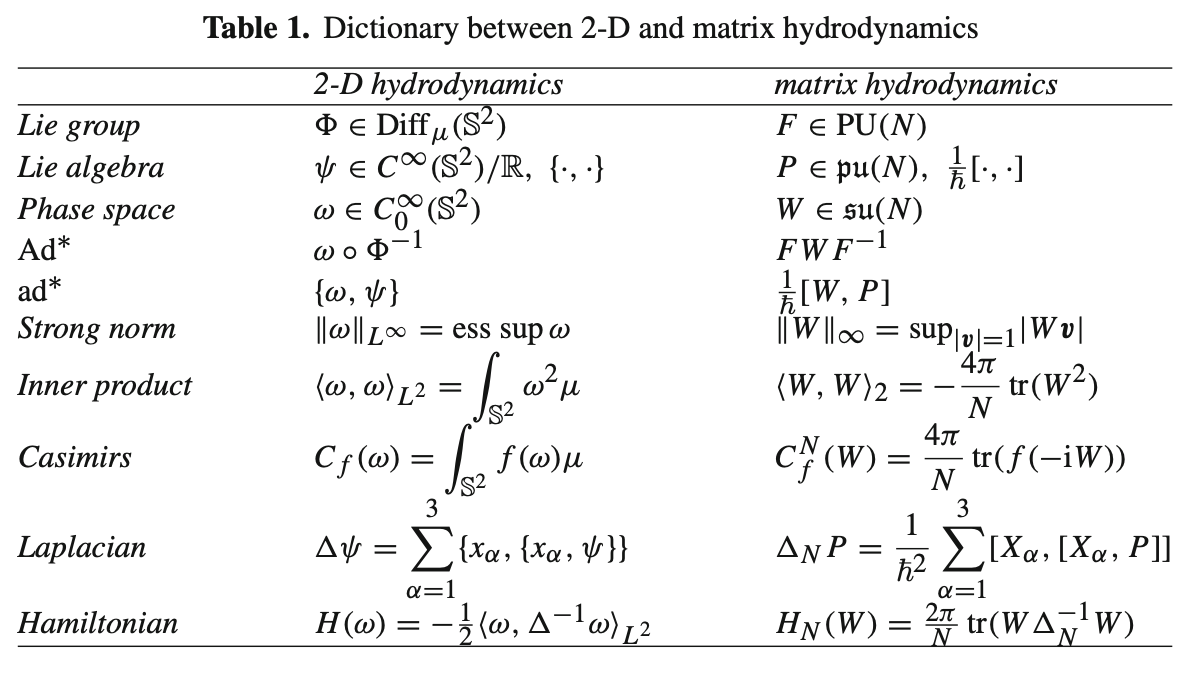
Right-invariant Riemannian metric determined by inner product on \(\mathfrak{g}\)
\(G\)
\(T_eG\simeq\mathfrak g\)
Euler-Arnold
(Lie-Poisson)
Euler-Lagrange
Transport
Inner product:
Arnold's theorem: \(\gamma(t)\in \operatorname{Diff}_\mu(M)\) geodesic curve \(\Rightarrow\) vector field \(v(t) = \dot\gamma(t)\circ\gamma(t)^{-1}\) fulfills Euler's equations
Inner product:
Lie-Poisson formulation:
Hoppe-Yau Laplacian
Lie-Poisson system for \(\omega \in\mathfrak{g}^*\)
(strong form)
(weak form)
(weak co-adjoint orbit)
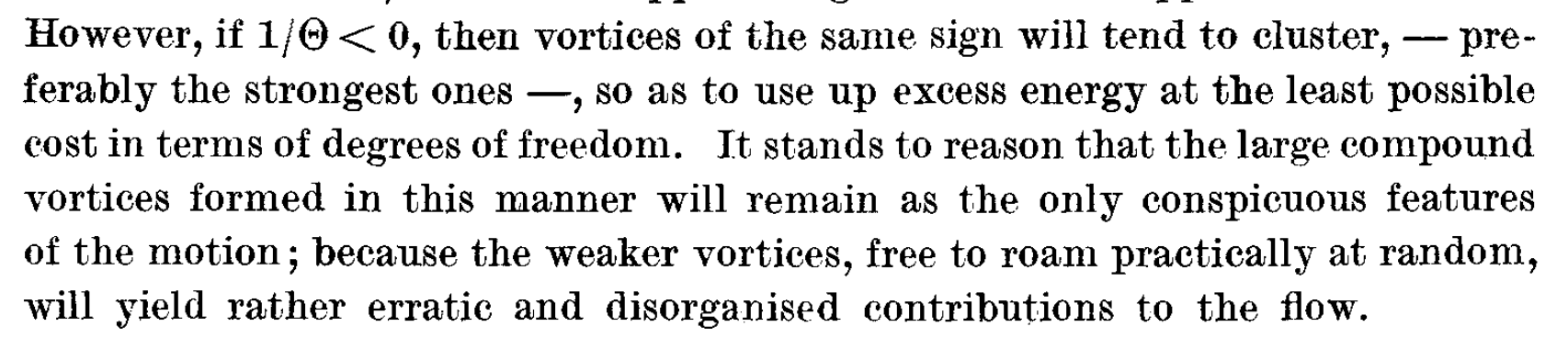
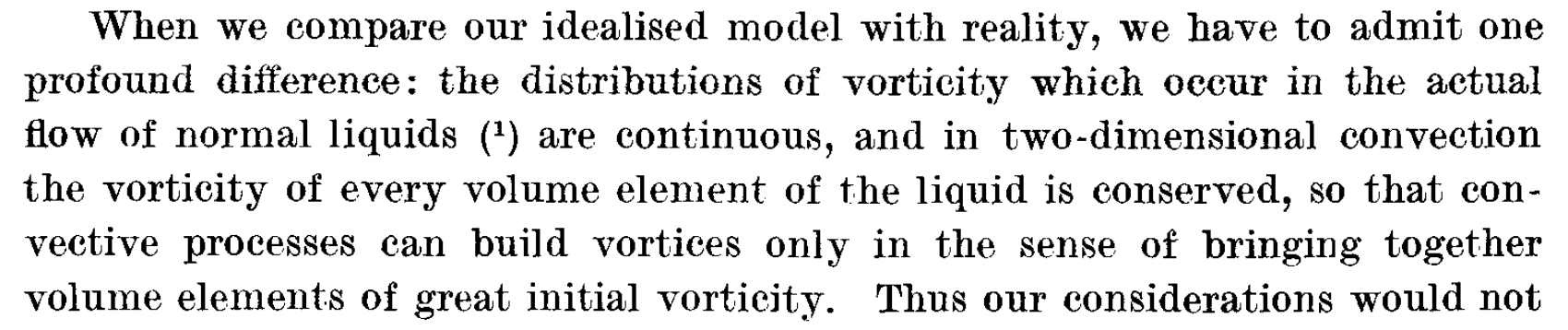
Idea by Onsager (1949):
Hamiltonian function:
Idea by Onsager (1949):
Hamiltonian function:
Onsager's observation:
Pos. and neg. strengths \(\Rightarrow\) energy takes values \(-\infty\) to \(\infty\)
Idea by Onsager (1949):
Hamiltonian function:
Onsager's observation:
Pos. and neg. strengths \(\Rightarrow\) energy takes values \(-\infty\) to \(\infty\)
\(\Rightarrow\) phase volume function \(v(E)\) has inflection point
Idea by Onsager (1949):
Hamiltonian function:
Vanishing total
angular momentum
Non-vanishing total
angular momentum
Vanishing total
angular momentum
Non-vanishing total
angular momentum
Vanishing total
angular momentum
Non-vanishing total
angular momentum
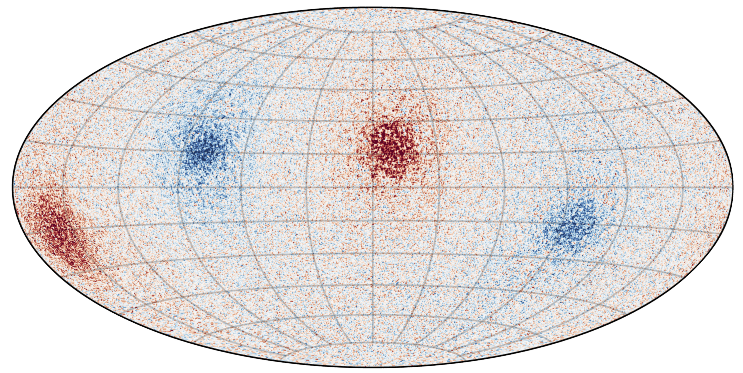
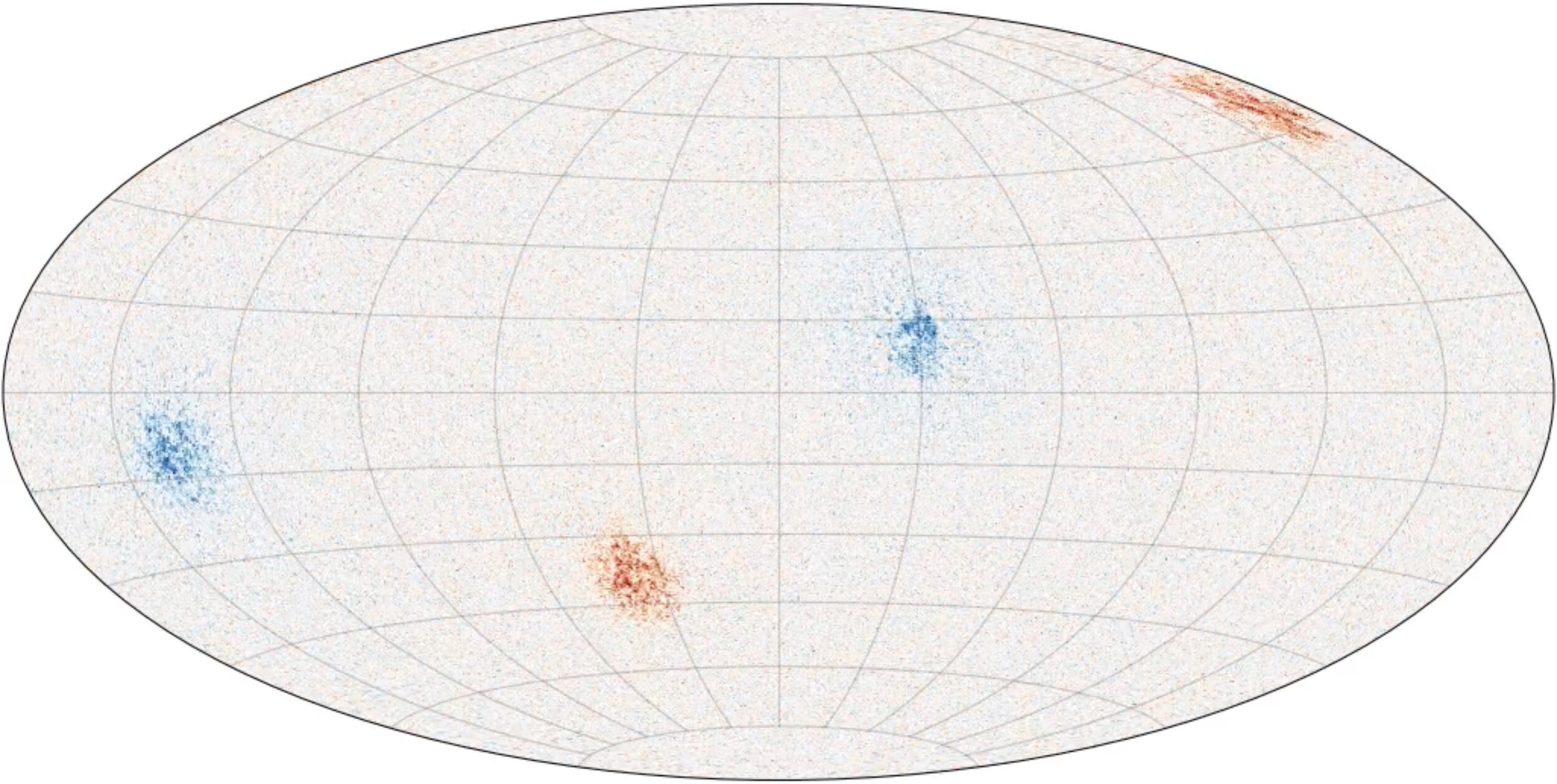
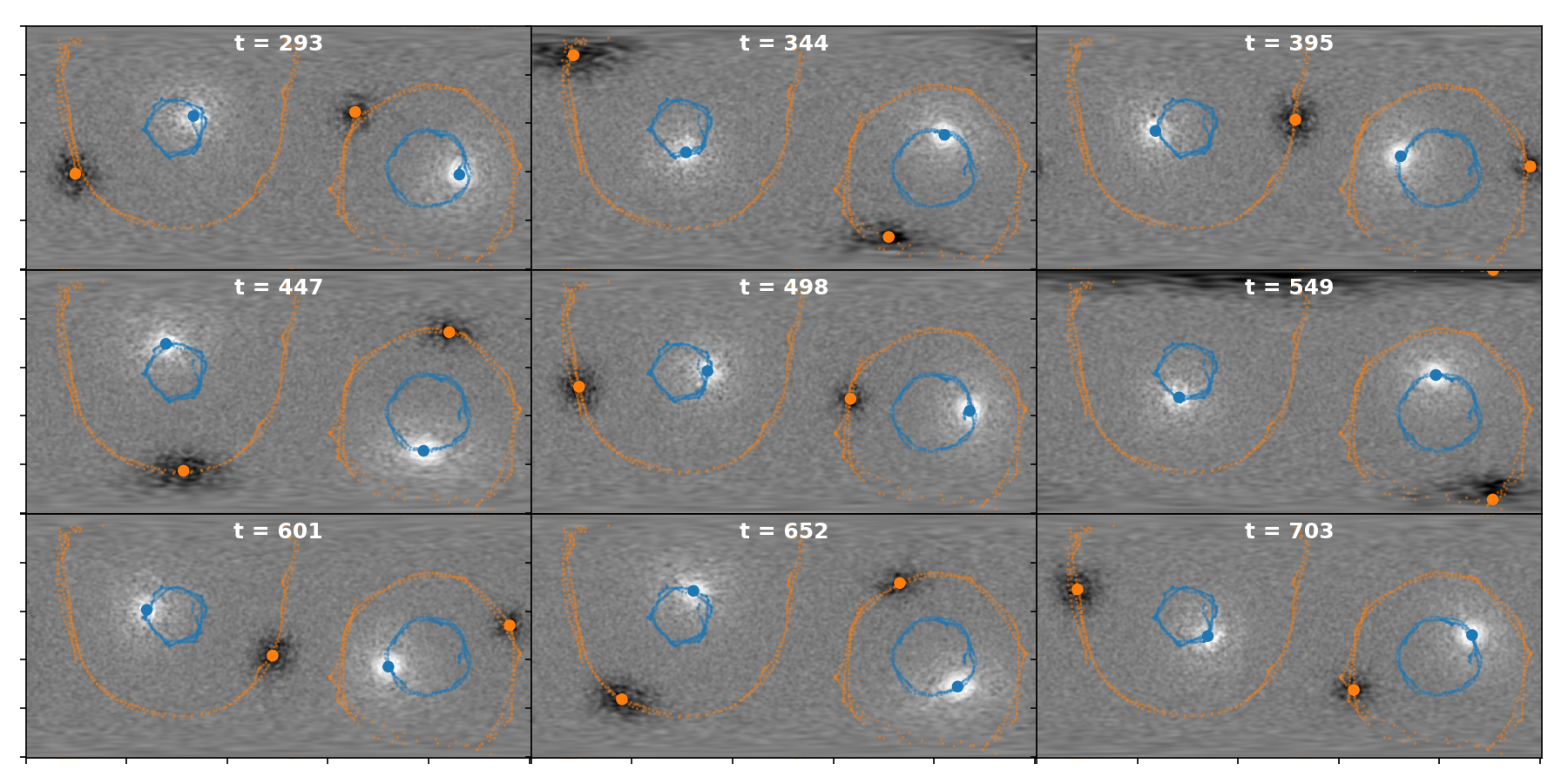
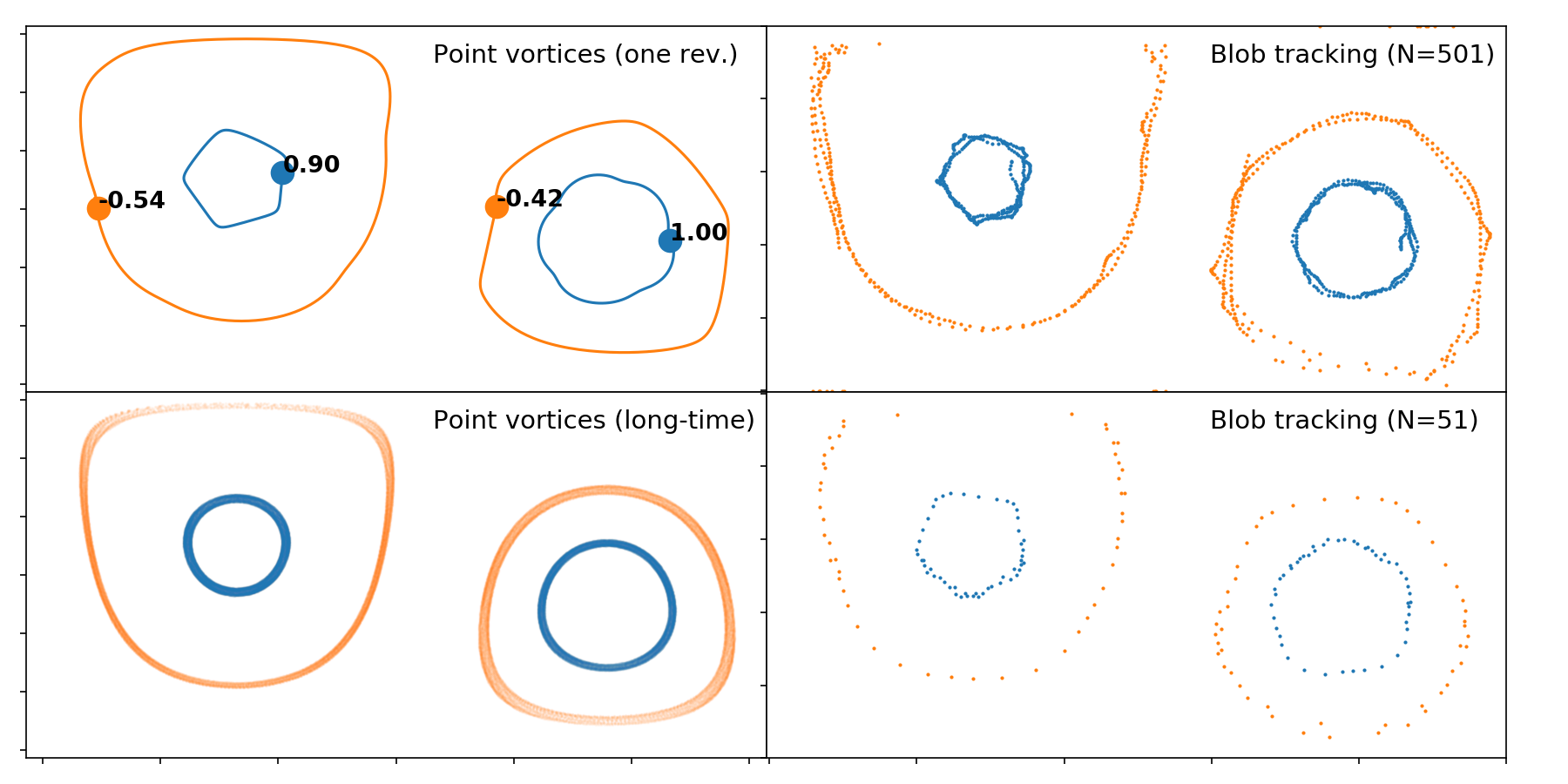
Point vortex dynamics on \(\mathbb{S}^2\)
Symplectic reduction theory:
only \(SO(3)\) symmetry needed in proof
Blob vortex dynamics on \(\mathbb{S}^2\)
By Klas Modin
Seminar at TU Braunschweig, Feb 2026.