




Juan Romero-Luis
Science Communication & UX Researcher
Teacher Juan Romero Luis
Feb 10, 2025
Unit 3
bit.ly/BWD24U3
bit.ly/BWD24U3
N
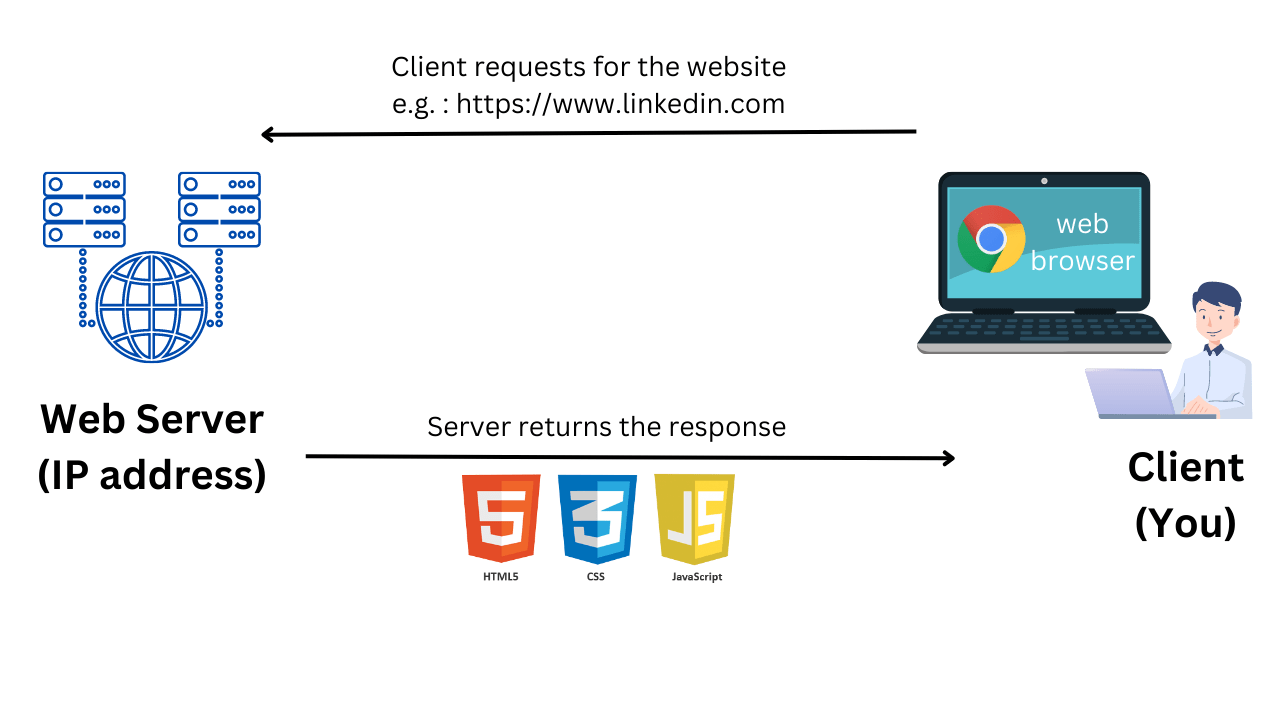
What are internet protocols?
They are a set of rules and conventions that define how devices communicate and exchange data on the Internet.
N
N
N
Source: john3s.
Hypertext Markup Language
What is HTML?
<p>This is a paragraph.</p>
Element
Opening tag
Closing tag
Content
<h1>This is a heading</h1>
<div>


</div>
<p>This is a paragraph inside a box.</p>
Closing tag
Content
Opening tag
Opening tag
Closing tag
Element 2
Element 1
<p>This is some text. <br> This is some more text on a new line.</p>
🎯 Try the <br> element in VisualStudio Code.
Unique tag
<p>This is text in <i>italic</i>.</p>
Opening tag
Closing tag
Element 2
Element 1
🎯 Try the <strong>, tags in Visual Studio Code.<i>, <mark> <em> in
<!DOCTYPE html>
<html>
  <head>
    <title>My First Web Page</title>
  </head>
  <body>
    <h1>Welcome to My First Web Page</h1>
    <p>This is a paragraph of text on my web page.</p>
  </body>
</html>
Teacher Juan Romero Luis
Feb 11, 2025
Unit 3
bit.ly/BWD24U3
🎯Let's continue with the exercise we started yesterday (40-50 min)
<!-- This is a comment -->
<p>This is a paragraph.</p>
<!-- This is another comment -->
🎯 Create a comment in HTML using VisualStudio Code to see how it behaves.
<ul>
  <li>Apple</li>
  <li>Banana</li>
  <li>Cherry</li>
</ul>
<ol>
  <li>Apple</li>
  <li>Banana</li>
  <li>Cherry</li>
</ol>
Ordered list
Unordered
Teacher Juan Romero Luis
Feb 17, 2025
Unit 3
bit.ly/BWD24U3
bit.ly/BWD24U3
<a href="https://www.eg.com">Linked text.</a>
<img src="image.jpg" alt="Description">
Opening tag
Closing tag
Unique tag
Attribute
Attribute 1
Attribute 2
<a href="https://www.eg.com">Linked text.</a>
<img src="image.jpg" alt="Description">
Name
Value
Name
Value
Name
Value
Paths in HTML refer to the way we specify the location of resources such as images, links, or other files that we want to use or reference in our HTML document.
What are paths in HTML?
An absolute path points to the same location in a file system, regardless of the current working directory.
<img src="http://www.example.com/images/picture.jpg">
📂 example directory
📂 images
🏙️ picture.jpg
📂 Directory
📄mysite.html
Absolute path
A relative path is a path relative to the current working directory.
<img src="picture.jpg">
📂 My site folder
📄site.html
📂 images
🏙️ picture.jpg
📂 My site folder
📄site.html
🏙️ picture.jpg
<img src="images/picture.jpg">
<img src="../images/picture.jpg">
<img src="../../images/picture.jpg">
📂 My site folder
📂 images
🏙️ picture.jpg
📂 folder
📄site.html
📂 My site folder
📂 images
🏙️ picture.jpg
📂 folder
📂 folder
📄site.html
Teacher Juan Romero Luis
Feb 18, 2025
Unit 3
bit.ly/BWD24U3
📝 Deliverable: Up3.2 Link, images and paths
<body>, introduce an "About Me" section using <h1> tag.<p> tag.src attribute of an <img> tag to add this image to your page. Remember to include the alt attribute to describe the image and the width attribute to establish the size you want the picture to be shown.<img>, but this time use a relative path in the src attribute.<a> tag. The text of the link should say "Image source".bit.ly/BWD24U3
Remember to use quotation marks when inserting attribute values
If an image does not display, ensure the correct path has been included. Verify in which folder the image is located
Although links can be unnested, if you are linking text, it must be nested within a paragraph or heading
<p>
Paragraph is here with a
<a href="https://example.com">link</a>.
</p>
name="value"
<img src="image/image.jog">
<a href="https://www.example.com" target="_blank" title="Visit Example Website">Click here.</a>
Teacher Juan Romero Luis
Feb 24, 2025
Unit 3
bit.ly/BWD24U3
<table>
  <tr>
    <th>Header 1</th>
    <th>Header 2</th>
  </tr>
  <tr>
    <td>Cell 1 of Row 2</td>
    <td>Cell 2 of Row 2</td>
  </tr>
  <tr>
    <td>Cell 1 of Row 3</td>
    <td>Cell 2 of Row 3</td>
  </tr>
</table>
| Header 1 | Header 2 |
|---|---|
| Cell 1 of Row 2 | Cell 2 of Row 2 |
| Cell 1 of Row 3 | Cell 2 of Row 3 |
<table>: This tag defines the table itself. Every table begins and ends with this tag.<tr>: This stands for 'table row'. This tag is used to define each row in the table.<th>: This stands for 'table header'. This tag is used to define a header cell in the table, which is typically used to label columns or rows.<td>: This stands for 'table data'. This tag is used to define each cell in the row.
<thead>: This element is used to group the header content in an HTML table. <tbody>: This element is used to group the body content in an HTML table. <tfoot>: This element is used to group the footer content in an HTML table. It is used to store information such as total, sum, etc., that is calculated from the data in the table cells.| Header 1 | Header 2 |
|---|---|
| Cell 1 of Row 2 | Cell 2 of Row 2 |
| Cell 1 of Row 3 | Cell 2 of Row 3 |
| Footer 1 | Footer 2 |
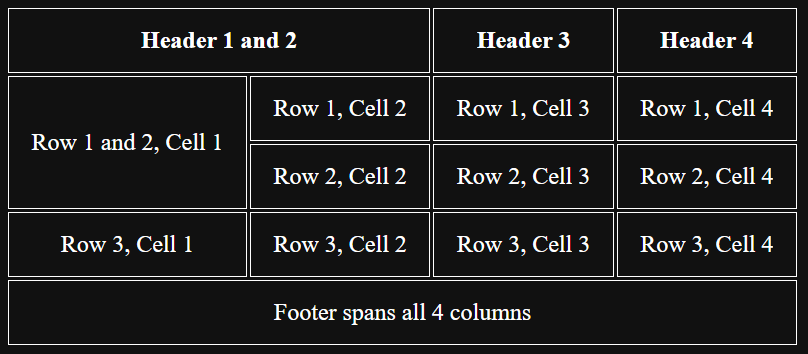
colspan is used to make a cell span multiple columns. For example, if you want a cell to span 3 columns, you would use <td colspan="3">. rowspan is used to make a cell span multiple rows. For example, if you want a cell to span 2 rows, you would use <td rowspan="2">. 🎯 Activity: Complex table (2)
Incorporate the colspan and rowspan attributes to make your table look like this one.
Remember, colspan and rowspan are attributes and behave as such.
📝 Deliverable: Up3.3 Tables in HTML
Upload the html document you have been working on in class.
Teacher Juan Romero Luis
Feb 25, 2025
Unit 3
bit.ly/BWD24U3
<img src="image.jpg" alt="A beautiful sunset over the mountains" width="500" height="600" title="Sunset over the Rockies">
<!-- using img tag to insert an SVG file -->
<img src="image.svg" alt="Description of SVG">
<!-- inline SVG -->
<svg width="100" height="100">
  <circle cx="50" cy="50" r="40" stroke="green" stroke-width="4" fill="yellow" />
</svg>
N
N
🎯 Step by step activity. Be quite and pay attention to your teacher.
N
<video src="sample.mp4" alt="Description of the video" width="320" height="240" controls autoplay loop muted>
 <p> Your browser does not support the video tag. </p>
</video>
N
<iframe src="https://www.example.com" title="Example Website" width="500" height="300" frameborder="1" allowfullscreen></iframe>
Teacher Juan Romero Luis
May 3, 2025
Unit 3
bit.ly/BWD24U3
bit.ly/BWD24U3
<!DOCTYPE html>
<html lang="en">
...
</html>
<!DOCTYPE html>
<html lang="en">
  <head>
      <title>Introduction to HTML - Web Development Course</title>
  </head>
  ...
</html>
<!DOCTYPE html>
<html lang="en">
  <head>
      <title>Introduction to HTML - Web Development Course</title>
      <meta charset="UTF-8">
      <meta name="author" content="Author Name">
      <meta name="description" content="Free Web tutorials">
      <meta http-equiv="refresh" content="30">
      <meta name “robots” content=”noindex”>
  </head>
  ...
</html>
<!DOCTYPE html>
<html lang="en">
  <head>
      <title>Introduction to HTML - Web Development Course</title>
      <meta charset="UTF-8">
      <meta name="author" content="Author Name">
      <meta name="description" content="Free Web tutorials">
      <meta http-equiv="refresh" content="30">
      <link rel="stylesheet" type="text/css" href="mystyle.css">
  </head>
  ...
</html>
<!DOCTYPE html>
<html lang="en">
  <head>
      <title>Introduction to HTML - Web Development Course</title>
      <meta charset="UTF-8">
      <meta name="author" content="Author Name">
      <meta name="description" content="Free Web tutorials">
      <meta http-equiv="refresh" content="30">
      <link rel="stylesheet" type="text/css" href="mystyle.css">
      <script src="myscripts.js"></script>
  </head>
  ...
</html>
<!DOCTYPE html>
<html lang="en">
  <head>
      <title>Introduction to HTML - Web Development Course</title>
      <meta charset="UTF-8">
      <meta name="author" content="Author Name">
      <meta name="description" content="Free Web tutorials">
      <meta http-equiv="refresh" content="30">
      <link rel="stylesheet" type="text/css" href="mystyle.css">
  </head>
  <body>
  	<!-- Your HTML code -->
  	<script src="myscripts.js"></script>
  </body>
</html>
Is this a void element?
By Juan Romero-Luis


