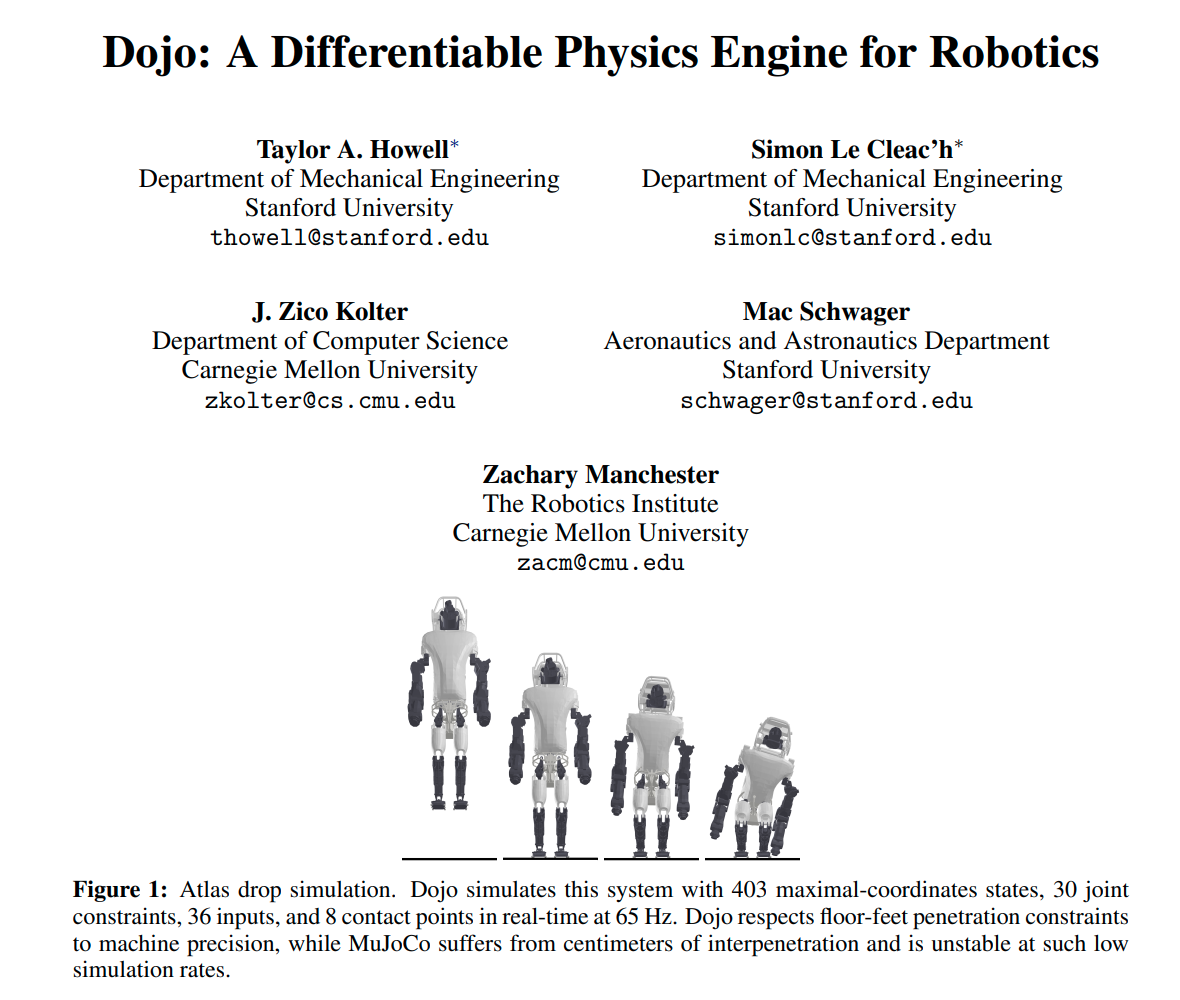
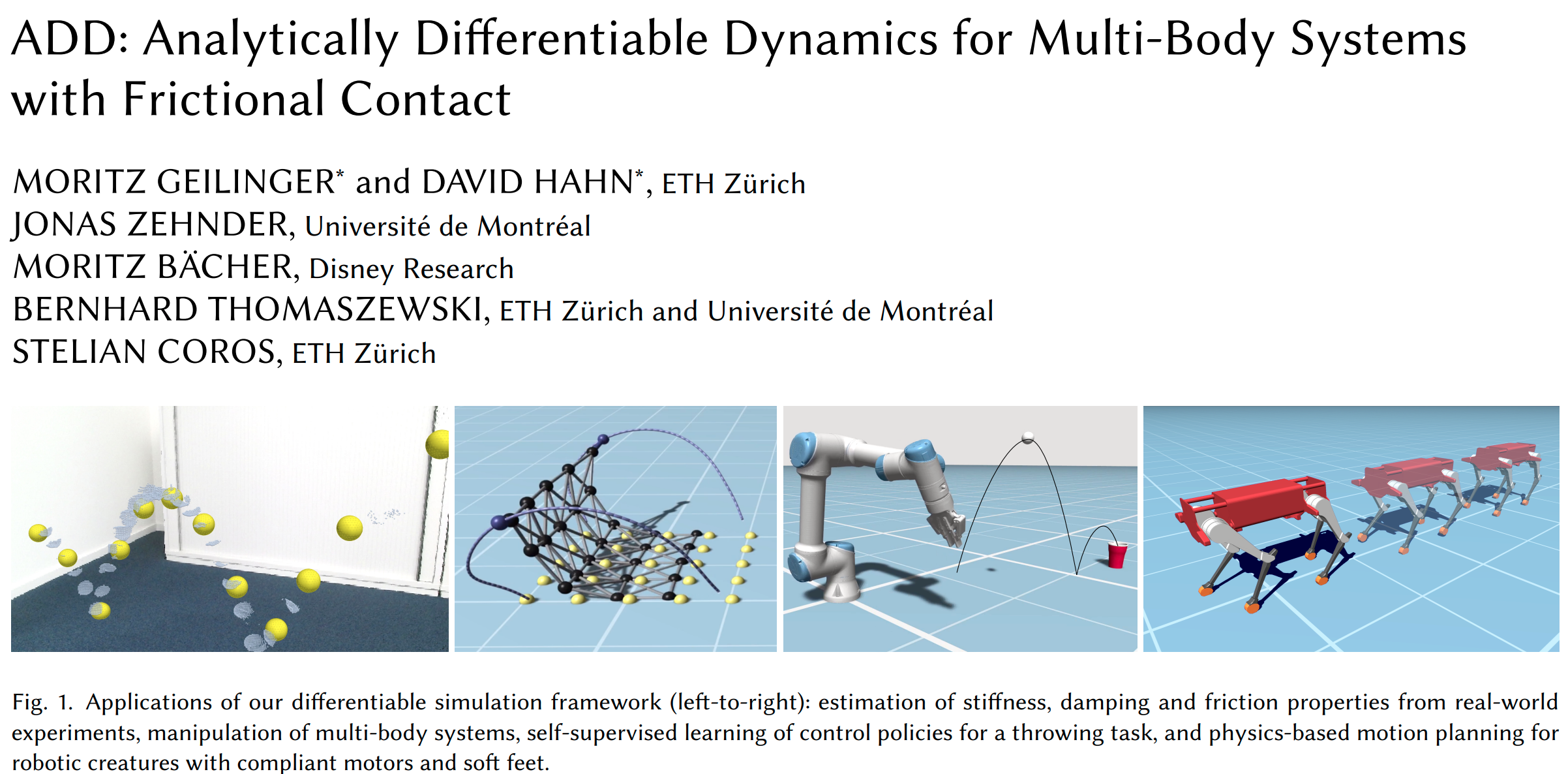
(Physics) Model-based Planning for Contact-rich Robotic Manipulation
Tao Pang
Nov 2022

Why contact-rich?
Collision-free Motion Planning
Interact with the world
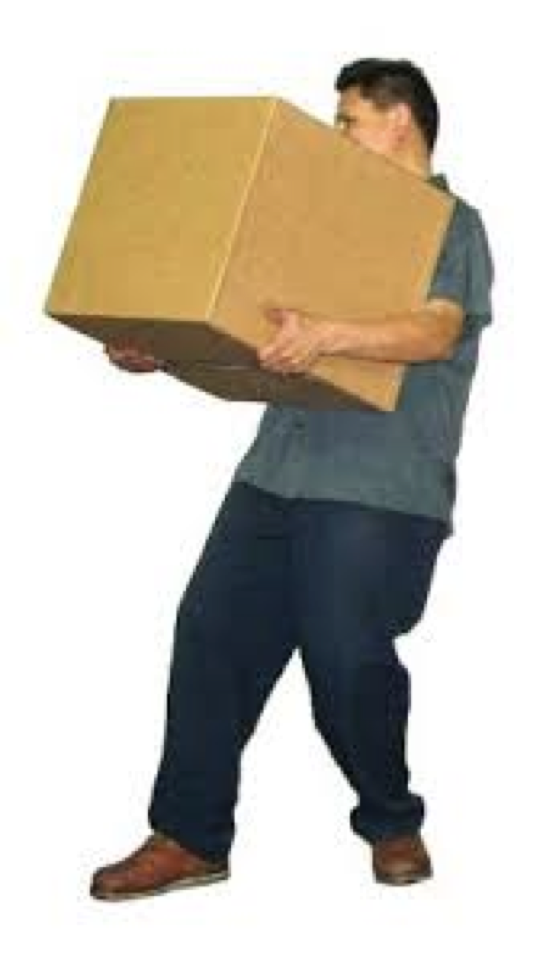
Smaller
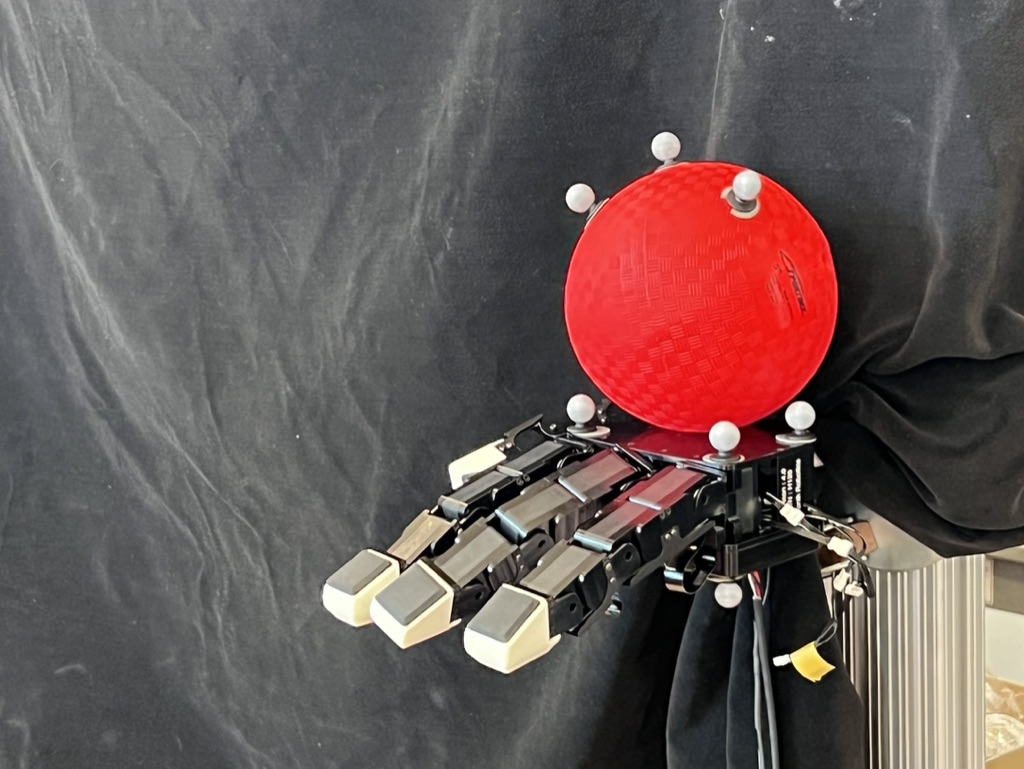
What can we learn from RL (reinforcement learning)?
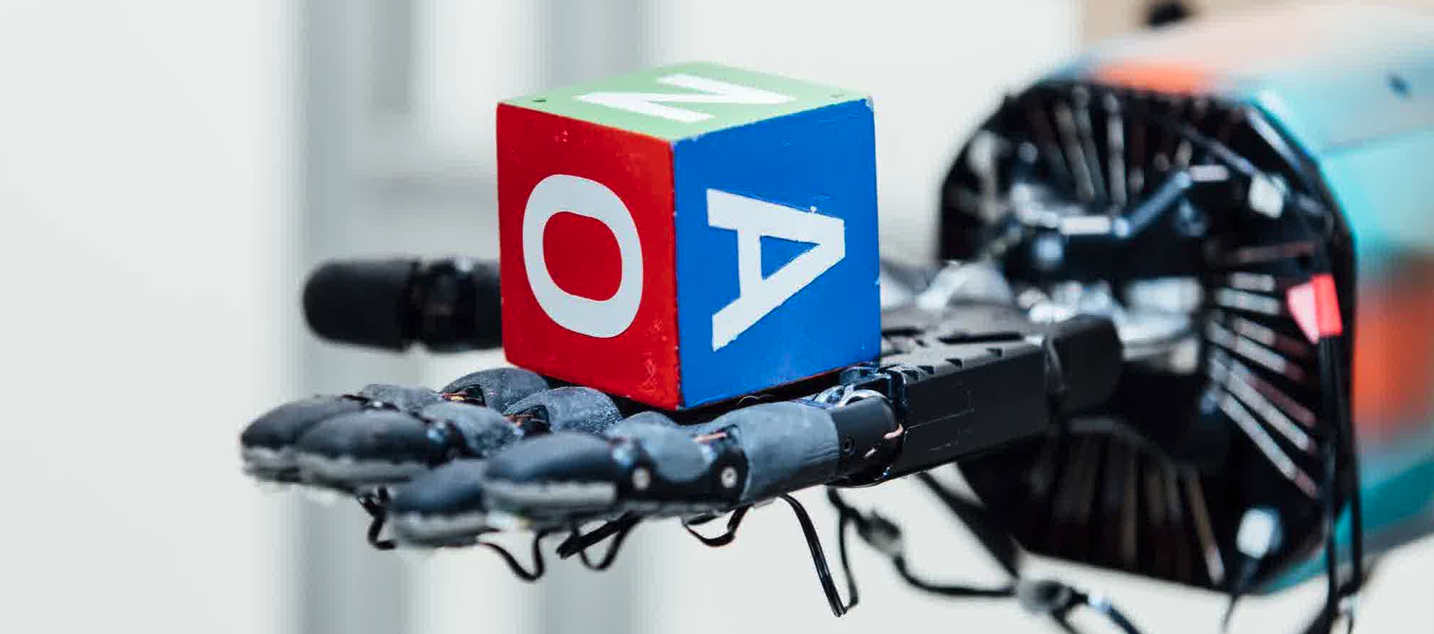
- RL still requires heavy offline computation.
- The Nvidia policy is trained with "only 8 NVIDIA A40 GPUs" for 60 hours.
- (OpenAI) Andrychowicz et al. "Learning dexterous in-hand manipulation." The International Journal of Robotics Research, 2020.
- (Nvidia) Handa et al. "DeXtreme: Transfer of Agile In-hand Manipulation from Simulation to Reality", arXiv preprint, 2022.
-
H.J. Terry Suh*, Tao Pang*, Russ Tedrake, “Bundled Gradients through Contact via Randomized Smoothing”, RA-L, 2022.
-
Tao Pang*, H.J. Terry Suh*, Lujie Yang, Russ Tedrake, "Global Planning for Contact-Rich Manipulation via Local Smoothing of Quasi-dynamic Contact Models", under review, 2022.
[1] OpenAI.
[2] Nvidia.
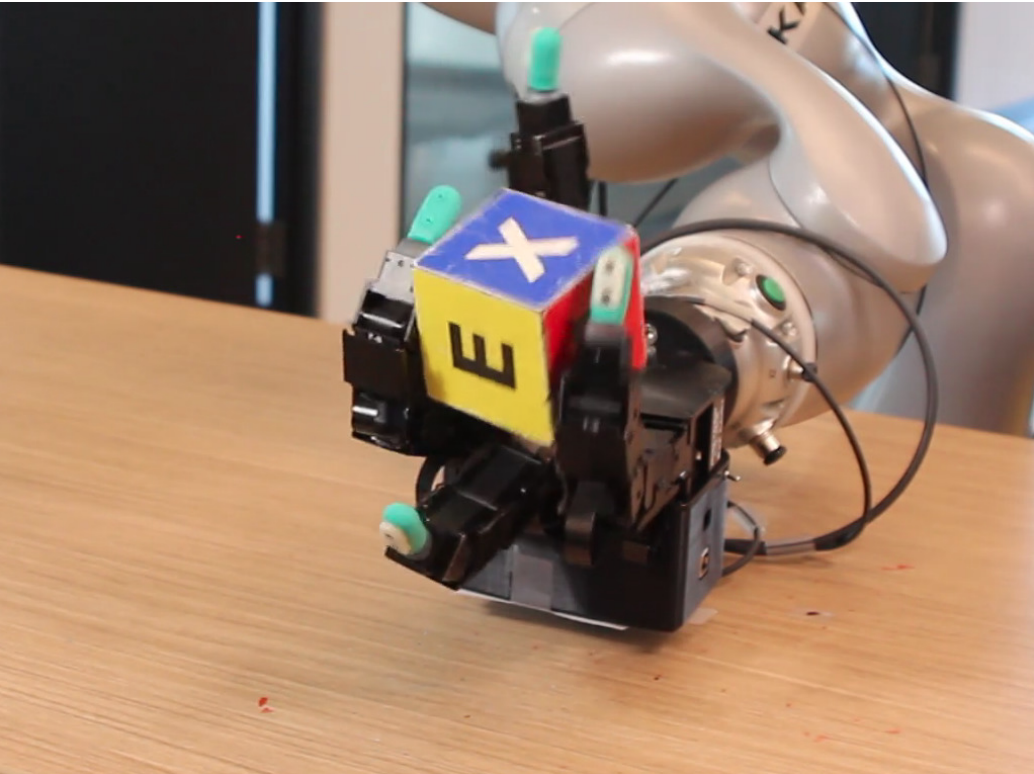
How does RL power through non-smooth contact dynamics? [3][4]
- RL maximizes a stochastic reward using gradients estimated from sampling.
- Sampling has a smoothing effect on the reward's landscape.
In model-based planning, we can smooth contact dynamics, but without using samples (faster!).
Why is contact-rich planning hard?
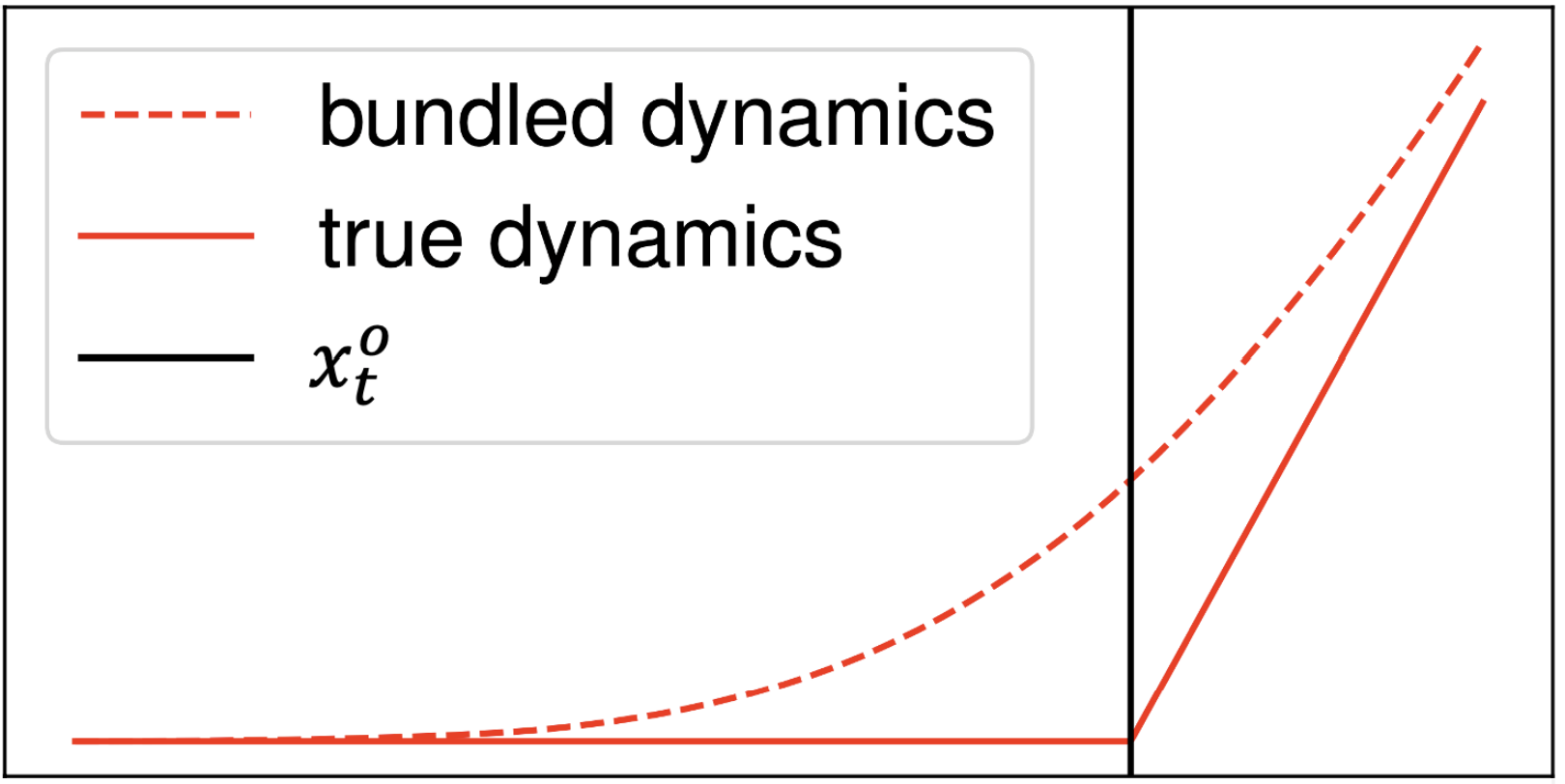
Contact dynamics is non-smooth!
Two solutions
Descend with gradients of smoothed dynamics
Reason explicitly about contact mode transitions
q^\mathrm{a}_+
u
Contact
No Contact
- But descent methods get stuck in local minima.
- Therefore they need non-trivial initialization.
- Good at escaping local minima,
- But mode enumeration scales poorly (exponentially) with the number of contacts.
x_+ = u
x_+ = 0
u > 0
u \leq 0
q^\mathrm{a}_+
u
smoothed dynamics
original dynamics
\(u = 0\)
Model-based Planning through Contact: a Quick Review
- Trajectory Optimization through Contact
- Mordatch, Igor, Emanuel Todorov, and Zoran Popović. "Discovery of complex behaviors through contact-invariant optimization." ACM Transactions on Graphics (TOG), 2012.
- Hogan, François Robert, and Alberto Rodriguez. "Feedback control of the pusher-slider system: A story of hybrid and underactuated contact dynamics." arXiv preprint arXiv:1611.08268, 2016.
- Posa, Michael, Cecilia Cantu, and Russ Tedrake. "A direct method for trajectory optimization of rigid bodies through contact." The International Journal of Robotics Research, 2014.
- Aydinoglu, Alp, and Michael Posa. "Real-time multi-contact model predictive control via admm." 2022 International Conference on Robotics and Automation (ICRA), 2022.
- Cheng, Xianyi, et al. "Contact mode guided motion planning for quasidynamic dexterous manipulation in 3d." 2022 International Conference on Robotics and Automation (ICRA), 2022.
- Marcucci, Tobia, et al. "Approximate hybrid model predictive control for multi-contact push recovery in complex environments." 2017 IEEE-RAS 17th International Conference on Humanoid Robotics (Humanoids), 2017.
- Enumerate mode switches locally
- Enumerate Mode Switches
Good
Scalability (Smoothed dynamics)
Bad Scalability (Mode Transitions)
Local Planning
Global Planning
Global planning with RRT + Smoothed dynamics?
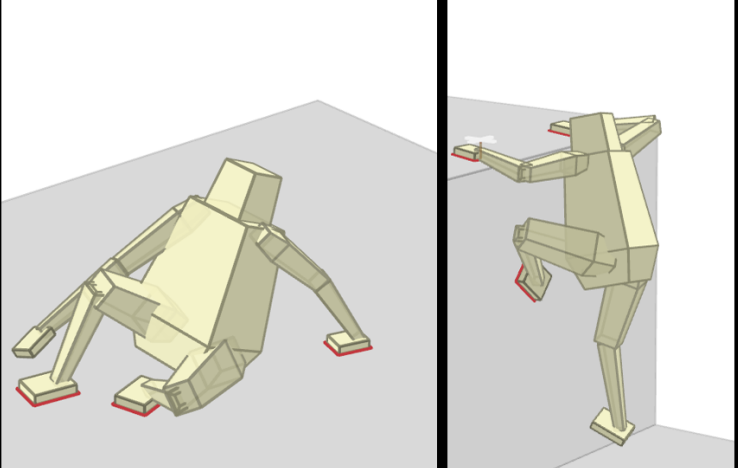
[1] Mordatch et al.

[3] Posa et al.
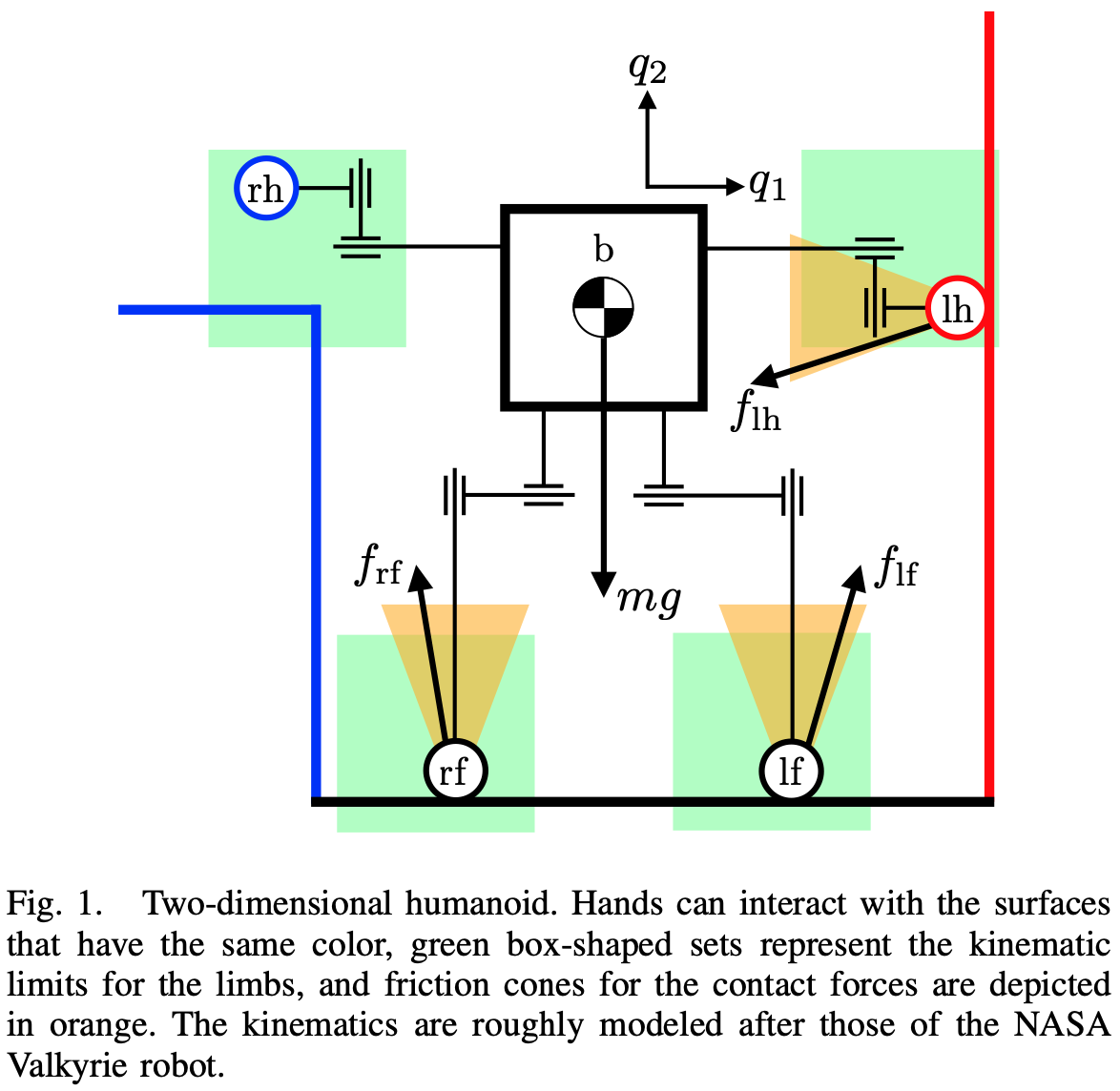
[6] Marcucci et al.
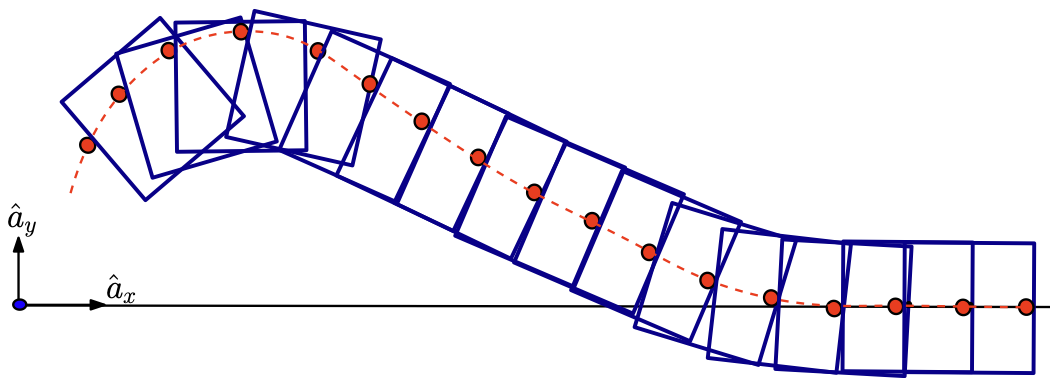
[4] Aydinoglu and Posa.

[2] Hogan and Rogriguez.
- Sampling mode transitions.
[5] Cheng et al.
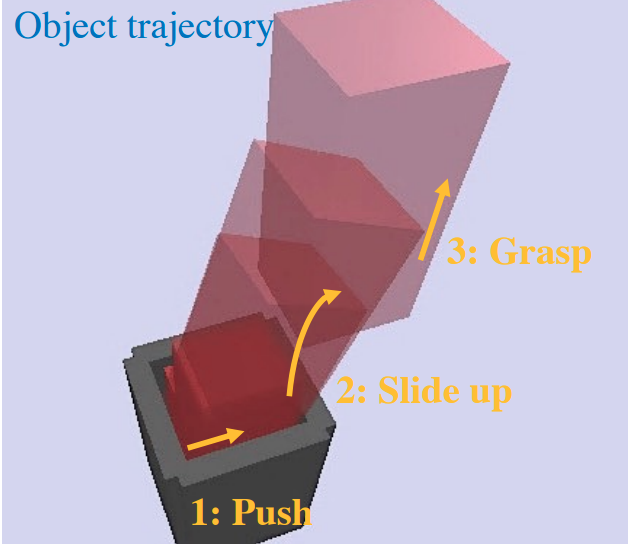
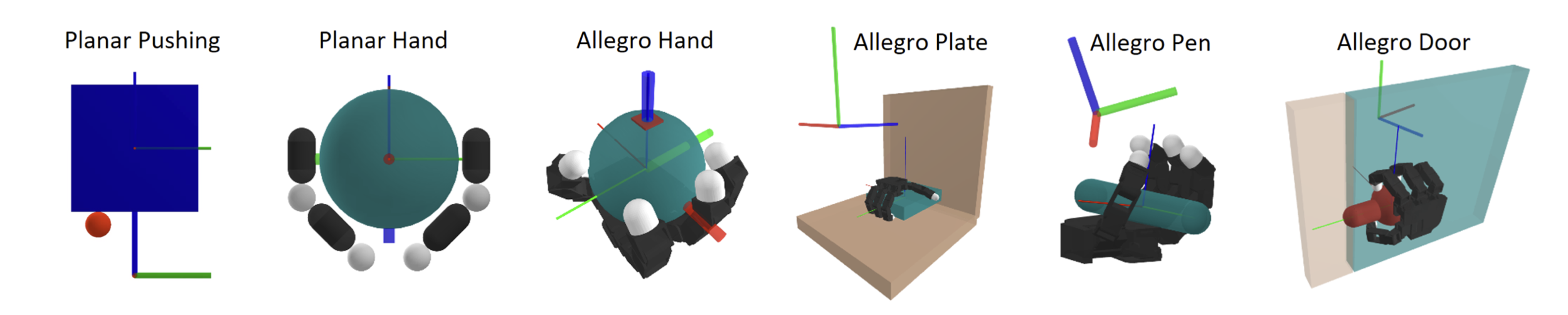
Our Method: Sim and Hardware Demos.
- Our planner combines
- sampling-based global search and
- smoothed contact dynamics.
- Our planner takes less than a minute to find most plans shown above, on a single CPU.
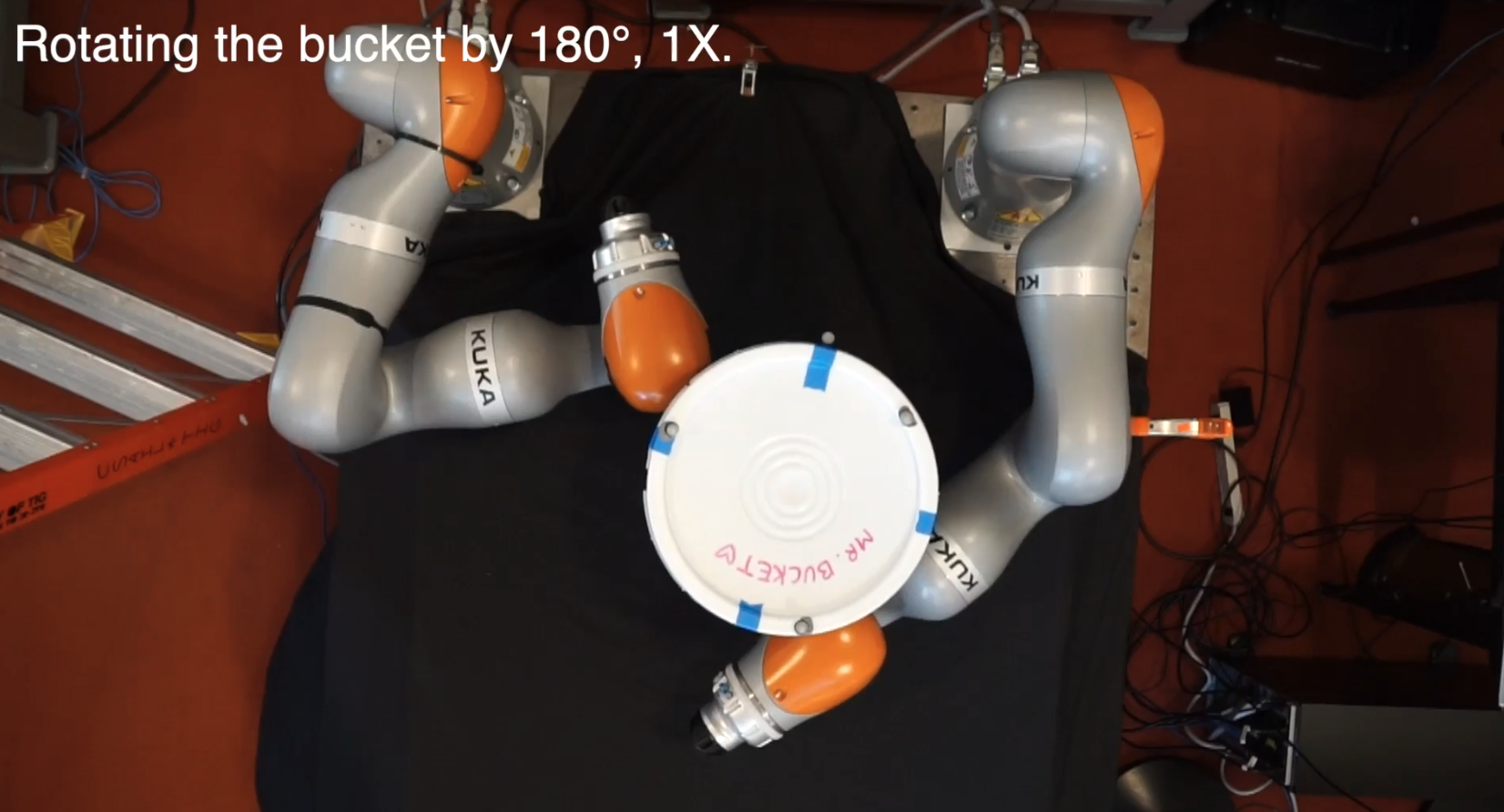
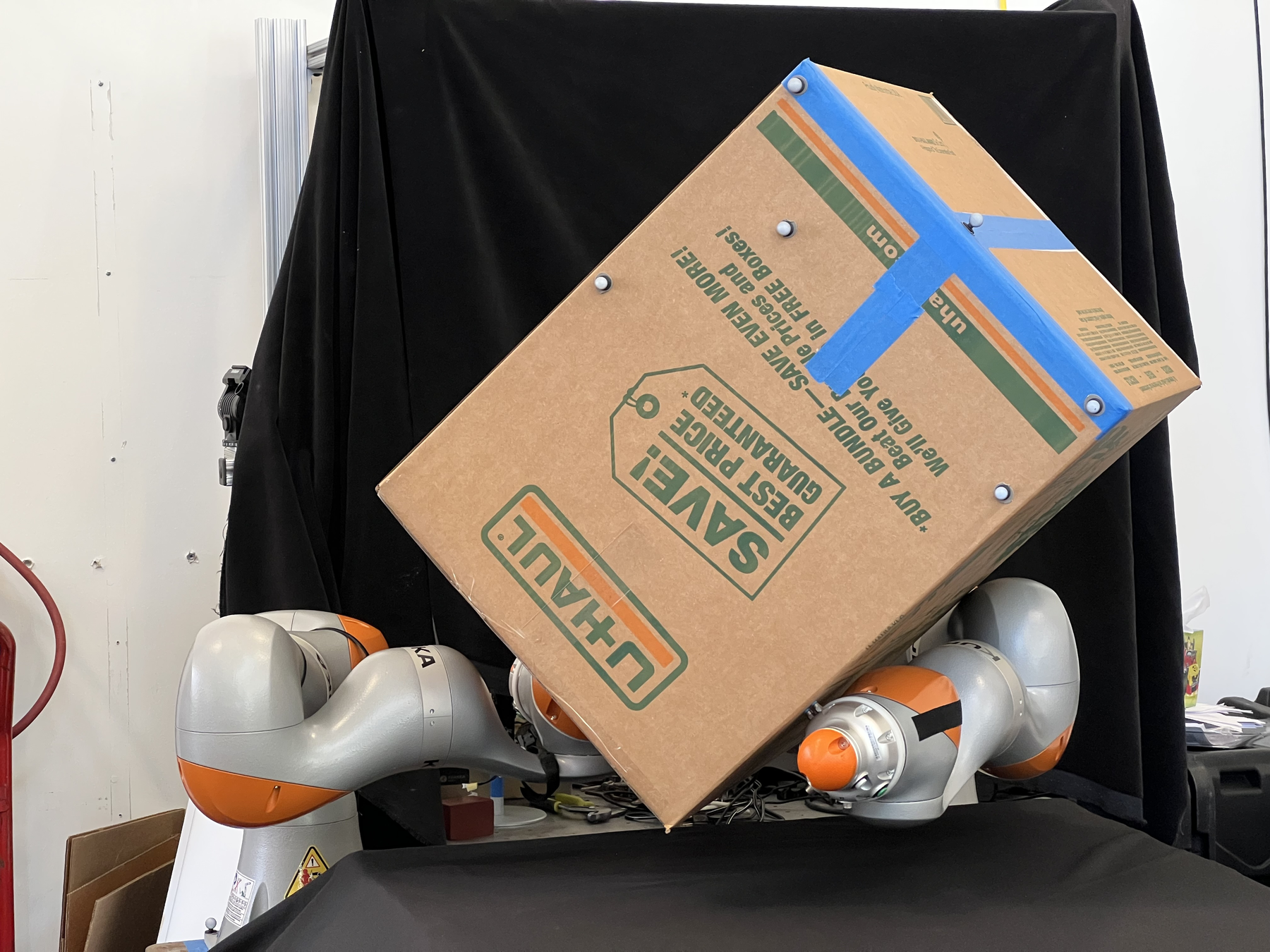
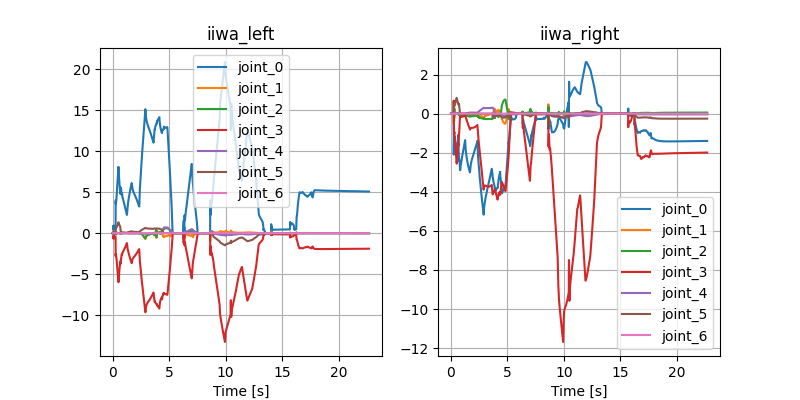
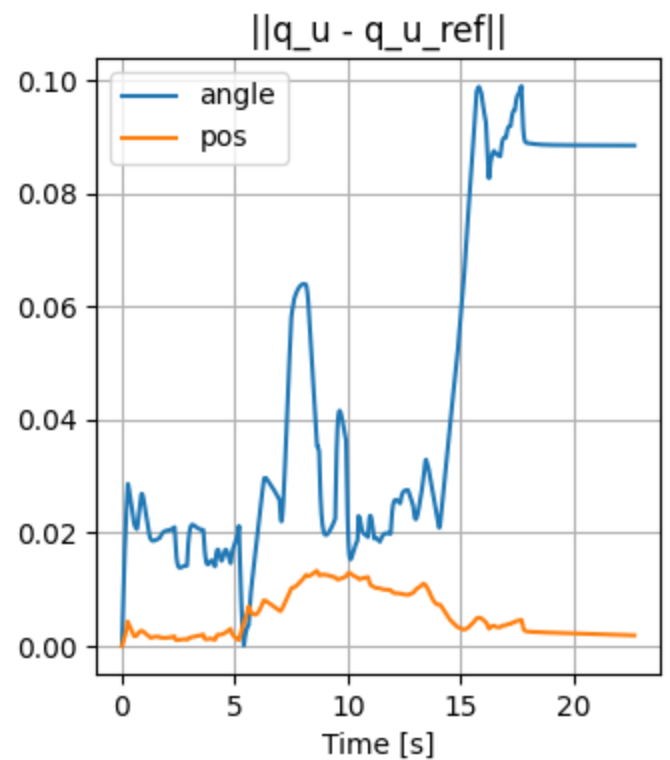
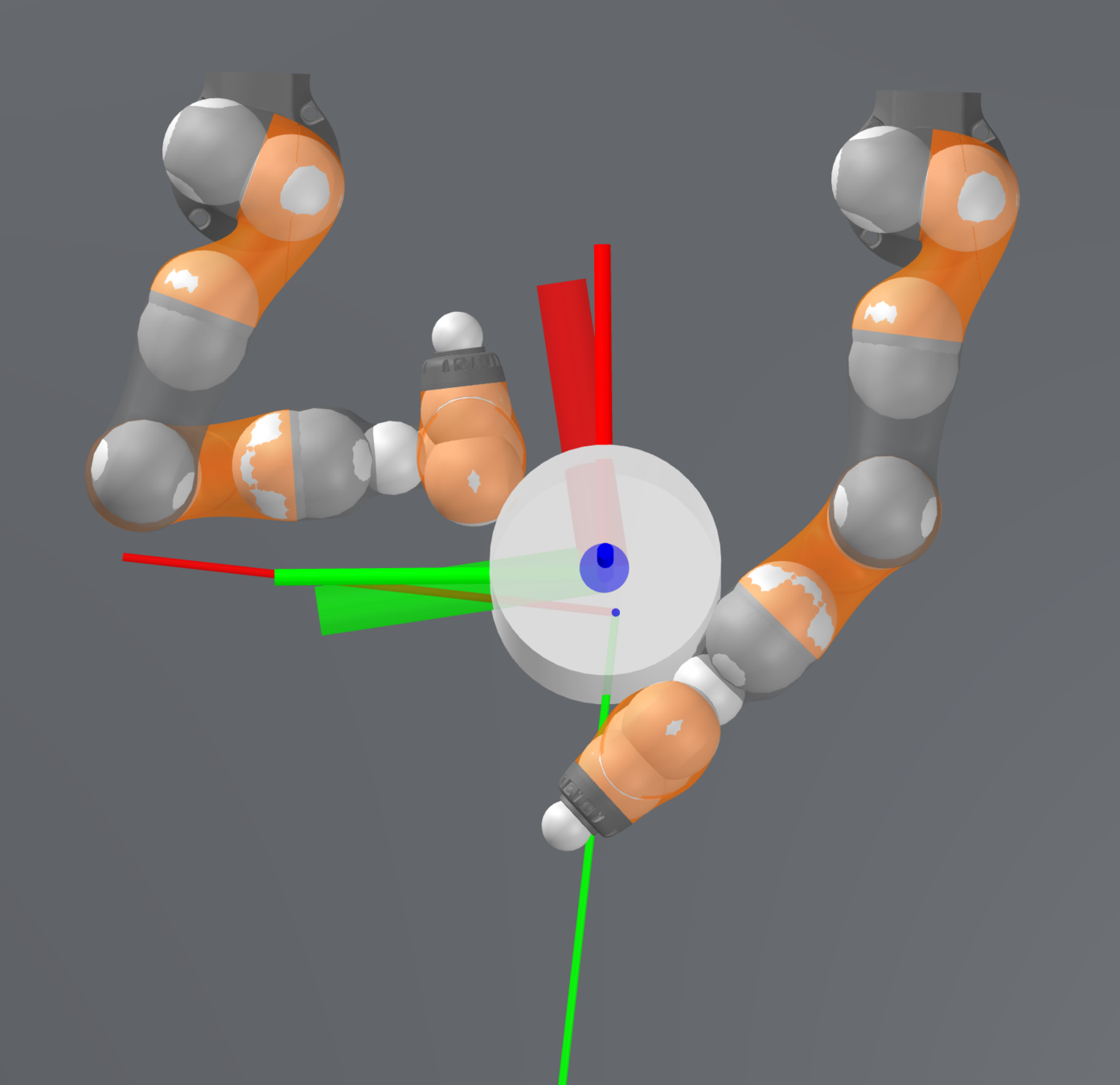
Open-loop execution of contact-rich plans on hardware:
A better contact dynamics model for contact-rich planning
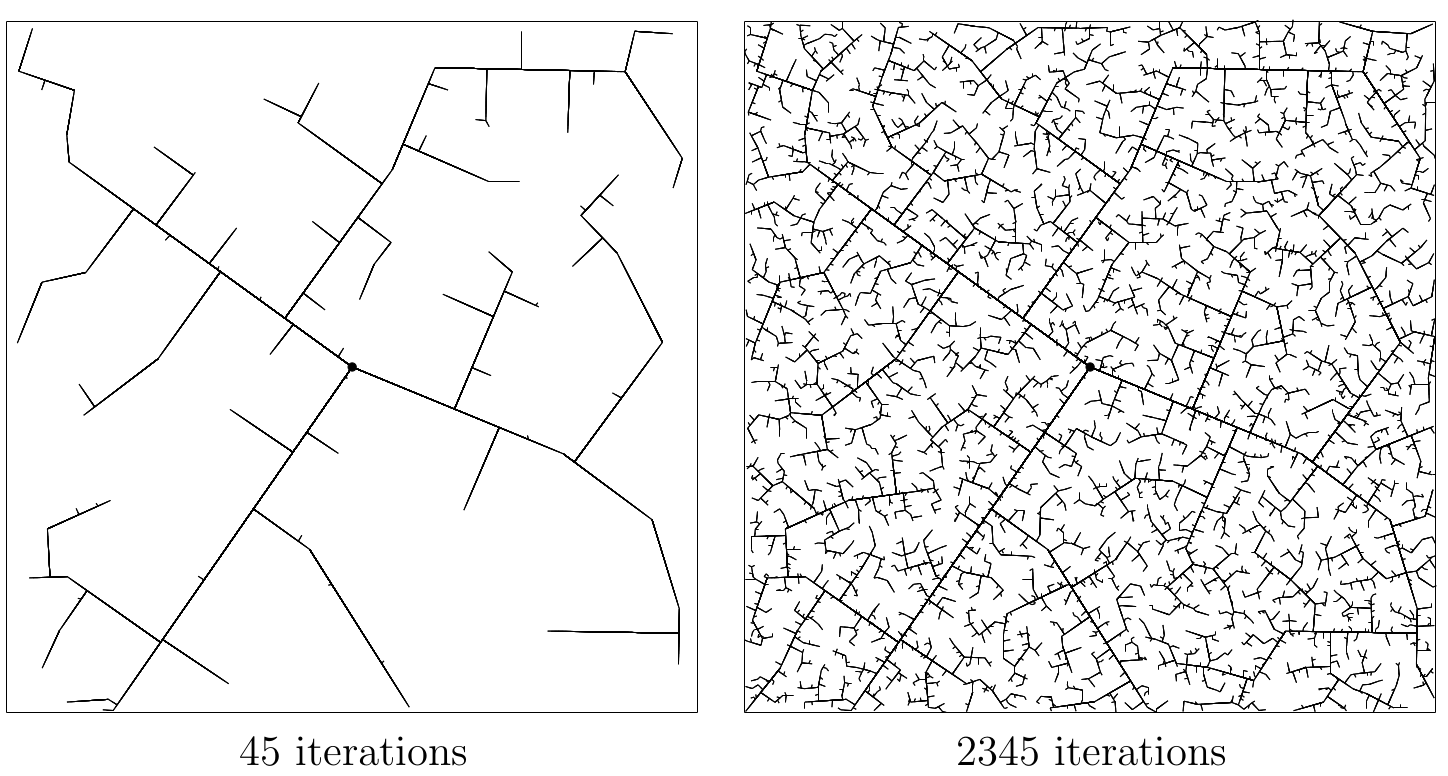
- Rapidly-Exploring Random Tree (RRT): iteratively builds a tree that fills the state space. [1]
- A good distance metric should reflect dynamic reachability. [2]
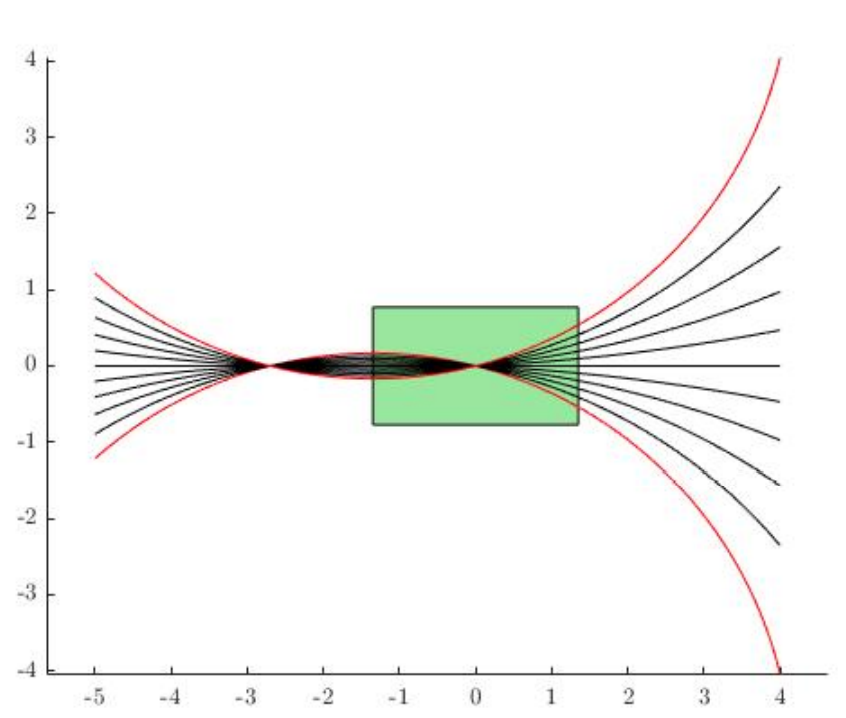
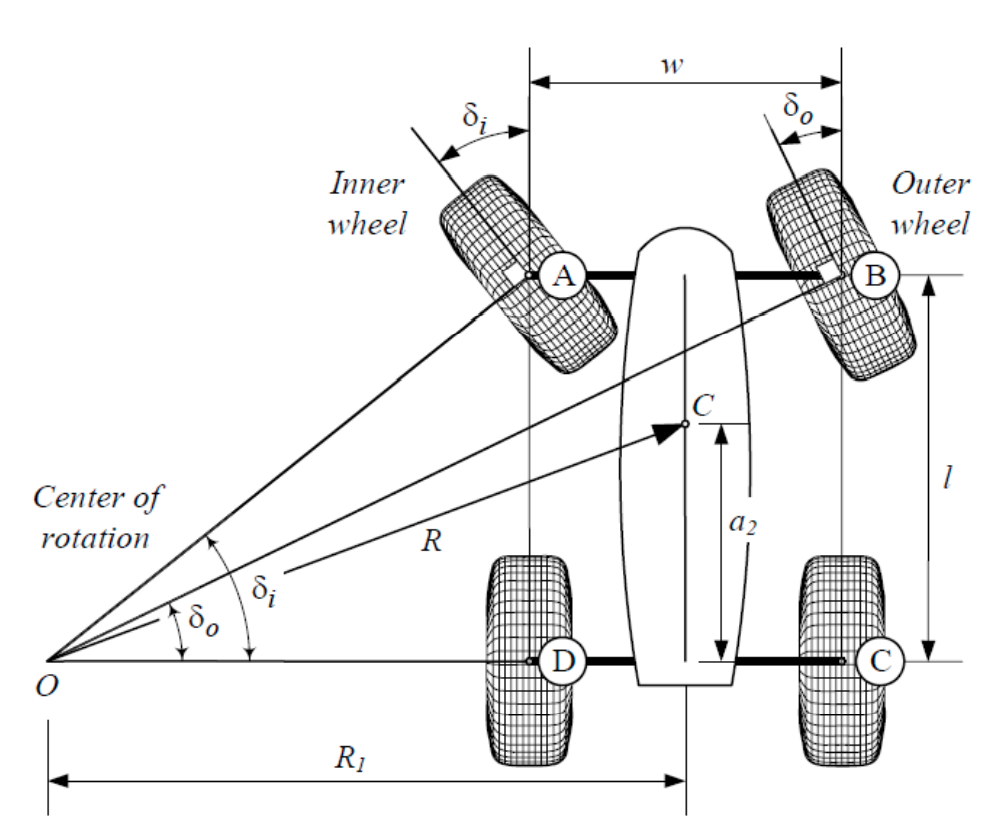
- , "Planning Algorithms", Cambridge University Press , 2006.
-
H.J.T. Suh, J. Deacon, Q. Wang, "A Fast PRM Planner for Car-like Vehicles", self-hosted, 2018.
-
Tao Pang*, H.J.T. Suh*, Lujie Yang, Russ Tedrake, "Global Planning for Contact-Rich Manipulation via Local Smoothing of Quasi-dynamic Contact Models", under review, 2022.
How do we measure reachability under the non-smooth contact-dynamics constraint?
A convex, quasi-static, differentiable contact model that can be easily smoothed. [3]
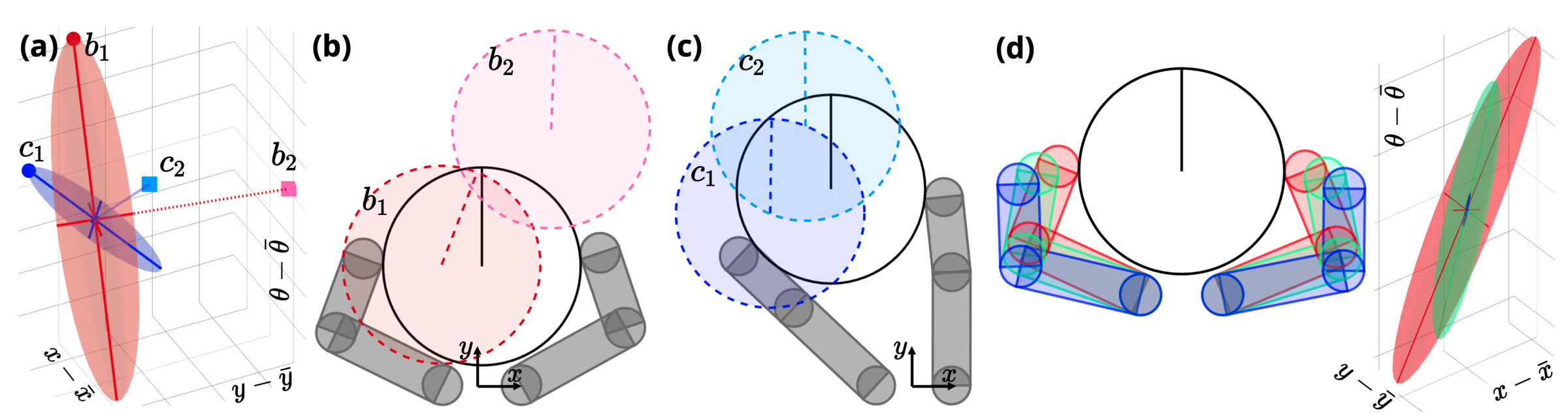
Reachability-informed distance metric using smoothed linearization of our model
Presented Works
Collaborators
-
Tao Pang*, H.J. Terry Suh*, Lujie Yang, Russ Tedrake, "Global Planning for Contact-Rich Manipulation via Local Smoothing of Quasi-dynamic Contact Models", under review.
-
H.J. Terry Suh*, Tao Pang*, Russ Tedrake, "Bundled Gradients through Contact via Randomized Smoothing", RA-L, 2022.
Terry Suh
Lujie Yang
Russ Tedrake
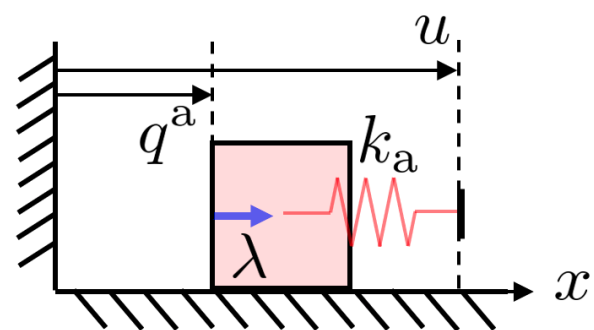
What is quasi-static dynamics?
q^\mathrm{a}
u
K_\mathrm{a}
q^\mathrm{u}
- Quasi-static: velocity is small so that inertial and Coriolis forces are negligible.
- \(x \coloneqq q \coloneqq [q^\mathrm{u}, q^\mathrm{a}]\): system configuration.
- \(q^\mathrm{a}\): actuated, imepdance-controlled robots
- \(q^\mathrm{u}\): un-actuated objects.
- \( u \):
robot velocitiesposition command to the stiffness-controlled robots [1]. - \(\delta q \coloneqq q_+ - q\)
- \(h\): step size in seconds.
\( x_{+} = f(x, u)\)
\lambda_1
\lambda_3
\lambda_1
\lambda_2
- \(\lambda_i\): contact forces/impulses
- \(\phi_i \): signed distances
\phi_2({q})
\phi_1({q})
\phi_3({q})
\begin{aligned}
\underset{\delta q^\mathrm{a}, \delta q^\mathrm{u}}{\min} \; &\frac{1}{2} hK (q^\mathrm{a} + \delta q^\mathrm{a} - u)^2 \; \text{s.t.} \\
&\phi_i (q + \delta q)\geq 0, \forall i.
\end{aligned}
\Leftrightarrow
(KKT)
- A convex quadratic program (QP), after linearizing \(\phi_i\).
- "Minimizing potential energy, subject to non-penetration constraints."
\begin{cases}
hK(q^\mathrm{a} + \delta q^\mathrm{a} - u) = -\lambda_1 + \lambda_2, \\
0 = \lambda_1 - \lambda_3, \\
\phi_i(q + \delta q) \geq 0, \; \forall i, \\
\lambda_i \geq 0 \; \forall i, \\
\phi (q + \delta q) \lambda = 0, \forall i.
\end{cases}
Force balance of the robot.
Force balance of the object.
Non-penetration.
"Contact forces cannot pull."
"Contact force needs contact."
-
Tao Pang, Russ Tedrake, "A Convex Quasistatic Time-stepping Scheme for Rigid Multibody Systems with Contact and Friction", ICRA, 2021.
Quasi-static dynamics is good for manipulation planning!
- Many manipulation tasks are quasi-static.
- Spatial benefit: Smaller state space (\([q, v]\) vs. only \(q\)).
-
Temporal benefit: Ignoring transients => looking into the future with fewer steps.
-
Tao Pang, Russ Tedrake, "A Convex Quasistatic Time-stepping Scheme for Rigid Multibody Systems with Contact and Friction", ICRA, 2021.
q^\mathrm{a}
m^\mathrm{a}
u
K
D
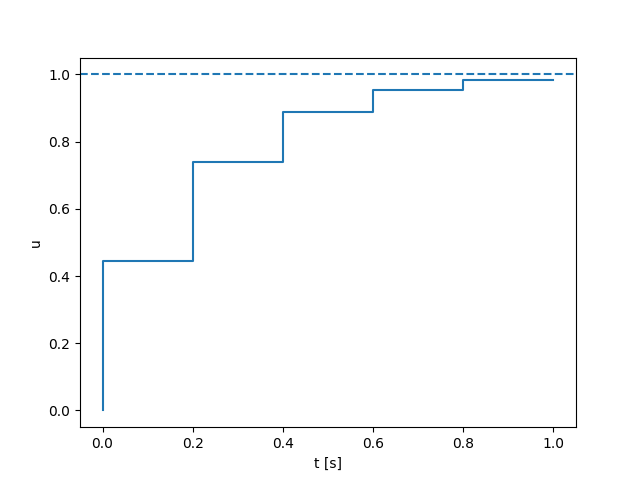
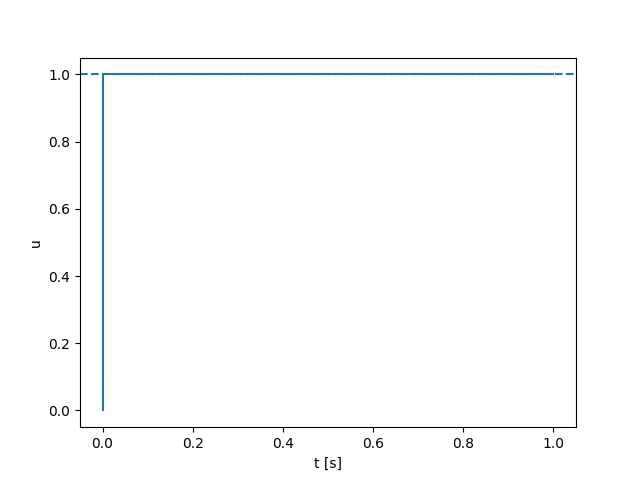
Second-order Dynamics
Quasi-static Dynamics
\begin{aligned}
m^\mathrm{a} &= 1.0 \\
D &= 20.0\\
K &= 100.0
\end{aligned}
Quasi-static Dynamics Needs Regularization
\begin{aligned}
\underset{\delta q^\mathrm{a}, \delta q^\mathrm{u}}{\min} \; &\frac{1}{2} hK (q + \delta q^\mathrm{a} - u)^2, \; \text{s.t.} \\
&\phi_i (q + \delta q)\geq 0, \forall i.
\end{aligned}
Quasi-static Dynamics
- The quadratic cost is positive semi-definite.
- The object can be anywhere between the robot and the wall, similar to having a null space.
\underset{x}{\min} \|Ax - b\|^2
\underset{x}{\min} \|Ax - b\|^2 + \epsilon \|x\|^2
Regularized least squares
Regularized Quasi-static Dynamics
\begin{aligned}
\underset{\delta q^\mathrm{a}, \delta q^\mathrm{u}}{\min} \; &\frac{1}{2} hK (q^\mathrm{a} + \delta q^\mathrm{a} - u)^2 + \frac{1}{2} \epsilon (\delta q^\mathrm{u})^2, \; \text{s.t.} \\
&\phi_i (q + \delta q)\geq 0, \forall i.
\end{aligned}
- The quadratic cost is now positive definite.
- "Among all possible object motions, give me the one that moves the least."
- Picking \(\epsilon = m^\mathrm{u} / h\) gives Mason's definition of quasi-dynamic dynamics.
q^\mathrm{a}
u
K_\mathrm{a}
q^\mathrm{u}
\phi_2({q})
\phi_1({q})
\phi_3({q})
What about friction?
\begin{aligned}
\underset{\delta q}{\min} \;
&\frac{1}{2}
{\underbrace{
\begin{bmatrix}
\delta q^\mathrm{u} \\
\delta q^\mathrm{a}
\end{bmatrix}}_{\delta q}}^\intercal
\underbrace{
\begin{bmatrix}
\mathbf{M}_\mathrm{u} / h & 0 \\
0 & h \mathbf{K}_\mathrm{a}
\end{bmatrix}}_{\mathbf{Q}}
\underbrace{
\begin{bmatrix}
\delta q^\mathrm{u} \\
\delta q^\mathrm{a}
\end{bmatrix}}_{\delta q}
+
{\underbrace{
h
\begin{bmatrix}
- \tau^\mathrm{u} \\
- \mathbf{K}_\mathrm{a} (u - q^\mathrm{a}) - \tau^\mathrm{a}
\end{bmatrix}}_{b}}^\intercal
\underbrace{
\begin{bmatrix}
\delta q^\mathrm{u} \\
\delta q^\mathrm{a}
\end{bmatrix}}_{\delta q}
\;\text{s.t.} \\
&\underbrace{\phi_i + \mathbf{J}_{\mathrm{n}_i}\delta q}_{\text{Linearized} \; \phi_i(q + \delta q)} \geq 0, \; \forall i \in \{1 \cdots n_{\mathrm{c}}\}.
\end{aligned}
- For a frictionless multi-body system with \(n_\mathrm{c}\) contacts, the dynamics can be solved as a QP:
- \(\mathcal{K}^\star_i\) is the dual of the \(i\)-th friction cone.
- Still convex! Convexity is achieved at the expense of "hydroplaning" between relatively-sliding objects.
- But hydroplaning disappears as \(h \rightarrow 0\).
\begin{aligned}
\underset{\delta q}{\min} \;
&\frac{1}{2} {\delta q}^\intercal \mathbf{Q} \delta q + b^\intercal \delta q \;\text{s.t.} \\
&
\begin{bmatrix}
\phi_i + \mathbf{J}_{\mathrm{n}_i}\delta q \\
\mathbf{J}_{\mathrm{t}_i}\delta q
\end{bmatrix}
\in \mathcal{K}^\star_i, \; \forall i \in \{1 \cdots n_{\mathrm{c}}\}.
\end{aligned}
- Anitescu [1] has a nice convex approximation of Coulomb friction constraints, allowing us to write down the dynamics as a Second-Order Cone Program (SOCP):
Tangential displacements
\begin{aligned}
\underset{\delta q^\mathrm{a}, \delta q^\mathrm{u}}{\min} \; &\frac{1}{2} hK (q + \delta q^\mathrm{a} - u)^2 + \frac{1}{2} \frac{m^\mathrm{u}}{h} (\delta q^\mathrm{u})^2, \; \text{s.t.} \\
&\phi_i (q + \delta q)\geq 0, \; \forall i.
\end{aligned}
Dynamics of the Toy Problem
- Anitescu, Mihai. "Optimization-based simulation of nonsmooth rigid multibody dynamics." Mathematical Programming 105.1 (2006): 113-143.
Differentiability
\begin{aligned}
\delta q^\star \coloneqq \underset{\delta q}{\text{argmin}.} \;
&\frac{1}{2} {\delta q}^\intercal \mathbf{Q} \delta q + b^\intercal \delta q \;\text{s.t.} \\
&
\begin{bmatrix}
\phi_i + \mathbf{J}_{\mathrm{n}_i}\delta q \\
\mathbf{J}_{\mathrm{t}_i}\delta q
\end{bmatrix}
\in \mathcal{K}^\star_i, \; \forall i \in \{1 \cdots n_{\mathrm{c}}\}.
\end{aligned}
Convex, Quasi-Static, Differentiable Dynamics (an SOCP)
q_+ = f(q, u) = q + \delta q^\star(q, u)
\newcommand{\DfDx}[2]{\frac{\partial {#1}}{\partial {#2}}}
\mathbf{A} \coloneqq \DfDx{f}{q} = \mathbf{I} + \DfDx{\delta q^\star}{q}, \;
\mathbf{B} \coloneqq \DfDx{f}{u} = \DfDx{\delta q^\star}{u},
- The KKT optimality condition of the dynamics SOCP defines equality constraints (including active contact constraints), from which the derivatives of \(\delta q^\star\) w.r.t. \((\mathbf{Q}, b, \phi_i, \mathbf{J}_{\mathrm{n}_i}, \mathbf{J}_{\mathrm{t}_i})\) can be computed using the Implicit Function Theorem (IFT).
- \(\mathbf{A}, \mathbf{B}\) can then be computed using the gradients from IFT and the chain rule.
- Standard practice for many differentiable simulators, even though many of them do not find the active constraints by solving convex programs.
Smoothing
- The contact dynamics \(f(q, u) \in C^0\) has discontinuous gradients, which are bad for planning methods that use gradients.
- Smoothing with "force at a distance" is a common method to alleviate this problem.
Optimality Condition
\begin{aligned}
\underset{\delta q^\mathrm{a}, \delta q^\mathrm{u}}{\min} \; &\frac{1}{2} hK (q + \delta q^\mathrm{a} - u)^2 + \frac{1}{2} \frac{m^\mathrm{u}}{h} (\delta q^\mathrm{u})^2
- \frac{1}{\kappa}\sum_i\log{\phi_i(q + \delta q)}
\end{aligned}
\Leftrightarrow
\begin{aligned}
\underset{\delta q^\mathrm{a}, \delta q^\mathrm{u}}{\min} \; &\frac{1}{2} hK (q + \delta q^\mathrm{a} - u)^2 + \frac{1}{2} \frac{m^\mathrm{u}}{h} (\delta q^\mathrm{u})^2, \; \text{s.t.} \\
&\phi_i (q + \delta q)\geq 0, \forall i.
\end{aligned}
\Leftrightarrow
KKT
Original Dynamics
\begin{cases}
hK(q^\mathrm{a} + \delta q^\mathrm{a} - u) = -\lambda_1 + \lambda_2, \\
(m^\mathrm{u} / h) \delta q^\mathrm{u} = \lambda_1 - \lambda_3, \\
\phi_i(q + \delta q) \geq 0, \; \forall i, \\
\lambda_i \geq 0, \; \forall i, \\
\phi (q + \delta q) \lambda = 0, \forall i.
\end{cases}
q^\mathrm{a}
u
K_\mathrm{a}
q^\mathrm{u}
\lambda_1
\lambda_3
\lambda_1
\lambda_2
\phi_2({q})
\phi_1({q})
\phi_3({q})
Smoothed Dynamics
\begin{cases}
hK(q^\mathrm{a} + \delta q^\mathrm{a} - u) = -\lambda_1 + \lambda_2, \\
(m^\mathrm{u} / h) \delta q^\mathrm{u} = \lambda_1 - \lambda_3, \\
\phi_i(q + \delta q) \geq 0, \; \forall i, \\
\lambda_i \geq 0, \; \forall i, \\
\phi_i (q + \delta q) \lambda = 1 / \kappa, \forall i.
\end{cases}
Smoothing, the general case.
\begin{aligned}
\underset{\delta q}{\text{min}.} \;
&\frac{1}{2} {\delta q}^\intercal \mathbf{Q} \delta q + b^\intercal \delta q \;\text{s.t.} \\
&
\begin{bmatrix}
\phi_i + \mathbf{J}_{\mathrm{n}_i}\delta q \\
\mathbf{J}_{\mathrm{t}_i}\delta q
\end{bmatrix}
\in \mathcal{K}^\star_i, \; \forall i \in \{1 \cdots n_{\mathrm{c}}\}.
\end{aligned}
\underset{\delta q}{\text{min}.} \;
\frac{1}{2} {\delta q}^\intercal \mathbf{Q} \delta q + b^\intercal \delta q
-
\frac{1}{\kappa}
\sum_{i=1}^{n_\mathrm{c}}
\log
\left[
\frac{(\phi_i + \mathbf{J}_{\mathrm{n}_i}\delta q)^2}{\mu_i^2} - (\mathbf{J}_{\mathrm{t}_i}\delta q)^\intercal (\mathbf{J}_{\mathrm{t}_i}\delta q)
\right]
Put constraints in a generalized log for \(\mathcal{\kappa}_i^\star\)
\Rightarrow
- An unconstrained convex program.
- Can be solved with Newton's method.
- Also differentiable.
Convex, Quasi-Dynamic, Differentiable Dynamics (an SOCP)
Notation:
q_+ = f(q, u)
Original dynamics
q_+ = f_\rho(q, u)
Smoothed dynamics
Smoothed gradients enable trajectory optimization for dexterous hands, but...
Task: Turning the ball by 30 degrees.
What about 180 degrees?
Finding this trajectory requires powering through local minima!
Sampling-based Motion Planing is Great at Global Exploration, but...
- Rapidly-Exploring Random Tree (RRT): iteratively builds a tree that fills the state space. [1]
- Dynamic reachability is essential for efficient exploration. [2]
- , "Planning Algorithms", Cambridge University Press , 2006.
-
H.J.T. Suh, J. Deacon, Q. Wang, "A Fast PRM Planner for Car-like Vehicles", self-hosted, 2018.
How do we think about reachability under the contact-dynamics constraint?
A distance metric that reflects reachability
q_+ = f_\rho(q, u),
\newcommand{\DfDx}[2]{\frac{\partial {#1}}{\partial {#2}}}
\mathbf{A}_\rho \coloneqq \DfDx{f_\rho}{q}\big|_{q,u}, \\
\mathbf{B}_\rho \coloneqq \DfDx{f_\rho}{u}\big|_{q,u}.
\mathcal{R}_{\rho, \varepsilon}^\mathrm{u} (\bar{q})\coloneqq \left\{\mathbf{B}_\rho^\mathrm{u}(\bar{q},\bar{q}^{\mathrm{a}}) \delta u + f_\rho^\mathrm{u}(\bar{q},\bar{q}^\mathrm{a})\; | \; \|\delta u\|\leq \varepsilon\right\}
Smoothed Contact Dynamics
\(\varepsilon \) sub-level set
Nominal state
un-actauted(objects)
Smoothed
\begin{aligned}
d^\mathrm{u}_{\rho}(q; \bar{q}) &\coloneqq \frac{1}{2} (q^\mathrm{u} - \mu^\mathrm{u}_\rho)^\intercal {\left[\mathbf{B}_{\rho}^{\mathrm{u}} {\mathbf{B}_{\rho}^{\mathrm{u}}}^\intercal\right]}^{-1} (q^\mathrm{u} - \mu^\mathrm{u}_\rho) \\
\mu_\rho^\mathrm{u} &\coloneqq f_\rho^\mathrm{u}(\bar{q}, \bar{q}^\mathrm{a})
\end{aligned}
At state \(\bar{q}\), what doe an \(\varepsilon\)-ball in action space get transformed into under the smoothed dynamics?
RRT through contact
Three modifications to the vanilla RRT are made:
- Nearest node on tree is found using \( d^\mathrm{u}_{\rho}(q; \bar{q}) \).
- Contact sampling: robot configuration is occasionally reset to one that has a good distance metric, which typically corresponds to grasps.
- Dynamic-consistent extension: an action is computed using the smooth linearized dynamics to reach \(q\).
Distance Metric
RRT tree for a simple system with contacts
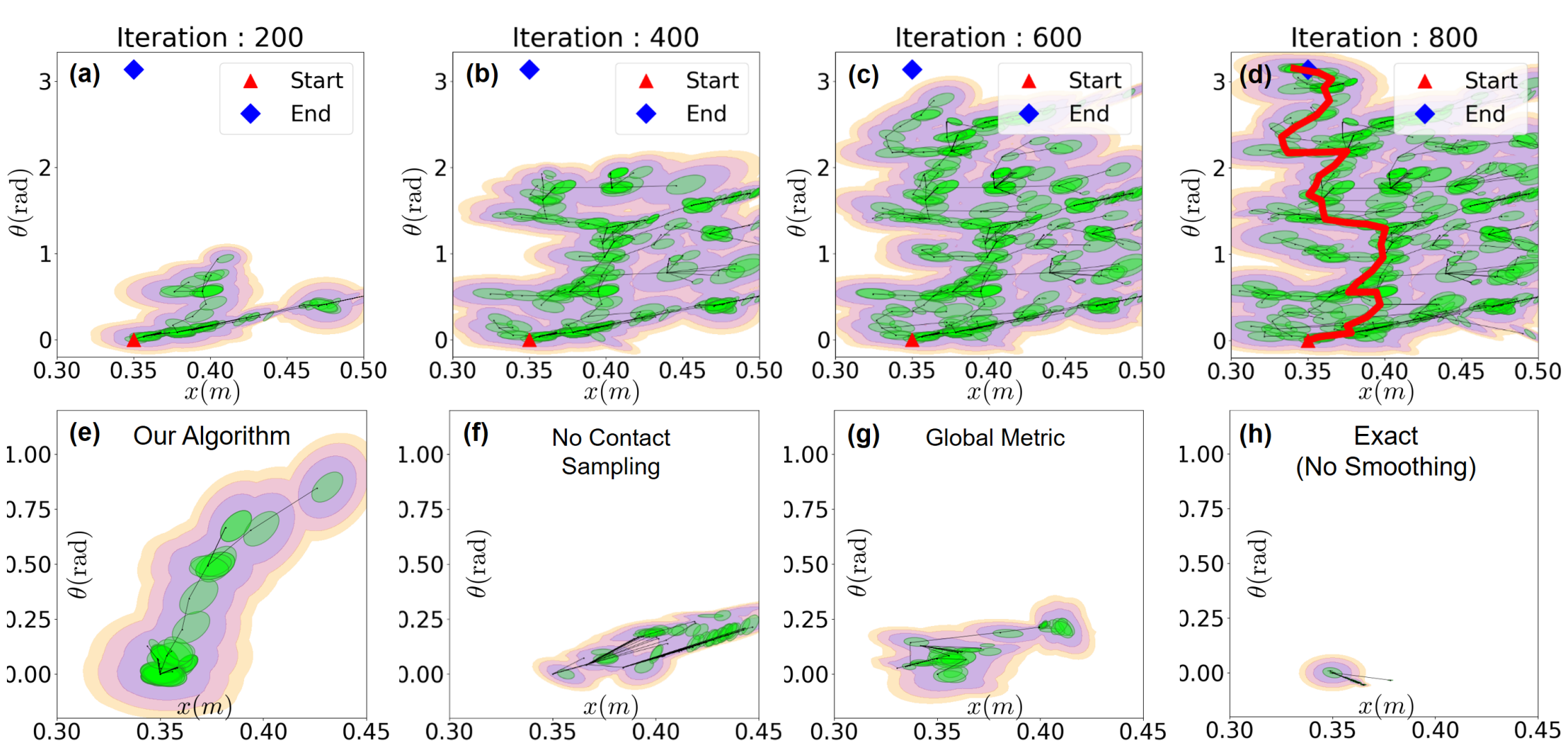
Ablation study: what trees look like after growing a fixed number of nodes.
\begin{aligned}
d^\mathrm{u}_{\rho}(q; \bar{q}) &\coloneqq \frac{1}{2} (q^\mathrm{u} - \mu^\mathrm{u}_\rho)^\intercal {\left[\mathbf{B}_{\rho}^{\mathrm{u}} {\mathbf{B}_{\rho}^{\mathrm{u}}}^\intercal\right]}^{-1} (q^\mathrm{u} - \mu^\mathrm{u}_\rho) \\
\mu_\rho^\mathrm{u} &\coloneqq f_\rho^\mathrm{u}(\bar{q}, \bar{q}^\mathrm{a})
\end{aligned}
The modified RRT works well for contact-rich tasks!


Planning wall-clock time (seconds)
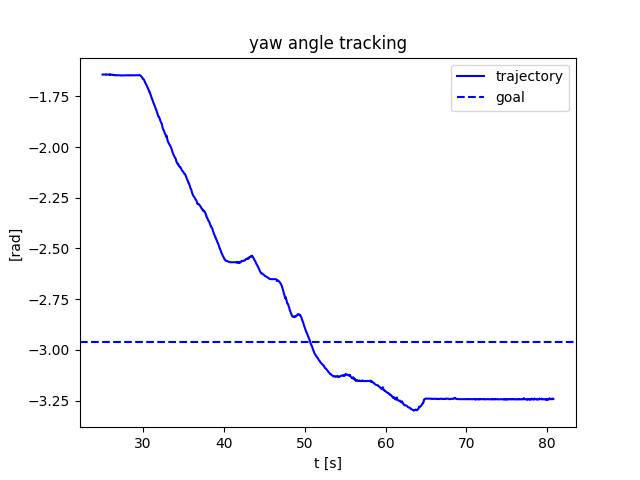
Preliminary: stabilizing contact-rich plans
Open-loop
Closed-loop
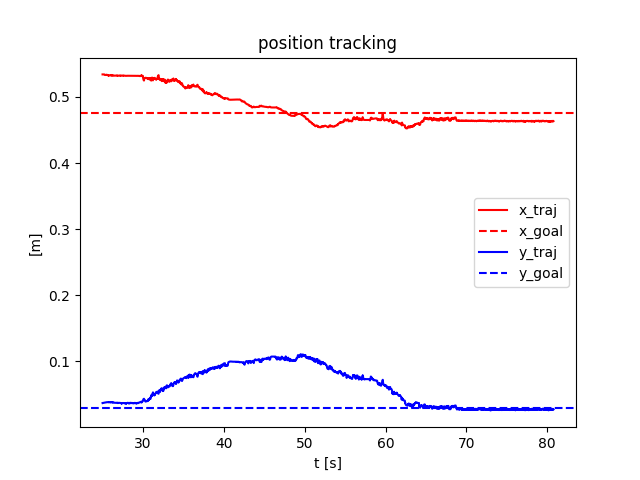

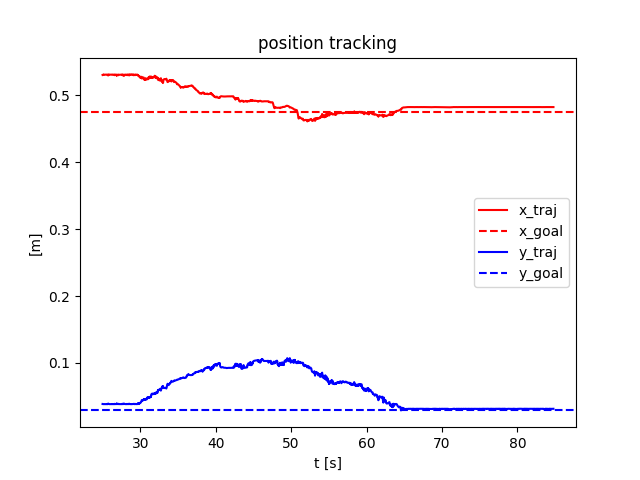
\begin{aligned}
\underset{q^\mathrm{u}_+, u}{\min} &\|q_+^\mathrm{u} - q_+^\mathrm{u, ref}\|_\mathbf{Q} + \|u - u^\mathrm{ref} \|_\mathbf{R}, \text{s.t.}\\
& q^\mathrm{u}_+ = f^\mathrm{u}(q^\mathrm{ref}, u^\mathrm{ref}) + \mathbf{B}_\rho^\mathrm{u} (u - u^\mathrm{ref})
\end{aligned}
Naive QP controller based on smoothed linearization:
Quasi-static dynamical systems: how to fix it.
q^\mathrm{a}
m^\mathrm{a}
u
K
D
A Impedance-controlled 1D robot and an object.
m^\mathrm{u}
q^\mathrm{u}
- Pang, Tao, and Russ Tedrake. "A convex quasistatic time-stepping scheme for rigid multibody systems with contact and friction." 2021 IEEE International Conference on Robotics and Automation (ICRA). IEEE, 2021.
- Pang, Tao, and Russ Tedrake. "A robust time-stepping scheme for quasistatic rigid multibody systems." 2018 IEEE/RSJ International Conference on Intelligent Robots and Systems (IROS). IEEE, 2018.
\( x_{+} = f(x, u)\)
- \(x \coloneqq q \coloneqq [q^\mathrm{u}, q^\mathrm{a}]\): system configuration.
- \(q^\mathrm{a}\): actuated, imepdance-controlled robots
- \(q^\mathrm{u}\): un-actuated objects.
- \( u \):
robot velocities.position command to the impedance-controlled robots.
\begin{cases}
\end{cases}
Contact force and \(q_+\) can now be uniquely* determined from \(u\), even for grasping.
Force-acceleration vs. Impulse-Momentum
q^\mathrm{a}
m^a \ddot{q}^\mathrm{a} + D \dot{q}^\mathrm{a} + K(q^\mathrm{a} - u) = 0
m^\mathrm{a}
u
``\Sigma F = ma"
Force-acceleration
K
D
- Stewart, David E. "Rigid-body dynamics with friction and impact." SIAM review 42.1 (2000): 3-39.
``h\Sigma F = m\Delta v"
m^\mathrm{a} (\delta v) + hD v^\mathrm{a} + hK(q^\mathrm{a} + \delta q^\mathrm{a} - u) = 0
Impulse-momentum
0
0
0
0
\underset{\delta q^\mathrm{a}}{\min} \; \frac{1}{2} hK (q^\mathrm{a} + \delta q^\mathrm{a} - u)^2
is the optimality condition of
But impacts can lead to infinite forces (e.g. Painleve's Paradox) [1].
Time step
Stabilizing contact-rich plans
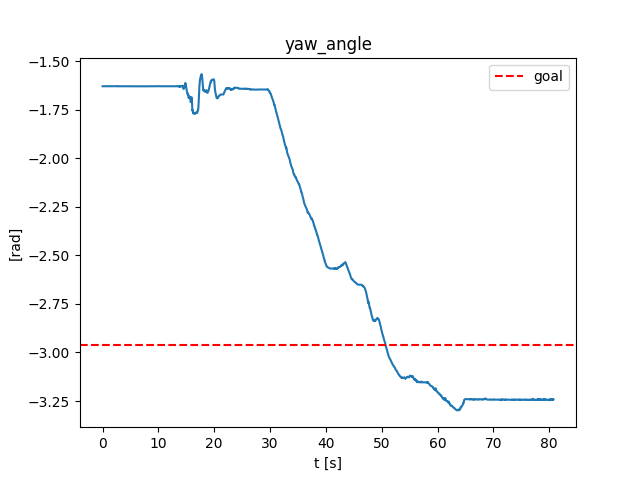
Open-loop hardware
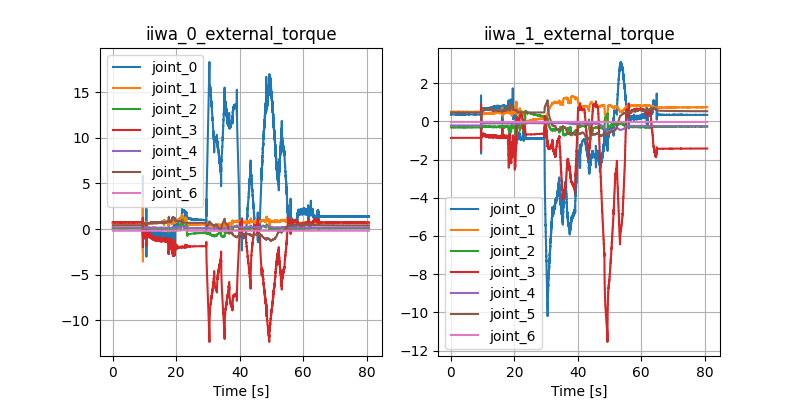
Open-loop Drake
talk_10min
By Pang


