GPIO Programming:
Now with Interrupts!

Computing Machinery II Tutorial:
Week of March 25th
Review
- Breadboard circuits (LED + 2 types of button)
- C programs to control GPIO pins (gpio.h)
- Setup pin to be output, have LED Blink when set
- Setup pin to be input, have button change variable
GPIO C Programming
- lets just use gpio.h in C
- why do it in ARM Assembly?
- we read and write to specific memory addresses to control the Pi's GPIO pin voltages
- GPFSEL0, GPFSEL1,..., GPSEL5
- GPSET0, GPSET1
- GPCLR0, GPSET1
- GPLEV0, GPLEV1

Assignment 3
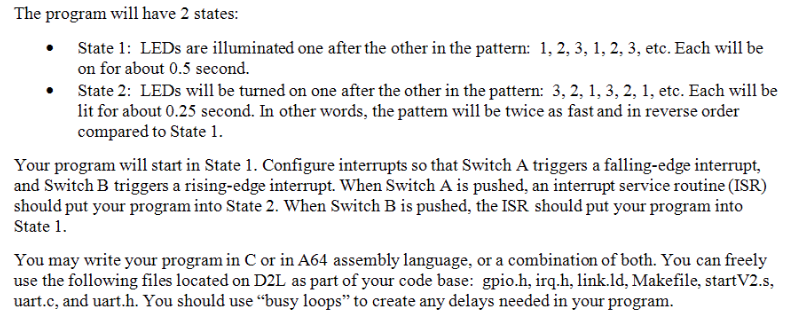
Today:
- Interrupt-driven programming
- see what assignment 3 demo should look like
- 05_GPIO_PushButton_Interrupt as toy example
- wire breadboard for this program
- compile and run code
- review code
- add switch A, falling edge type, interrupt control to decrement counter
- extra time? outline steps to do assignment
Breakdown of interrupt code
- includes
-
"sysreg.h" for enableIRQ();
-
"irq.h" for IRQ_ENABLE_IRQS_2
-
- sharedValue
- outside of main, in main, and in handlers.c
- while loop
- main take away: the sharedValue can change at any time, i.e. during the busy loop
-
init_GPIO_to_risingEdgeInterrupt()
-
*GPREN0 = (0x1 << 17);
-
*IRQ_ENABLE_IRQS_2 = (0x1 << 20);
-
- handers.c
- IRQ_handler() runs for all of our interrupts
-
sharedValue++
Add decrement button interrupt
- places to modify code:
- main.c
- define init_GPIO18_to_fallingEdgeInterrupt()
- copy code from init_GPIO17_to_....
- GPREN0 should be replaced with GPFED0
- 17 should be replaced with 18
- in main()
- add your new init function
- define init_GPIO18_to_fallingEdgeInterrupt()
- handler.c
- add condition for ( *GPEDS0 == (0x1 << 18) ) to decrement sharedValue
- main.c
Recommended assignment steps
- start with GPIO_PushButtonInterrupt code
- get single state program running
- remove printing of program and exception state info
- add back LED control functions from other toy examples.
- init_GPIO_to_output(), set_GPIO(), and clear_GPIO()
- either replicate these LED control functions (and calls in main()) for each LED pin numbers or abstract the functions to take pin number argument.
- infinite loop in main() just calls light_next(current_LED)
int light_next(current LED) {
    busy_loop();
    clear_GPIO(current LED);
    set_GPIO(previous LED);
    return next LED
}
More steps...
- add states
- sharedValue -> current state
- modify handler.c
....
if (*IQR_PENDING_2 == 0x00100000) {
    if (interrupt pin is 23) {current_state set to 2}
    else if (interrupt pin is 24) {current_state set to 1}
    write GPEDS0 value back to itself to indicate the interrupt has been serviced
}
....- reparameterize light_next and busy_loop functions to also take state parameters i.e., speed and order
- write helper functions e.g. busy_loop(int time)
- rewrite infinite loop
while (true) {
    if (current state is 1) {
        current LED = light_next(state parameters, current LED)
    }
    else if (current state is 2) {
        current LED = light_next(state parameters, current LED)
    }

}
Final steps...
- fill in all the details I missed
- test and debug from the beginning
- submit on D2L
Thursday..
do assignment 3 and ask questions
Pi_4
By pathomas