


Player-Computer Interaction
EVALUATION
MODELS
UNIT 9:
Prof. Dr. Eike Langbehn
Department of Media Technology
Faculty of Design, Media and Information
Hamburg University of Applied Sciences


SECTION NAME
EXAMPLES
UNIT 2:
AGENDA
PLAYER-COMPUTER INTERACTION
UNIT 9: EVALUATION MODELS
1. INTRO
2. REQUIREMENT
ANALYSIS
3. GAME
DESIGN
0. ORGANIZATION
4. GETTING STARTED
WITH GODOT
5. USER
STUDIES
6. ANALYSIS OF
HUMAN FACTORS
7. INTERACTION
DESIGN
8. ADVANCED PROGRAMMING
WITH GODOT
9. EVALUATION
MODELS
10. MARKET
ANALYSIS
11. NARRATIVE
DESIGN
12. GAME ENGINE
ARCHITECTURE
LEARNING outcomes
- Knowledge about models for usability evaluation
PLAYER-COMPUTER INTERACTION
UNIT 9: EVALUATION MODELS
human action cycle
PLAYER-COMPUTER INTERACTION
UNIT 9: EVALUATION MODELS
Gulf of Execution
Discrepancy between goal and execution
Gulf of Evaluation
Discrepancy between display and interpretation
Forming
the goal
Forming
the intention
Specifying
the action
Executing
the action
Evaluating
the outcome
Interpreting
the state of the world
Perceiving
the state of the world


Norman, D. (2013). The Design of Everyday Things. New York, NY: Basic Books
klm-goms
PLAYER-COMPUTER INTERACTION
UNIT 9: EVALUATION MODELS
- GOMS:
- Goals
- Operators
- Methods (Sequence of Operators)
- Selection Rules (Select which Method)
- Keystroke-level model
- time estimation for simple tasks with mouse and keyboard
USE-CLOSE-METHOD USE-CTRL-W-METHOD
P (to Menu) 1.1s M 1.2s
B (LEFT down) 0.1s K (CTRL & W) 0.28s
M 1.2s
P (to Close) 1.1s
B (LEFT up) 0.1s
Total: 3.6s Total: 1.48s
GOAL: CLOSE-WINDOW
[select:
- GOAL:
- USE-CLOSE-METHOD
- MOVE-MOUSE-TO-FILE-MENU
- PULL-DOWN-FILE-MENU
- MOVE-MOUSE-TO-CLOSE-OPTION
- CLICK-CLOSE-OPTION
- GOAL:
- USE-CTRL-W-METHOD
- PRESS-CONTROL-W-KEYS
S. Card, T. Moran, A. Newell: The Psychology of Human Computer Interaction. Lawrence Erlbaum Associates. ISBN0-89859-859-1,1983
fitt's law
PLAYER-COMPUTER INTERACTION
UNIT 9: EVALUATION MODELS
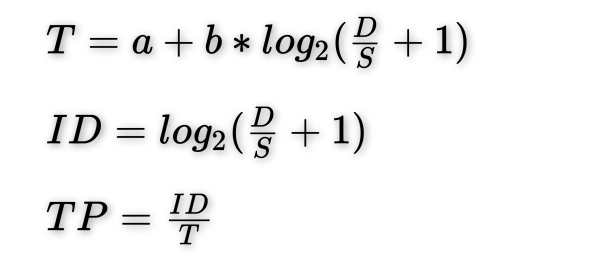
Speed-Accuracy tradeoff
Speed and accuracy of motor action
S
D
- S: Size of target
- D: Distance to target
- T: Movement time
- a,b: empirically determined
- ID: Index of Difficulty
- TP: Throughput / Index of Performance
P. Fitts: The information capacity of the human motor system in controlling the amplitude of movement. Journal of Experimental Psychology, 47(6), pp.381–391, 1954
fitt's law in guis
PLAYER-COMPUTER INTERACTION
UNIT 9: EVALUATION MODELS
P. Fitts: The information capacity of the human motor system in controlling the amplitude of movement. Journal of Experimental Psychology, 47(6), pp.381–391, 1954
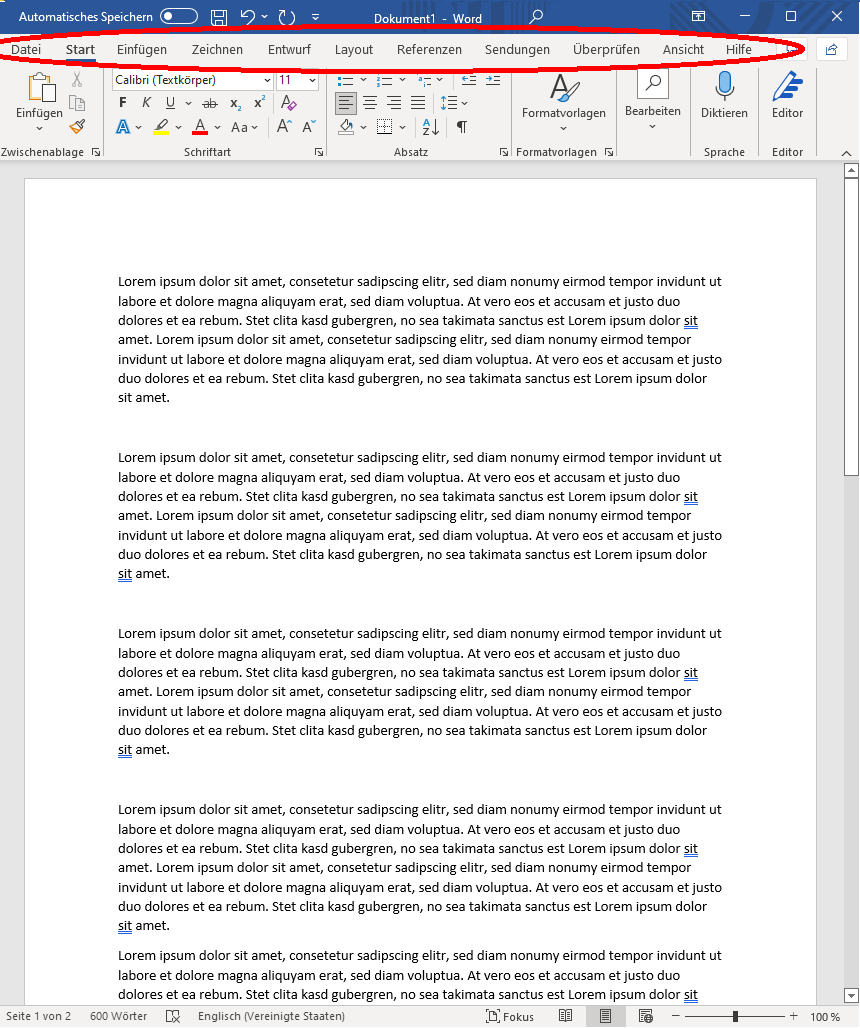
Windows 11

Infinite Target Widths at Edges
∞
∞
steering law
PLAYER-COMPUTER INTERACTION
UNIT 9: EVALUATION MODELS
. Accot and S. Zhai: Performance evaluation of input devices in trajectory-based tasks: An application of the steering law. In Proceedings of ACM CHI 1999, pp. 466–472, 1999
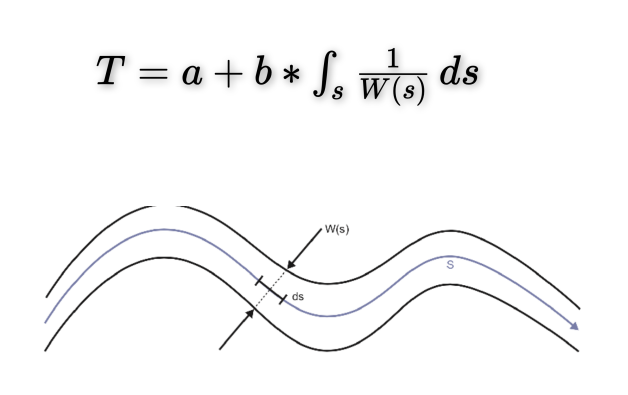
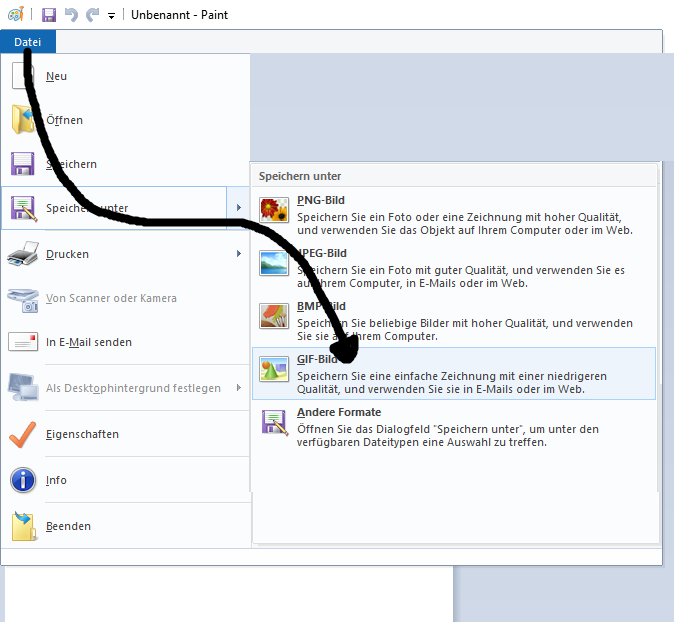
Navigate through tunnel:
Player-Computer Interaction
The contents of this Open Educational Resource are licensed under the Creative-Commons Attribution 4.0 International license (CC BY 4.0)
Attribution: Eike Langbehn, Anh Sang Tran, Peter Wood
Unit 9 - V5
By sangow