AR 13
Usage du Calcul Haute Performances en Géomatique
Paul Chapron
Etienne Delay
Jean-Baptiste Féret
Sébastien Rey-Coyrehourcq
(Laboratoire LASTIG Univ. Gustave Eiffel, ENSG-IGN),
(CIRAD UMR Sens),
(UMR TETIS, INRAE),
(UMR IDEES)
*
Juste Raimbault
(Laboratoire LASTIG Univ. Gustave Eiffel, ENSG-IGN),
nov 2025, Lyon
Qu'est ce que le HPC ?
"High Performance Computing" ou
"Calcul Haute Performances"
High-Performance Computing (HPC) refers to any form of computing where the density of processing or the size of the problems addressed require more than a standard or commodity computing system in order to achieve the expected result under the given constraints, and the application of advanced techniques such as the use of multiple processors (tens, hundreds, thousands or even more) connected together by some kind of network to achieve a performance well above that of a single processor.
Both projects began in 1993, with significant systems deployed in 1994,
and both had strong impact on the community, essentially defining the
range of capabilities and techniques to be incorporated to this day.
https://www.etp4hpc.eu/
Qu'est ce que le HPC ?
"High Performance Computing" ou
"Calcul Haute Performances"
The term “HPC” is very easy : it stands for high-performance
computing (or “computer” depending on context), but the definition of what is “high-performance” is vague, relative and almost constantly changing as hardware continues to improve.
It is a characteristic feature that today’s workstations now offer levels of performance (or better) than only three-five years ago required extremely expensive HPC hardware in the form of vector supercomputers.
OpenShaw & Turton 2000
High performance computing and the art of parallel programming : an introduction for geographers, social scientists, and engineers
Action de recherche
Objectifs
Moyens
Dresser un paysage/inventaire au niveau national
Enquête(s) interne besoins MAGIS
Webinaires
Faire connaitre et promouvoir le HPC
Rédaction d'un "Position Paper"
Ateliers
Présence dans la communauté "Calcul" nationale & européenne
Identifier et valoriser les enjeux présent / à venir
Fédérer et animer une communauté de pratiques
NewsLetter
Enquête(s) nationale auprès des ressources
(GIS FranceGrille , groupe Calcul => JCAD )
Le HPC en géomatique ?


simulation
NLP / TAL
teledetection
geoviz
3D

...
...
...
2022
Le HPC en géomatique ?
simulation
NLP / TAL
teledetection
geoviz
3D
...
...
...
2022
2025
Résumé des actions
2022 - 2023
- Atelier journées MAGIS
- Lancement de l'AR et travail sur une première Enquête "Votre usage du HPC ?"
- Test de l'enquête (sept-oct 2023) : Lastig (Strudel) => 11 réponses
2024
- Webinaire 1 / juillet 2024 :
- Yousra Hamrouni (Dynafor),
- Jocelyn Degoer (EPIA)
- Webinaire 2 (co-organisé avec le GT Notebook) / octobre 2024 :
- Bernard Chambon (IN2P3),
- Benoist GASTON (CRIANN),
- Pierre-Antoine Boutier (GRICAD),
- Ludovic Courtès (Inria)
=> + 100 personnes inscrites sur Webinaire 2
Résumé des actions
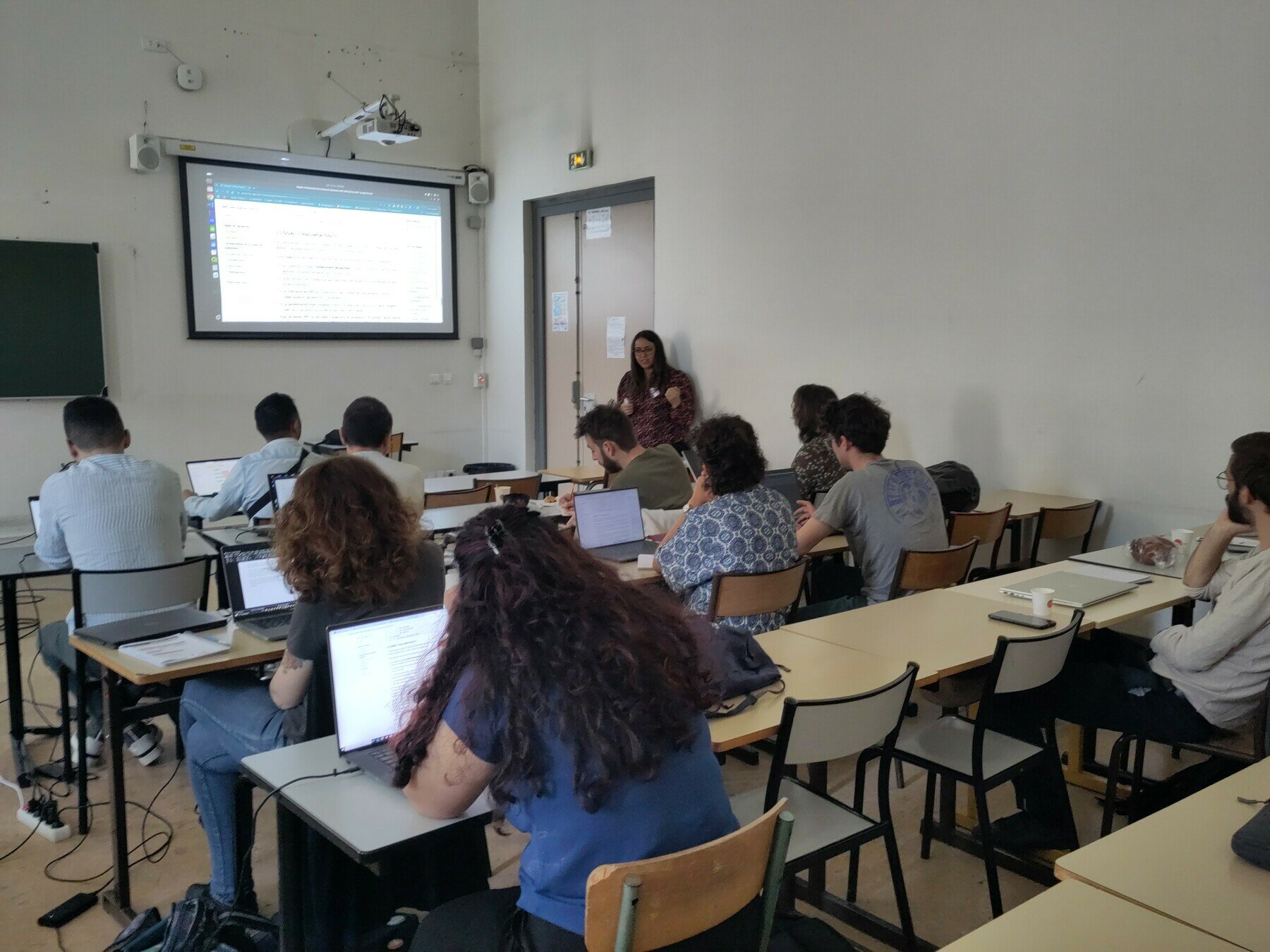
2025 / Atelier Sagéo
- Création from scratch d'une formation R & Python pour le HPC sur une chaine de postraitement en télédetection
- + de 11 réunions de travail entre janvier et mai
- 4 intervenant.e.s : Nicolas Roelandt, Yousra Hamrouni, Juste Raimbault et moi
- 2 mésocentres : CRIANN (Benoist Gaston), de LILLE (Jan gmys) + infrastructure OpenStack du LAL
- 20 inscrit.e.s et 18 participant.e.s
- 1 site web compagnon + repository
- 1 enquête (9 répondant.e.s)
Perspectives
2026 - ...
-
Début 2026 : Webinaire 3
- Rémi Cresson (Inrae)
- Séries temporelles d'imagerie satellite et imagerie très haute résolution
- Plateforme MTD : https://www.stac.teledetection.fr/en/
- Février 2026 (à valider) : Atelier OpenMOLE à Théoquant
-
Fin 2026 : Formation SPARK + Sedona (cartouche spatial) inédite
- Traitement de données massives spatialisées
- Données envisagées : AIS , Regata, Vélib
- Organisateur : Mattia Bunnel, avec le support humain de l'AR 13
- Intervenants : Julien Peloton (CCIN2P3), Laurent Carrafa (IGN), etc.
- Cible : Ingénieur.e.s
- Infrastructure OpenStack du CCIN2P3
- Objectifs :
- Montée en compétence en géomatique sur OpenStack + SPARK
- Site web support de formation
- Recettes déploiements de l'infra
(On rempile et on discute du projet début 2026)
Perspectives
2026 - ...
- Le "Position Paper" reste un objectif
- Corriger l'enquête et la diffuser au niveau national
- Continuer les webinaires, + fréquents
- Continuer sur l'axe Télédetection
- Discuter avec l'AR Télédetection ...
- ... puis AR Humanités Numériques Spatialisés
- Rejouer / Valoriser cette formation HPC de Sagéo
(On rempile et on discute du projet début 2026)
magis journées 2025
By sebastien rey coyrehourcq