



Vidhi Lalchand
Postdoctoral Fellow, Broad and MIT
Vidhi Lalchand, Ph.D.
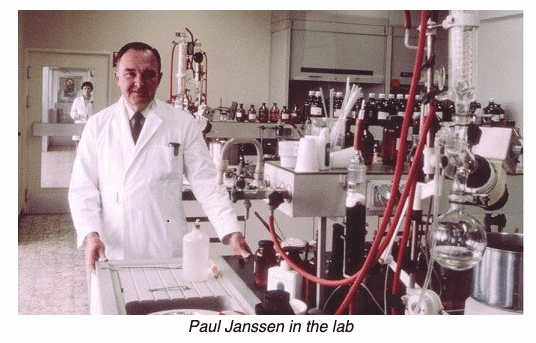
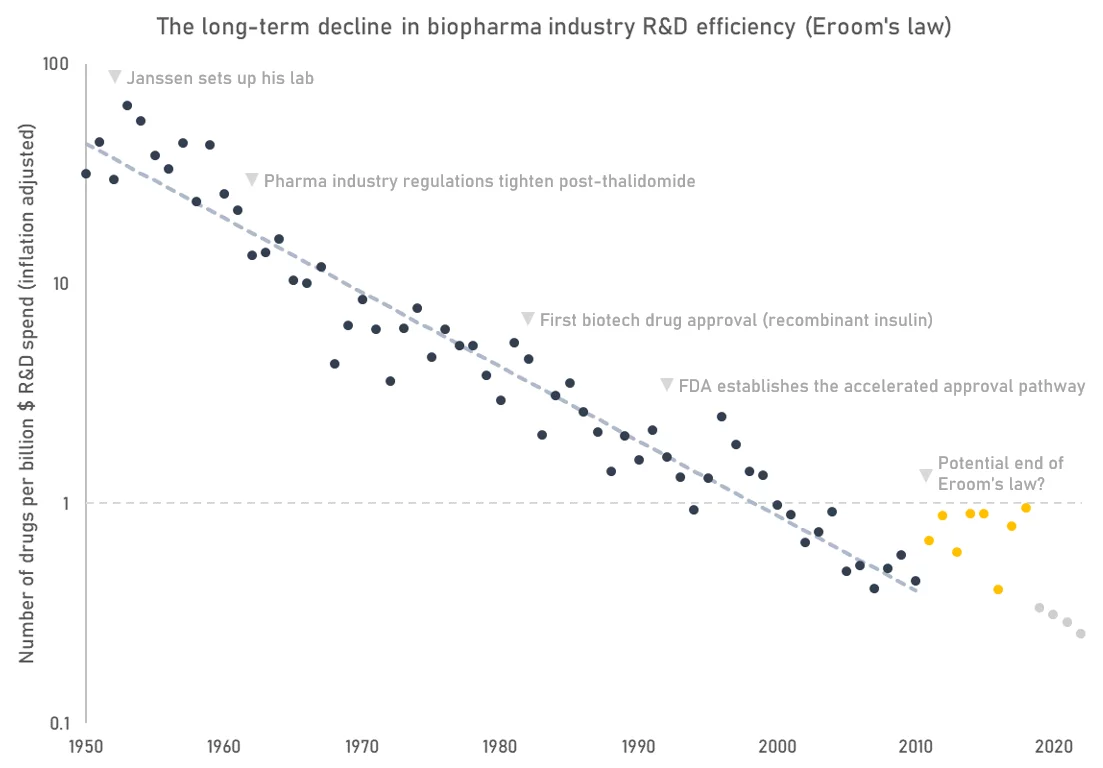
Paul Janssen to today: why drugs got harder to develop
Manual synthesis of drugs
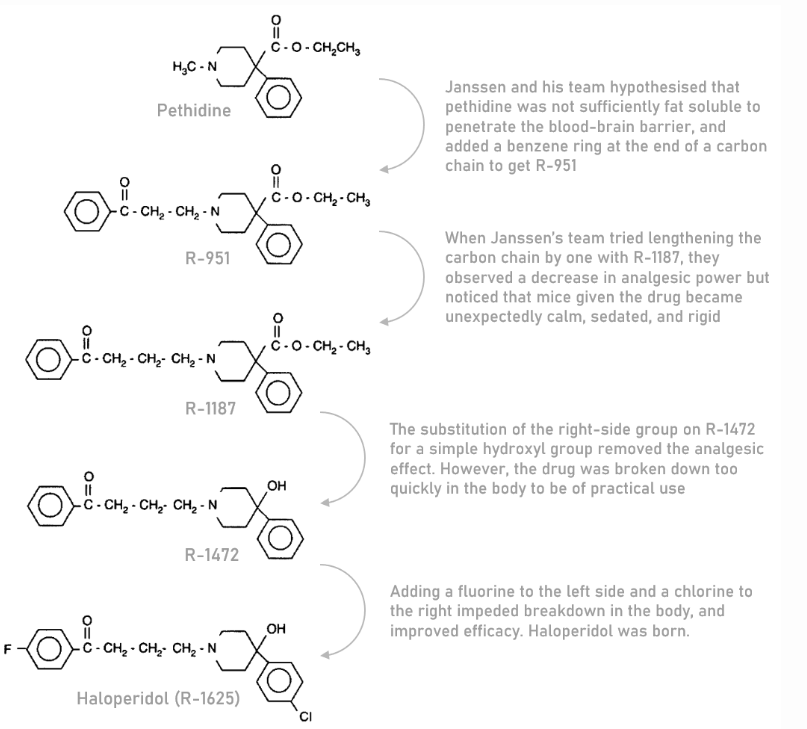
How Janssen developed Haloperidol (an antipsychotic) drug using structural tweaks.
Added a benzene ring to make it penetrate the BBB.
synthetic painkiller
Added fluorine to the left side and chlorine to the right to impede fast breakdown in the body.
Lengthening the carbon chain removed the analgesic effect but caused the mice to become unexpectedly calm and sedated.
Substituted the right-side group with a simple hydroxyl but the drug was broken down to quickly in the body.
antipsychotic drug used to treat schizophrenia, acute psychosis and bipolar disorder
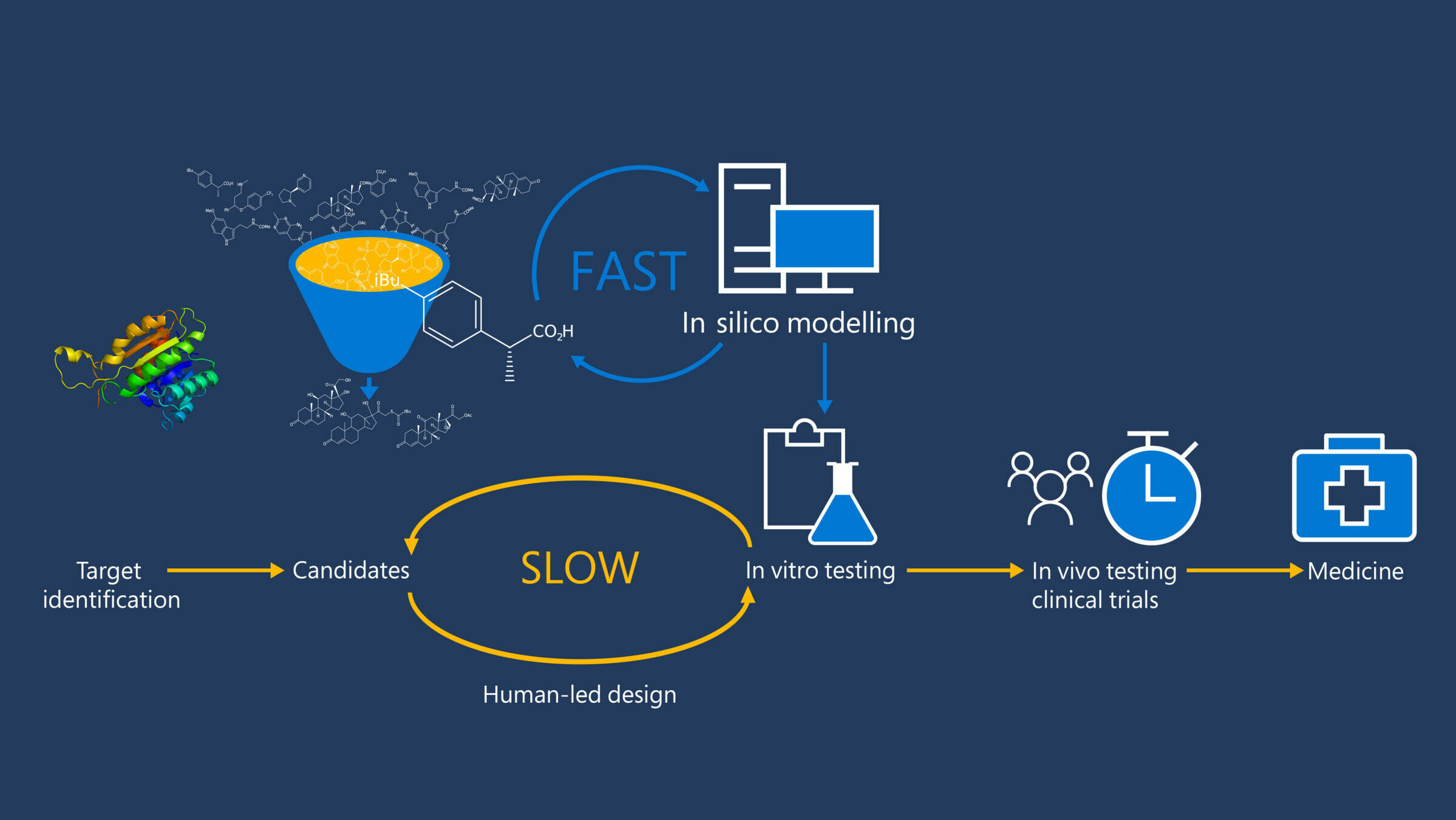
Human-led synthesis is largely upended by in silico techniques which work by identifying candidates that satisfy complex multi-property objectives.
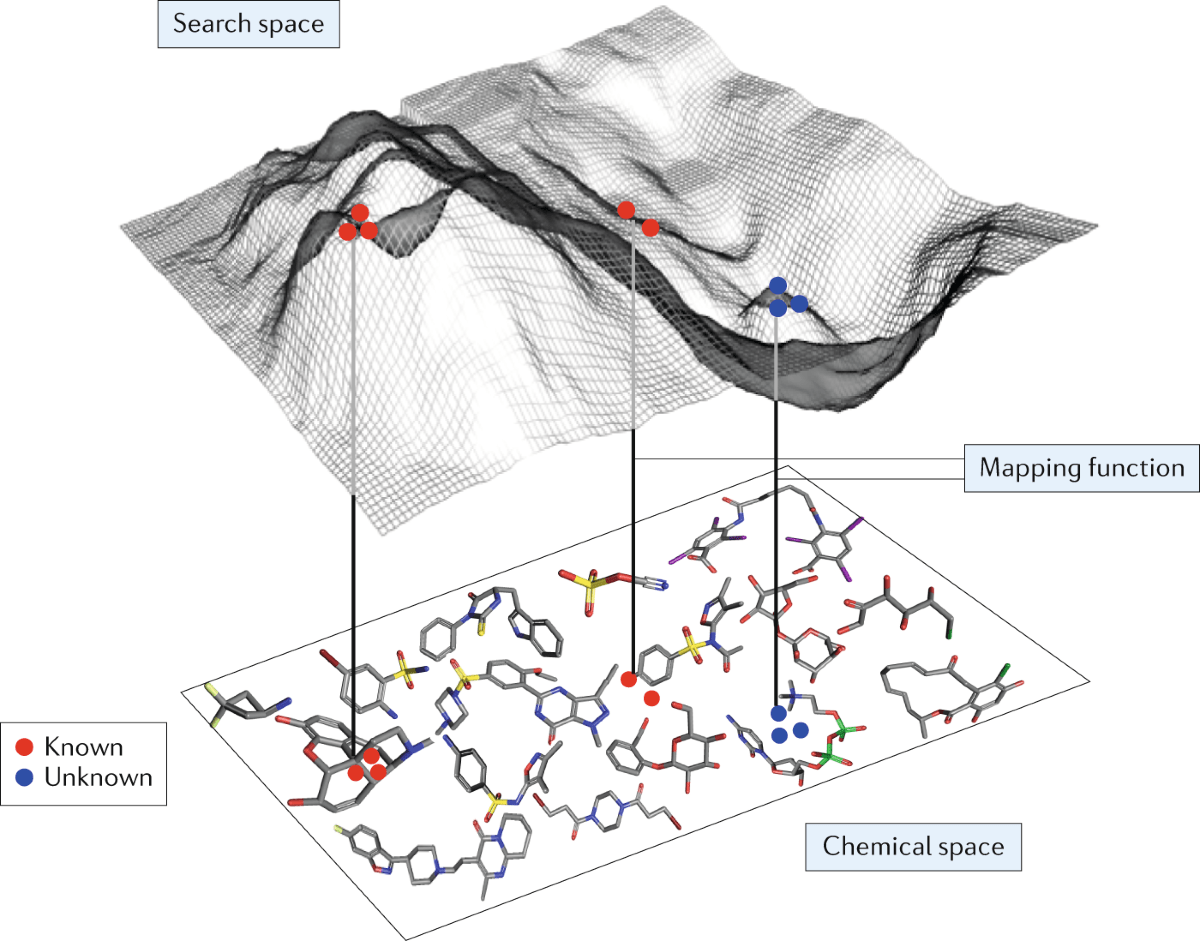
Concept of a chemical space v. functional space
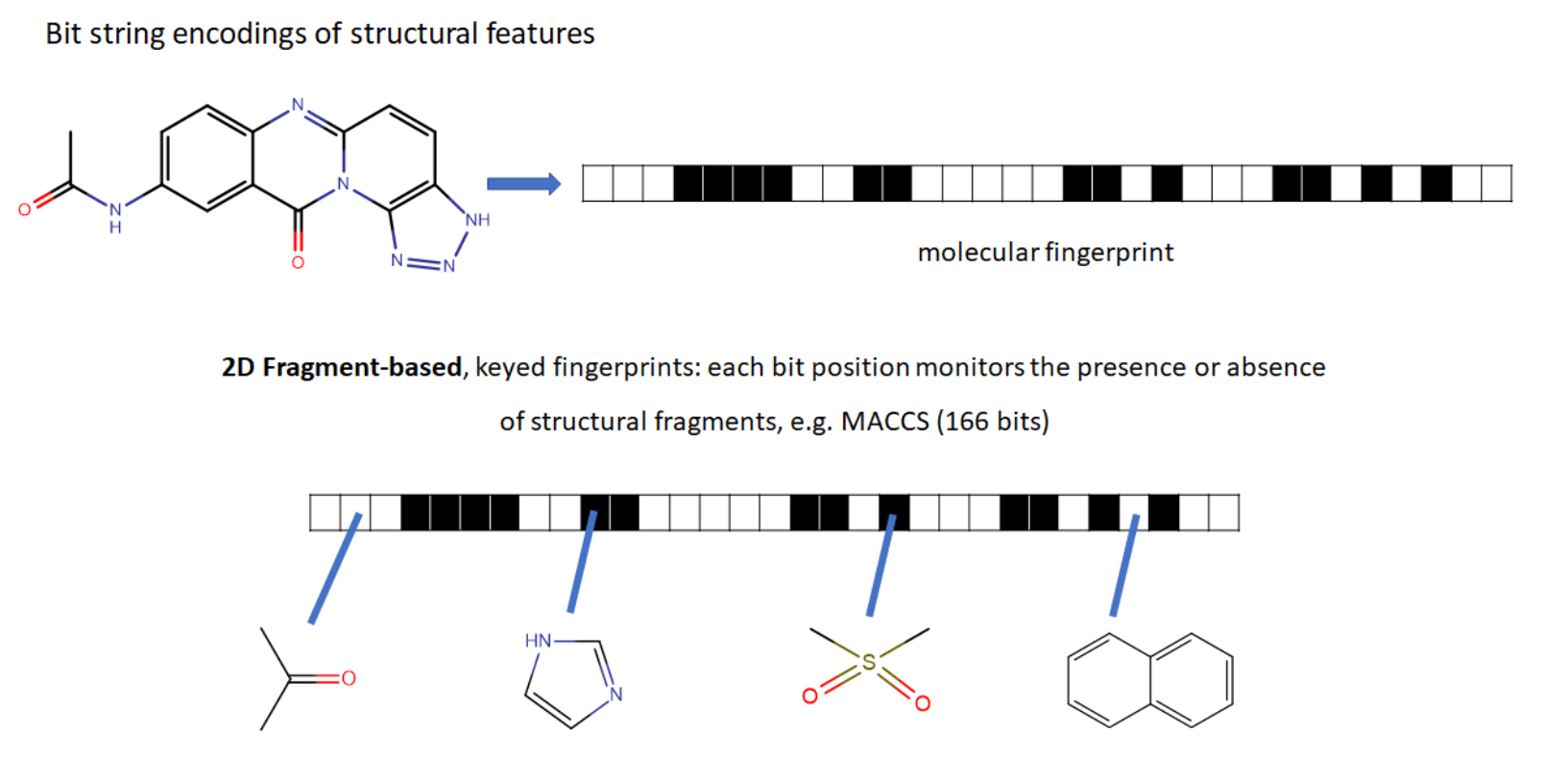
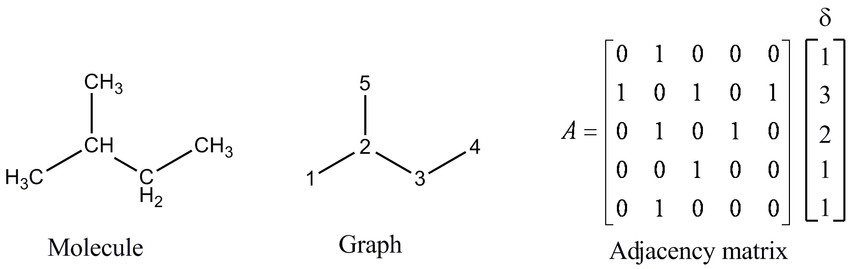
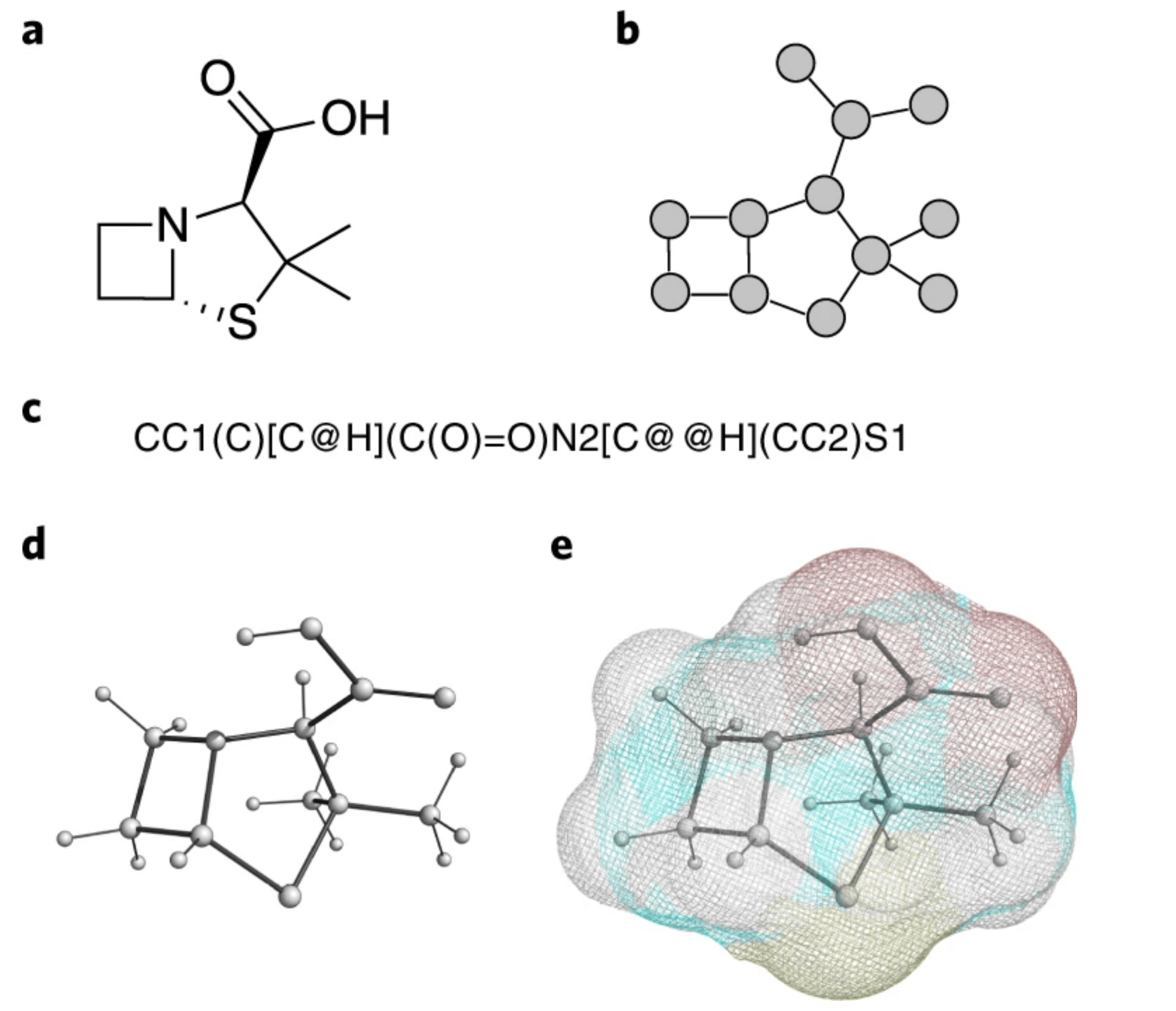
Representation of discrete chemical data
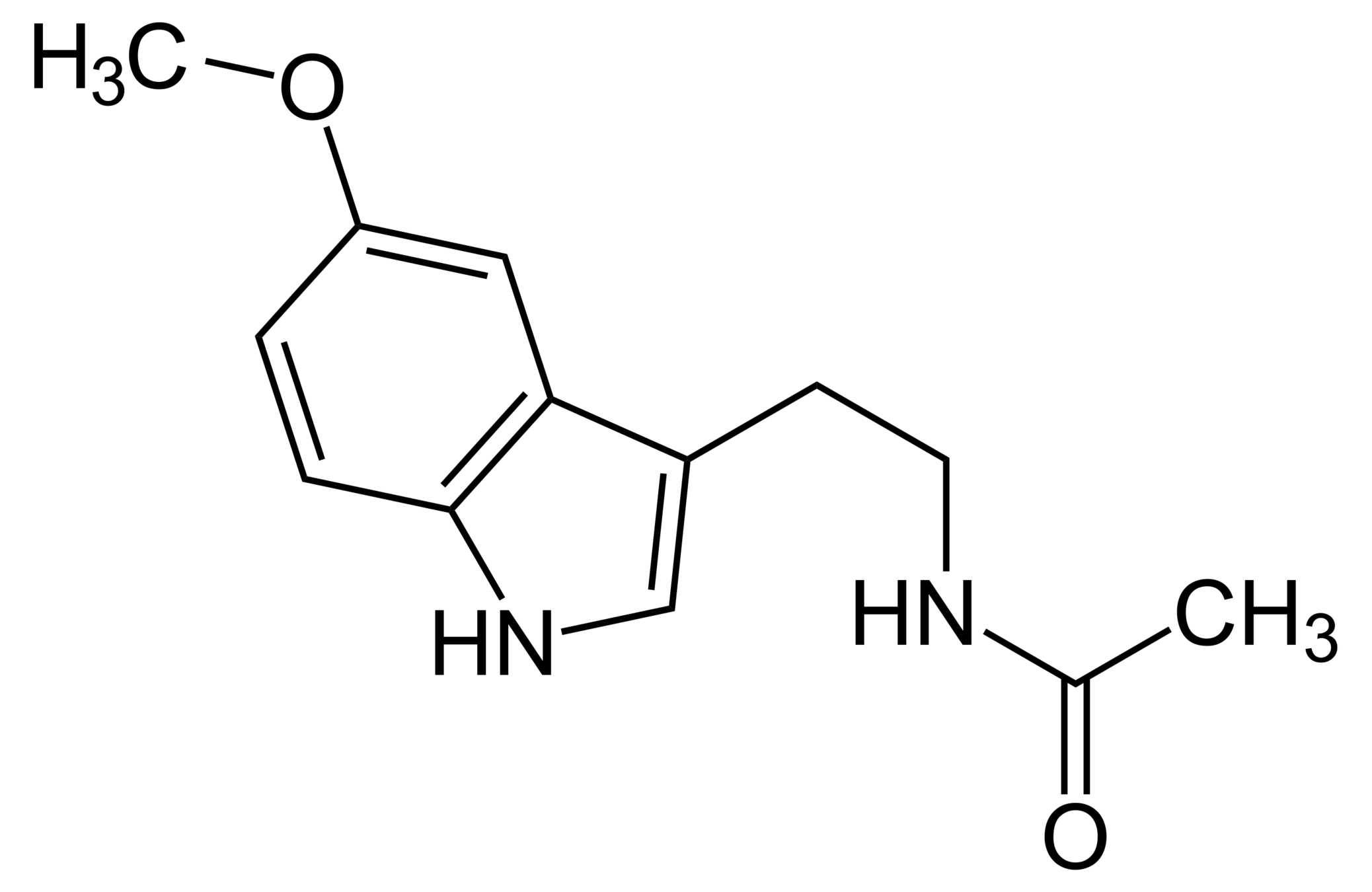
CC(=O)NCCC1=CNc2c1cc(OC)cc2
Melatonin
ECFP (Extended connectivity fingerprints)
2D or 3D graphs
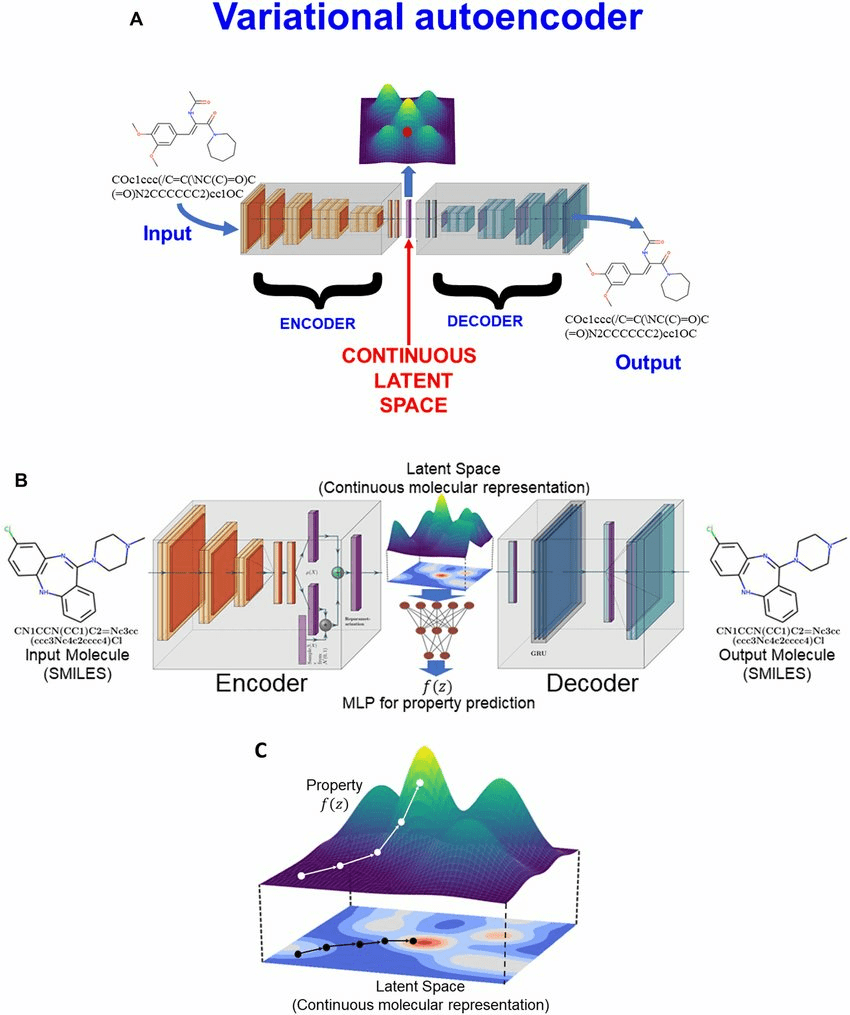
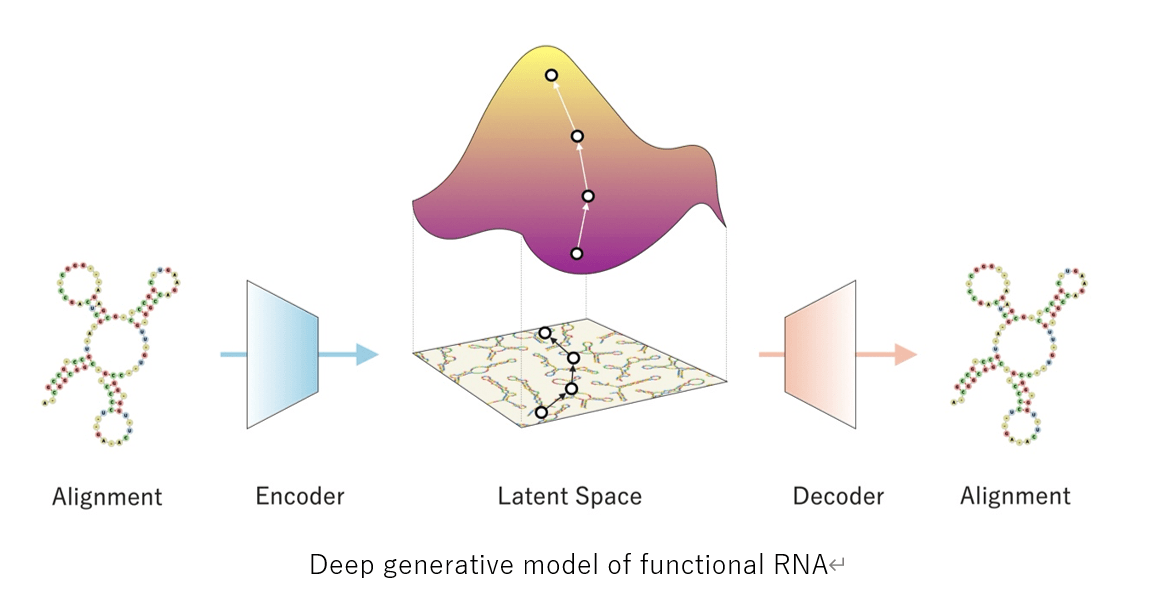
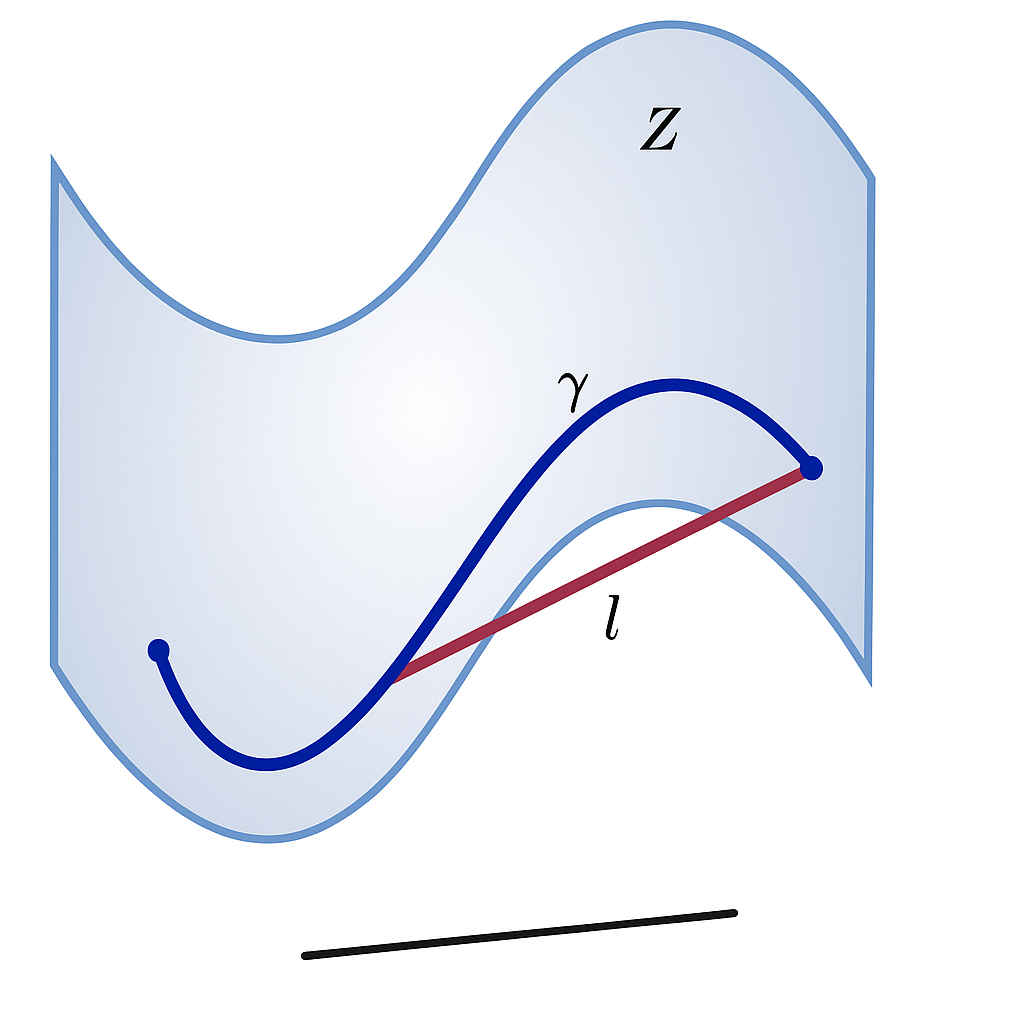
A chemical latent space is the continuous representation of molecular structure learned by a generative model trained on discrete chemical data.
Source: ChatGPT
Once we have this latent manifold Z\mathcal{Z}Z, we can define functions over it, e.g., property predictors, energy surfaces, acquisition functions.
Let's call this latent manifold \(\mathcal{Z}\)
\(f: \mathcal{Z} \longrightarrow R\)
Canonical Architecture for molecular generation tasks
When we train a generative model (VAE, diffusion model, flow model, etc.), we are learning a continuous embedding of the discrete chemical space.
This a prominent baseline architecture used to facilitate inverse design of small molecules, RNA, DNA and proteins.
Loss framework
Navigation
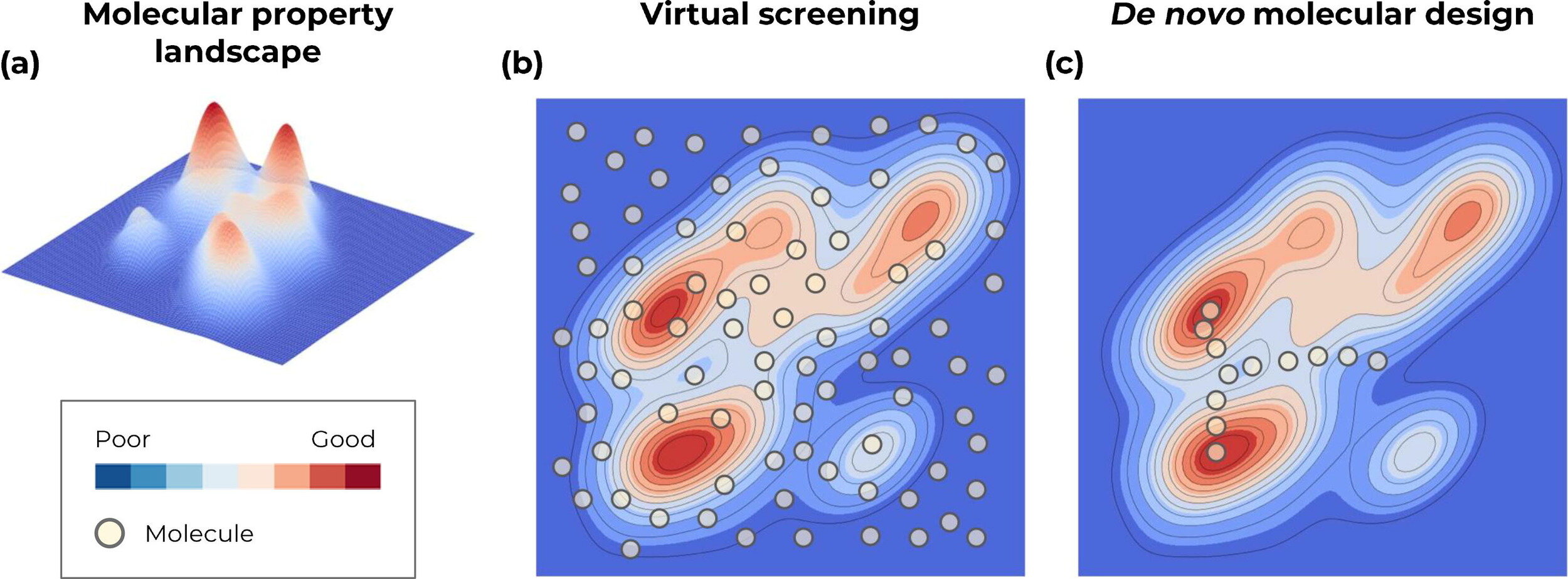
Dominant paradigms in ML driven early stage drug discovery
Screen from a finite list of known molecules
Traverse the continuous representation of the chemical space (through optimisation)
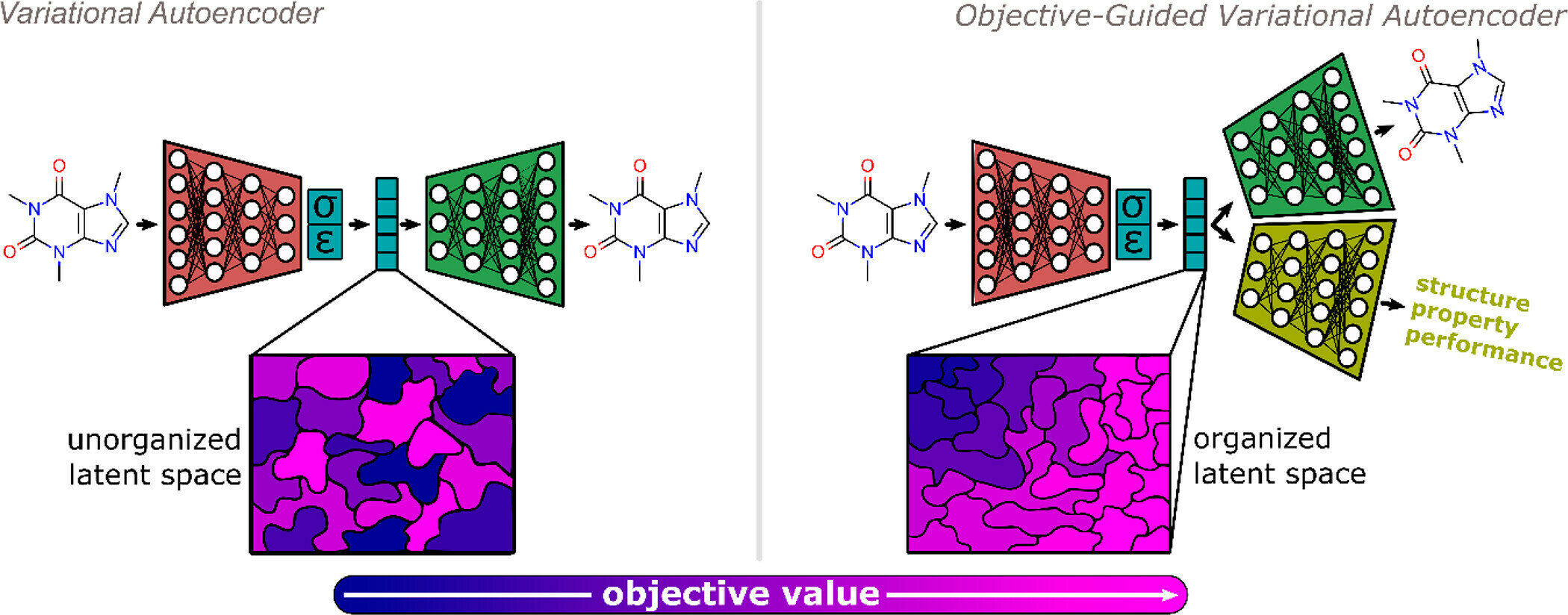
Regularising the latent space with auxiliary objectives
Generative Models as an Emerging Paradigm in the Chemical Sciences. Journal of the American Chemical Society
Concurrent training of propert predictors along with the encoder/decoder organises the latent space according to property similarity.
Generative Backbone & Overall architecture
Baseline
Warping
Encoder
Decoder
Global Property predictor
\( f_{\psi}: \mathbb{R}^{256} \longrightarrow \mathbb{R}^{3}\)
High-dimensional latent space
Low dim. warped space
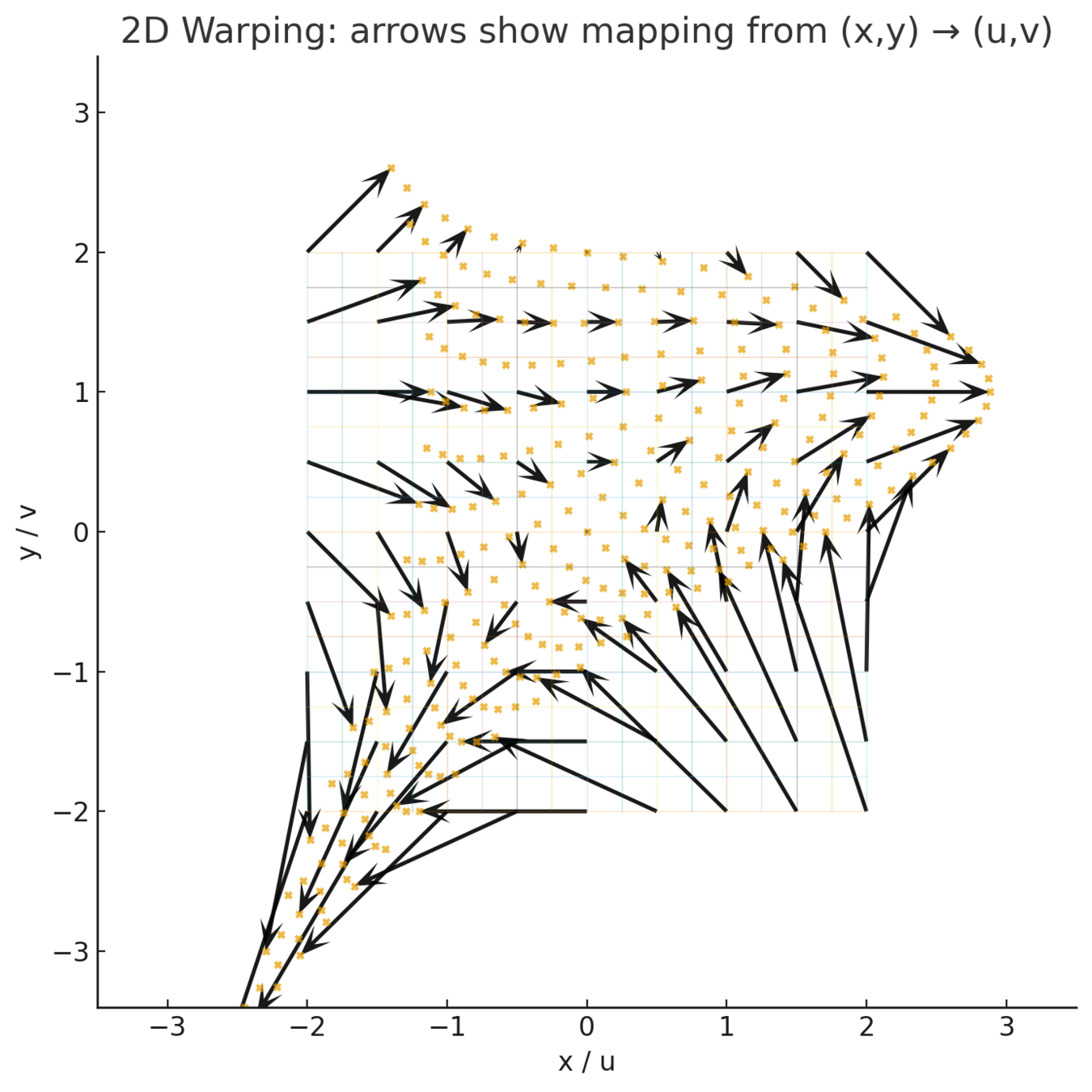
What is warping
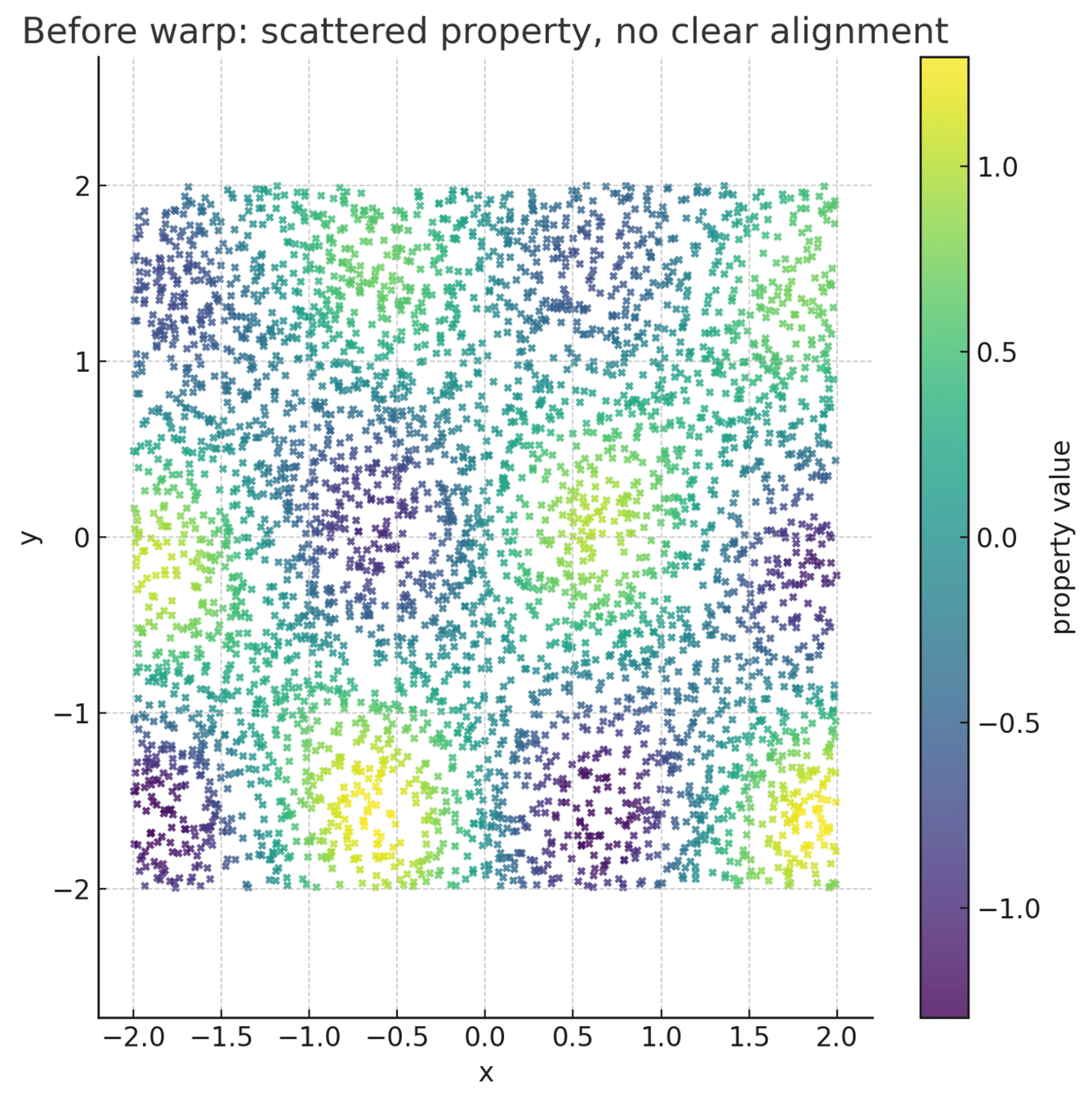
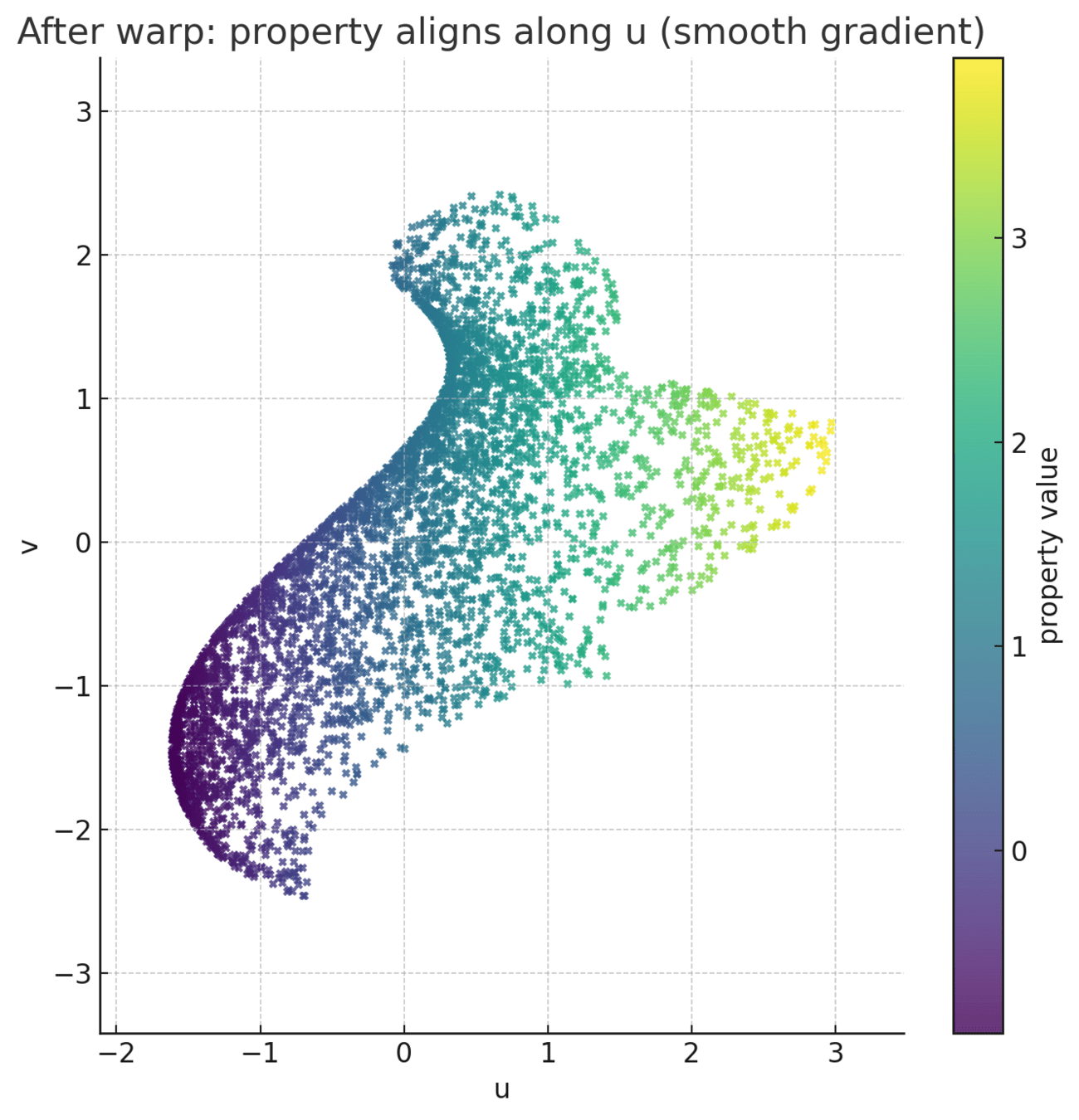
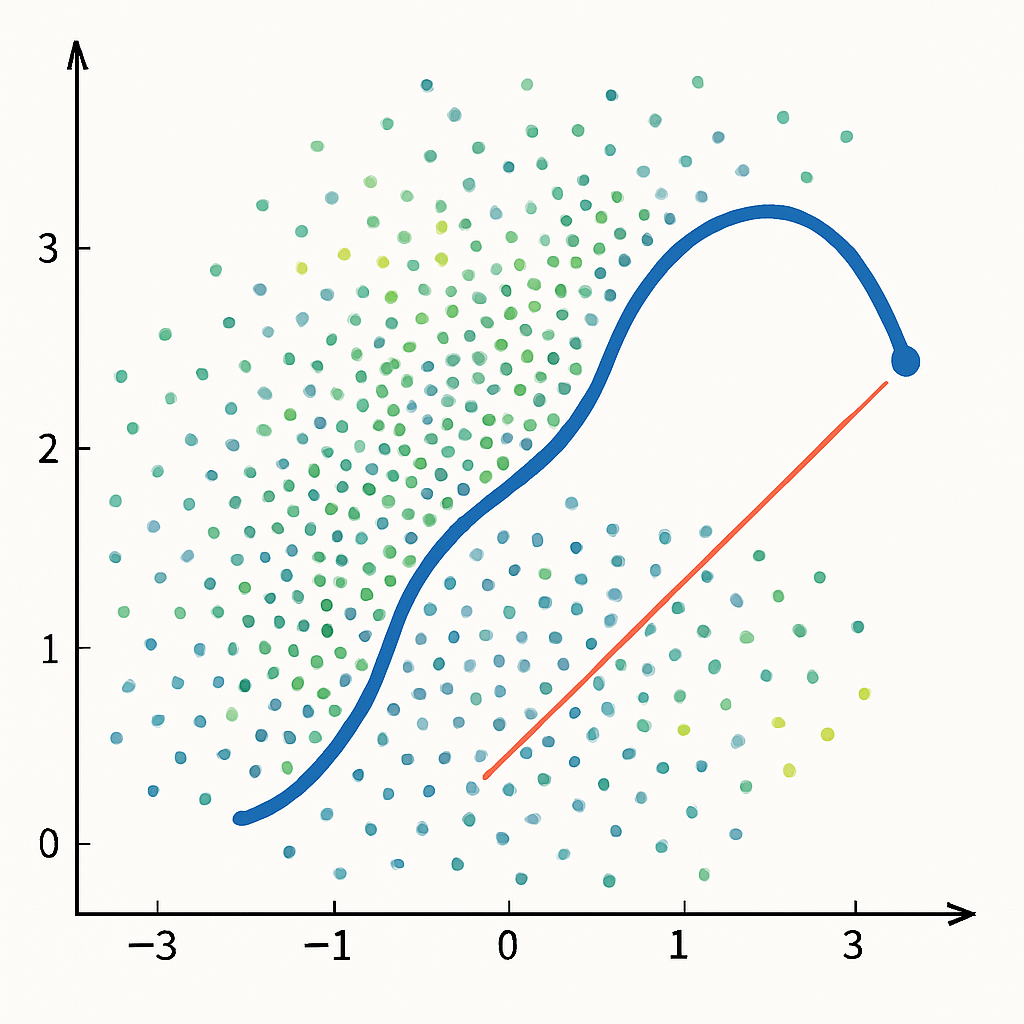
Warping learns a non-linear coordinate transform that re-expresses the latent space such that distances (or similarities) between points reflect differences in their target property values.
In effect, it “bends” the latent manifold so the property becomes a smooth, nearly monotonic function along certain directions.
High-dimensional global latent space
\(\mathbf{z} \in \mathbb{R}^{256}\)
Low-dimensional warped space
\( \mathbf{u} \in \mathbb{R}^{4}\)
A
B
C
Dead zone
A
B
C
Feasible generations
Infeasible generations
Understanding the data shape / structure
| Core input (drug sequence) | |||||||||
|---|---|---|---|---|---|---|---|---|---|
| C[C@H1]1C(=O)NCCN1C(=O)C(C2=CC=CC=C2)C3=CC=CC=C | |||||||||
| O=C(CN1C=CC(C(F(F)F)=N1)NN2CC3=CC=CC=C3C2 | |||||||||
| CN(C[C@H1]1CCCCO1)C(=O)C2=CC3=CC=CC=C3C(=O)[NH1]2 | |||||||||
| CN(C[CH1]1C2=CO1)=CC=CC=C3C(=O)[NH1]O | |||||||||
| CC1=CC(=O)N(CC(=O)NC2=CC=CC(C(F)(F)F)=C2)C=N1 | |||||||||
................
................
................
................
................
................
Properties (auxilliary features that we want to align our latents w.r.t)
................
What the generative model is trained on
Mathematical Framework: Warped coordinate space & Alignment loss
Once we have a pre-trained generative model, we freeze the encoder/decoder weights to learn property specific transformations,
that map global latents \(\mathbf{z} \in \mathcal{Z}\) to warped coordinates \(\mathbf{u}_{j} = T_{j}(\mathbf{z})\)
where a batch is defined by the tuple \(\{(\mathbf{z}^{a},\, y^{a}_{j})\}_{a=1}^{B}\) and \( B\) is the batch size. \(y_{i}\) denotes the scalar property values with respect to which we want to align the \( \mathcal{U}\)-space.
This loss makes the geometry of the warped coordinate \(\mathbf{u}_{j}\) mirror the magnitude of the property difference \(y_{j}\). The scale \(\alpha_{j}\) matches units so the model is free to warp: it can contract regions where \(y_{j}\) varies little and expand where \(y_{j}\) changes rapidly.
1/4
Naive minimisation of this loss function with a free-form \(\alpha\) leads to model collapse as \(\mathbf{u}_{j}^{a} \longrightarrow 0 \quad \forall a\) and \(\alpha \longrightarrow 0\).
Mathematical Framework: Covariance whitening & Property prediction
2/4
In order to keep \(\mathbf{u}_{j}\) un-collapsed and well-conditioned we penalise collapse by adding a covariance whitening loss given as,
where we penalise how far the unbiased batch covariance of the warped coordinates are from identity. Overall, it makes the learned \(\mathbf{u}_{j}\) space have unit variance along each axis and zero cross-correlations.
make the warped coordinates match the VAE prior \(\mathcal{N}(0,I)\)
Finally, we need to do something useful with the warped coordinate space, so we learn a very simple property prediction head, a linear map.
The overall loss function for learning the warped coordinate space per property is,
\(\hat{y}_{j}(\mathbf{u}_j) \;=\; w_j^{\top}\mathbf{u}_j \;+\; b_j\), where \(\mathbf{u}_{j} = T_{j}(\mathbf{z})\)
Mathematical Framework: Optimisation
Given a warped property-aligned coordinate space \(\mathbf{u}_{j}\) and a trained linear head \(\hat{y}_{j}(\mathbf{u}_{j}) \;=\; w^{\top}_{j}\mathbf{u}_{j} +\ b_{j}\), we can score candidates via the objective,
3/4
The practical route is gradient ascent in the \( u\)-space since we want \( \mathbf{u}\) to stay on manifold
2nd term pull toward origin effect
In theory, there is a closed form maximiser for the linear property predictor head:
Mathematical Framework: Decoding
Ultimately, we need to lift warped points back into the global latent space in order to decode them with the decoder.
4/4
We run optimisation in the warped property specific coordinate space, this yields a point \( \mathbf{u}^{\star}\). But \( T_{j}\) goes from latent to warped space and it is not invertible, \(T_{j}\) does not exist.
but when PP\(T_{j}\) is a non-linear transform (as it is in our case), the map z↦P(z)z\mapsto P(z)\( \mathbf{z} \longrightarrow T_{j}(\mathbf{z})\) can fold, stretch, or have many preimages for the same \(\mathbf{u}\) u∗u^*\(\longrightarrow\) the loss above becomes non-convex with potentially multiple minima. Hence, sensitive to initialisation.
We want something called local isometry -> where infinitestimal neighbourhoods in \( \mathbf{z}\)-space are not excessively distorted ( Jacobian of the transformation \(\partial T_{j}/\partial \mathbf{z}\))
👉 Local isometry emerges primarily from the covariance loss term,
\( \mathcal{U}\)-space is not strictly isometric to the \(\mathcal{Z}\)-space but is locally smooth even if the alignment loss softly pulls them apart
which prevents excessive folding and the manifold from tearing apart, this allows local invertibility
Optimisation on the warped space and gradient ascent
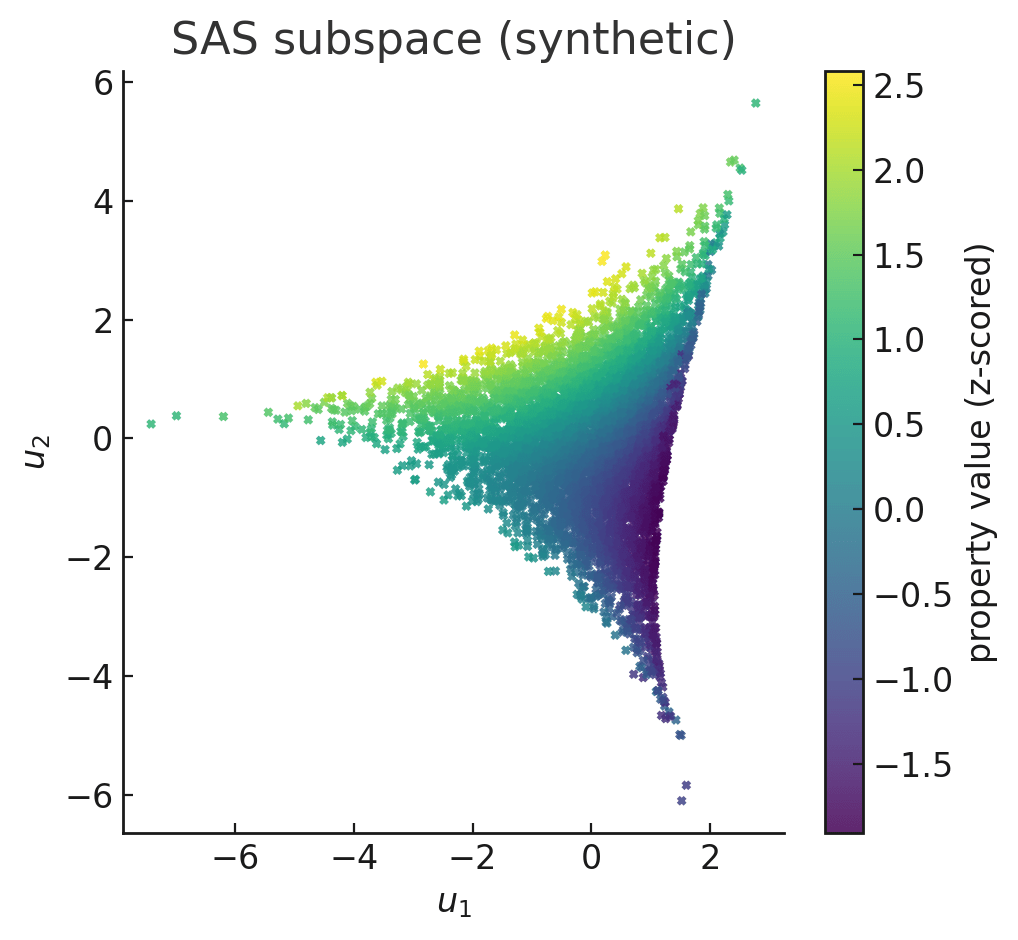
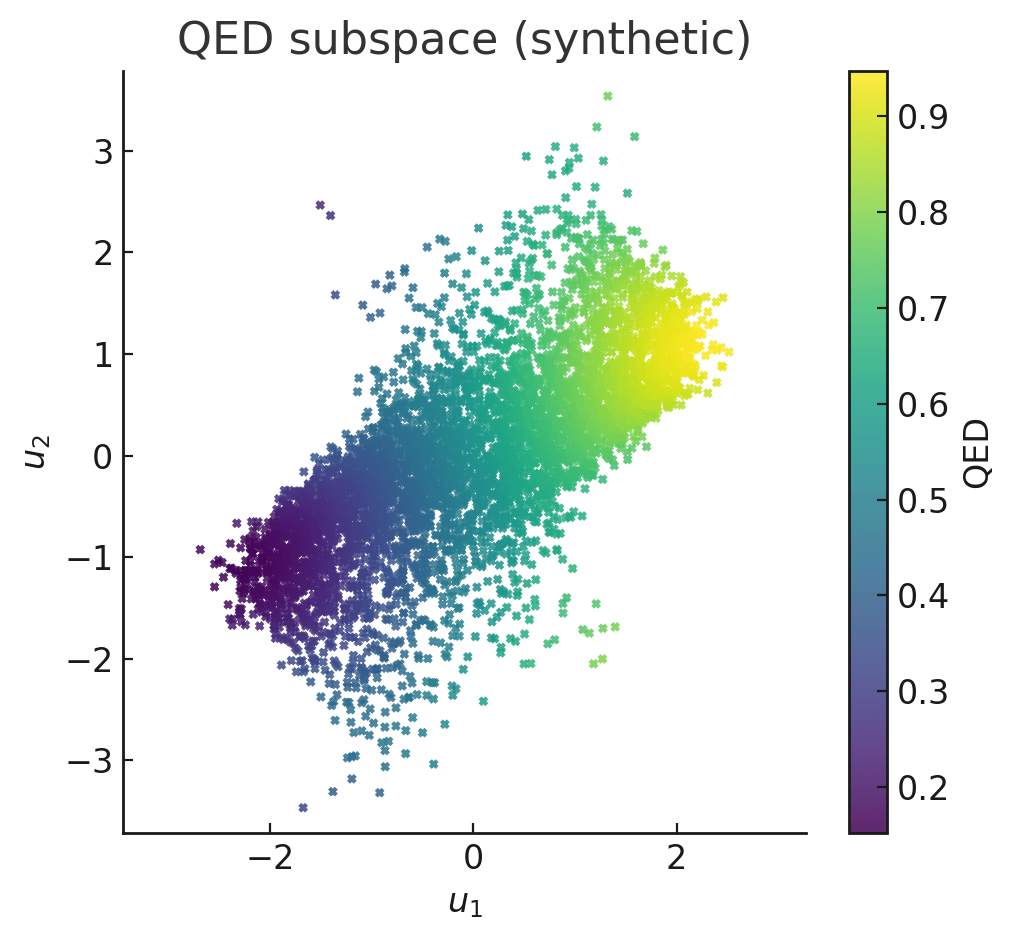
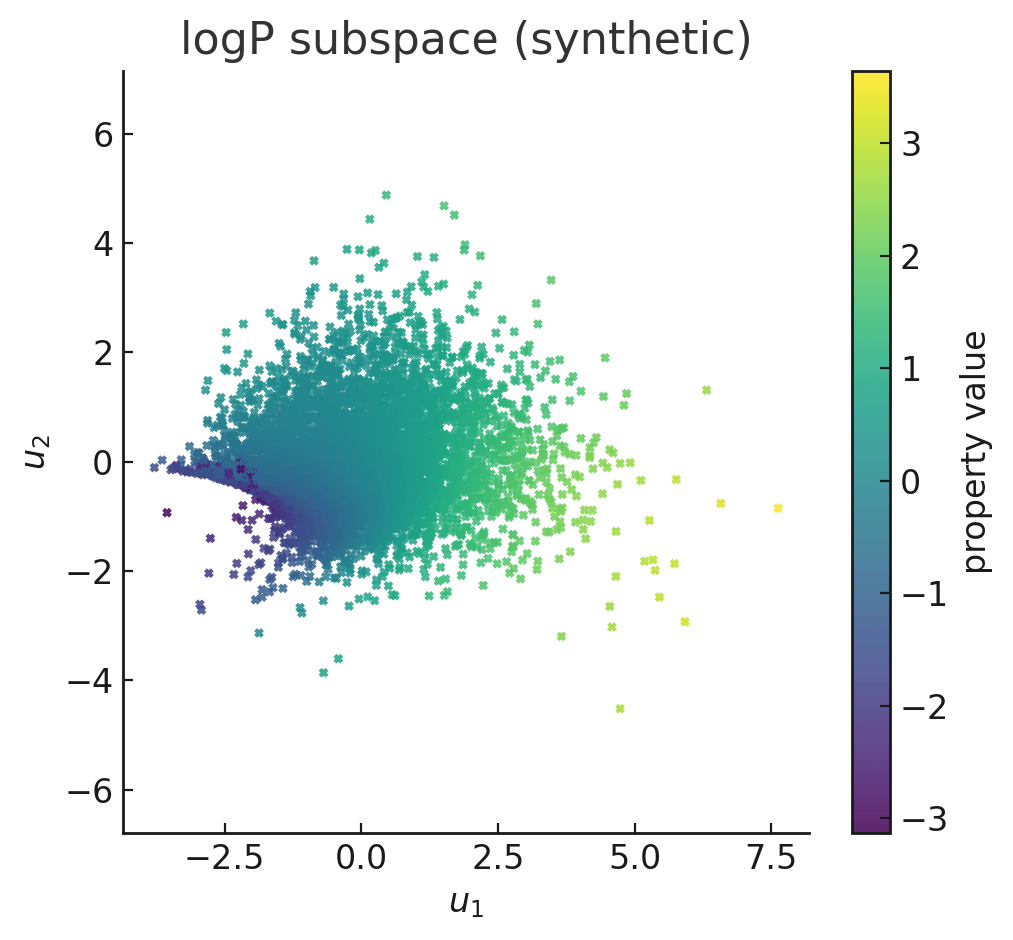
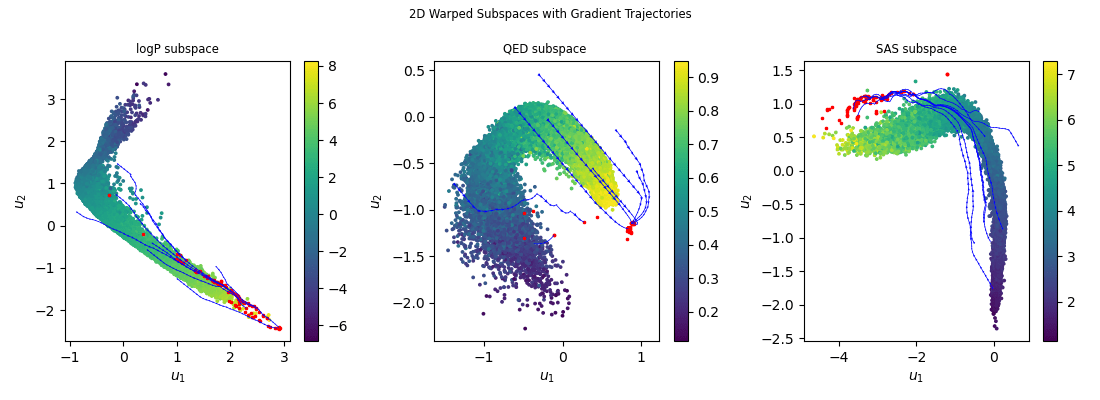
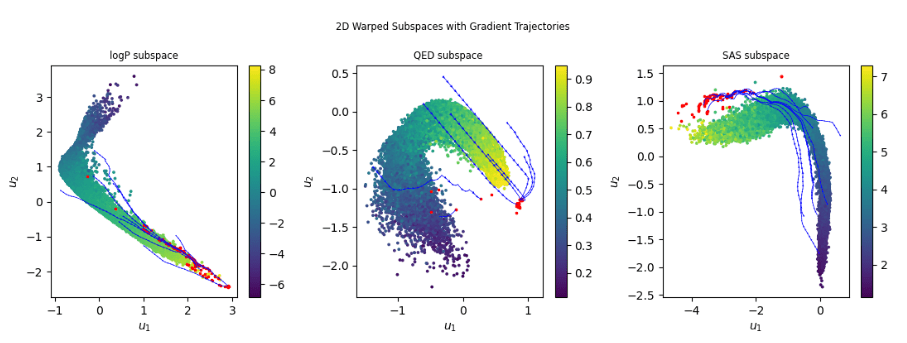
Two-dimensional slices of the learned 4D warped subspaces for logP, QED, and SAS, with gradient-based optimisation trajectories (blue) and converged optima (red). Points are coloured by ground-truth property values. The optimiser predominantly converges to high-scoring regions of the manifold.
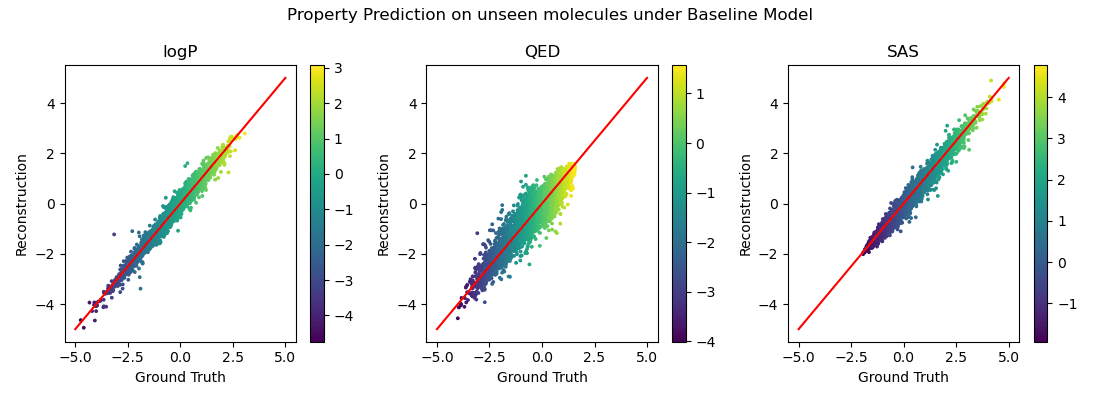
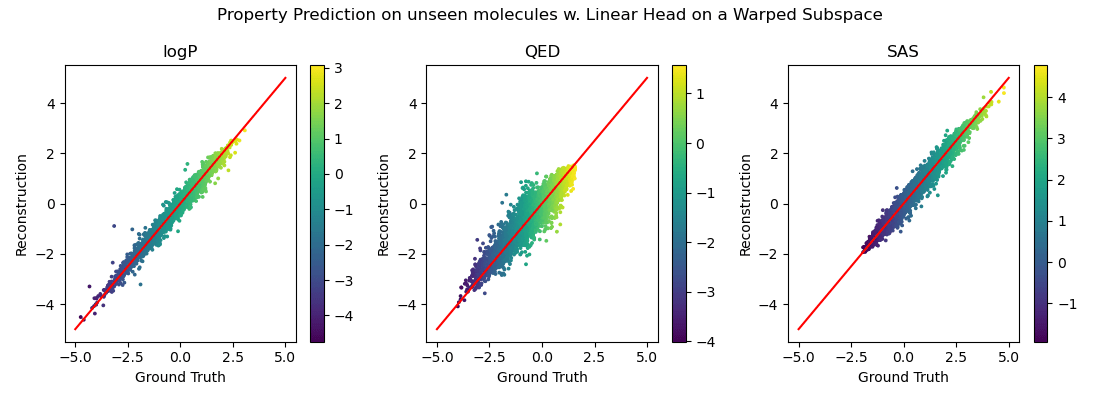
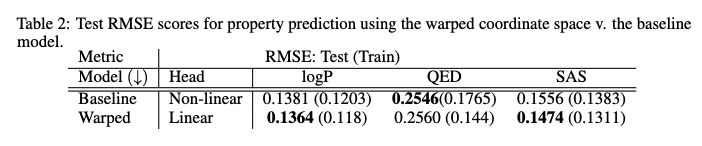
Property prediction on the warped space
\(\hat{y}_{j} \;=\; w_j^{\top}\mathbf{u}_j \;+\; b_j\)
\(\hat{y}_{j} \;=\; f_{\psi}(\mathbf{z})\)
\( f_{\psi}\)
is an MLP
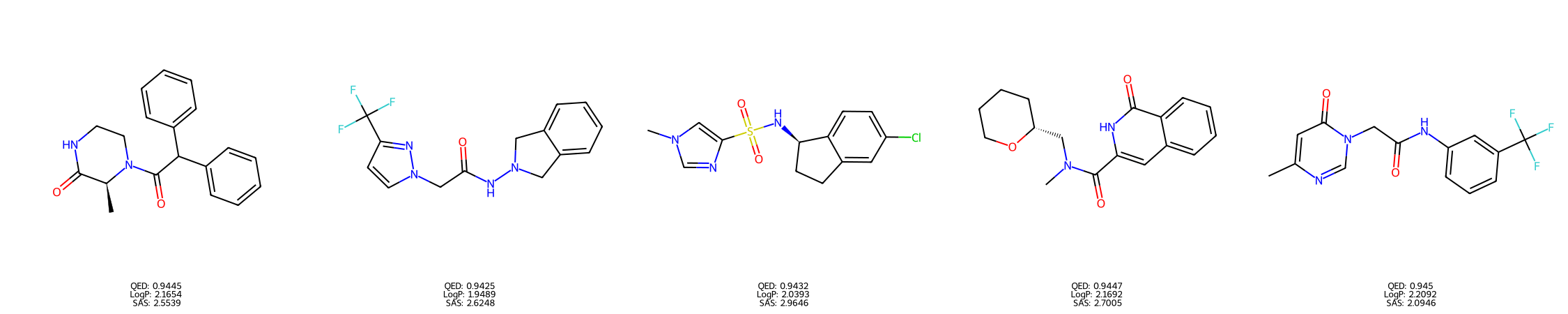
Property optimisation for QED (drug-likeness score)
| SMILES | QED | logP | SAS |
|---|---|---|---|
| C[C@H1]1C(=O)NCCN1C(=O)C(C2=CC=CC=C2)C3=CC=CC=C3 | 0.9444 | 2.1654 | 2.5538 |
| O=C(CN1C=CC(C(F)(F)F)=N1)NN2CC3=CC=CC=C3C2 | 0.94254 | 1.9489 | 2.6247 |
| CN1C=NC(S(=O)(=O)N[C@@H1]2CCC3=CC(Cl)=CC=C32)=C1 | 0.94315 | 2.0392 | 2.9646 |
| CN(C[C@H1]1CCCCO1)C(=O)C2=CC3=CC=CC=C3C(=O)[NH1]2 | 0.94465 | 2.1692 | 2.7004 |
| CC1=CC(=O)N(CC(=O)NC2=CC=CC(C(F)(F)F)=C2)C=N1 | 0.9450 | 2.2092 | 2.0946 |
Top scoring decoded molecules corresponding to optimised points \(\mathbf{u}_{j}^{\star}\) in the QED specific warped space.
Top molecules decoded from optimised points in the warped QED subspace. All candidates
are novel (not in the training data) and achieve QED > 0.94. The top scoring molecule in ZINC250 has a QED score of 0.948
Optimisation in the baseline model (with 100 restarts in \(\mathcal{Z}\)-space) yielded a best score of 0.9208.
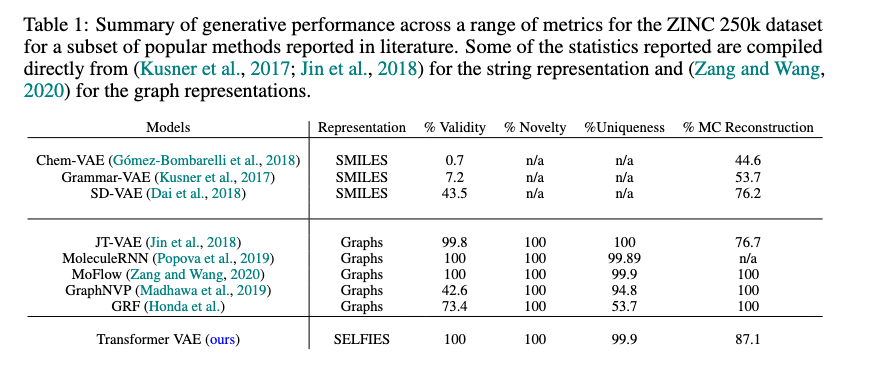
Generative Performance of the Transformer VAE
Summary
Thank you!
Warped Latent Spaces and Traversal in Chemical Deep Generative Models
Under Review at Transactions of Machine Learning Research
compute this feature for all molecules and learn a warping to align with pLogP
Particularly interesting as the surrogate GP can now be fit in low-dimensional space warped space.
Some interesting questions that emerge are:
Align only w.r.t observed property labels but devise a semi-supervised loss function for the unlabeled points.
For instance, predict pseudo-labels \( \tilde{y} = f_{\theta}(\mathcal{D}_{unlabel})\) every few epochs and merge.
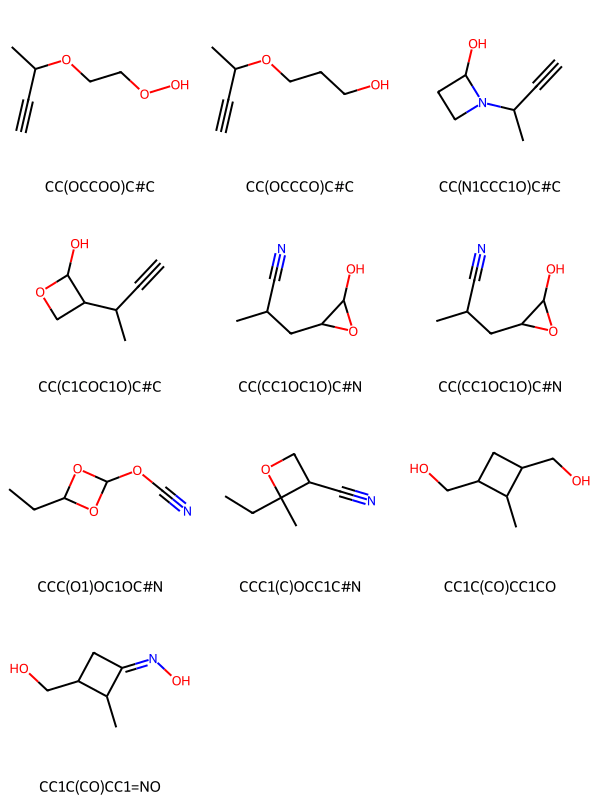
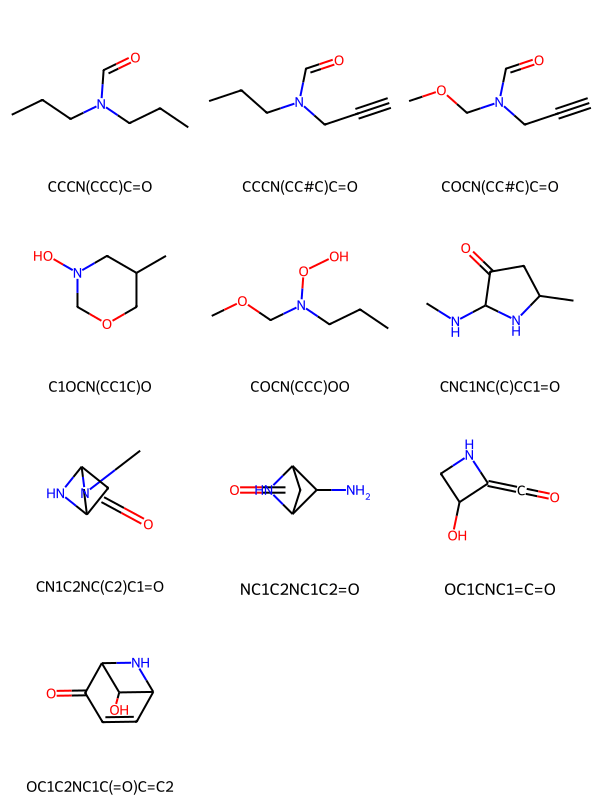
Stability of Decoding protocol
Interpolation between two molecules in \(\mathcal{U}\)-space:
Diminishing similarity measured by tanimoto metric to starting molecule
Start
End
By Vidhi Lalchand