The Spatial and Contextual Exposome:
Methodological Challenges
and Paths Forward
Hui Hu Ph.D.
Assistant Professor of Medicine
Associate Epidemiologist
Channing Division of Network Medicine
Brigham and Women's Hospital and Harvard Medical School
May 8, 2025


The Exposome

To draw attention to the critical need for more complete environmental exposure assessment
"encompasses all life-course environmental exposures from the prenatal period onwards, complementing the genome"
"in a broader sense of all lifestyle, infections, radiation, natural and man-made chemicals and occupational exposures"
Environmental Exposures

Source: Hu et al. 2022
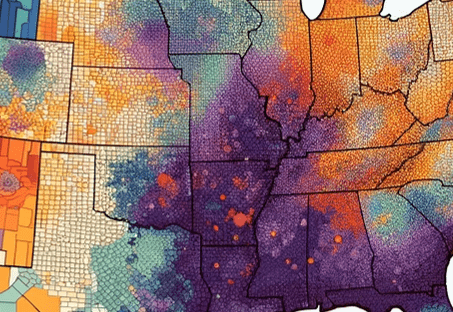
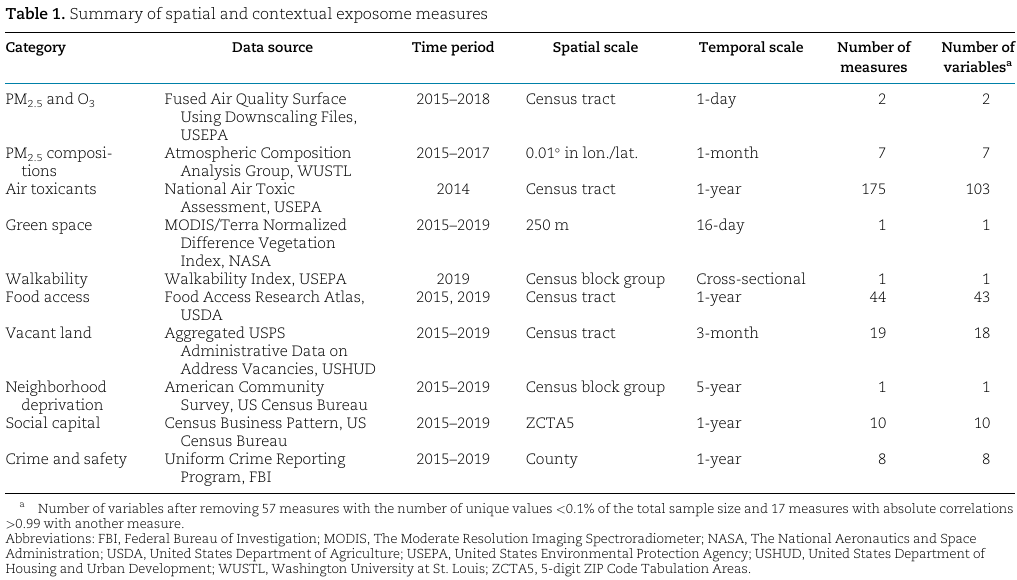
Examples of publicly available spatial and contextual exposome data sources
Source: Hu et al. 2022
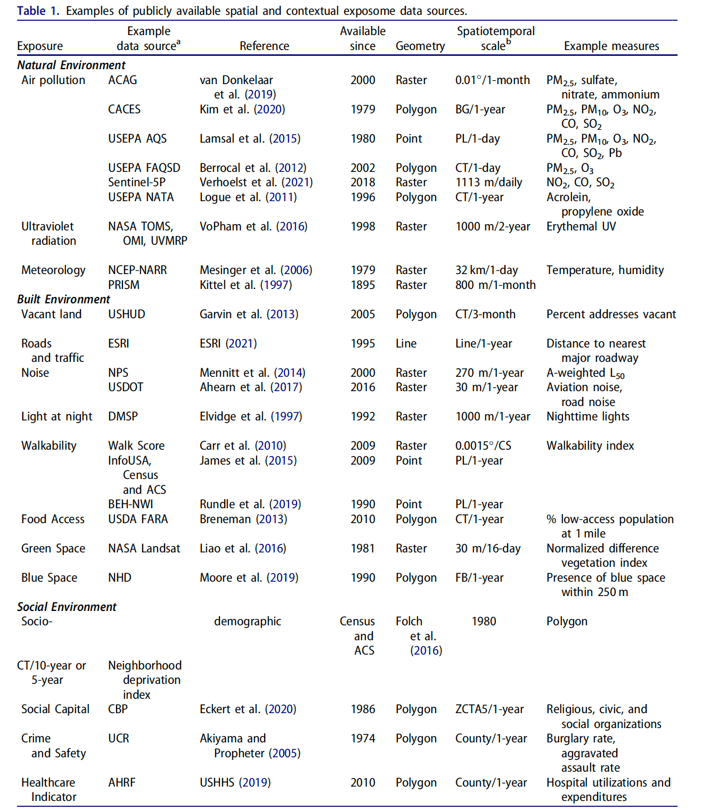
- There is a wealth of existing data on spaital and contextual exposome
- Can be linked to individuals based on their geolocations to retrospectively assess historical exposures
- Spatial and contextual exposome are very different from other individual-level exposome factors:
- multiple methodological challenges

Challenge 1:
Engineering of the spatial and contextual exposome data

- Multiple data sources available to assess the same spatial and contextual measure
- PM2.5:
- Air Quality System (AQS) - EPA
- Fused Air Quality Surface Using Downscaling (FAQSD) - EPA
- LUR modelled estimates - CACES
- GWR modelled estimates - ACAG
... - Walkability:
- Walk Score - Redfin
- National Walkability Index - EPA
...
Data Source Identification
Source: Hu et al. 2022
- How to choose?
- Based on spatiotemporal coverage and scale
- What if there are still multiple options available with similar spatiotemporal coverage and scale?
- Traditional studies: domain knowledge + sensitivity analyses
-
This approach is increasingly challenging in spatial and contextual exposome studies:
- Lack of expertise
- Infeasible to conduct sensitivity analyses
-
Potential solution: establish reference spatial and contextual exposome databases with gold-standard measures
- on different spatial and contextual exposome constructs
- across different geographic areas and time periods
Variable Selection
- Large variabilities in the number of variables included in existing exposome-health research
- 8 ~ 14,663 based on our systematic review
- A data source may include multiple variables measuring similar spatial and contextual exposome constructs
- Example: ACS includes thousands of variables characterizing contextual-level social environment
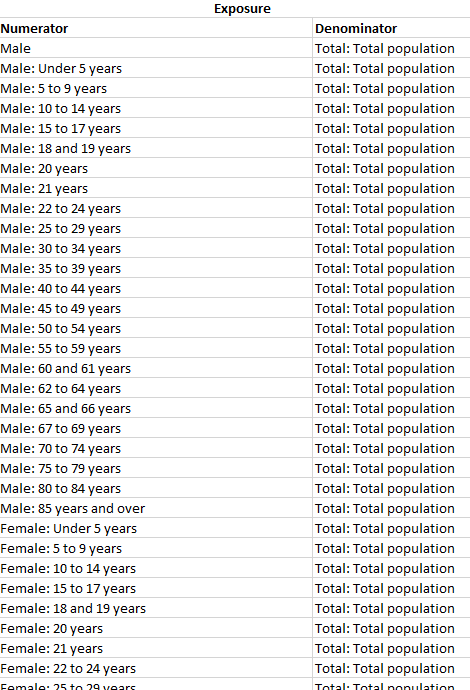
Two approaches with different assumptions/hypotheses:
- Include all individual variables:
- Assumption: they represent different constructs
- Seeks to understand the impact of each variable separately
- Perform dimension reductions and use indices:
- Assumption: these variables matter in aggregate
- Quantifying their individual contributions is difficult or not of interest
vs
- Neighborhood deprivation index
- Index of concentration at the extremes
...
Source: Hu et al. 2020
Variable Selection
- For many spatial and contextual exposome factors, it is possible to generate multiple variables with the exposures aggregated at different spatiotemporal windows
- Example: ACS, FARA
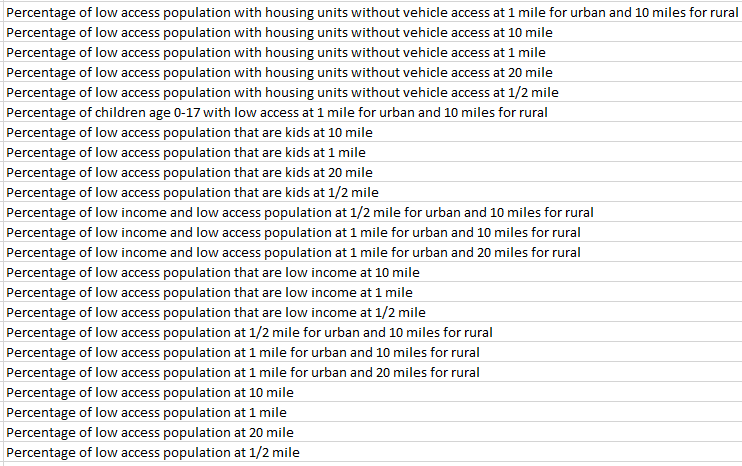
- Large impacts on downstream studies:
- different p-value cut points used to account for multiple testing
| Total number of variables | p-value of var1 | p-value cut point | Statistically significant? |
|---|---|---|---|
| 100 | 0.0001 | 0.0005 | Yes |
| 1,000 | 0.0001 | 0.00005 | No |
- Potential solution:
- develop ontology-based approaches to standardize variable selection and the approaches of making these choices
Source: Hu et al. 2020
Challenge 2:
Spatiotemporal linkages of spatial and contextual exposome data to indivdiuals
Spatiotemporal Linkages
| ID | Longitude | Latitude | StartDate | EndDate |
|---|---|---|---|---|
| ID | exp1 | exp2 | exp3 | ... |
|---|---|---|---|---|
- Common geolocation information:
- 5 digit ZIP Codes
- 9 digit ZIP Codes
- Residential Address
- Temporal resolution of geolocation information:
- usually encounter-based updates in RWD
- more detailed in cohort studies
Why not just pre-link everything?
- Spatial and contextual exposome factors are spatiotemporally dynamic
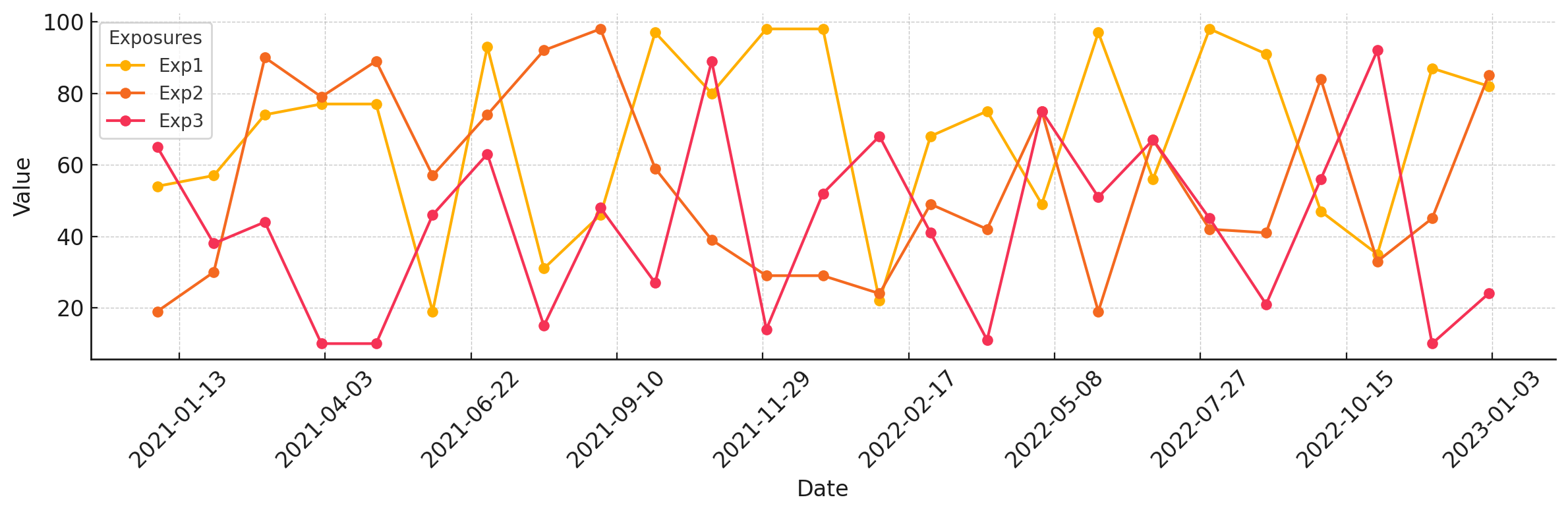
Pregnancy 1
Pregnancy 2
Pregnancy 3
Weeks 1-20
Weeks 21-38
- Two spatial aggregation approaches:
1. Preserve the original spatial scale: treat the exposures as area-level factors
2. Use buffers to generate individual-level exposure estimates based on area- /population-weighted aggregations

Spatiotemporal Linkage
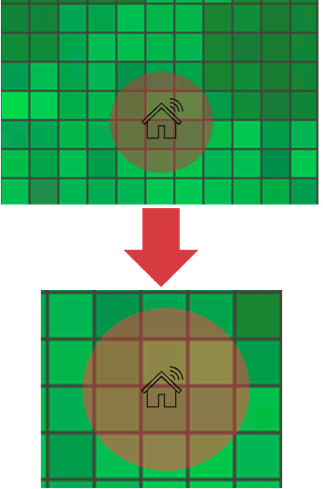
- Different buffer sizes:
- 270m for visible greenness
- 1230m for walkable greenness
- Not necessarily circular buffers:
- can also use other shapes based on individuals' time-activity patterns
- Computationally challenging:
- large number of spatial and contextual exposome factors
- large sample size
- large number of spatiotemporal windows
- high-resolution exposme data resulting in massive dataset volumes
Challenges in Spatiotemporal Linkage
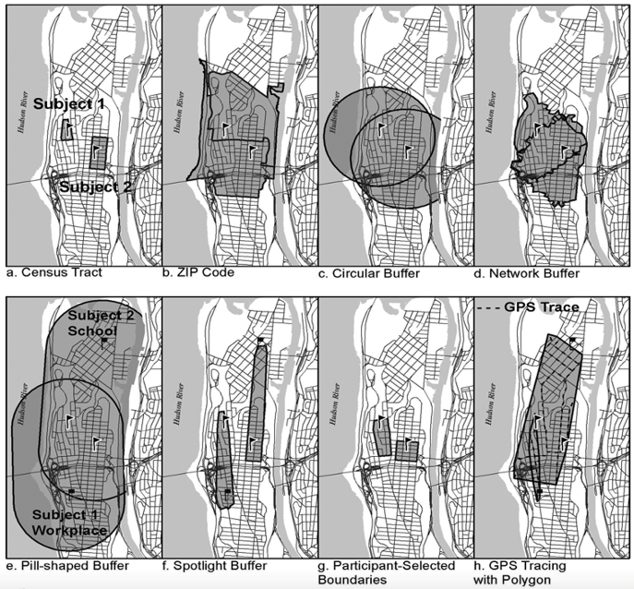
Source: Lovasi et al. 2011
- Privacy concerns and regulations make it challenging to share/access geolocaiton information from RWD and cohort studies
- Linkages to spatial and contextual exposome data are usually carried out by internal teams managing RWD/cohort studies
- Rarely have adequate expertise to address the complexities and challenges of spatial and contextual exposome data
- Leads to a lack of standardization and concerns of replicability
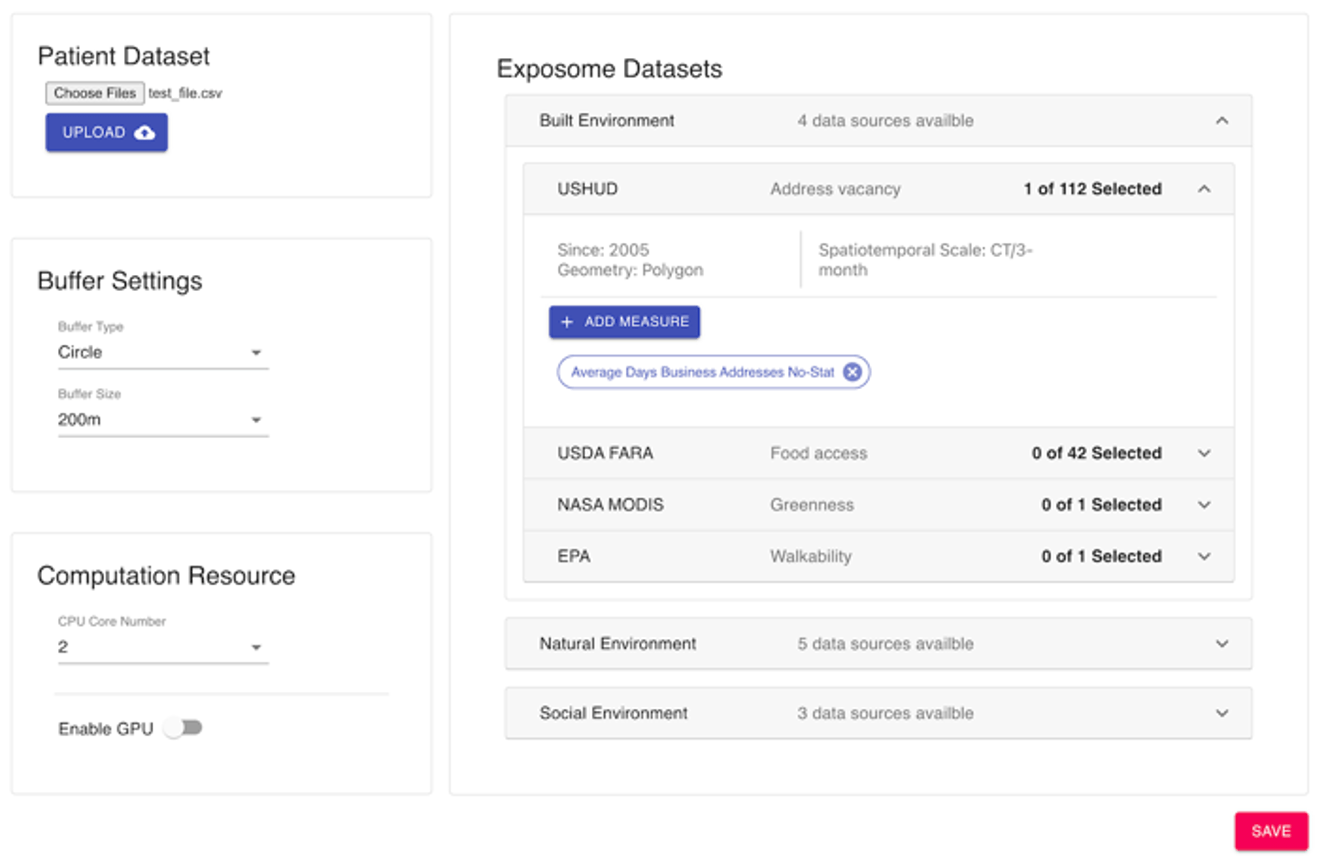
- A tool to address these challenges:
- SPACESCANS: SPATIAL AND CONTEXTUAL EXPOSOME SEMANTIC DATA INTEGRATION SYSTEM
Challenges in Sharing of Geospatial Information
Challenge 3:
Statistical methods for spatial and contextual exposome-health studies

Many statistical methods have been developed/applied in exposome-health studies
Predominantly developed to handle exposures measured at the individual-level
Source: Hu et al. 2022
Differences between toxicant/chemical mixtures and the spatial and contextual exposome
| Toxicant/Chemical Mixtures | The Spatial and Contextual Exposome | |
|---|---|---|
| Number of variables | 10-10 | 10 -10 |
| Common sample size | 10 -10 | ≥10 |
| Spatial structure | No | Yes |
| Temporal structure | Minimal | Yes |
2
4
3
2
4
5
Scalability
- Some methods have been applied to studies with thousands of exposures
ExWAS and elastic-net
p=5,784
N=819,399


ExWAS
p=337
N=3,108

Scalability
- Most existing methods have only been applied to studies with relatively small number of exposures and sample size
- existing simulation studies often consider small scale scenarios

p=237
N=1,200
p<20
N<250


Lack of consensus to handle heterogeneous spatiotemporal scales
- Different spatiotemporal aggregations can lead to subsequently different associations
- the modifiable areal unit problem
- the modifiable temporal unit problem
- Two approaches widely used in the field to address data heterogeneity:
- area-/population- and time-weighted averages based on pre-selected spatiotemporal exposure windows
- preserve the original spatiotemporal scales and account for them in analyses using appropriate statistical methods
- Largely unknown:
- performance of these two strategies
- whether and how the modifiable areal/temporal unit problems impact results
- whether the performance and impacts are different by exposures
Challenge 4:
Using spatial and contextual exposome data for disease prediction
- Spatial and contextual exposome data are promising to be used in disease prediction:
- wide availability of geolocation data in both clinical and research settings
- low cost to obtain and append these data to large number of individuals
- Most existing efforts so far only used single or very few spatial and contextual factors

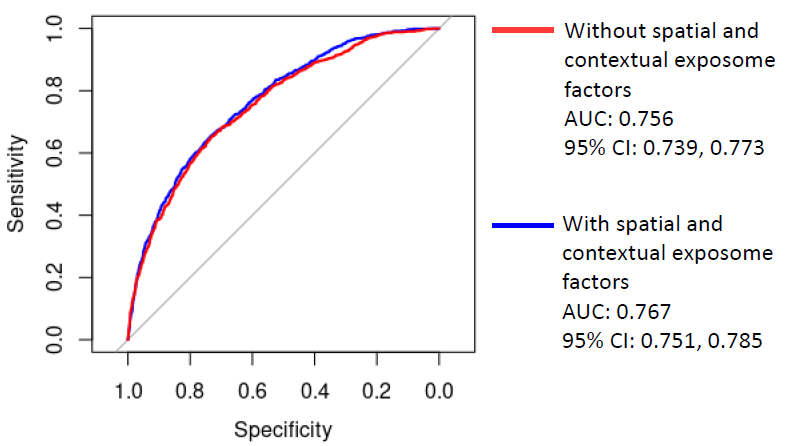
50,368 patients with COVID-19 between March 2020 and October 2021
Predictors:
- Sociodemographic factors: age, gender, race/ethnicity, health insurance
- Comorbidities
- County-level COVID-19 related factors (#days since first case, vaccination rates, hospital bed capacity)
- With or without the spatial and contextual exposome




- Traditional machine learning models have been predominantly used
- manual spatiotemporal aggregations -> loss of spatiotemporal structures -> loss of model performance
- Deep learning approaches are appealing
- perform automatic feature selection and engineering
- especially useful for data with spatiotemporal structures

- Spatial and contextual data include spatiotemporal structures, which cannot be fully leveraged by traditional machine learning models
- Deep learning has been shown to outperform traditional machine learning to preserve spatiotemporal structures in image and time series data
- Differences between spatial/contextual data and image/time-series data
- thousands of variables vs. few variables
- different spatiotemporal resolutions vs. common resolution
- for certain exposures (e.g., air pollution, green space), only a few 'pixels' matters (based on time-activity pattern)
- Existing deep learning model architectures cannot fully leverage the predictive power of spatial/contextual data
Summary
- Engineering of the spatial and contextual exposome data
- Spatiotemporal linkages of spatial and contextual exposome data to individuals
- Statistical methods for spatial and contextual exposome-health studies
- Using spatial and contextual exposome data for disease prediction
Acknowledgements
- NIH/NIEHS R24ES036131
- NIH/NIA RF1AG084178
- NIH/NHLBI K01HL153797
- NIH/NIEHS R21ES032762
- NIH/NHLBI OTAHL161847
- AHA 17SDG33630165
Thank you!

SPACESCANS
The Spatial and Contextual Exposome: Methodological Challenges and Paths Forward
By Hui Hu
The Spatial and Contextual Exposome: Methodological Challenges and Paths Forward
UF-FSU CTSA: LHS & AI Symposium