Fearless programming and reasoning with infinities
Alexander Gryzlov
IMDEA Software Institute
06/06/2024
Agenda
- Totality, partiality and fixed points
- Infinite data
- Interfaces and objects
- Automata
- Extra ideas & conclusions
Part 1
purely functional programming
=
programming and reasoning with
referentially transparent
higher-order functions
Having explicit effects simplifies
reasoning and formalization
Totality, partiality and fixed points
Purity
Very useful for reasoning about
intention and correctness
Types classify well-behaved programs,
but we inevitably lose some
So there's a quest to regain expressivity by
making type system more powerful
Allow more communication between
types and programs!
Totality
Pushing type-based reasoning further gives
dependent types
We can program the type-checker itself and build structures with invariants
data Vec (A : 𝒰 ℓ) : ℕ → 𝒰 ℓ where
  []  : Vec A zero
  _∷_ : A → Vec A n → Vec A (suc n)
Totality
data Format = Number Format | Str Format
            | Lit String Format | End

PrintfType : Format → 𝒰
PrintfType (Number fmt) = (i : Int) → PrintfType fmt
PrintfType (Str fmt) = (str : String) → PrintfType fmt
PrintfType (Lit str fmt) = PrintfType fmt
PrintfType End = String

printfFmt : (fmt : Format) → (acc : String) → PrintfType fmt
printfFmt (Number fmt) acc = λ i → printfFmt fmt (acc ++ show i)
printfFmt (Str fmt) acc = λ str → printfFmt fmt (acc ++ str)
printfFmt (Lit lit fmt) acc = printfFmt fmt (acc ++ lit)
printfFmt End acc = acc

toFormat : (xs : List Char) → Format
toFormat [] = End
toFormat ('%' :: 'd' :: chars) = Number (toFormat chars)
toFormat ('%' :: 's' :: chars) = Str (toFormat chars)
toFormat ('%' :: chars) = Lit "%" (toFormat chars)
toFormat (c :: chars) = case toFormat chars of
                             Lit lit chars' => Lit (strCons c lit) chars'
                             fmt => Lit (strCons c "") fmt

printf : (fmt : String) -> PrintfType (toFormat (unpack fmt))
printf fmt = printfFmt _ ""
Totality
This however means that purity is not enough
Functions have to be total: defined everywhere
Otherwise the type-checking crashes or fails
= inconsistent logic
{-# TERMINATING #-}
void : ⊥
void = void

oops : 2 + 2 = 5
oops = absurd void
Safety and liveness
Correctness properties typically split into
- safety (nothing bad ever happens)
- liveness (something good eventually happens)
Totality also has two aspects:
- defined input (no crashing)
- producing output (no hanging)
Safety & liveness reasoning
Partial functions violating safety
=
some arguments are not handled
Typically handled by either restricting the domain
or wrapping codomain in Maybe/Either
Violation of liveness = non-termination
We need to reason about unfolding computations
Non-termination
Temporal aspects are typically "invisible"
How to model endless computation?
Total programming usually restricts to
terminating functions
Too narrow, cannot reason about interactive programs
Need to model control flow in the type system
Non-termination hacks
We can try adding hacks:
- construct individual terminating steps
- make a small unsafe function that spins the steps
- alternatively, add number of steps and then unsafely generate an infinite number
data Fuel = Dry | More Fuel

limit : ℕ → Fuel
limit  zero   = Dry
limit (suc n) = More (limit n)

{-# TERMINATING #-}
forever : Fuel
forever = More forever
There should be a fully formal solution
Type-level time
A natural way of reasoning about time is to split it into steps/ticks on some global clock
The flow of time should be unidirectional
...
A thunk calculus
- Add a special type constructor
▷ -
▷Ais "A, but available one step later" - Essentially a type-level thunk
() ⇒ A - Can also be thought of as staging (to run in the next stage)
- The program generates a new program that runs after the first one and so on
...
▷
▷▷
▷▷▷
Structure of later
It's an applicative functor
(will write ap as ⊛)
next : A → ▷A
ap : ▷(A → B) → ▷A → ▷B
Functorial structure
- We can derive a functorial action (will write
mapas ⍉) - All the laws hold definitionally (by symbolic computation)
map : (A → B) → ▹ A → ▹ B
map f a▹ = next f ⊛ a▹
ap-map : (f : A → B) → (x▹ : ▹ A)
→ (next f ⊛ x▹) = f ⍉ x▹
ap-map f x▹ = refl
Not a monad
There is no monadic structure
flatten : ▹ ▹ A → ▹ A
This ensures that the temporal structure is preserved
▷
For an arbitrary type there's also typically no
▹ A → A
(though we can do it for universes)
Guarded recursion
- We can schedule computations, what now?
- Terminating → Productive recursive programs
- Every recursive call is "guarded" by a thunk, returning control
- Infinite / streaming computations, servers, OSs
...
▷
▷▷
▷▷▷
Guarded recursion
- A form of Y-combinator
- Postulated definition, unfolding made propositional
- Can be erased into a general recursive fixpoint
fix: (▹ A → A) → Apostulate
dfix : (▹ A → A) → ▹ A
pfix : (f : ▹ A → A) → dfix f = next (f (dfix f))
fix : (▹ A → A) → A
fix f = f (dfix f)
fix-path : (f : ▹ A → A) → fix f = f (next (fix f))
fix-path f i = f (pfix f i)
Ticked type theory
- We'll use Agda proof assistant for interactive examples
- Guarded modality is encoded as a function from a modal
Tick:𝕋 - A tick is a proof of an elapsed time step
- Can encode
next,apandmap -
Black triangle ▸ is a type-level time shift
▹_ : 𝒰 ℓ → 𝒰 ℓ
▹_ A = (@tick α : Tick) → A

▸_ : ▹ 𝒰 ℓ → 𝒰 ℓ
▸ A▹ = (@tick α : Tick) → A▹ α
Ticked cubical type theory
- Technically we're using the cubical mode of Agda
- Equality is encoded as a function from a continuous interval type 𝕀
- The interval is allowed to commute with the tick ("time-travel")
- Allows to reason about the future in the present
▹-ext : {A : 𝒰 ℓ} {x▹ y▹ : ▹ A}
      → ▹[ α ] (x▹ α = y▹ α)
      → x▹ = y▹
▹-ext p i α = p α i

▹-iso : x▹ = y▹ ≅ (▹[ α ] (x▹ α = y▹ α))
Logical justification
- A flavour of provability modality
- 1933 - Gödel's analysis of
S4 - 1950s - (Weak) Löb's axiom:
□(□A → A) → □A -
We're using the strong version:
(□A → A) → A - 1960s -
GLsystem - 1970s - intuitionistic systems, fixed points
- 2000s - links to formal semantics and category theory
Nakano's approximation
- Nakano, [2000] "A modality for recursion"
-
▷was initially written⏺ - Continued by many authors, most notably:
Atkey-McBride'13 - A series of papers by Birkedal and coauthors in 2010s
- Viewed as a special type constructor in the type system
Programming with ▷
So, to recap we have essentially 4 new constructs:
▷, next, ap/⊛, fix
(+ ▸, map/⍉ and some proof machinery)
What can we write with these?
Part 2
Which infinite types make sense?
Infinite data
Fitting the fix
Previously, I've said that for an arbitrary type there typically is no
▹ A → A
However, that is the type of function we need:
We can construct such types with ▹
fix: (▹ A → A) → APartiality effect
- Recall the motivation of having a non-termination effect
- We can express it with 2 constructors + a guard annotation
- Many names:
L(ift),Event,Delay
data Part (A : 𝒰) : 𝒰 where
  now   : A → Part A
  later : ▹ Part A → Part A
...
Partiality functor
Mapping a function = waiting until the end and applying it
map-body : (A → B)
         → ▹ (Part A → Part B)
         →    Part A → Part B
map-body f m▹ (now a)   = now (f a)
map-body f m▹ (later p) = later (m▹ ⊛ p)

map : (A → B) → Part A → Part B
map f = fix (map-body f)
...
...
Partiality applicative
Unwind both structures "in parallel"
pure : A → Part A
pure = now

ap-body : ▹ (Part (A → B) → Part A → Part B)
          →  Part (A → B) → Part A → Part B
ap-body a▹ (now f)    (now x)    = now (f x)
ap-body a▹ (now f)    (later x▹) = later (a▹ ⊛ next (now f) ⊛ x▹)
ap-body a▹ (later f▹) (now x)    = later (a▹ ⊛ f▹ ⊛ next (now x))
ap-body a▹ (later f▹) (later x▹) = later (a▹ ⊛ f▹ ⊛ x▹)

ap : Part (A → B) → Part A → Part B
ap = fix ap-body
...
...
...
Partiality monad
-
Essentially an arbitrary sequence of nested
▹'s -
Reassociating makes it a monad (▹▹▹(▹▹A) → ▹▹▹▹▹A)
flatten-body : ▹ (Part (Part A) → Part A)
             →   Part (Part A) → Part A
flatten-body f▹ (now p)    = p
flatten-body f▹ (later p▹) = later (f▹ ⊛ p▹)

flatten : Part (Part A) → Part A
flatten = fix flatten-body
...
...
Partiality effect
never : Part ⊥
never = fix later

collatz-body : ▹ (ℕ → Part ⊤) → ℕ → Part ⊤
collatz-body c▹ 1 = now tt
collatz-body c▹ n =
  if even n then later (c▹ ⊛ next (n ÷2))
            else later (c▹ ⊛ next (suc (3 · n)))

collatz : ℕ → Part ⊤
collatz = fix collatz-body
Wraps potentially non-terminating computations
Indexed partiality monad
Complexity can be made explicit by
indexing with steps
data Delayed (A : 𝒰) : ℕ → 𝒰 where
  nowD   : A → Delayed A zero
  laterD : ∀ {n} → ▹ (Delayed A n) → Delayed A (suc n)
Cannot express infinite computations anymore:
there's no ▹ (Delayed A n) → Delayed A n
Indexed partiality monad
Can be made more explicit by indexing with steps
mapᵈ : (A → B) → Delayed A n → Delayed B n

apᵈ : Delayed (A → B) m
    → Delayed A n
    → Delayed B (max m n)
runs sequentially
Encoding applicative via bind changes complexity!
_>>=ᵈ_ : Delayed A m
       → (A → Delayed B n)
       → Delayed B (m + n)
runs "in parallel"
Conaturals
Unary numbers extended with numerical infinity
≅ Part⊤
data ℕ∞ : 𝒰 where
  ze : ℕ∞
  su : ▹ ℕ∞ → ℕ∞

infty : ℕ∞
infty = fix su

+-body : ▹ (ℕ∞ → ℕ∞ → ℕ∞) → ℕ∞ → ℕ∞ → ℕ∞
+-body a▹    ze        ze     = ze
+-body a▹ x@(su _)     ze     = x
+-body a▹    ze     y@(su _)  = y
+-body a▹   (su x▹)   (su y▹) =
      su (next (su (a▹ ⊛ x▹ ⊛ y▹)))

_+_ : ℕ∞ → ℕ∞ → ℕ∞
_+_ = fix +-body
Conatural subtraction
∸-body : ▹ (ℕ∞ → ℕ∞ → Part ℕ∞)
       →    ℕ∞ → ℕ∞ → Part ℕ∞
∸-body s▹    ze      _      = now ze
∸-body s▹ x@(su _)   ze     = now x
∸-body s▹   (su x▹) (su y▹) = later (s▹ ⊛ x▹ ⊛ y▹)

_∸_ : ℕ∞ → ℕ∞ → Part ℕ∞
_∸_ = fix ∸-body
(Saturating) subtraction is partial:
∞ ∸ ∞ never terminates
Conatural proof
∸ᶜ-infty : infty ∸ᶜ infty = never
∸ᶜ-infty = fix λ cih▹ →
  infty ∸ᶜ infty
    ~⟨ ... unroll subtraction and infinity definitions with fix-path ... ⟩
  later ((next _∸ᶜ_) ⊛ next infty ⊛ next infty)
    ~⟨⟩
  later (next (infty ∸ᶜ infty))
    ~⟨ ap later (▹-ext cih▹) ⟩
  later (next never)
    ~⟨ fix-path later ⁻¹ ⟩
  never
    ∎
Proofs typically follow this pattern:
- unroll fixed points by a necessary amount of steps
- apply equations + "coinductive hypothesis"
- roll fixed points back
Co/free monad
Partiality is just an instantiation of the free monad with the ▷ functor
-
Freemonad is an F-branching tree with data on the leaves -
Cofreecomonad is a tree with data at the branches - What do we get by instantiating
Cofreewith ▷ ?
data Free (F : 𝒰 → 𝒰) (A : 𝒰) : 𝒰 where
  Pure : A → Free F A
  Roll : F (Free F A) → Free F A

data Cofree (F : 𝒰 → 𝒰) (A : 𝒰) : 𝒰 where
  Cof : A → F (Cofree F A) → Cofree F A
Streams
- Another classical infinite structure
- An inductive list with a delayed tail and no empty case
- A lazy linear producer of values
data Stream (A : 𝒰) : 𝒰 where
  cons : A → ▹ Stream A → Stream A
...
Stream functions
headˢ : Stream A → A
headˢ (cons x _) = x

tail▹ˢ : Stream A → ▹ Stream A
tail▹ˢ (cons _ xs▹) = xs▹

repeatˢ : A → Stream A
repeatˢ a = fix (cons a)

mapˢ-body : (A → B)
          → ▹ (Stream A → Stream B)
          →    Stream A → Stream B
mapˢ-body f m▹ as = cons (f (headˢ as)) (m▹ ⊛ (tail▹ˢ as))

mapˢ : (A → B) → Stream A → Stream B
mapˢ f = fix (mapˢ-body f)

natsˢ-body : ▹ Stream ℕ → Stream ℕ
natsˢ-body n▹ = cons 0 (mapˢ suc ⍉ n▹)

natsˢ : Stream ℕ
natsˢ = fix natsˢ-body
Stream comonad
extract = head
duplicate = tails
extractˢ : Stream A → A
extractˢ = headˢ

duplicateˢ-body : ▹ (Stream A → Stream (Stream A))
                →    Stream A → Stream (Stream A)
duplicateˢ-body d▹ s@(cons _ t▹) = cons s (d▹ ⊛ t▹)

duplicateˢ : Stream A → Stream (Stream A)
duplicateˢ = fix duplicateˢ-body
...
...
...
...
...
Causality
- We can define
stutterbuteveryother - Violates casualty
- (can be defined with clocks, however)
stutter : Stream A → Stream A
stutter = fix λ d▹ s →
  cons (headˢ s) (next (cons (headˢ s) (d▹ ⊛ tail▹ˢ s)))

-- everyother : Stream A → Stream A
-- everyother = fix λ e▹ s →
--   cons (headˢ s) (e▹ ⊛ tail▹ˢ (tail▹ˢ s {!!}))
...
Folds and numbers
- We can define other familiar functions
-
foldr,scan,zipWith,interleave - numerical streams
fibˢ-body : ▹ Stream ℕ → Stream ℕ
fibˢ-body f▹ =
  cons 0 ((λ s → cons 1 $ (zipWithˢ _+_ s) ⍉ (tail▹ˢ s)) ⍉ f▹)

fibˢ : Stream ℕ
fibˢ = fix fibˢ-body

primesˢ-body : ▹ Stream ℕ → Stream ℕ
primesˢ-body p▹ = cons 2 ((mapˢ suc ∘ scanl1ˢ _·_) ⍉ p▹)

primesˢ : Stream ℕ
primesˢ = fix primesˢ-body
Part 3
Let's look at the definition of the stream again
Objects and interfaces
A datatype with a single constructor is essentially a record
data Stream (A : 𝒰) : 𝒰 where
  cons : A → ▹ Stream A → Stream A
Iterator
We can treat the stream as an iterator object with two methods:
- reading the head value
- advancing by one step
record Stream (A : 𝒰) : 𝒰 where
  constructor cons
  field
    hd  : A
    tl▹ : ▹ Stream A
Branching iterator
Can be generalized to an infinite binary tree
data Tree∞ (A : 𝒰) : 𝒰 where
  node : A → ▹ Tree∞ A → ▹ Tree∞ A
       → Tree∞ A

record Tree∞ (A : 𝒰) : 𝒰 where
  constructor node
  field
    val : A
    l▹  : ▹ Tree∞ A
    r▹  : ▹ Tree∞ A
...
Branching iterator
Or a rose tree with arbitrary branching
data RTree (A : 𝒰) : 𝒰 where
  rnode : A → List (▹ RTree A) → RTree A

record RTree (A : 𝒰) : 𝒰 where
  constructor rnode
  field
    val : A
    ch▹ : List (▹ RTree A)
...
Terminating iterators
Multiple constructors makes this harder
data Colist (A : 𝒰) : 𝒰 where
  cnil  : Colist A
  ccons : A → ▹ Colist A → Colist A

record Colist0 (A : 𝒰) : 𝒰 where
  constructor ccons0
  field
    hd  : Maybe A
    tl▹ : ▹ Colist0 A

record Colist1 (A : 𝒰) : 𝒰 where
  constructor ccons1
  field
    hd   : A
    emp? : Bool
    tl▹  : ▹ Colist1 A
Set interface
How would we represent an infinite set of ℕ?
(a finite set is usually some search structure RedBlackTree ℕ)
Typically via a function ℕ → Prop/Bool
We can also use Stream Bool
Generally, Stream A ≅ ℕ → A
Tabulation of a function
However, this is not very efficient
...
1
2
3
1
0
Set interface
Instead, we can encode a set interface as
a recursive guarded record
(actual implementation a bit more technical)
record Setℕ : 𝒰 where
  constructor mkSet
  field
    emp? : Bool
    has? : ℕ → Bool
    ins  : ℕ → ▹ Setℕ
    uni  : ▹ Setℕ → Part Setℕ
Strict positivity
- Guarded recursion has two general areas of application:
- Working with potentially infinite data structures
- Encoding non-strictly-positive recursive types
- Strictly positive type appears to the left of 0 arrows
- A syntactic approximation of monotonicity
Strict positivity
- Strictly positive type appears to the left of 0 arrows
- Another syntactic approximation
- Positive type appears in even positions
- Negative type appears in odd positions
data Expr : 𝒰 → 𝒰 where
  Foo : ((Expr a → Expr a) → Expr b) → Expr (a → b)
          ^^^^^^----------------------- positive occurrence
                   ^^^^^^-------------- negative occurrence
                             ^^^^^^---- strictly positive occurrence
A finite set object
finiteSet-body : ▹ (List ℕ → Setℕ)
               →   List ℕ → Setℕ
finiteSet-body f▹ l =
  mkSet (empty? l)
        (λ n → elem? n l)
        (λ n → f▹ ⊛ next (n ∷ l))
        (λ x▹ → later ((λ x →
           foldrP (λ n z →
              later (now ⍉ (z .ins n))) x l) ⍉ x▹))

finiteSet : List ℕ → Setℕ
finiteSet = fix finiteSet-body
Carries around the search structure (here a List)
An infinite set object
evensUnion-body : ▹ (Setℕ → Setℕ)
                →    Setℕ → Setℕ
evensUnion-body e▹ s =
  mkSet false
        (λ n → even n or s .has? n)
        (λ n → e▹ ⊛ s .ins n)
        (λ x▹ → later ((λ f →
           mapᵖ f (s .uni x▹)) ⍉ e▹))

evensUnion : Setℕ → Setℕ
evensUnion = fix evensUnion-body
Delegates to the parameter
Objects with IO
This idea can be extended to state and effects
Encode IO as a form of a partiality monad and
abstract over methods using polynomials
record IOTree : 𝒰 (ℓsuc 0ℓ) where
  field
    Command : 𝒰
    Response : Command → 𝒰

data IOProg (I : IOTree) (A : 𝒰) : 𝒰 where
  ret : (a : A) → IOProg I A
  bnd : (c : Command I) (f : Response I c → ▹ IOProg I A) → IOProg I A

record Interface : 𝒰 (ℓsuc 0ℓ) where
  field
    Method : 𝒰
    Result : Method → 𝒰

record IOObj (Io : IOTree) (I : Interface) : 𝒰 where
  field
    mth : (m : Method I) → IOProg Io (Result I m × IOObj Io I)
Part 4
Let's go back to the idea of function tabulation
Stream A ≅ ℕ → A
What is the infinite tree isomorphic to?
Automata
data Tree∞ (A : 𝒰) : 𝒰 where
  node : A → ▹ Tree∞ A → ▹ Tree∞ A
       → Tree∞ A
Word consumers
Tree∞ A ≅ ℕ₂ → A
(the type of binary numbers)
There's general construction to tabulate
T → A into some F A
where the structure of F mirrors that of T
...
1
10
11
101
100
110
111
Tries
We can think of structures as infinite tries whose branching factor is determined by T
...
Word automata
This idea can be generalized even further, to tabulated polymorphic functions:
data Stream (A : 𝒰) : 𝒰 where
  cons : A → (⊤ → ▹ Stream A) → Stream A

data Tree∞ (A : 𝒰) : 𝒰 where
  cons : A → (Bool → ▹ Tree∞ A) → Tree∞ A

data Moore (X A : 𝒰) : 𝒰 where
  mre : A → (X → ▹ Moore X A) → Moore X A
Word automata
Moore X A ≅ List X → A
Deterministic Moore automaton, common special case is
Moore X Bool ≅ List X → Bool
which is typically called a recognizer
data Moore (X A : 𝒰) : 𝒰 where
  mre : A → (X → ▹ Moore X A) → Moore X A
Operations on automata
pure : B → Moore A B
pure b = fix (pure-body b)

map : (B → C)
    → Moore A B → Moore A C
...

ap : Moore A (B → C) → Moore A B → Moore A C
..

zipWith : (B → C → D)
        → Moore A B → Moore A C → gMoore A D
zipWith f = ap ∘ map f

cat : Moore A B → Moore B C → Moore A C
...
Regular expressions
Lang : 𝒰 → 𝒰
Lang A = Moore A Bool

∅ : Lang A
∅ = pure false

ε : Lang A
ε = mre true λ _ → ∅

char : A → Lang A
char a = Mre false λ x →
           if ⌊ x ≟ a ⌋ then ε else ∅

compl : Lang A → Lang A
compl = map not

_⋃_ : Lang A → Lang A → Lang A
_⋃_ = zipWith _or_

_⋂_ : Lang A → Lang A → Lang A
_⋂_ = zipWith _and_
Mealy automata
data Mealy (X A : 𝒰) : 𝒰 where
  mly : (X → A × ▹ Mealy X A) → Mealy X A

data Moore (X A : 𝒰) : 𝒰 where
  mre : A → (X → ▹ Moore X A) → Moore X A
Mealy X A ≅ Stream X → Stream A
transducer automaton
Resumptions
data Res (I O A : 𝒰) : 𝒰 where
  ret  : A → Res I O A
  cont : (I → O × ▹ Res I O A) → Res I O A
- A Mealy automaton that possibly terminates
- a combination of a partiality and state monad
Harrison, Procter, [2015] "Cheap (But Functional) Threads”
Coroutines
Passing control back and forth via thunks is conceptually programming with coroutines
Can be compiled into patterns of communication between consumer and producer automata
data Consume (A B : 𝒰) : 𝒰 where
  end  : B → Consume A B
  more : (A → ▹ Consume A B) → Consume A B

pipe-body : ▹ (Stream A → Consume A B → Part B)
          →    Stream A → Consume A B → Part B
pipe-body p▹ _           (end x)   = now x
pipe-body p▹ (cons h t▹) (more f▹) = later (p▹ ⊛ t▹ ⊛ f▹ h)

pipe : Stream A → Consume A B → Part B
pipe = fix pipe-body
Part 5
Where to go next?
Extra ideas & conclusions
Clocked type theory
- We can work "under" thunks but not remove them
- Delayedness never decreases
- Weaker than proper coinduction
- Can be extended by a constant ☐ modality or clock variables to allow forcing "completed" thinks
force : (∀ κ → ▹ κ (A κ)) → ∀ κ → A κ- Controlled violation of causality
- E.g. we can write
everyotherfunction on streams
Bird's algorithm
- aka
replaceMin - later generalized to value recursion
(MonadFix) in Haskell - given a binary tree with data in leaves, replaces all values with a minimum in a single pass
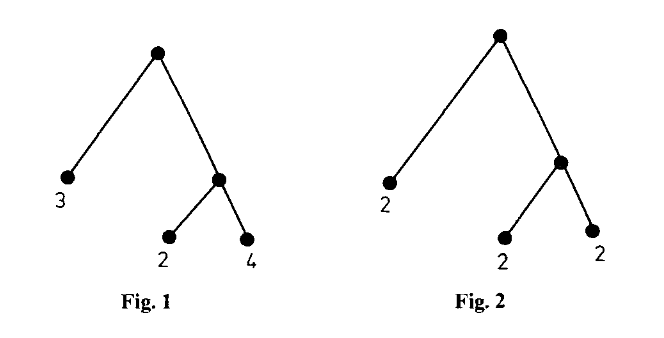
Bird's algorithm
Classical form is somewhat weird
replaceMin :: Tree -> Tree

replaceMin t =
  let (r, m) = rmb (t, m) in r
  where
  rmb :: (Tree, Int) -> (Tree, Int)
  rmb (Leaf x, y) = (Leaf y, x)
  rmb (Node l r, y) =
    let (l',ml) = rmb (l, y)
        (r',mr) = rmb (r, y)
     in
   (Node l' r', min ml mr)
Guarded decomposition
- We can decompose this in two temporal phases
- Compute the minimum and construct the thunk
- Then run the thunk
- Uses the feedback combinator
feedback : (▹ A → B × A) → B⍉_
feedback f = fst (fix (f ∘ snd)) -
Inserts intermediate data between steps
-
Cannot run the thunk without clocks
Guarded decomposition
replaceMinBody : Tree ℕ
               → ▹ ℕ → ▹ (Tree ℕ) × ℕ
replaceMinBody (Leaf x) n▹ = Leaf ⍉ n▹ , x
replaceMinBody (Br l r) n▹ =
  let (l▹ , nl) = replaceMinBody l n▹
      (r▹ , nr) = replaceMinBody r n▹
    in
  (Br ⍉ l▹ ⊛ r▹) , min nl nr

feedback : (▹ A → B × A) → B
feedback f = fst (fix (f ∘ (snd ⍉_)))

-- main function

replaceMin : Tree ℕ → ▹ Tree ℕ
replaceMin t = feedback (replaceMinBody t)
Continuations
- We can reason about control-flow based algorithms
- Harper's algorithm for matching on regexps with continuations
- Hofmann's algorithm for tree BFS
data StdReg = NoMatch | MatchChar Char | Or StdReg StdReg
            | Plus StdReg | Concat StdReg StdReg

type MatchT = (String -> Bool) -> Bool

matchi :: StdReg -> Char -> String -> MatchT
matchi  NoMatch       c cs k = False
matchi (MatchChar c') c cs k = if c == c' then k cs else False
matchi (Or r1 r2)     c cs k = matchi r1 c cs k || matchi r2 c cs k
matchi (Plus r)       c cs k = matchi r c cs (\cs -> k cs || matchh cs (Plus r) k)
matchi (Concat r1 r2) c cs k = matchi r1 c cs (\cs -> matchh cs r2 k)

matchh :: String -> StdReg -> MatchT
matchh []       r k = False
matchh (c : cs) r k = matchi r c cs k

match :: String -> StdReg -> Bool
match s r = matchh s r null
Breadth-first traversal
- Another form of a binary tree, data on both leaves and nodes
- Compute a breadth-first traversal
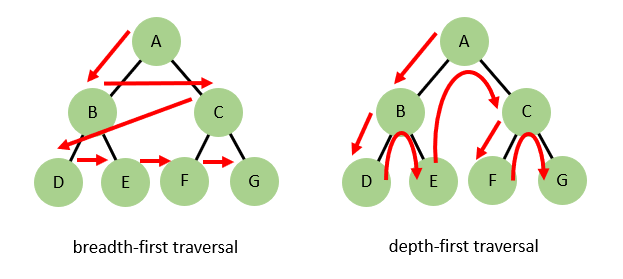
Hoffman's algorithm
- Typically done with queues
- Hoffman invented a purely functional continuation-based algorithm in 1993
- Requires a intermediate (non-strictly) positive datatype
data Rou A where
  Over : Rou A
  Next : ((Rou A → List A) → List A) → Rou A
---        ^^^^^
Hoffman's algorithm
- We can encode this in guarded theory by switching to
Colists - requires smart constructors that transport terms over the fixpoint (un)rolling equalities internally
data RouF (A : 𝒰) (R▹ : ▹ 𝒰) : 𝒰 where
  overRF : RouF A R▹
  nextRF : ((▸ R▹ → ▹ Colist A) → Colist A) → RouF A R▹

Rou : 𝒰 → 𝒰
Rou A = fix (RouF A)

overR : Rou A
nextR : ((▹ Rou A → ▹ Colist A) → Colist A) → Rou A
Stream calculus
exact real numbers, series
stream differential equations

Search algorithms
- can encode sequential topology
- constructive Tychonoff's theorem
→c-searchable : (ds : is-discrete X)
              → c-searchable X (discrete-clofun ds)
              → c-searchable (Stream X) (closenessˢ ds)
A generic framework for
search/selection/minimization algorithms
Vs coinduction
- Coinductive mechanisms are more liberal
- Productivity checker is purely syntactic
- Spend a few hours on a proof, get shot down
- Guarded constructions are type-directed
Conclusion
- A principled way to work with non-termination
- A common theme is overcoming syntactic approximations
- Thunks, streams, partiality
- Non-strictly positive datatypes
- Synthetic topology and domain theory
- Concurrency models (quotienting & cubical gizmos)
Working repos
Literature
- Nakano, [2000] "A modality for recursion"
- Artemov, Beklemishev, [2004] "Provability logic"
- https://agda.readthedocs.io/en/latest/language/guarded.html
- Atkey, McBride, [2013] "Productive Coprogramming with Guarded Recursion"
- Bird, [1984] "Using circular programs to eliminate multiple traversals of data"
- Berger, Matthes, Setzer, [2019] "Martin Hofmann's Case for Non-Strictly Positive Data Types"
- Clouston, Bizjak, Grathwohl, Birkedal, [2016] "The guarded lambda-calculus: Programming and reasoning with guarded recursion for coinductive types"
- Paviotti, Mogelberg, Birkedal, [2015] "A model of PCF in Guarded Type Theory"
Contacts
IMDEA Fearless Programming and Reasoning with Infinities
By Alex Gryzlov