James.Wilson@ColoState.Edu.
Professor of Mathematics, Colorado State University
Patterns in Data & the Algebra That Finds It
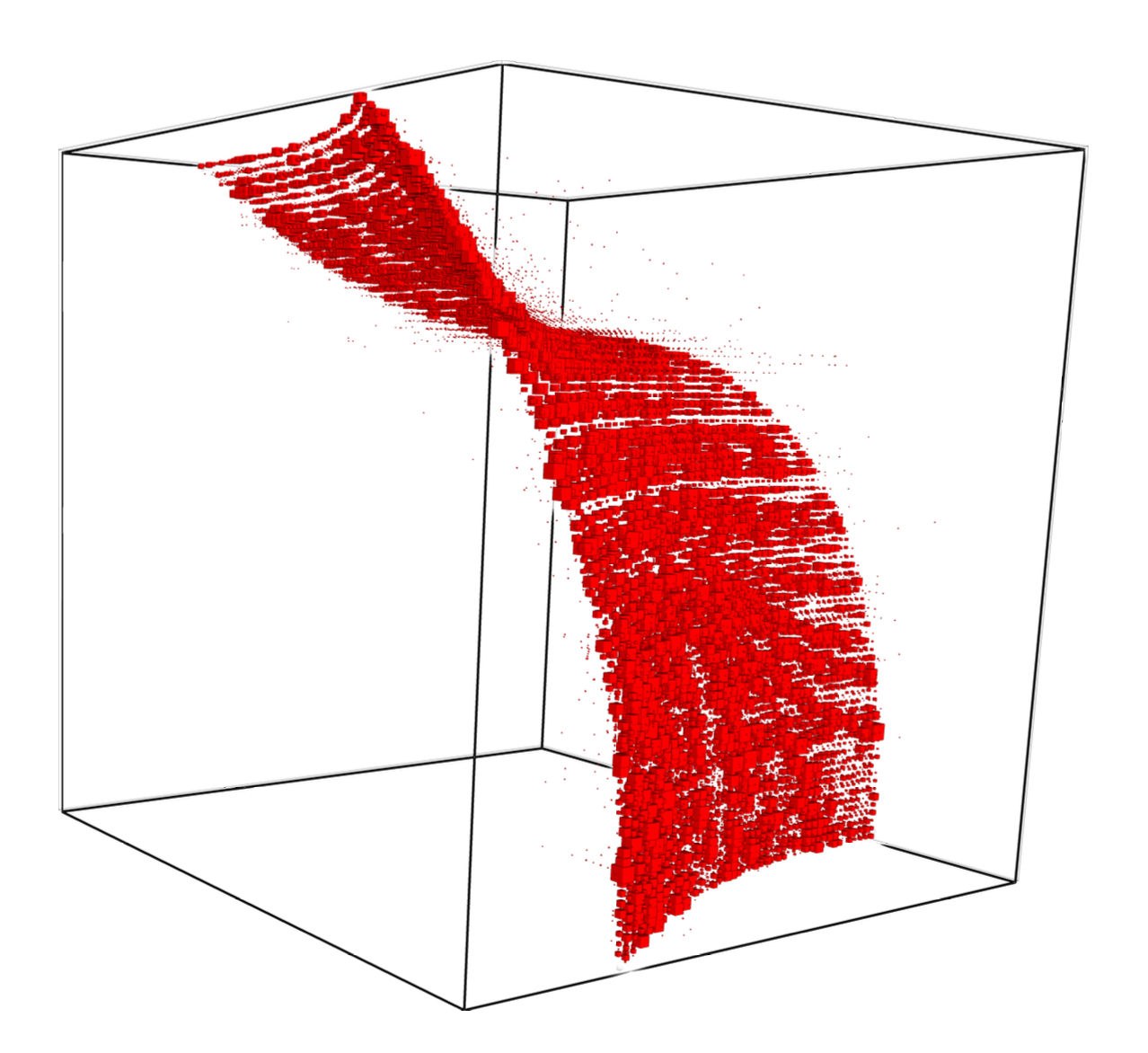
https://slides.com/jameswilson-3/data-algebra
A Problem:
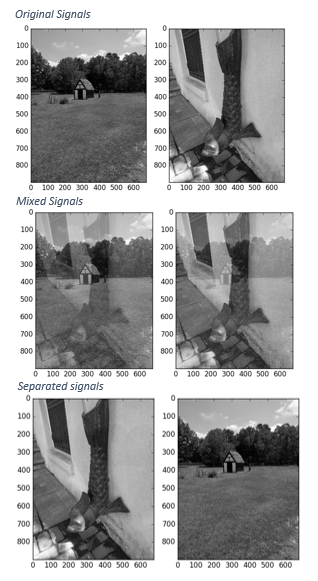
Blind Source Separation (BSS)
Signals get mixed in ...
- collection
- transmission
- decoding
Goal: separate them.


Strategy:
- Signal \(u_1=[9,2,9,1], u_2=[8,3,9,2]\)
- Build "statistic", e.g. sums of squares \[\langle u_i, u_j\rangle=u_{i1}u_{j1}+u_{i2}u_{j2}+u_{i3}u_{j3}+u_{i4}u_{j4}\] for all \(i,j\) \[\begin{array}{|c|cc|} \hline \langle u_i,u_j\rangle & 1 & 2 \\ \hline 1 & 167 & 161 \\ 2 & 161 & 158 \\ \hline \end{array}\]
- Separate the differences...\[v_1= u_1,\qquad v_2=-\frac{161}{167}u_1+u_2\] \[\begin{array}{|c|cc|} \hline \langle v_i,v_j\rangle & 1 & 2\\ \hline 1 & 167 & 0 \\ 2 & 0 & -2.78 \\ \hline \end{array}\]
Cluster Patterns in Tensors Data
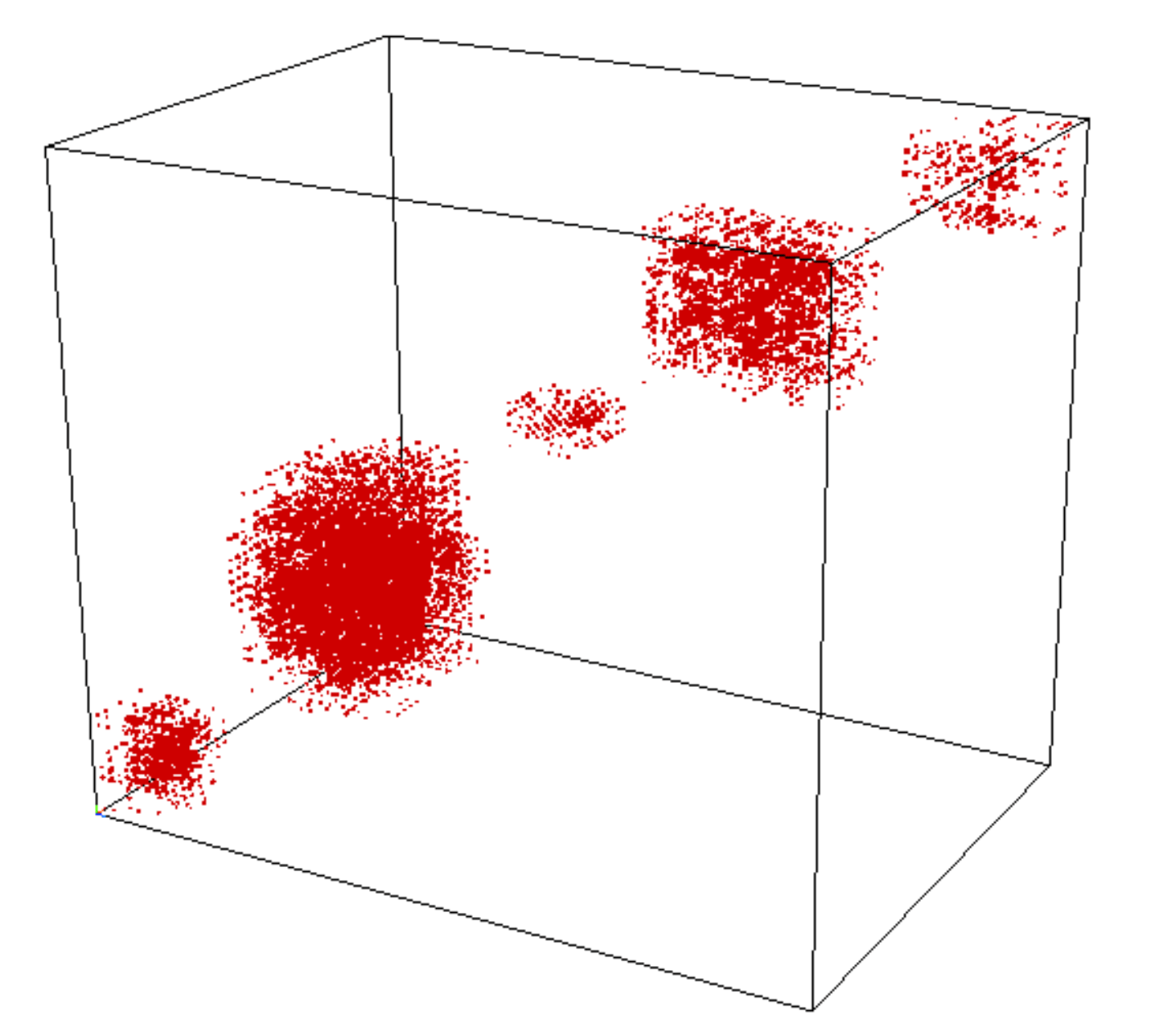
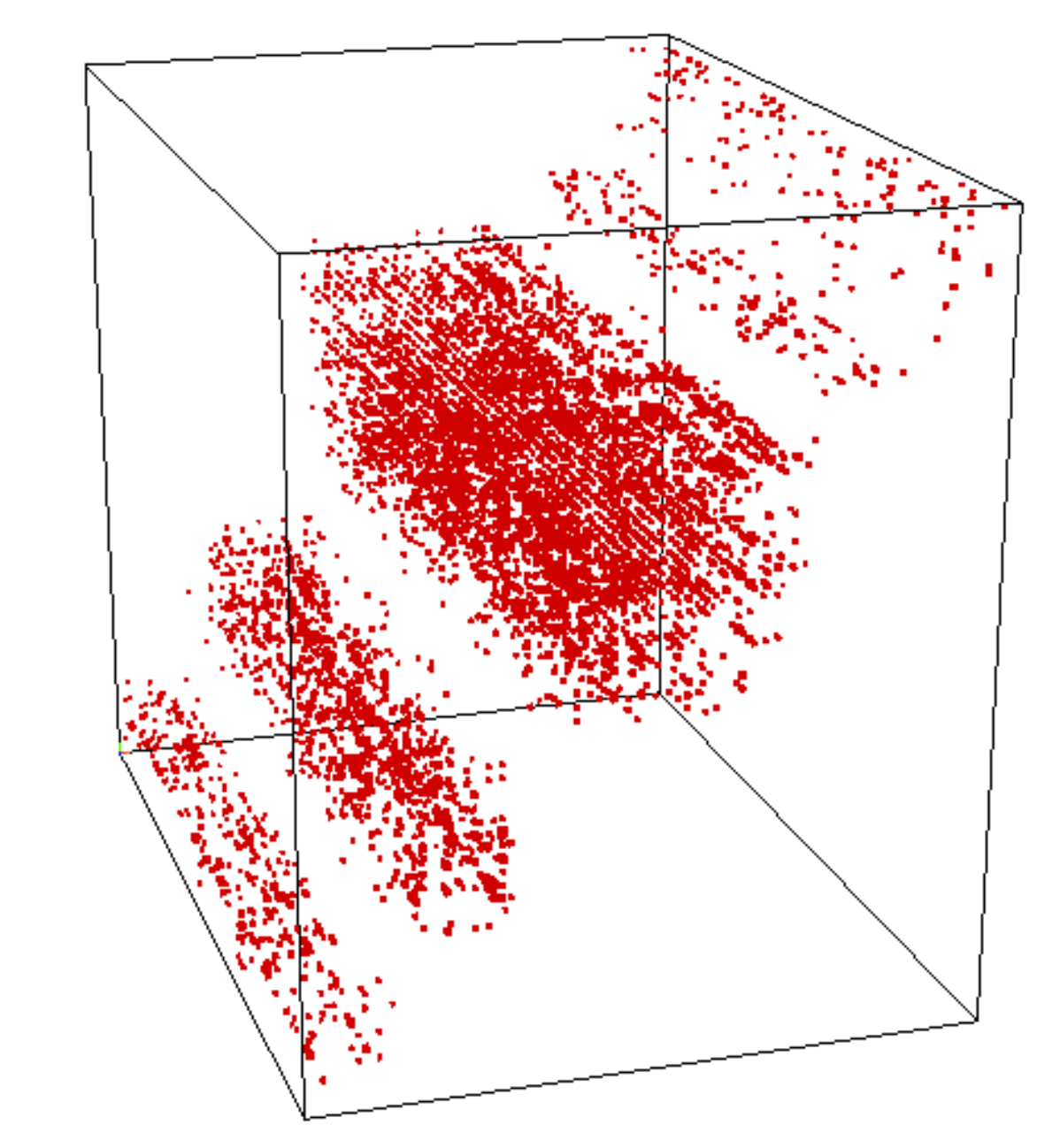
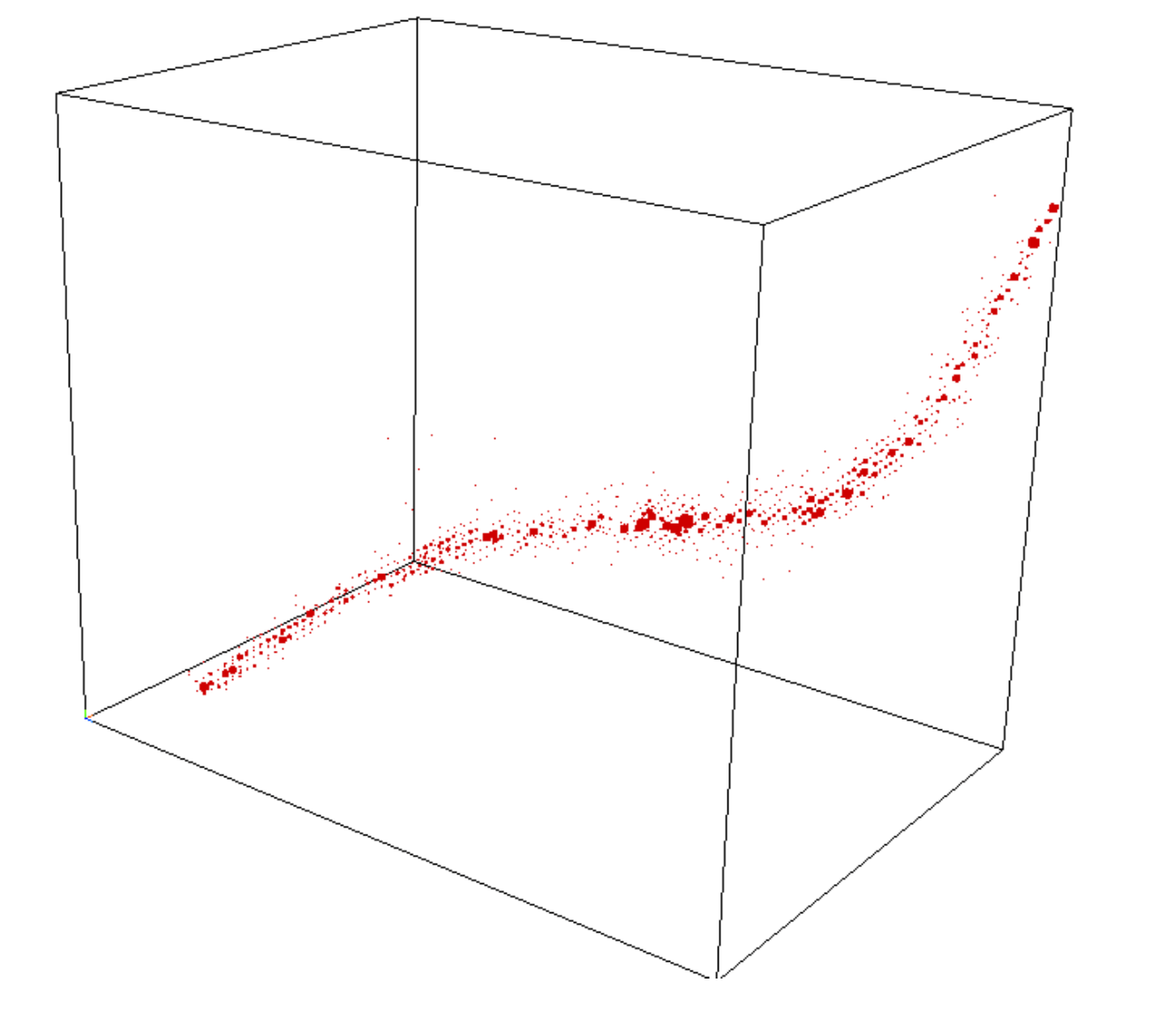
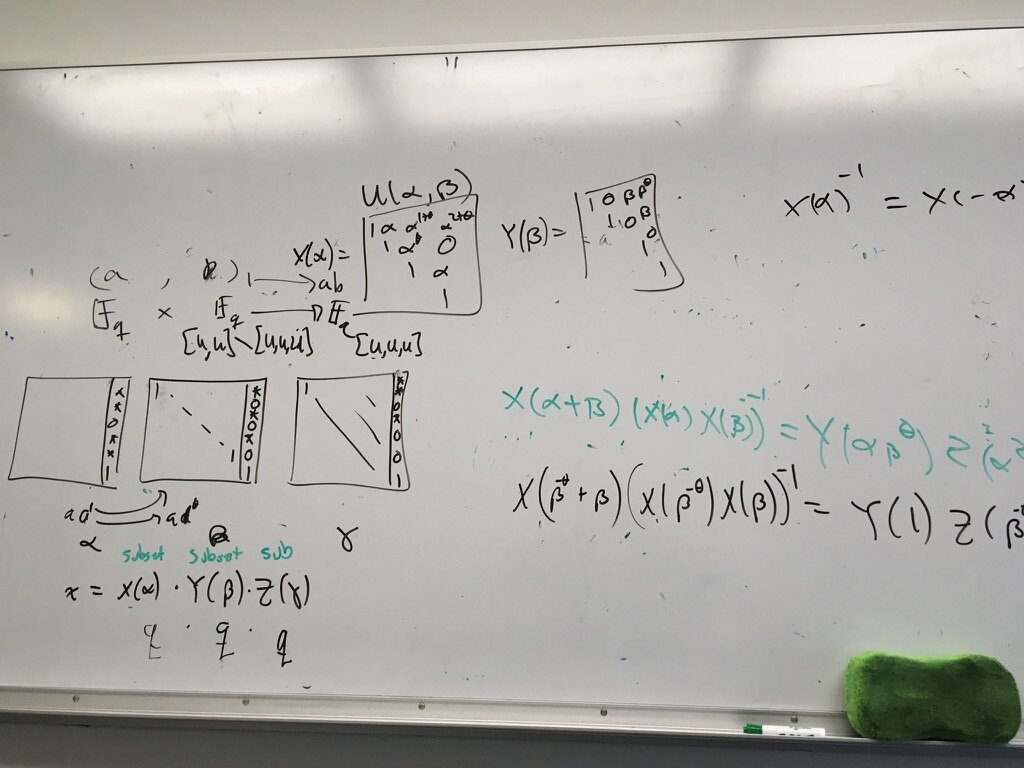
WhO Me?
Couldn't Be!


-
Then Who?
-
Maybe you?
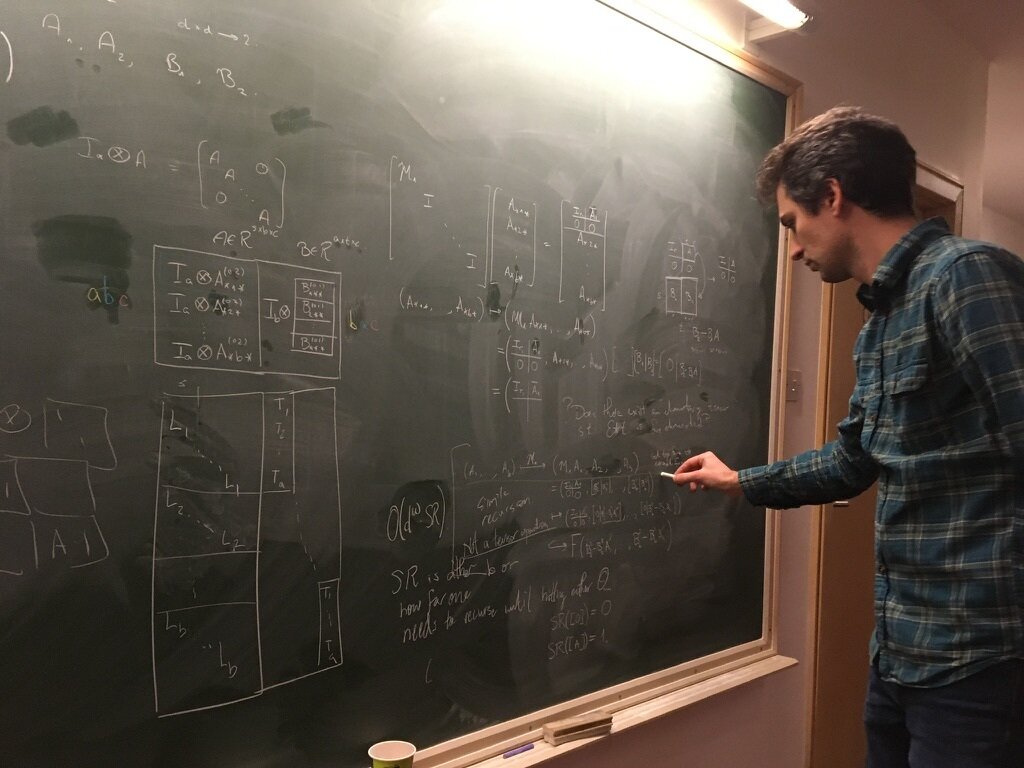

Tensors as AreA &volume
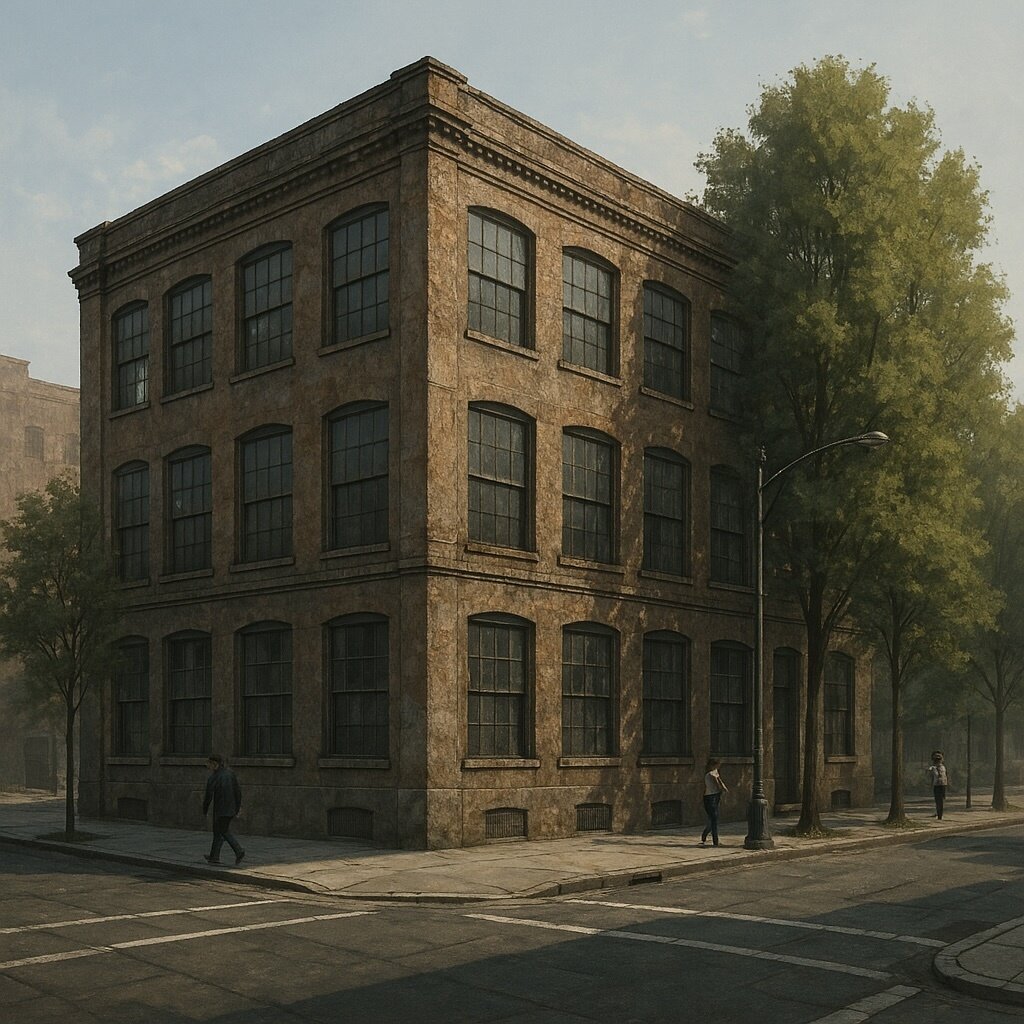
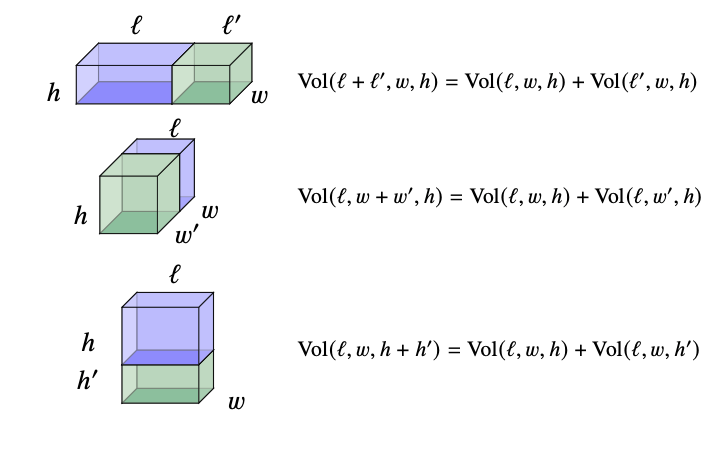
Volume basics
Volume: west window bays x east window bays x floors \[\text{Vol}(4,5,3) = 4\text{bays} \times 5\text{bays}\times 3\text{floors} = 60\text{rooms}.\]
Lessons:
- Volumes are distribute products
- They need multiplication tables ("tensors")
Oops! Miss counted, but easy update: \[\text{Vol}(4,5+{\color{red}1},3)=\text{Vol}(4, 5, 3)+{\color{red}\text{Vol}(4,1,3)}=60+12=72\]
Need it in Cubic feet? Easy.
Vol(4,6,3) = 160 \(\text{ft}^4/\text{bay}^2~\text{floor}\) \(\times 4 \text{bays} \times 6\text{bays} \times 3 \text{floors}\)
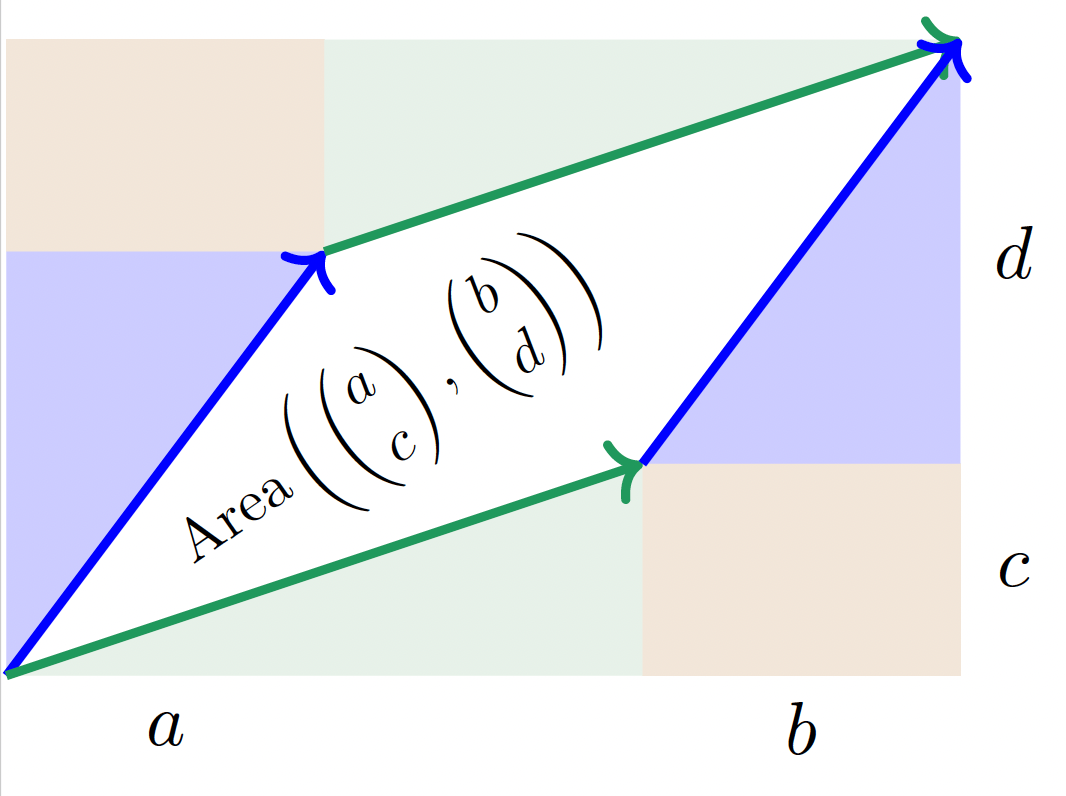
Area...easy
Area...
Less easy
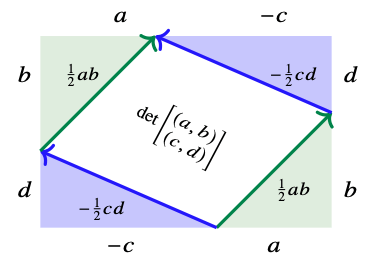
\[\text{Area}\left(\begin{bmatrix} a\\ c\end{bmatrix}, \begin{bmatrix} b\\ d\end{bmatrix}\right) = (a+b)(c+d)-2bc-2\frac{1}{2}ac-2\frac{1}{2}bd=ad-bc= \begin{bmatrix} a & b\end{bmatrix}\begin{bmatrix} 0 & 1 \\ -1 & 0 \end{bmatrix}\begin{bmatrix} c\\ d \end{bmatrix}\]
Adjust the Multiplication Table "tensor"
Indirect Area...Even Harder
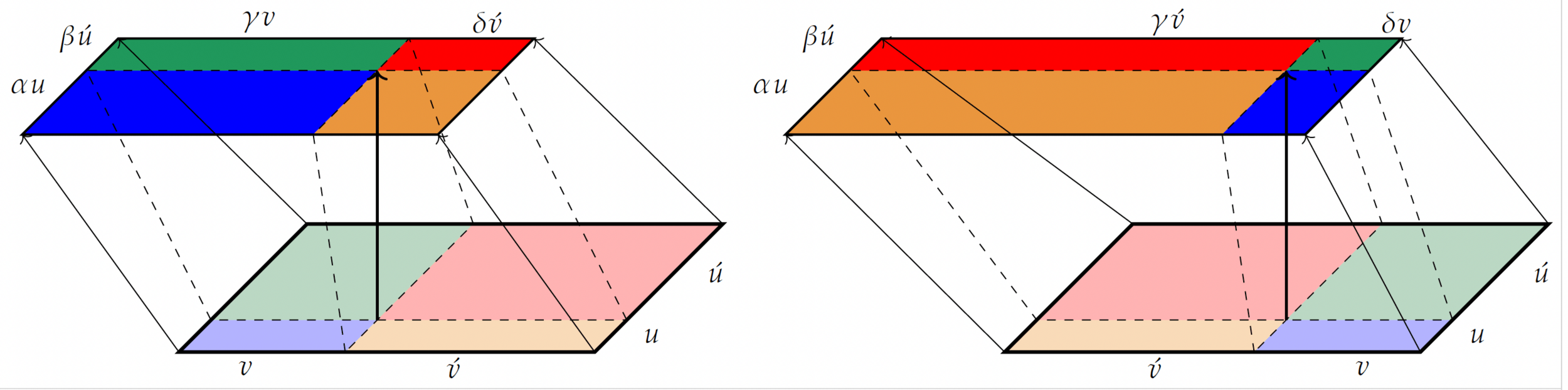
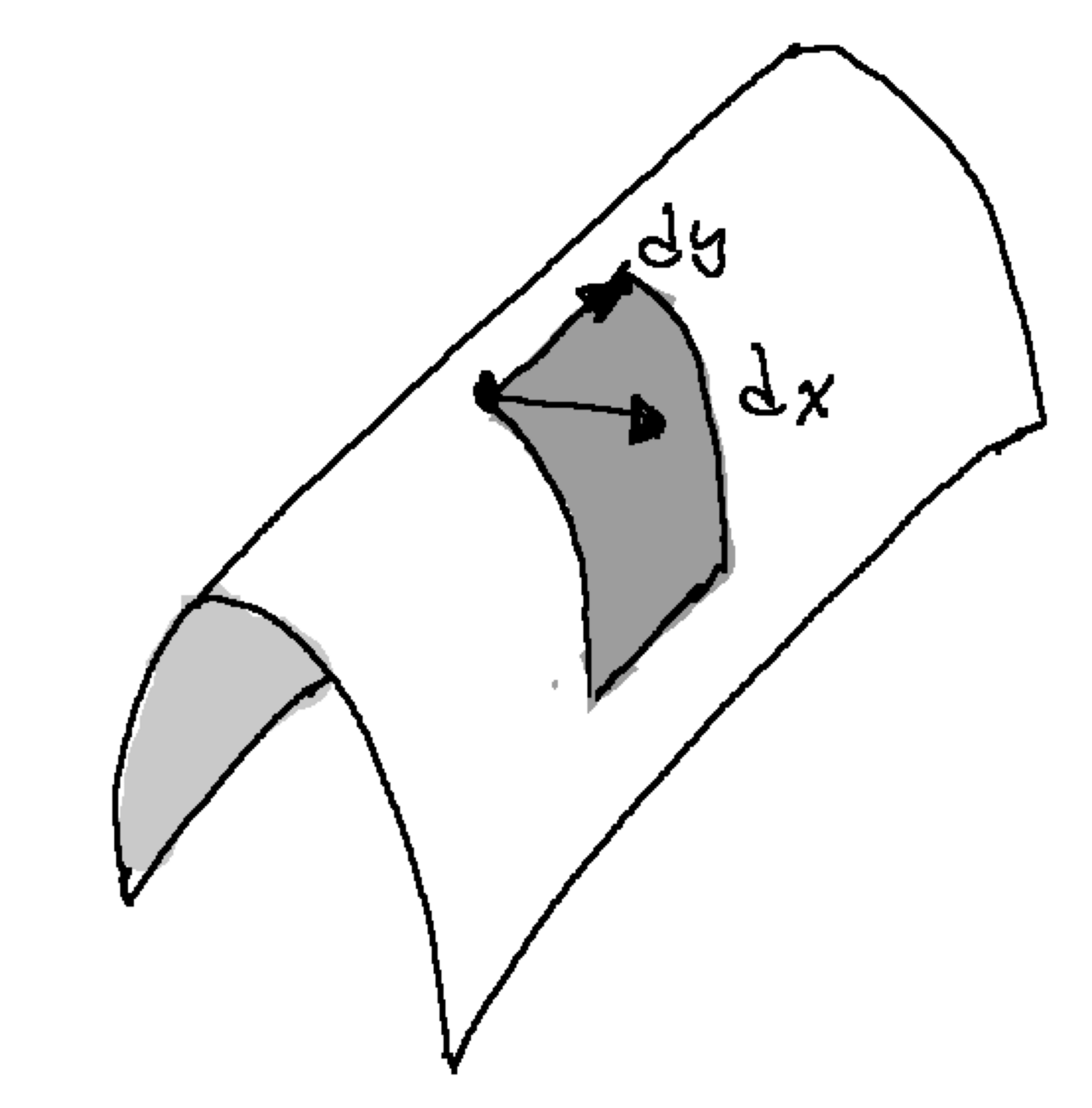
Area/Volume wrapped onto surfaces, measure inputs by proxy \[Jac(x,y)=\begin{bmatrix}\partial_x & \partial_y\end{bmatrix} \begin{bmatrix} 0 & 1 \\ -1 & 0 \end{bmatrix}\begin{bmatrix} x\\ y\end{bmatrix}\]
Proportionate measures add strangely \[p_1\boxplus p_2=\frac{V_1}{V_3}p_1+\frac{V_2}{V_3}p_2\neq p_2\boxplus p_1\] E.g. adding gas pressure or supply/demand.
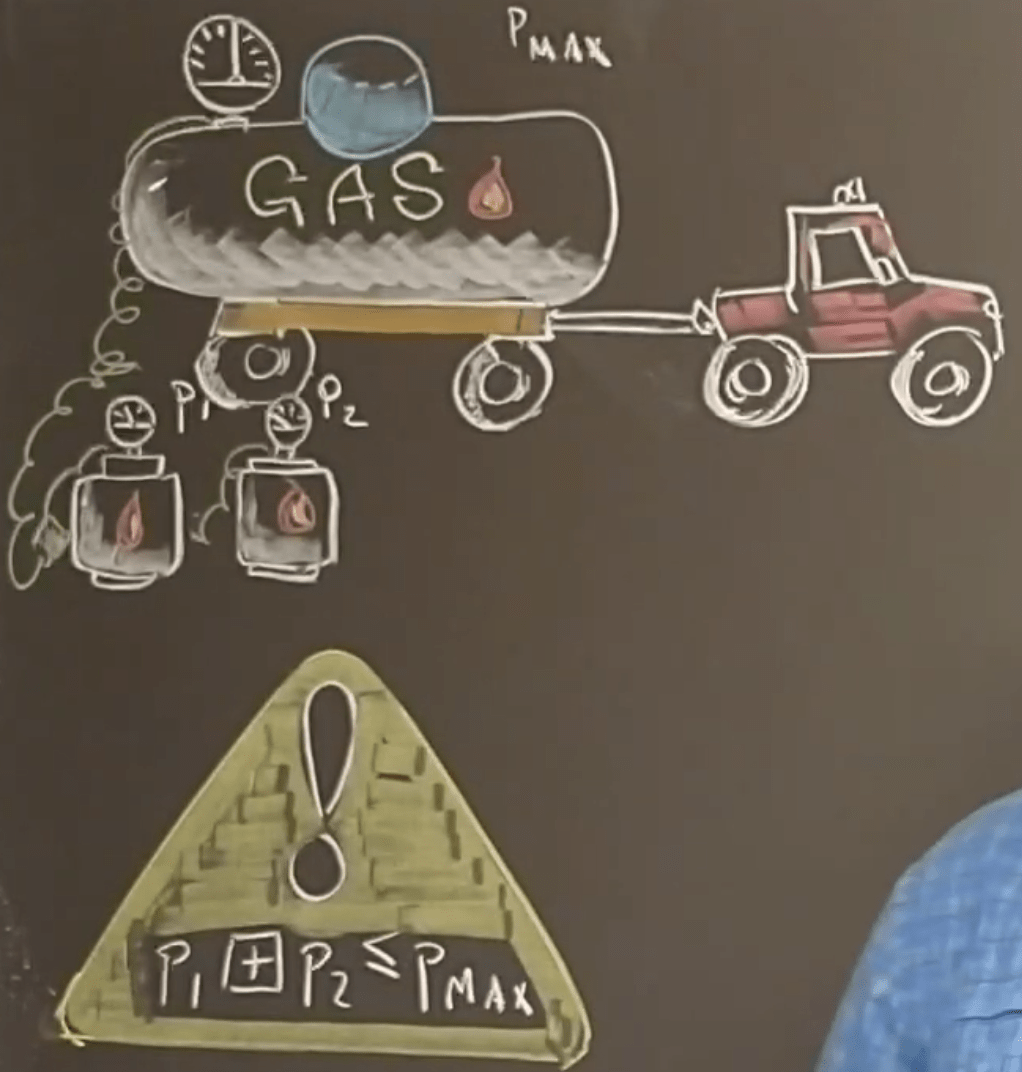
New uses? Make up new measurements
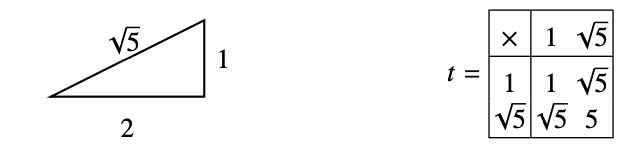
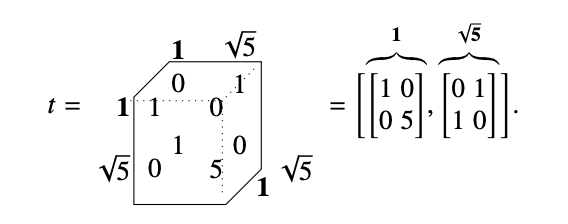
New uses? Sales Volume?
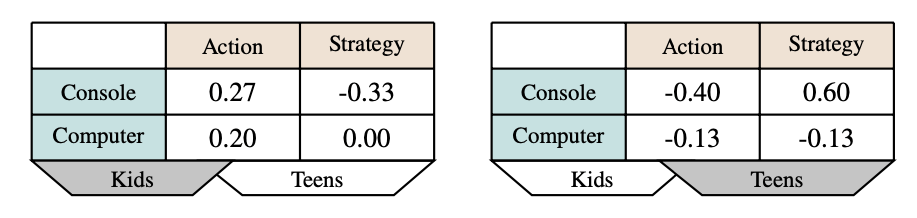
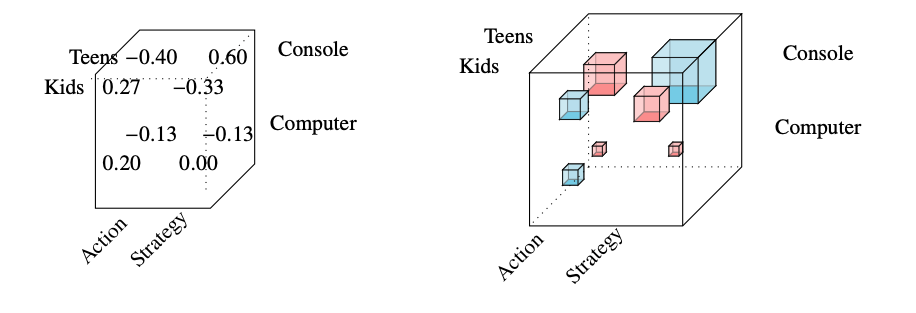
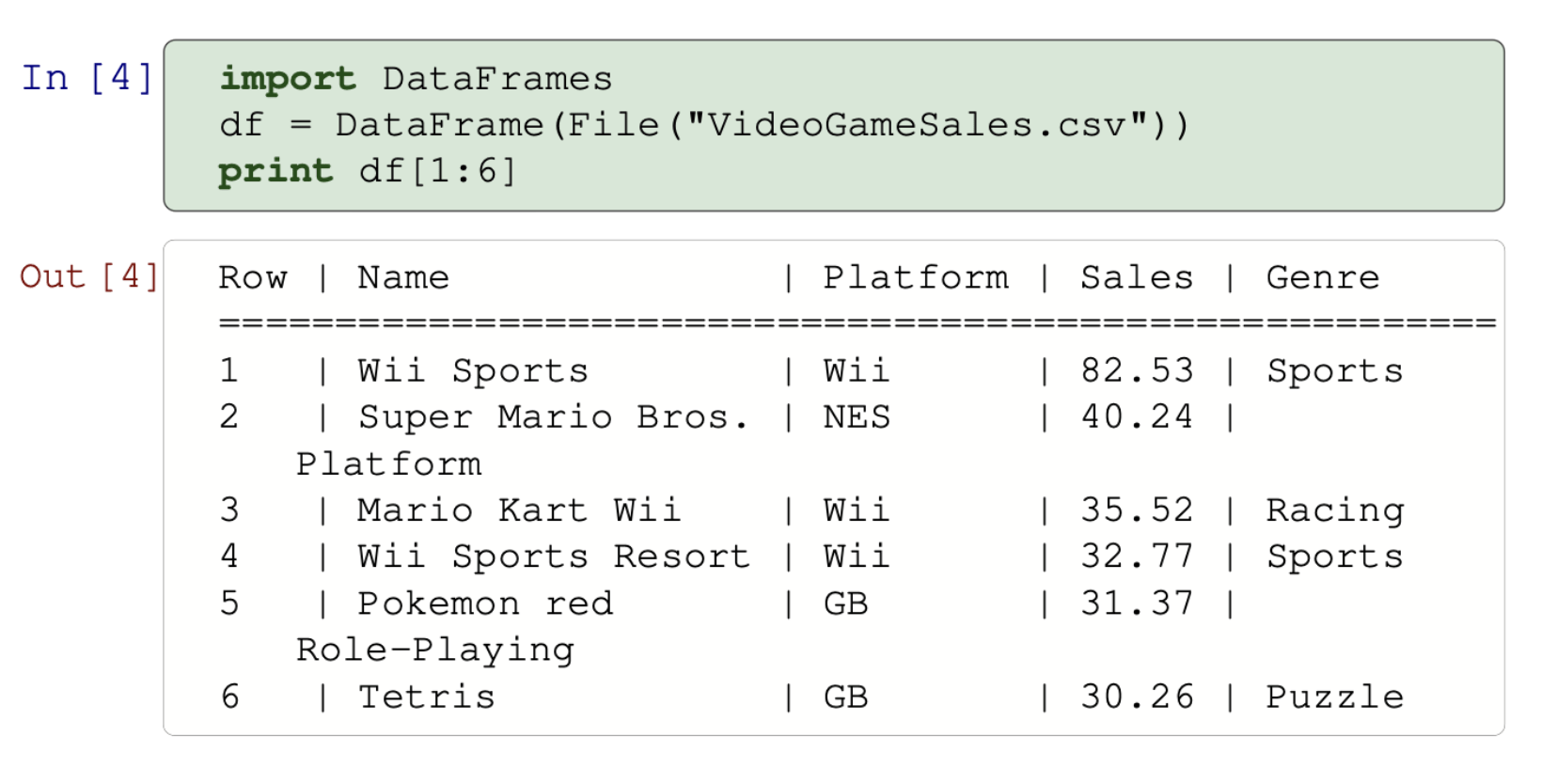
Slightly more honest
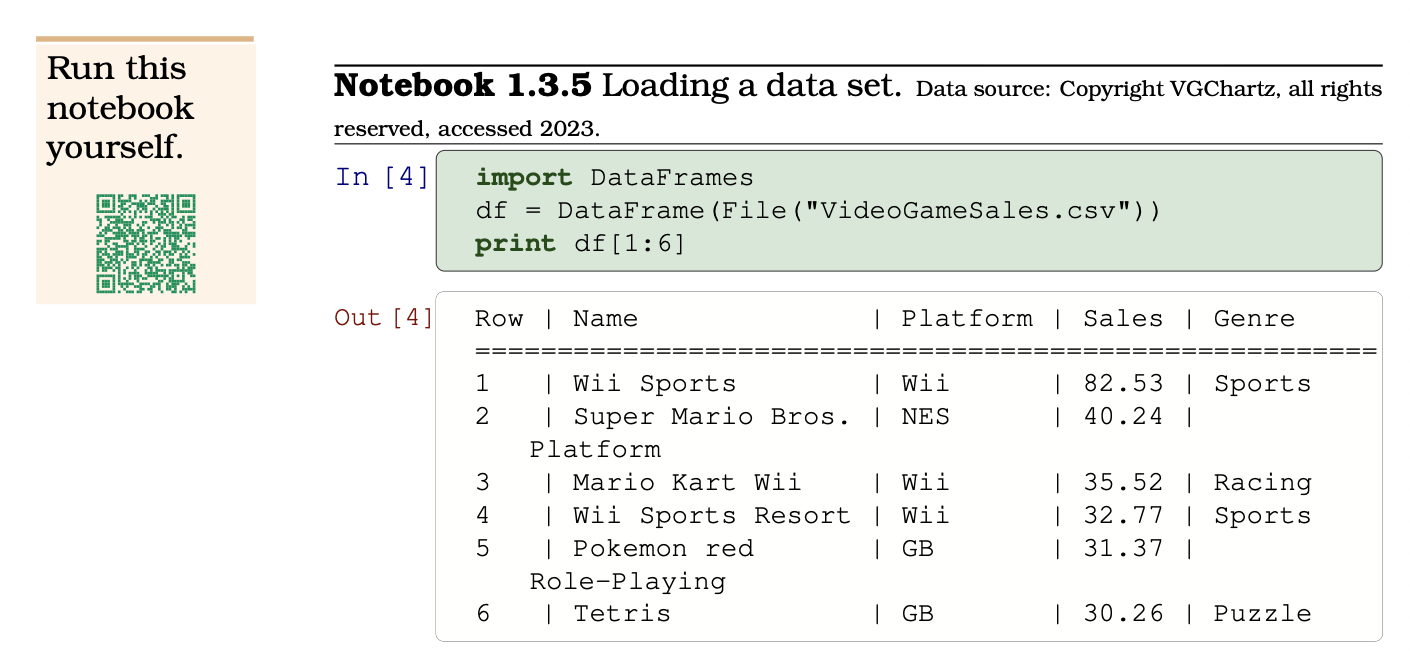
Scores from from VSChartz.com in 2021
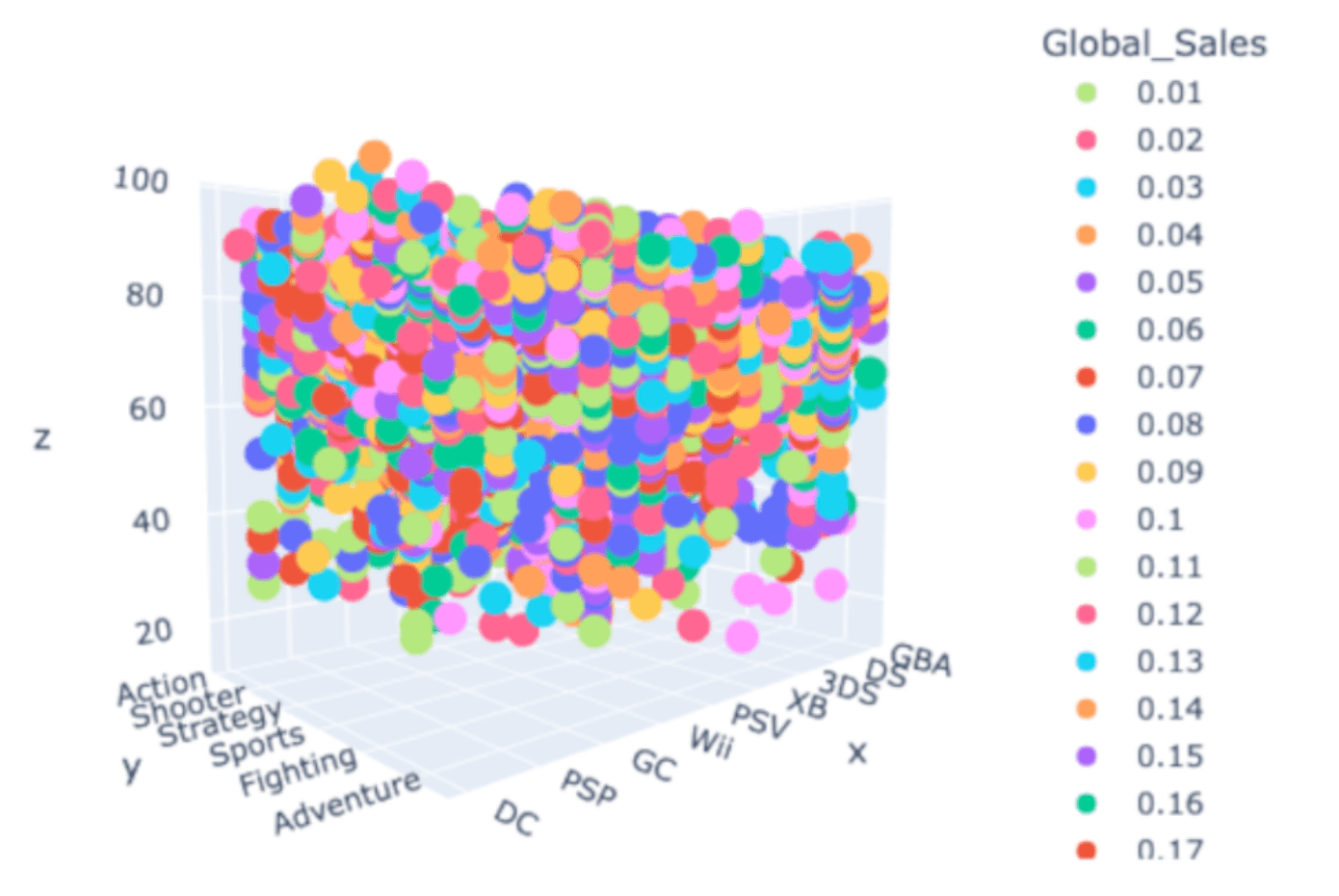
Histogram Visualization

A Tensor is...
data treated as a distributive product
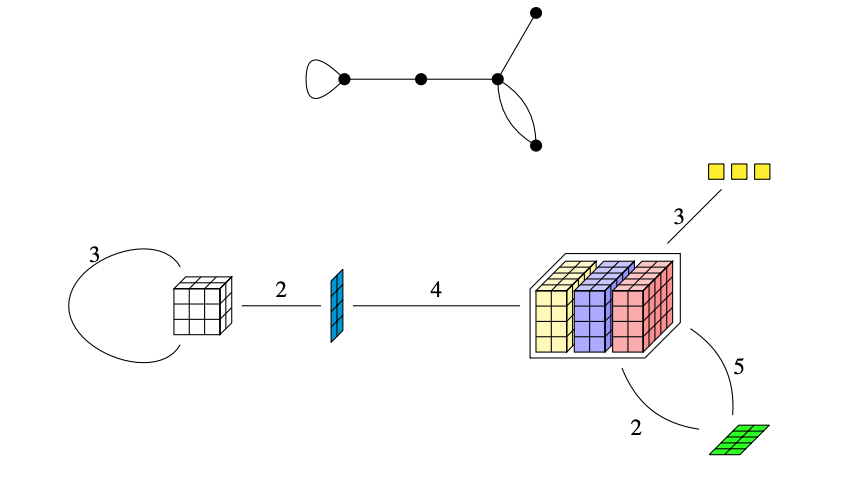
If tensor replace products \(xyz\) then networks replace polynomials

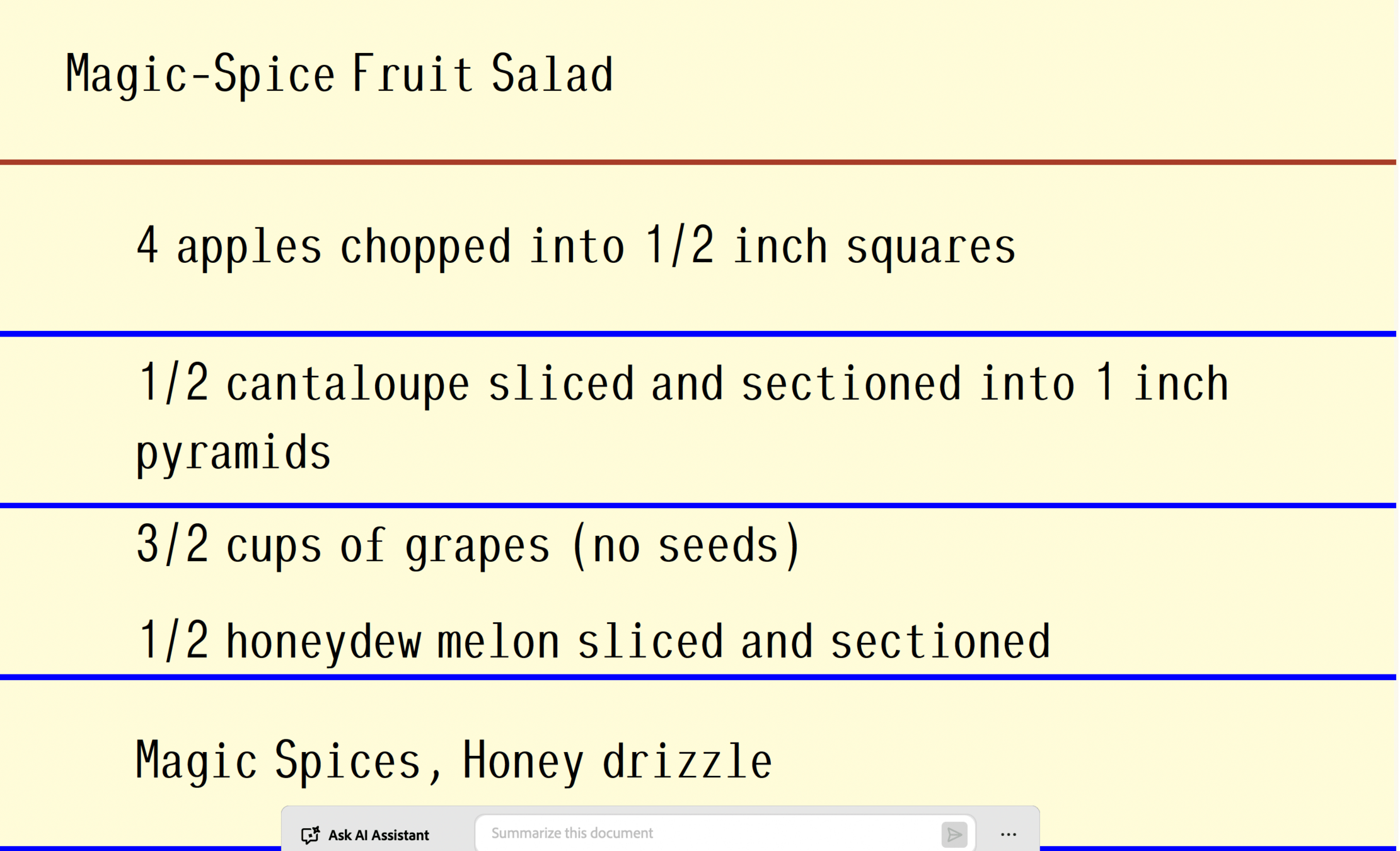
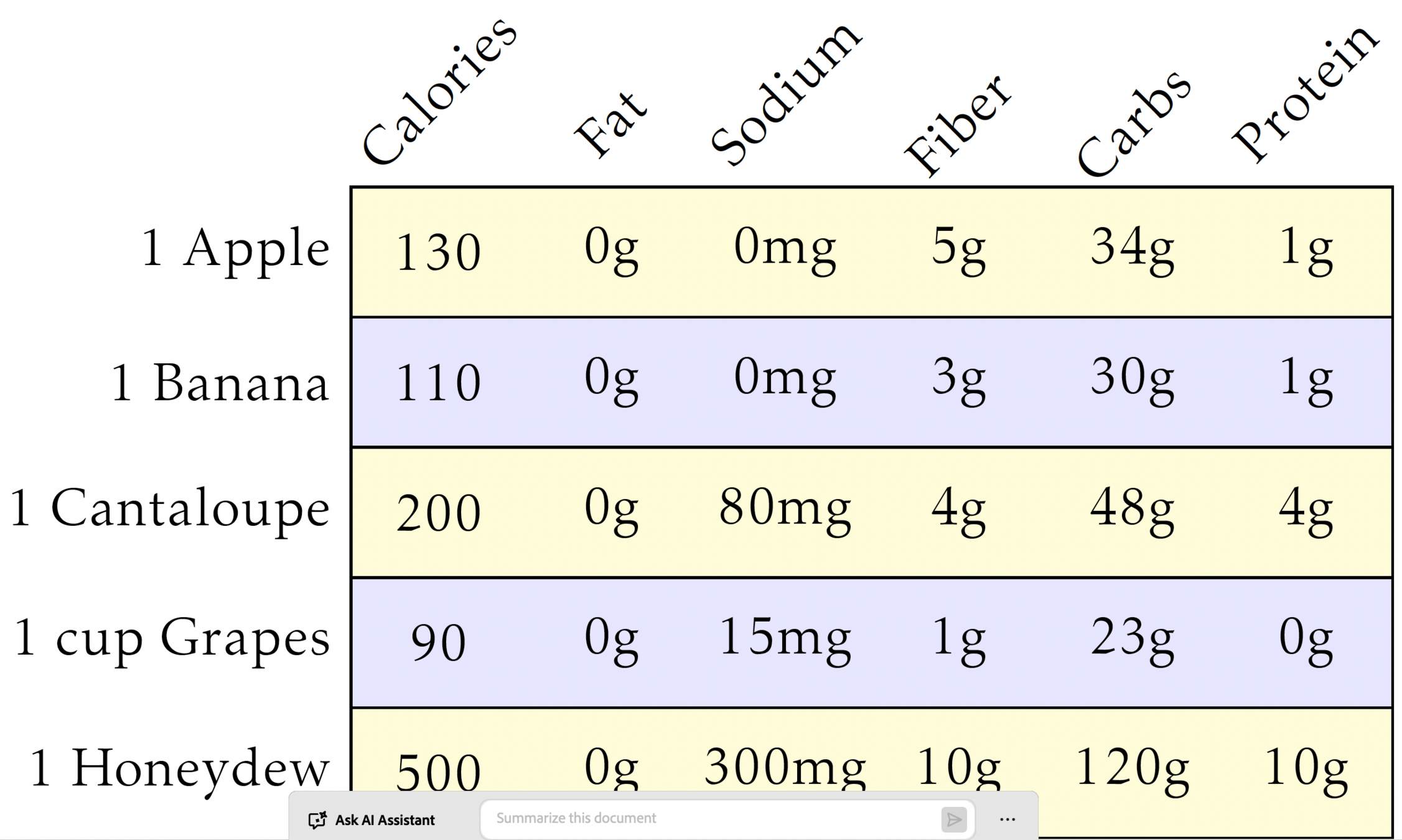
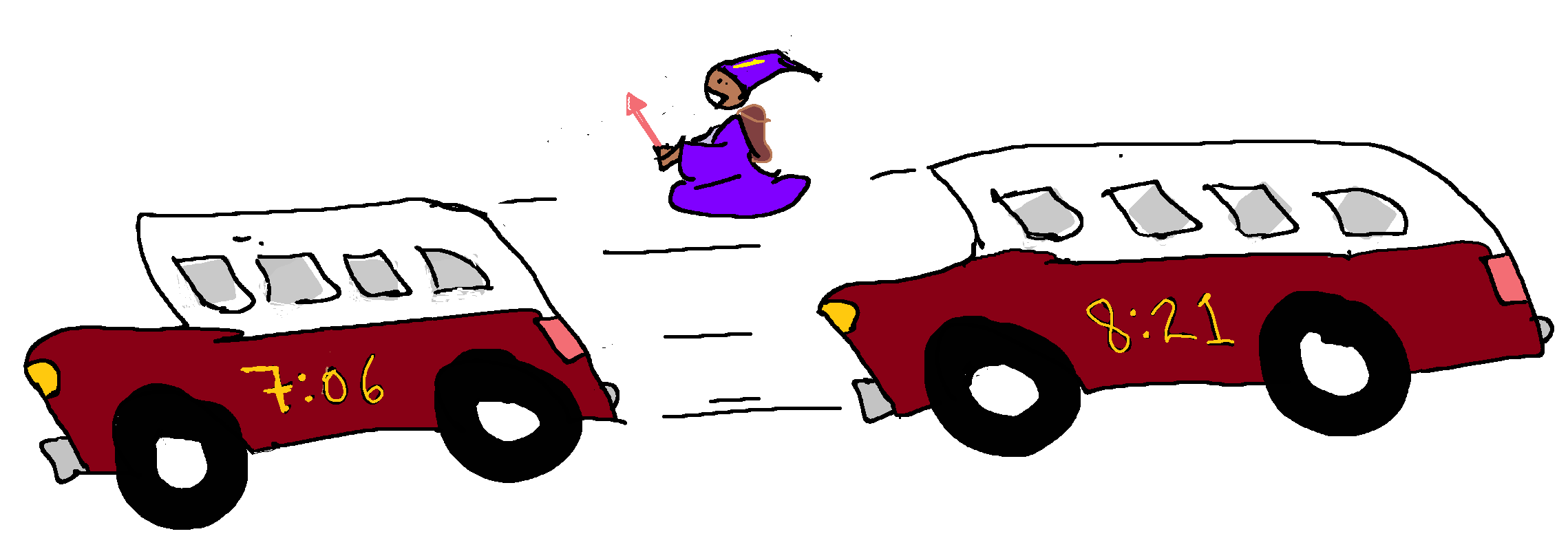
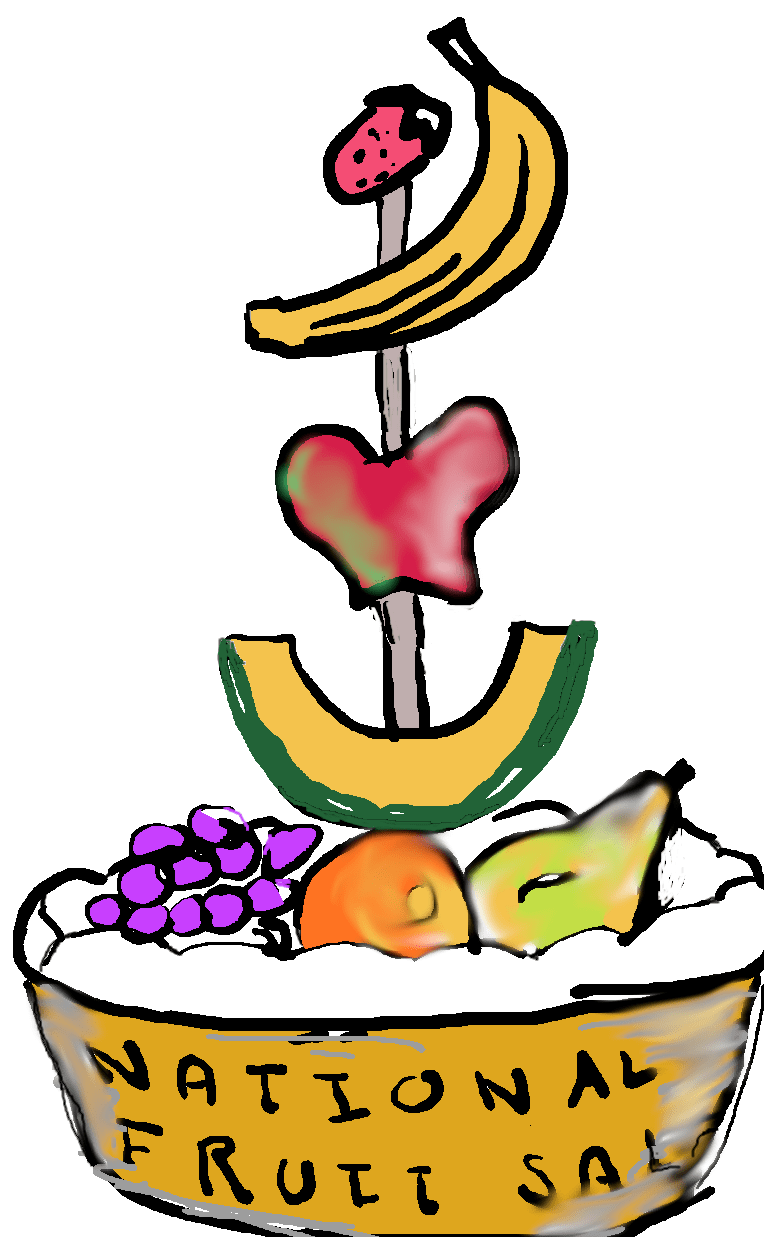
- Goal: Locate nutrition of fruit salad.
- Problem: Data table has no fruit salad row.
Solution: compute the combination of rows specified by the recipe.
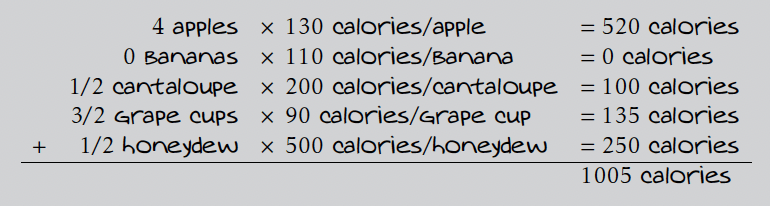
Lewisberg --- Harrisburg
18:00 ---- 20:30
19:00 ---- 21:30
Lewisberg --- Harrisburg
0.5 * 18:00 ---- 20:30
+ 0.5 * 19:00 ---- 21:30
-------------------------------------
18:30 ---- 21:00
- Goal: Arrive in Harrisburg at 21:00
- Problem: Data only has 20:30 and 21:30
Solution: Use the recipe
1/2 of bus 1 and 1/2 bus 2!
Linear data: Information is in the combinations of the table, i.e. data table => Multiplication table
Consequence: You can change coordinates!
Back to Patterns
What are the GAME markets?
Data table --> Multiplication table
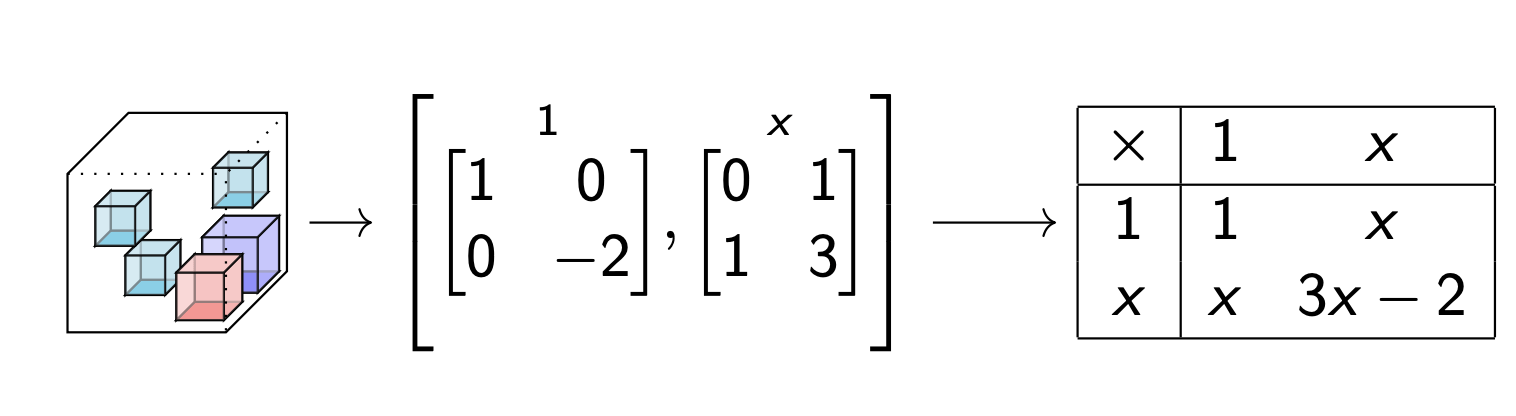
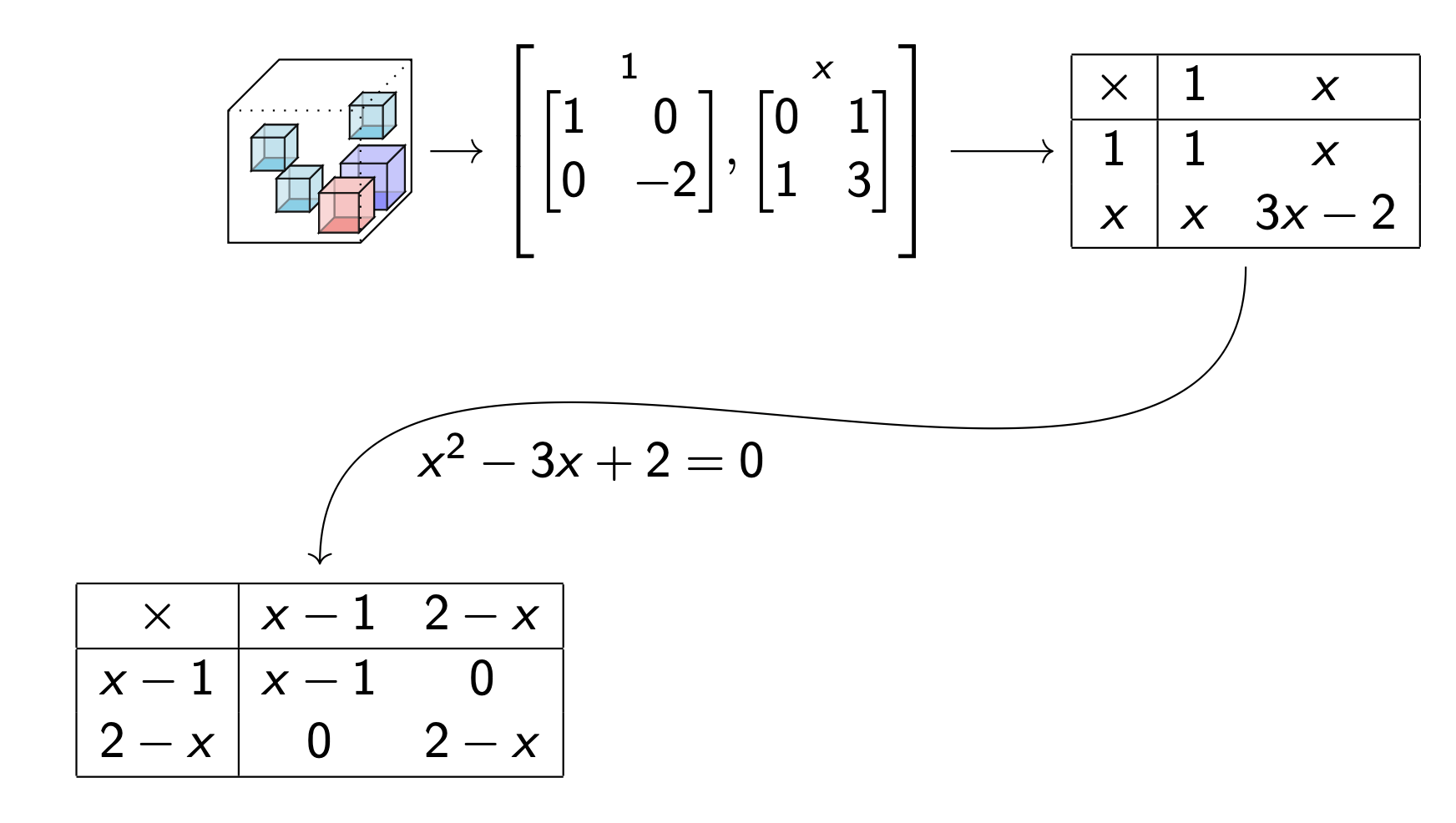
Use algebra to factor
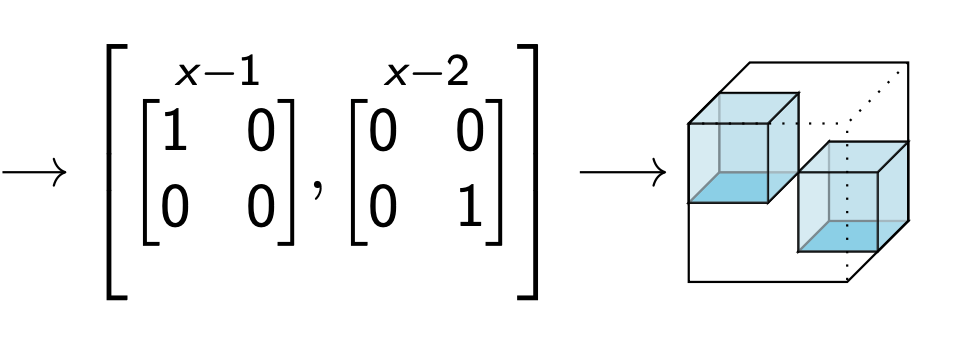
Ok... Now Factor This?
\begin{array}{c|ccc|} * & f_1 & f_2 & f_3 \\
\hline e_1 & 0.2g_1+0.9g_2-0.4g_3 & 0.2g_1+0.9g_2-0.4g_3 & -1.0g_1+0.4g_2-0.1g_3\\
e_1 & -9.1g_1+8.9g_2+0.7g_3 & -2.0g_1+0.1g_2-0.1g_3 & 0.0g_1+1.8g_2-0.4g_3 \\
\hline & & \end{array}
Or this...
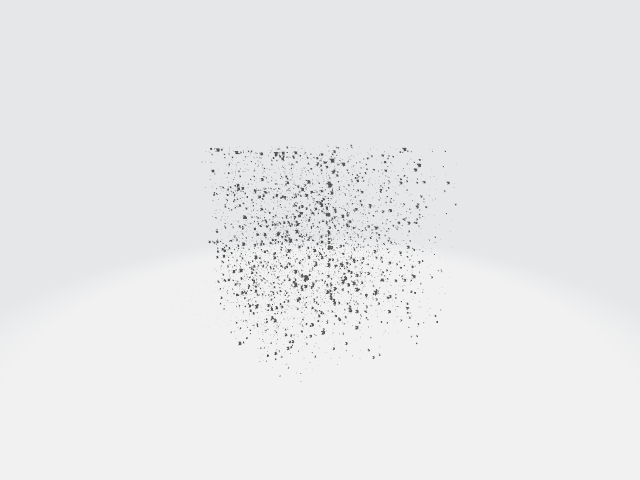
Yes, even movies can be tensors...
Finding Good Algebra in Real Life
How do you study something curved?
How do you study something curved?
With lines tangent to it!
Product Rule:
\[D(x*y)=D(x)*y+x*D(y)\]
We can do this on ANY tensor, and notice D is linear (exponent 1)
The main fact:\[A*B=0\Rightarrow A=0\text{ or } B=0\]
Experts: A is a scalar, B is a vector
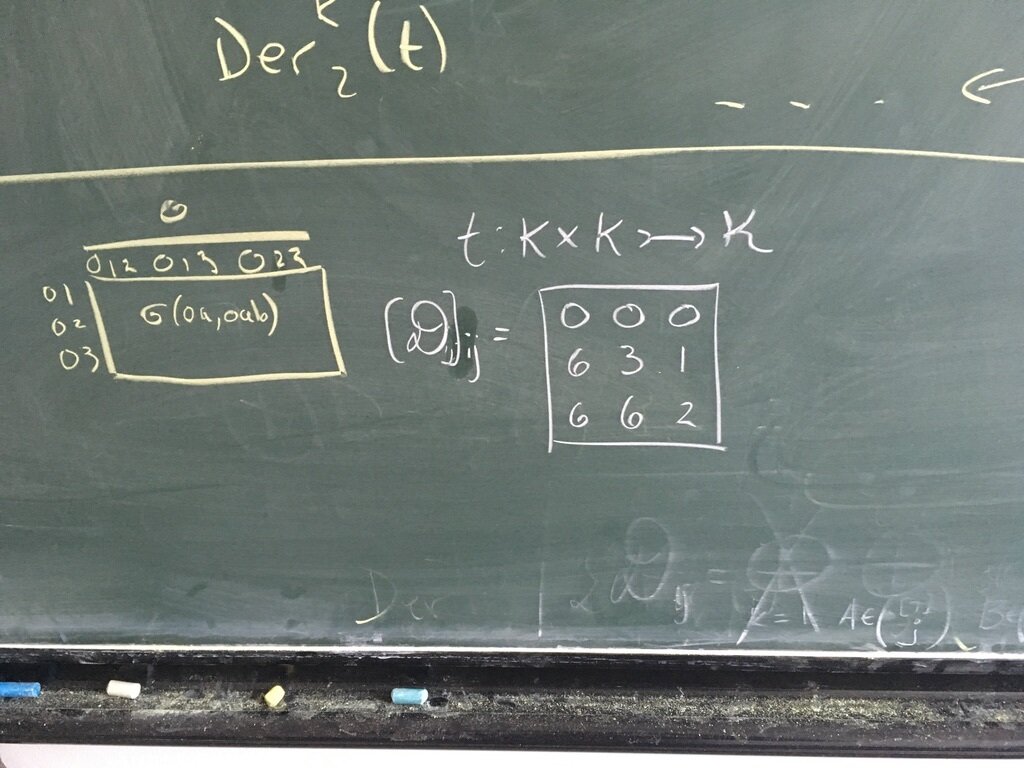
- \(D_0 (x*y) = D_1(x)*y+ x*D_2(y)\)
- \(D_0 (x*y) - D_1(x)*y - x*D_2(y) = 0\)
- \(5 (x*y) - 3x*y +2 x*y = 0\)
- \((5- 3+2)(x*y) = 0\)
- So \(x*y=0\)! I.e. a pattern! \[\begin{array}{c|ccc|} * & \cdots & y & \cdots \\ \hline \vdots & ? & ? & ? \\ x & ? & 0 & ?\\ \vdots & ? & ? & ? \\ \hline \end{array}\]
If \(D_0(x*y)=5(x*y)\), \(D_1(x)=3x\) and \(D_2(y)=-2y\). [True for Eigenvectors]
1
1
2
2
3
4
3
5
6
X Row
Y Col
Z= Page
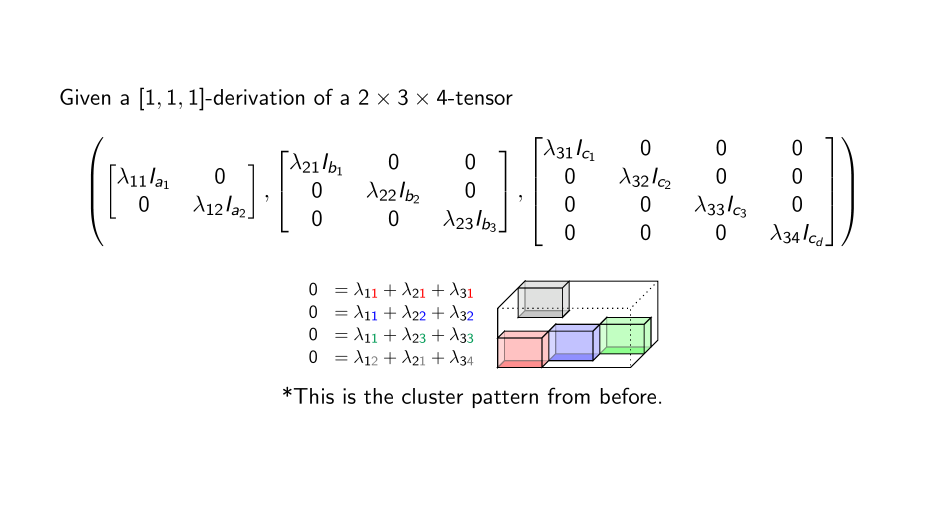
(X,Y,Z) where \[Z(u*v)=(Xu)*v+u*(Yv)\] look for \(z=x+y\)
2= 1 + 1
3= 1 + 2
4= 1 + 3
6= 5 + 1
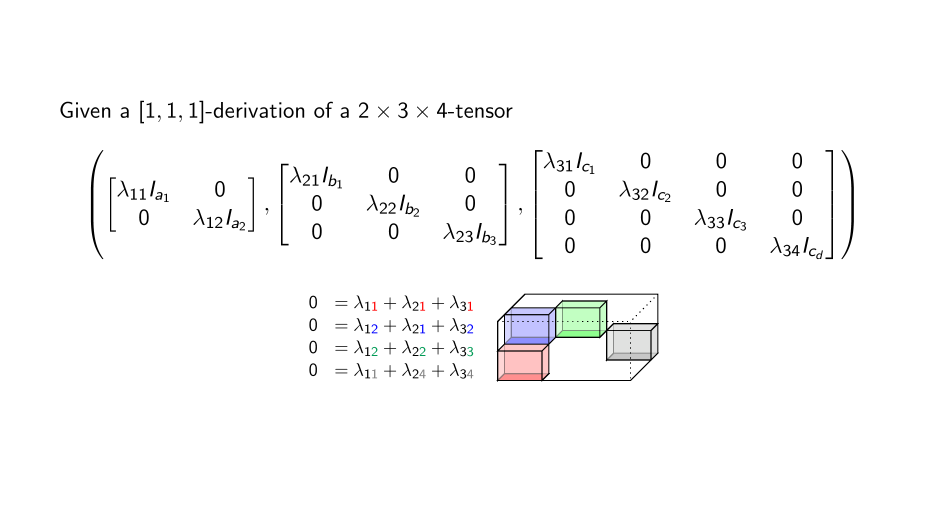
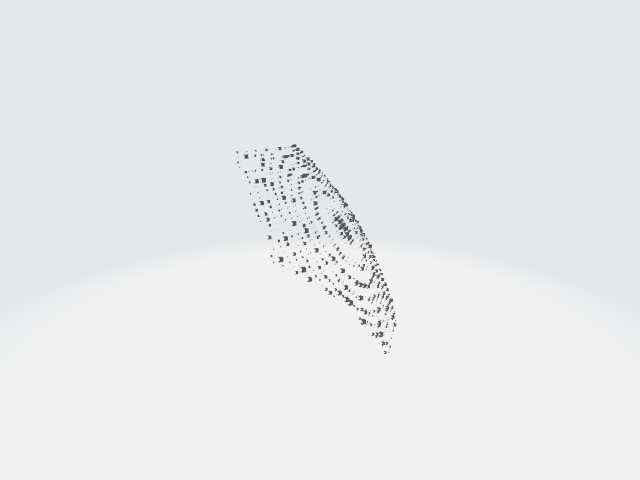
First every universal chisel!
\begin{aligned}
-12 W(\text{Vol}(s,t,u)) & = 4\text{Vol}(Xs, t, u) -2 \text{Vol}(s,Yt, u) + 13\text{Vol}(s,t,Zu)\\
1 W(\text{Vol}(s,t,u)) & = 0\text{Vol}(Xs, t, u) +1 \text{Vol}(z,Yt, u) + 5\text{Vol}(s,t,Zu)\\
\end{aligned}
Generalize!
"Chisels" are selections of equations and constraints on the derivations, e.g.:\[C=\begin{bmatrix} 12 & 4 & -2 & 13\\ -1 & 0 & 1 & 5 \end{bmatrix}\] together with \[A=A^{\dagger}, B=Diag(B), C=D\]
They control what patterns can be discovered.
Theorem. (Brooksbank-Kassabov-W.) Chisels detect cluster patterns in time \(O(n^{2})\).
- Tucker (vector space) chisels \[\begin{bmatrix} 1 & 0 & 0 \end{bmatrix},\begin{bmatrix} 1 & 0 & 0 \\ 0 & 1 & 0 \end{bmatrix},\begin{bmatrix} 1 & 0 & 0 \\ 0 & 1 & 0 \\ 0 & 0 & 1 \end{bmatrix}\]
- Centroids (commutative ring) chisels\[\begin{bmatrix} 1 & 0 & -1 \\ 0 & 1 & -1 \end{bmatrix}\]
- Adjoints (ring with involution) chisels \[\begin{bmatrix} 1 & -1 & 0 \end{bmatrix}\]
- Derivations (Lie algebra) chisels\[\begin{bmatrix} 1 & 1 & -1 \end{bmatrix}\]
- In 4+ valence there \(\infty\) types.
Liu-Maglione-W.
Now \(O(n^{1+1/d})\) on average.
Theorem. Clusters you detect are essentially unique, because of the algebra.
- (Folklore) Tucker (vector space) unique, greedy solve.
- (Eberly-Giesbrecht 1990, W.08) Centroids (commutative ring) have unique patterns.
- (Parker-Norton MeatAxe, 1980's Ronyai, 1990's) (W.08, Maehara-Murota 10) Adjoints (ring with involution) have conjugate patterns.
- (BKW 2020's) Derivations (Lie algebra) unique over \(\mathbb{C}\)
REPORDUCIBLE
Is it useful?
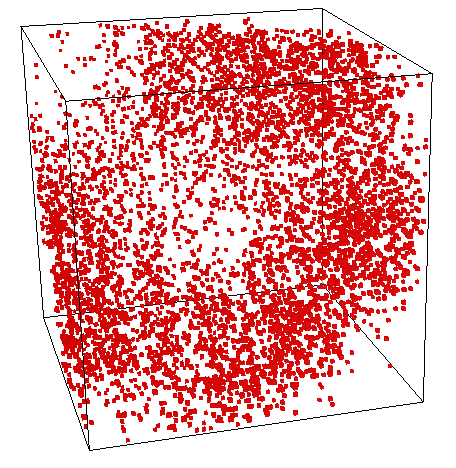
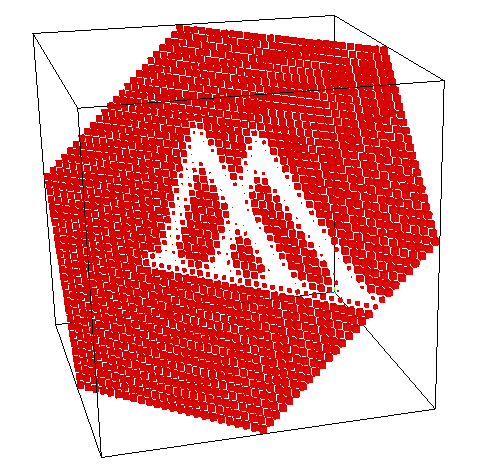
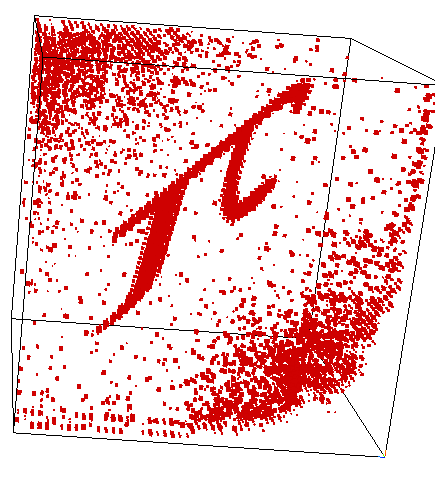
"Random" Basis Change
Blind source separation
Oulier Detection
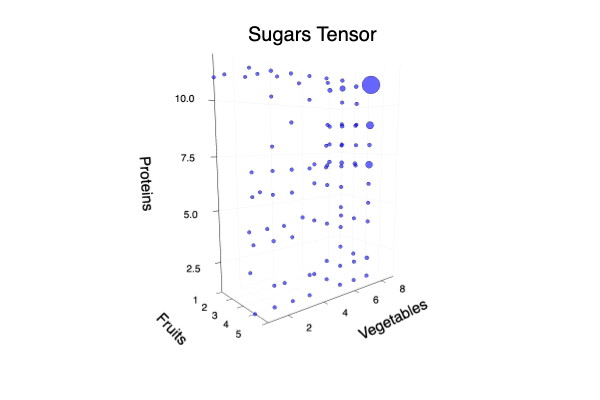
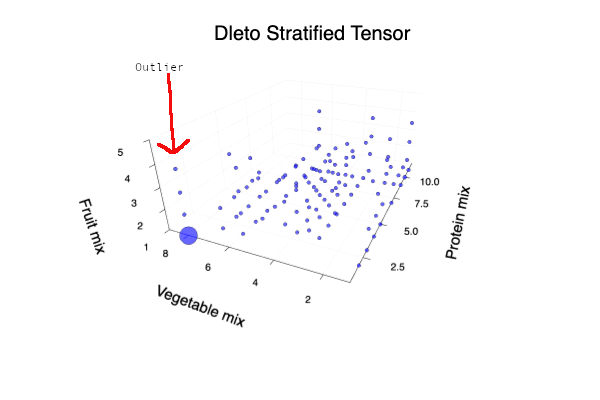
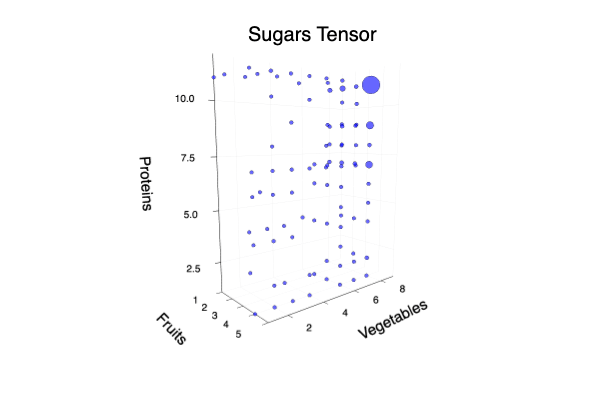
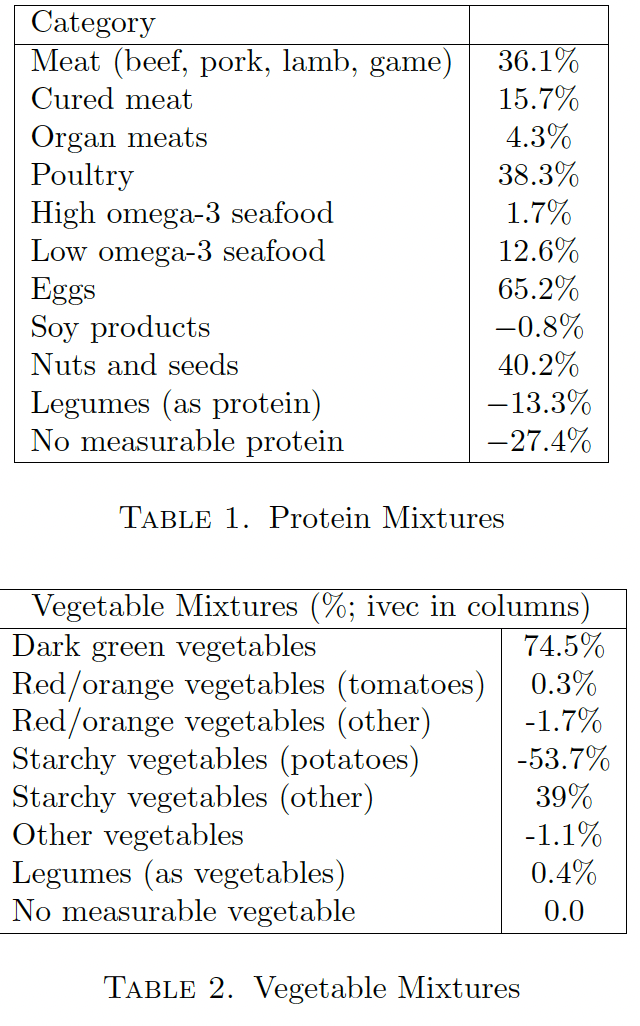
USDA Study "What We Eat in America" (add sugars data) .
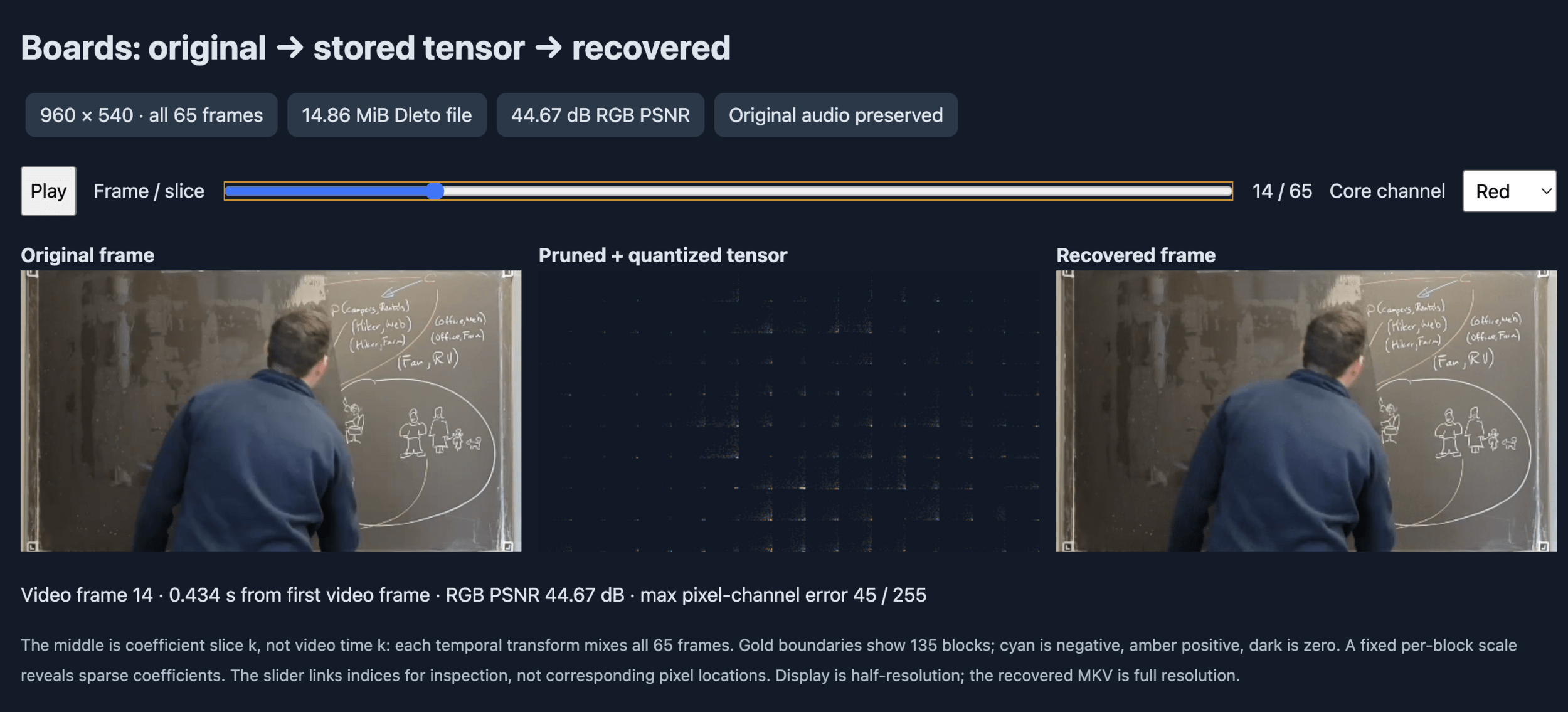
Compression? THeory says yes, Quality works, beats HOSVD, DCT, but Still Tied or worse than HEVC
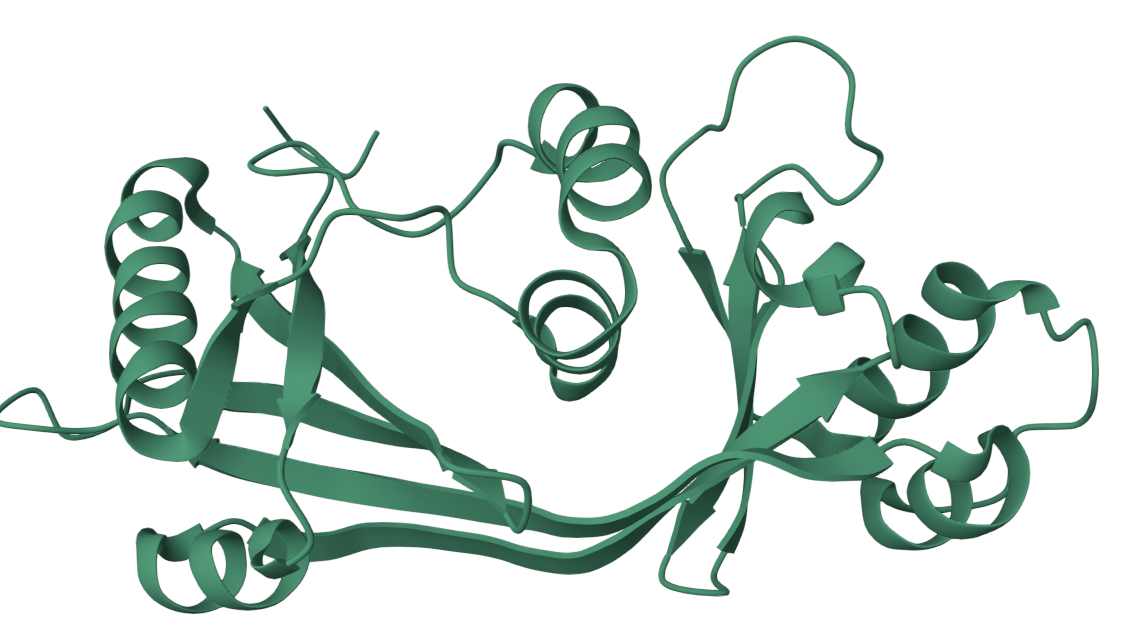
mouse thiamine triphosphatase
Video CompressionNew Theory
Bucknell's Uses?
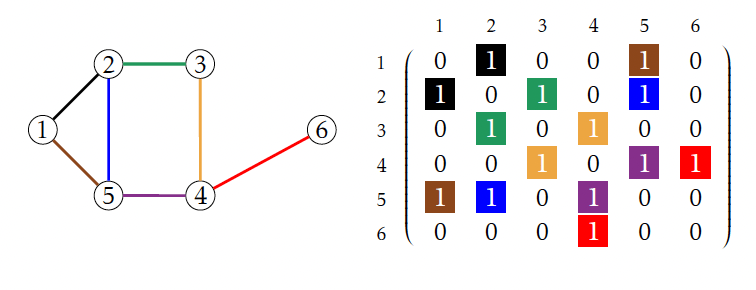
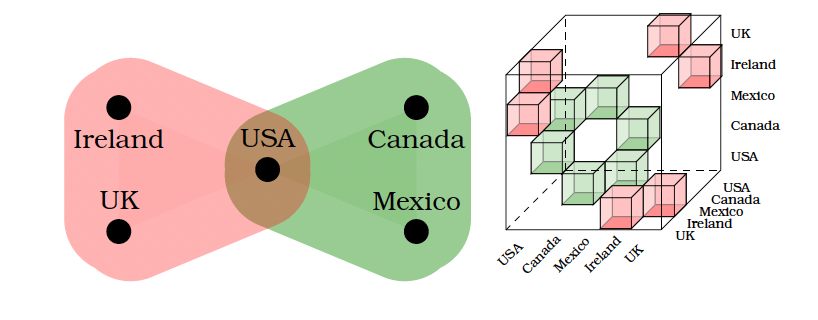
Some data ain't linear
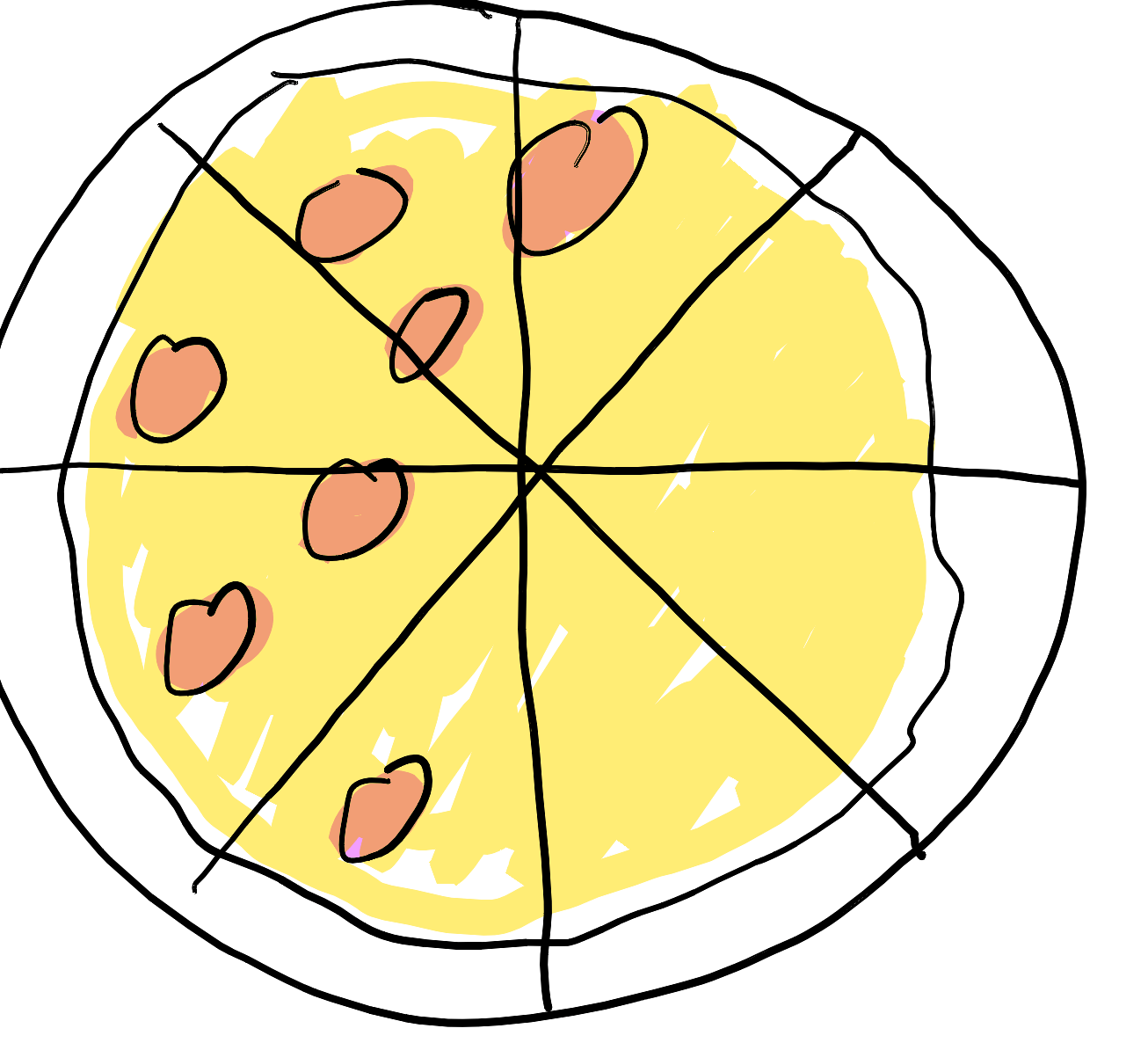
One day a pizza arrived at Lineum's home. Half cheese, half pepperoni! Yumm!!
Somewhere into his 5th slice, Matica sent Lineum a message:
Send me a picture of the pizza I ordered so I can make sure it was made right!
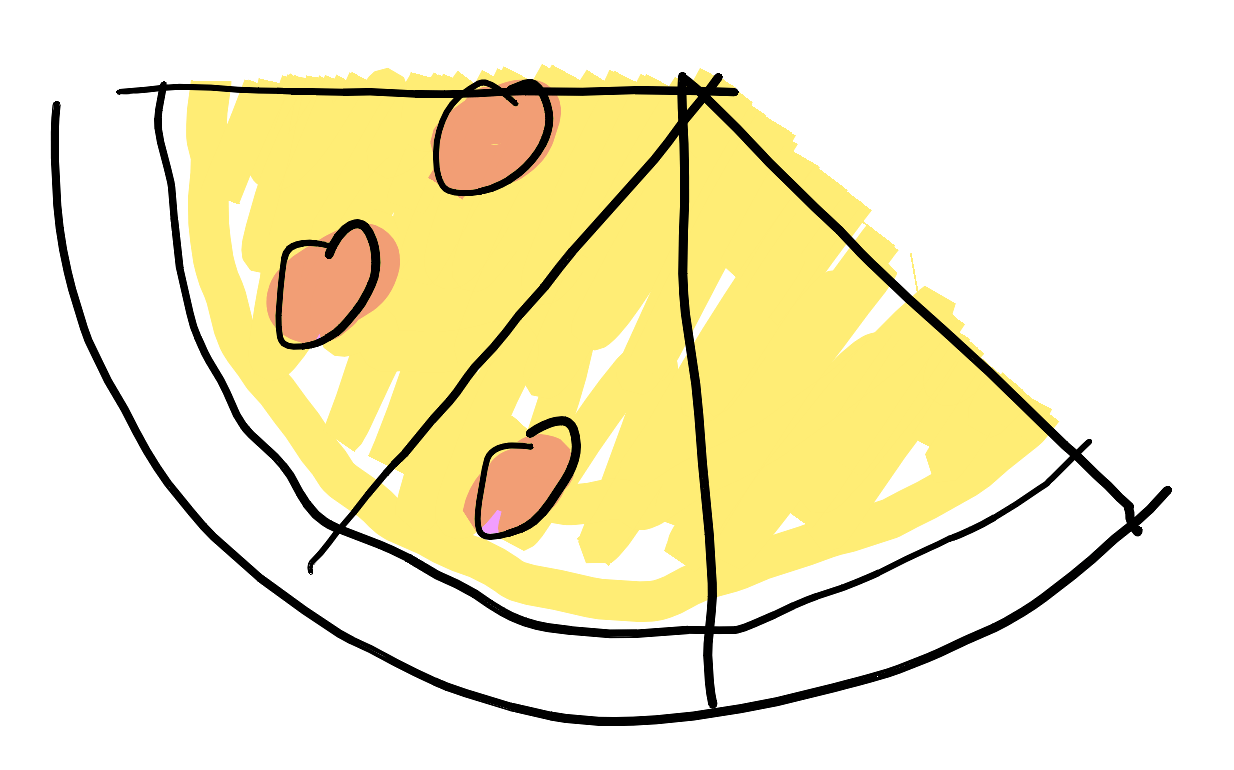
Panicked, Lineum stared at the pieces left then hatched a plan. He took a photo and then cut-and-pasted the pieces to make a whole pie and sent it to Matica.
Moral: Some ways to cut up data have a remarkable amount of similarities to the whole.
How had she known he'd already started eating it?!
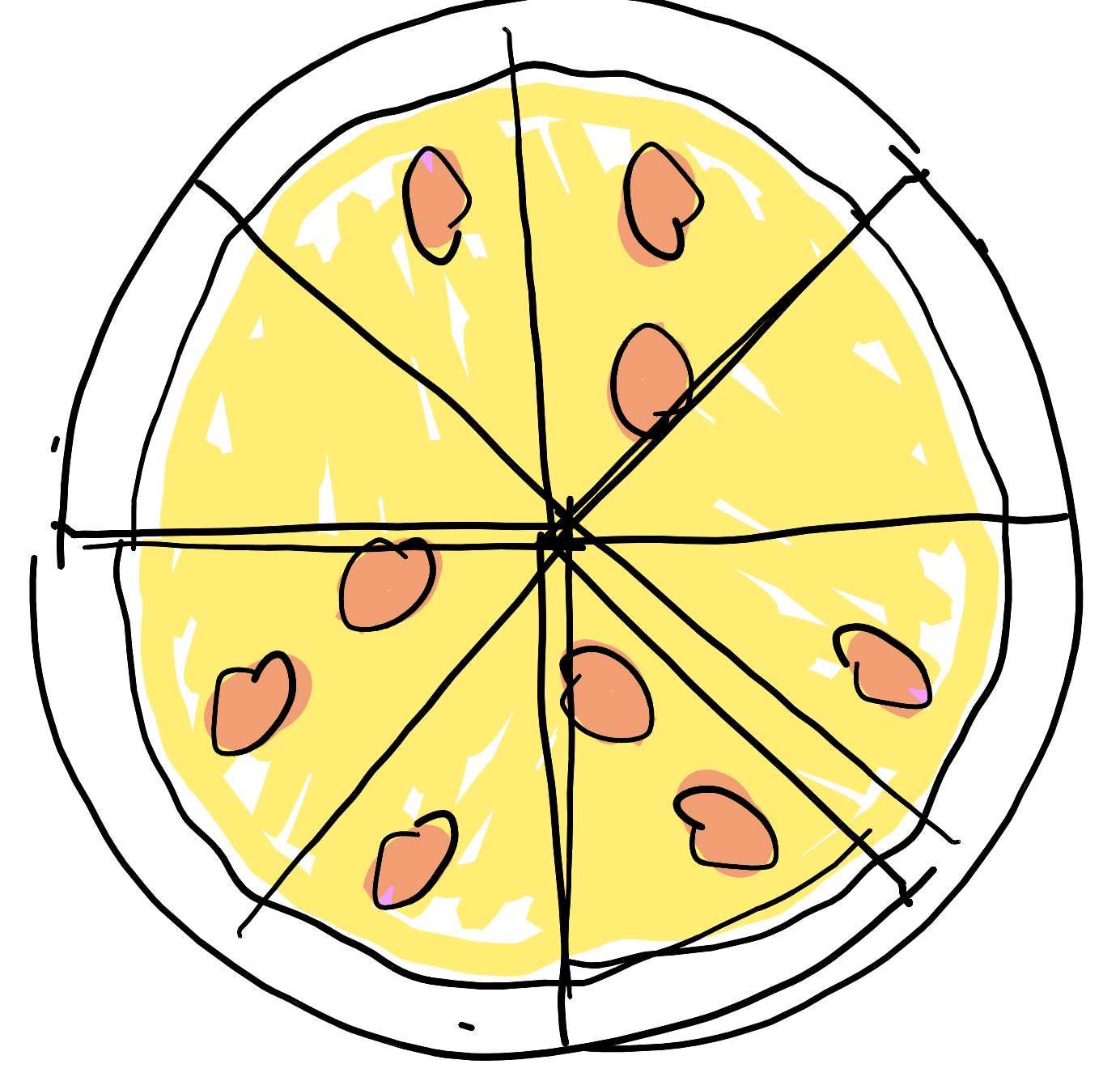
Great! Glad you liked it, but save me the rest!
Spectural Data: The information is the Geometry between the vectors, "Inner (Dot) products"
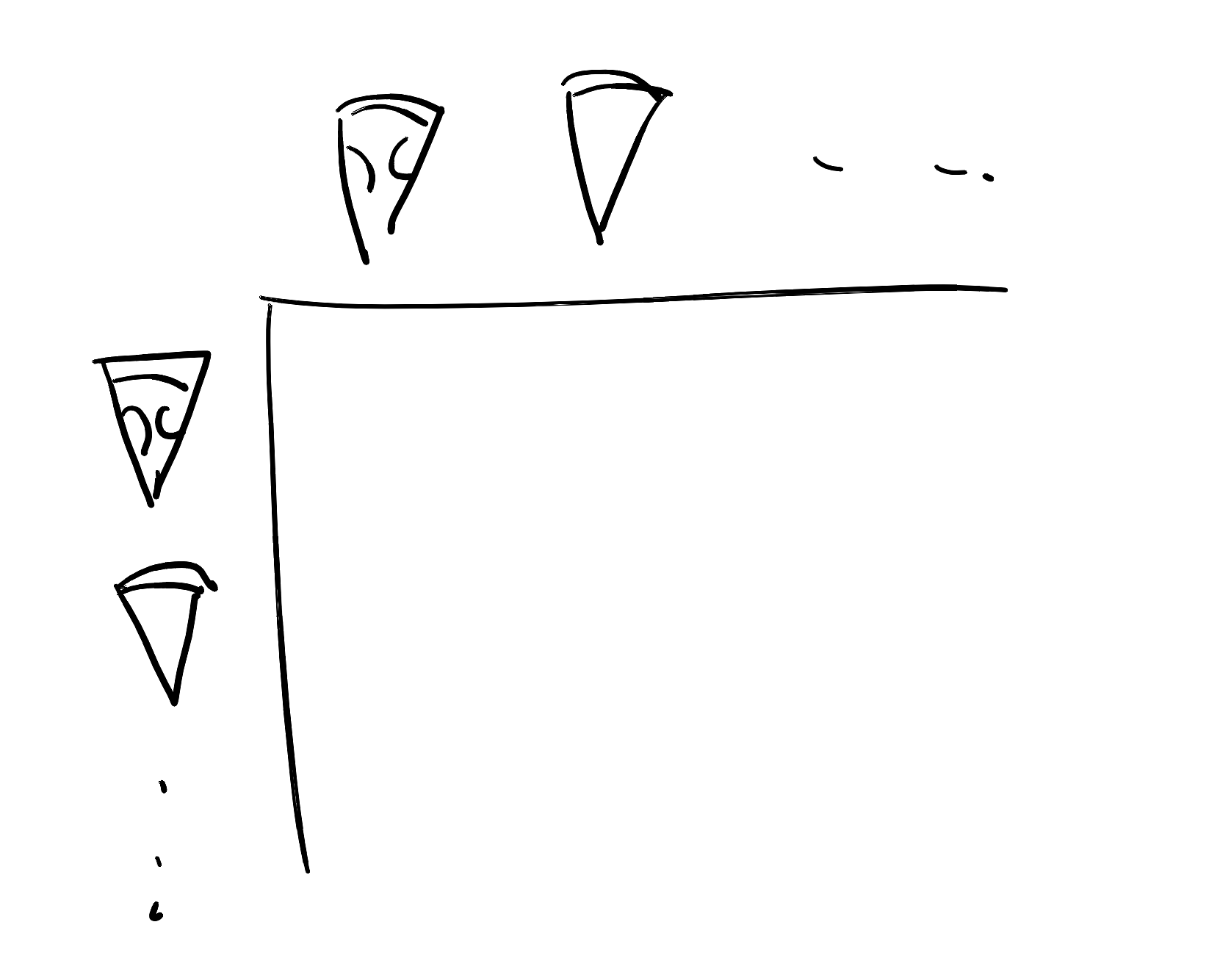
Captured by
\[\langle u,v\rangle = u_1v_1+\cdots +u_n v_n\] and with matrices as
\[M^{\top} M\]
etc.
See prof. Pete Brooksbank
Chisels work on spectral data!
Forget about looks; deeper structure
Mouse thiamine triphosphatase : pdb_00002jmu https://www.rcsb.org/3d-view/2JMU
Nuclear Magnetic Resonance NMR:
-
put some goo in a jar surrounded by magnets.
-
Turn on the radio.
-
Watch it dance.
-
Decide what your protein molecule looks like.


Mouse thiamine triphosphatase : pdb_00002jmu https://www.rcsb.org/3d-view/2JMU
NMR Tensor?
(Experts: I don't know any better! Teach me!)
-
Watch magnetic changes under pulses that excite Hydrogen, Nitrogen, Carbonyl gives 3 axes.
-
Look for coordinates in wave space to identify what "tugs" on what, i.e. is the hydrogen attached to the nitrogen or the Carbon, etc.
-
Peaks in the wave frequency are the key.
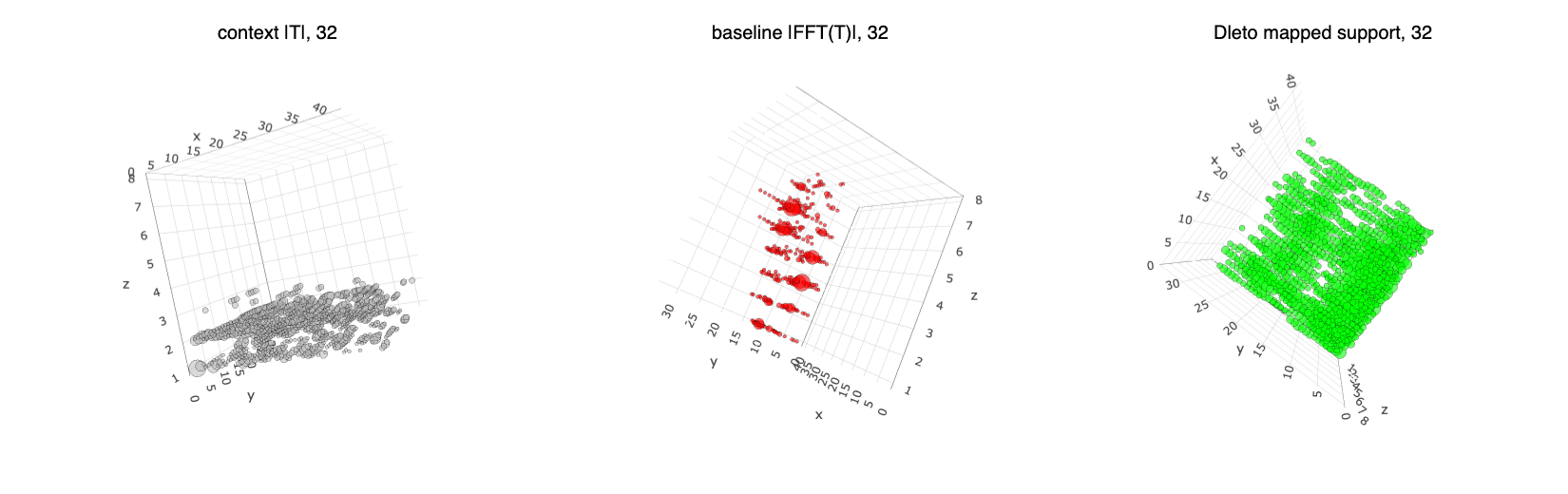
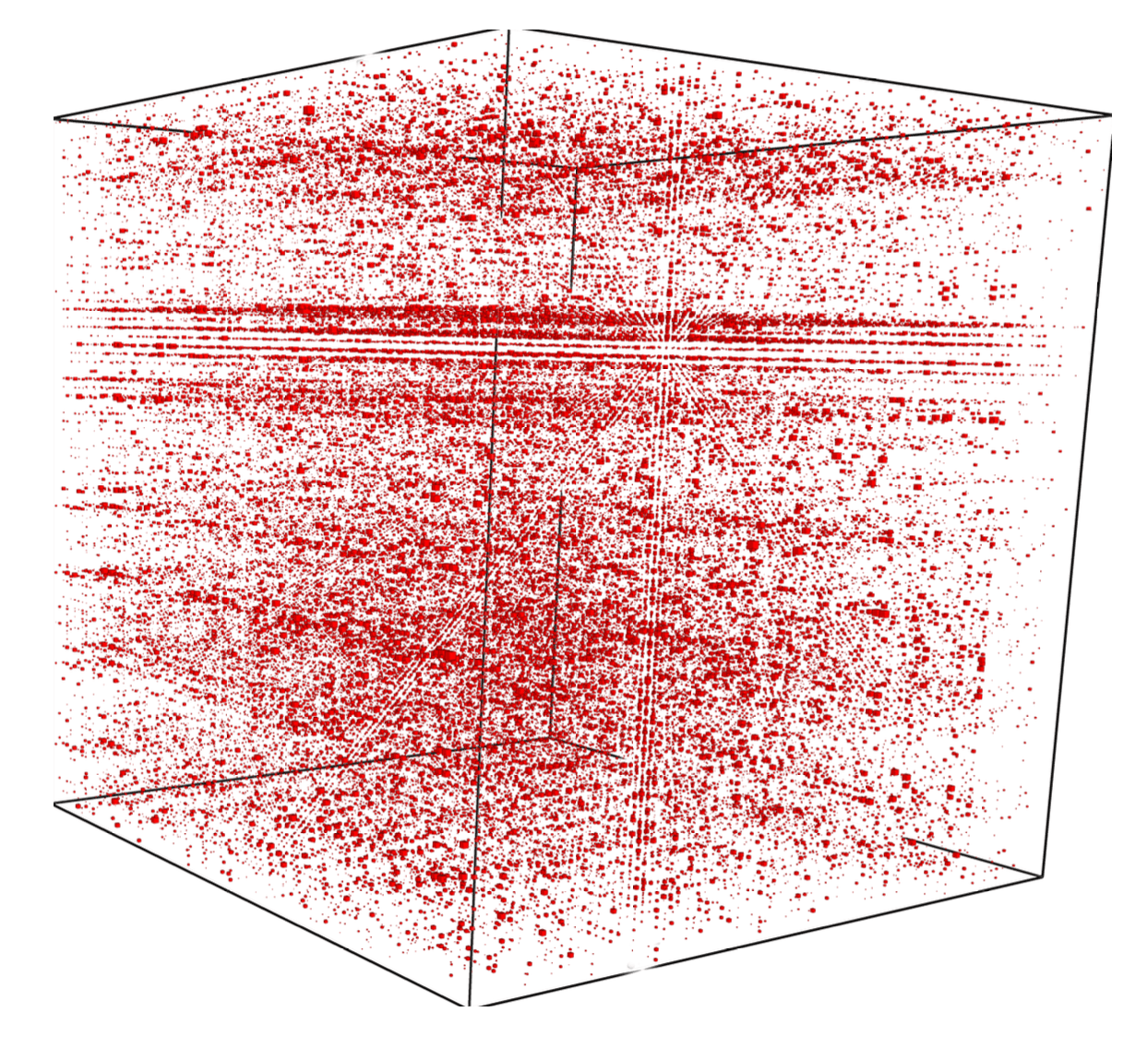
To the eye, the FFT looks far more organized than Dleto (not always the case just this example)
Look with instruments; Dleto is actually quite systematic.
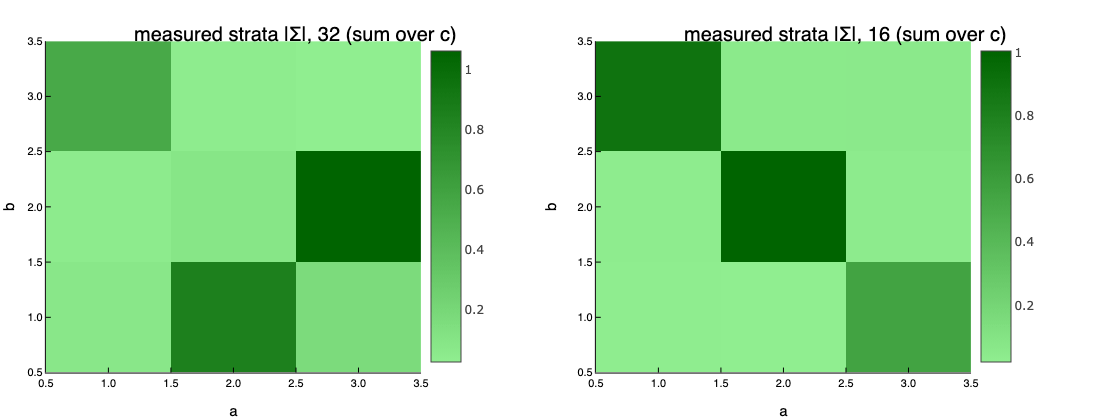
Molecule shape tracks with how atoms move.
More Peaks = More structure (more dots to connect)
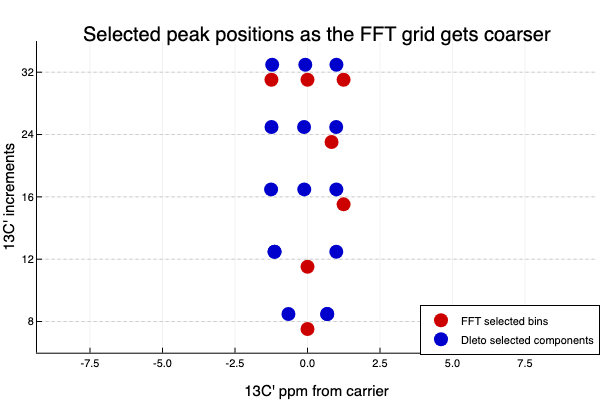
-
FFT needs more measurements to find all 3 peaks.
-
Chiseling can retain statistically significant with data 1/2 to even 1/8 the data of the FFT.
-
Twice as fast means...
-
Half price.
-
More scans.
-
Finer features at same price.
-
Why?
-
FFT assumes frequency bins like keys on a piano.
-
Need more frequencies? Build a bigger piano.


- Chiseling scans the data you have and decides what bins to make.
- It's tuning your instrument for the music instead of building a bigger one.

When Data tables => Multiplication Tables
Cluster patterns => algebra
=> Reproducible Algorithms
Summary
Talks, Articles, and Books
PleaseDistribute.Org
Software:
TheTensor.Space (links to GitHub projects)
Tell me what I need to learn: James.Wilson@ColoState.Edu
Data-Algebra
By James Wilson