Narrative Inquiry:
Ontario College Degree Programs
EDUC 5203G - Dynamics of Change
Agenda
- Reasons for this Inquiry
- Ties to Course Themes
- Narrative Inquiry
- Relevant Literature
- Application and Barriers
- Discussion Questions
- Feedback
- References
Reasons for this Inquiry
What Change is Happening?
- As of the year 2000, Ontario's Colleges were granted the ability to award baccalaureate degrees (Panacci, 2014).
- Collins (2002), Skolnik (2016) and others have discussed credential inflation.
- Durham College was among the last to offer a baccalaureate degree program, which is being offered starting for the 2018-2019 academic year (Durham College, 2017).
- This arguably creates debate around the role of universities and colleges in Ontario (Skolnik, 2016).
Why Does This Matter to Me?
- I'm an employee of Durham College, where this not-so-new change still feels new!
- It is hard to avoid conversation about this with colleagues recently.
- We feel the change around us.
- Less personally, Durham College is an interesting case study for discussing this change as it shares a campus with the recently founded University of Ontario Institute of Technology (UOIT), so degree options were always relatively available.

Ties to Course Themes
Close Ties
- Change Concepts and Theories (Week 2-3)
- Educational Change and Culture (Week 4)
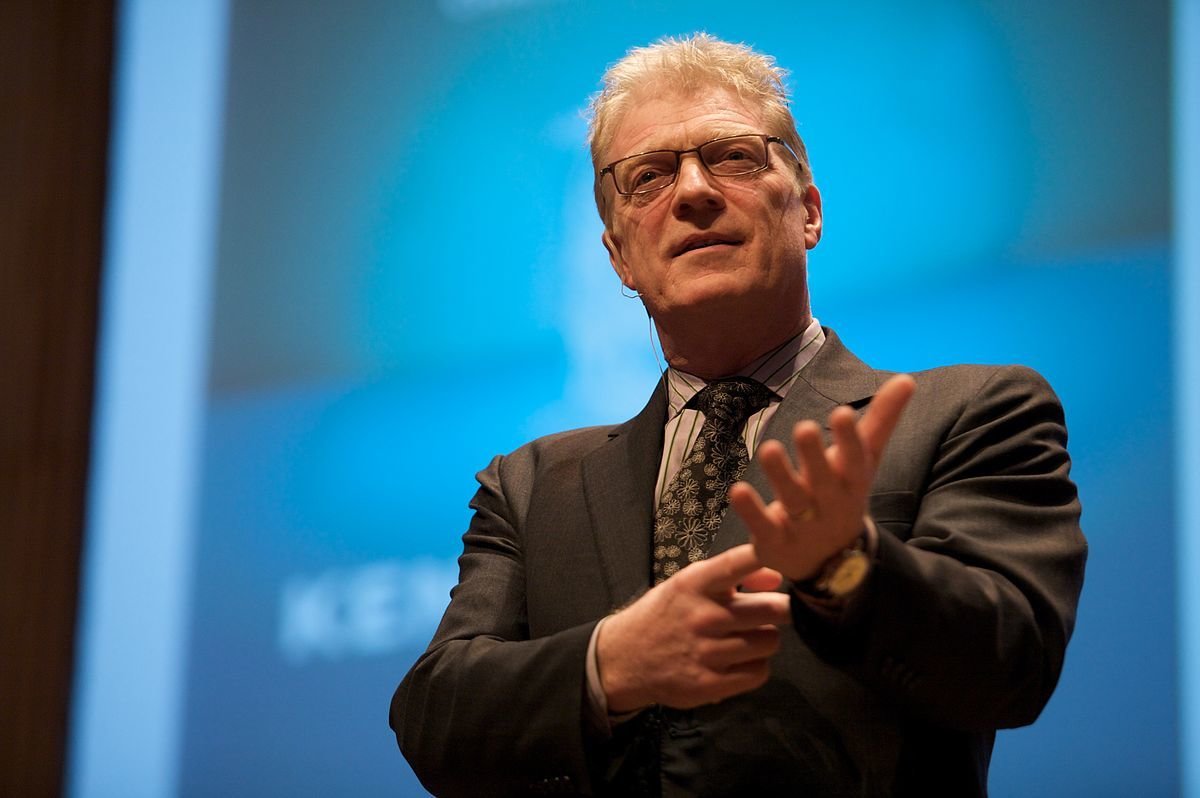
Ken Robinson at the Creative Company Conference, Amsterdam in 2009.
Photo by Sebastiaan ter Burg via WikiMedia Commons.
Moderate Tie-In
- Change Disruptors and Resistance (Week 6)
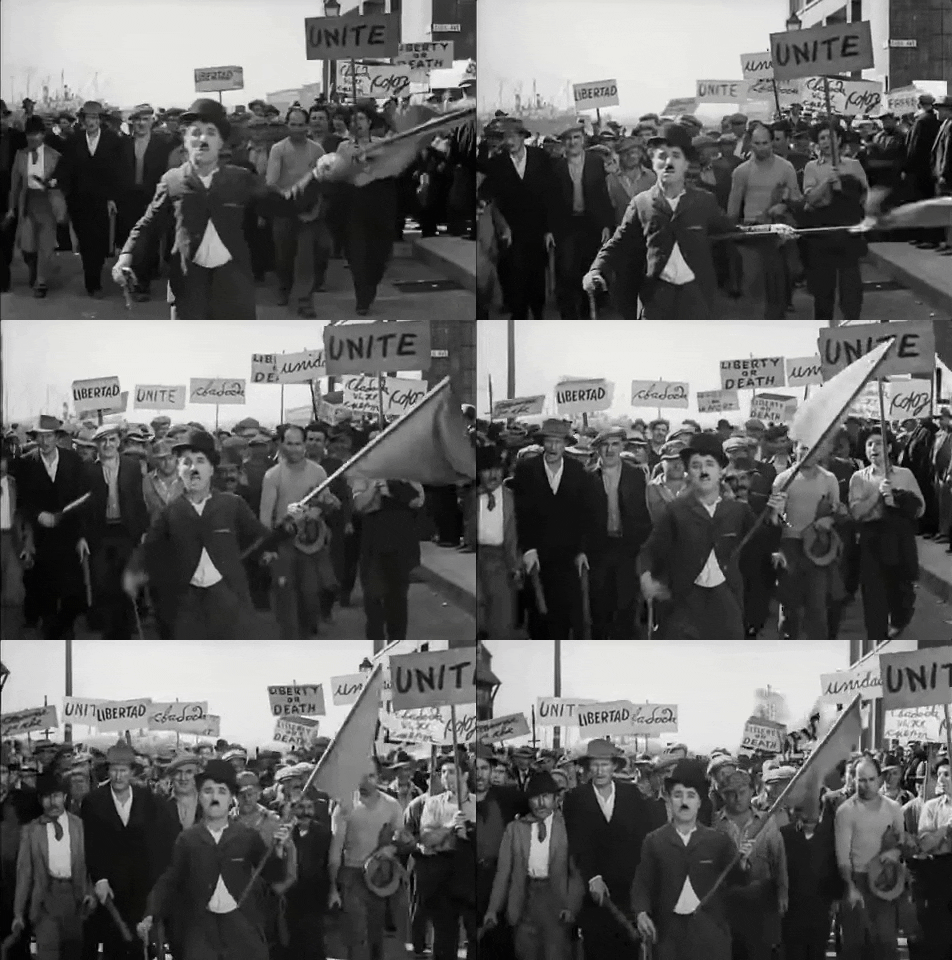
Little or No Tie-In
- Material and Structual Change: Globalization, Technology and Rationalization (Week 5)
- Characteristics of Change Leaders and Professional Learning (Week 7)

Narrative Inquiry
The Nature of Narrative Inquiry
- Narrative inquiry has been defined as a research methodology by Connelly and Clandinin (2006) to formalize the process of using the lived experience of individuals and groups immersed in a situation to describe feelings and relationships.
- As I said, colleagues are frequently discussing the new degree programs and the change has been described as a feeling. This seemed like a suitable fit.
"Loose" Narrative Inquiry
- Many discussions were had over months, but not always thoroughly documented.
- The timing of this body of work in a busy (for me) and generally sparse (for most) Spring/Summer semester created some barriers.
- When it came to documented conversations, people in the Durham College community didn't want to be named! (Fear of misinterpretation and consequent reprisal from administration!)
- Thus, the actual narrative has limitations; I present most of it here in general terms.

Note that this man is still fairly recognizable but he was not actually consulted for this study.
Narrative Inquiry Plan
- Besides occasional conversations with friends and colleagues in my office or in the hallway, I intentionally met with four people involved in the Durham College / UOIT community with interview-style questions.
- Bigby: Current DC support staff, former DC/UOIT shared support staff, UOIT alumni, PT DC faculty
- A: Current DC support staff, former DC/UOIT shared support staff, PT DC faculty
- L: Current UOIT support staff, former DC/UOIT shared support staff
- Muggleton: Current DC/UOIT shared support staff, occasional PT DC faculty
On the Relationship Between DC and UOIT
- When I asked each of my four subjects about the reasons for DC / UOIT coexisting, they mostly discussed marketing. Some mentioned cost savings from shared services and only "A" mentioned the 2003 "double cohort" year.
- All parties discussed services being shared and gradually, things like tutoring services, career services, and accessibility services all separated.
- Subjects generally thought things were positive. "A" said it varies depending on the mindset of the UOIT president.
On Whether College Degrees Are A Good Thing
- "Bigby" said he felt the degrees blurred the roles.
- "A" said she thinks Durham College is just trying to keep up, with no other reason for doing this, but also saying this is going to confuse students.
- "L" expressed feeling neutral but seeing no harm.
When asked why they think this is happening, only "A" had any insight, saying it's a matter of keeping pace with the rest of the system.
On "Humberization"
- In my narrative proposal, I discussed apparent change since Durham College had Dr. Elaine Popp join as Vice President, Academic in mid-2015.
- Dr. Popp comes from Humber College, and a fairly high proportion of administration hiring has been from Humber College and other institutions outside of Durham since 2015.
- Colloquially among faculty, I have heard this referred to as "Humberization".
- Asked about the term, only "Bigby" had heard it before, defining it as "a shift in process to one that resembles 'how things are/were done at Humber',", adding that it is unclear whether the changes are based on merit.
On Hiring Changes
- All participants had different commentary on changes in hiring practices, including "Bigby" mentioning HR automation and increased external hires and "L" mentioning increased contract positions and credential inflation.
- I was expecting credential inflation to be a bigger recurring theme - particularly for faculty - but it wasn't.
- "L" said, "If you don't have a degree it is highly unlikely that the college will hire or promote an employee which I believe is hypocritical."
- There is unusual / changing treatment of part-timers / contract workers.
On Ontario Advanced Diplomas
- Having heard so much from internal career professionals about the value of our three-year diplomas, I was surprised to hear everyone I spoke to say these were almost definitively on their way out.
- "Bigby" and "A" stated that employers don't know the difference.
- "L" implied that she doesn't know the difference.
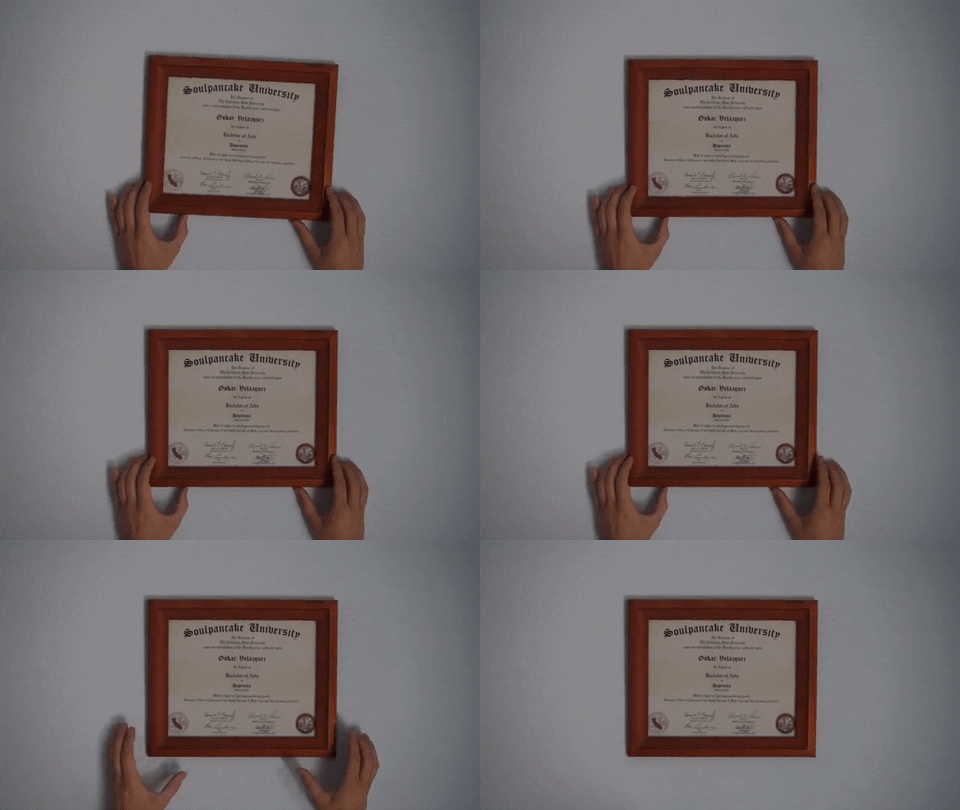
- With college degrees, my colleagues express there is little or no value in three-year diplomas.
Relevant Literature
About the Relevant Literature
- There is a wealth of literature to compare as post-secondary systems vary dramatically by region.
- I was not able to learn everything I originally wanted to this semester, including thorough examination of systems in Australia and Quebec.
- There was a lot of reading but a subset has been selected for this part of the presentation; this is not a comprehensive literature review.
Credential Inflation and the Future of Universities
- AUTHOR: Collins, R.
- YEAR: 2002
- SYNOPSIS: This article is a discussion and explanation of credential inflation and some theorizing about what it means for the future of formal education. Given that the paper was written in 2002, it includes some interesting predictions that seem very close to the present state of education.
- RELEVANCE: Community college degrees are not expressly discussed here, but if degrees are increasingly required for work, it makes sense that they must be more readily available. Thus, higher degrees - "PhDs for janitors" (p. 235) - would most likely come to be offered in existing research institutions while baccalaureate degrees should be available in a community college.
Baccalaureate Degrees at Ontario Colleges: Issues and Implications
- AUTHOR: Panacci, A. G.
- YEAR: 2014
- SYNOPSIS: Panacci discusses a number of issues related to baccalaureate degrees offered in Ontario colleges, including concern about the proposal to introduce three-year applied degrees since this would render Ontario's three-year advanced diplomas redundant. This article also presented many statistics about enrolment.
- RELEVANCE: In terms of my narrative inquiry, there has been discussion of whether three-year Ontario advanced diplomas have a future, and this article certainly casts further doubt on that.
The Work of Michael Skolnik
- Michael Skolnik of OISE has published a great deal about changes to Ontario's college system since 2005.
- Three of his articles were of particular value and one was the subject of my critical analysis.

Michael Skolnik
from https://www.oise.utoronto.ca/hec/Higher_Education_Policy_Symposiums/Ontario_Policy_Research_Symposium/Speaker_Bios.html
Origin of Ontario College Bachelor Degrees
- AUTHOR: Skolnik, M.
- YEAR: 2016
- SYNOPSIS: This short, independent paper was a very quick introduction to the history of Ontario's colleges offering baccalaureate degrees and generally described the history of this decision.
- RELEVANCE: A great first step toward finding relevant literature for my narrative inquiry, with ties to other work. For example, Skolnik (2016) writes, "One of the Harris Government’s major goals was to make the province more economically competitive in the global arena (Courchene & Telmer, 1998, cited in Young, 2002), and it believed that greater reliance on market forces within the higher education sector would contribute to that end (Young, 2002)." (p. 3). Tying this into Skolnik (2008) there's a suggestion that this allows market forces (i.e. corporations) to better influence degree program offerings.
Theorizing About the Emergence of the Community College Baccalaureate
- AUTHOR: Skolnik, M.
- YEAR: 2008
- SYNOPSIS: Skolnik looks at sets of theoretical frameworks explaining the vocationalization of community colleges in the United States as described by Brint and Karabel (1989) and Dougherty (1994) to explain the emergence of Ontario's college degrees.
- RELEVANCE: In the United States, community colleges were not originally intended to be vocation-specific, and these frameworks were used to explain that change. In Ontario, nearly the opposite seems to be happening!
Re-conceptualizing the Relationship Between Community Colleges and Universities Using a Conceptual Framework Drawn from the Study of Jurisdictional Conflict Between Professions
- AUTHOR: Skolnik, M.
- YEAR: 2011
- SYNOPSIS: This article closely looks at the conflict between universities and colleges in the United States and Canada where community colleges have started offering degrees and uses a framework to examine the relationship.
- RELEVANCE: In Ontario, I had not been particularly aware of conflict when colleges were given the ability to grant degrees. Resistance is indeed something to be examined, though, since this decision arguably conflicts with the mission of Ontario's colleges.
Application and Barriers
The Future of Program Offerings At Durham College
- Factoring in my narrative inquiry discussion about three-year Ontario advanced diplomas and "Humberization" as well as Skolnik and Panacci's views on the future of diplomas, it seems very likely that three-year advanced diplomas are reasonably likely to end.
- In many cases, we can anticipate them being replaced by degree programs.
- This jives well with conversations I've had with other colleagues and other rumors I've heard.
- This change is most likely part of the vision of upper administration, kept somewhat quiet to avoid sudden, massive change.
The Future of Program Offerings At Ontario Colleges
- Durham College happens to be new to the "degree game" but it's likely similar at other institutions.
- It is possible that a provincial directive about Ontario advanced diplomas no longer being offered is a possibility.
- However, 2012's Drummond Report advocated no further Ontario college degree programs and grandfathering existing ones out (Drummond, 2012; Panacci, 2014).

The Impact on Ontario Universities
- Based on Panacci (2014), even a decade after baccalaureate degrees started being offered at Ontario colleges, the enrolment was extremely low: ~3%.
- It seems likely that there will be no observable impact to Ontario universities for a very long time.
- If credential inflation continues as some project (Collins, 2002), universities would see growth in graduate programs regardless.
Effect on Hiring Practices
- Anecdotally, it seems there is a pendulum swing in hiring for college faculty where sometimes high credentials are preferred and sometimes industry experience is more important. This also varies depending on program needs.
- Currently, my administration is insisting on industry-relevant higher education as a priority over experience.
- If administration is actually uncertain whether they must be prepared to offer increased numbers of degrees or not, they need higher-credentialed instructors.
- This leaves many long-running part-time faculty ineligible for permanent positions, and creates that situation "L" described where we don't hire people who have our own credentials.
- This has a negative effect on faculty culture.
Effect on Classroom Culture
- Fullan (2006), Robinson (2013) and others have discussed the essential power of positive classroom culture. Fullan (2006) also discusses how it is essential in leadership.
- Being unsure of the future of staffing and major decisions affecting programs causes doubt and a lack of trust; there is a negative effect on culture among faculty.
- It is possible that this isn't the fault of administration, who are waiting on Ministry-level decisions (especially now, shortly after a provincial election).

Outcome
- This explains the change and some of the feeling of negativity around it.
- There is no resulting advice or outcome - nothing that can be immediately applied - for classroom-level educators.
Discussion Questions
Skolnik's articles do not discuss classroom culture, but he has has made mention of Ontario colleges seeming “below” Ontario universities and trying to elevate their status (Skolnik, 2008; Skolnik, 2016). Changing which credential is offered is not the type of change that happens in the classroom, which has been said to be more impactful (Fullan, 2006; Robinson, 2013).
- Ignoring credentials earned to focus on effective student learning, what might happen if teaching faculty were to treat Ontario college students in diploma programs as if they were in a degree program? Would this carry any learning benefit?
- Alternatively, what if you gave two groups of similarly-sampled students the exact same course material and instruction and told one they were earning a diploma and the other they were earning a degree? Would this impact the classroom culture? Would this impact student learning? Why?
Feedback
Please fill out my Google Form for feedback at
https://goo.gl/forms/NaqRKa510GOmHUn03
References (1/3)
Collins, R. (2002). Credential inflation and the future of universities. The future of the city of intellect: The changing American university, 23-46.
Connelly, F. M., and D. J. Clandinin. 2006. “Narrative Inquiry.” In Handbook of Complementary Methods in Education Research. 3rd ed., edited by J. Green, G. Camilli, and P. Elmore, 477–487. Mahwah, NJ: Lawrence Erlbaum
Dougherty, K. J. (1994). The contradictory college: The conflicting origins, impacts, and futures of community colleges. Albany, NY: State University of New York Press.
Drummond, D. (2012). Commission on the reform of Ontario’s public services (Drummond Report). Toronto, ON: Queen’s Printer for Ontario. Retrieved from http://www.fin.gov.on.ca/en/reformcommission/chapters/report.pdf
Durham College. (2017, August 21). Durham College to launch its first four-year degree program in 2018 | Durham College. Retrieved from Durham College | Oshawa, Ontario, Canada: https://durhamcollege.ca/new-notable/college-news/durham-college-to-launch-its-first-four-year-degree-program-in-2018-2
References (2/3)
Durham College. (n.d.). History | Durham College. Retrieved June 5, 2018, from Durham College | Oshawa, Ontario, Canada: https://durhamcollege.ca/about/history
Fullan, M. (2006). Change theory: A force for school improvement. Centre for Strategic Education, Victoria. 1-14.
ontariocolleges.ca. (n.d.). Search | ontariocolleges.ca. Retrieved May 17, 2018, from The Application Service for Ontario's Public Colleges | ontariocolleges.ca: https://www.ontariocolleges.ca/en/programs/search
Panacci, A. G. (2014). Baccalaureate degrees at Ontario colleges: Issues and implications. College Quarterly, 17(1). Retrieved May 17, 2018, from http://collegequarterly.ca/2014-vol17-num01-winter/panacci.html
Robinson, K. (2013). How to escape education's death valley. TED Talks Education. Retrieved from https://www.ted.com/talks/ken_robinson_how_to_escape_education_s_death_valley
References (3/3)
Skolnik, M. (2008). Theorizing about the emergence of the community college baccalaureate. Community College Journal of Research and Practice, 33(2), 125-150. doi:10.1080/10668920802564873
Skolnik, M. (2016). Origin of Ontario College Bachelor Degrees. Retrieved May 2018, 17, from https://www.oise.utoronto.ca/pew/UserFiles/File/OriginOntarioCollegeBachelorDegrees.pdf
Skolnik, M. L. (2011). Re-conceptualizing the relationship between community colleges and universities using a conceptual framework drawn from the study of jurisdictional conflict between professions. Community College Review, 39(4), 352-375.
University of Ontario Institute of Technology. (2002, October 17). University of Ontario Institute of Technology eases double cohort anxiety | News and announcements. Retrieved June 5, 2018, from University of Ontario Institute of Technology: https://news.uoit.ca/archives/2002/10/20021017_1.php
University of Ontario Institute of Technology. (n.d.). Pre-2003: How Durham Region's Dream of a University Became Reality | University of Ontario Institute of Technology. Retrieved June 5, 2018, from University of Ontario Institute of Technology: https://uoit.ca/about/uoit-info/history.php
Narrative Inquiry:Degree Programs Offered by Ontario Colleges
By Kyle Chapman
Narrative Inquiry:Degree Programs Offered by Ontario Colleges
A slide deck prepared as an artefact related to a narrative inquiry conducted as a part of EDUC 5203G - Dynamics of Change in June / July 2018.