Aleja's Lesson
Modals of deduction, quantifiers, comparatives and superlatives.
Comparatives
- To compare one person or thing with another.
- We often use THAN after a comparative.
Ellie works harder than Amy.

The office is much quieter than it was in the morning.
- One syllable (-er): young - younger.
- Two syllable (more): important - more important.
Superlatives
- To compare one person or thing with the others of the same group.
- We normally use THE after a superlative.
My house is the largest one in our neighborhood.

I think Lydia is the most successful person in the company.
- One syllable (-est): young - younger - youngest.
- Two syllable (most): important - more important - most important.
| Adjective | Comparative | Superlative |
|---|---|---|
| Tall | Taller | |
| Happy | ||
| Good | Best | |
| Expensive | More expensive | |
| Large | ||
| Fat | ||
| Hard | Hardest | |
| Bad | ||
| Much/Many | Most | |
| Big | ||
| Sad | Saddest | |
| Far | Farther |
Quantifiers
*Are words that we write BEFORE NOUNS to give an indication of the QUANTITY of that NOUN.
*We use it when we want to tell some information about the NUMBER of something (How much and How many).

Countable
Uncountable
Have a SINGULAR and PLURAL form.
Are the nouns that we can COUNT.
Have only ONE form (Singular).
Are the nouns that we can't COUNT.
| Quantifier | C/U | +/-/? |
|---|---|---|
| SOME | Uncountable Plural countable |
+ |
| ANY | Uncountable Plural countable |
- ? |
| MANY | Countable | - / ? |
| MUCH | Uncountable | - / ? |
| A LOT OF | U / C Before a NOUN |
+ / - / ? |
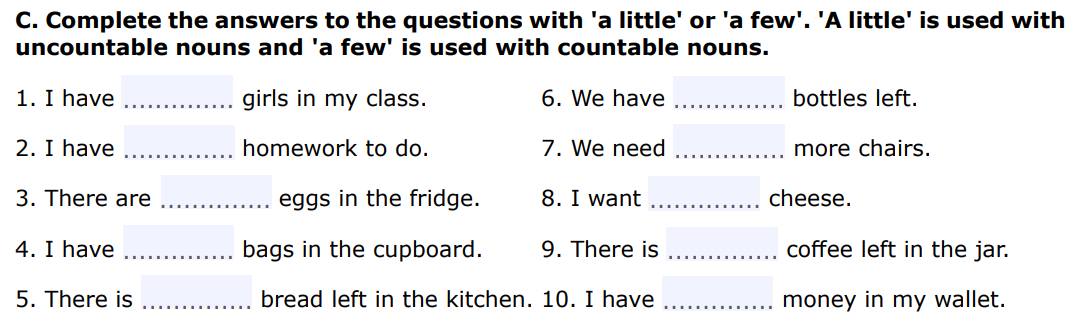
| A LITTLE | Uncountable | |
| A FEW | Countable |
Little
*Used before UNCOUNTABLE NOUNS.
*It's the opposite of much: a small quantity.
*Almost nothing or not much.
Few
*Used before COUNTABLE NOUNS.
*Few means a small number.
Ex. I'm sorry, I speak little french.

Ex. There are few honest politicians.
*He posted few photos on Instagram.

A little
*Used before UNCOUNTABLE NOUNS.
*A certain quantity of something that you CAN'T count.
*Means a small amount or some.
A few
*Used before COUNTABLE NOUNS.
*Means a small amount or some.
Are related with positive quantity
Ex. We have a little extra time this afternoon. Do you want to watch a movie?
Ex. We stayed a few days in Barcelona and visited the Gothic Neighborhood.

Activity
Can you decide which is the correct answer?
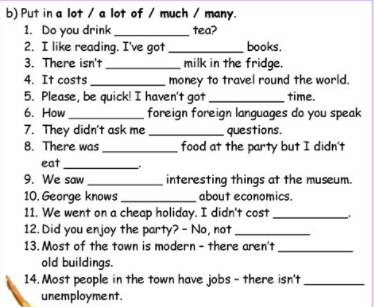
A LOT OF (LOTS OF)
Work for both groups: COUNTABLE and UNCOUNTABLE NOUNS.
Can replace MUCH or MANY.
Large number or quantity.
Most common in affirmative sentences.
Ex. I ate a lot of pizza last night.

Ex. I need lots of coffee today.
SOME
Work for both groups: COUNTABLE and UNCOUNTABLE NOUNS.
*Can replace A LITTLE or A FEW.
*Works in AFFIRMATIVE sentences.
Ex. Would you like some coffee?
*When you are offering something.

ANY
*Is generally used in NEGATIVE sentences.
*We use it with PLURAL countable and UNCOUNTABLE nouns.
*It can be use in QUESTIONS.
Ex. She doesn't have ANY money.
Ex. Do you have any pets?

Quantifiers
Modal verbs of deduction
Are words used to express how certain or unsure you are about a situation (based on evidence).
- MUST : 90-100% sure it's true.
- CAN'T: 90-100% sure NOT true.
- MAY/MIGHT: 30-50% maybe it's true or NOT.

That girl looks just like him. It must be his daughter.
They can't have gone on holiday; James has his exam tomorrow.
Aleja's Lesson. Modals of deduction, quantifiers, comparatives and superlatives.
By Valentina Rodríguez Ramírez