










*chto@uchicago.edu

Challenges and Opportunities for Roman High Latitude Imaging Survey

Chun-Hao To*

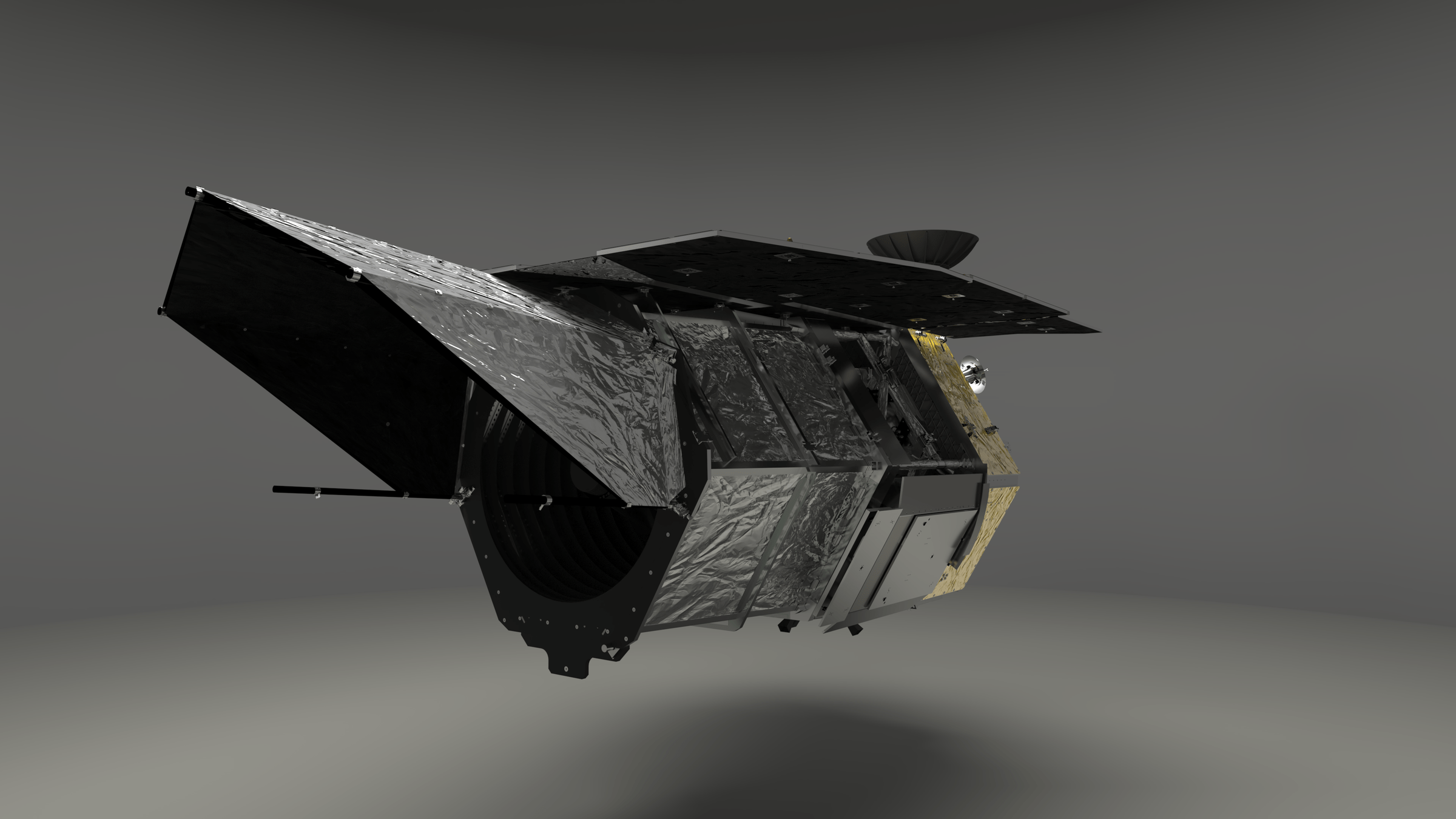
2.4 m (same as Hubble)

(i.e. similar resolution)

Text

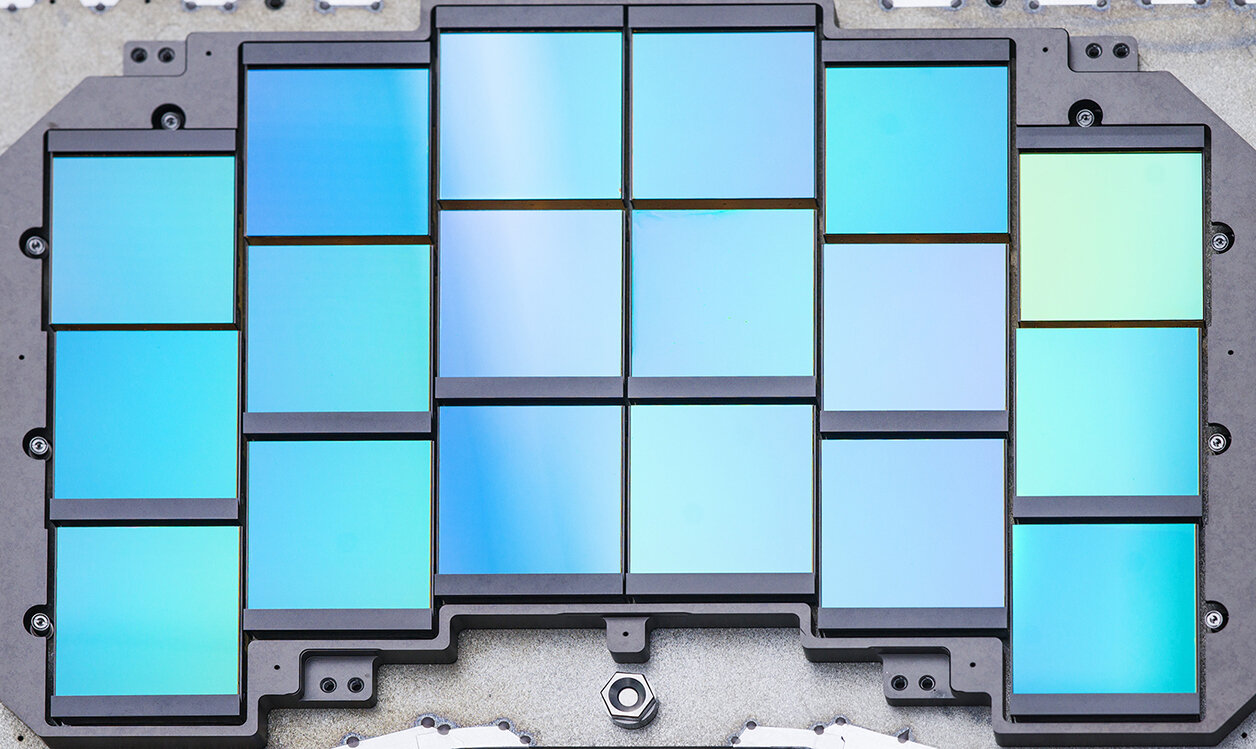
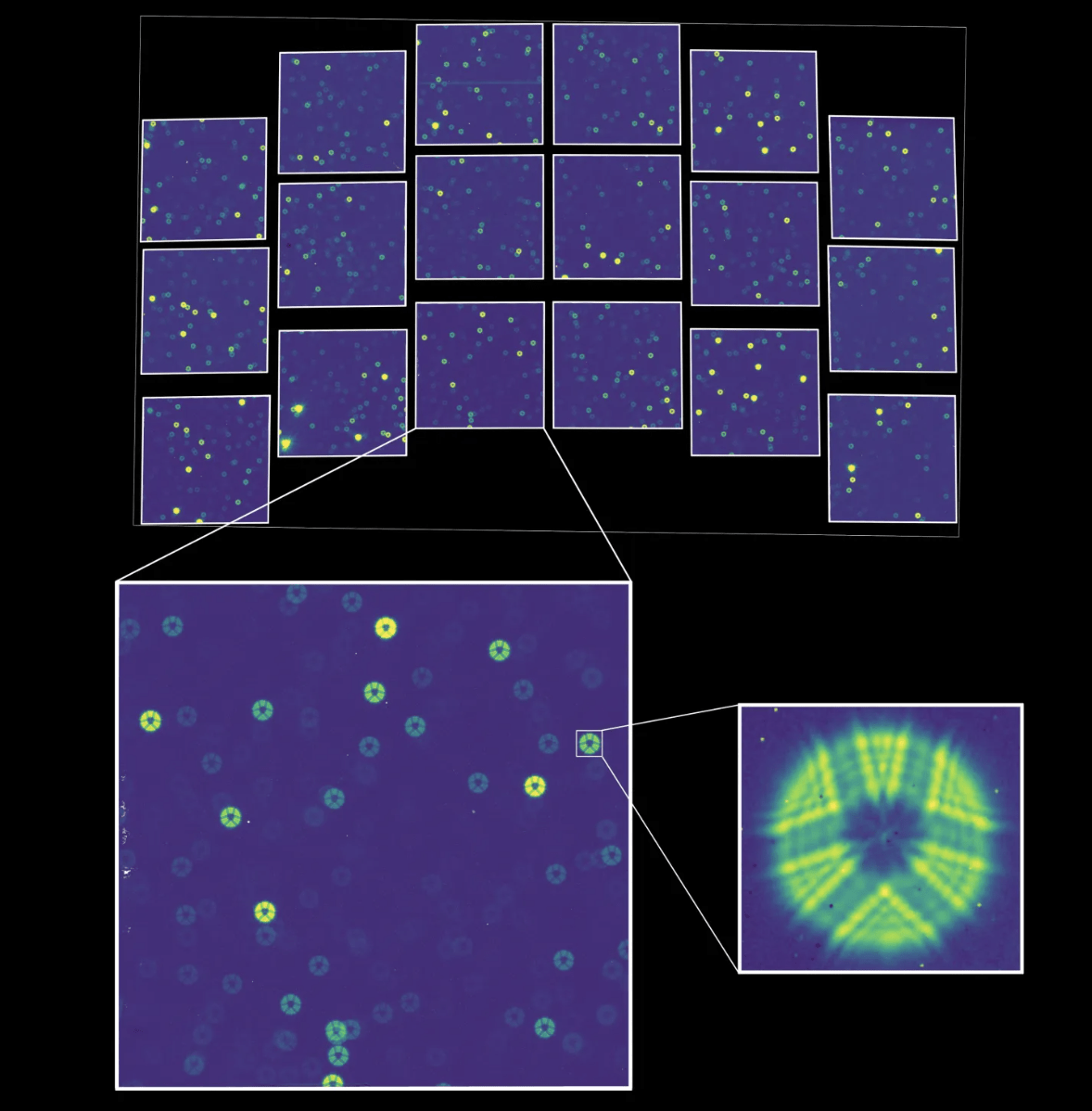
Wide Field Instrument (WFI):

18 4096x4096 pixel sensors

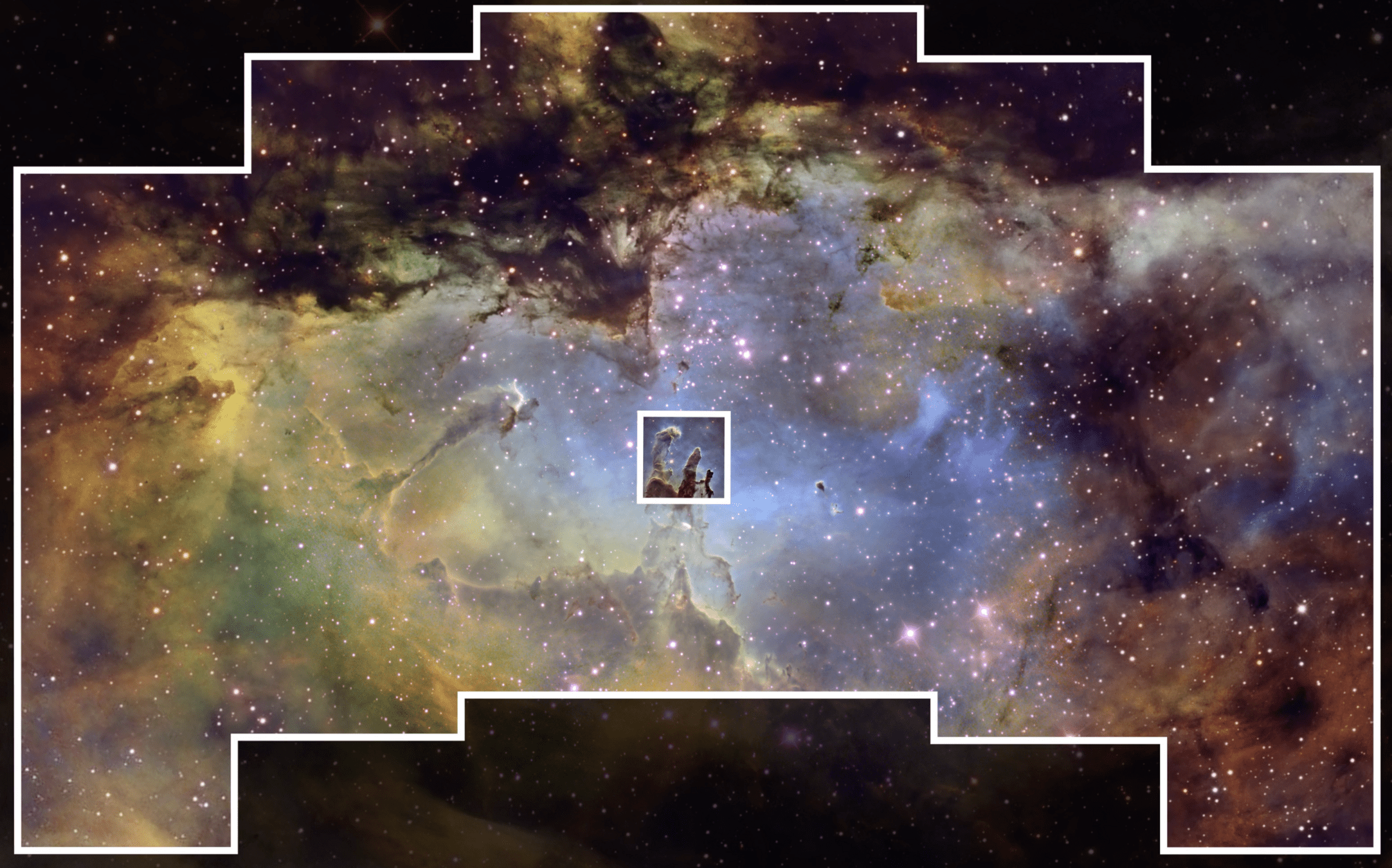
~200x of Hubble's WFC3 NIR
(i.e. much larger FOV)

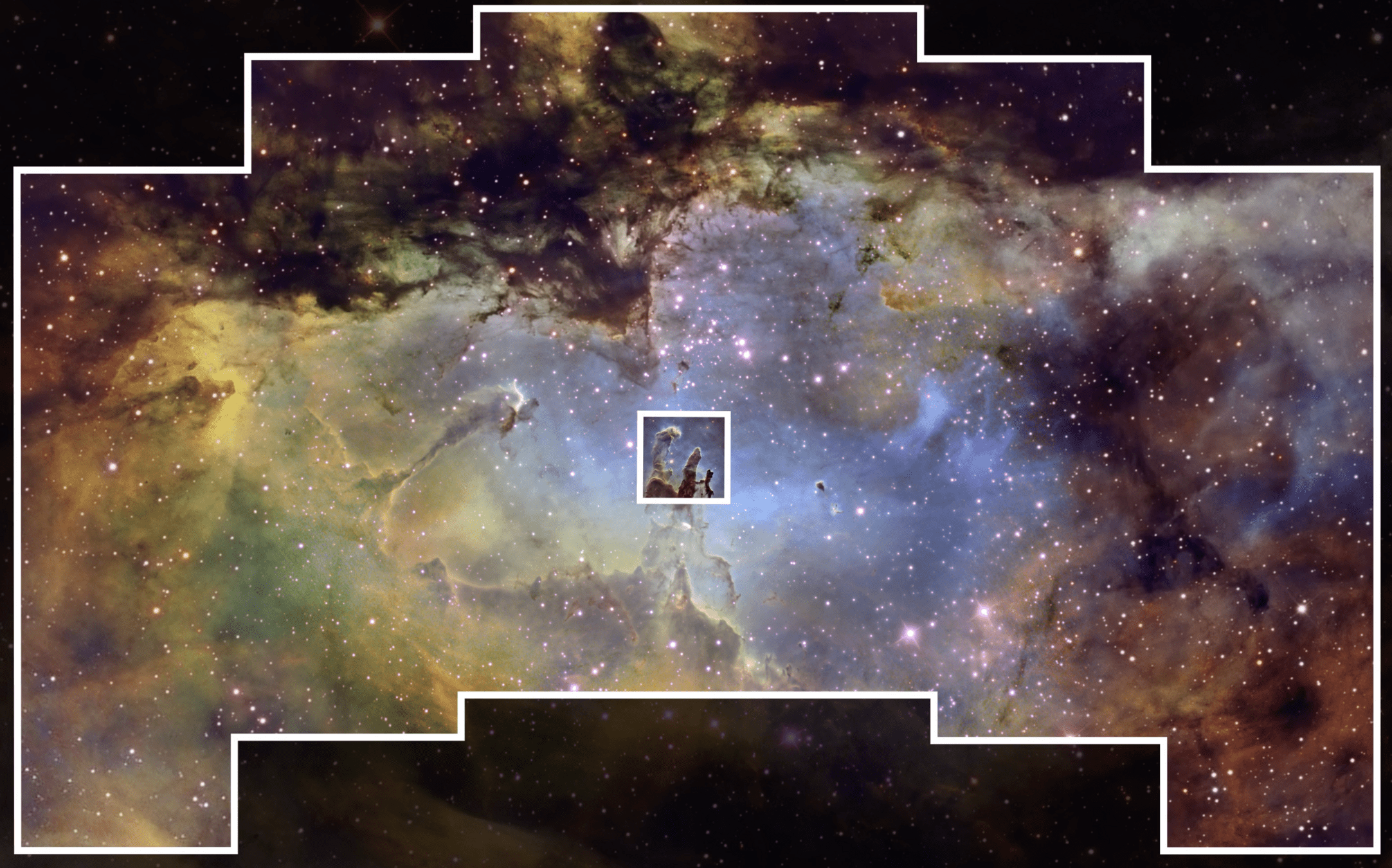
Image credit: NASA

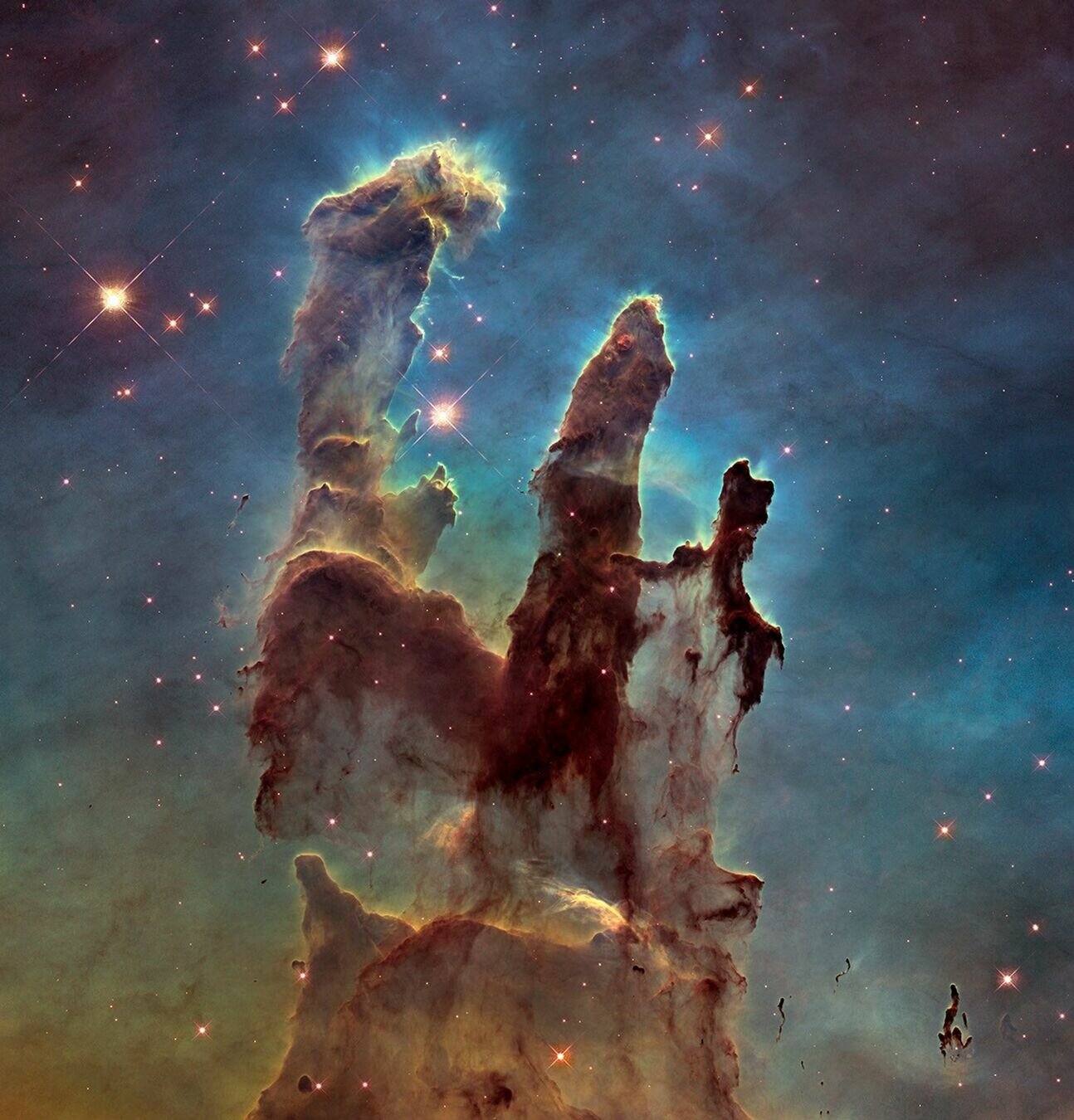
Hubble's Pillars of Creation

Expected Roman image

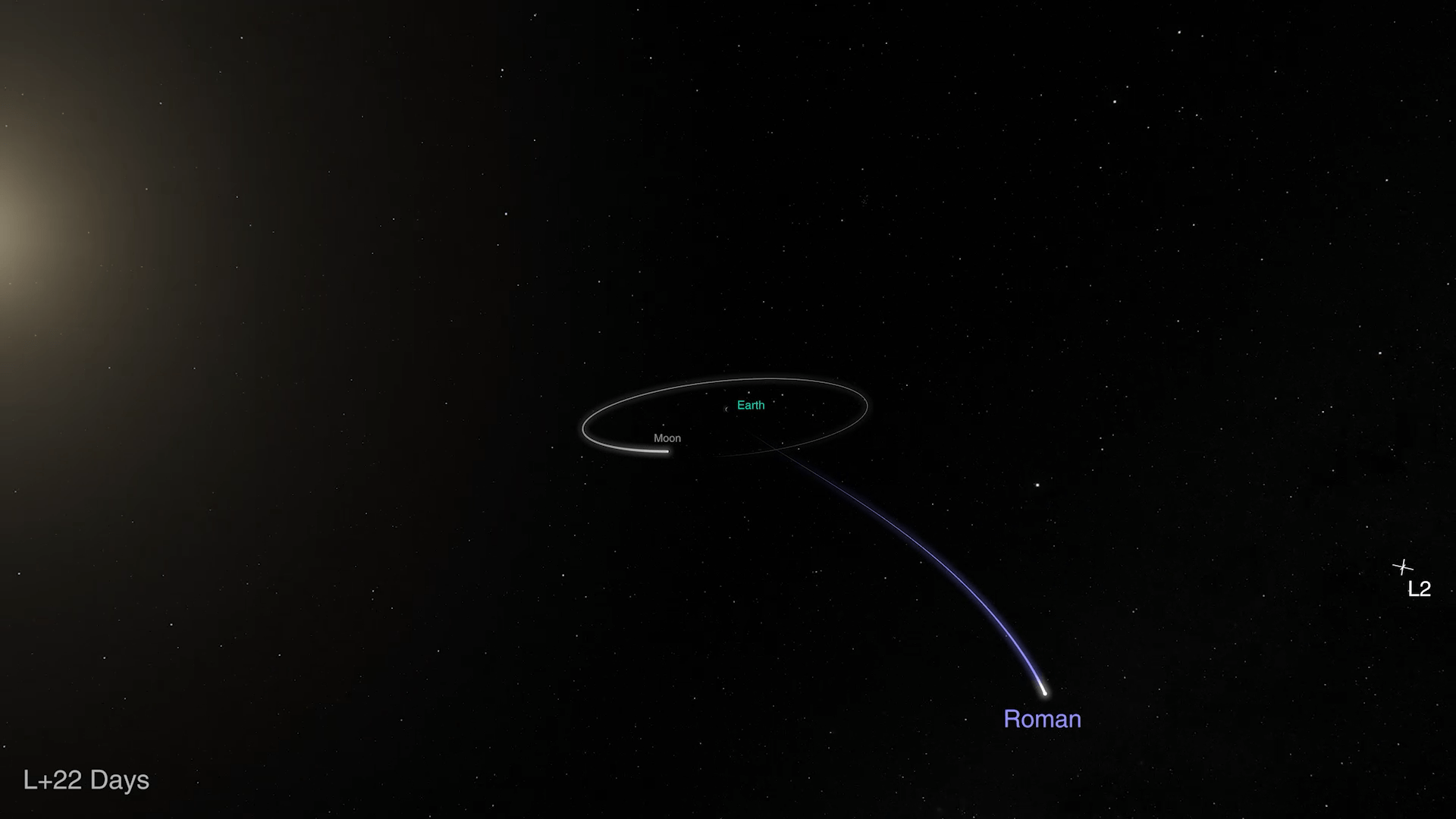
Roman will orbit around the sun at L2 

takes ~ 3 months to settle in L2 orbit before the start of the science operations

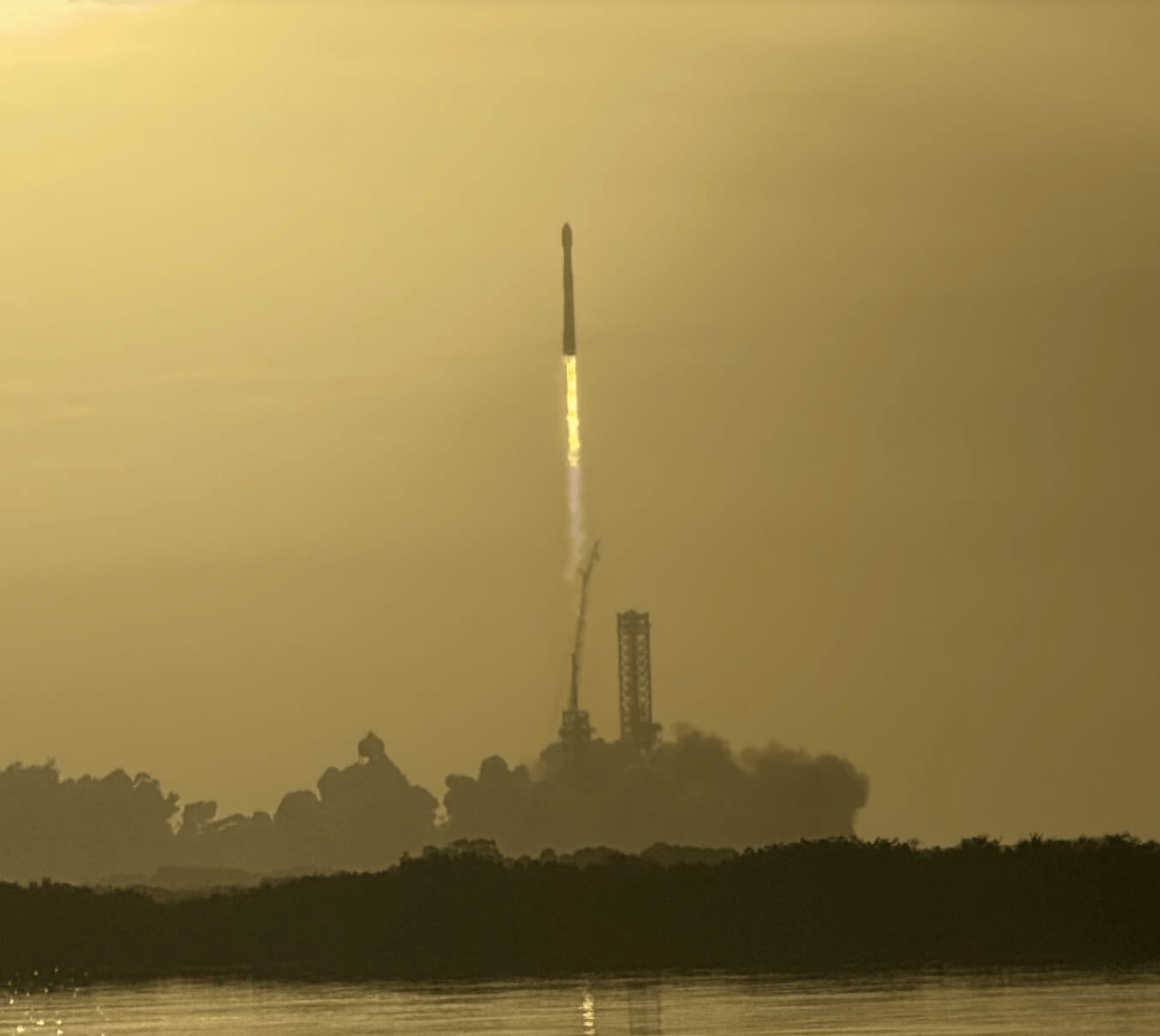
Aug 30 2026

~2 weeks

Roman

NASA GFSC

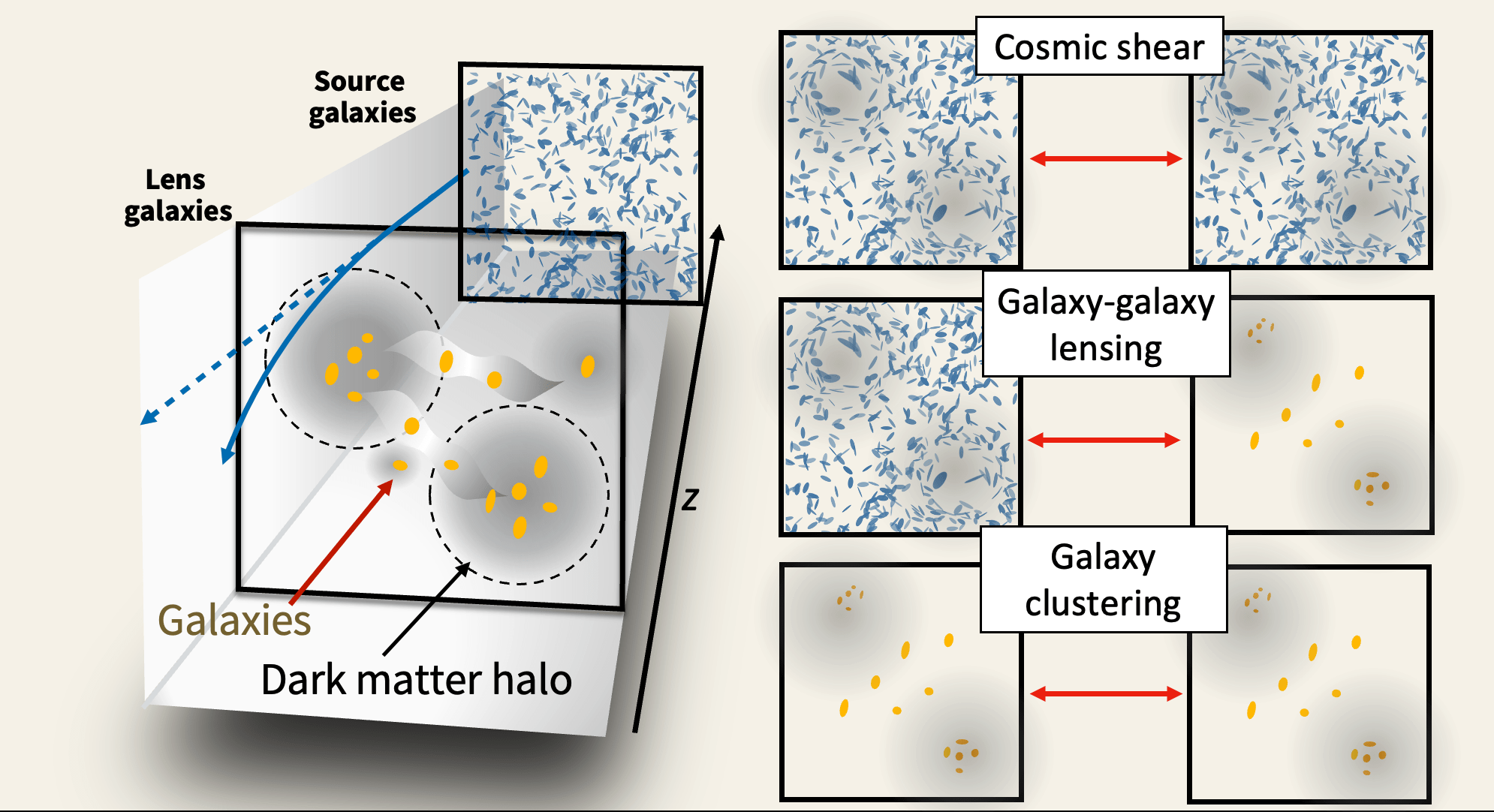
Weak lensing cosmology probes

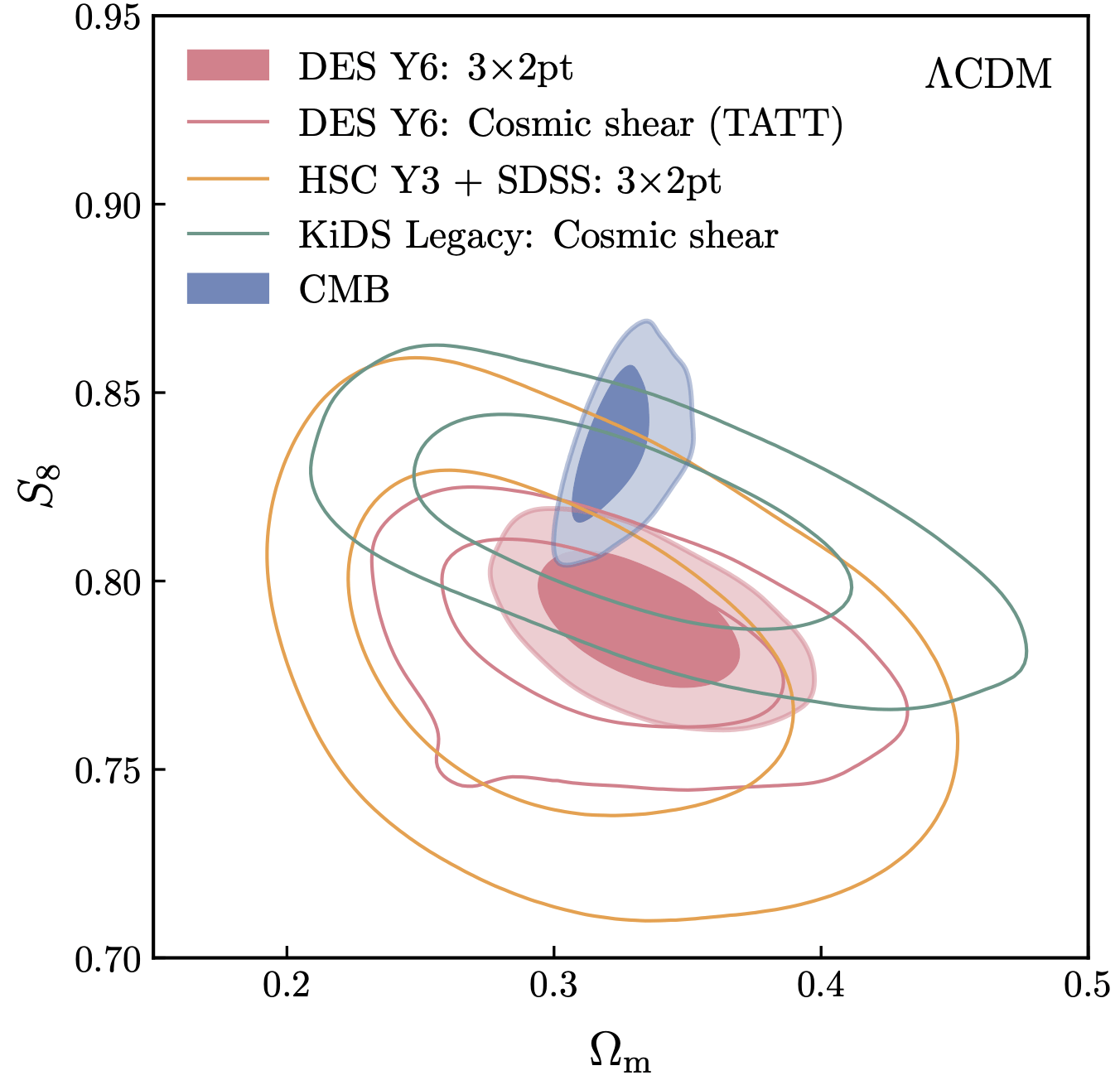
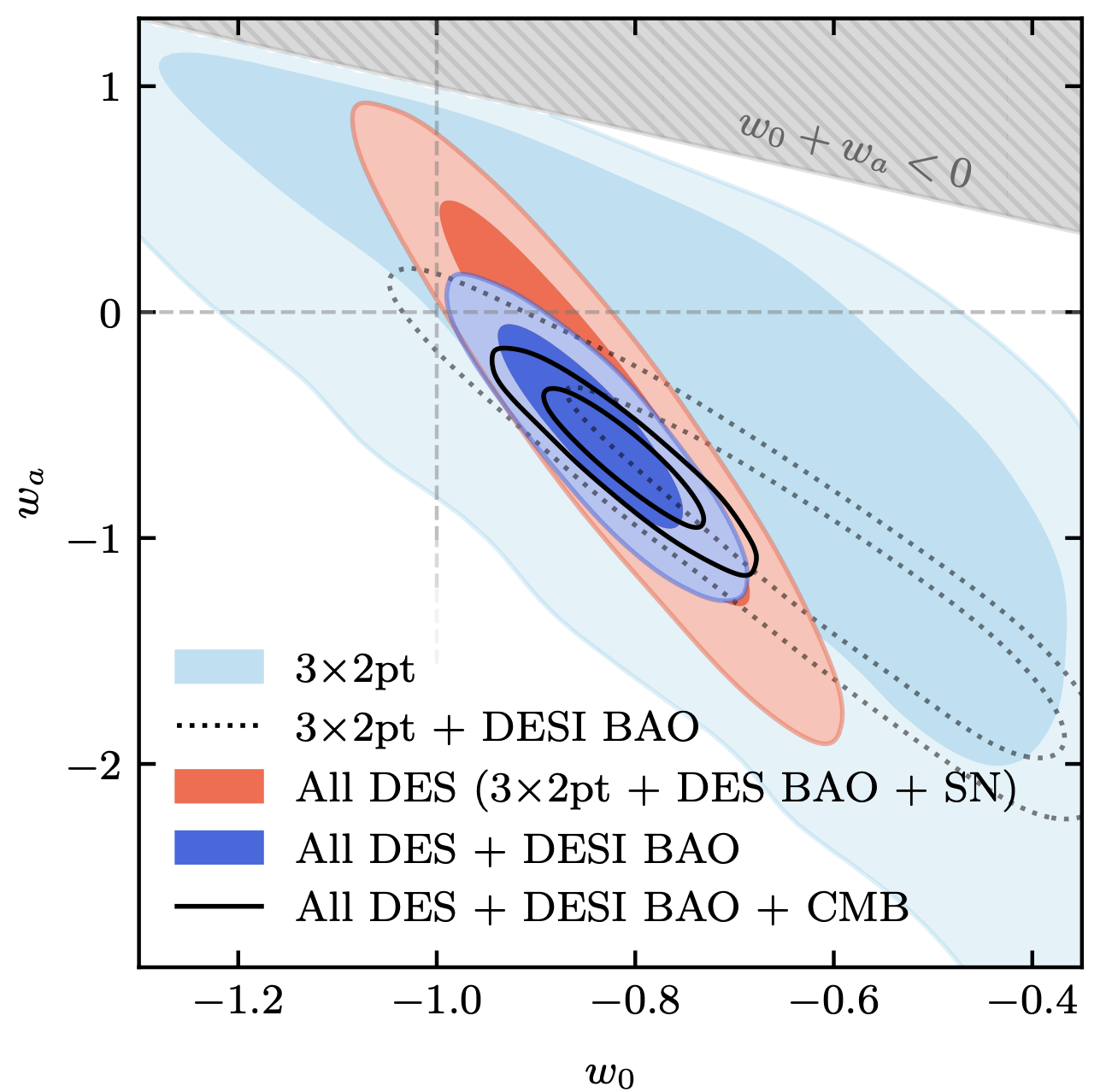
Weak lensing cosmology today

Dark Energy Survey Collaboration et al.  (incl. CT) 2026 (paper1, 2)

\Lambda \text{CDM}
w_0w_a\text{CDM}

Roman

Survey Year

09

09

12

19

19

20

24

25

26

Galaxy Density


Survey Area
 

18000

154

2

20

1500

5000

1400

15000

(\small{\rm{deg}^2})
(\small{\rm{arcmin}^{-2}})

154

5100

41

End Date

Start Date

CFHTLS

11

COSMOS

65

DLS

17

KIDS

11

DES

9

HSC

26

Euclid

30

Rubin

30

Weak lensing surveys

What will Roman do for WL cosmology

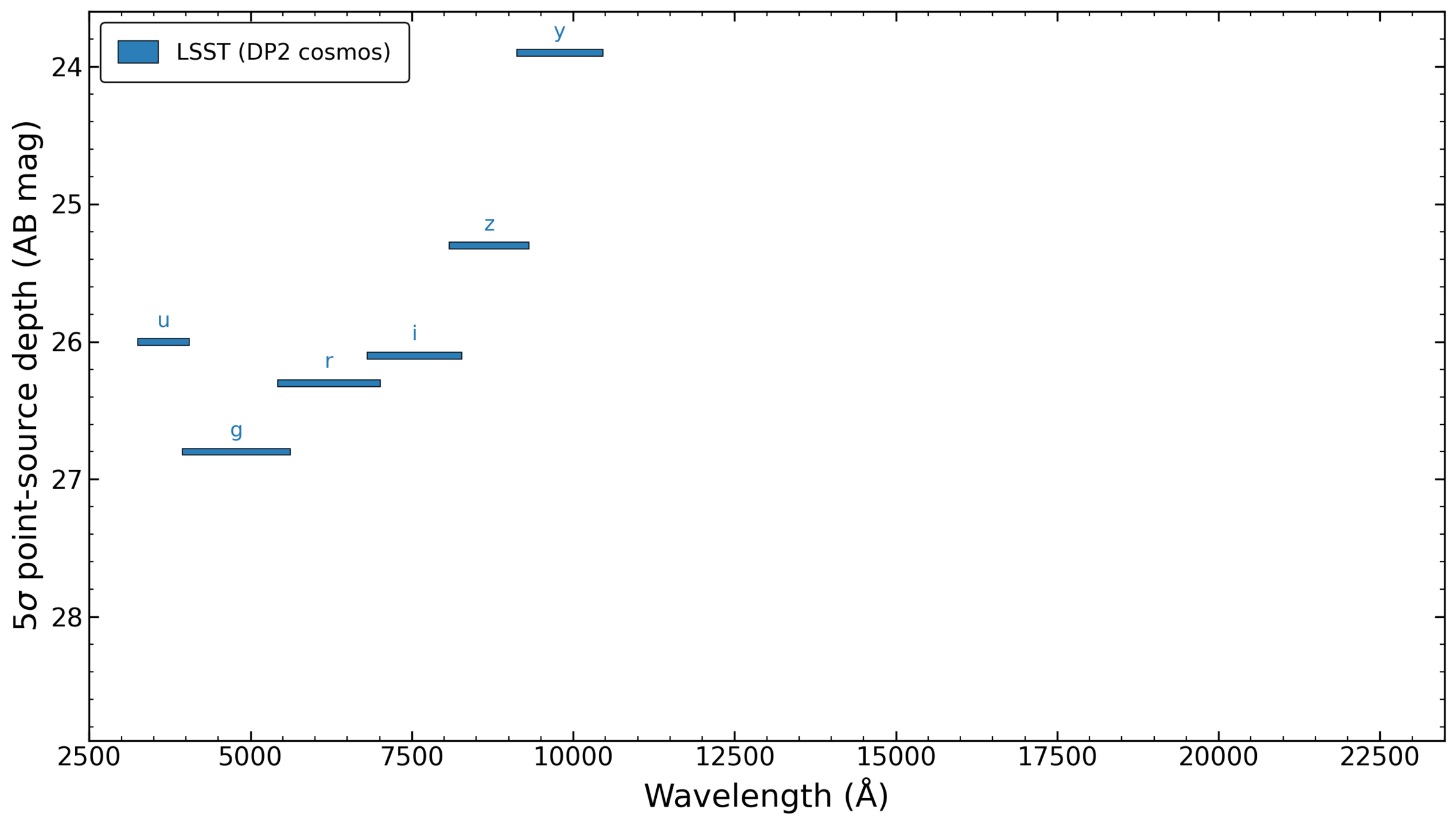
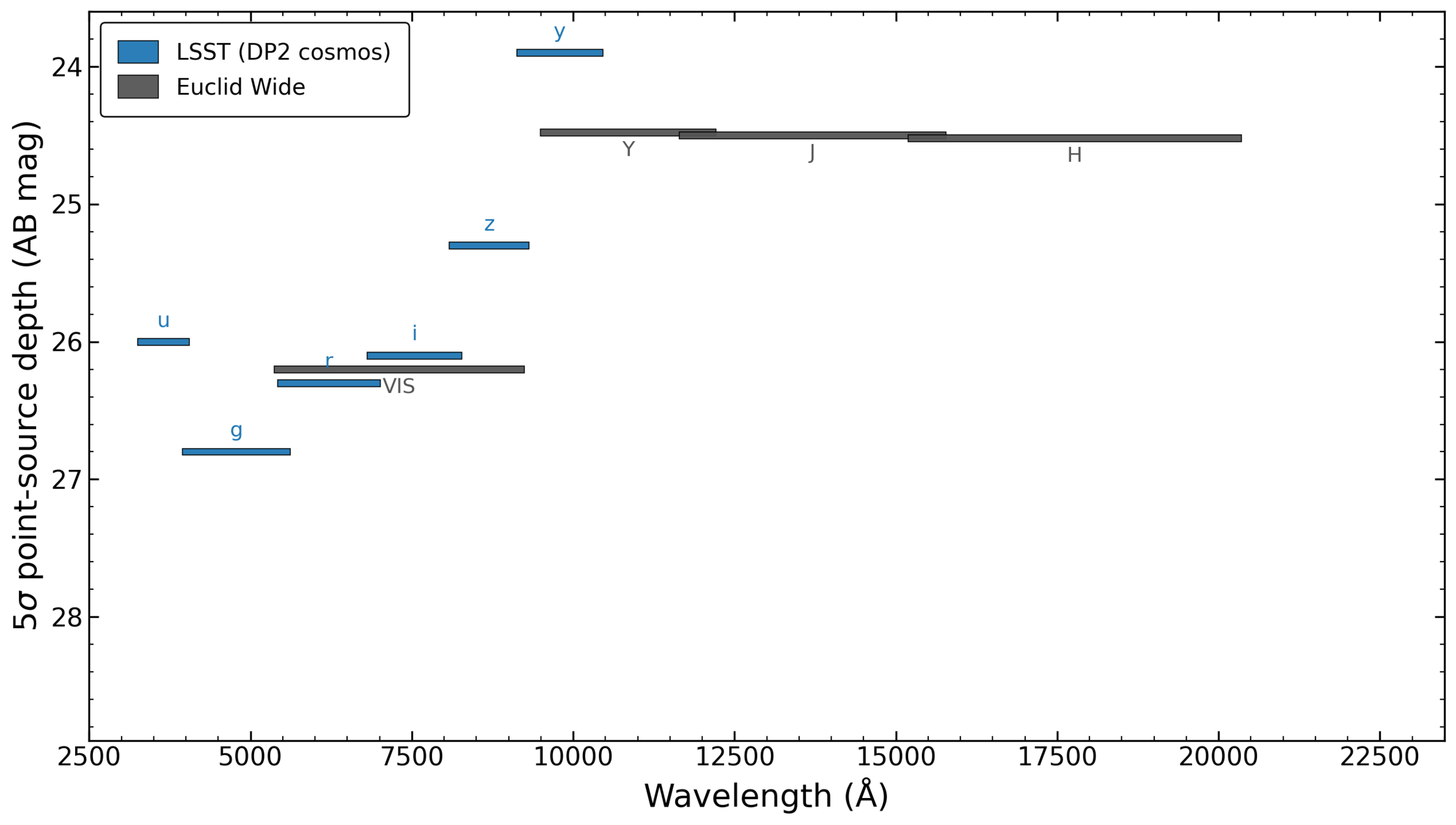
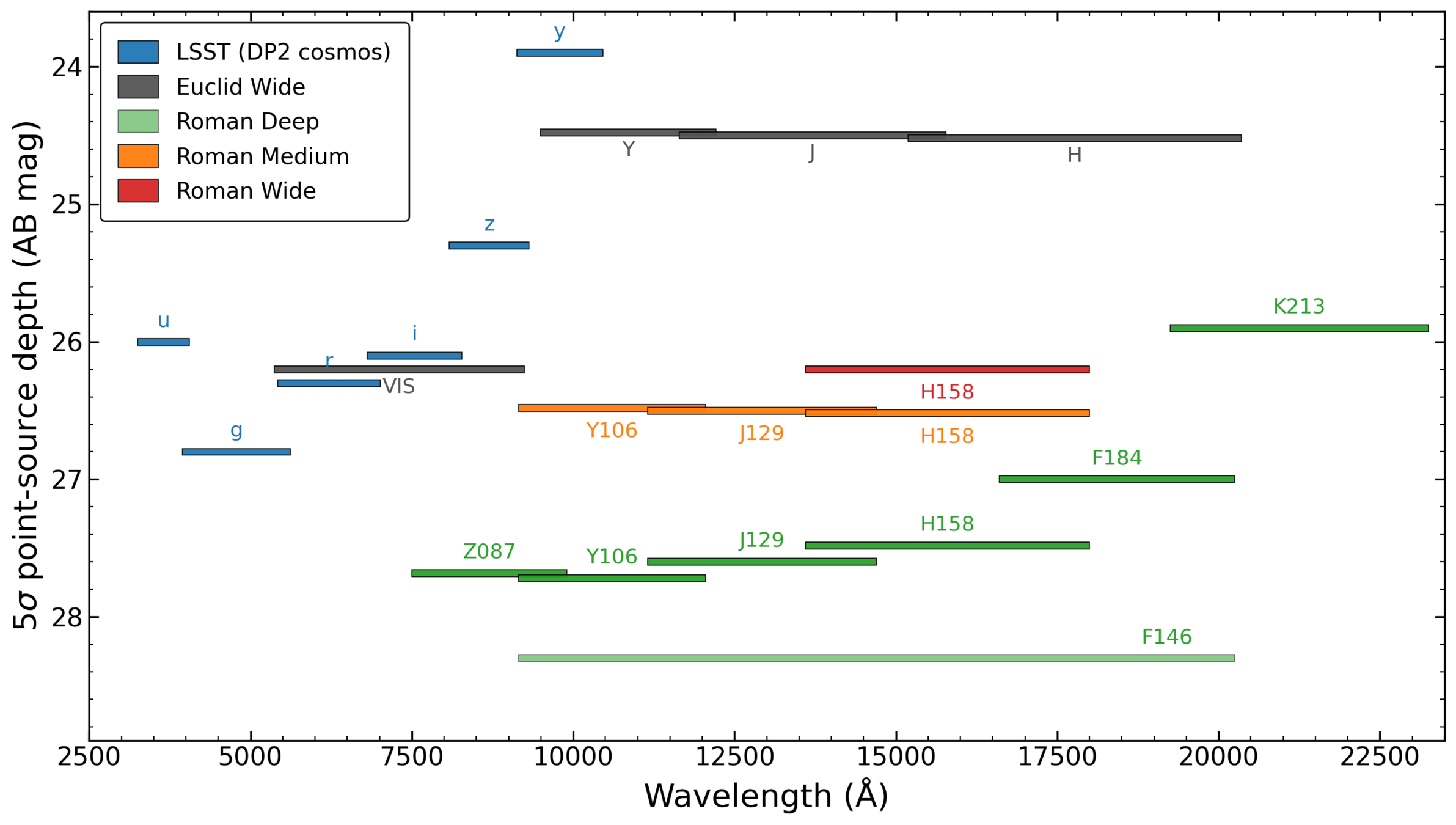
A deep catalog of galaxies with exquisite PSF (~0.2") and multiband coverage (0.9-2.0        ).  


Many galaxies       low noise

Less blending/star-galaxy separation

Great photo-z when combined with Rubin LSST

\mu m

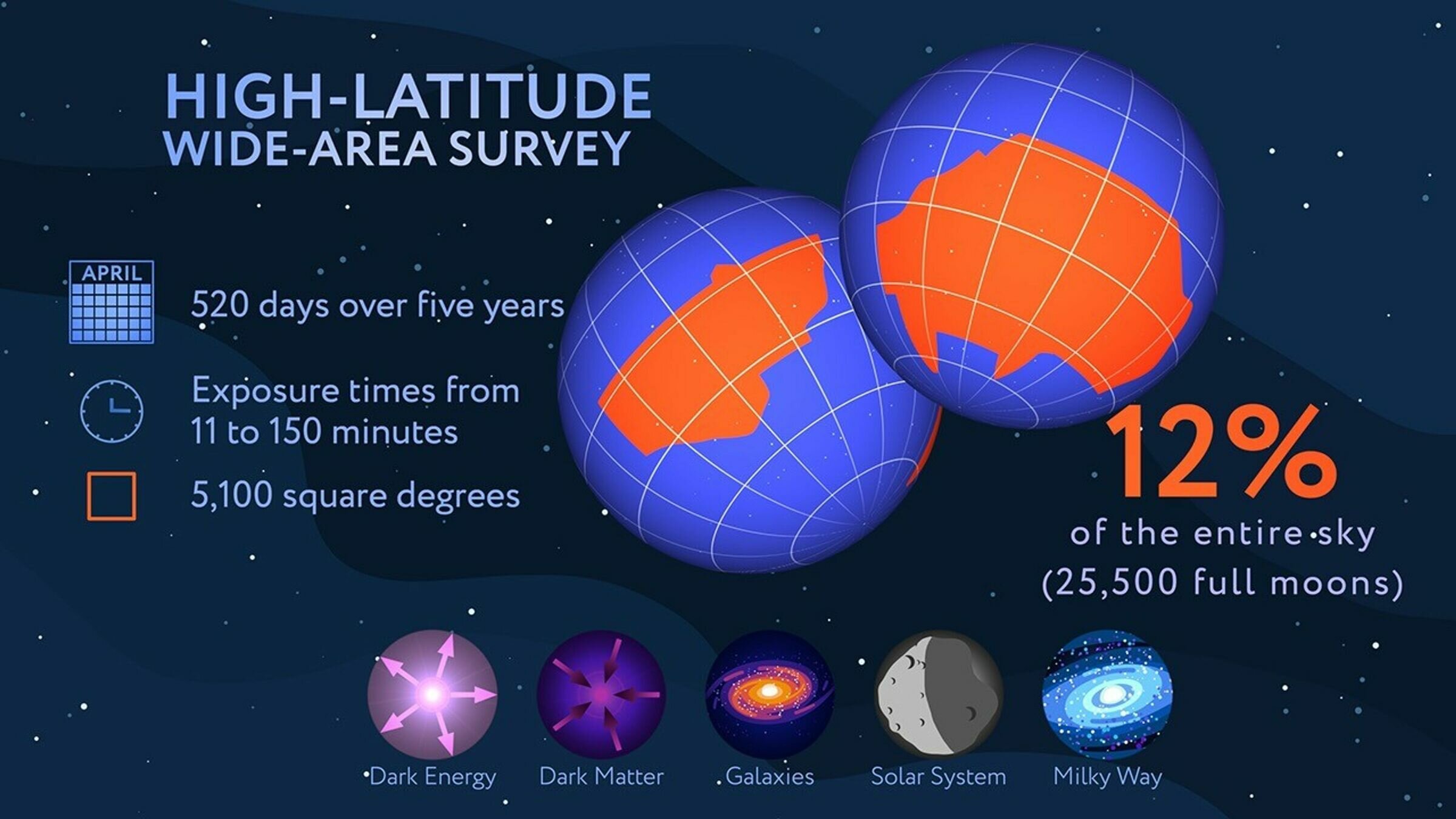
Roman High Latitude Wide Area Survey

Roman

Survey Year

24

25

26

Galaxy Density


Survey Area
 

18000

15000

(\small{\rm{deg}^2})
(\small{\rm{arcmin}^{-2}})

5100

41

Start Date

Euclid

30

Rubin

30

Roman High Latitude Imaging Survey Project Infrastructure Team (HLIS-PIT)

  • We build pipelines to enable Roman's 3x2pt + cluster science.
    • Shear catalogs and calibrations (such as m, photo-z, ...). 
    • Lens and cluster catalogs and calibrations (such as weights, photo-z, ...). 
    • Associated products for the above, such as coadd images, PSF, theory pipeline...
       
  • See https://roman-hlis-cosmology.caltech.edu/  for details. 
  1. Shear and Color measurement. 
    1. Internal and external individual-exposure calibration and point-spread function modeling. 
    2. Image Coaddition.
    3. Shear measurement, photometry, and forced photometry on Rubin.
    4. Image simulations and synthetic source injections. 
  2. Catalog and Statistics.
    1. Photometric redshift estimation and characterization. 
    2. Lens sample selection and characterization.
    3. Galaxy cluster selection and characterization. 
    4. 2pt measurement and uncertainty quantification. 
  3. Cosmological Parameter inference.
    1. Covariance matrix. 
    2. Baryon and nonlinear power spectra modeling. 
    3. Intrinsic alignment models. 
    4. Galaxy bias models. 
    5. Cluster systematic models. 
    6. 3x2pt likelihood inference. 
    7. Mass mapping and higher-order statistics. 

Pixel-to-cosmology pipeline 

  • Space-based weak lensing experiments in infrared.
    • Undersampled PSF: Pixel size and PSF size are comparable.  
    • Correlated noise.
       
  • Poor spec-z coverage.
     
  • Theory uncertainties: 
    Reshift evolution of IA and baryonic feedback from z=0-3. 

What are the unique challenges for Roman compared to other ground based lensing survey?

Roman photometry problem

  • Ground-based telescope (LSST/DES):

     Sky background ~ 2000 e/p/s vs Read noise ~ 8.8 e/p
           Poisson shot noise.
  • Space-based telescope (Roman/JWST):

    Zodiacal+thermal ~ 0.76 e/p/s vs Read noise ~ 8.5 e/p
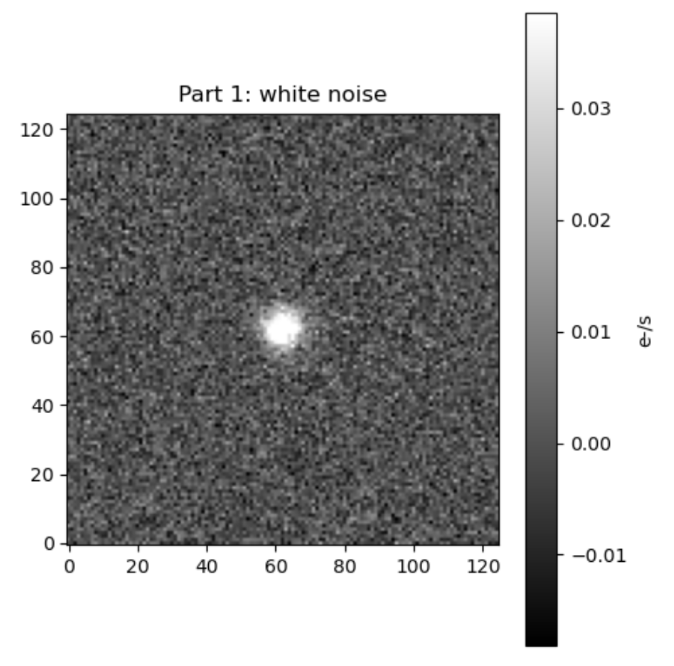
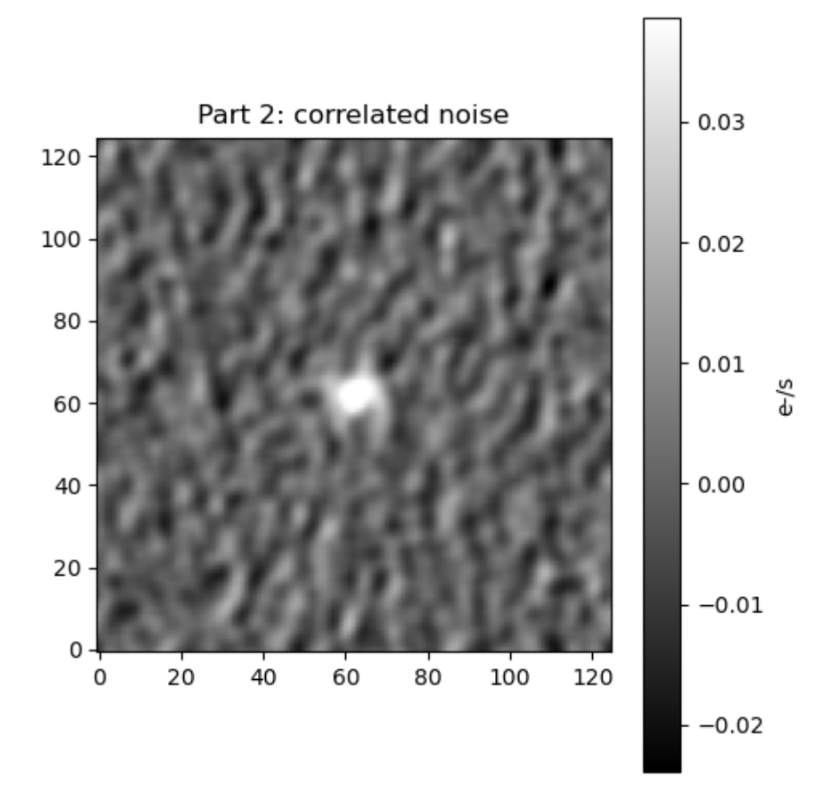
          readout noise is no longer negligible, which can be correlated across pixels (1/f noise). 

Visualizations of correlated noise

Generated with remaining noise powerspectrum  

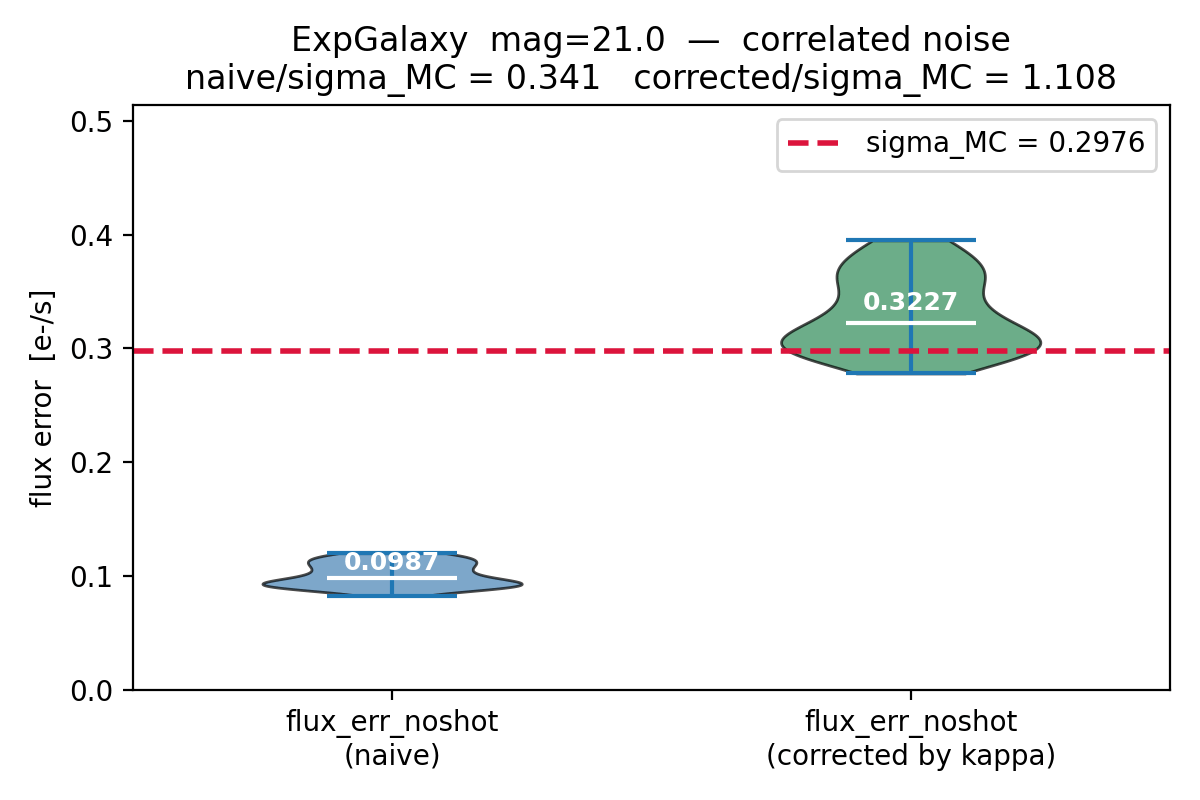
Impact on flux uncertainty

MonteCarlo Simulation 

Out-of-the-box Flux Uncertainty

Flux uncertainty is an important component in defining the width of the red sequence and serves as a metric for photo-z.

Flux uncertainty correction

Assuming the noise is homogeneous and isotropic within a block (1.6'x1.6'), we can estimate the correlation using the correlation of the noise realization. 

r(\Delta\alpha,\Delta\beta) = \left\langle \bar{n}(\alpha+\Delta\alpha,\beta+\Delta\beta) \bar{n}(\alpha,\beta) \right\rangle

where the normalized noise field is defined as:

\bar{n}(\alpha,\beta) = \sqrt{w_{\alpha,\beta}} \, n(\alpha,\beta)

Flux uncertainty correction

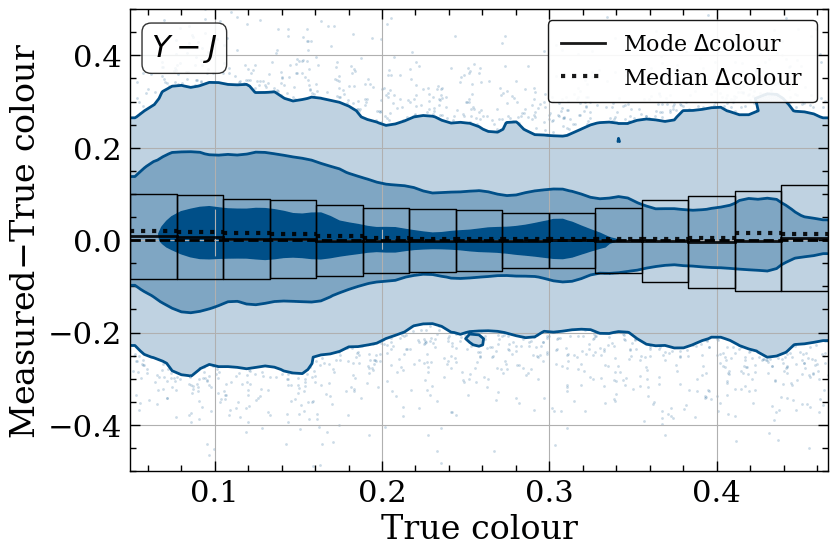
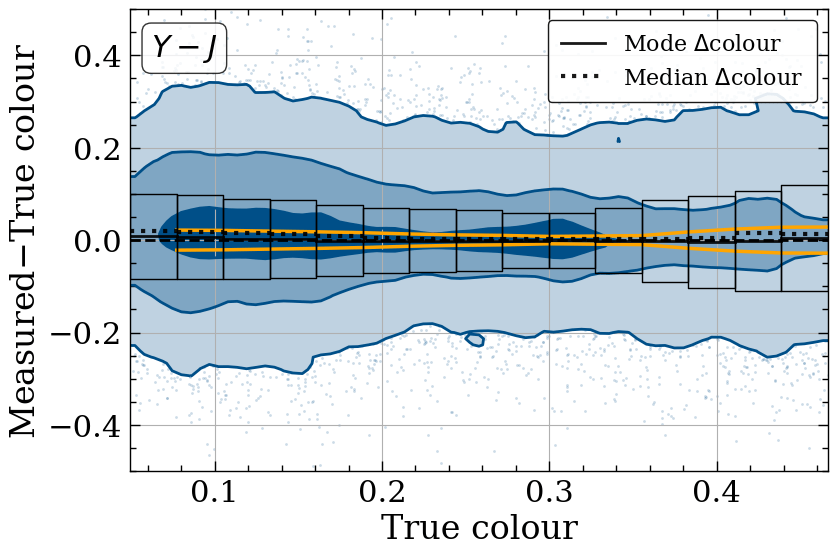
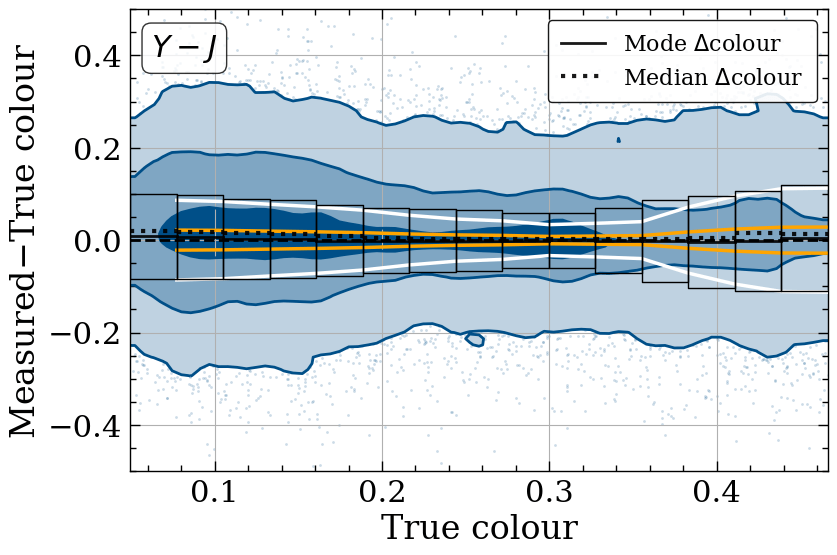
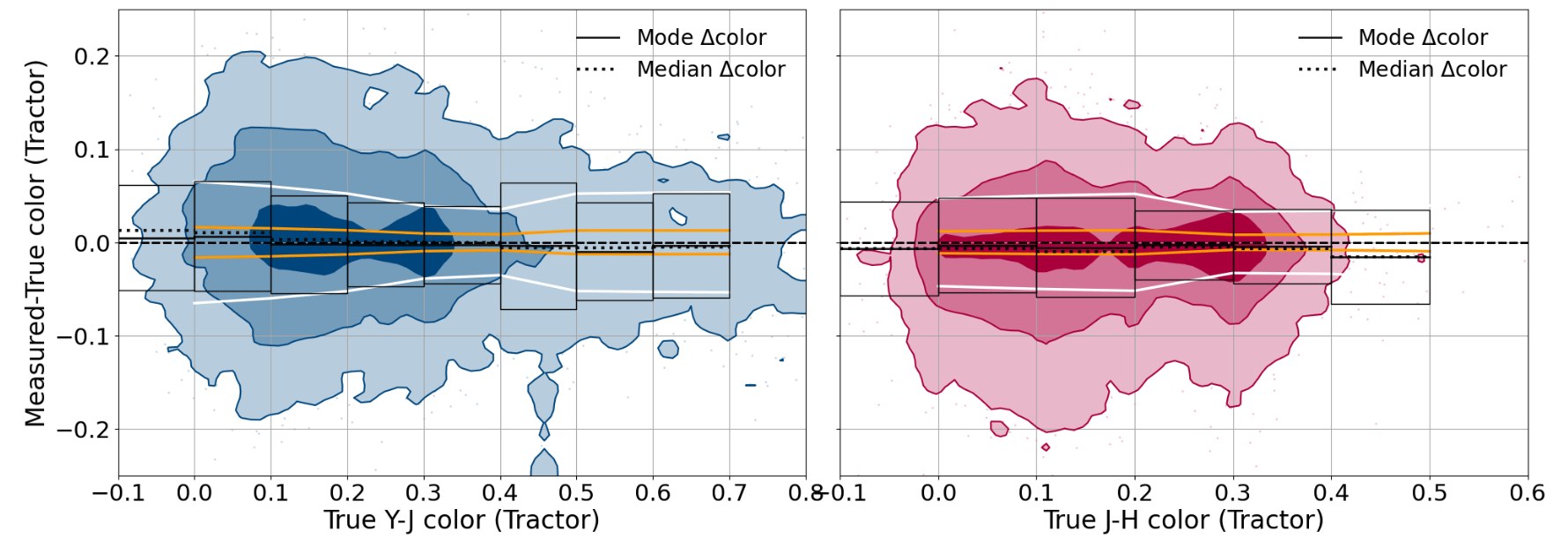
Performance: Roman Color

Out-of-the-box uncertainty

Our method

Color Error

To+2026  (arxiv: 2607.09849)

Slimfarmer photometry pipeline 

  • Slimfarmer is a simple photometry pipeline that only does detection and photometry 
    • Correlated noise 
    • Multi-object fitting (MOF)
    • Forced Rubin photometry 
    • Tuned to work on Roman-like images
  • Using SlimFarmer, DC25 sim, and Roman-SOMPZ, we find:
    • MOF is only important for absolute photometry but not colors
    • Failure to account for correlated noise can underestimate flux uncertainties by several factors, but has only a small impact on SOMPZ.
    • Rubin photometry will be important for Roman weak lensing photo-z. 
  • A model-fitting-based photometry pipeline that is tested on realistic Roman image simulations.
     
  • Features:
    • Correlated noise correction.
    • Supports forced photometry on ground-based observations, with validated performance.
    • Performance tested for downstream applications: galaxy clustering and photometric redshift characterization.
       
  • See To+2026  (arxiv: 2607.09849) for details.  
  • Space-based weak lensing experiments in infrared.
    • Undersampled PSF: Pixel size and PSF size are comparable.  
    • Correlated noise.
       
  • Poor spec-z coverage.
     
  • Theory uncertainties: 
    Reshift evolution of IA and baryonic feedback from z=0-3. 

What are the unique challenges for Roman compared to other ground based lensing survey?

Two types of photometric redshifts

  • Individual photo-z: For galaxy and galaxy cluster selections.
    • Need high precision.  
  • Ensemble photo-z: For n(z) characterization.
    • Need high accuracy. 

Challenge: incomplete/non-representative calibration sample

  • Dominated redshift calibration uncertainty in DES Y6 (Yin+26)

  • Will be worse for Roman with deeper surveys…  

One of the leading methods for n(z) characterization is
SOM-PZ

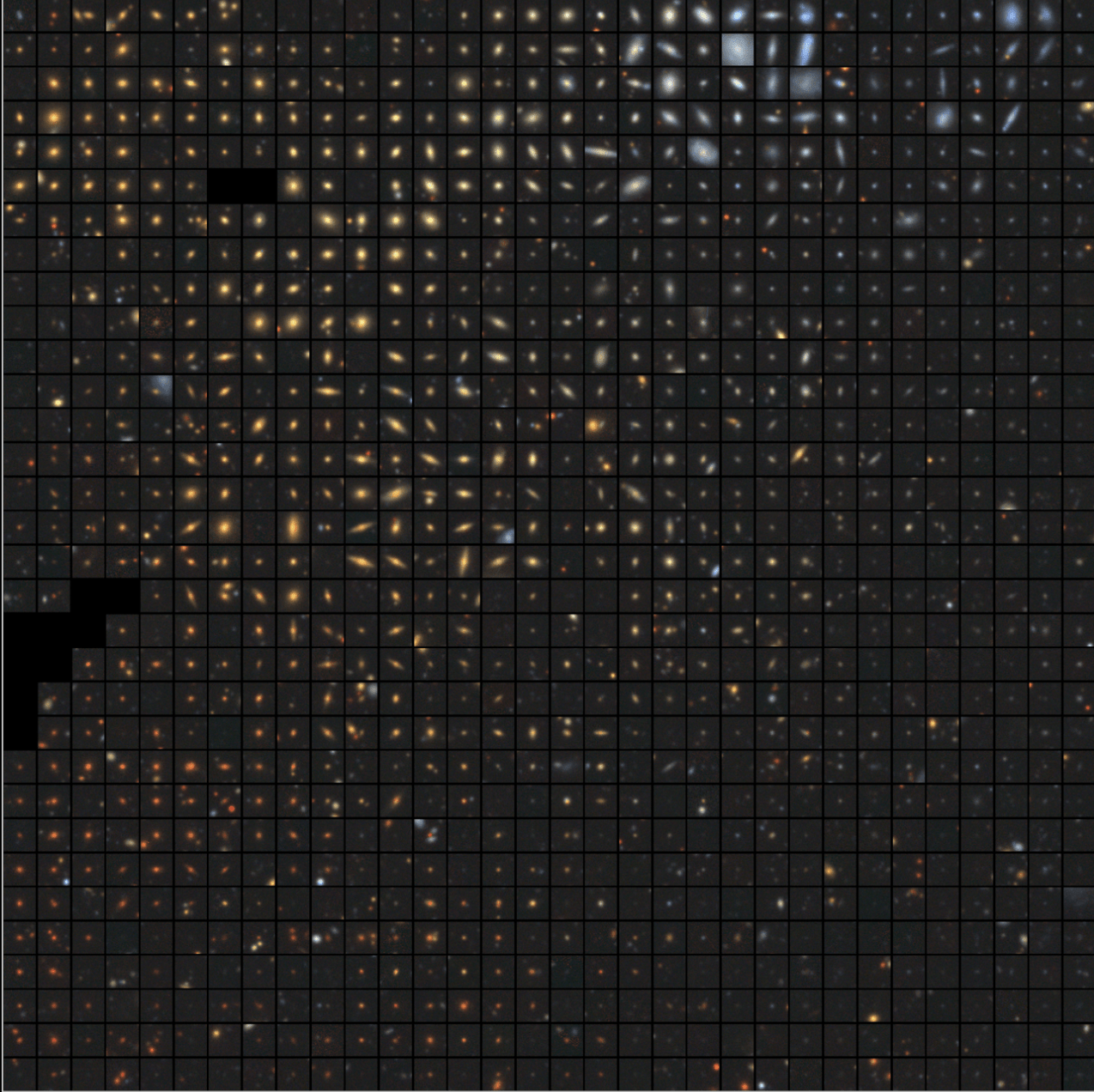
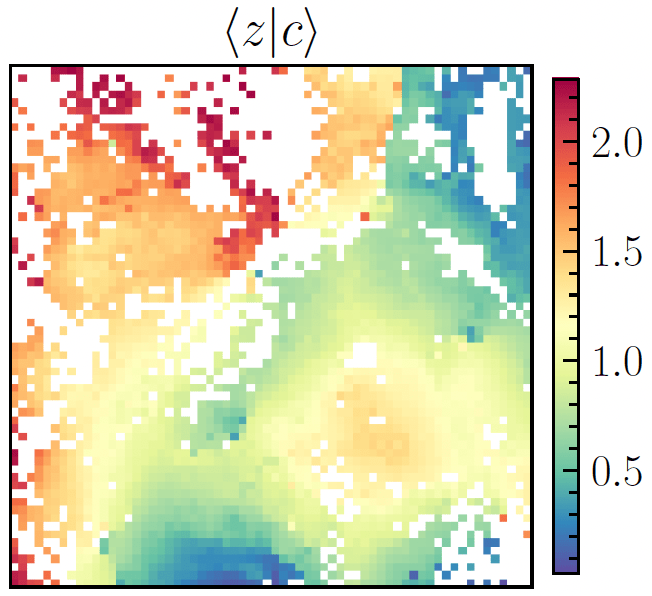
  • An unsupervised learning algorithm that characterizes galaxies into different phenotypes (c).
     
  •  The redshifts distribution for galaxies in each tomographic bin (b) can be calcaulated by
n(z | b) = \sum_{c \in b} p(z|c)

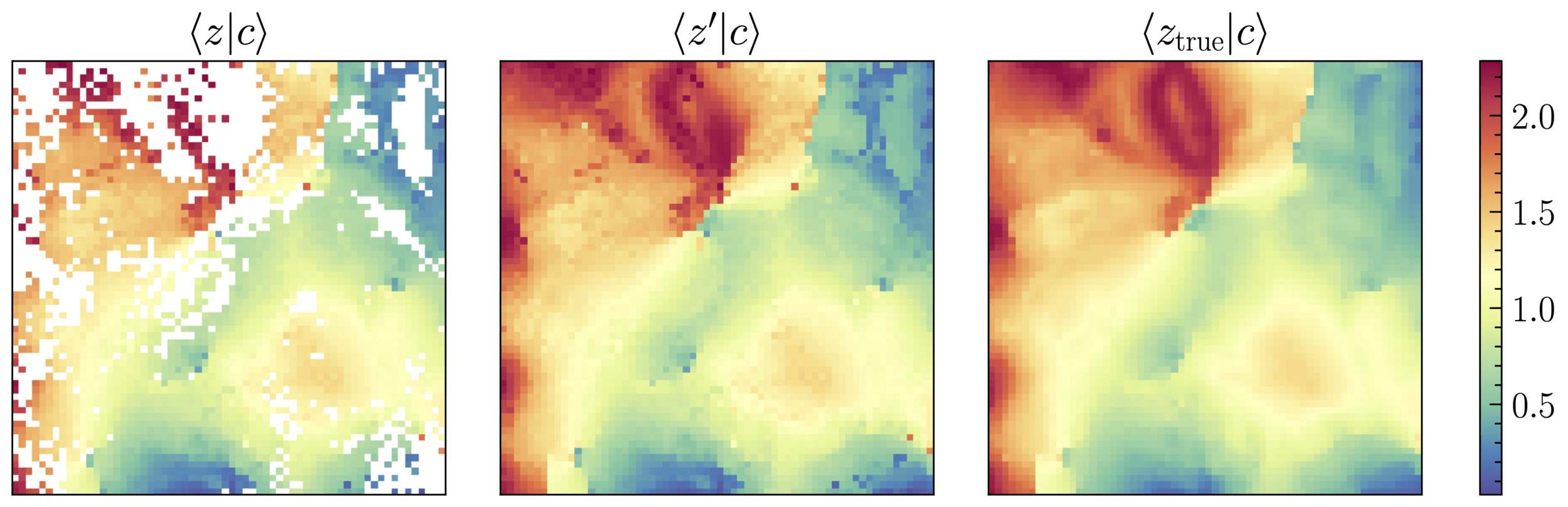
Using available spectra

What does it look like in Roman simulations?

About 26.6% of the galaxies living in color spaces lack of spectroscopic galaxies. 

Solution 1: more spectroscopic galaxies.

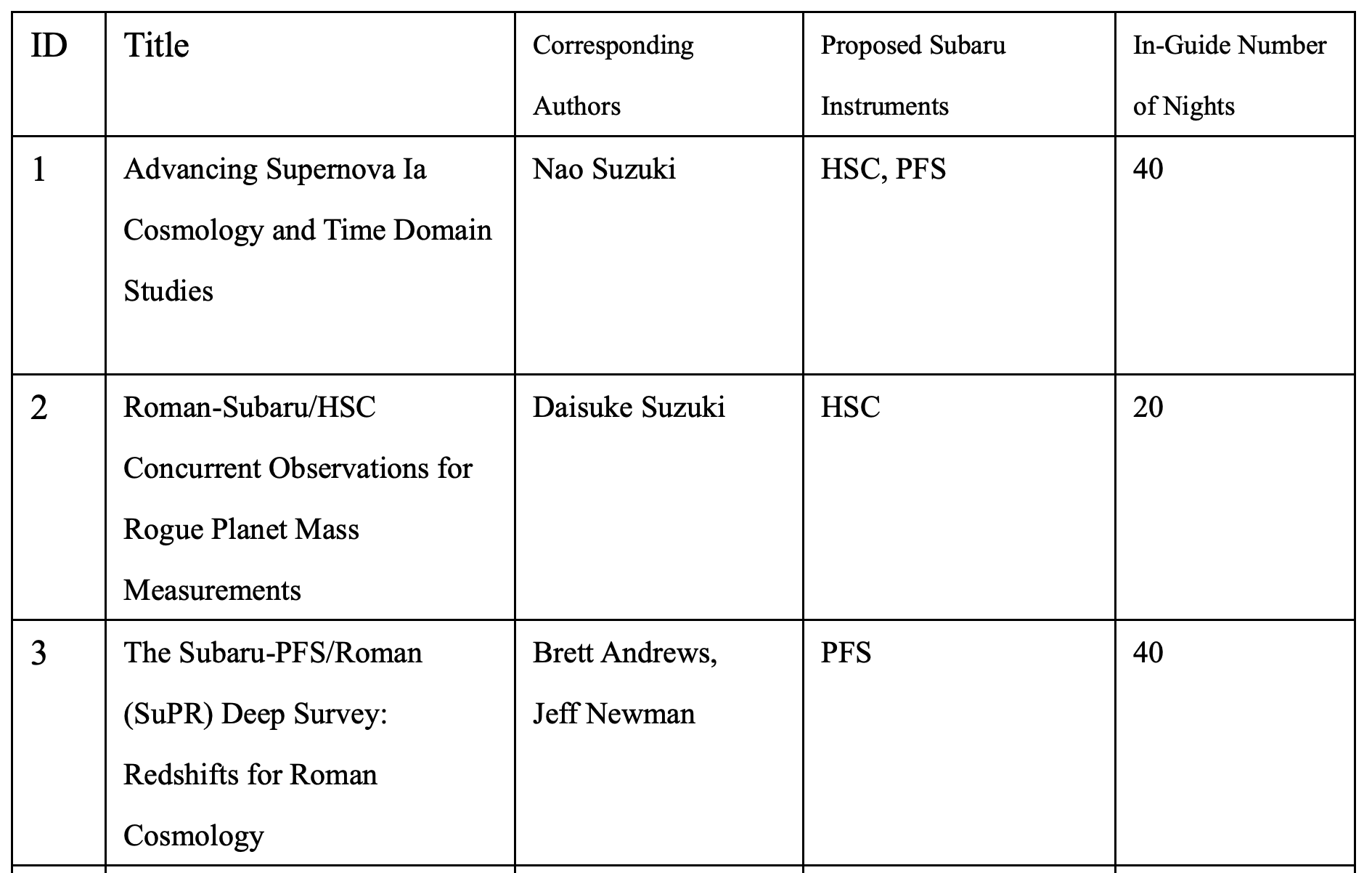
Brett Andrews, Jeff Newman, Dan Masters

Cosmos DDF

XMM DDF

20k-30k spectra with H depth of ~24.5 (AB), subsampled to have flatter mag distribution.
 

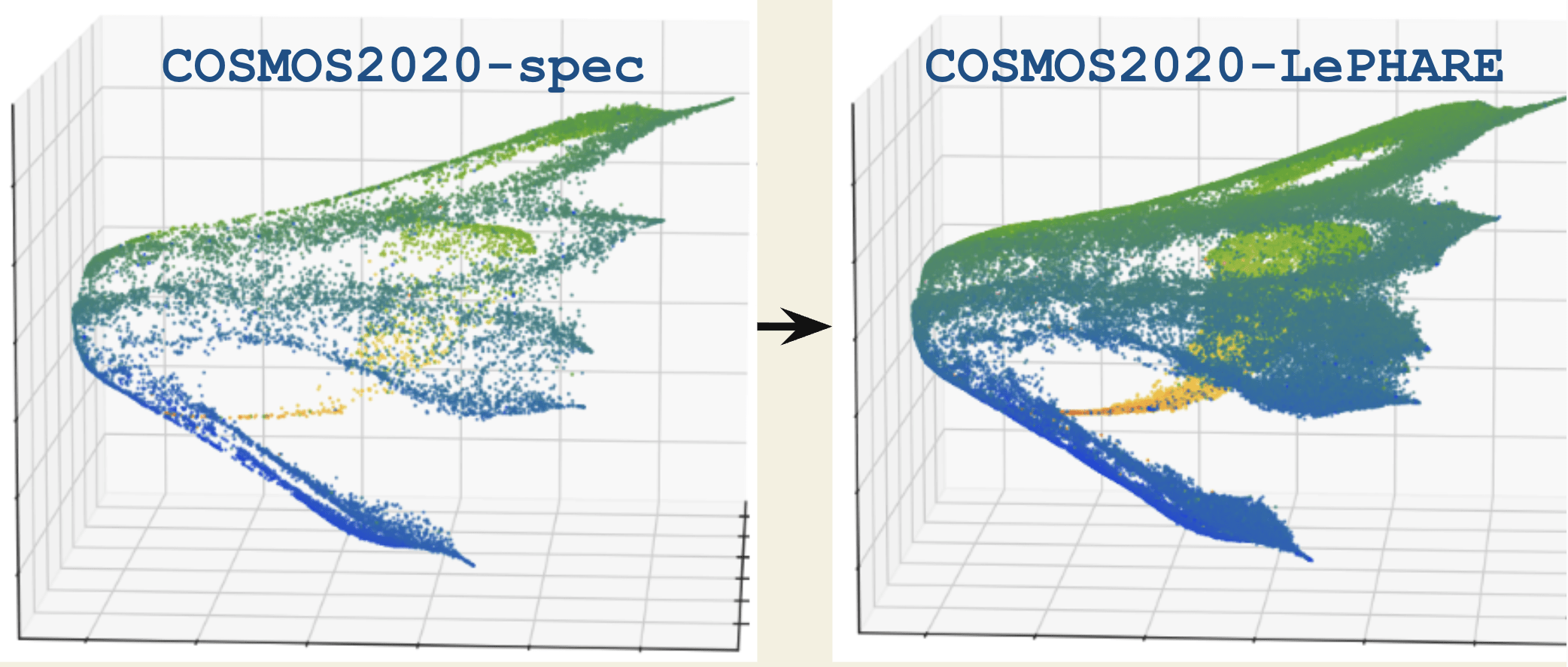
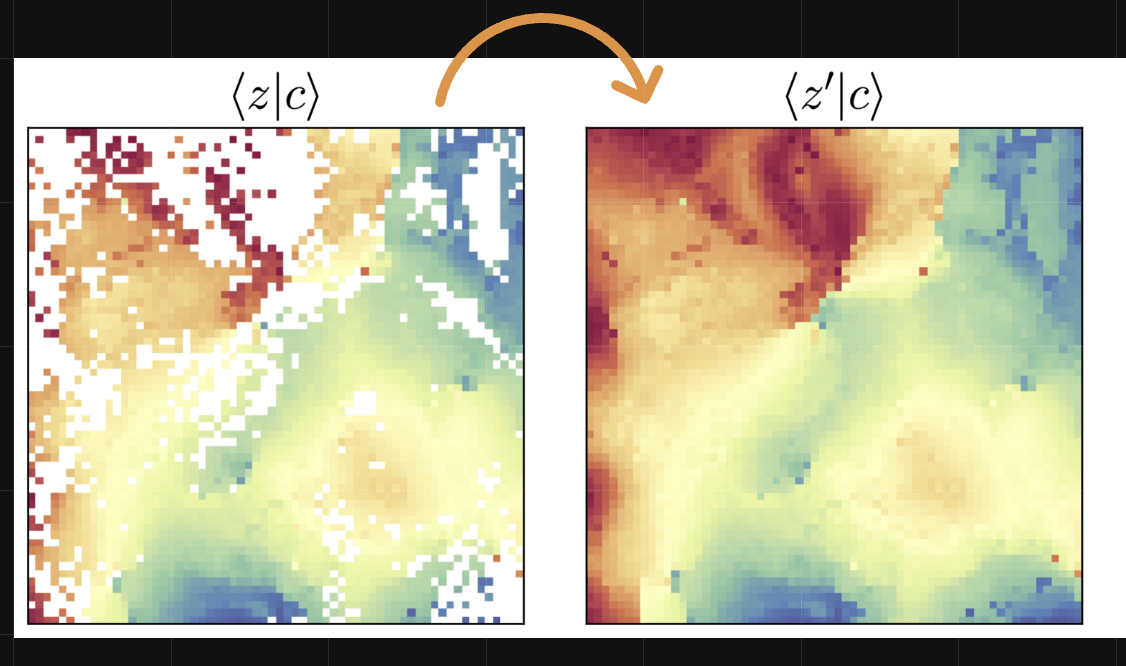
Interim Approach: Augmenting spec-z training sets for SOMPZ

YuFei Zhen

🤔

SOM

Embedding methods matter!

YuFei Zhen

😃

z

Ashmead+25 

Umap

Interim Approach: Augmenting spec-z training sets for SOMPZ

YuFei Zhen

Using UMAP to interpolate and SOM for visulization

Interim Approach: Augmenting spec-z training sets for SOMPZ

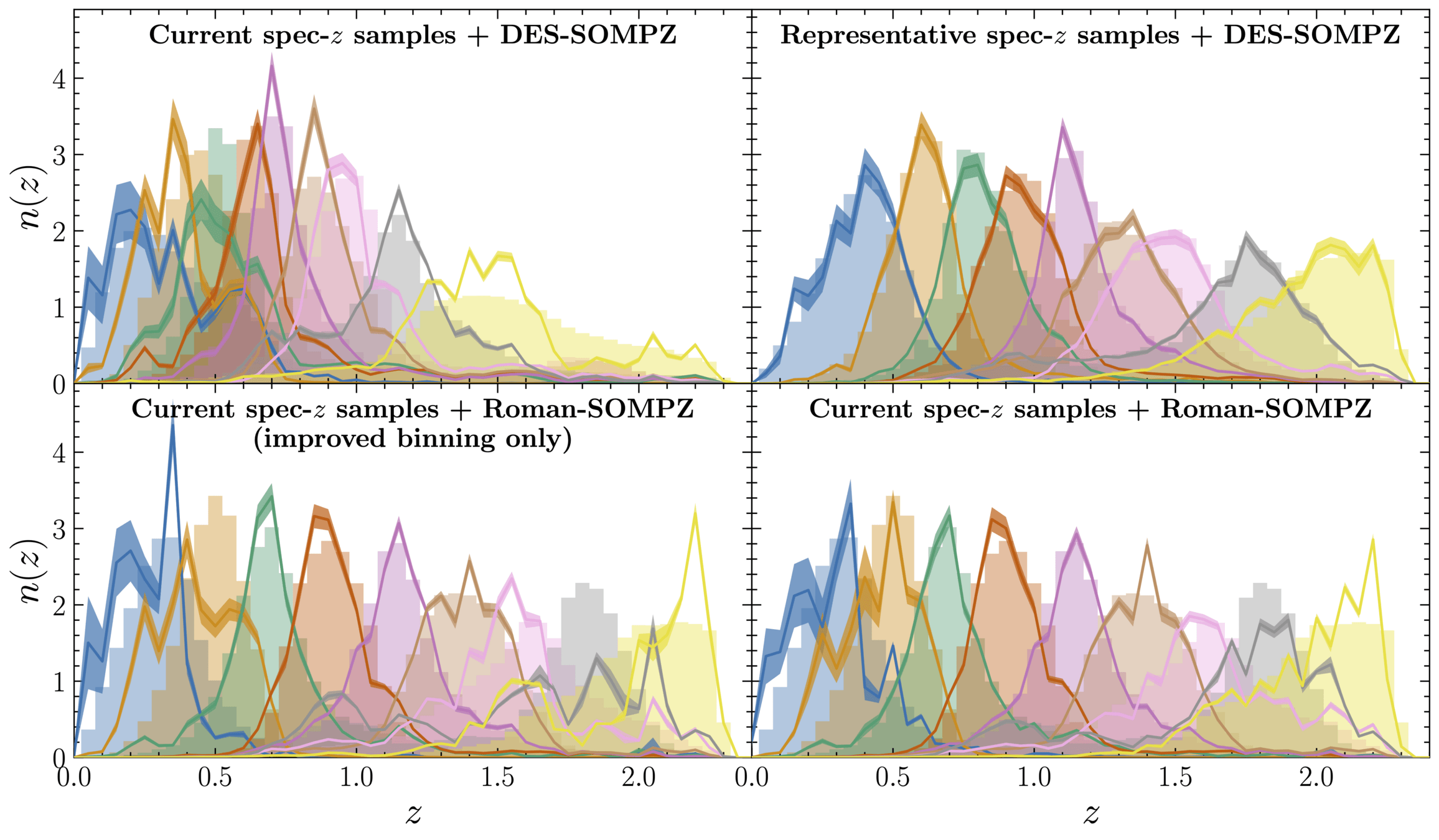
Out-of-the-box DES SOMPZ

Roman-SOMPZ

True n(z)

Estimated  n(z)

Zhen+ in prep.

YuFei Zhen

DES SOMPZ

Roman SOMPZ

Aug 30 2026

Now

To+2026  (arxiv: 2607.09849)

Zhen+ in prep.

asiaa seminar 092126

By CHUN-HAO TO

asiaa seminar 092126

  • 71