





























Jonas Neergaard-Nielsen PRO
Associate Professor @ DTU Physics, Denmark
Jonas S. Neergaard-Nielsen
QPIT & bigQ, DTU Physics
Technical University of Denmark
QCi3 summer school
Oxford, 14 September 2026
Eugene Polzik
Akira Furusawa
Ulrik Andersen
Quite different from
qubit encoding
Quite different from
stationary qubit platforms
Measurement-based QC:
Quite different from
gate model of quantum computing
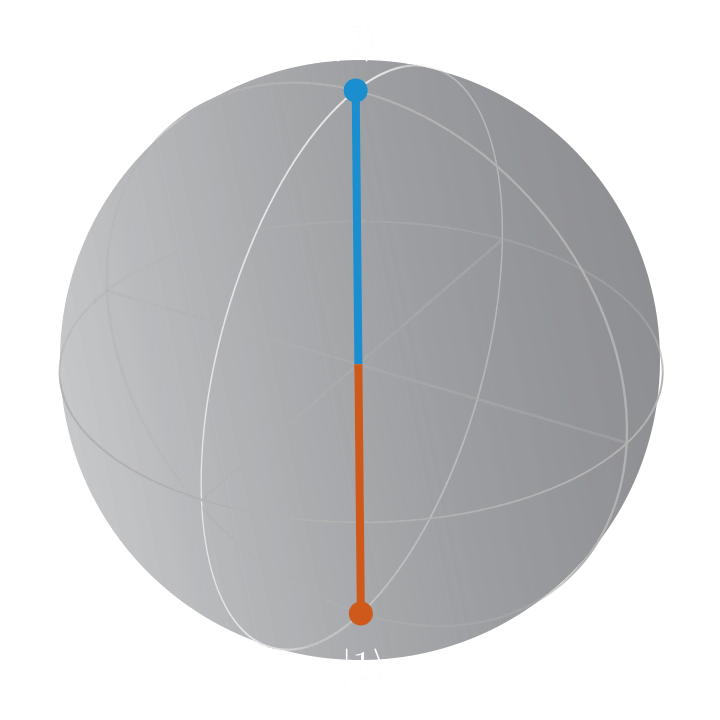
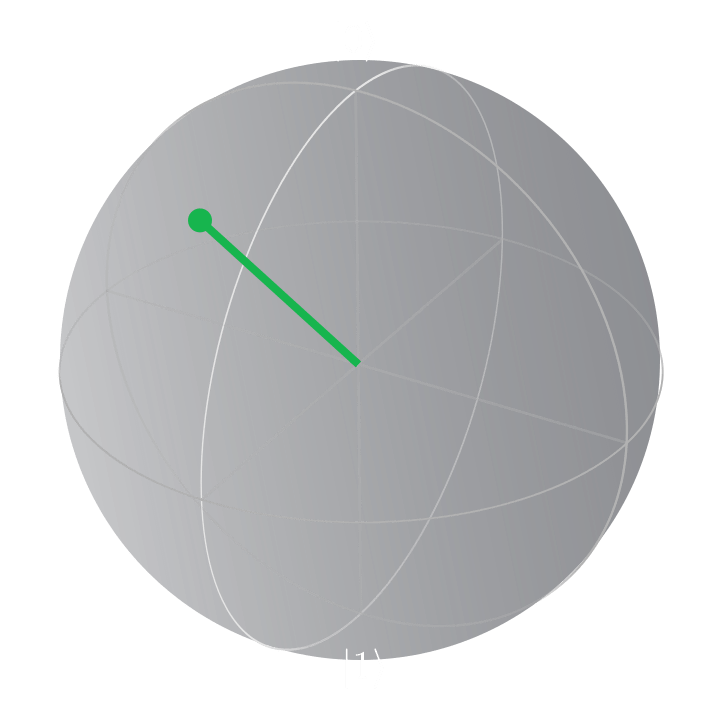
2-dimensional Hilbert space
- atomic levels, superconducting charge,
electronic spin, photon polarisation or path, ...
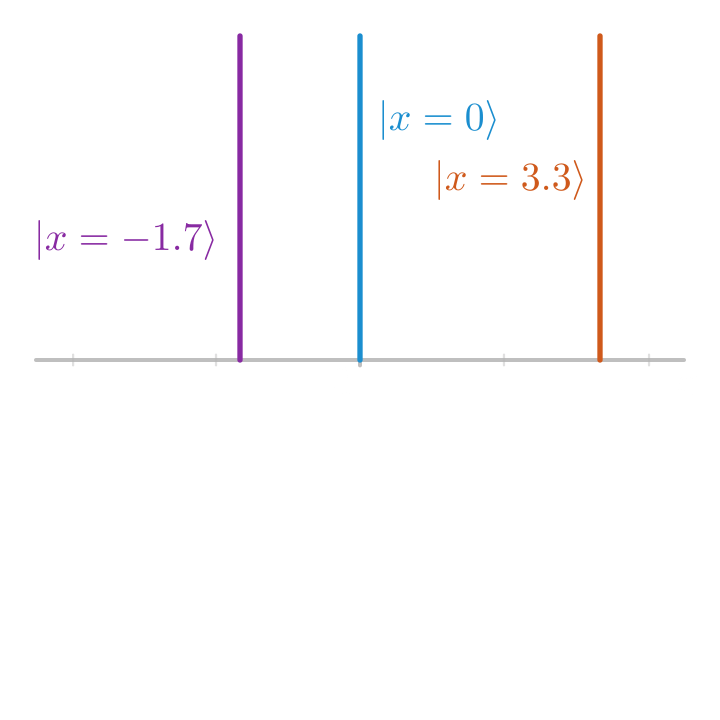
\(\infty\)-dimensional Hilbert space
- motion of trapped ion, MW resonator field,
single-mode laser field, ...
\(\ket{0}\) and \(\ket{1}\)
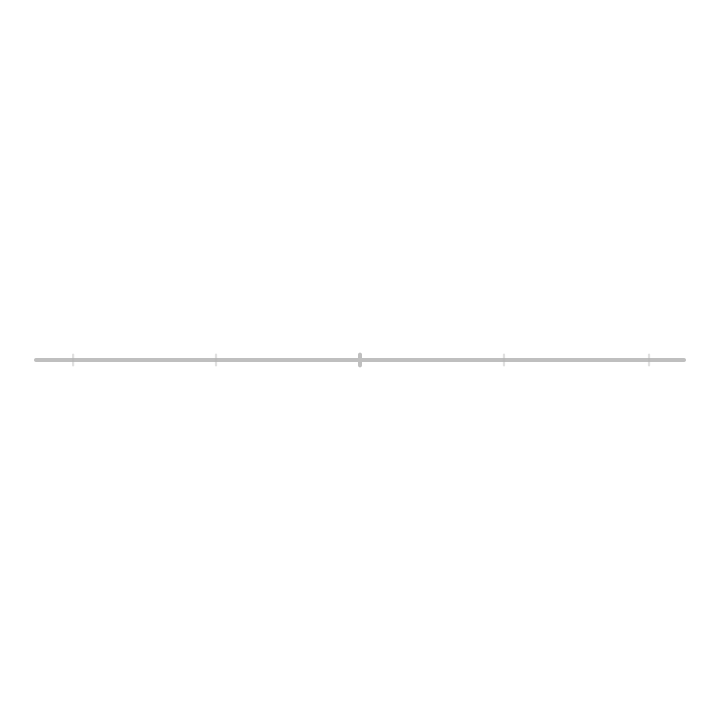
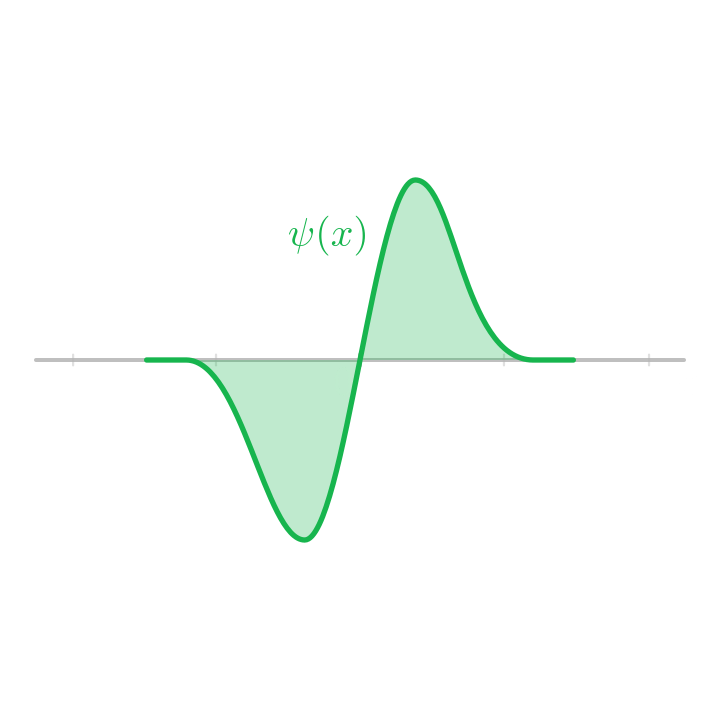
\(\ket{x}\) for any \(x\in\mathbb{R}\)
\[\ket{\psi} = c_0\ket{0} + c_1\ket{1} = \sum_{k=0}^1 c_k\ket{k}\]
\[ \ket{\psi} = \int_{-\infty}^{\infty}dx\ \psi(x) \ket{x}\]
\( c_k = \braket{k|\psi} \)
\( \psi(x) = \braket{x|\psi} \)
\[ [\hat Z,\hat X] = 2i\hat Y \]
\( [\hat{x},\hat{p}] = i \) (with \(\hbar=1\))
\[ \hat{p} = -i\hbar\frac{\partial}{\partial x} \]
\[ \Delta x \Delta p \ge \frac{1}{2} \]
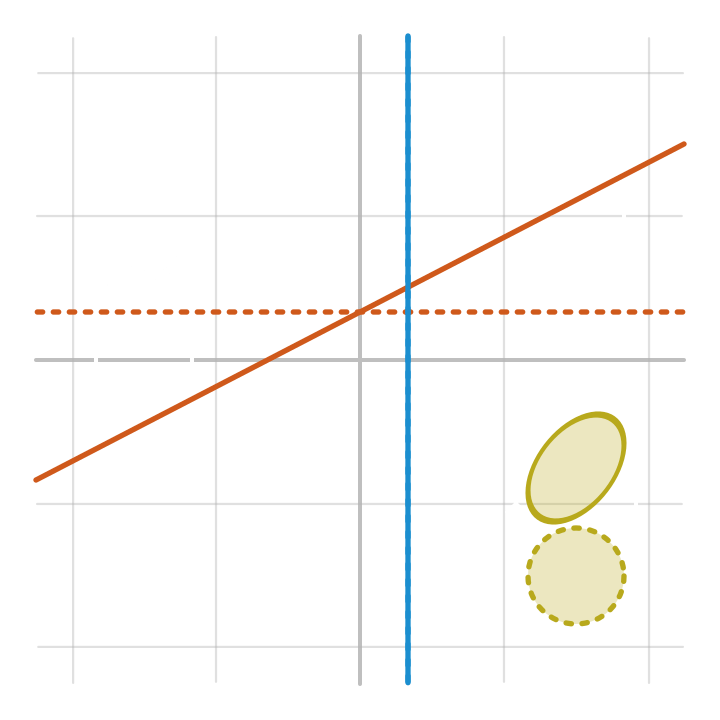
"phase space"
\( [\hat{x},\hat{p}] = i \) (with \(\hbar=1\))
\[ [\hat Z,\hat X] = 2i\hat Y \]
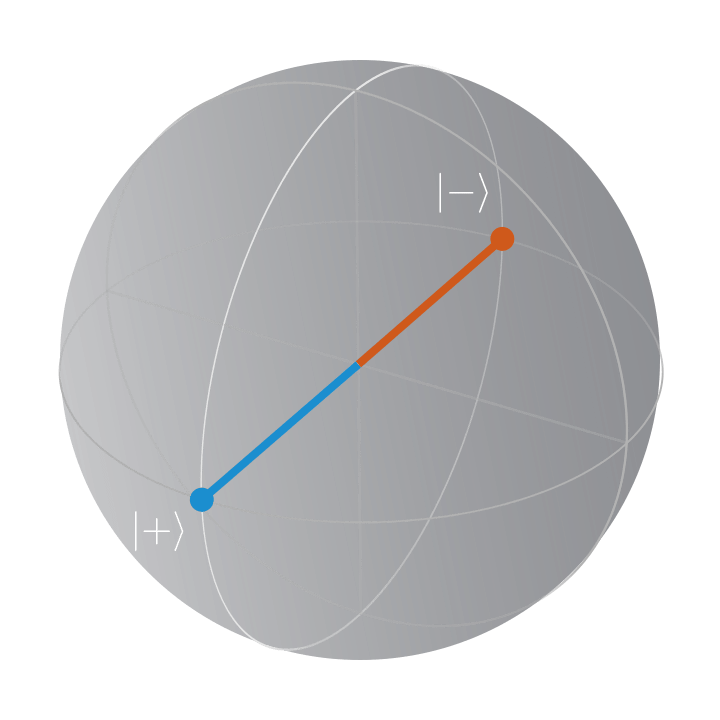
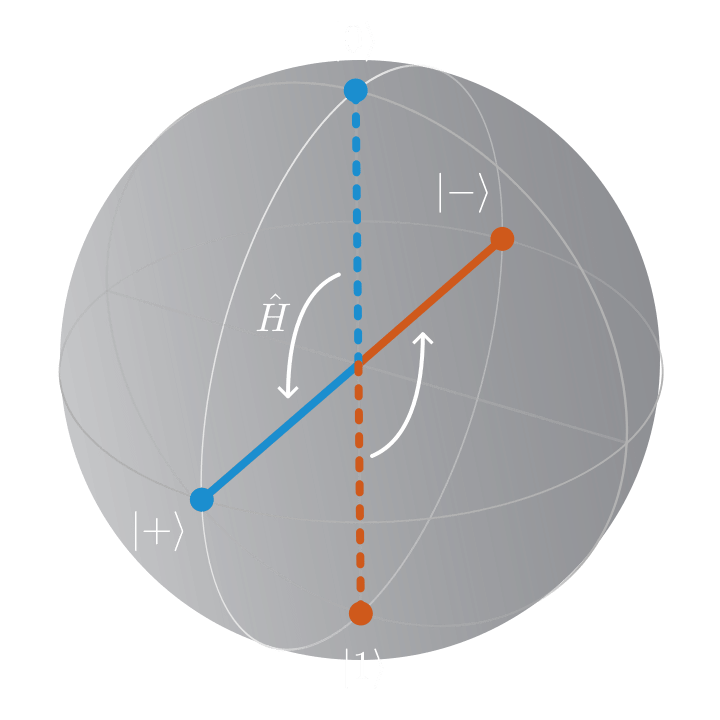
\[ \ket{+} = \hat H \ket 0 \quad \ket - = \hat H \ket 1 \]
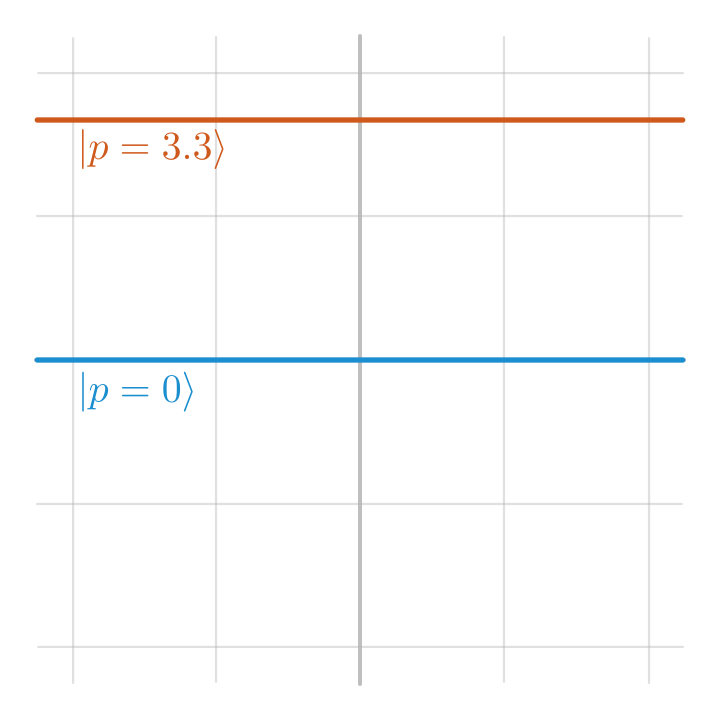
\( \ket{p=a} = \frac{1}{\sqrt{2\pi}} \int dx\ e^{iax} \ket{x} = \hat F \ket{x=a} \)
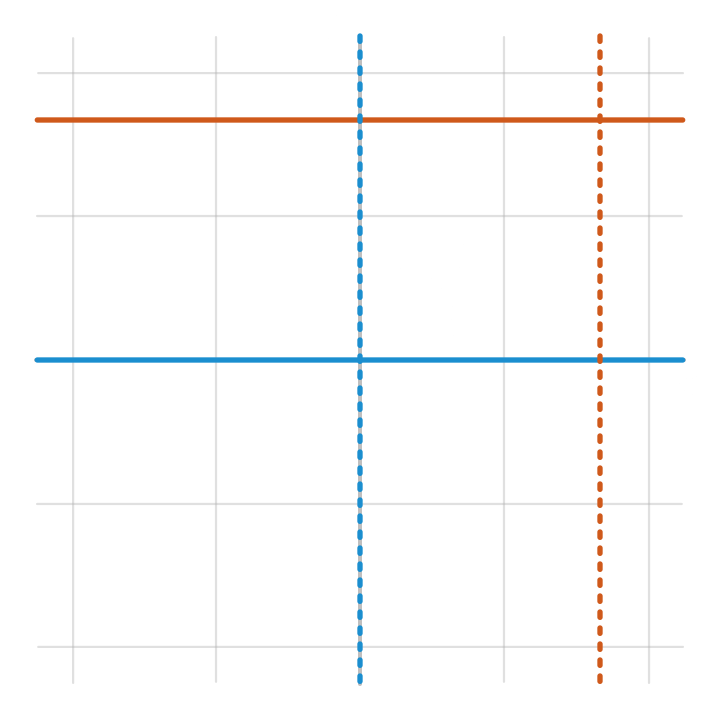
Fourier transform = 90° phase space rotation
Hadamard = 1-qubit QFT
\( \hat H = \frac{1}{\sqrt{2}} \begin{pmatrix}1&1\\1&-1\end{pmatrix} \)
\( \hat F = \exp[i\frac{\pi}{4} (\hat x^2 + \hat p^2)] \)
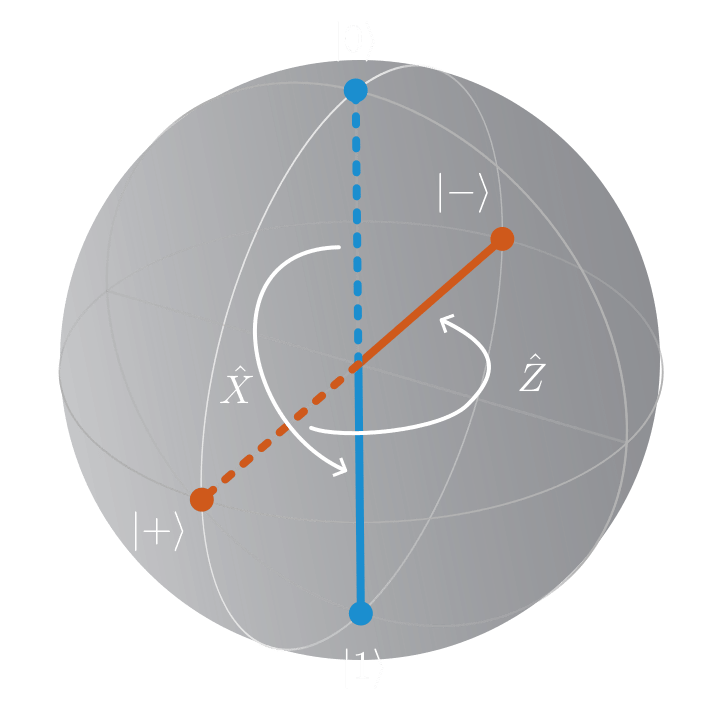
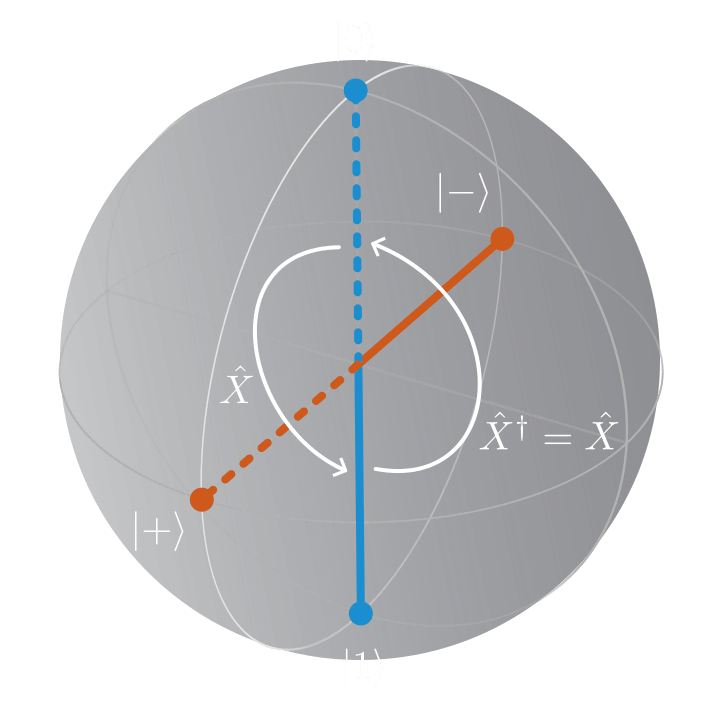
\[ \hat X \ket k = \ket{k \oplus 1} \quad \hat Z \ket k = (-1)^k \ket k \]
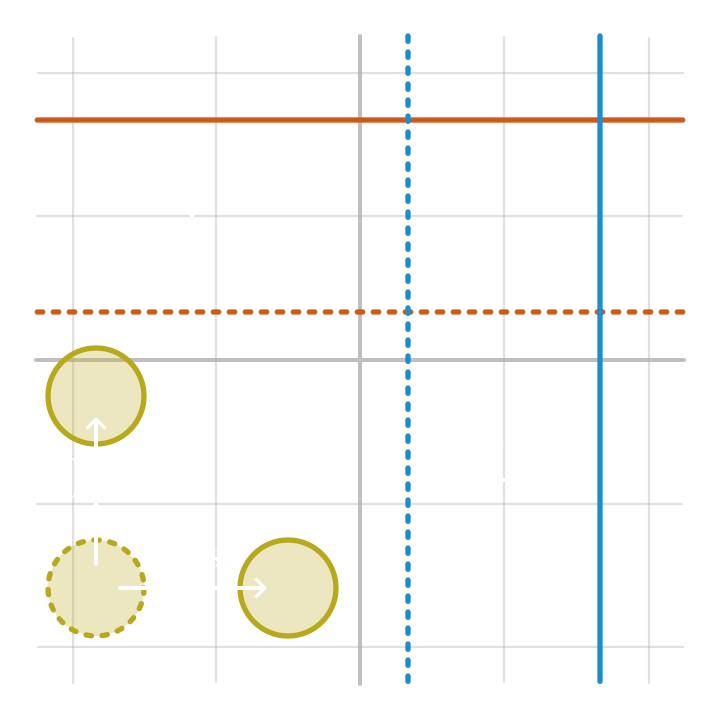
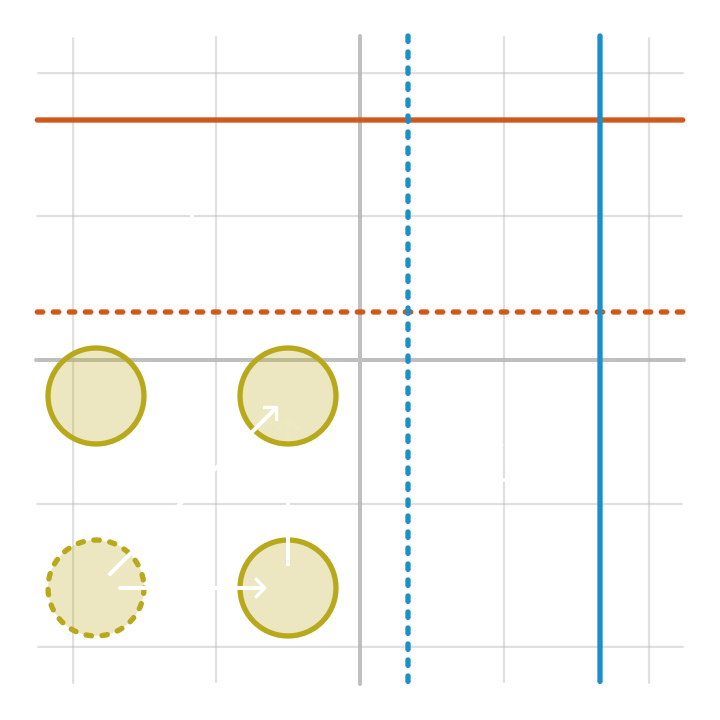
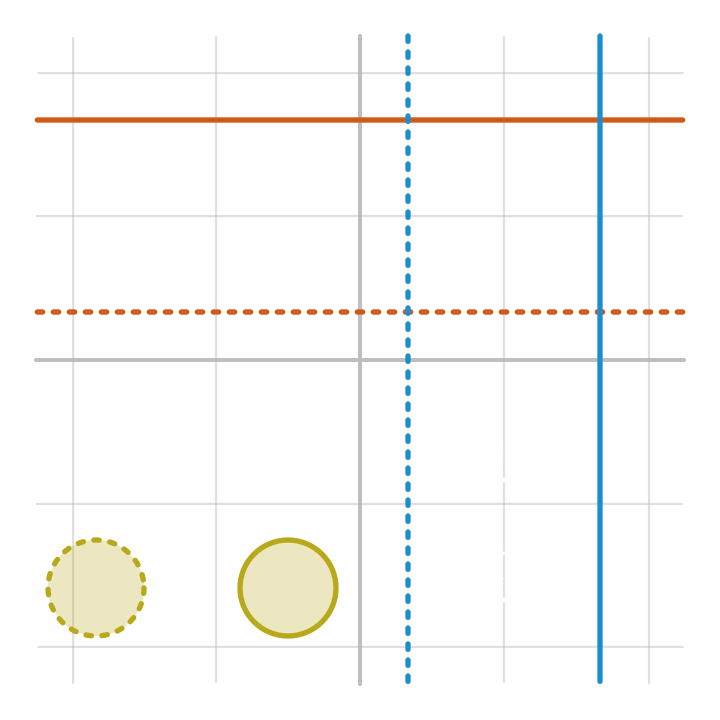
\( \hat X(s) \ket{a} = \ket{a+s} \quad \hat Z(s) \ket{a} = e^{isa} \ket{a} \)
\( \hat X \) shifts value (position),
\( \hat Z \) shifts phase (momentum)
\(\hat X\) shifts the value, \(\hat Z\) gives a phase
\( \hat X(s) = e^{-is\hat p} \quad \hat Z(s) = e^{is\hat x} \)
\[ \hat X \hat Z = -\hat Z \hat X = -i\hat Y\]
\( \hat X(s) \hat Z(t) = e^{-ist} \hat Z(t) \hat X(s) \)
\( = \hat D(s,t) \) (up to phase)
\( \hat X(s) = e^{-is\hat p} \quad \hat Z(s) = e^{is\hat x} \)
\( \hat X(s) = e^{-is\hat p} \quad \hat Z(s) = e^{is\hat x} \)
\( \hat P(s) = e^{\frac{is}{2}\hat x^2} \)
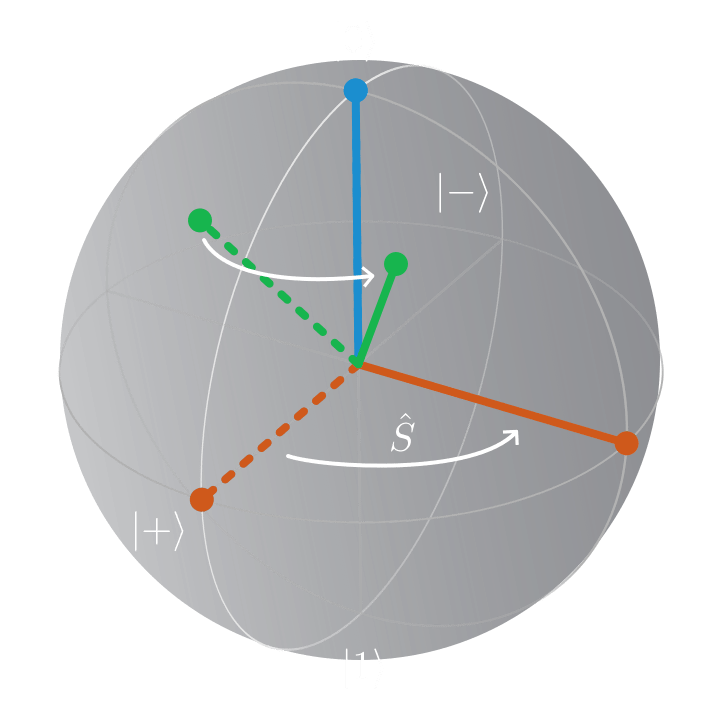
\[ \hat S \ket k = i^k \ket k \]
\(\hat S = \hat P(\frac{\pi}{2}) = \sqrt{\hat Z} \) gives a \( \pi/2 \) phase
\[ \hat P(s) \ket a = e^{isa^2/2} \ket a \]
the CV phase or shear gate
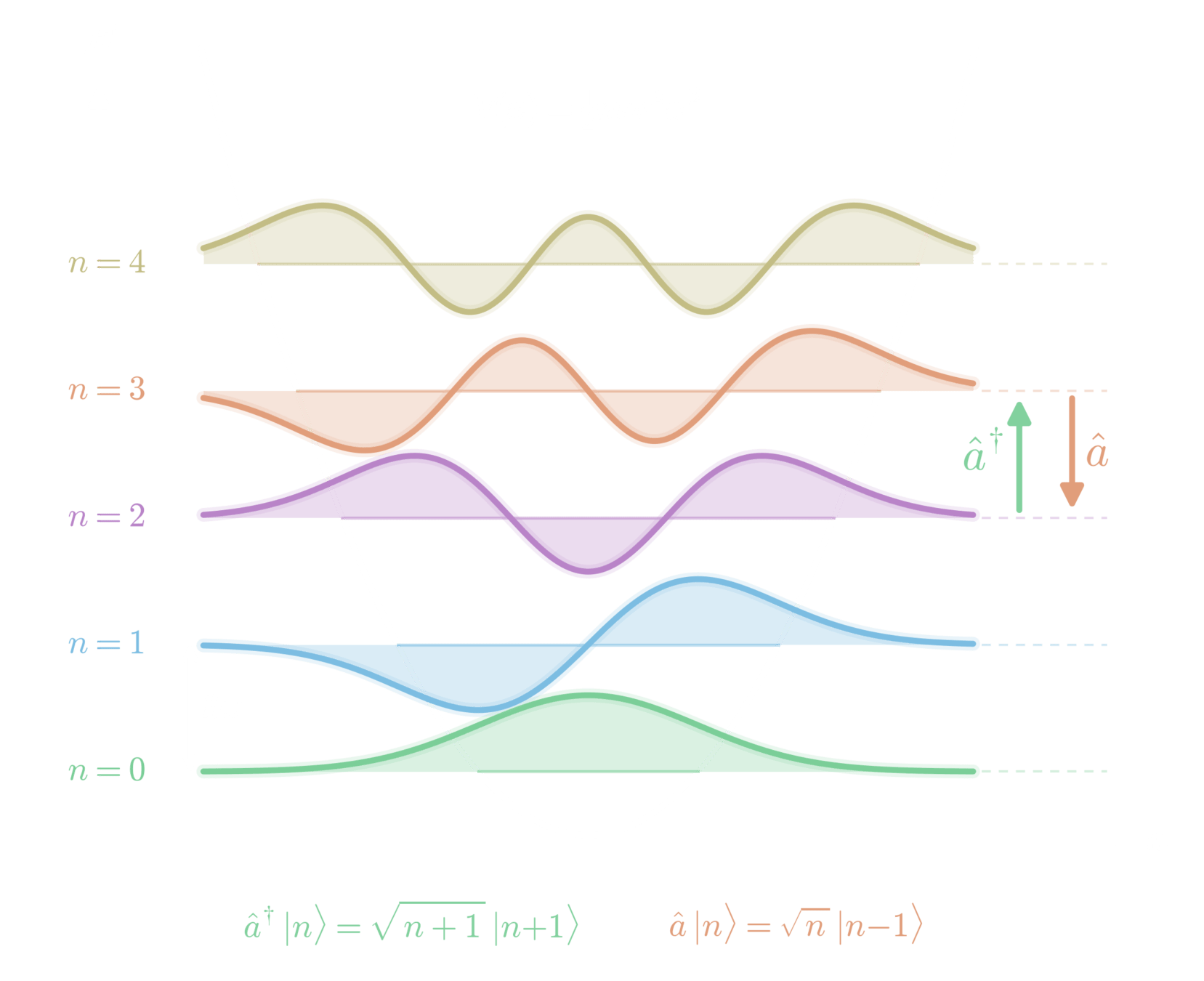
\( \hat x = \dfrac{\hat a + \hat a^\dagger}{\sqrt 2} \)
\( \hat p = \dfrac{\hat a - \hat a^\dagger}{i\sqrt 2} \)
Relation between quadratures and raising + lowering operators
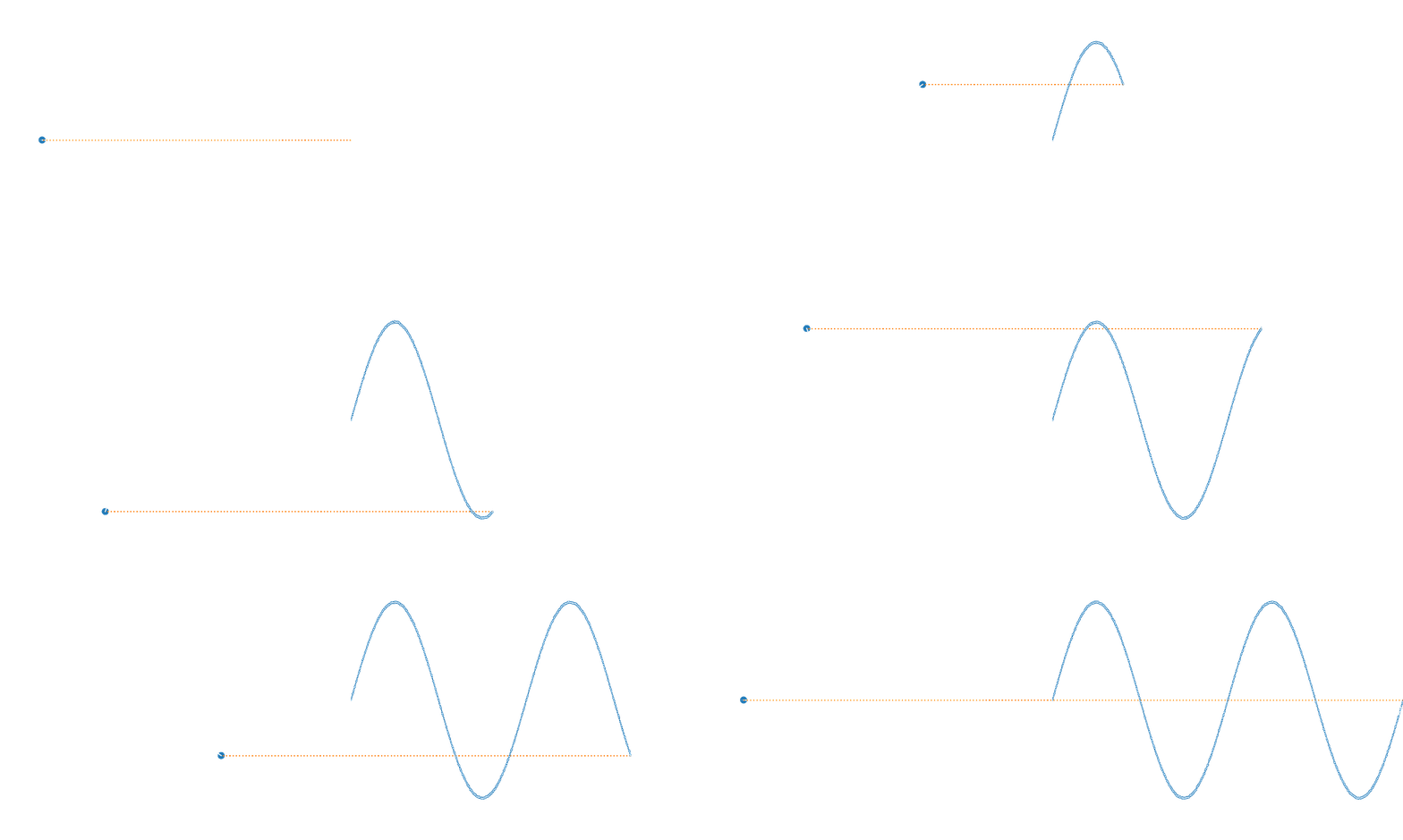
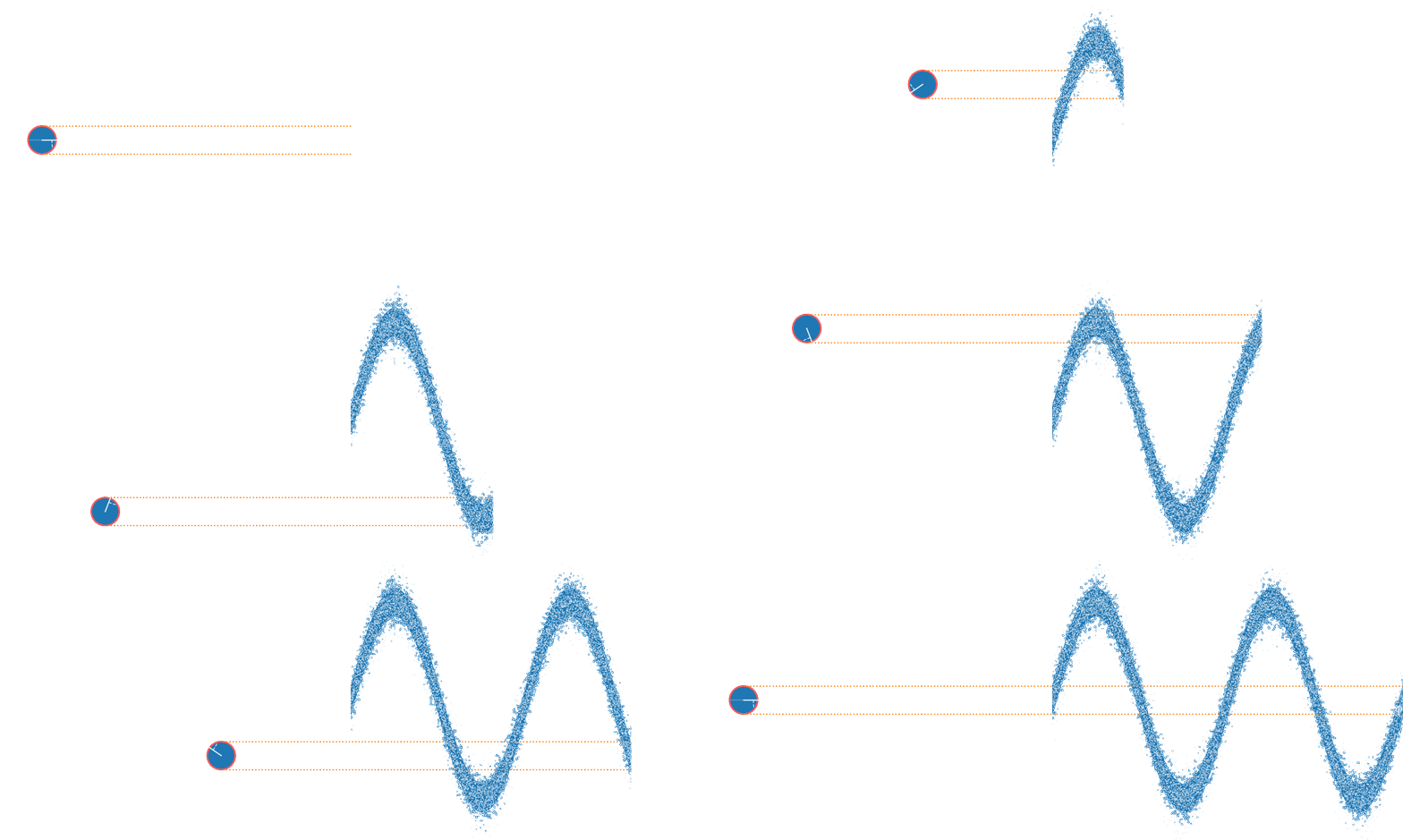
monochromatic EM field: harmonic oscillator
\(\hat x\) and \(\hat p\) represent the field quadratures
σx σp ≥ ħ/2
[x,p]=iħ ⇒
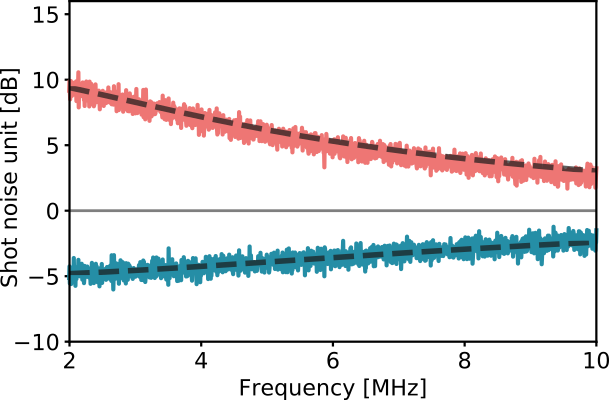
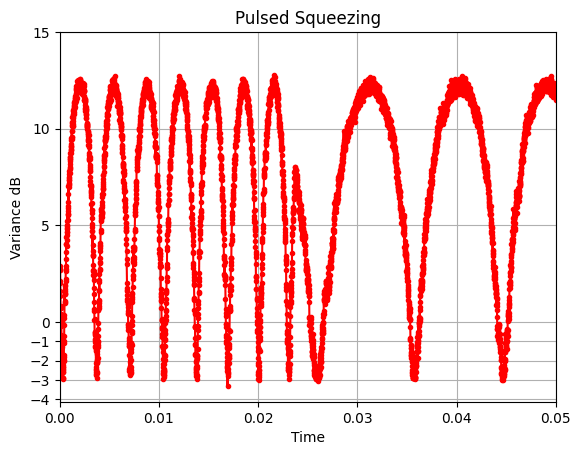
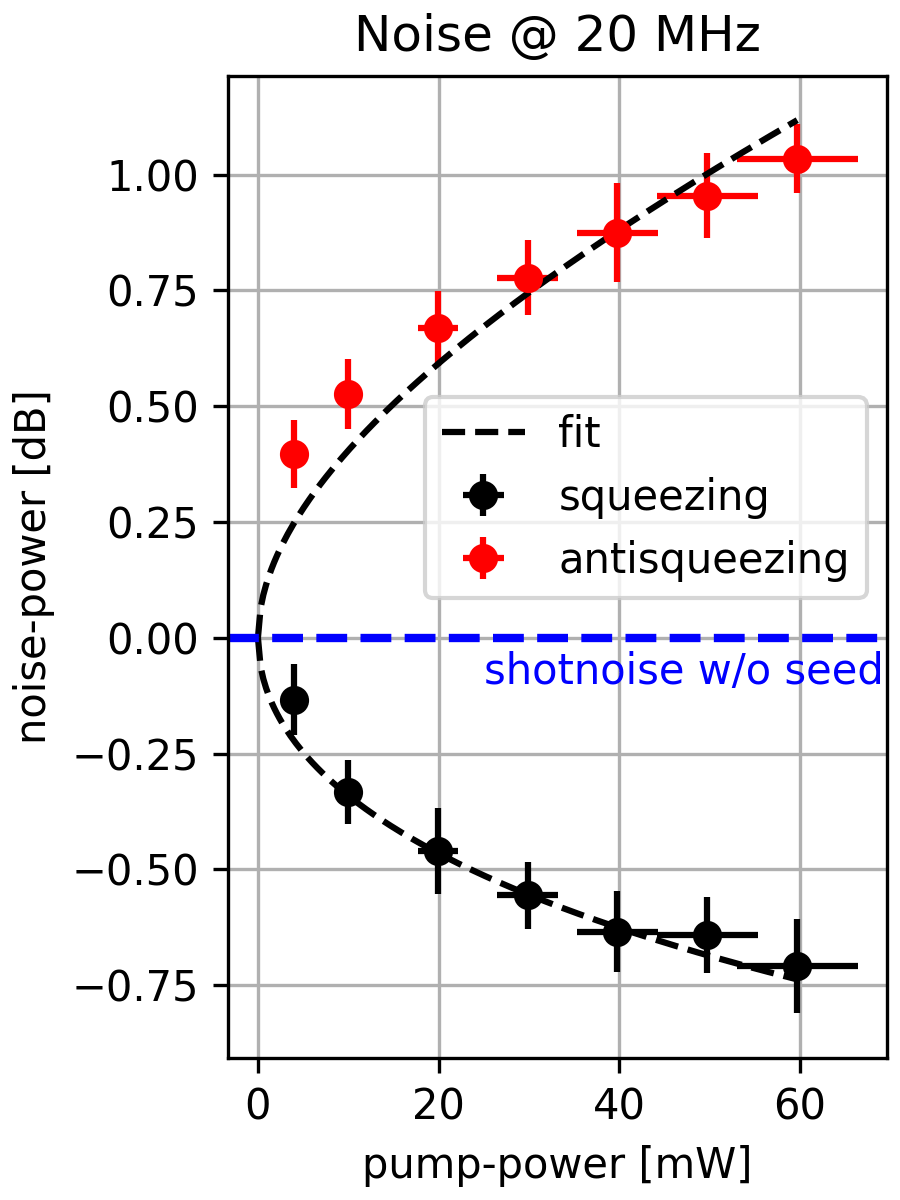
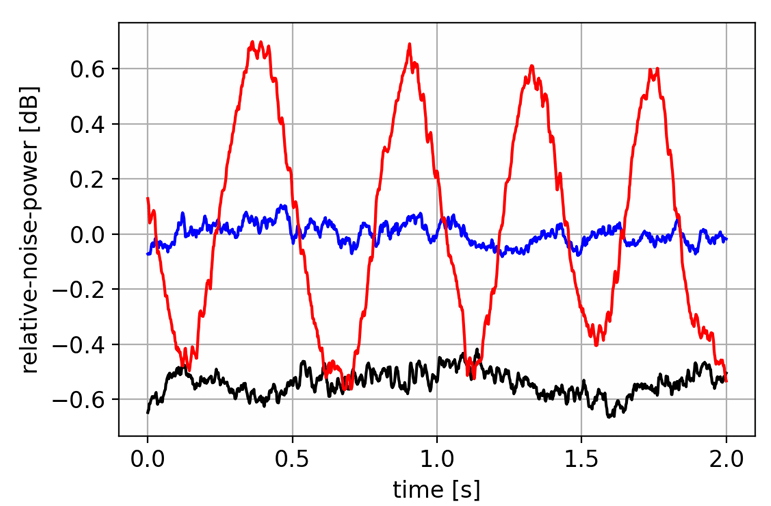
quantum noise!
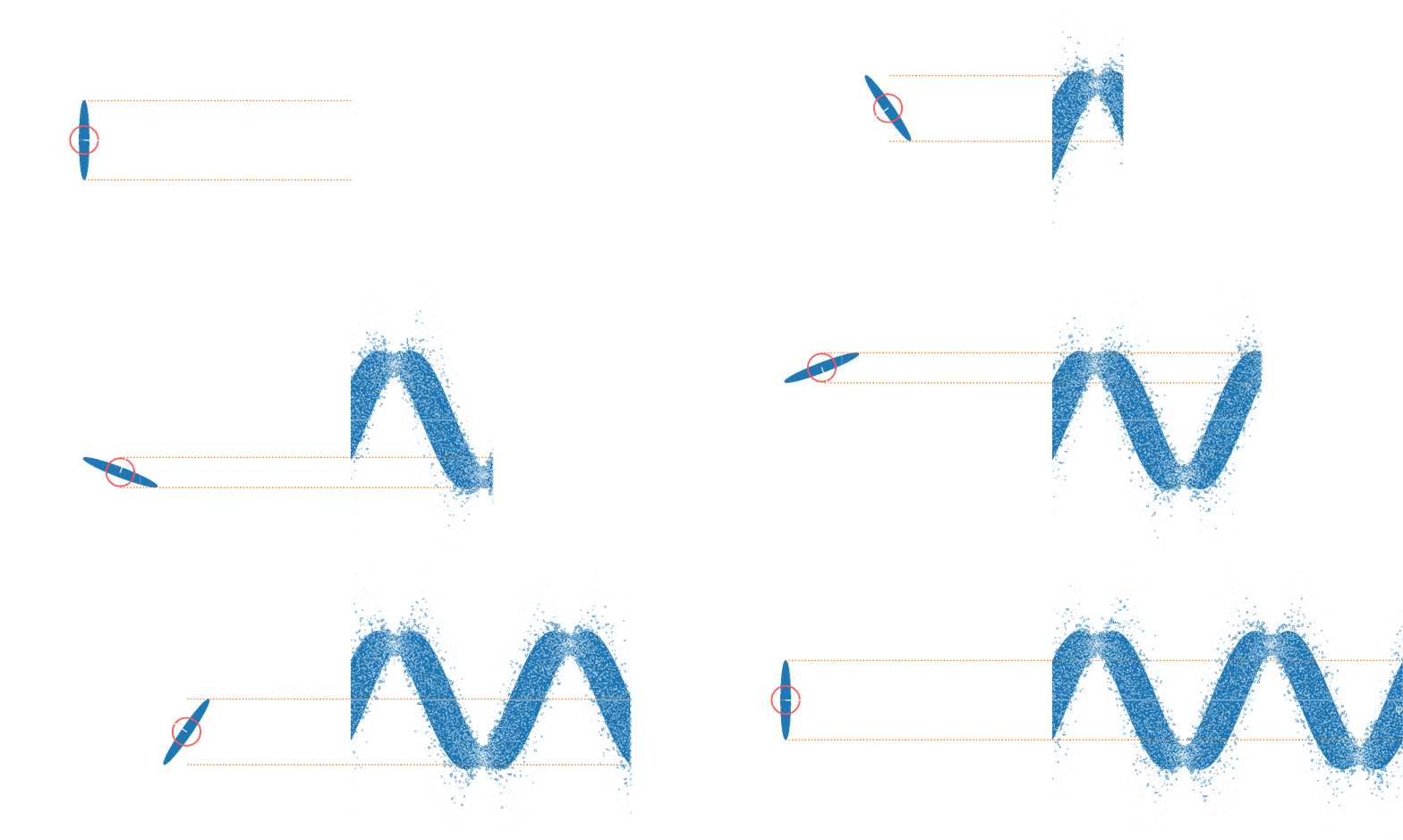
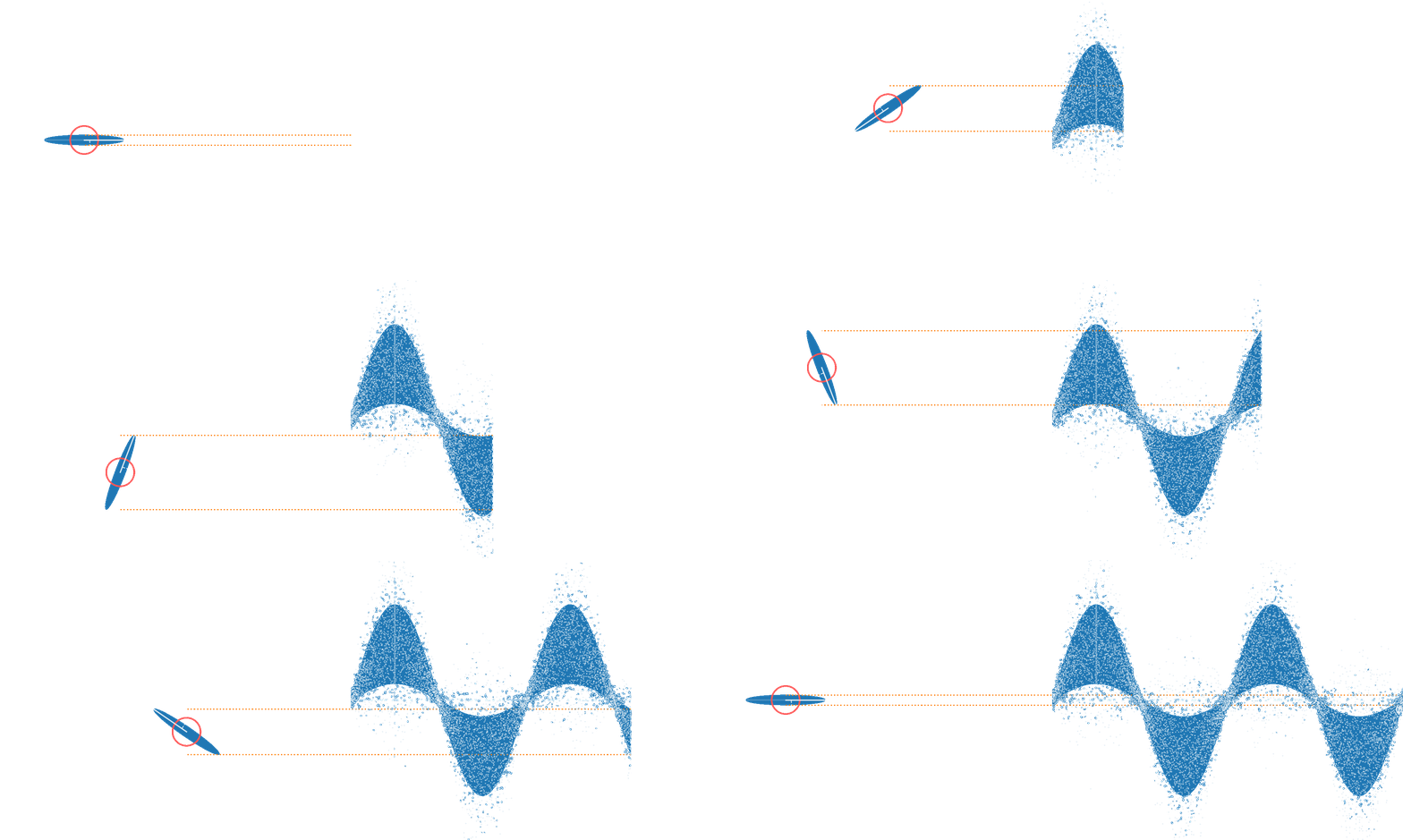
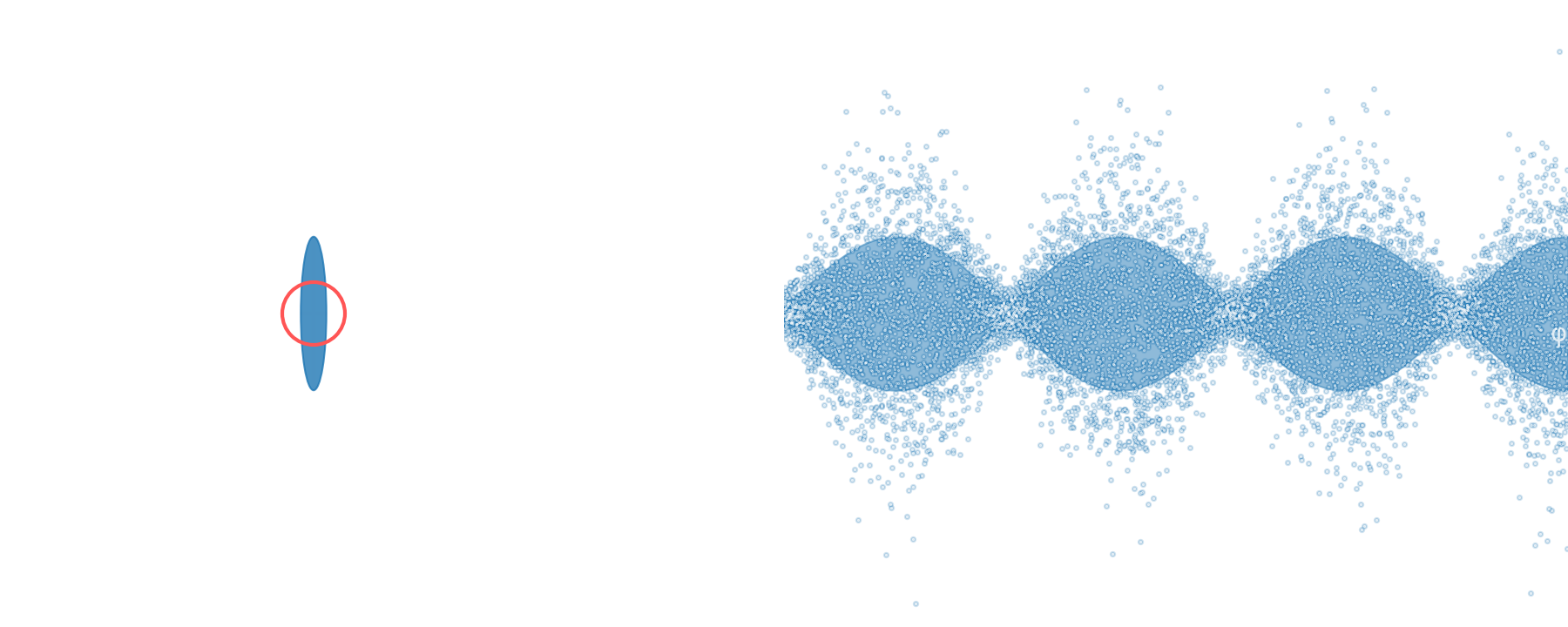
- can be redistributed
σx σp ≥ ħ/2
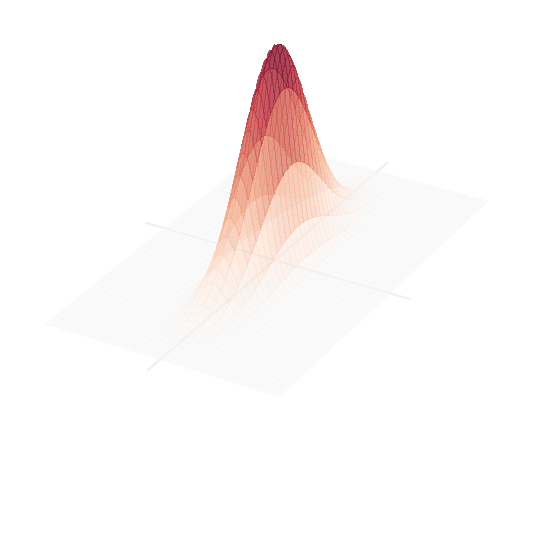
amplitude squeezing
σx σp ≥ ħ/2
phase squeezing
σx σp ≥ ħ/2
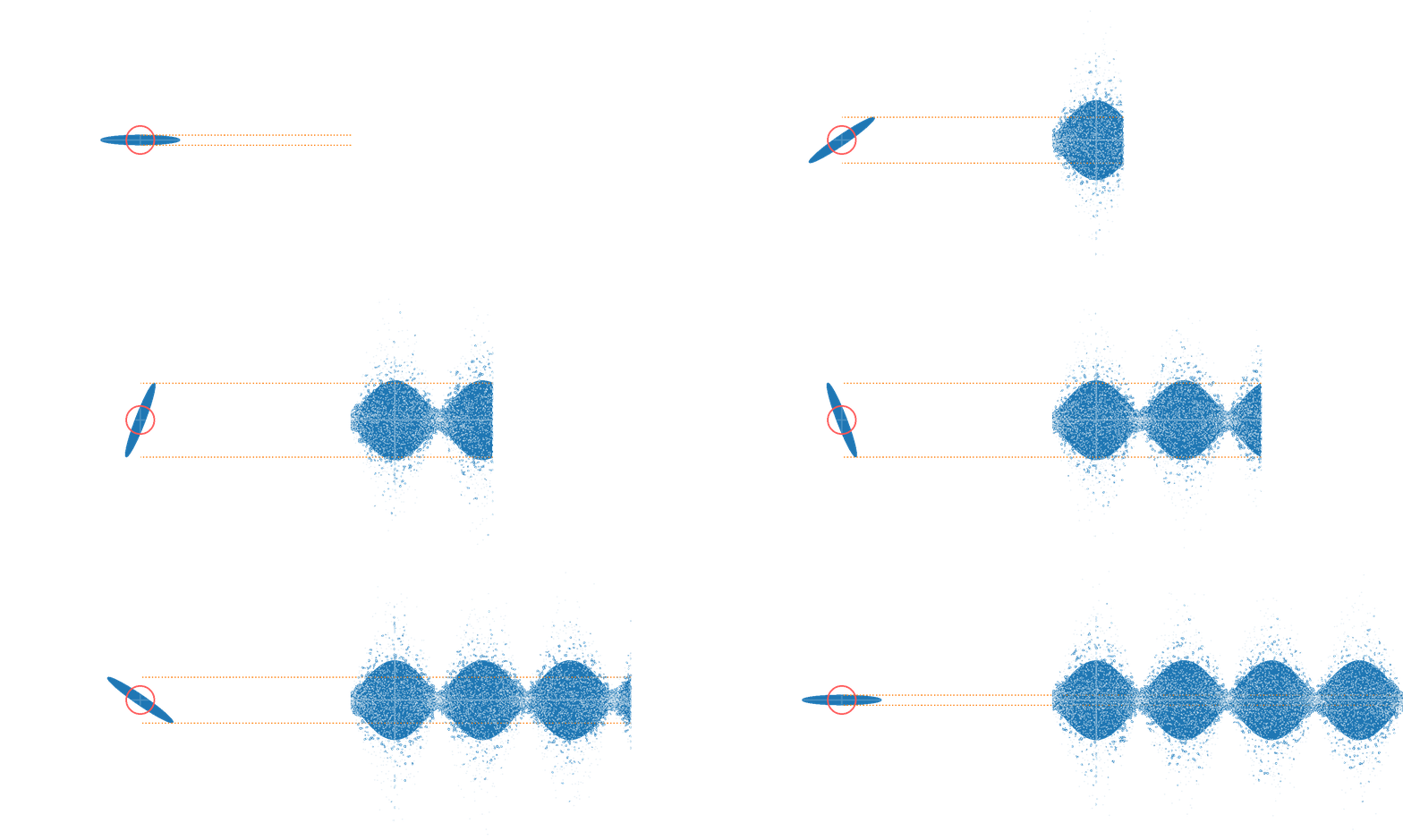
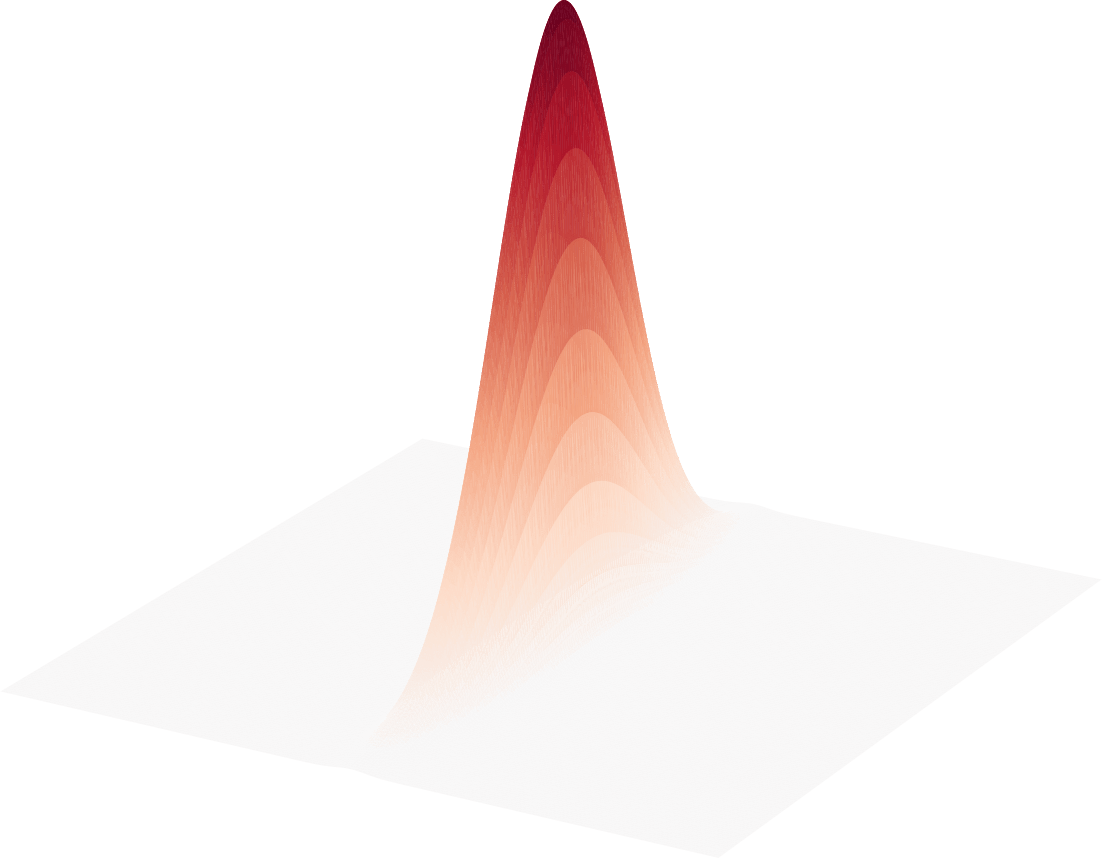
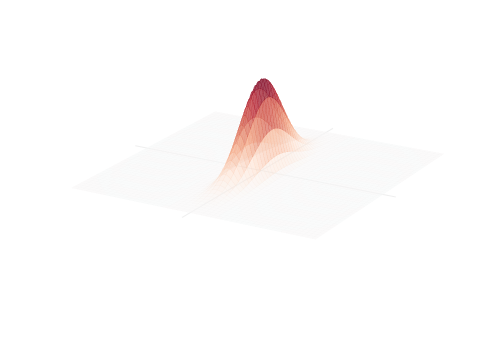
squeezed vacuum
\( \hat S(r) = \exp[\frac{ir}{2}(\hat x\hat p + \hat p\hat x)] \)
CV basis states \( \ket x \) are unphysical
- infinitely squeezed, i.e. infinite energy
- a fundamental limitation of CV
Use squeezed state as an approximation
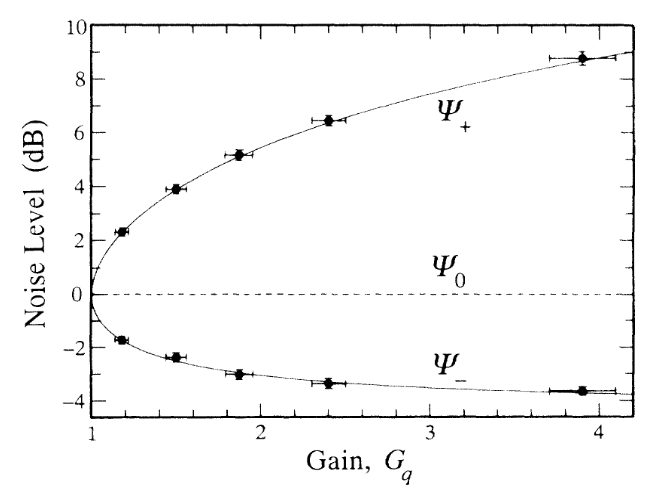
Same Hamiltonian \( -i\hbar \frac{g}{2} (\hat a^2 - \hat a^{\dagger 2})\) as for SPDC (spontaneous parametric down-conversion) - the workhorse single-photon source
\( \hat S(r) = \exp[\frac{ir}{2}(\hat x\hat p + \hat p\hat x)] = \exp[\frac{r}{2}(\hat a^2 - \hat a^{\dagger 2}] \)
Low gain
High gain
\( \hat x, \hat p \) and intermediate quadratures \( \hat x(\theta) = \hat x\cos\theta + \hat p\sin\theta \) can be efficiently measured by homodyne detection
signal field
local oscillator
- strong reference field at phase \(\theta\)
output voltage \(V \propto x(\theta)\)
not "clicks" - data is always there
Main difference between DV and CV photonics [somewhat generalised]:
DV photonic qubits are (often) probabilistic. DV gates are probabilistic.
Squeezing is deterministic. CV gates are deterministic.
DV protocols are typically post-selected - they work (well) when they work. Loss reduces the rate.
CV (Gaussian) protocols always work, but not necessarily well.
Loss reduces the quality.
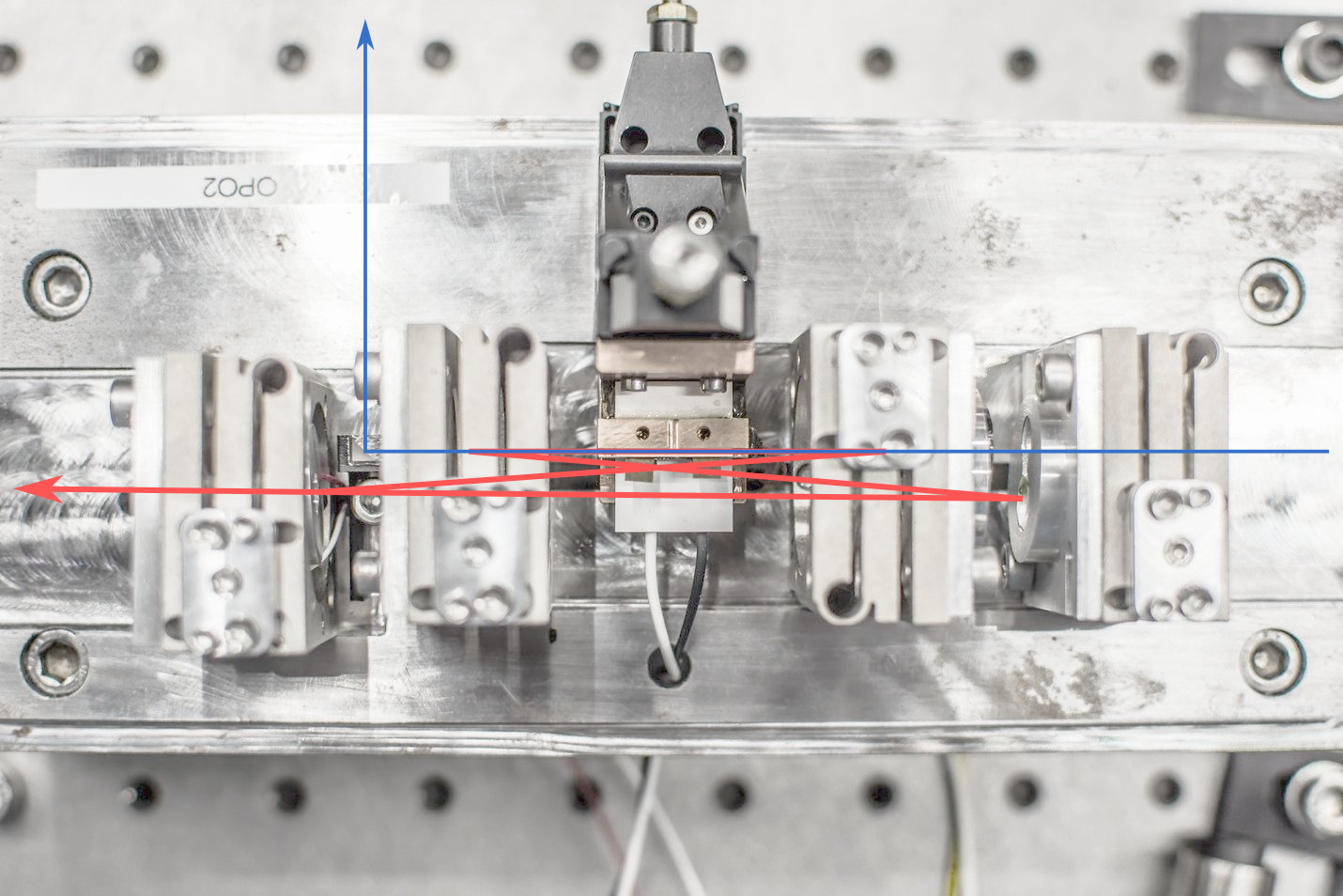
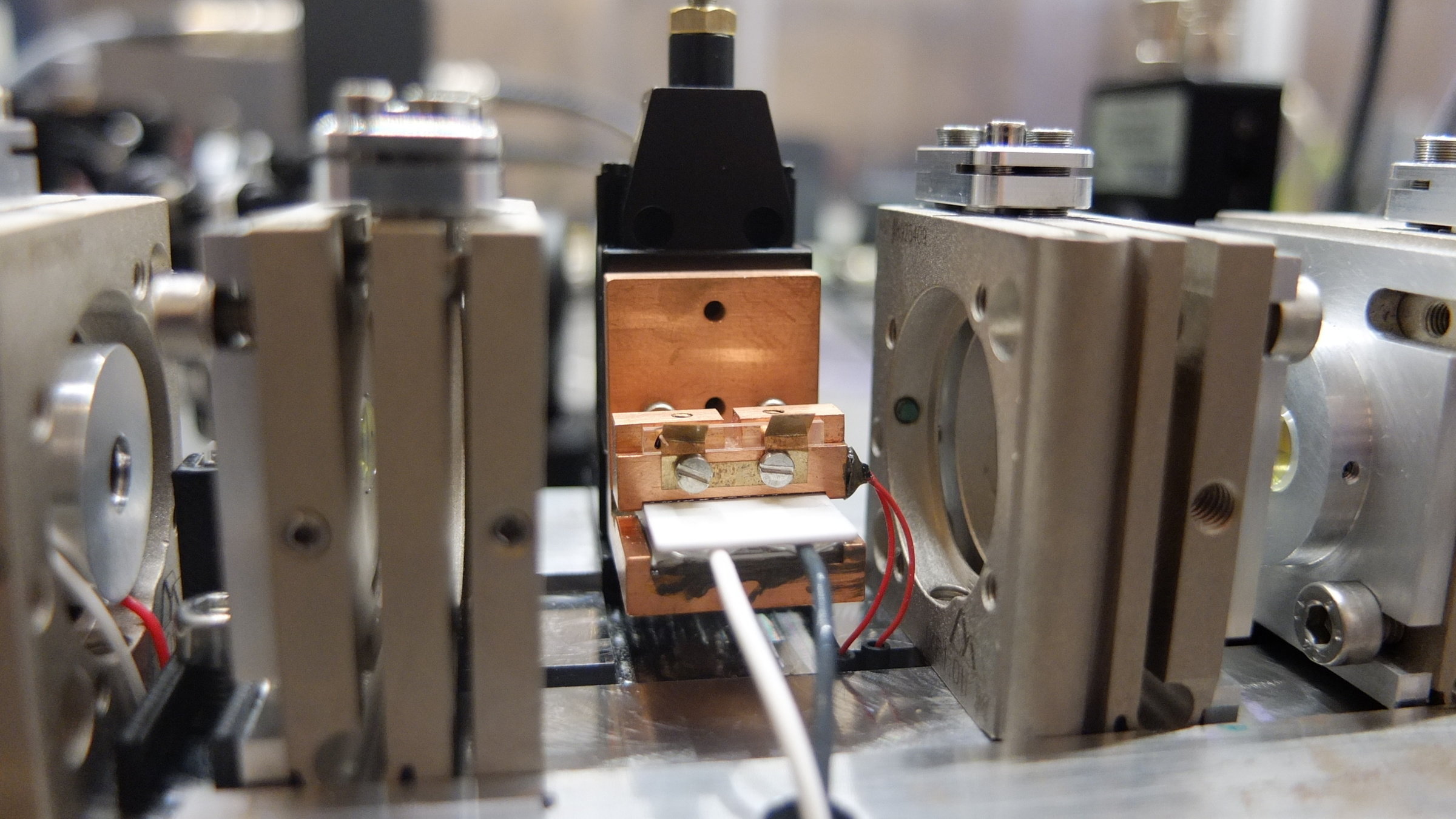
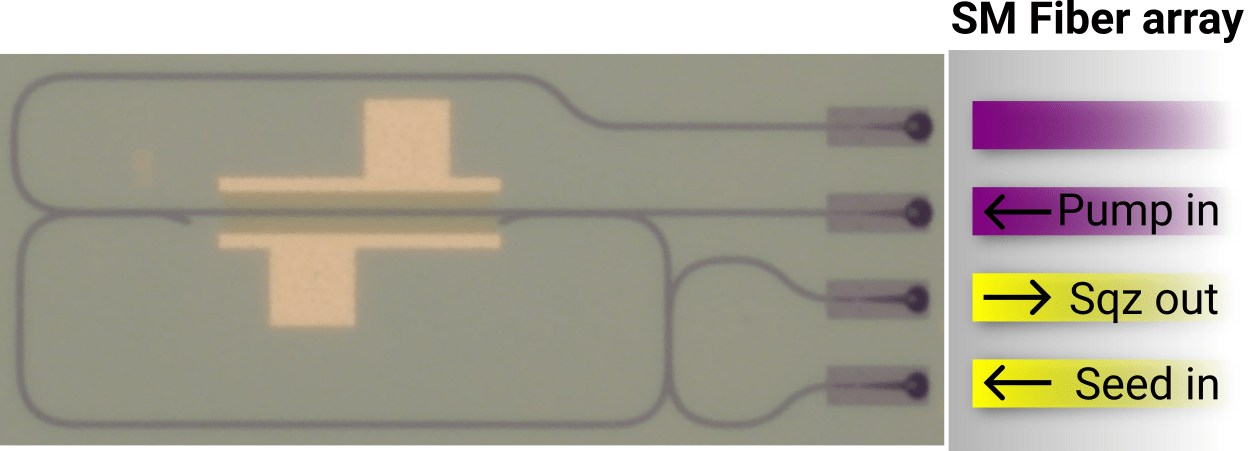
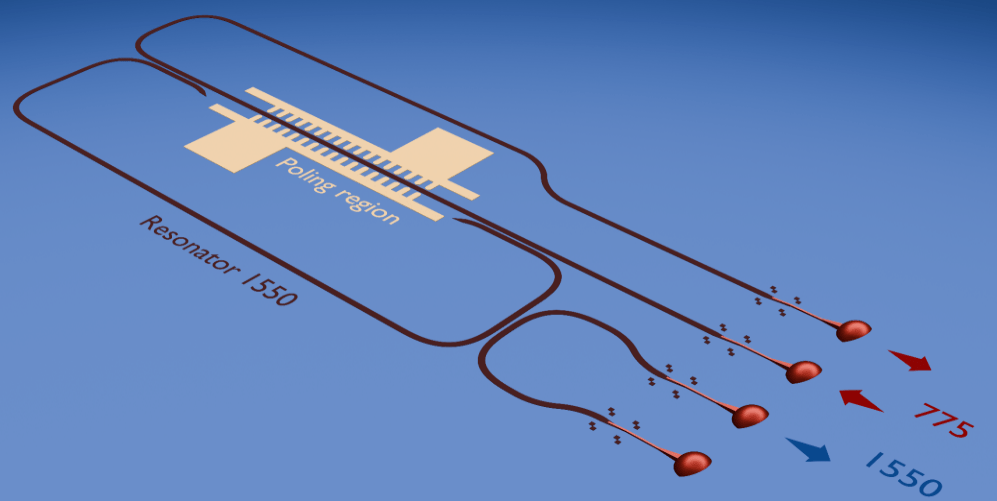
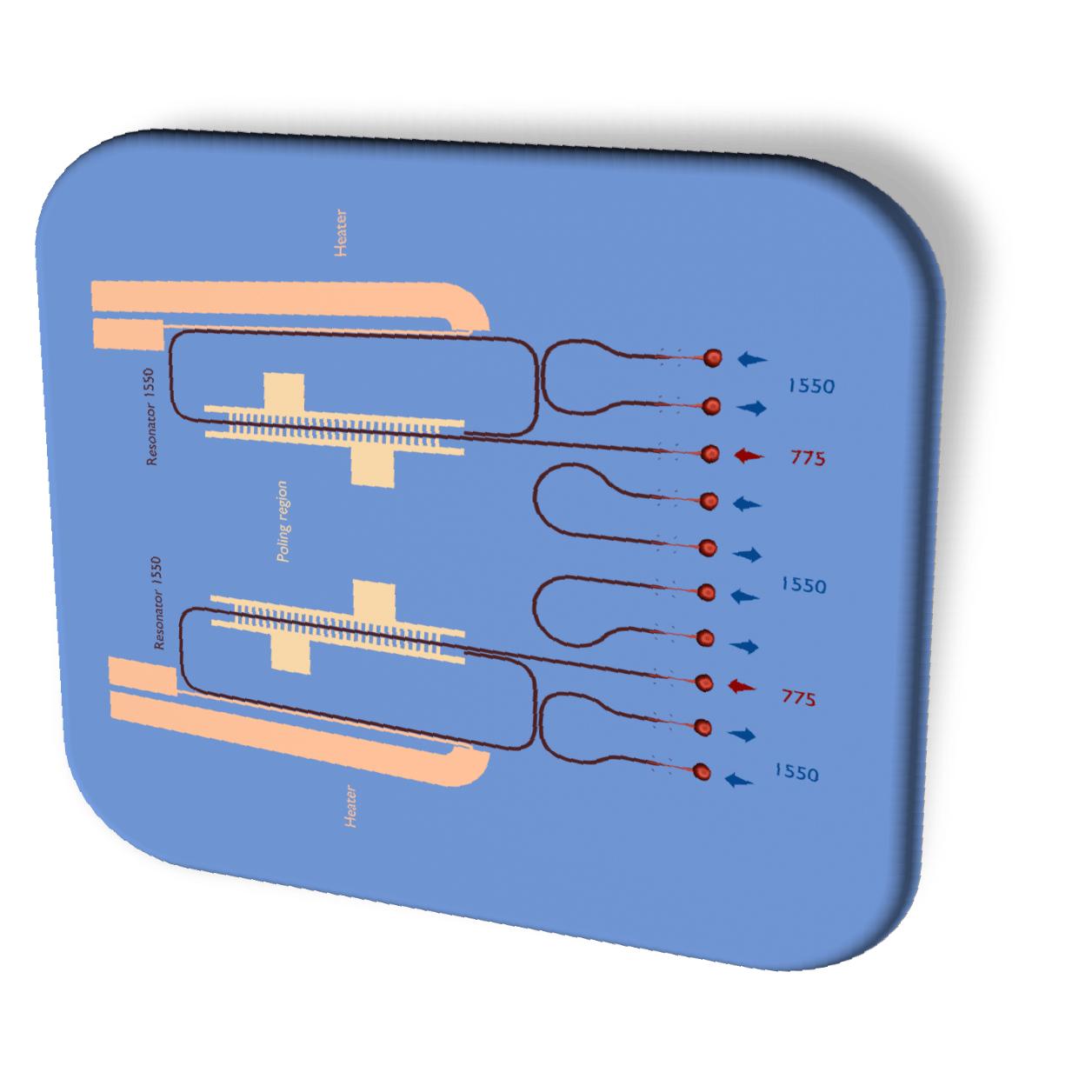
Currently ~17 squeezers
of various sorts
Applications:
\( CX\ket{x}_a\ket{y}_b = \ket{x}_a\ket{x\oplus y}_b \)
CNOT / CX
\( CX(g)\ket{x}_a\ket{y}_b = \ket{x}_a\ket{x+gy}_b \)
\( CX = \ket{0}_a\!\bra{0} \otimes \hat I_b + \ket{1}_a\!\bra{1} \otimes \hat X_b \)
\( CX(g) = \exp[-ig\hat x_a \hat p_b] \)
\( CX\ket{x}_a\ket{y}_b = \ket{x}_a\ket{x\oplus y}_b \)
CNOT / CX
\( CX(g)\ket{x}_a\ket{y}_b = \ket{x}_a\ket{x+gy}_b \)
\( CX = \ket{0}_a\!\bra{0} \otimes \hat I_b + \ket{1}_a\!\bra{1} \otimes \hat X_b \)
\( CX(g) = \exp[-ig\hat x_a \hat p_b] \)
\( CZ\ket{x}_a\ket{y}_b = (-1)^{xy}\ket{x}_a\ket{y}_b \)
\( CZ = \ket{0}_a\!\bra{0} \otimes \hat I_b + \ket{1}_a\!\bra{1} \otimes \hat Z_b \)
CZ (controlled-phase)
\( CZ(g)\ket{x}_a\ket{y}_b = e^{igxy}\ket{x}_a\ket{y}_b \)
\( CZ(g) = \exp[-ig\hat x_a \hat x_b] \)
\( CX\ket{x}_a\ket{y}_b = \ket{x}_a\ket{x\oplus y}_b \)
CNOT / CX
\( CX(g)\ket{x}_a\ket{y}_b = \ket{x}_a\ket{x+gy}_b \)
\( CX = \ket{0}_a\!\bra{0} \otimes \hat I_b + \ket{1}_a\!\bra{1} \otimes \hat X_b \)
\( CX(g) = \exp[-ig\hat x_a \hat p_b] \)
\( CZ\ket{x}_a\ket{y}_b = (-1)^{xy}\ket{x}_a\ket{y}_b \)
\( CZ = \ket{0}_a\!\bra{0} \otimes \hat I_b + \ket{1}_a\!\bra{1} \otimes \hat Z_b \)
CZ (controlled-phase)
\( CZ(g)\ket{x}_a\ket{y}_b = e^{igxy}\ket{x}_a\ket{y}_b \)
\( CZ(g) = \exp[-ig\hat x_a \hat x_b] \)
beamsplitter
\( BS(\theta) = \exp[i\theta(\hat x_a \hat p_b - \hat p_a \hat x_b)] \)
\(H + S + CNOT\) generate the Clifford group - "easy, non-magical operations"
\(F + P(s) + D(s,t) + BS(\theta)\) generate the Gaussian group
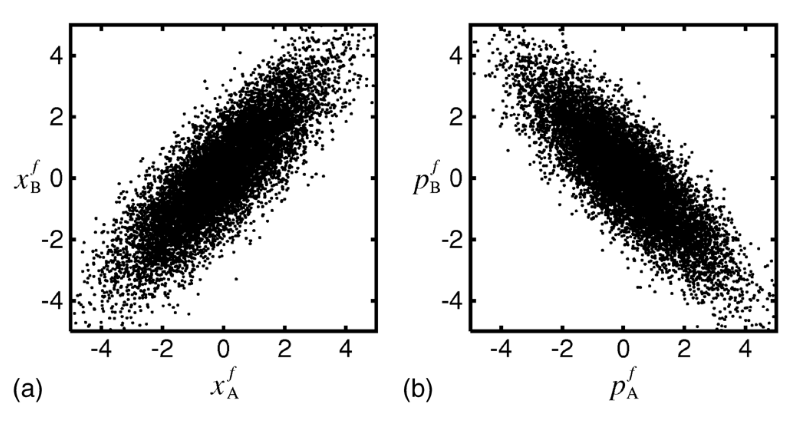
\( \frac{1}{\sqrt 2}(\ket{0}_a\ket{0}_b + \ket{1}_a\ket{1}_b) \)
\( \int dx' \ket{x'}_a \ket{x'}_b \)
perfect bit-value
correlations
perfect \(x\)-value
correlations
\( \frac{1}{\sqrt 2}(\ket{0}_a\ket{0}_b + \ket{1}_a\ket{1}_b) \)
\( \int dx' \ket{x'}_a \ket{x'}_b \)
equivalent (comes from \(\hat H \hat X \hat H = \hat Z\))
realistic / physical
EPR state
perfect bit-value
correlations
perfect \(x\)-value
correlations
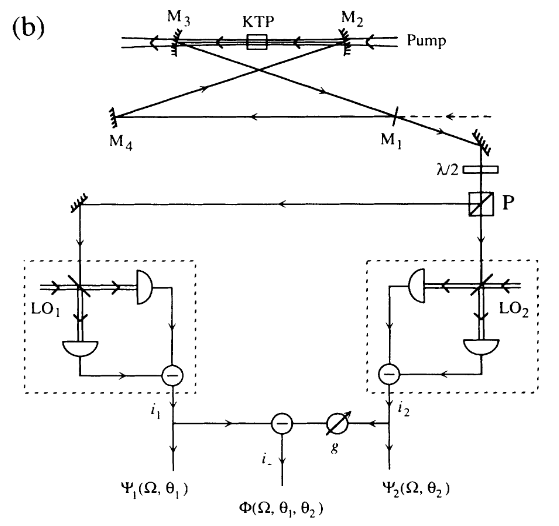
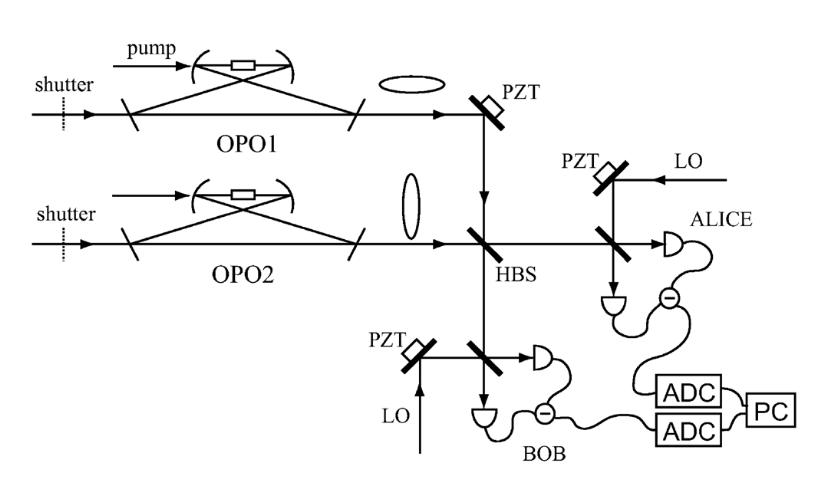
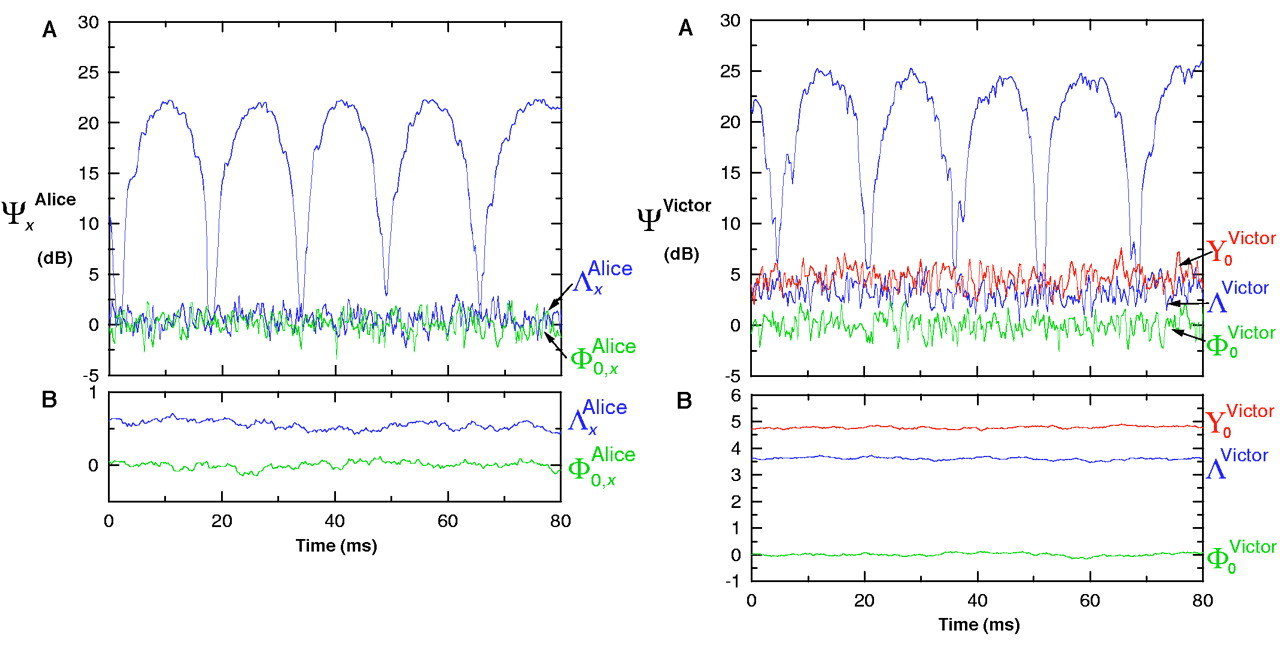
ZY Ou, SF Pereira, HJ Kimble, KC Peng,
PRL 68, 3663 (1992)
N Takei, N Lee, D Moriyama, JS Neergaard-Nielsen, A Furusawa,
PRA 74, 060101 (2006)
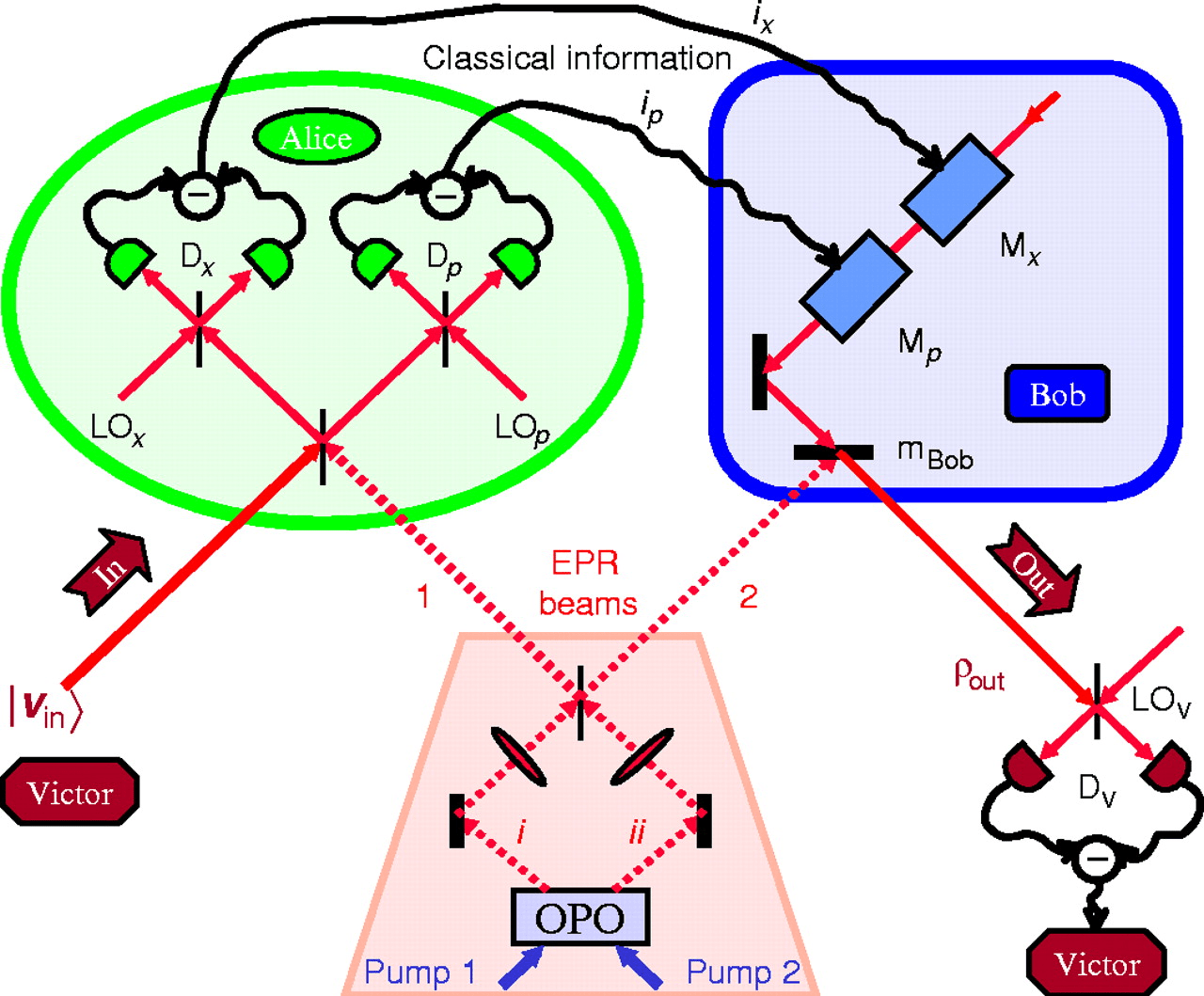
a Bell basis measurement essentially inverses the Bell state generation
different input would give different Bell state
Bell state
Bell state
Bell measurement
Bell measurement
A Furusawa, JL Sørensen, SL Braunstein, CA Fuchs, HJ Kimble, ES Polzik
Science 282, 706 (1998)
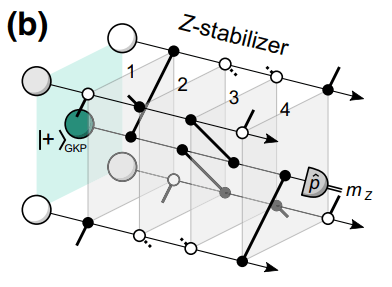
a cluster state or graph state is a multiparty entangled state
- the substrate for one-way or measurement-based quantum computing
\(\ket{G}\) can be represented as a graph
stabilized, i.e. \(\hat K_i\ket{G} =\ket G\) by \(\hat K_i = \hat X_i \sum_{j\in N(i)} \hat Z_j\)
CV version has nullifier \(\hat n_i = \hat p_i - \sum_{j\in N(i)} \hat x_j\)
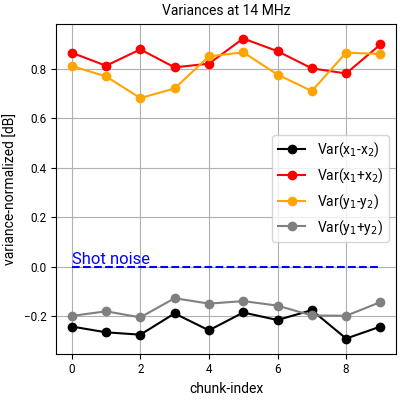
which has variance \(\text{Var}(\hat n_i) \propto e^{-2r} \rightarrow 0 \text{ for } r\rightarrow \infty\)
Single-qubit teleportation
Gate teleportation - depends on
measurement basis
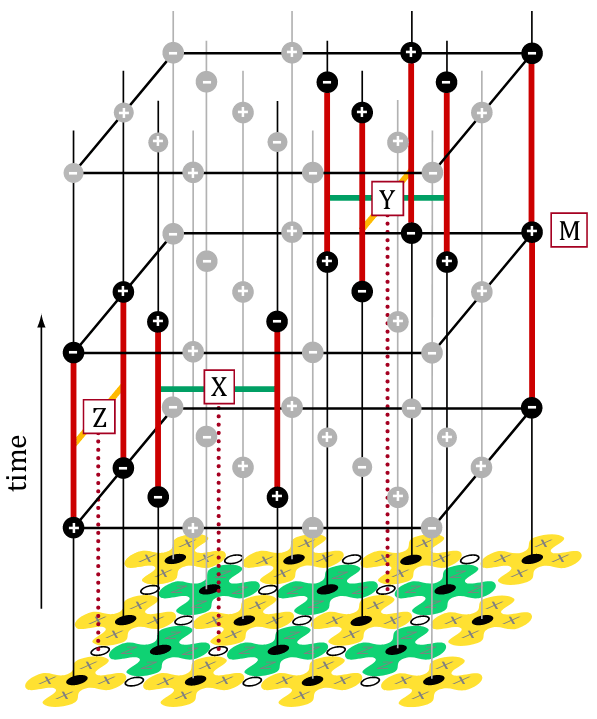
Fowler et al., PRA 86, 032324
Generating qubit clusters:
Generating CV clusters:
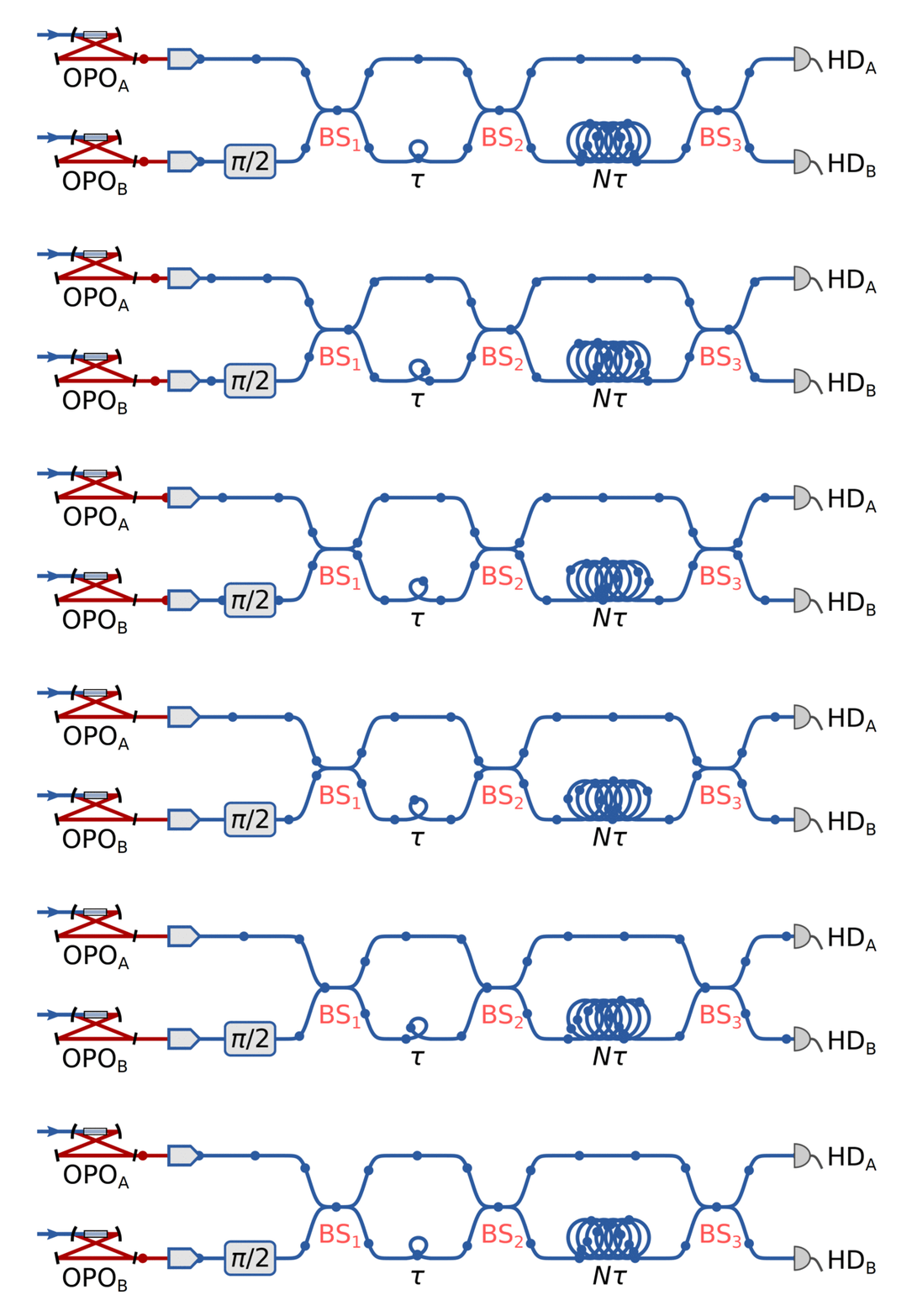
Easier approach:
- requires just squeezed states and linear optics
squeezed states
beam splitters
homodyne detection
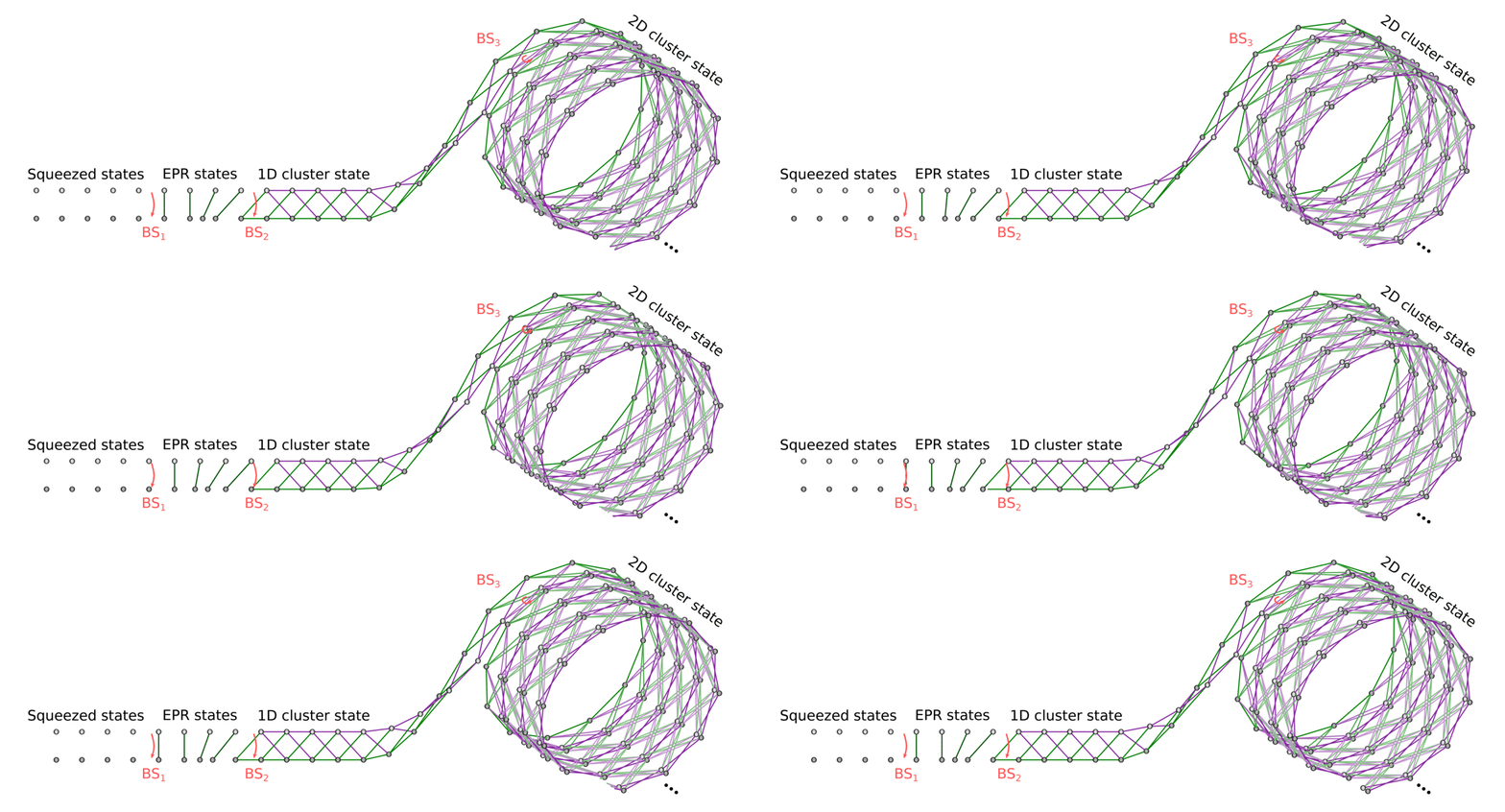
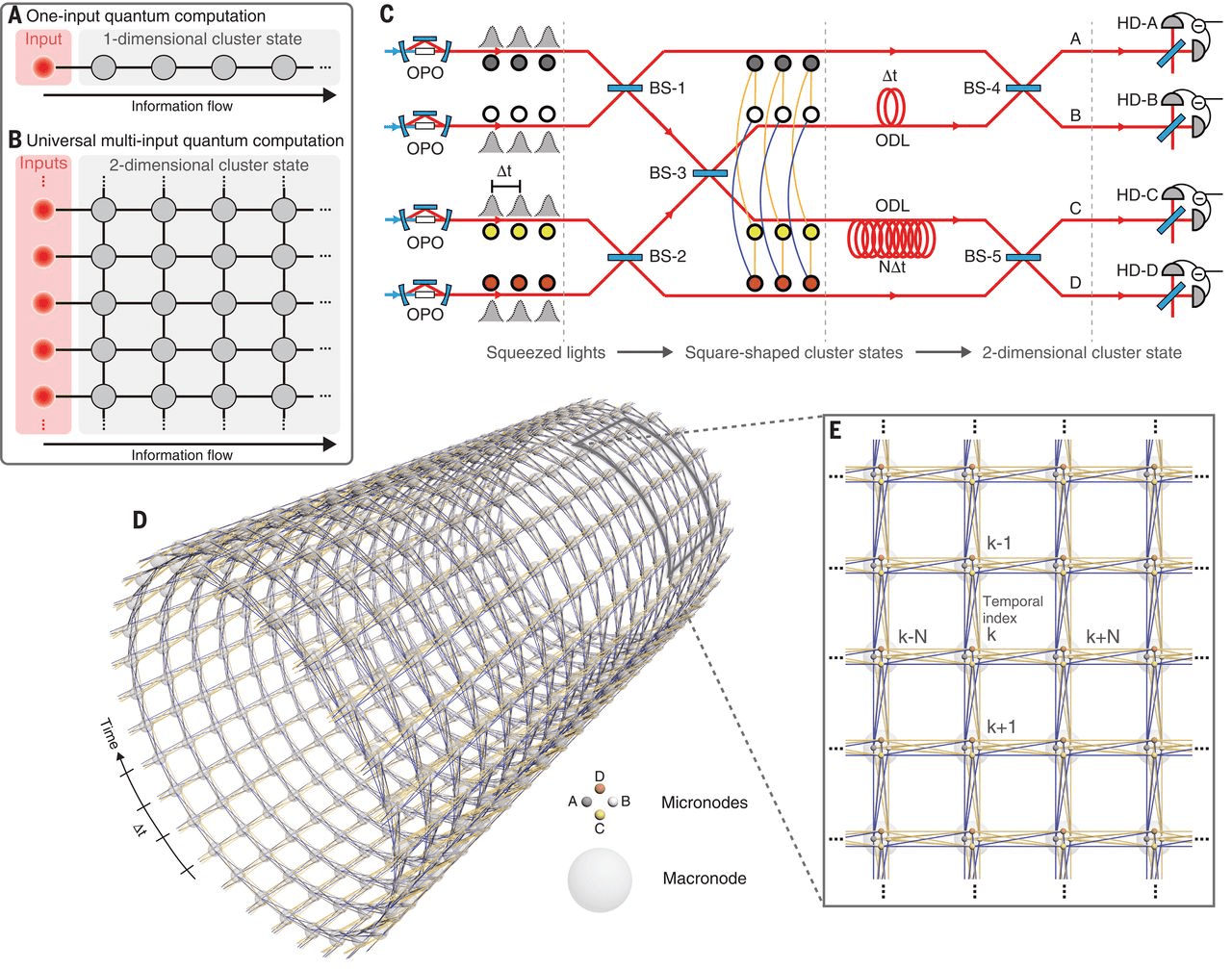
Cluster state generation:
Use temporal domain: efficient use of resources
credits:
Mikkel V. Larsen
Nullifiers of the 2D graph state:
\(\hat{n}_k^x=\hat{x}_{k}^A+\hat{x}_{k}^B-\hat{x}_{k+1}^A-\hat{x}_{k+1}^B-\hat{x}_{k+N}^A+\hat{x}_{k+N}^B-\hat{x}_{k+N+1}^A+\hat{x}_{k+N+1}^B\)
\(\hat{n}_k^p=\hat{p}_{k}^A+\hat{p}_{k}^B+\hat{p}_{k+1}^A+\hat{p}_{k+1}^B-\hat{p}_{k+N}^A+\hat{p}_{k+N}^B+\hat{p}_{k+N+1}^A-\hat{p}_{k+N+1}^B\)
\(k+1\)
\(k\)
\(k+N+1\)
\(k+N\)
with variance \(\langle\Delta\hat{n}_k^{x2}\rangle=4e^{-2r_A},\quad\langle\Delta\hat{n}_k^{p2}\rangle=4e^{-2r_B}\)
The 8 modes making up the nullifiers constitute a unit cell of the graph.
\(k+1\)
\(k\)
\(k+N+1\)
\(k+N\)
van Loock-Furusawa criterion for bipartition of \(S\):
Periodic, so enough to show inseparability of a unit cell
Complete inseparability: any bipartition is inseparable
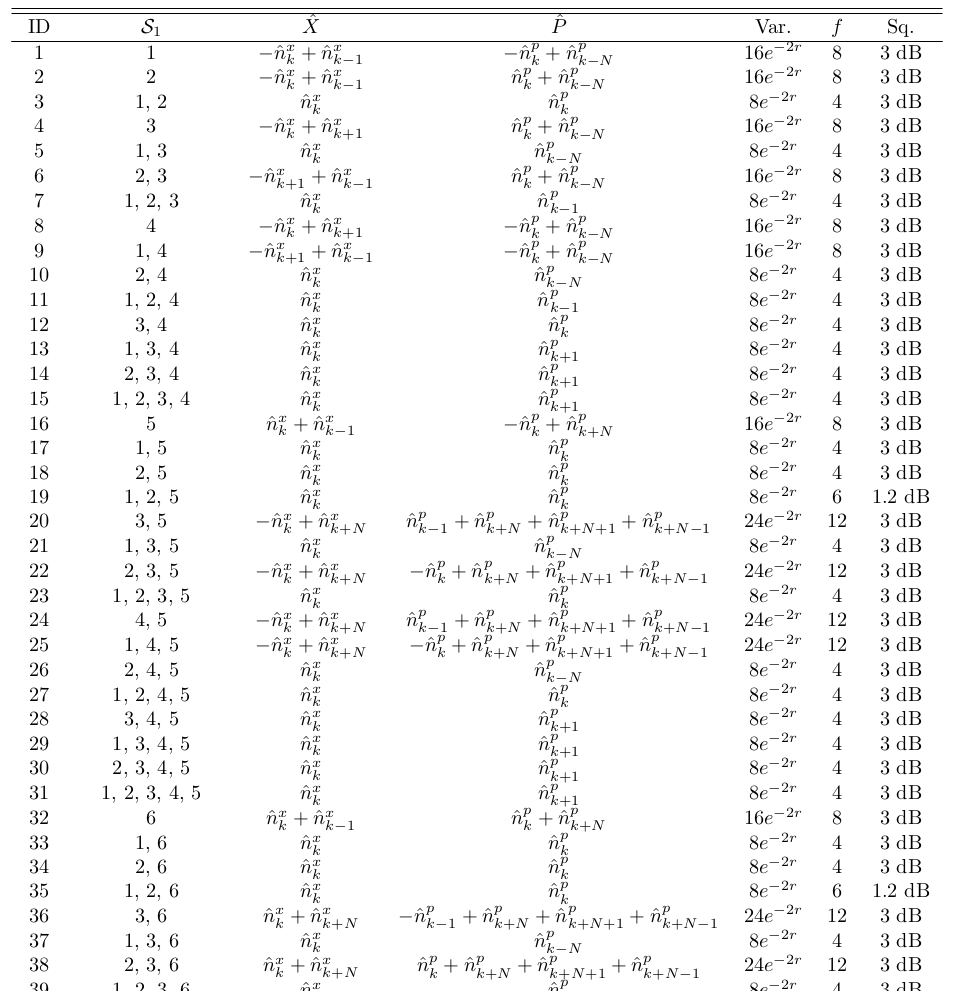
Task: find suitable \(\hat{X}, \hat{P}\) for all 127 possible bipartitions of the 8-mode unit cell
\(\displaystyle \langle\Delta\hat{X}^2\rangle + \langle\Delta\hat{P}^2\rangle < \Big|\sum_{j\in \mathcal{S}_1} h_j g_j\Big| + \Big| \sum_{j\in\mathcal{S}_2} h_j g_j\Big|\)
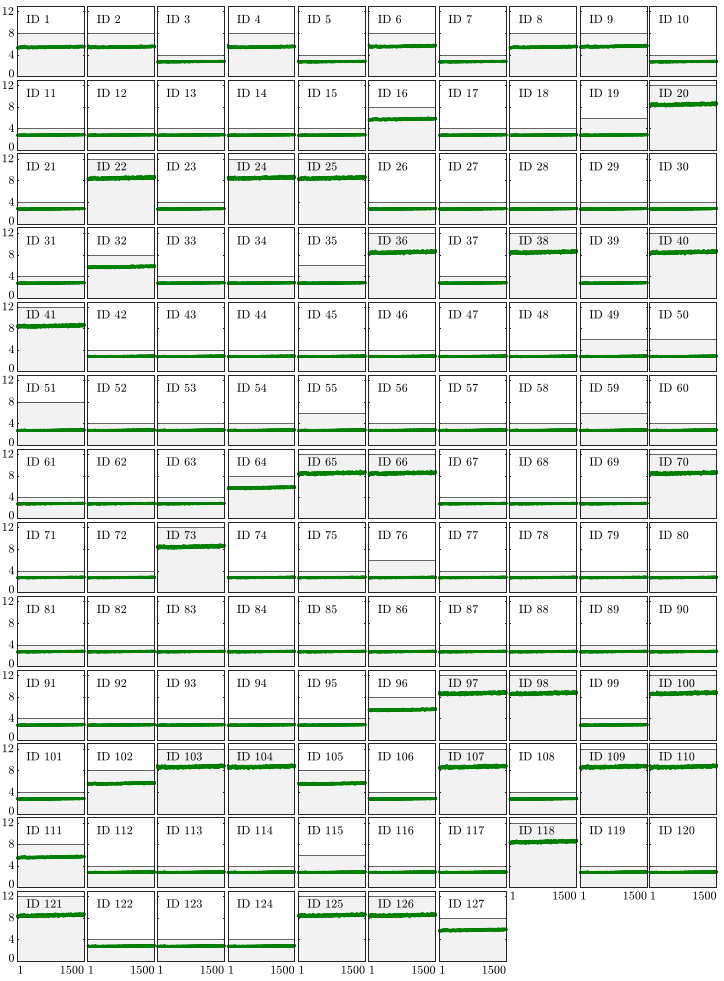
We find linear combinations of nullifiers as \(\hat{X}\) and \(\hat{P}\) for all 127 bipartitions of the unit cell
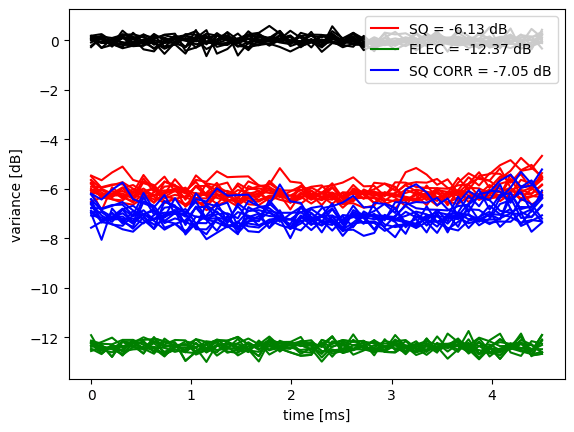
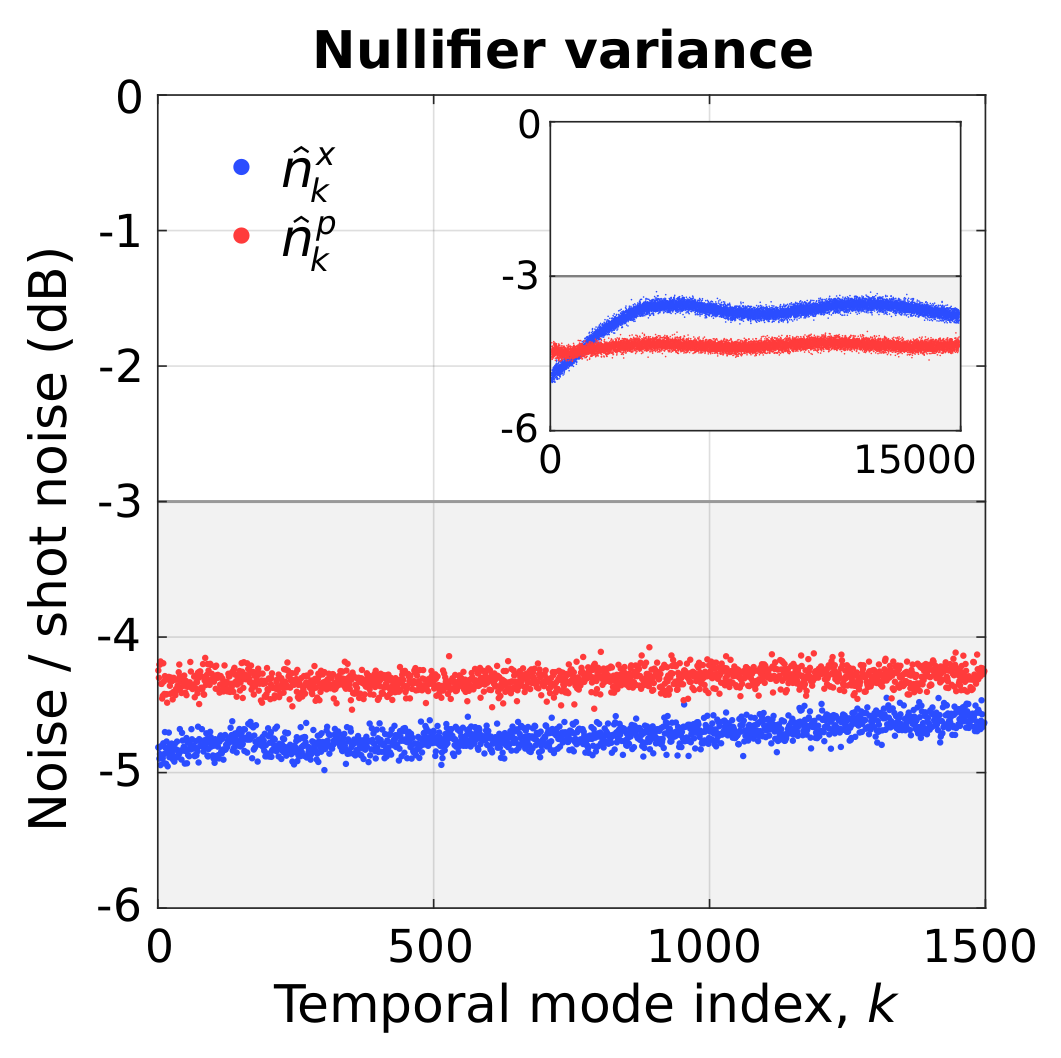
van Loock-Furusawa criterion is fulfilled if all nullifiers are squeezed by >3 dB
\(\displaystyle \langle\Delta\hat{X}^2\rangle + \langle\Delta\hat{P}^2\rangle < \Big|\sum_{j\in \mathcal{S}_1} h_j g_j\Big| + \Big| \sum_{j\in\mathcal{S}_2} h_j g_j\Big|\)
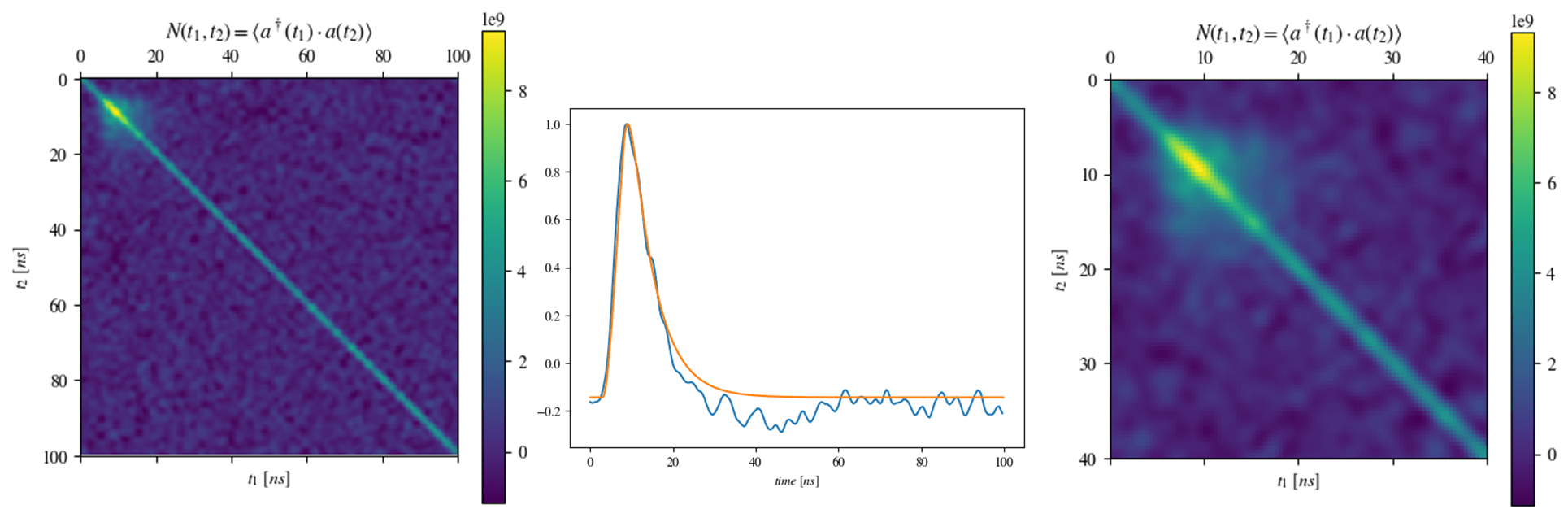
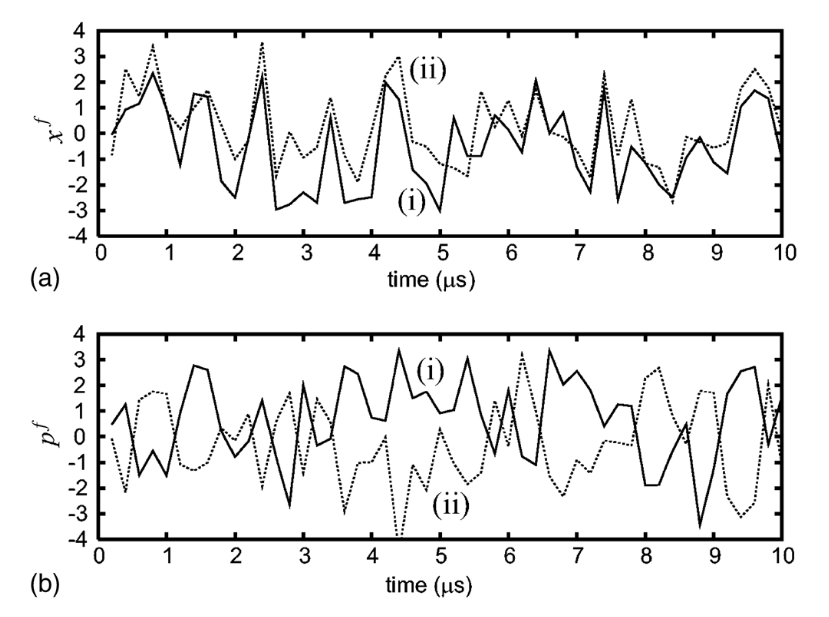
Complete inseperability confirmed for 2 × 15000 modes
MV Larsen, X Guo, CR Breum, JS Neergaard-Nielsen, UL Andersen
Science 366, 369 (2019)
W Asavanant, ..., A Furusawa
Science 366, 373 (2019)
Closely related result
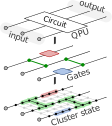
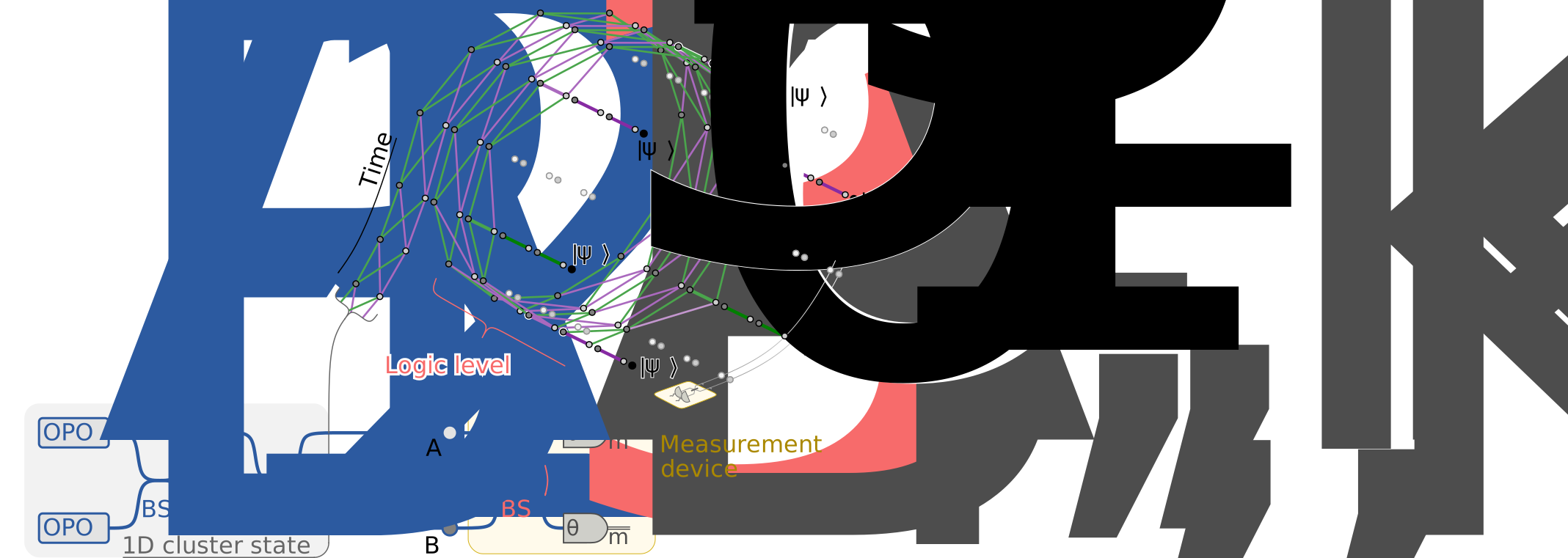
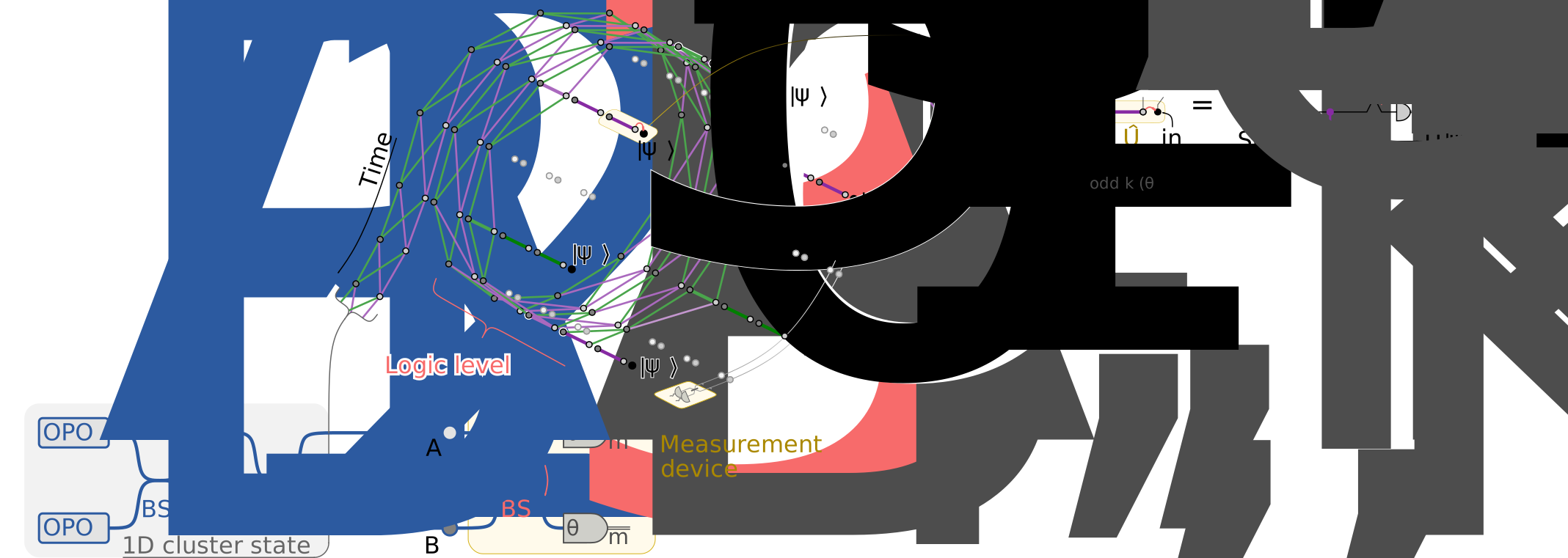
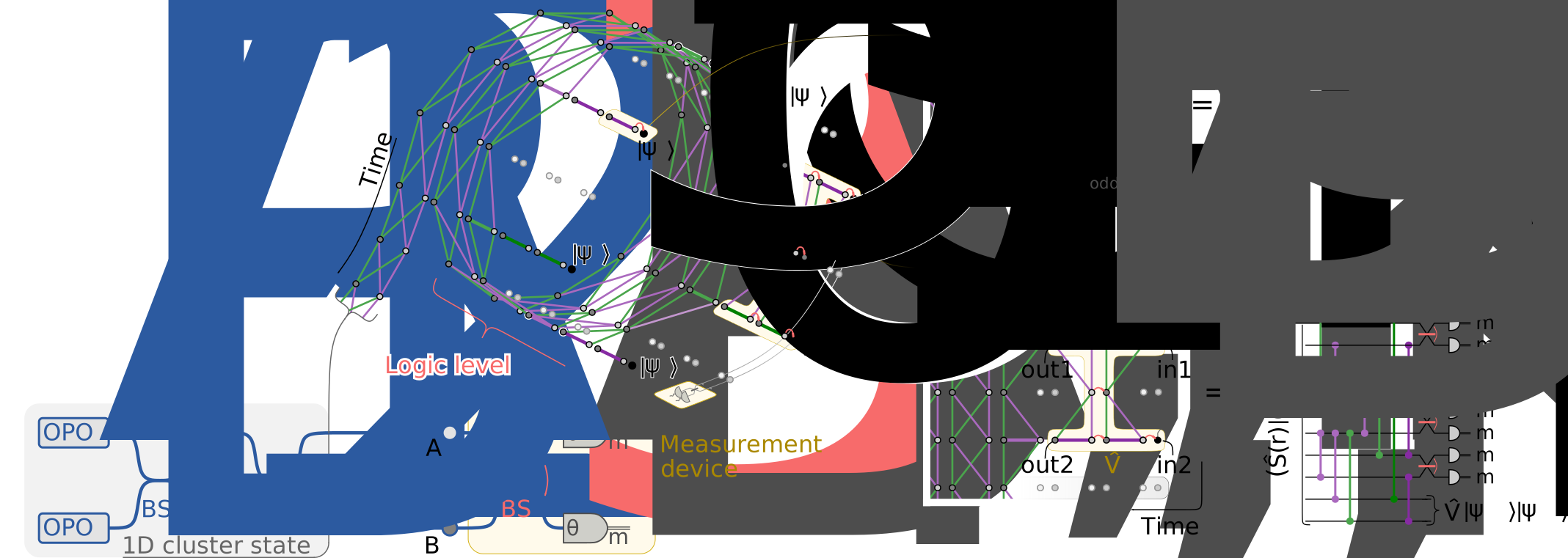
One way to implement gates and circuits on our cluster state: Reshape into "wires":
Measuring a node in the computational basis removes it and updates the graph
\(\hat{U}=(-1)^w\hat{R}\left(\frac{\theta_{+,k}}{2}\right)\hat{S}\left(\tan\frac{\theta_{-,k}}{2}\right)\hat{R}\left(\frac{\theta_{+,k}}{2}\right)\)
\(\theta_{\pm,k}=\pm\theta_{A,k}+\theta_{B,k}\)
Implemented gate:
\(\hat{U}=(-1)^w\hat{R}\left(\frac{\theta_{+,k}}{2}\right)\hat{S}\left(\tan\frac{\theta_{-,k}}{2}\right)\hat{R}\left(\frac{\theta_{+,k}}{2}\right)\)
\(\theta_{\pm,k}=\pm\theta_{A,k}+\theta_{B,k}\)
\(\mathbf{\hat{q}'} = \mathbf{U \hat{q}} + \mathbf{N\hat{p}_i} + \mathbf{Dm} \)
Side effects of the gate teleportation:
Noise from finite squeezing
- achilles heel of CV-MBQC!
Measurement outcome-dependent displacement
- can be treated in post-processing
Both \(\mathbf{U}\) and \(\mathbf{N}\) can be characterised by gate tomography
- use correlations between output and reference input (entangled with input)
\(\hat{U}=(-1)^w\hat{R}\left(\frac{\theta_{+,k}}{2}\right)\hat{S}\left(\tan\frac{\theta_{-,k}}{2}\right)\hat{R}\left(\frac{\theta_{+,k}}{2}\right)\)
\(\theta_{\pm,k}=\pm\theta_{A,k}+\theta_{B,k}\)
Rotation
Shear
- actually \(\hat F^j\hat P(\sigma)\) since \(\hat P(\sigma)\) cannot be done in one step
\(\hat{U}=(-1)^w\hat{R}\left(\frac{\theta_{+,k}}{2}\right)\hat{S}\left(\tan\frac{\theta_{-,k}}{2}\right)\hat{R}\left(\frac{\theta_{+,k}}{2}\right)\)
\(\theta_{\pm,k}=\pm\theta_{A,k}+\theta_{B,k}\)
Squeezing
\(\hat{U}=(-1)^w\hat{R}\left(\frac{\theta_{+,k}}{2}\right)\hat{S}\left(\tan\frac{\theta_{-,k}}{2}\right)\hat{R}\left(\frac{\theta_{+,k}}{2}\right)\)
\(\theta_{\pm,k}=\pm\theta_{A,k}+\theta_{B,k}\)
MV Larsen, X Guo, CR Breum, JS Neergaard-Nielsen, UL Andersen
Nature Physics 17, 1018 (2021)
Gaussian states
Gaussian operations
Gaussian measurements
So far:
- not sufficient for quantum computational advantage!
Need non-Gaussian
Merge qubits and CV!
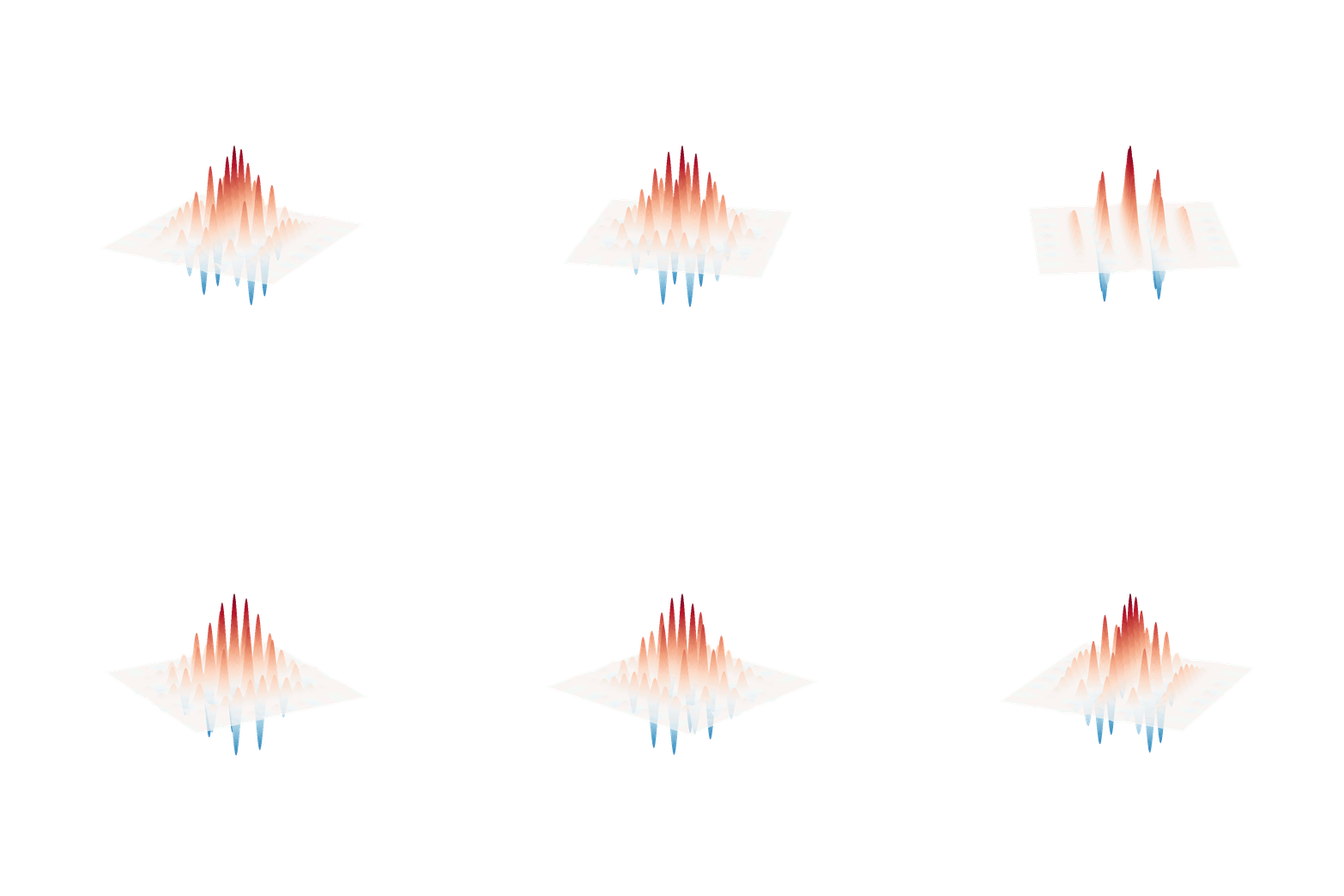
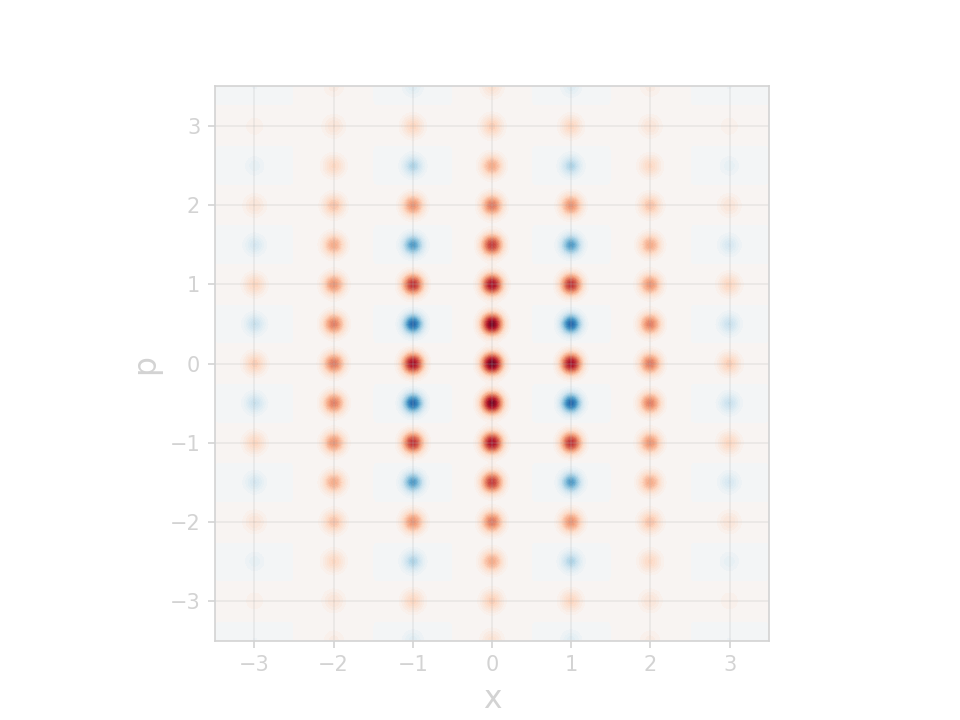
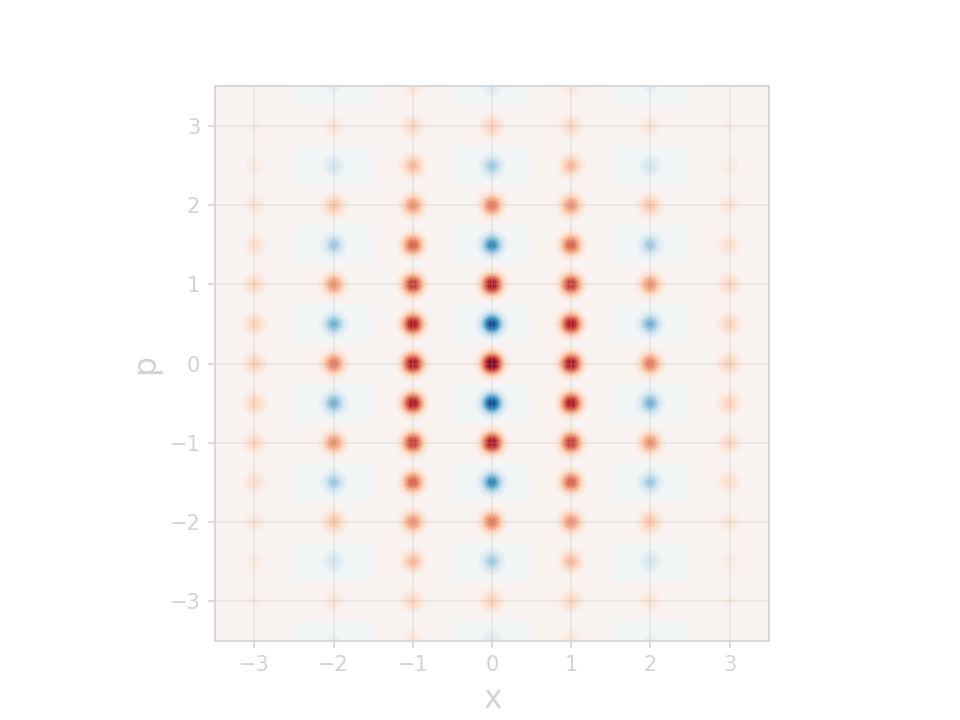
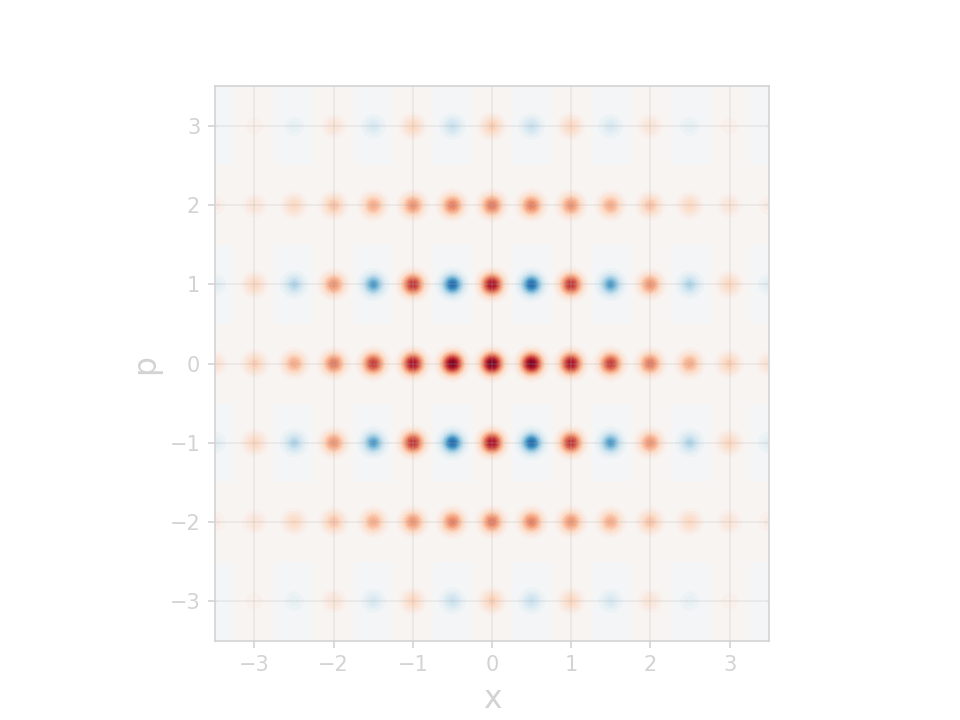
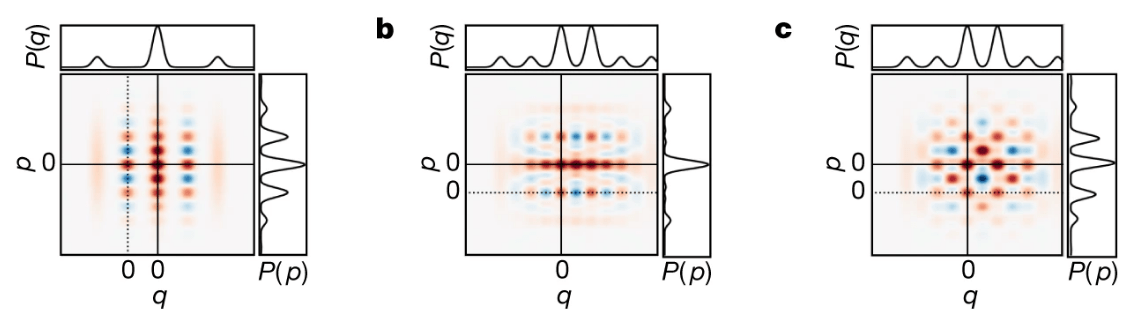
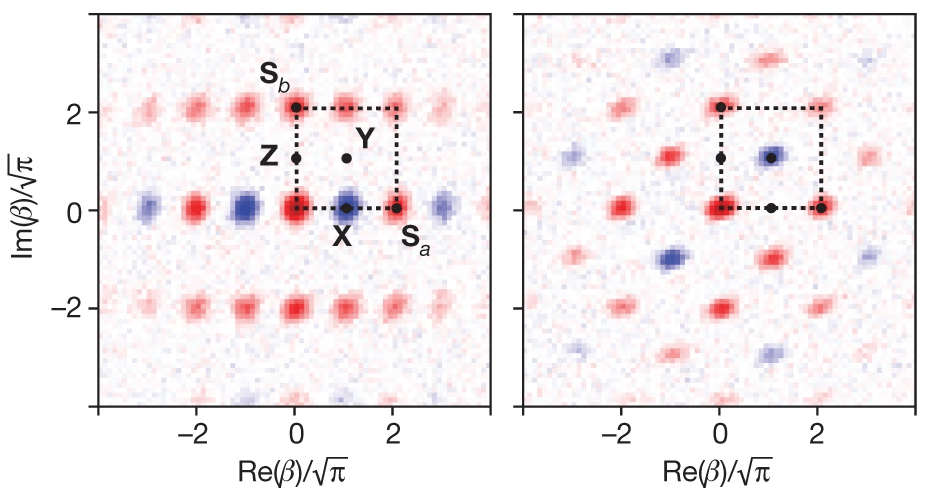
GKP \(|0\rangle\)
GKP \(|1\rangle\)
GKP \(|+\rangle\)
GKP \(|0\rangle\)
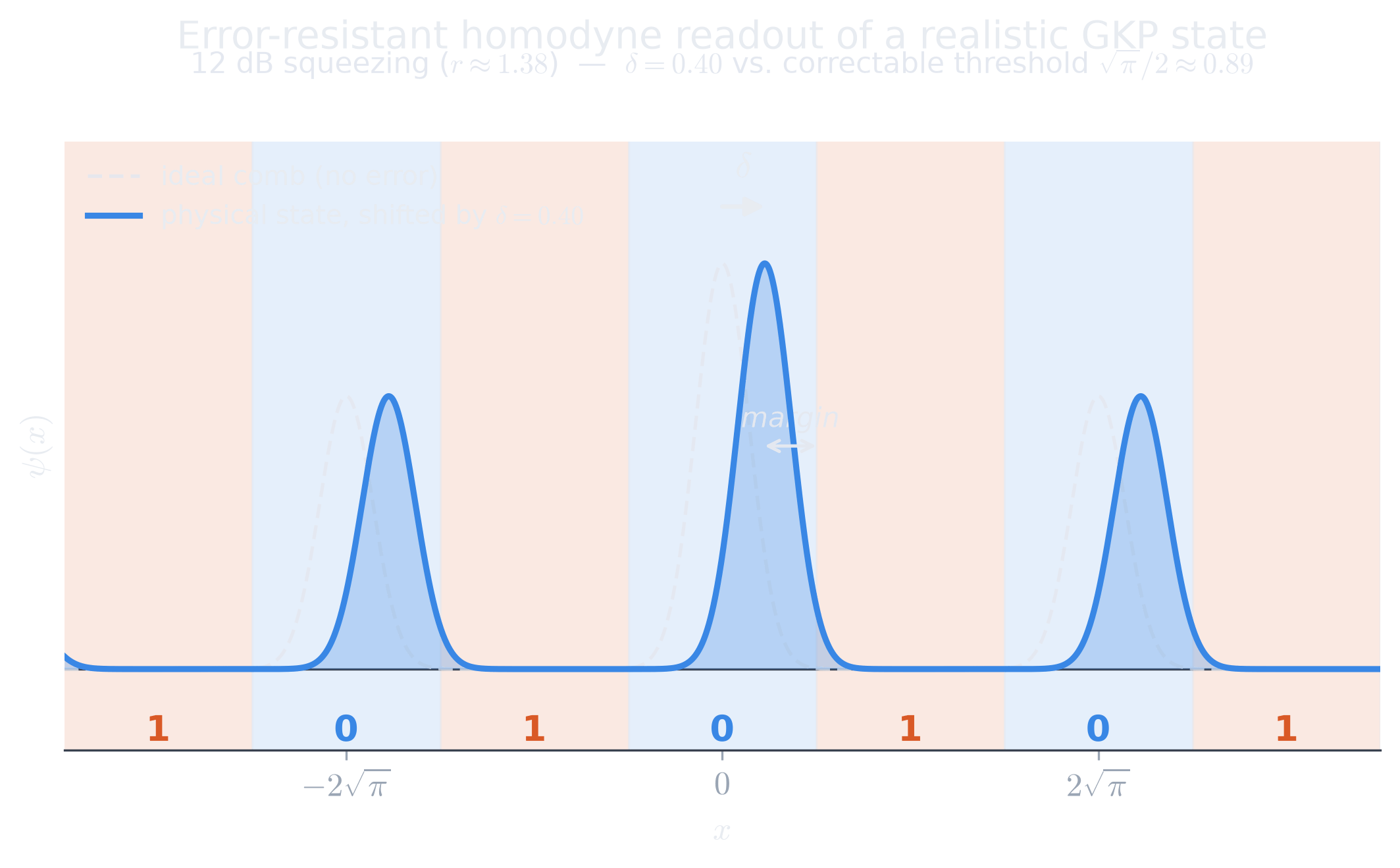
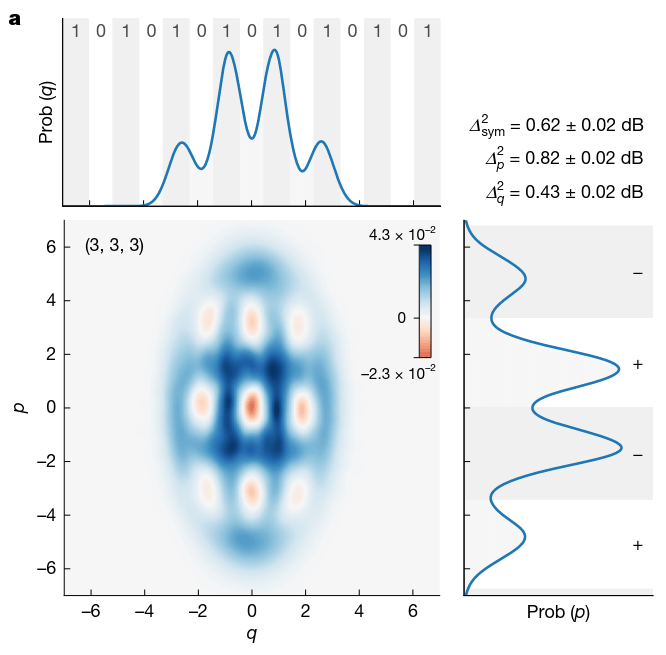
The GKP state is a logical qubit with built-in error protection
Homodyne measurement modulo \(2\sqrt{\pi}\) gives a logical 0 or 1
Small displacements are corrected, but a small probability of logical error
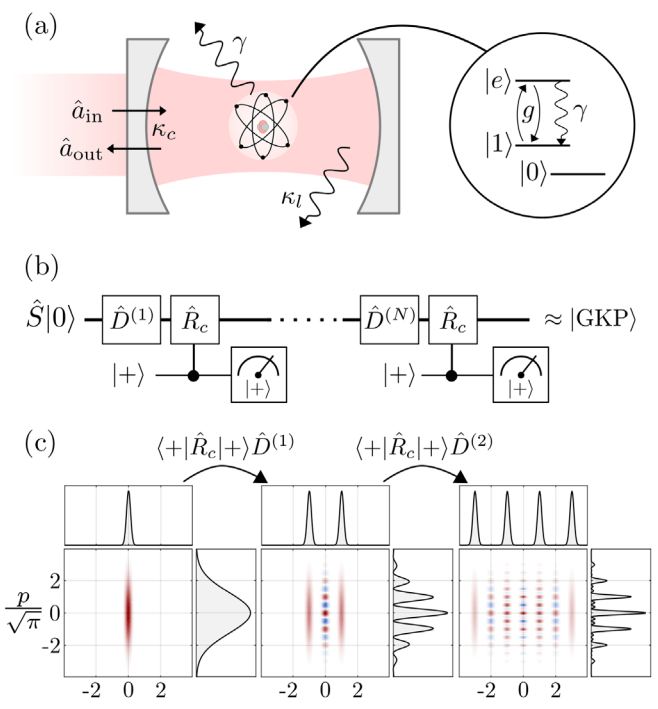
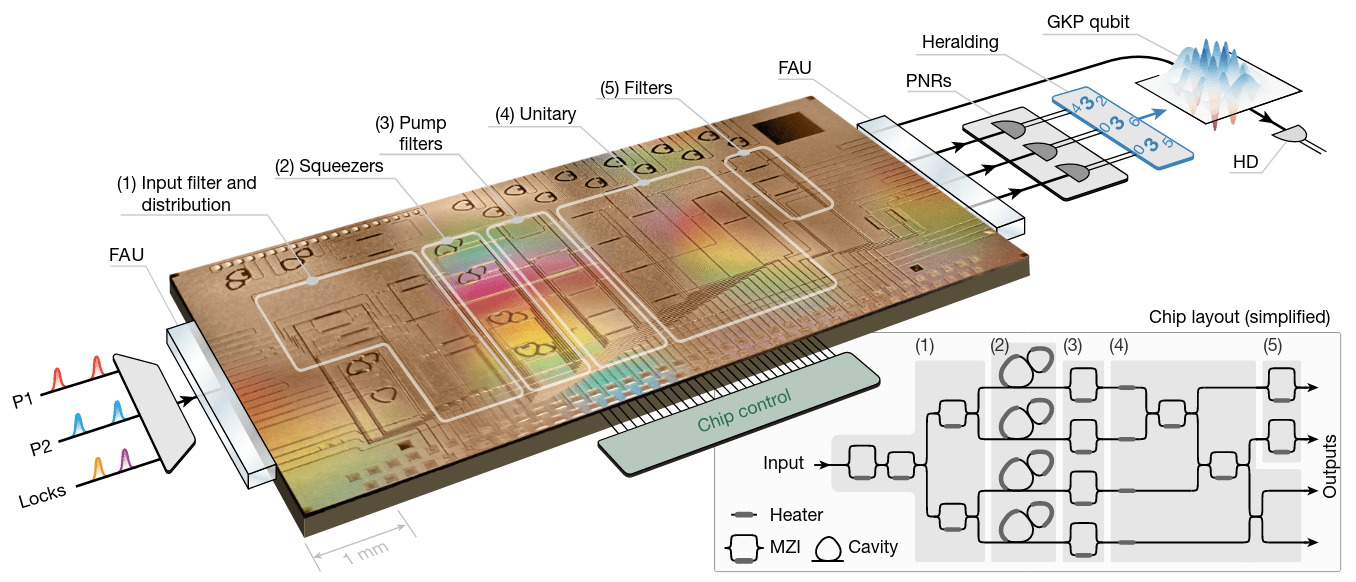
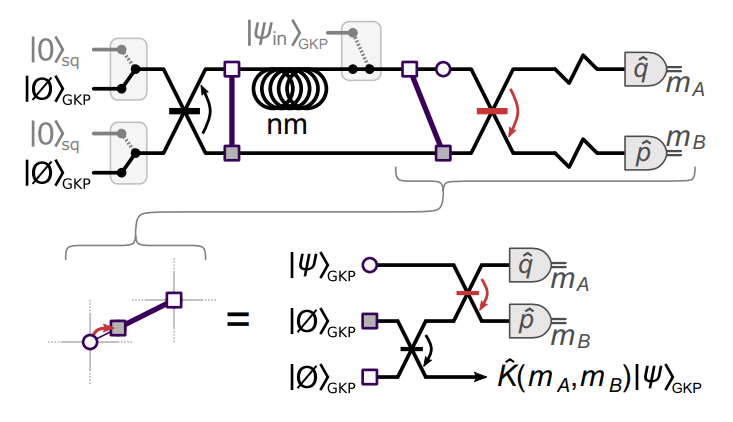
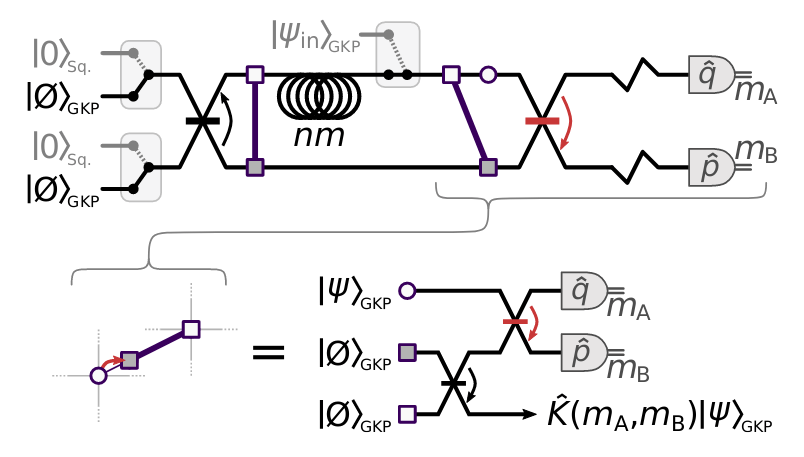
With a supply of offline generated GKP qunaught states, FTQC is possible using only Gaussian resources
E.g. with the GKP teleportation gadget
B Baragiola et al.
Phys. Rev. Lett. 123, 200502 (2019)
B Walshe et al.
Phys. Rev. A 102, 062411 (2020)
D Gottesman, A Kitaev, J Preskill
Phys. Rev. A 64, 012310 (2001)
P. Campagne-Ibarcq
Nature 584, 368 (2020)
C Flühmann et al.
Nature 566, 513 (2019)
Trapped ions
Superconducting cavity
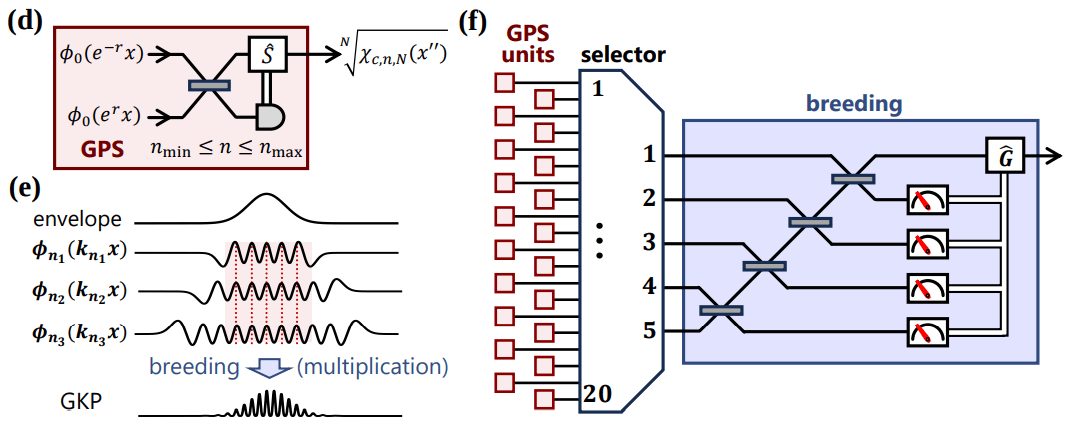
The hard problem!
J Hastrup & UL Andersen
Phys. Rev. Lett. 128, 170503 (2022)
K Takase et al.
Phys. Rev. A 110, 012436 (2024)
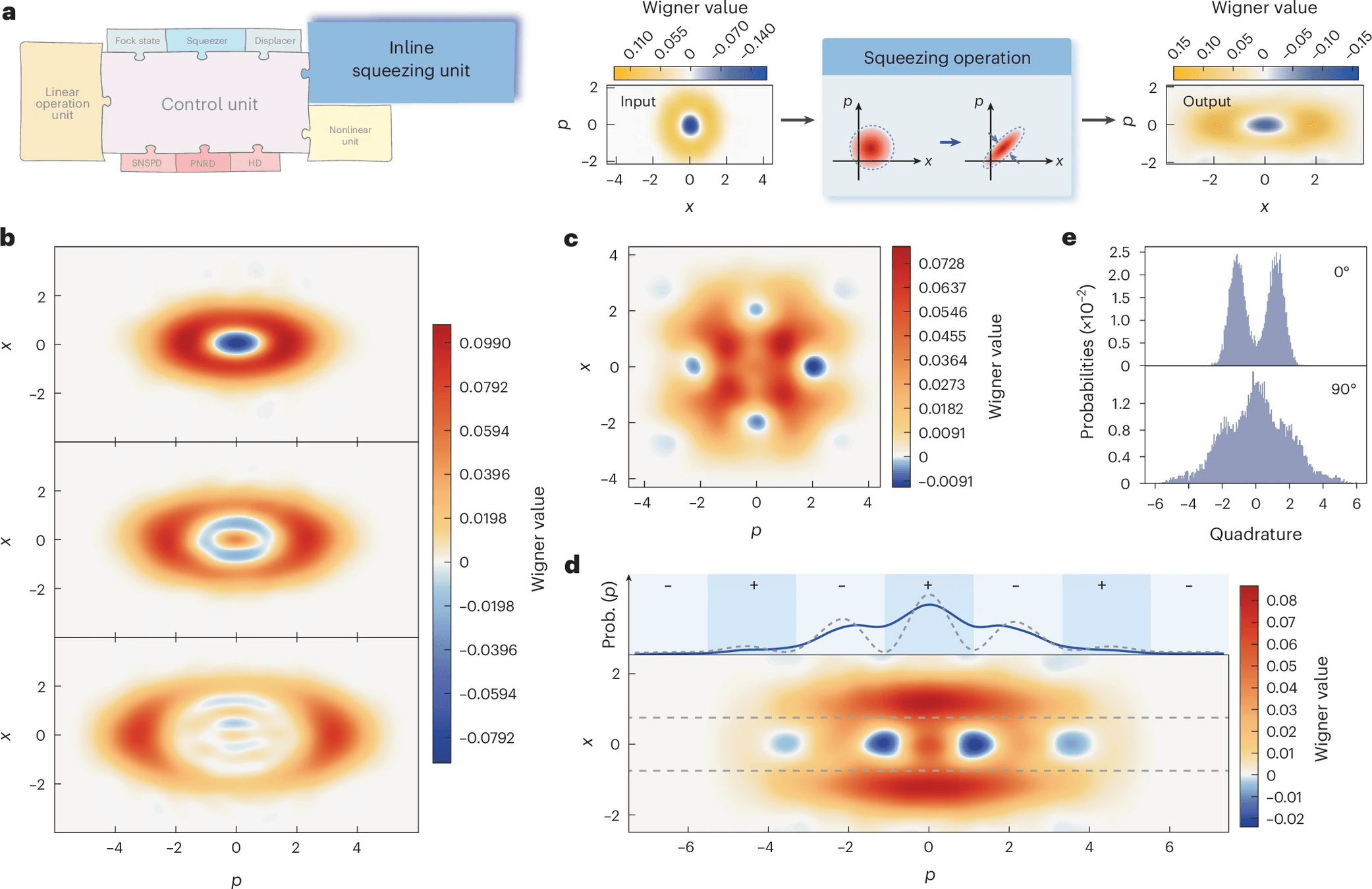
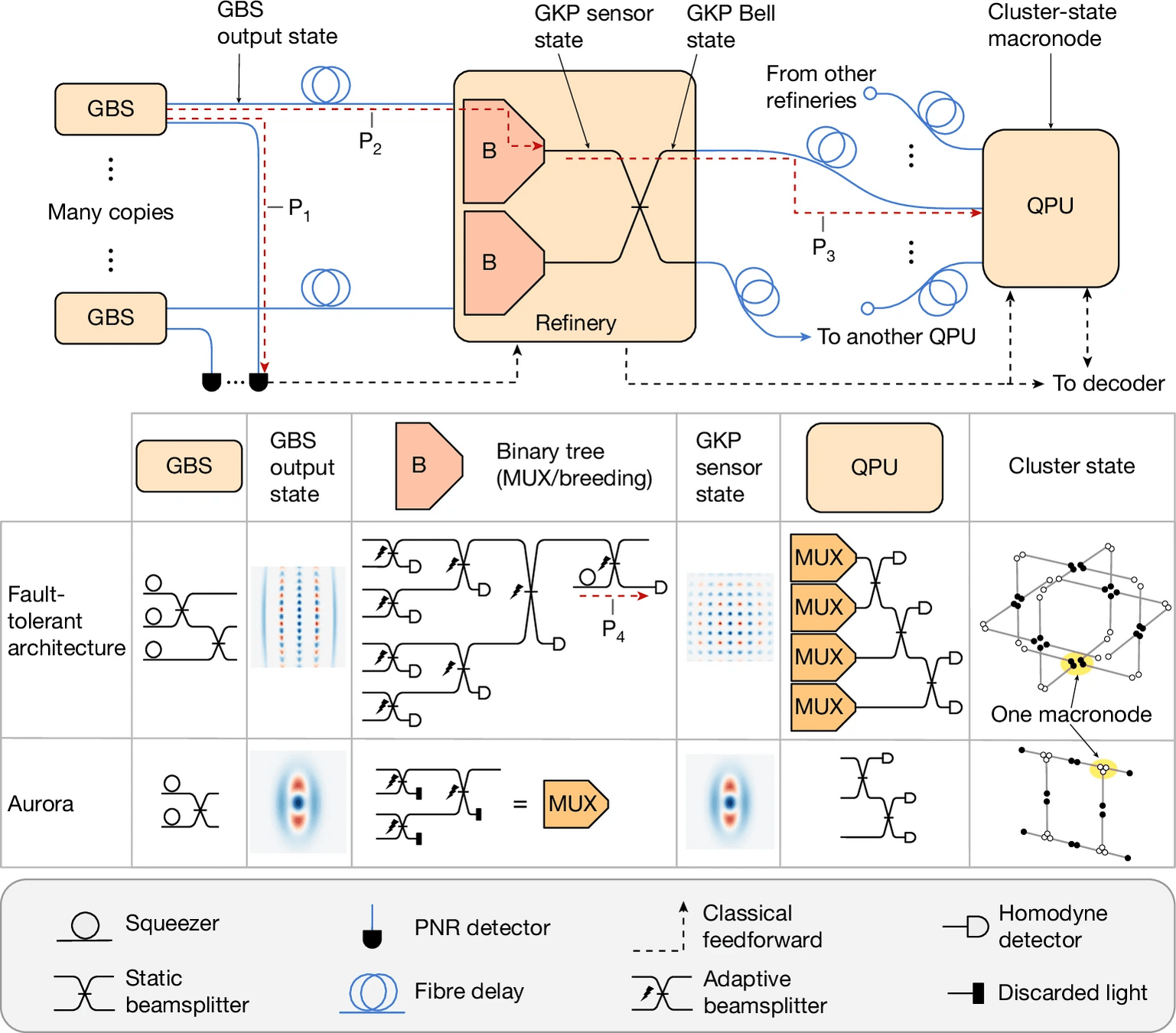
MV Larsen et al. (Xanadu)
Nature 642, 587 (2025)
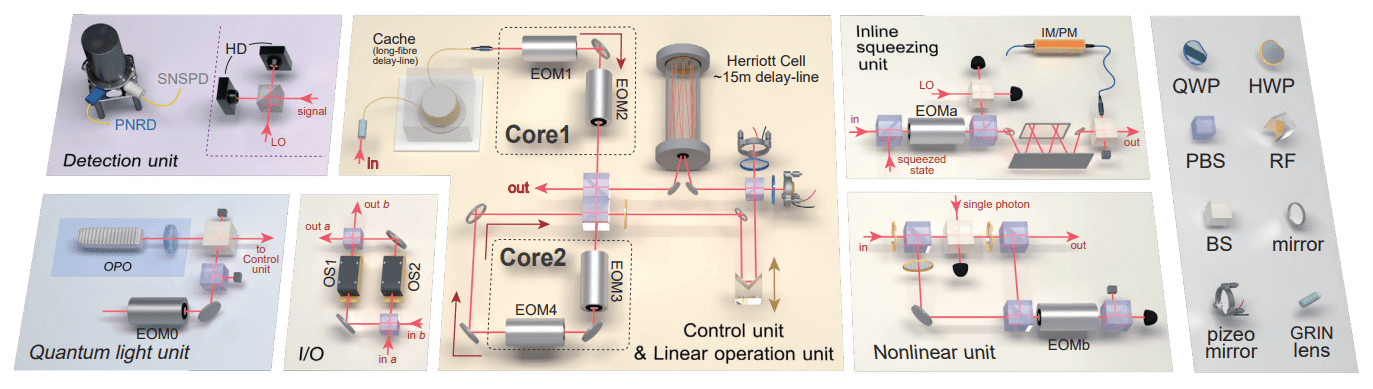
S Yu, J Sun, K-C Chen, ..., R Patel
Nature Photonics (July 2026)
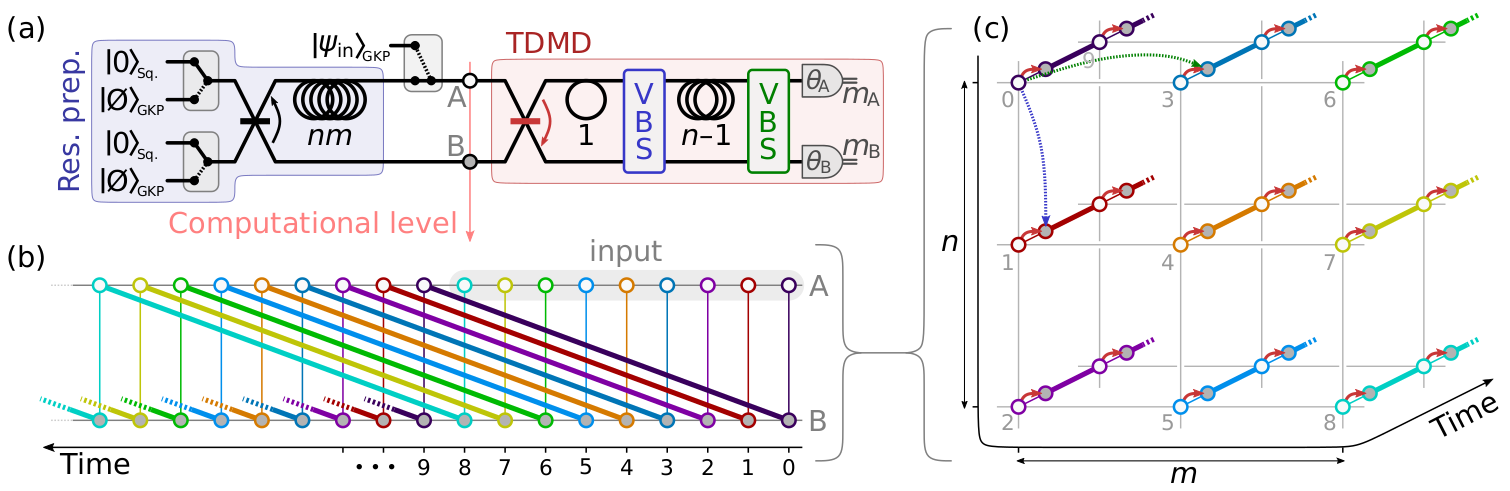
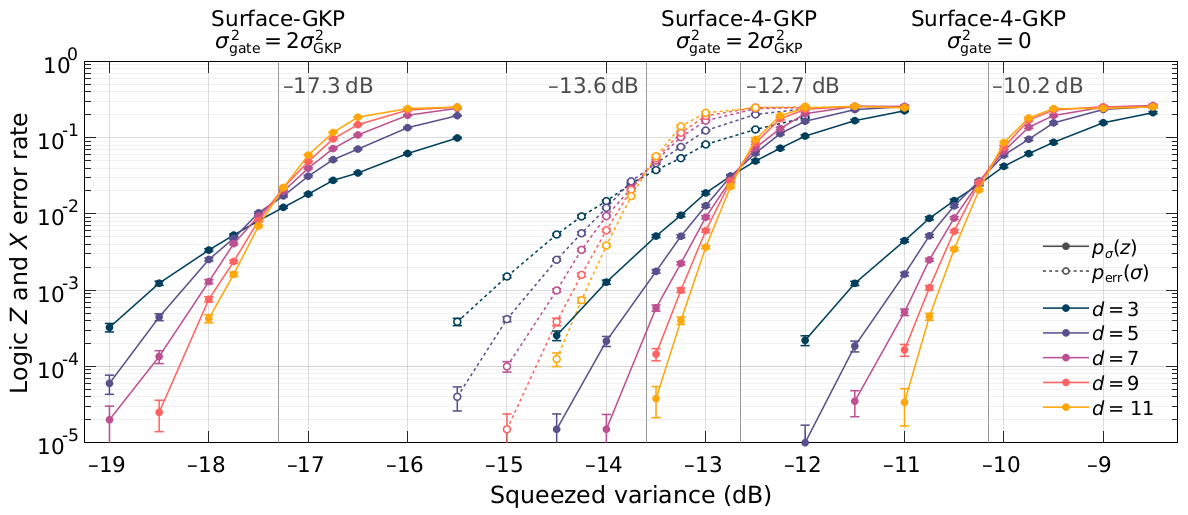
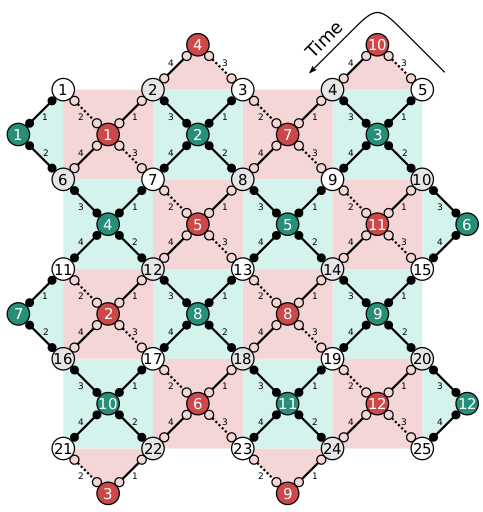
MV Larsen, C Chamberland,
K Noh, JS Neergaard-Nielsen,
UL Andersen
PRX Quantum 2, 030325 (2021)
MV Larsen, C Chamberland,
K Noh, JS Neergaard-Nielsen,
UL Andersen
PRX Quantum 2, 030325 (2021)
\(\lbrace\hat{F}=\hat{R}(\pi/2),\hat{P}(1),\hat{C}_Z(g)\rbrace\)
is a multi-mode Clifford gate set for GKP-encoded qubits - all-Gaussian
CV errors corrected by GKP state teleportation
GKP + Gaussian operations ⇒ universal, FTQC!
GKP error correction on Gaussian input ⇒
distillable magic states ⇒ non-Clifford gates
B Baragiola et al.
Phys. Rev. Lett. 123, 200502 (2019)
B Walshe et al.
Phys. Rev. A 102, 062411 (2020)
H
S
CZ
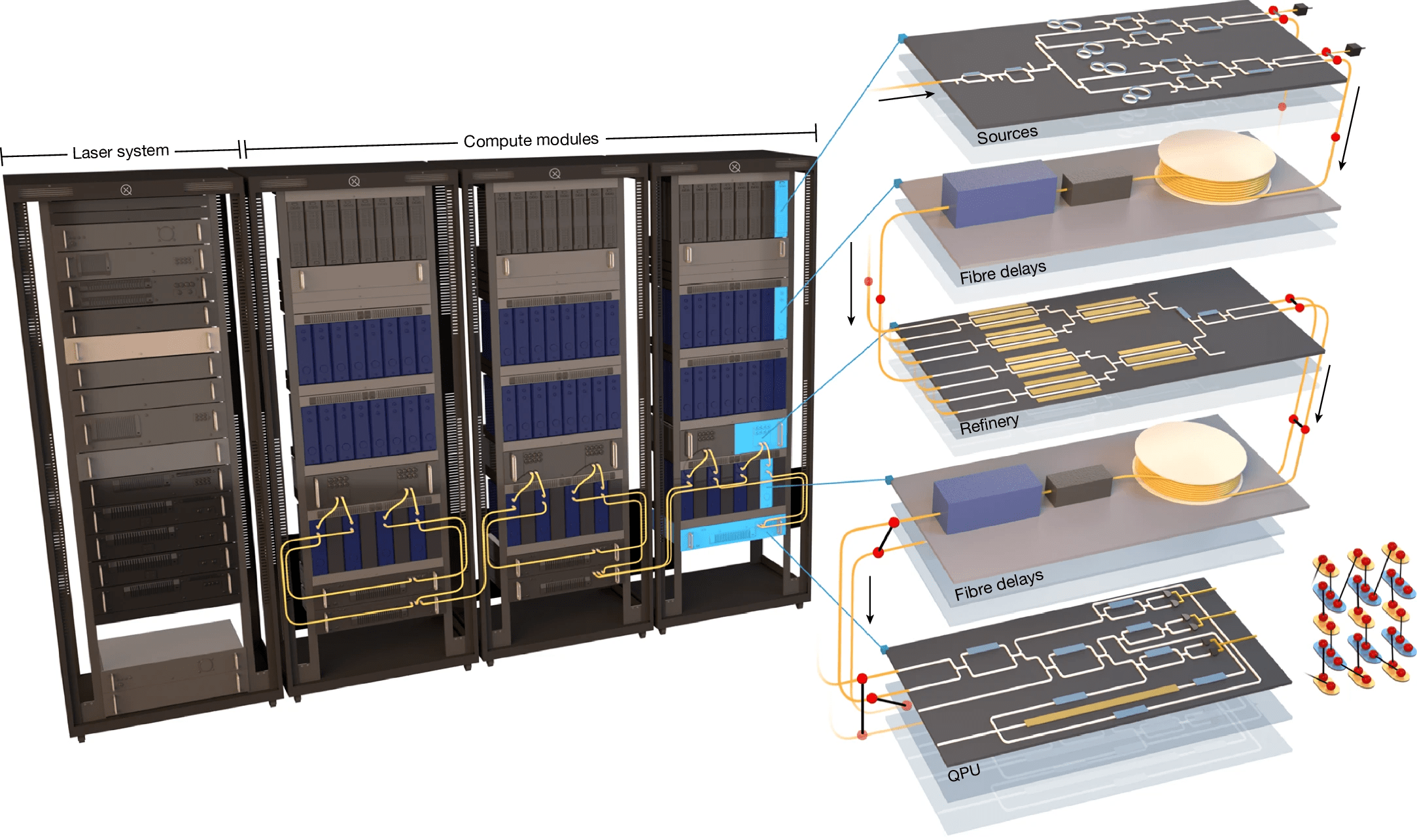
H. Aghaee Rad et al.
Nature 638, 912 (2025)
H. Aghaee Rad et al.
Nature 638, 912 (2025)
H. Aghaee Rad et al.
Nature 638, 912 (2025)
By Jonas Neergaard-Nielsen
Tutorial at QCi3 Quantum Technologies Summer School 2026, Oxford