Katya Malinova PRO
I am an Associate Professor, Mackenzie Investments Chair in Evidence-Based Investment Management at the DeGroote School of Business, McMaster University, Canada.
Discussion of
by Indira Puri, Mohan (Fred) Sun, and Mao Ye
Discussant: Katya Malinova
DeGroote School of Business, McMaster University
53rd Annual Meeting of the European Finance Association · August 19–22, 2026
Vlerick Business School, Ghent, Belgium
Reduced form
Execution time dispersion from Rule 605 bins: <9sec, 10-29, 30-59, 1-5min, 5-30min
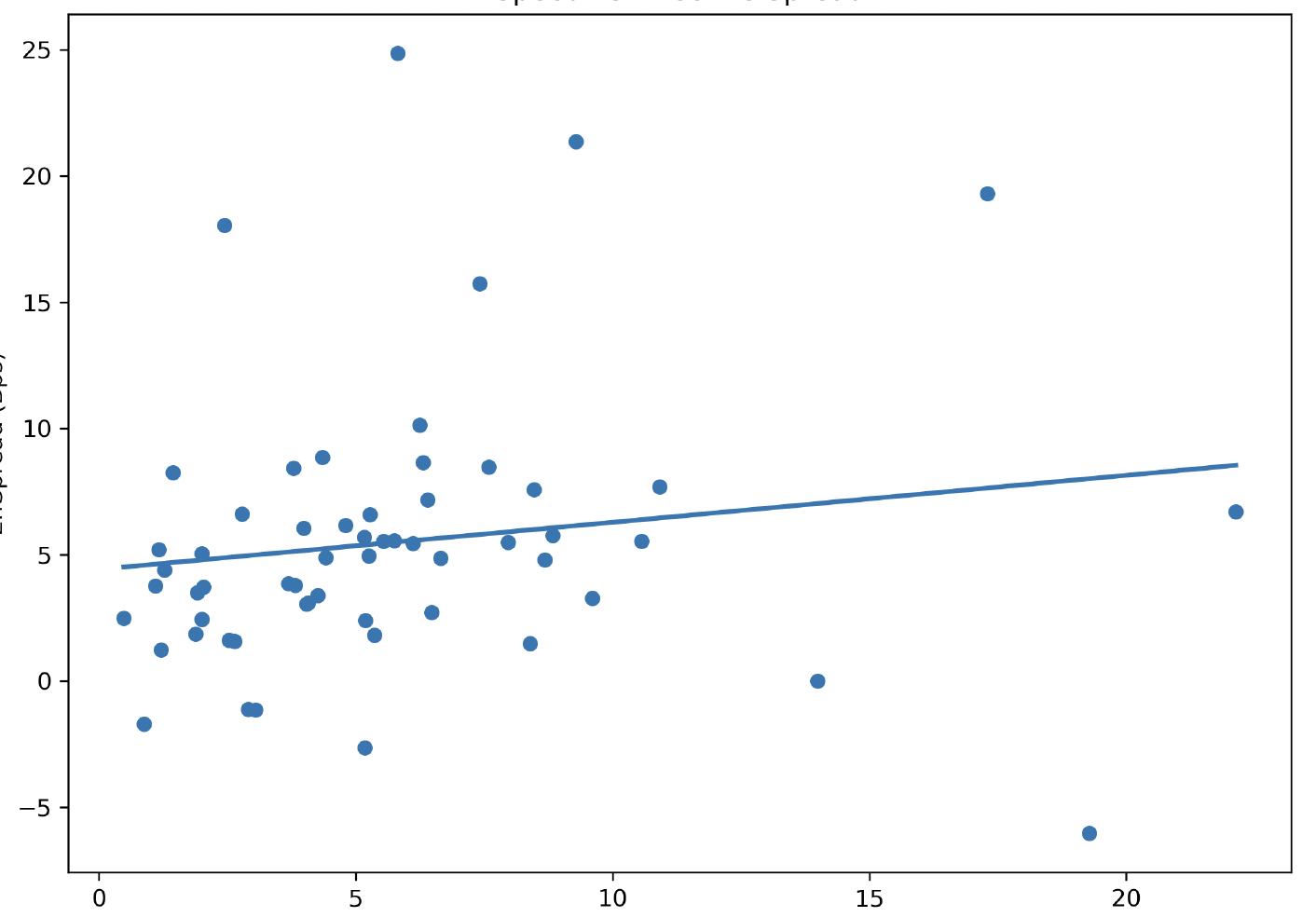
Regress effective spread on speed, speed volatility, non-execution
Is execution timing uncertainty priced?
Venue-choice model
Heterogeneous trader preferences over venue attributes
Fitted to observed venue shares
Can we rationalize coexistence?
Data note: 22.6m venue–stock–month cells → 2.6m used. Most cells have zero measured dispersion (single bin); this also removes exchanges, mostly in the <9sec bin.
→ A venue enters only through cells with non-zero dispersion. Conditioning on "hard to fill"?
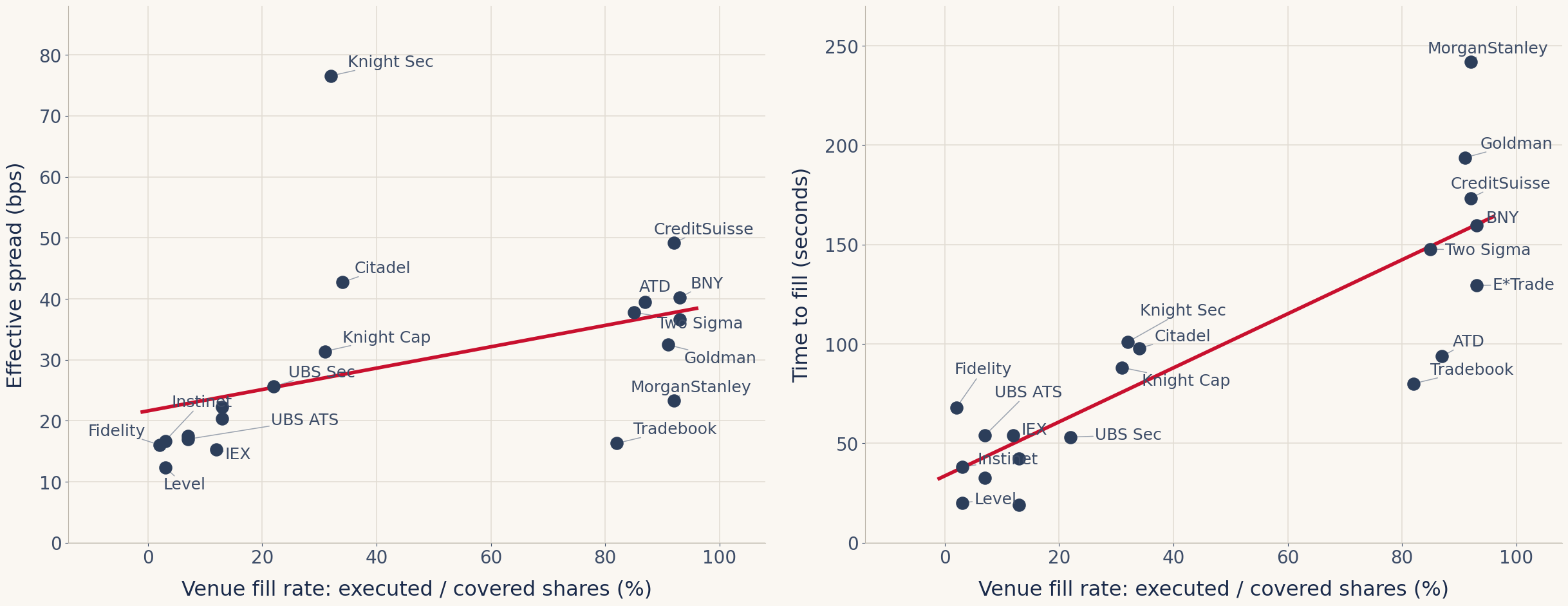
Effective spread (bps) costlier ↑
Time to fill (seconds) slower →
605 data: “slow” = very slow → over 9 seconds
Orders are marketable on arrival.
→ slow can be mechanically more expensive.
→ why not execute? low depth? a liquidity effect?
→ is the bigger puzzle fragmentation/existence of illiquid venues (many explanations
As an aside: once resting, the order supplies liquidity — execution time is now about limit price and queue position (Lo, MacKinlay & Zhang; Yueshen).
Effective spread (bps) costlier ↑
Time to fill (seconds) slower →
605 data: "slow" = very slow → over 9 seconds
Orders are marketable on arrival.
→ slow can be mechanically more expensive.
As an aside: once resting, the order supplies liquidity — execution time is now about limit price and queue position (Lo, MacKinlay & Zhang; Yueshen).
And: why didn't it execute? Low depth? Is speed volatility partly a liquidity measure?
And: is the broader puzzle the existence of illiquid venues?
→ Is the object execution speed volatility — or non-execution risk?
Good news, bad news: amended Rule 605 collection began August 1
Low-fill venues look faster and cheaper (conditional on execution; Table 1, Panel C — raw means).
"Unfilled" here ≠ never executed: non-execution at the receiving venue can include routing elsewhere.
Is the low spread partly a consequence of selective execution and/or venue business model?
Less-predictable execution timing ↔ lower effective spreads.
Table 6: ATSs are more predictable & costlier → architecture matters. But through what channel?
Paper: rule-based ATS matching vs greater non-ATS execution discretion.
Different mechanisms allow & attract different orders. Often the broker routes.
Heterogeneous preferences — or heterogeneous choice sets
→ does this affect the venue-choice model?
Would Rule 605 realized spread help tell some of these apart?
One puzzle solved: execution timing uncertainty is priced.
Would love to know more detail on the next one: why.
Go read it.
By Katya Malinova
This is discussion that I gave at the EFA 2026 in Aug 2026 in Ghent. If viewing online, best viewed in Chrome, Safari may not render properly. Just scroll down, no 2x2 arrangement for this one.