Double-bracket quantum signal processing
Marek Gluza
NTU Singapore
Scan QR code or go to slides.com/marekgluza



Z. Holmes

Y. Suzuki
B. Tiang
J. Son

N. Ng

What is quantum signal processing?
|\psi'\rangle = e^{-\tau H} |\psi\rangle = \sum_k \langle\lambda_k|\psi\rangle e^{-\tau \lambda_k }|\lambda_k\rangle \rightarrow 0
|\psi'\rangle = \frac{e^{-\tau H} |\psi\rangle}{\|e^{-\tau H} |\psi\rangle\|} \rightarrow |\lambda_0\rangle
|\psi'\rangle = \frac{P(H) |\psi\rangle}{\|P(H) |\psi\rangle\|} \rightarrow |\lambda_0\rangle
P(x)=\prod_{k=1}^K(x-x_k)\approx e^{-\tau x}
|\psi'\rangle = \frac{P(H) |\psi\rangle}{\|P(H) |\psi\rangle\|} \rightarrow \frac{H^{-1}|\psi\rangle}{\|H^{-1} |\psi\rangle\|}
P(x)\approx 1/x
Example 1: Exponential function
Example 2: Polynomial approximation to exponential
Example 3: Polynomial approximation to inversion
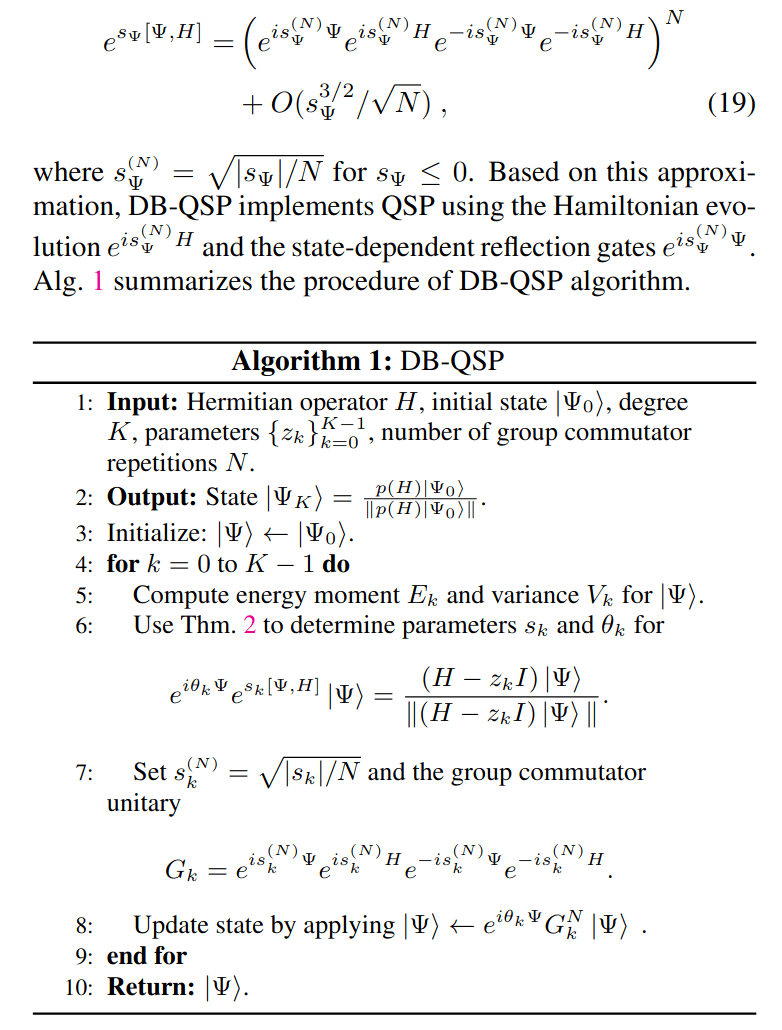
P(H)=\prod_{k=1}^K(H-x_k)\approx e^{-\tau H}
Quantum signal processing maps between states according to a polynomial filter
|\psi'\rangle = \frac{P(H) |\psi\rangle}{\|P(H) |\psi\rangle\|}
Approach 2. Exponentials of commutators
- Recursive ~ exponentially long circuits
- Double-bracket quantum algorithms link to Riemannian gradients
Approach 1. Block-encodings
- Probablistic ~ exponentially unlikely postselection
- Grand unification of quantum algorithms https://arxiv.org/abs/2105.02859
|\psi'\rangle = \frac{P(H) |\psi\rangle}{\|P(H) |\psi\rangle\|} = U_\psi(P) |\psi\rangle
U_\psi(P)
Next:
- we will consider \(1-\tau H \approx e^{-\tau H}\)
- we will find \(U_\psi(P = 1-\tau H)\)
- discuss how to generalize to any QSP
|\psi'\rangle = \frac{P(H) |\psi\rangle}{\|P(H) |\psi\rangle\|} = U_\psi(P) |\psi\rangle
U_\psi(P)
|\psi'\rangle = \frac{P(H) |\psi\rangle}{\|P(H) |\psi\rangle\|} = U_\psi(P) |\psi\rangle
U_\psi(P)
|\phi'\rangle = e^{s[|\phi\rangle\langle\phi|,H]} |\phi\rangle
U_\phi(P) = e^{s[|\phi\rangle\langle\phi|,H]}
We will show that
\(P(H) = 1-\tau_sH\)
Ansatz:
|\psi'\rangle = e^{s[|\psi\rangle\langle \psi|,H]} |\psi\rangle
|\psi'\rangle = \sum_{n=0}^\infty \frac{s^n}{n!} ([|\psi\rangle\langle \psi|,H])^n |\psi\rangle
[|\psi\rangle\langle \psi|,H] |\psi\rangle = |\psi\rangle\langle \psi|H |\psi\rangle - H|\psi\rangle\langle \psi |\psi\rangle
[|\psi\rangle\langle \psi|,H] |\psi\rangle = (E-H) |\psi\rangle
Double-bracket ansatz:
\(n=1\):
([|\psi\rangle\langle \psi|,H])^2 |\psi\rangle = [|\psi\rangle\langle \psi|,H](E-H) |\psi\rangle
([|\psi\rangle\langle \psi|,H])^2 |\psi\rangle = E(E-H) |\psi\rangle - [|\psi\rangle\langle \psi|,H] H |\psi\rangle
= - V|\psi\rangle
([|\psi\rangle\langle \psi|,H])^{2k} |\psi\rangle = (- 1)^k V^k|\psi\rangle
([|\psi\rangle\langle \psi|,H])^{2k+1} |\psi\rangle = (- 1)^k V^k(E-H)|\psi\rangle
[|\psi\rangle\langle \psi|,H] |\psi\rangle = (E-H) |\psi\rangle
\(n=1\):
\(n=2\):
Y. Suzuki
= E^2 |\psi\rangle - EH |\psi\rangle - |\psi\rangle\langle \psi|H^2 |\psi\rangle + E H|\psi\rangle
V =\langle \psi |H^2|\psi\rangle - \langle \psi |H|\psi\rangle^2
([|\psi\rangle\langle \psi|,H])^{2k} |\psi\rangle = (- 1)^k V^k|\psi\rangle
([|\psi\rangle\langle \psi|,H])^{2k+1} |\psi\rangle = (- 1)^k V^k(E-H)|\psi\rangle
This starts looking like quantum signal processing, let's see more next.
Lemma 1. Any linear polynomial with a real root \(P(H) = 1-\tau H\) can be implemented this way.
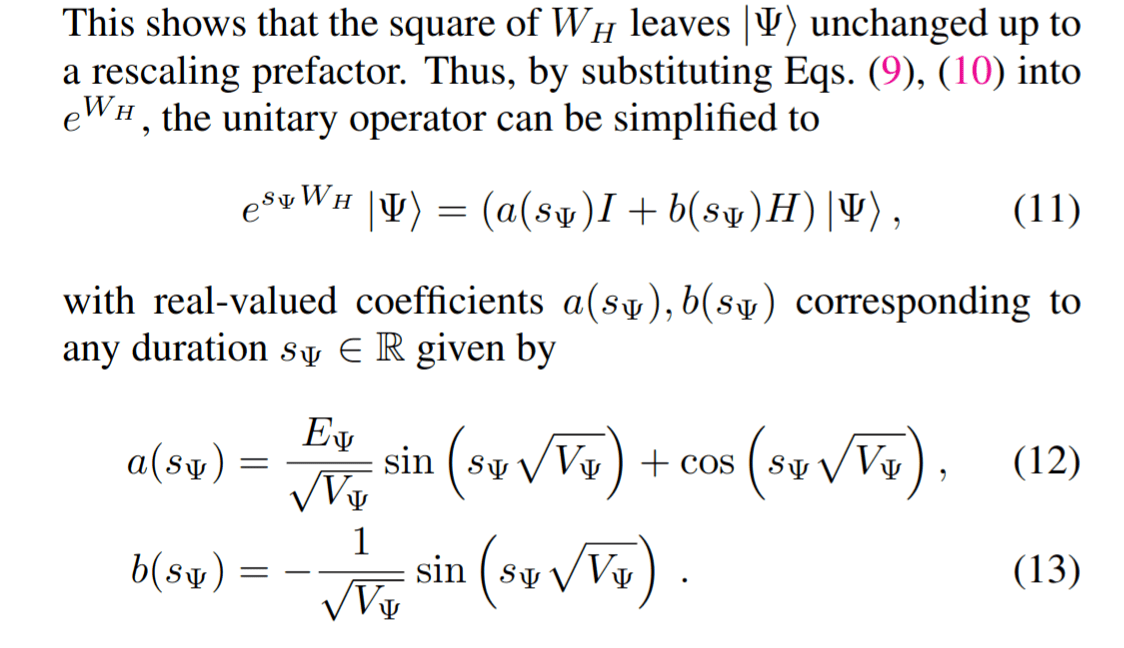
([|\psi\rangle\langle \psi|,H])^{2k} |\psi\rangle = (- 1)^k V^k|\psi\rangle
([|\psi\rangle\langle \psi|,H])^{2k+1} |\psi\rangle = (- 1)^k V^k(E-H)|\psi\rangle
This starts looking like quantum signal processing, let's see more next.
Lemma 1. Any linear polynomial with a real root \(P(H) = 1-\tau H\) can be implemented this way.

Observation. If there is a complex root \(P(H) = H-z\) can be done by
\(U_\psi(P) = e^{i\theta |\psi\rangle\langle\psi|}e^{s[|\psi\rangle\langle\psi|,H]}\)
Result: Recursive iteration implements any QSP!
This starts looking like quantum signal processing, let's see more next.
Lemma 1. Any linear polynomial with a real root \(P(H) = 1-\tau H\) can be implemented this way.
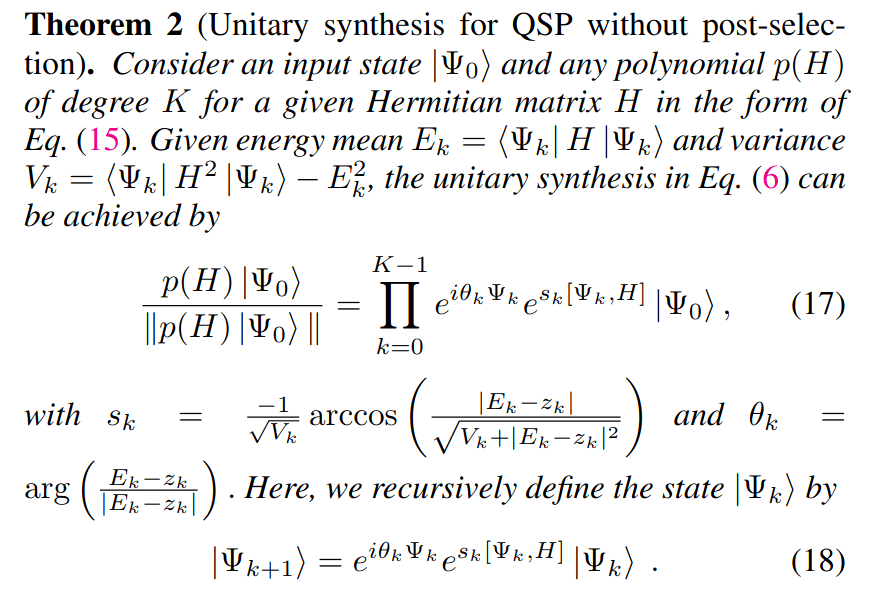
4 stages of creating quantum algorithms
1. Design choice:
How to go about it?
|\psi(\tau)\rangle = \frac{e^{-\tau H}|\psi\rangle}{\| e^{-\tau H}|\psi\rangle\|}

2. Unitary synthesis:
How to do it?
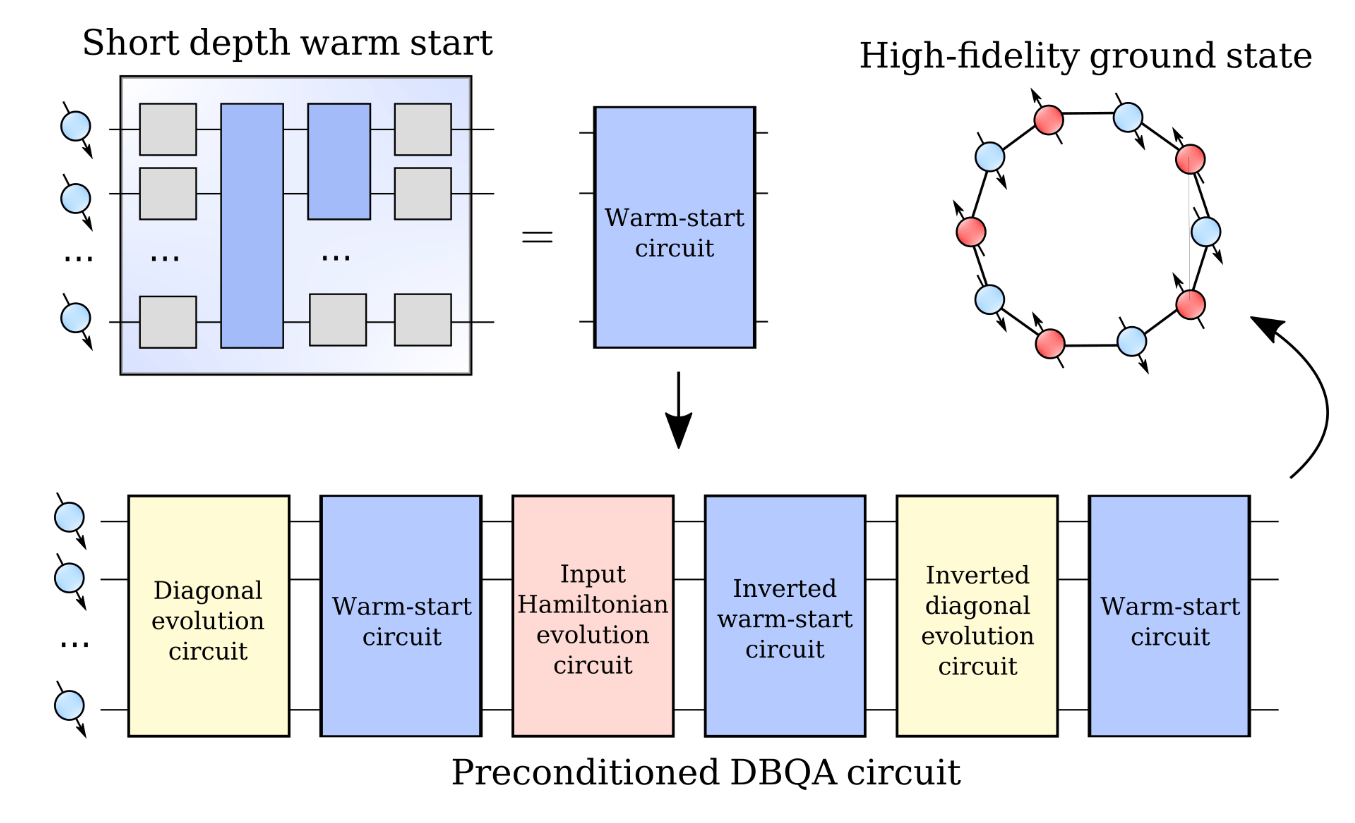

3. Circuit compilation:
What gates to do?
0. Problem choice:
What challenge to take up?
Double-bracket quantum algorithms:
Systematic framework for unitary synthesis
Design choices for optimization
| Diagonalization |
|
Inefficient? |
|---|---|---|
|
Imaginary-time evolution |
Non-unitary? | |
| Quantum signal processing | Probabilistic? |
U^\dagger H U =
\begin{pmatrix}
\lambda_0&&\\
&\lambda_1&\\
&&\ddots
\end{pmatrix}
|\psi(\tau)\rangle = \frac{e^{-\tau H}|\psi\rangle}{\| e^{-\tau H}|\psi\rangle\|}
|\psi(z)\rangle = \frac{ p(H)|\psi\rangle}{\| p(H)|\psi\rangle\|}
Double-bracket quantum algorithms
Click these links at slides.com/marekgluza
| Diagonalization | https://arxiv.org/abs/2206.11772 | ||
|---|---|---|---|
| Imaginary-time evolution | https://arxiv.org/abs/2412.04554 | ||
| Quantum signal processing | https://arxiv.org/abs/2504.01077 | ||
| Grover's search | https://arxiv.org/abs/2507.15065 | Approximates ITE |
U^\dagger H U =
\begin{pmatrix}
\lambda_0&&\\
&\lambda_1&\\
&&\ddots
\end{pmatrix}
|\psi(\tau)\rangle = \frac{e^{-\tau H}|\psi\rangle}{\| e^{-\tau H}|\psi\rangle\|}
\frac{ \prod_{k=1}^K(H-z_k I)|\psi\rangle}{\| \prod_{k=1}^K(H-z_k I)|\psi\rangle\|}
\prod_{k=1}^Ke^{i\theta_k|\psi_k\rangle\langle\psi_k|} e^{s_k[|\psi_k\rangle\langle\psi_k|,H]}|\psi\rangle
H' = e^{-s[D,H]}H e^{s[D,H]}
e^{s[|\psi\rangle\langle\psi|,H]}|\psi\rangle +O(\tau^2)
(1-2|\psi\rangle\langle\psi|)\times e^{i t H_f}
e^{s[|\psi\rangle\langle\psi|,H]}|\psi\rangle
Riemannian gradient: Unique vector \(g\) in the tangent space such that the directional derivative is a projection onto \(g\)
\nabla_A f(x) = \text{lim}_{s\rightarrow 0}\frac{ f(x+s A) - f(x)}{s} = \langle g, A\rangle
\nabla_A E(\psi) = \text{lim}_{s\rightarrow 0} \frac{ \langle \psi| e^{-isA}He^{isA}- H | \psi\rangle}{s} = \langle \psi| i [H,A] |\psi\rangle
Tr(ABC) = Tr(CAB)\\
\Downarrow \\
Tr(|\psi\rangle\langle \psi| [H,A] ) = Tr([|\psi\rangle\langle \psi|,H]A)
E(\psi) = \langle \psi| H | \psi\rangle
| \psi\rangle \mapsto e^{is A}|\psi\rangle
\nabla_A f(x) = \langle g, A\rangle
\nabla_A E(\psi) =
\langle [H,|\psi\rangle\langle \psi|] , i A\rangle_{\rm{HS}}
\\\Downarrow\\
g \equiv -i[|\psi\rangle\langle \psi|,H]
|\psi'\rangle = e^{s[|\psi\rangle\langle \psi|,H]} |\psi\rangle
|\psi\rangle \mapsto e^{isg} |\psi\rangle
|\psi''\rangle = e^{s[|\psi'\rangle\langle \psi'|,H]} |\psi'\rangle
Double-bracket quantum algorithms:
Systematic framework for implementing exponentials of commutators and uncovering new unitary synthesis formulas
Riemannian gradient: Unique vector \(g\) in the tangent space such that the directional derivative is a projection onto \(g\)
Double-bracket flows
\partial_t O(t)= i[H,O(t)]
\partial_t \rho(t)= i[H,\rho(t)]
\partial_t A(t)= [[A(t),B],A(t)]
H \sim -i[A(t),B]
|
Heisenberg picture |
Linear, variable: observable |
|---|---|
|
Schroedinger picture |
Linear, variable: density matrix |
|
Double-bracket flow |
Non-linear, variable: density matrix or observable The solution is a unitary rotation because |
Why double a bracket?
\partial_t \hat A(t) = i [ \hat H(t), \hat A(t)]
\partial_t \hat A(t) = [ \hat H(t), [\hat H(t), \hat A(t)]]
=
2 qubit unitary
Canonical
\partial_t \hat A(t) = [ \hat A(t), [\hat A(t), \hat H(t)]]
Double-bracket quantum algorithms
are inspired by double-bracket flows
and allow for quantum compiling of short-depth circuits which approximate grounds states
How do you create a quantum algorithm?
- Now: Not many distinct quantum algorithms
https://quantumalgorithmzoo.org/ - Why?
- 00's Shor: Why have not more algorithms have been found? https://cs.brynmawr.edu/Courses/cs380/fall2012/Shor2003.pdf
Either because the easy ones are efficient classically or we have no good language
- Classically: Reduction to decision problems
- Quantumly: Is \(\langle\psi|H|\psi\rangle\) lower than ...?
- Optimization: Only quadratic speed-up?
- Grand unification of quantum algorithms https://arxiv.org/abs/2105.02859 through block-encodings
- Another unification through double-bracket flows and Riemannian optimization - this talk
- Double-bracket quantum algorithms give intuition why unification possible: \(\langle\psi|H|\psi\rangle\) is optimization so interpret through Riemannian gradients
Click links at slides.com/marekgluza
- 90's Shor: factoring is in BQP
\nabla_A f(x) = \langle g, A\rangle
\nabla_A E(\psi) =
\langle [H,|\psi\rangle\langle \psi|] , i A\rangle_{\rm{HS}}
\\\Downarrow\\
g \equiv -i[|\psi\rangle\langle \psi|,H]
|\psi'\rangle = e^{s[|\psi\rangle\langle \psi|,H]} |\psi\rangle
|\psi\rangle \mapsto e^{isg} |\psi\rangle
|\psi''\rangle = e^{s[|\psi'\rangle\langle \psi'|,H]} |\psi'\rangle
What is the meaning of \(e^{s[|\psi\rangle\langle\psi|,H]}\)?
- Riemannian gradient update
- Quantum signal processing by a linear polynomial
- Linear approximation to imaginary-time evolution
Fact 1. Riemannian gradient: Unique vector \(g\) in the tangent space such that the directional derivative is a projection onto \(g\)
4 stages of creating quantum algorithms
1. Design choice:
How to go about it?
|\psi(\tau)\rangle = \frac{e^{-\tau H}|\psi\rangle}{\| e^{-\tau H}|\psi\rangle\|}
3. Circuit compilation:
What gates to do?
|\psi(\tau)\rangle = \frac{e^{-\tau H}|\psi\rangle}{\| e^{-\tau H}|\psi\rangle\|}
0. Problem choice:
What challenge to take up?
2. Unitary synthesis:
How to do it?
Double-bracket quantum algorithms:
Systematic framework for unitary synthesis
|\psi(\tau)\rangle = \frac{e^{-\tau H}|\psi\rangle}{\| e^{-\tau H}|\psi\rangle\|}
= e^{\tau[|\psi\rangle\langle\psi|,H]}|\psi\rangle +O(\tau^2)
|\psi(\tau)\rangle = \frac{e^{-\tau H}|\psi\rangle}{\| e^{-\tau H}|\psi\rangle\|} \\
= e^{\tau[|\psi\rangle\langle\psi|,H]}|\psi\rangle +O(\tau^2)\\
= e^{i\sqrt{\tau}H}e^{i\sqrt{\tau}|\psi\rangle\langle\psi|}e^{i\sqrt{\tau}H}|\psi\rangle + O(\tau^{3/2})
e^{itH}\\
e^{it|\psi\rangle\langle\psi|}

Product formula approximation:
\(e^{\tau[|\psi\rangle\langle\psi|,H]}| = e^{i\sqrt{\tau}H}e^{i\sqrt{\tau}|\psi\rangle\langle\psi|}e^{-i\sqrt{\tau}H}e^{-i\sqrt{\tau}|\psi\rangle\langle\psi|} + O(\tau^{3/2})\)
Product formula approximation:
\(e^{\tau[|\psi\rangle\langle\psi|,H]}| = e^{i\sqrt{\tau}H}e^{i\sqrt{\tau}|\psi\rangle\langle\psi|}e^{-i\sqrt{\tau}H}e^{-i\sqrt{\tau}|\psi\rangle\langle\psi|} + O(\tau^{3/2})\)
Quantum algorithm DB-QITE - iterate recursively:
- Define \(|{\psi_k}\rangle = U_k |0\rangle\)
- Use \(e^{is |\psi_k\rangle\langle\psi_k|} = U_ke^{is |0\rangle\langle0|}U_k^\dagger \)
- Recursively iterate \( U_{k+1} = e^{is H} U_k e^{is |0\rangle\langle 0|} U_k^\dagger e^{-is H} U_k\)
3 stages of creating quantum algorithms
1. Design choice:
How to go about it?
|\psi(\tau)\rangle = \frac{e^{-\tau H}|\psi\rangle}{\| e^{-\tau H}|\psi\rangle\|}
3. Circuit compilation:
What gates to do?
|\psi(\tau)\rangle = \frac{e^{-\tau H}|\psi\rangle}{\| e^{-\tau H}|\psi\rangle\|}
0. Problem choice:
What challenge to take up?
2. Unitary synthesis:
How to do it?
e^{itH}\\
e^{it|\psi\rangle\langle\psi|}
Two theorems for DB-QITE:
DB-QITE:
- Define \(|{\psi_k}\rangle = U_k |0\rangle\)
- Recursively iterate \( U_{k+1} = e^{is H} U_k e^{is |0\rangle\langle 0|} U_k^\dagger e^{-is H} U_k\)
Then:
1. Mean energy \(E_k := \langle \psi_k| H|{\psi_k}\rangle\) decreases as
\(E_{k+1} = E_k - 2s V_k + O(s^2)\)
where \(V_k := \langle \psi_k| H^2|{\psi_k}\rangle - E_k^2\)
2. Ground-state fidelity \(F_k := |\langle \lambda_0| {\psi_k}\rangle|^2\) increases as
\(F_{k} \ge 1 - q^k\)
where \(q = 1 - O( \Delta F_0 / \|H\|^3)\)



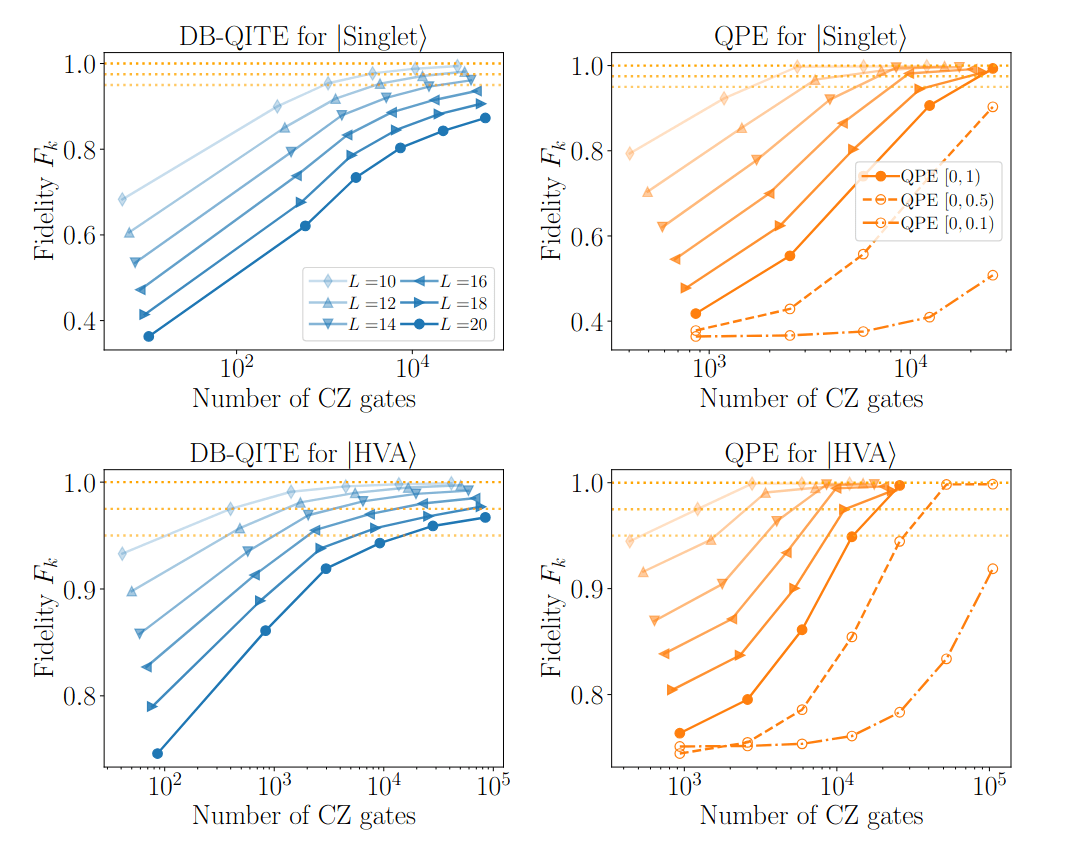
Numerical results for DB-QITE:
DB-QITE:
- Define \(|{\psi_k}\rangle = U_k |0\rangle\)
- Recursively iterate \( U_{k+1} = e^{is H} U_k e^{is |0\rangle\langle 0|} U_k^\dagger e^{-is H} U_k\)
Then:


Quantinuum
Double-bracket quantum algorithms
- coherently implement Riemannian gradient steps
-
give rigorous unitary synthesis for
- imaginary-time evolution
- quantum signal processing
- diagonalization unitaries
- Grover's algorithm is an approximation to imaginary-time evolution
J. Son
B. Tiang

S. Carrazza

R. Seidel
R. Zander
Z. Holmes
Y. Suzuki


Tell me when not fast enough? Get stuck? Something else?
Your input is needed to improve them!
N. Ng
Double-bracket quantum signal processing
By Marek Gluza