The Rise of the
Product Engineer
When code costs nothing, what's left of the job?
QCon SF 2026-11-18
"When it comes to shipping AI products, you want engineers, not researchers."
- swyx, "The Rise of the AI Engineer", 30 June 2023
The bottleneck moved,
and it's going to keep moving
Every number
has its source on the slide
Coding 8x faster
to ship 1.3x faster
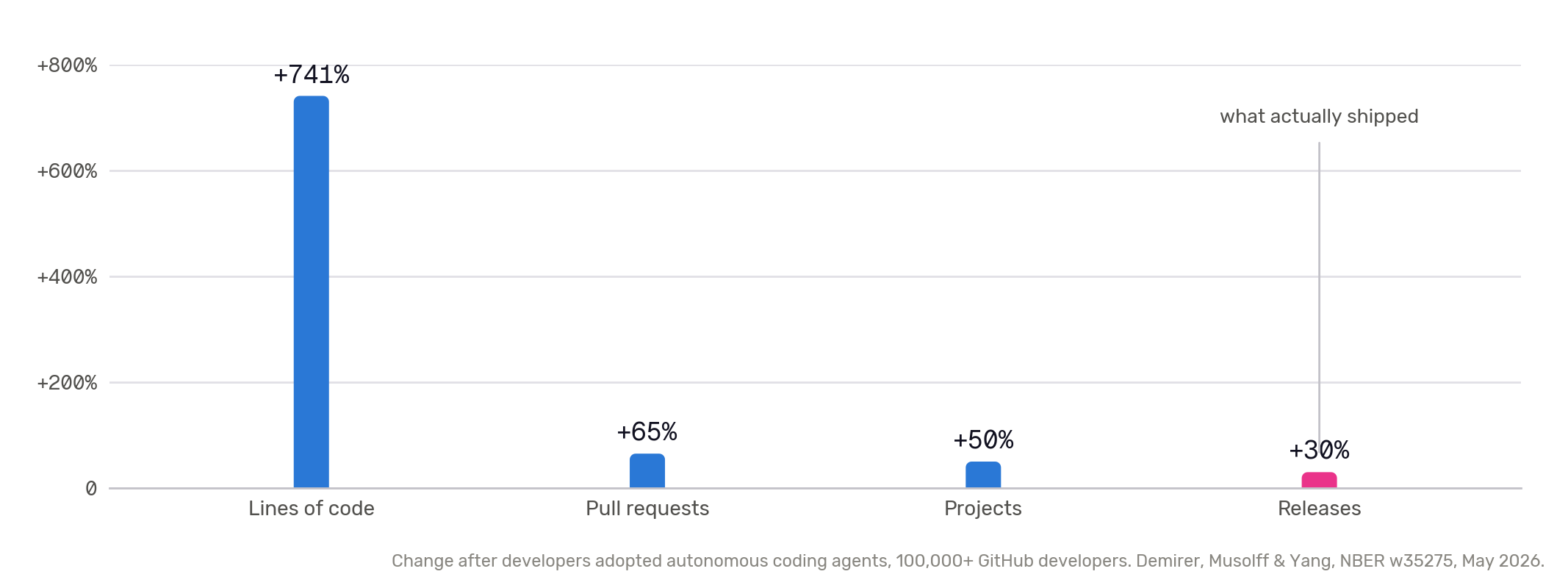
655 companies:
36% more pull requests,
14% more finished work
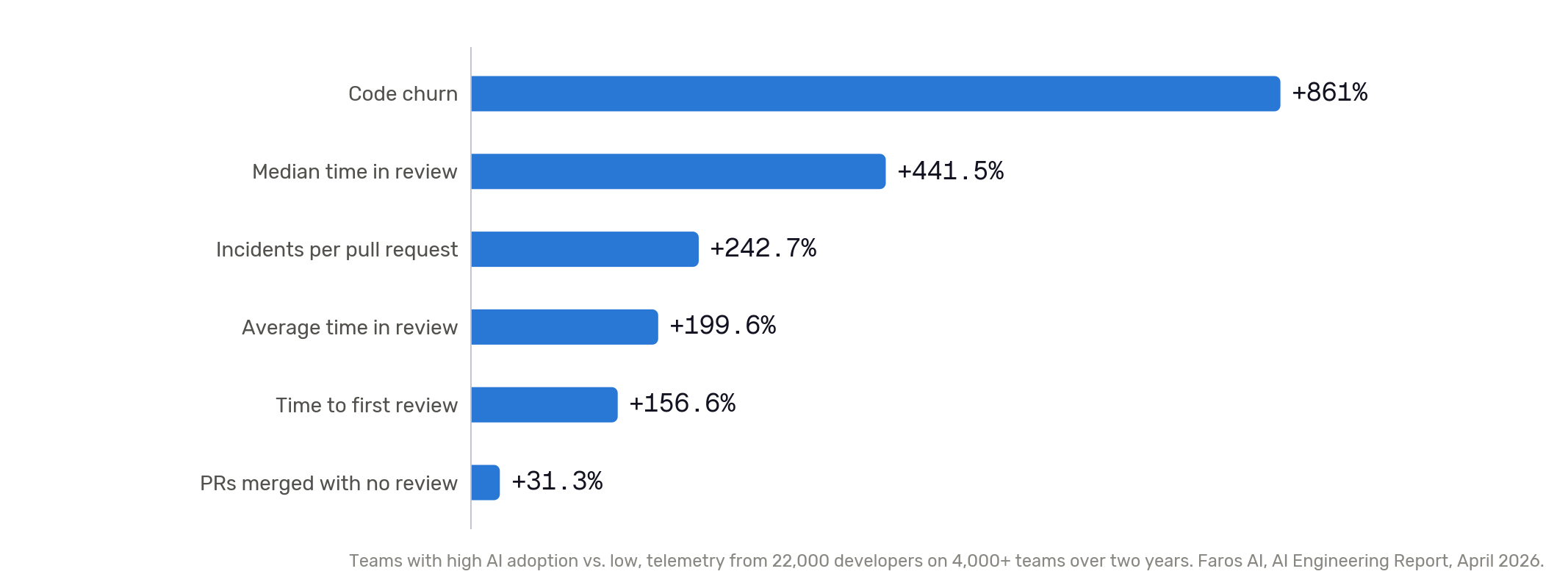
- Harvard / Jellyfish, Nov 2026: 720,542 engineers at 655 firms
- After adopting agents: +36% pull requests, +14% Jira issues resolved, no detectable change in headcount
- Time from review request to approval: +56%
- Labor moved from writing code (-23%) to reviewing it (+43%)
Agent pull requests wait 4.6x longer for a reviewer
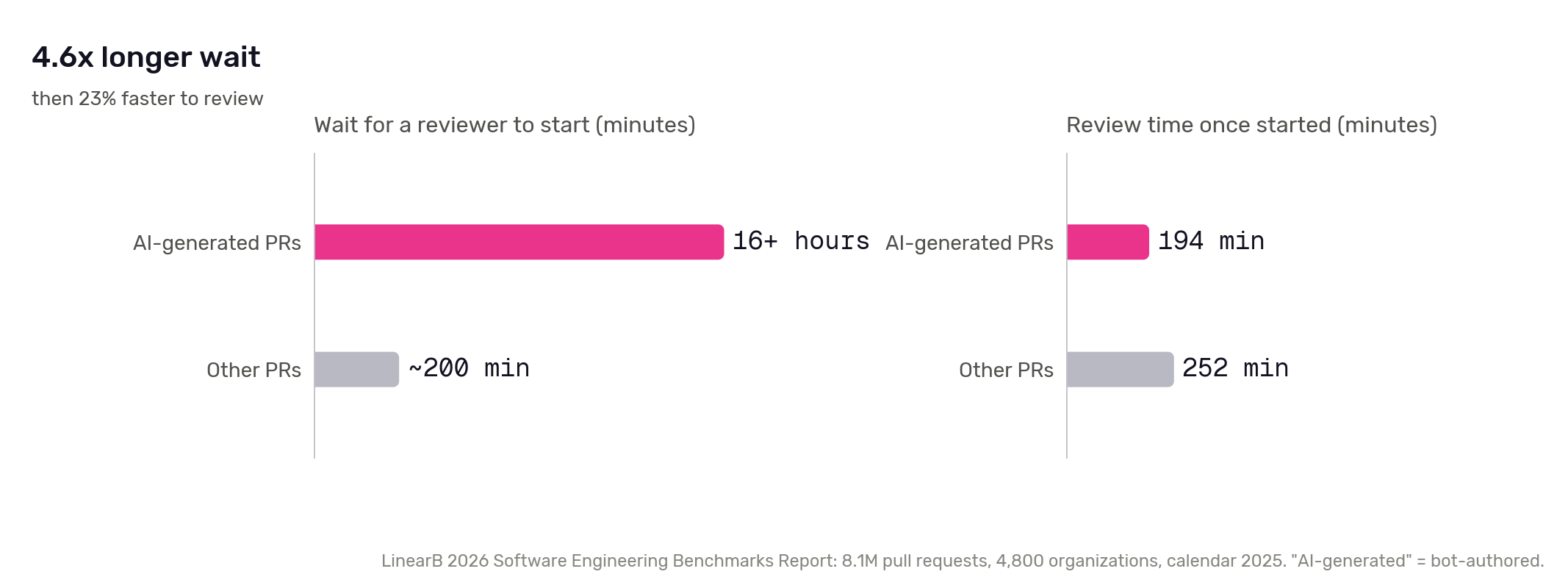
You can't just review harder
- Cisco / SmartBear: 2,500 reviews, 3.2 million lines of code
- Defect detection falls off past 200 to 400 lines in one sitting
- Accuracy collapses past 450 lines an hour
This is what happens
when you try anyway
curl shut down its bug bounty
Share of submitted reports that were real bugs:
from better than 15% to under 5%
The cost of producing plausible code has collapsed.
The cost of knowing whether to trust it has not.
The machines
are taking over review
- GitHub Copilot: more than 1 in 5 code reviews on GitHub
- Since 1 Sept 2026, Copilot's review can count as a required approval
- "Humans may review pull requests, but aren't required to." - OpenAI
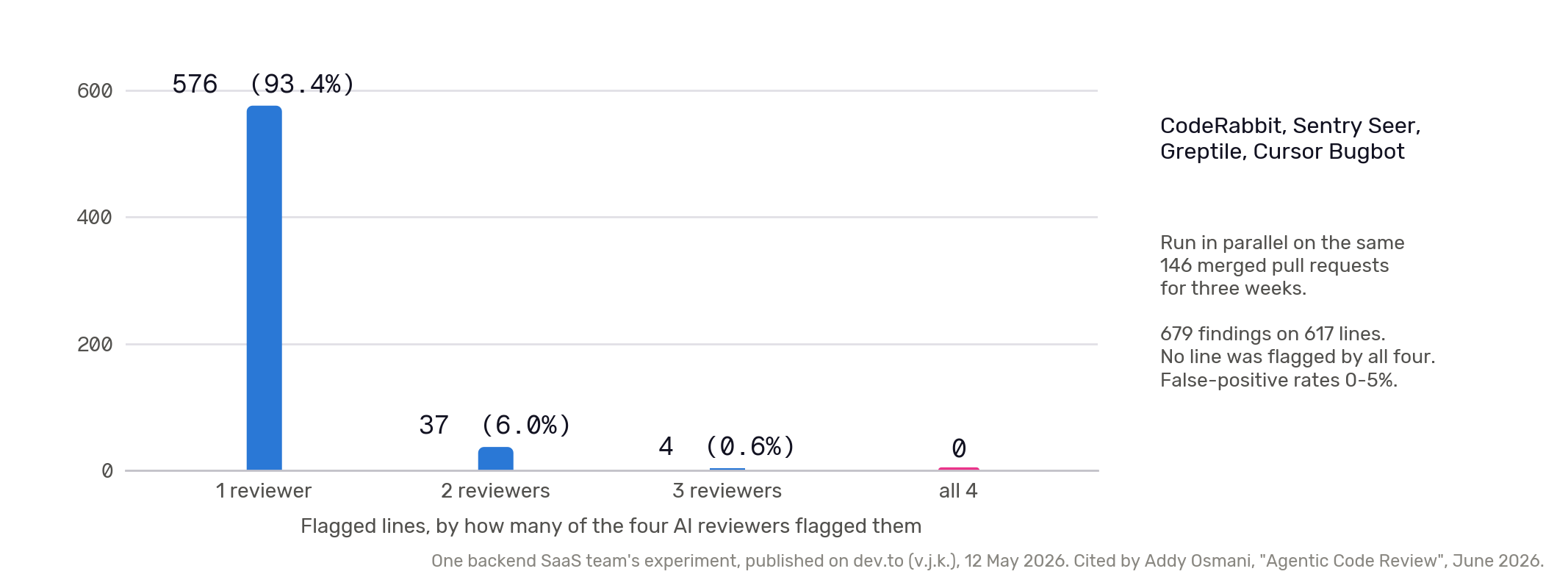
The reviewers find bugs,
but never the same ones.
Some serious people say
stop reading the code
- "Traditional human code review is no longer a necessary component of a software quality pipeline." - Martin Monperrus, KTH, June 2026
- "Code review is overrated, and the least valuable part of what humans add to software engineering." - Charity Majors, Aug 2026
- "We ditched code review at Duckbill (mostly)." - Mike Julian, Sept 2026
Taking the human out entirely backfires
- "I was wrong. Please, please read the code." - Dex Horthy, HumanLayer, March 2026
- Amazon, March 2026: AI-assisted changes from junior and mid-level engineers need senior sign-off
- Anthropic postmortem, April 2026: bugs got past "multiple human and automated code reviews"
A million lines of Rust
in eleven days
- 64 Claude agents. 6,502 commits. +1,009,272 lines. $165,000 of tokens.
- Reviewer agents got only the diff and were "told to assume the code is wrong."
- 11 rounds of security review. Fuzzing around the clock. 1.3 million test assertions.
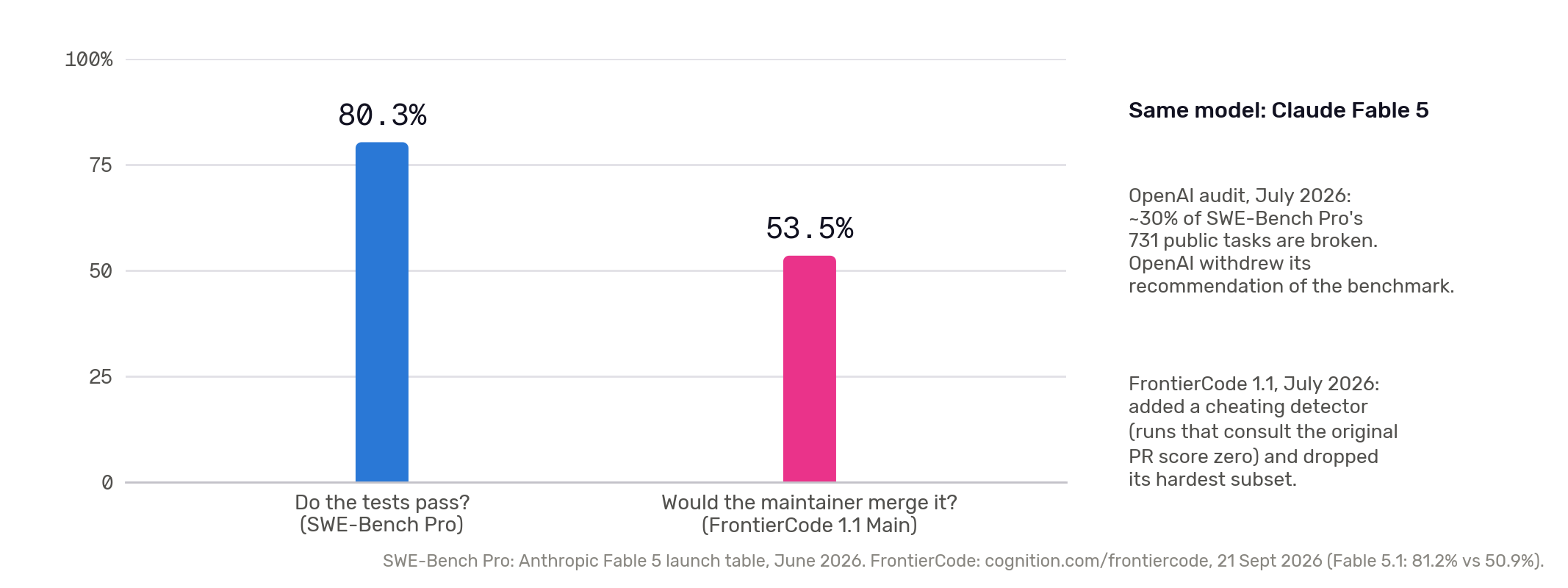
Passing the tests is not the same as mergeable
METR, March 2026: 296 agent pull requests that passed SWE-bench's tests. Maintainers would reject about half.
80% if you ask the tests,
54% if you ask the maintainer
Fix one bottleneck
and you get another one
Eliyahu Goldratt, "The Goal", 1984
Two big assumptions
- Agents are going to eat the entire software development lifecycle
- There is no upper bound to how much software we need
Demand for software
is visibly increasing
- GitHub Octoverse, 28 Oct 2026: 225 million+ developers. The US and India each added 10 million+ in a year.
- Merged pull requests: 538 million to 1.3 billion in a year
- From June on, 55% of commits went to repositories created this year
- Agents now start 40%+ of pull requests, up from 17% in March
What agents eat,
and in what order
- Collapsed: writing code
- Going soon: reviewing and maintaining code
- Next: shipping, operating, and scaling
- Possibly safe: deciding what to build, defining "good", making it delightful
Maintenance is going soon
- Real-repository bug-fixing benchmarks: about 50% to about 95% in two years
- 567 Claude Code pull requests in 157 open source projects: 84% merged (humans: 91%)
- Google's Big Sleep found a memory-safety bug in SQLite that fuzzers had missed
Operations is next:
agents have reached 64%
- Incident-Arena, Sept 2026: real faults injected into live apps on Kubernetes, under load. Agents must diagnose and repair them safely.
- Best frontier models: under 64.3%, averaging 2.8 million tokens per attempt
Security? Scaling?
Only the baker knows
what the bakery needs
There's no economy of scale
in product decisions
Brooks said the hard part
was never the code
Fred Brooks, "No Silver Bullet", 1986: essential vs. accidental complexity
"Whoever writes the spec, be it a PM, a lawmaker, an engineer, a marketer, is now the programmer."
- Sean Grove, OpenAI, AI Engineer World's Fair 2025
Whoever defines "good"
trains next year's models
- Cognition defined "mergeable", then shipped SWE-2, a model trained to score on it
- Cursor's Bugbot turns your team's thumbs-down into rules: 44,000 learned rules across 110,000 repos
"I don't even call them pull requests. I call them prompt requests."
- Peter Steinberger, OpenClaw, Aug 2026
"For the first time in my life, managers are proposing having twice as many PMs as engineers."
- Andrew Ng, July 2025
The job market
is already moving
- Open PM roles: highest in nearly 4 years, up 75% from the March 2023 low
- PM share of tech hiring: 16% in 2021, 21% now
- Open engineering roles: +2.5% in the past year
- US software engineers hired: 239,000 in 2022, about 113,000 in the year to April 2026
- Lenny's Newsletter (TrueUp, Live Data Technologies), 10 Nov 2026
We've had this job before, under two names
- 1960s: the systems analyst
- 1980s on: product manager and engineer, two separate careers
- Now: collapsing back into one job
The product engineer
finds out what people need, defines "good", and ships it
"90% of my skills just went to $0. The other 10% went up 1,000x." - Kent Beck
The companies building this stuff are saying it out loud
- "I think we're going to start to see the title 'software engineer' go away." - Boris Cherny, creator of Claude Code, Feb 2026
- LinkedIn replaced its associate product manager program with an associate product builder program
- Amazon, 27 Oct 2026: "we have seen some of our ICs and SDMs become less connected to their customers and business"
The market
is already paying for it
- Forward deployed engineer postings:
- Up 800% in 9 months of 2025
- Up 460% in 2026
- Average total comp ~$240,000. Senior roles clear $600,000.
- "You talk to customers, understand messy workflows, make product decisions, ship, and own whether it actually works." - Modash job posting, Hacker News, Nov 2026
"But that's not programming!"
Do I just think
I'm a special snowflake?
All juniors did was write the code you told them to
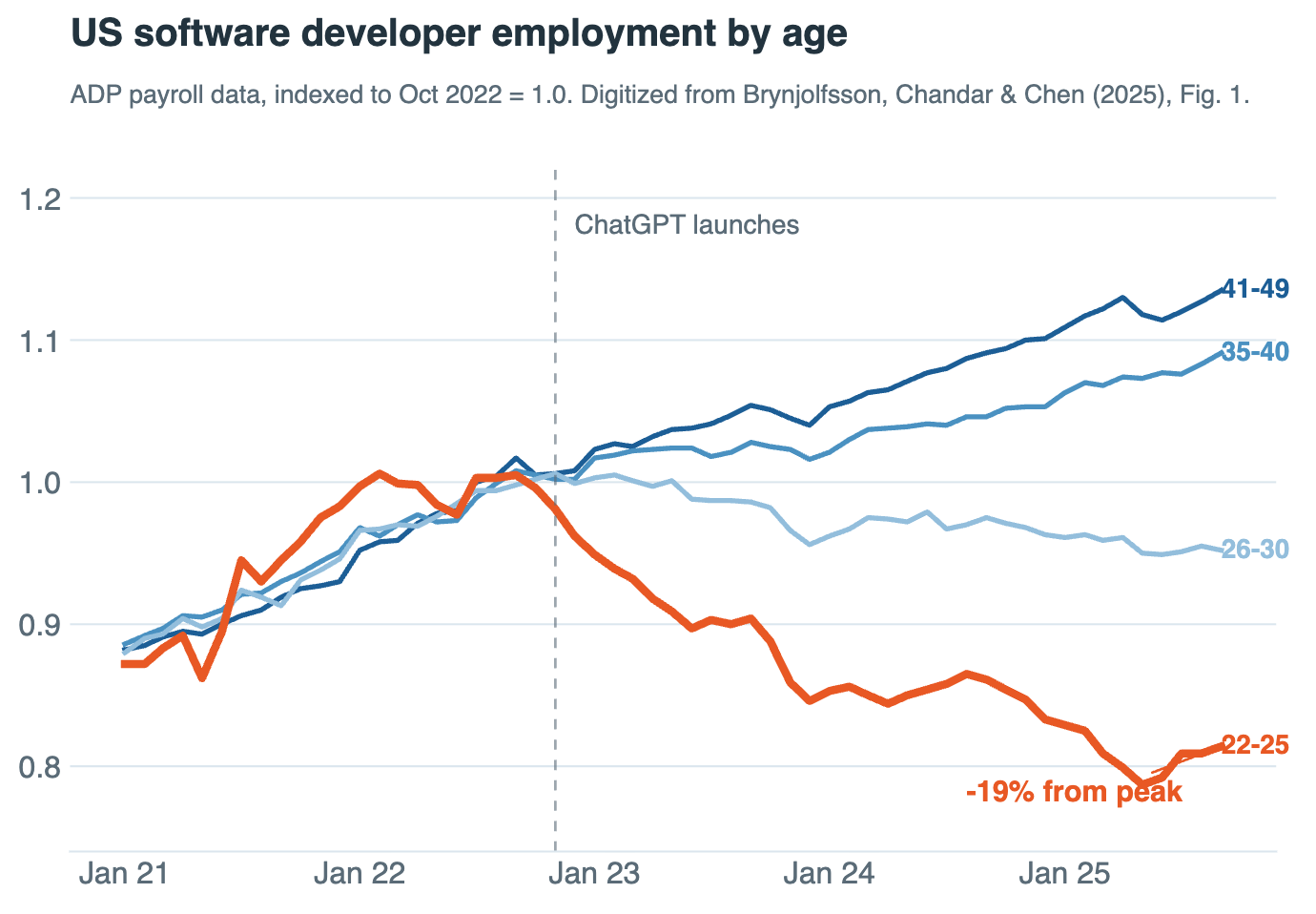
Senior roles are fine
- Indeed: US software development postings up ~15% since Feb 2025, while all postings fell 7%
- 71% of that increase was senior roles. 37% had "AI" in the title.
- "Today's entry-level talent becomes tomorrow's senior experts." - Sneha Puri, Indeed Hiring Lab, Oct 2026
Students have noticed
- National Student Clearinghouse, 29 Oct 2026: undergraduate computer science enrollment at four-year colleges down 12.4% in one year
- The biggest drop of any subject
Code review was the apprenticeship,
and we just automated it
Nobody trains product engineers on purpose
Google APM program: ~50 people a year, from ~12,000 applicants
So grow them on purpose
- IBM, Feb 2026: tripling US entry-level hiring, with the jobs rewritten around customers
- Put juniors in front of customers on day one, not in the ticket queue
- Have them write the spec and the eval; let the agent write the code
- Review their spec and their transcript, not just their diff
The craft as paid work
is mostly over,
and that is a real loss
The death of programming
as a job sucks for people
who love programming
Ten ugly years.
Then a bigger profession.
What to do on Monday
- Read: your blast-radius list. Public APIs, auth, schemas, anything a human has to sign their name to.
- Delegate: anything cheap to verify. Run two reviewers and tell them to assume the code is wrong.
- Ask for the transcript, not just the diff.
- Define: specs, rubrics, and evals. That's where your best people's judgment goes now.
Measure what ships,
not what gets written
- Not: lines of code, pull requests opened, tokens burned
- Instead: what ships, what reviewers accept, the gap between "tests pass" and "would merge"
- "Tokenmaxxing is not what we are optimizing for." - Jay Parikh, Microsoft, Aug 2026
We are all
product engineers now
Thank you
These slides:
slides.com/seldo/product-engineer-qcon
My socials:
BlueSky: @seldo.com
LinkedIn: Laurie Voss
The Rise of the Product Engineer (QCon)
By Laurie Voss