Field-Level Inference of Primordial
Non-Gaussianity from DESI
Hugo SIMON,
PhD student supervised by
Arnaud DE MATTIA and François LANUSSE
Durham, 2026/07

Cosmological inference
\(\Omega := \{ \Omega_m, \Omega_\Lambda, H_0, \sigma_8, f_\mathrm{NL},...\}\)
inference
\(P\)
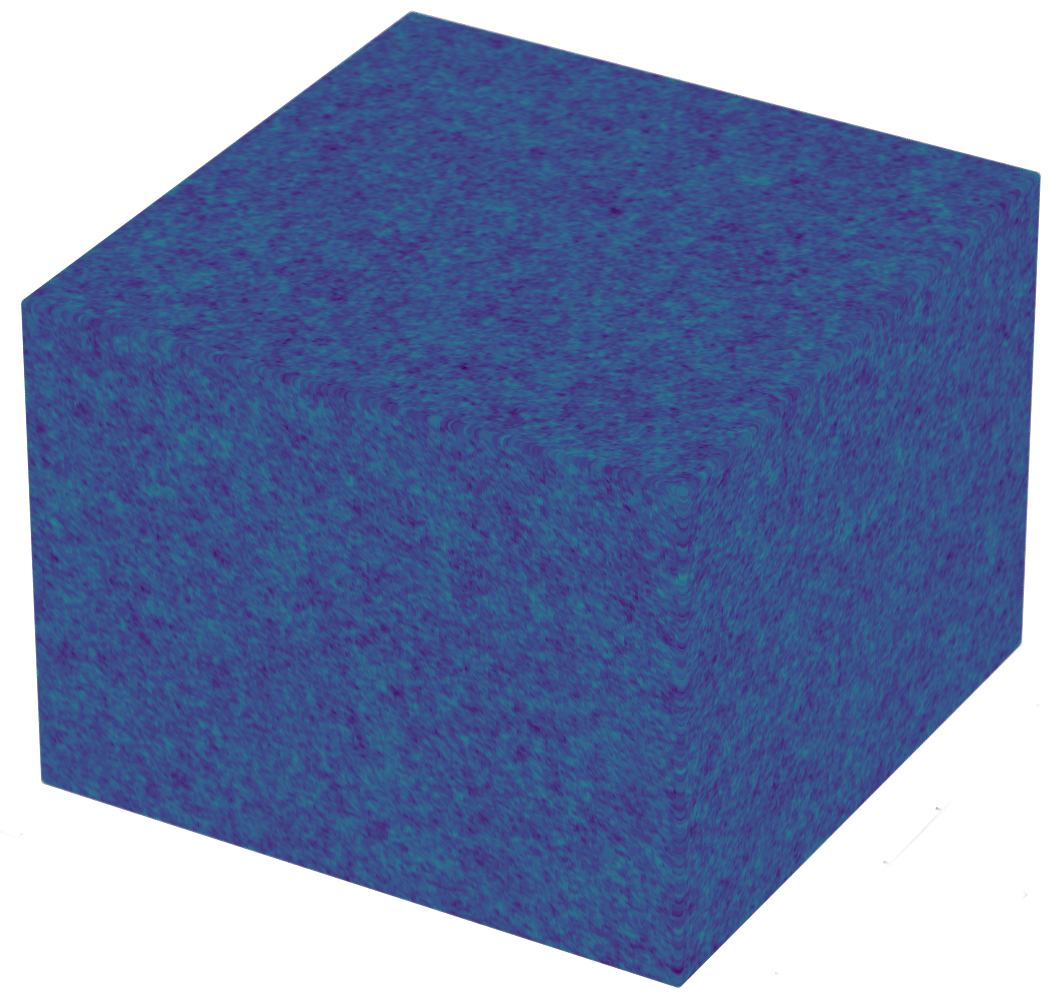
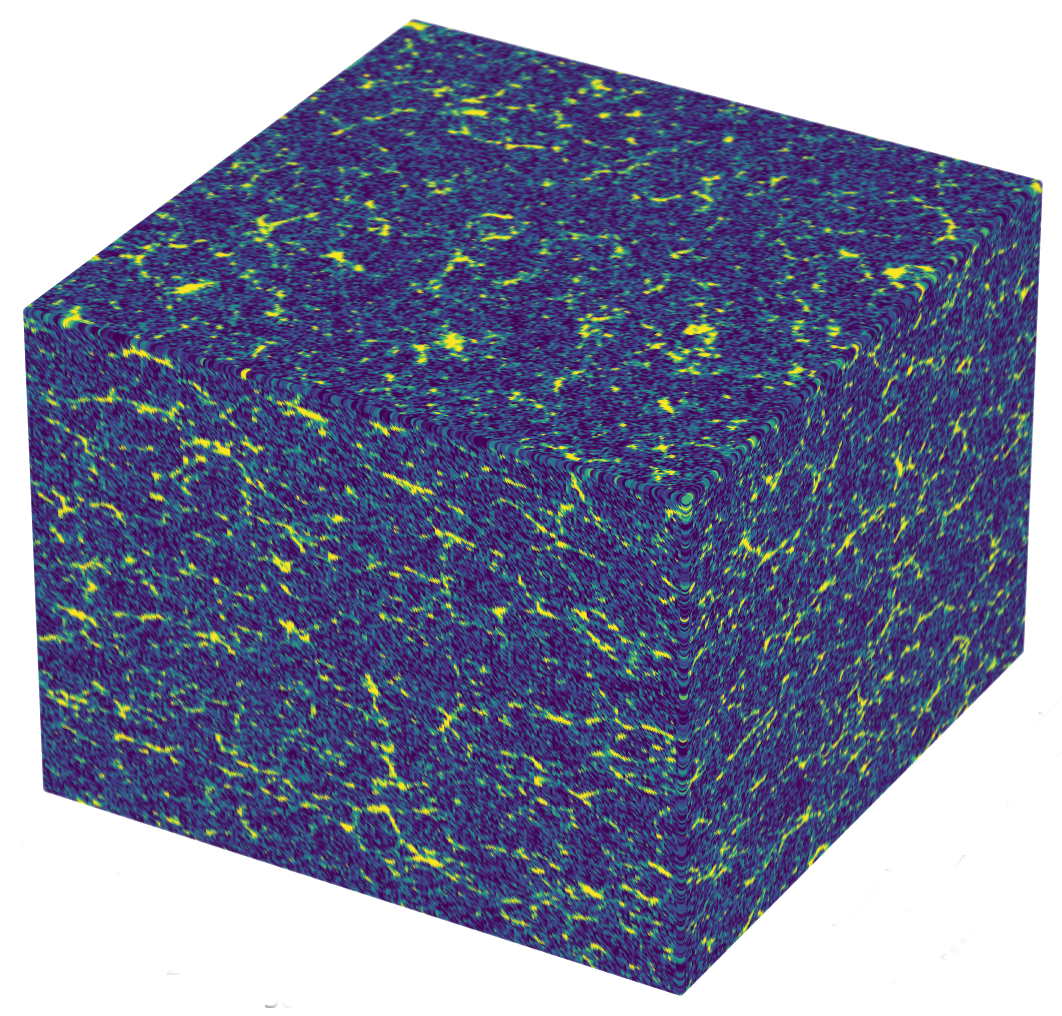
\(\Omega\)
\(\delta_L\)
\(\delta_g\)
Cosmological inference
\(\Omega := \{ \Omega_m, \Omega_\Lambda, H_0, \sigma_8, f_\mathrm{NL},...\}\)
\(\Omega\)
\(\delta_L\)
\(\delta_g\)
inference
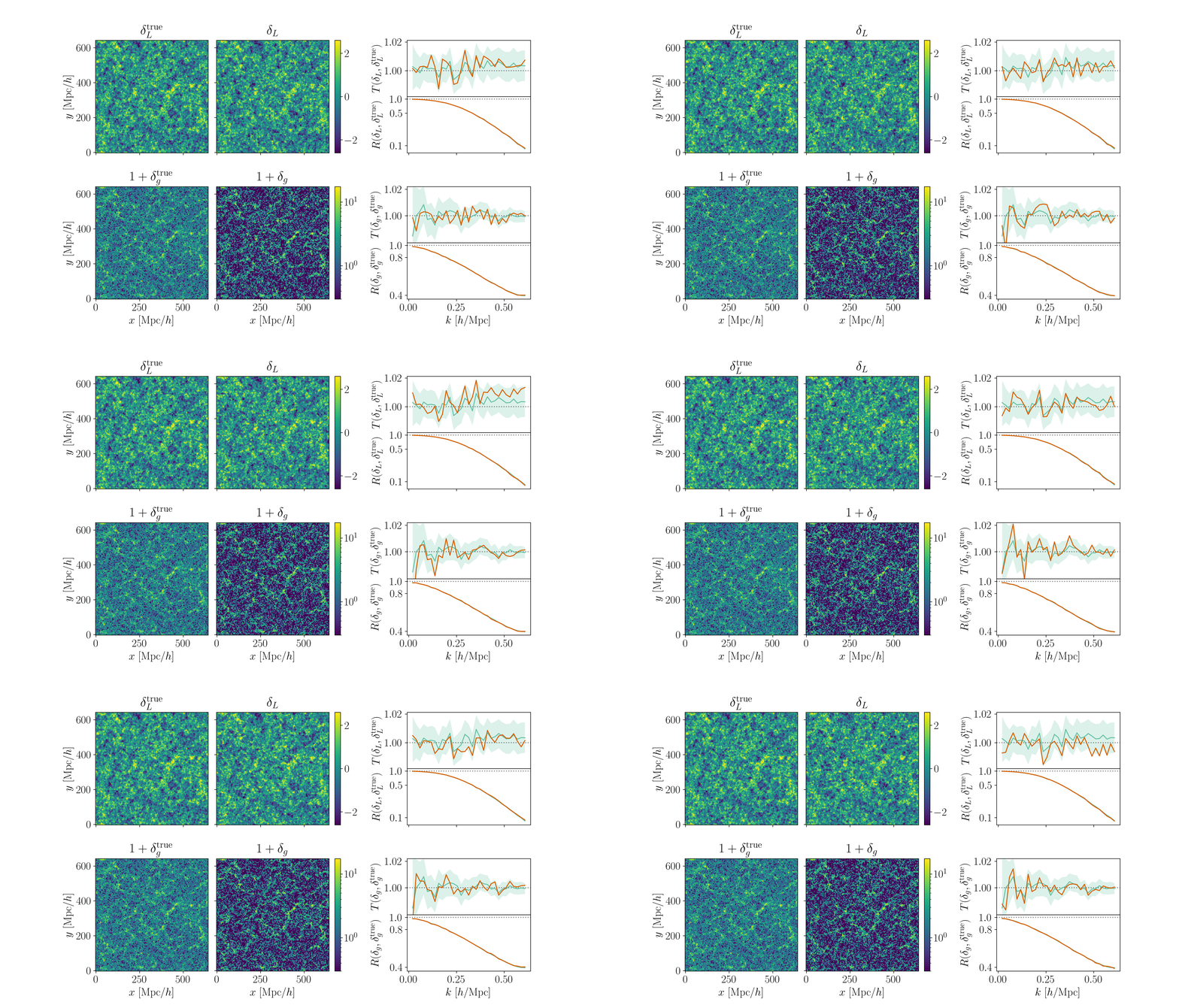
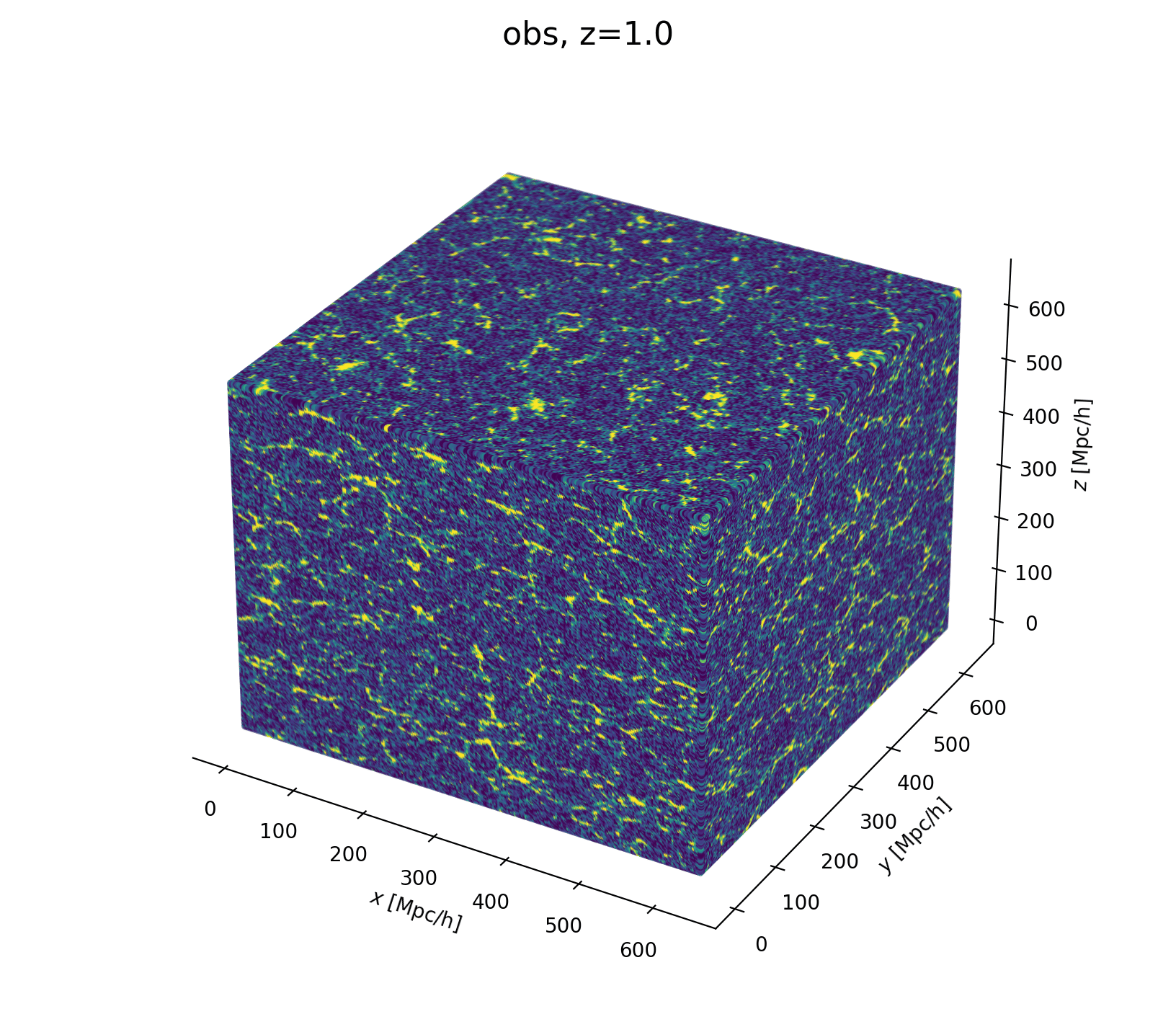
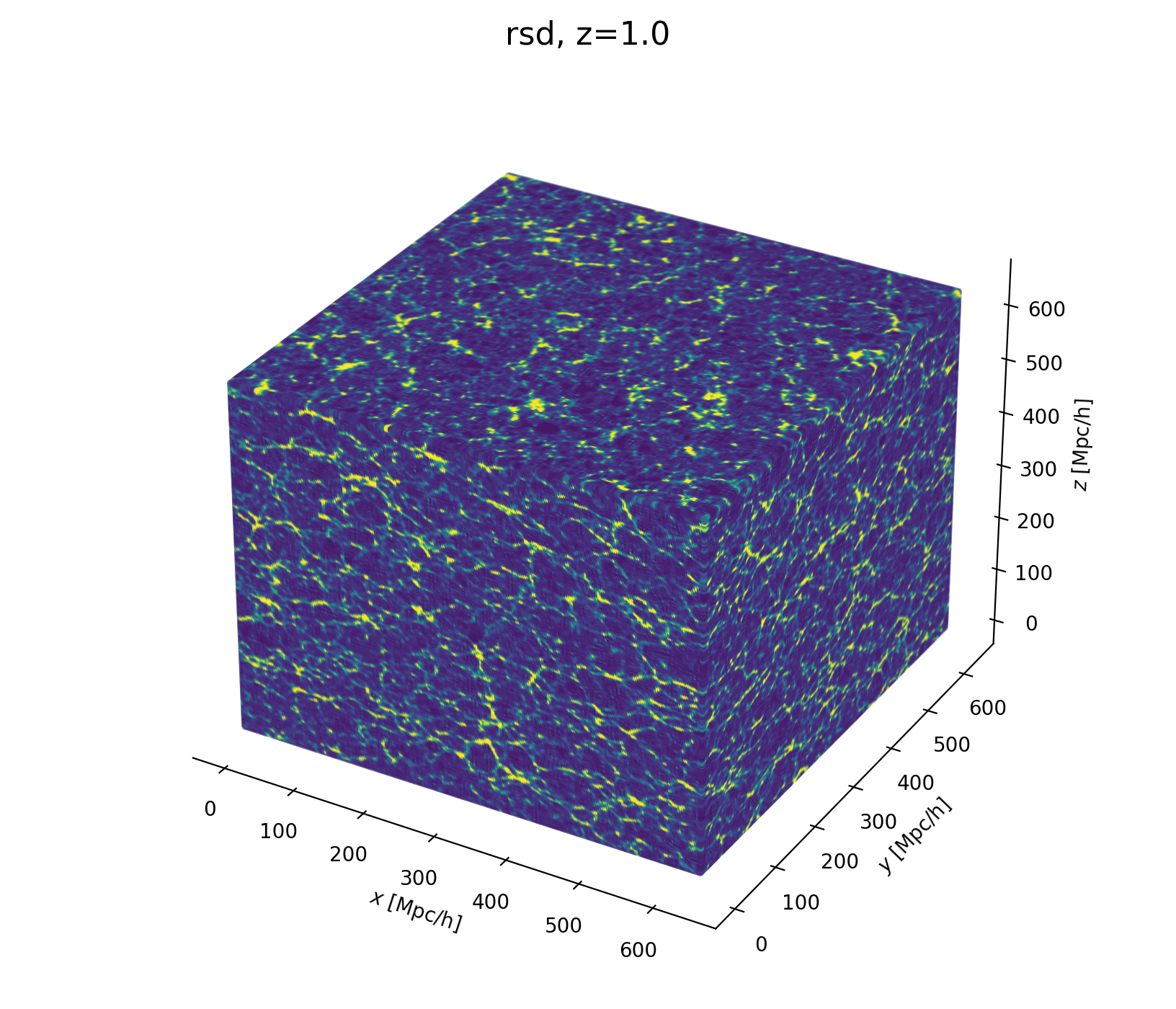
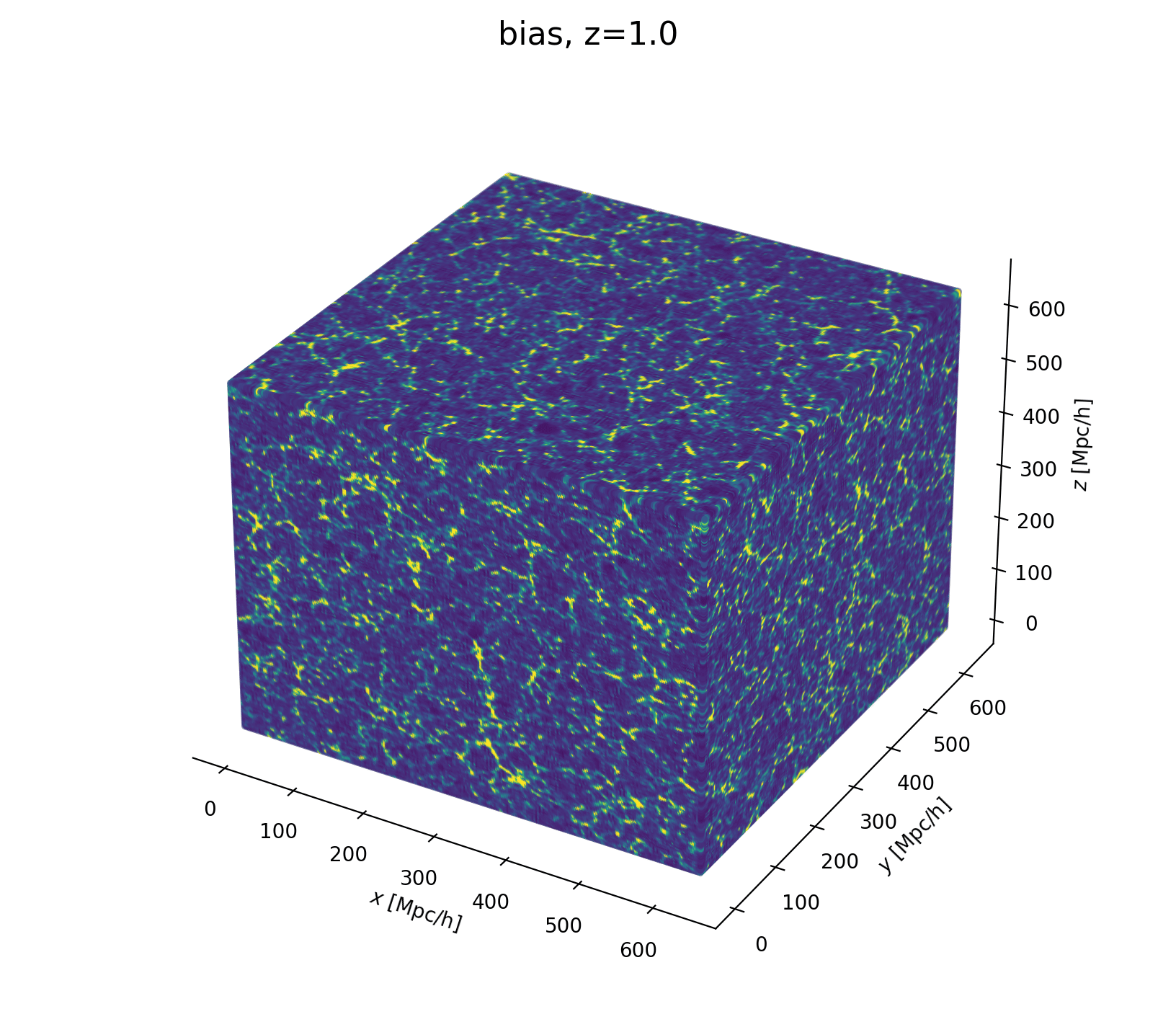
Field-Level modeling of PNG
- Sample initial conditions, add PNG
$$\phi=\phi_L+{\color{purple}f_{\mathrm{NL}}}\phi_L^{2}$$ - Lagrangian bias expansion
$$w_g = \sum_{\mathbb O} b^L_{\mathbb O} [\mathbb O_{L}] \supset {\color{purple}f_{\rm NL} b_\phi}\phi_L + {\color{purple} f_{\rm NL} b_{\phi\delta}} \phi_L \delta_{L}$$ - Evolve and weight particles on mesh
- Noise + selection
$$n_g \sim \mathcal N({\color{purple}\bar n_g } W(1+\delta_g),\, {\color{purple}\bar n_g }W({\color{purple}s_\varepsilon}+{\color{purple}s_{\varepsilon\delta}}\delta_L))$$
3 main PNG contributions,
2 options:
- infer the 3 as independent
- assume "mass relations"
$$\begin{align*}b_\phi &=2\delta_c({\color{purple} b_1}+1-p_\phi)\\b_{\phi \delta} &=2 (\delta_c {\color{purple} b_2}+ {\color{purple} b_1})\end{align*}$$(Lagrangian frame)
Fast and differentiable model in

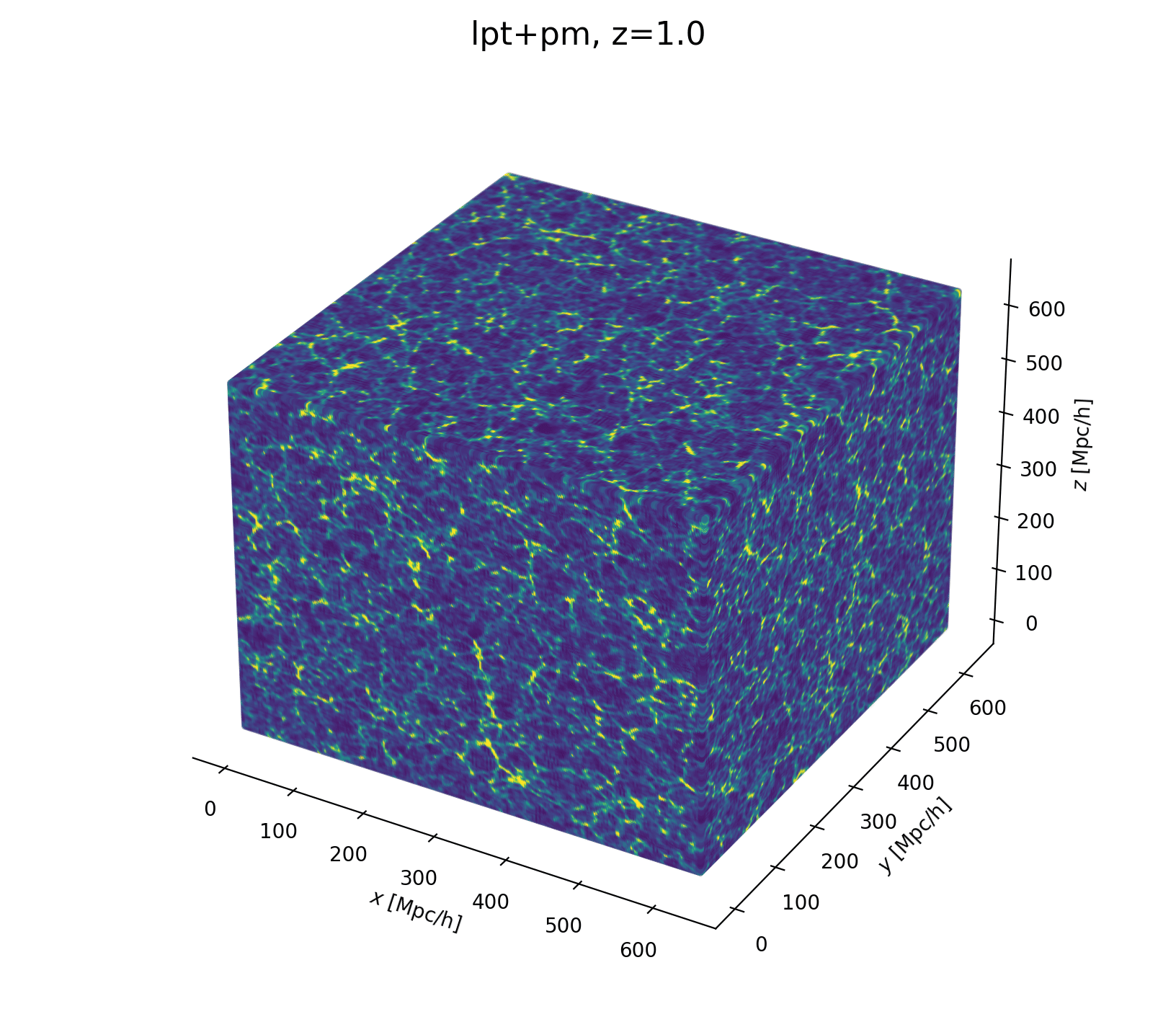
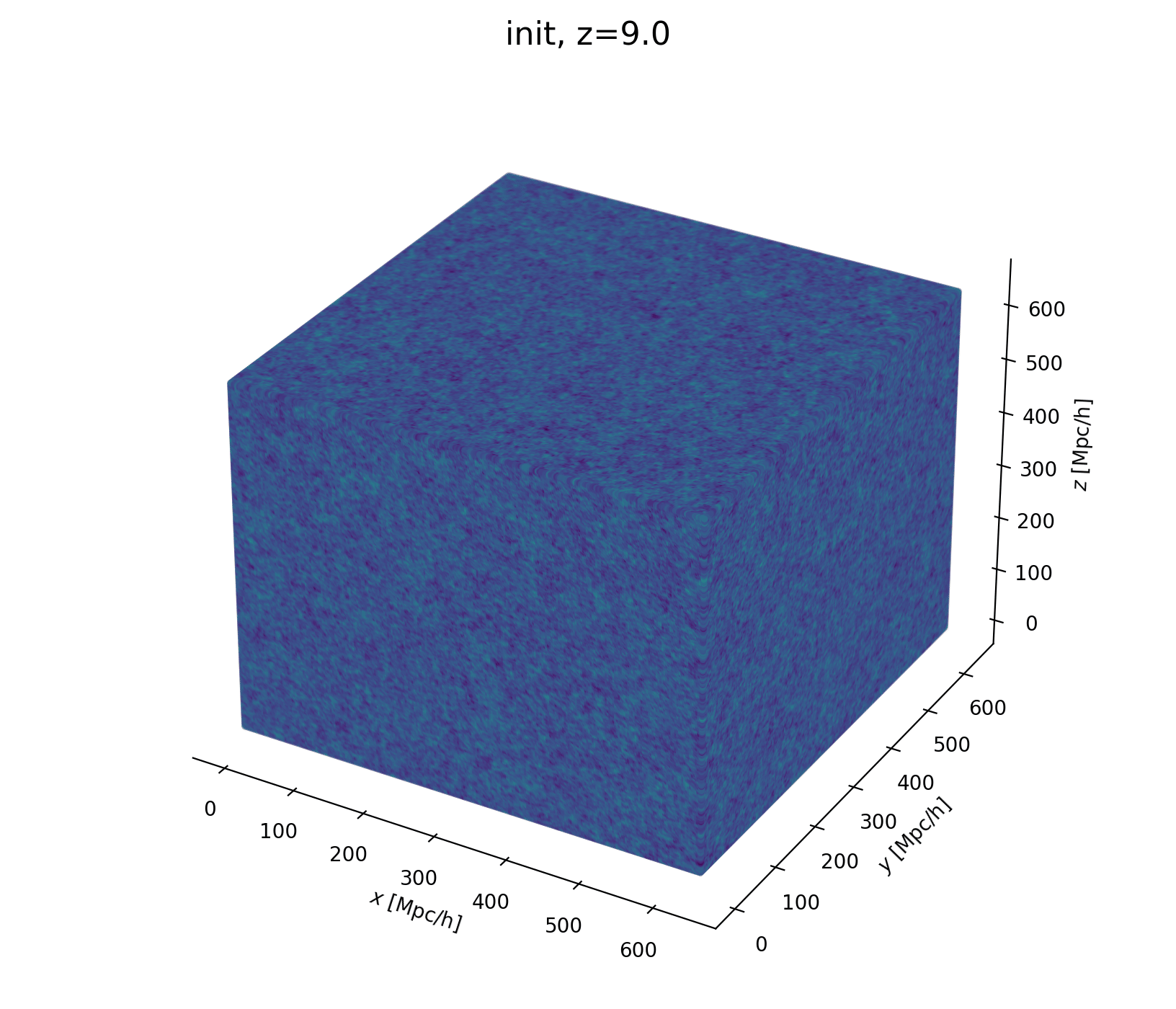
Fast and differentiable model with
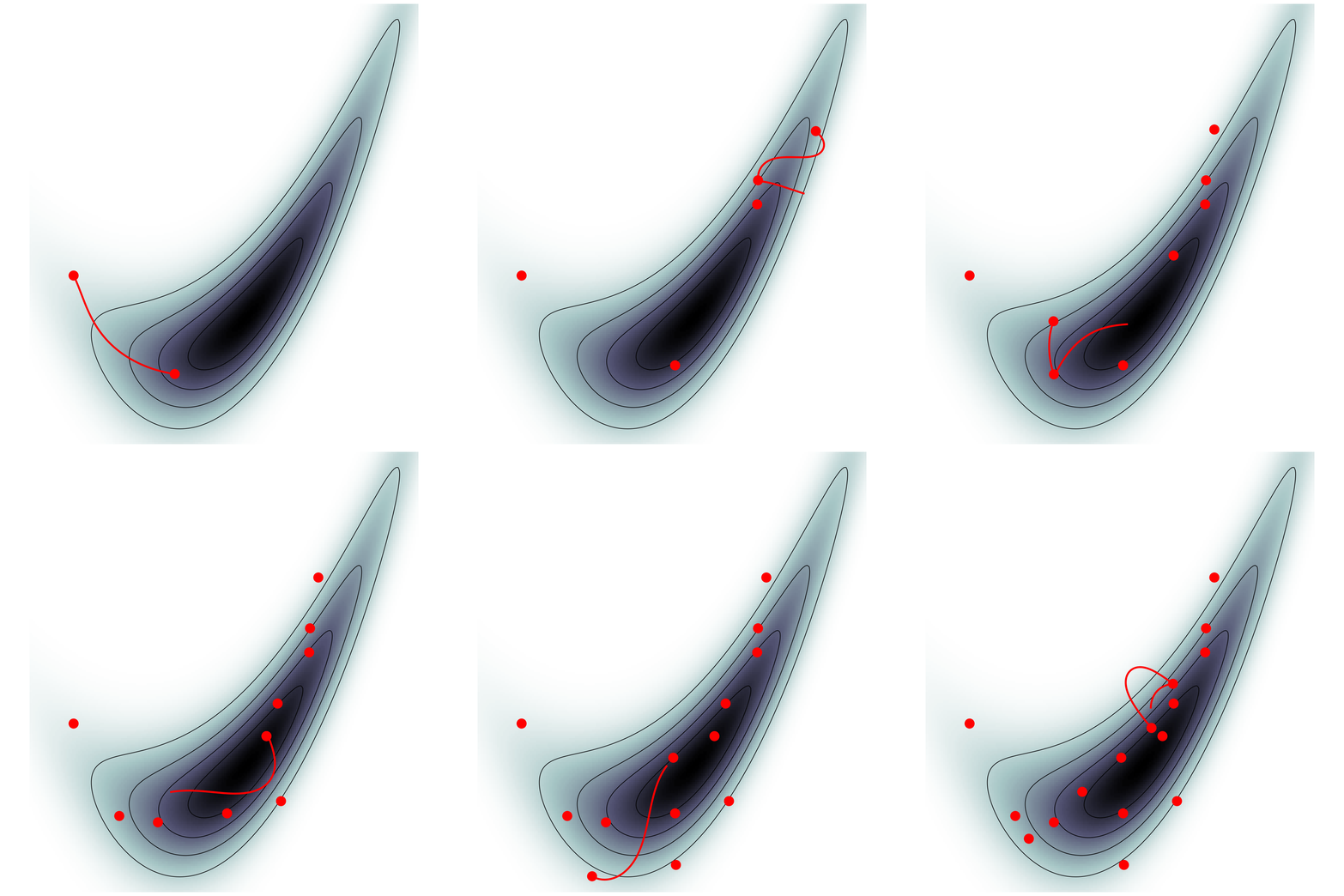
Field-Level sampling
Inferring jointly cosmology, bias parameters, and initial conditions allows full universe history reconstruction
+ preconditioning = \(128^3\) inference in 2h on a single GPU node (Simon+2025)
+
Field-Level Model
\(b\)
\(\delta_g\)
\(\Omega\)
\(\delta_L\)
Field-Level Inference of PNG
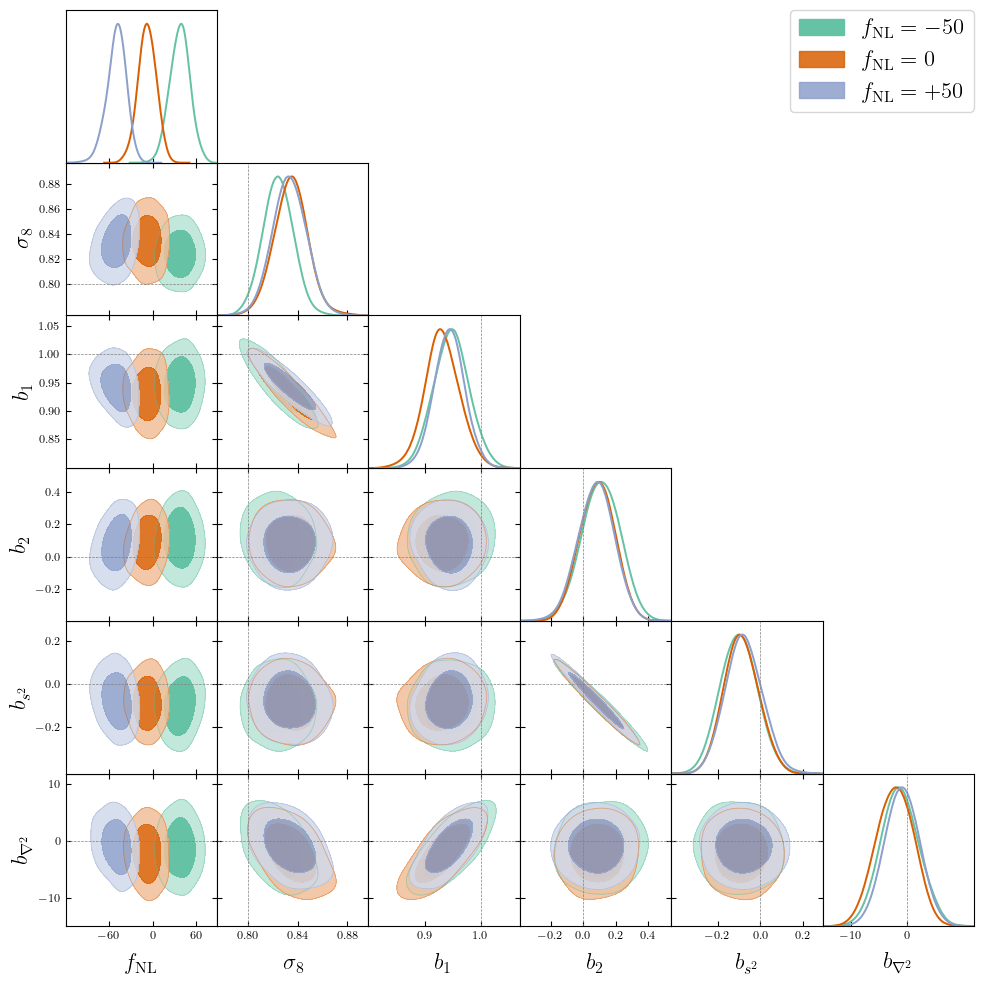
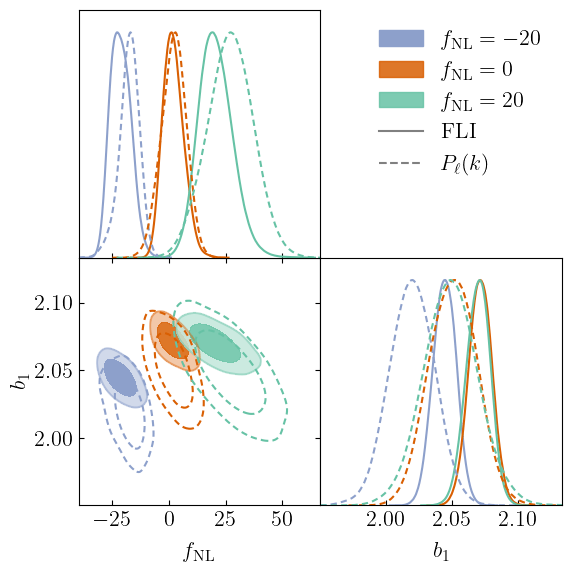
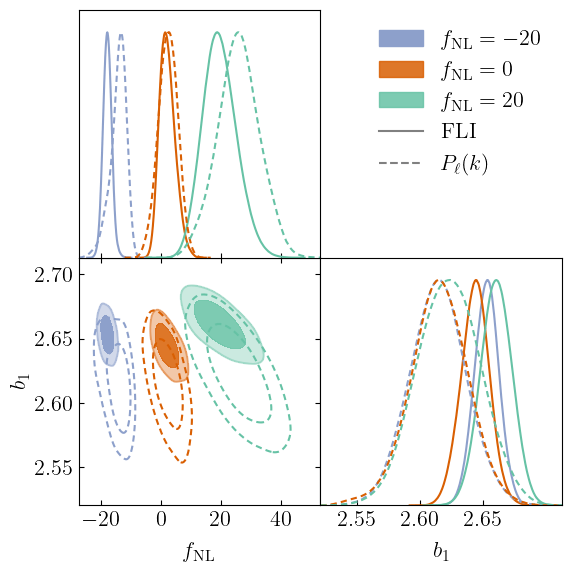
On \((3\ \mathrm{Gpc}/h)^3\) PNGUnitsim-XL
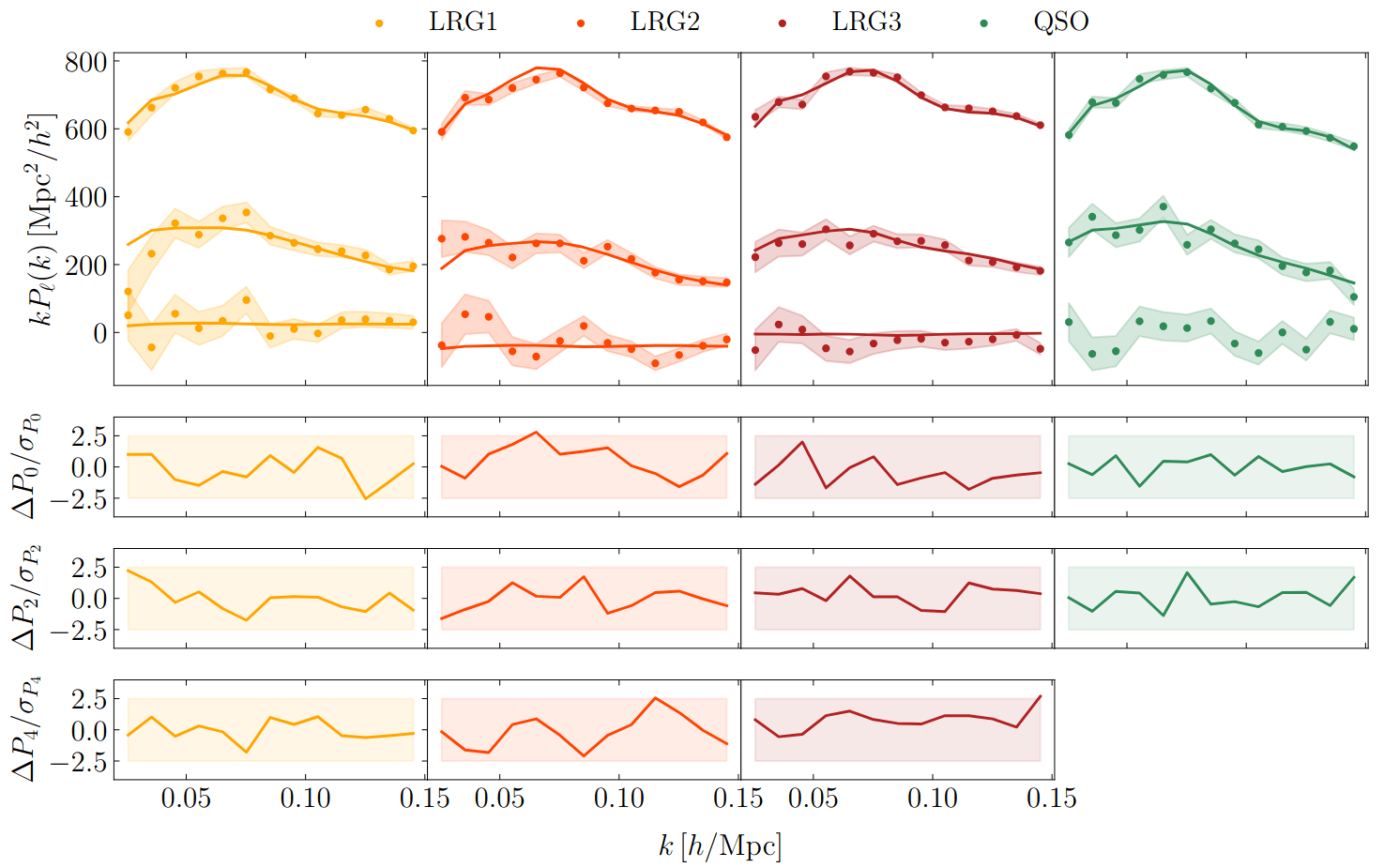
- \(\textrm{FLI at } k_\mathrm{Nyq} = 0.075\ h/\mathrm{Mpc}\ (64^3)\)
- \(P_{\{0,2\}}(k) \textrm{ at } k_\mathrm{max} = 0.08 h/\mathrm{Mpc}\)
Recovers true \(f_\mathrm{NL}\) and fitted \(b_1\) assuming fitted \(p_\phi\) (see Santiago's)
$$\mathrm{LRG}\, z=0.74$$ 5% to 30% gain
$$\mathrm{QSO}\, z=1.83$$ 20% to 50% gain
Field-Level Inference of PNG
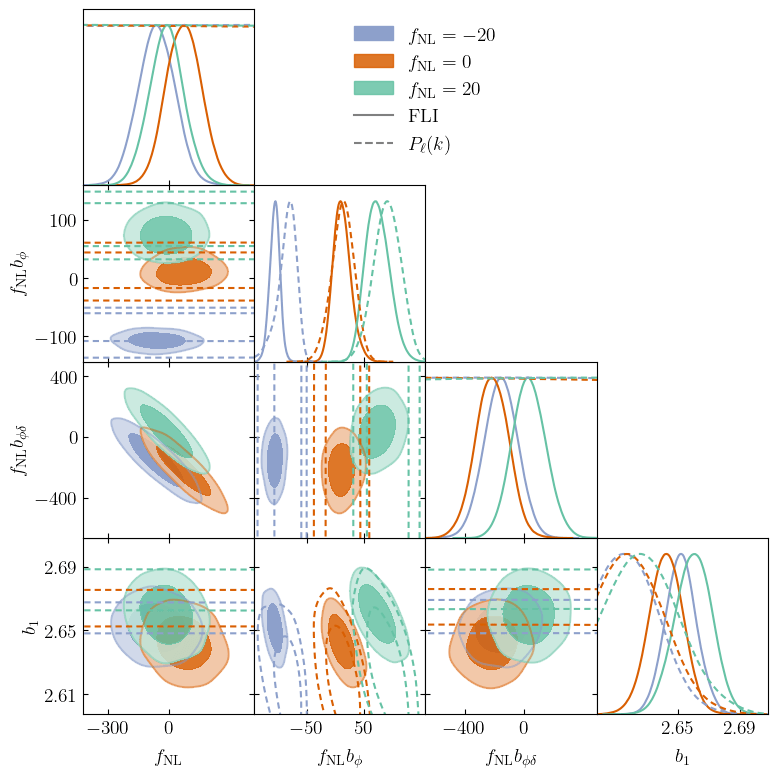
Where does the information come from?
- Mass relation with higher \(b_1\)?
- 2nd order terms \((f_\mathrm{NL}, f_\mathrm{NL} b_{\phi \delta})\)?
- \(f_\mathrm{NL} b_{\phi}\) from higher \(n\)-point?
Fit separately and compare:
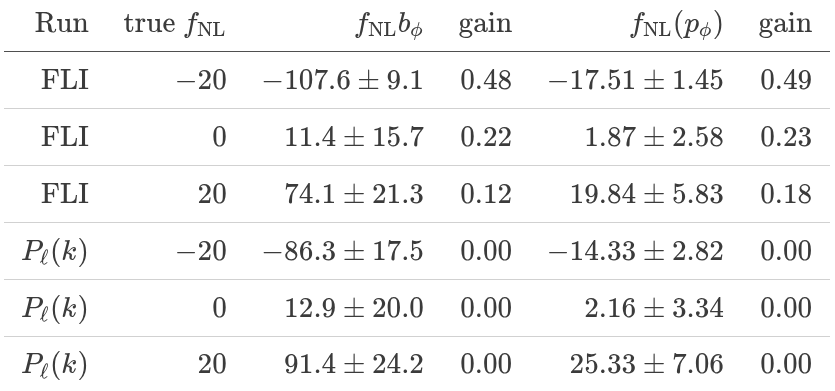
- Similar gain on \(f_\mathrm{NL} b_\phi\), independent of \(b_1\), so probably higher \(n\)-point \(f_\mathrm{NL} b_\phi\) signal
- 2nd order terms are constrained but does not provide much constraint on \(f_\mathrm{NL}\)
Toward more survey realism
Next steps:
- Cutsky mocks validation
- Contaminated mocks validation
- Application to DESI LRG and QSO
- Multi-probe analyses (see Jonathan's)
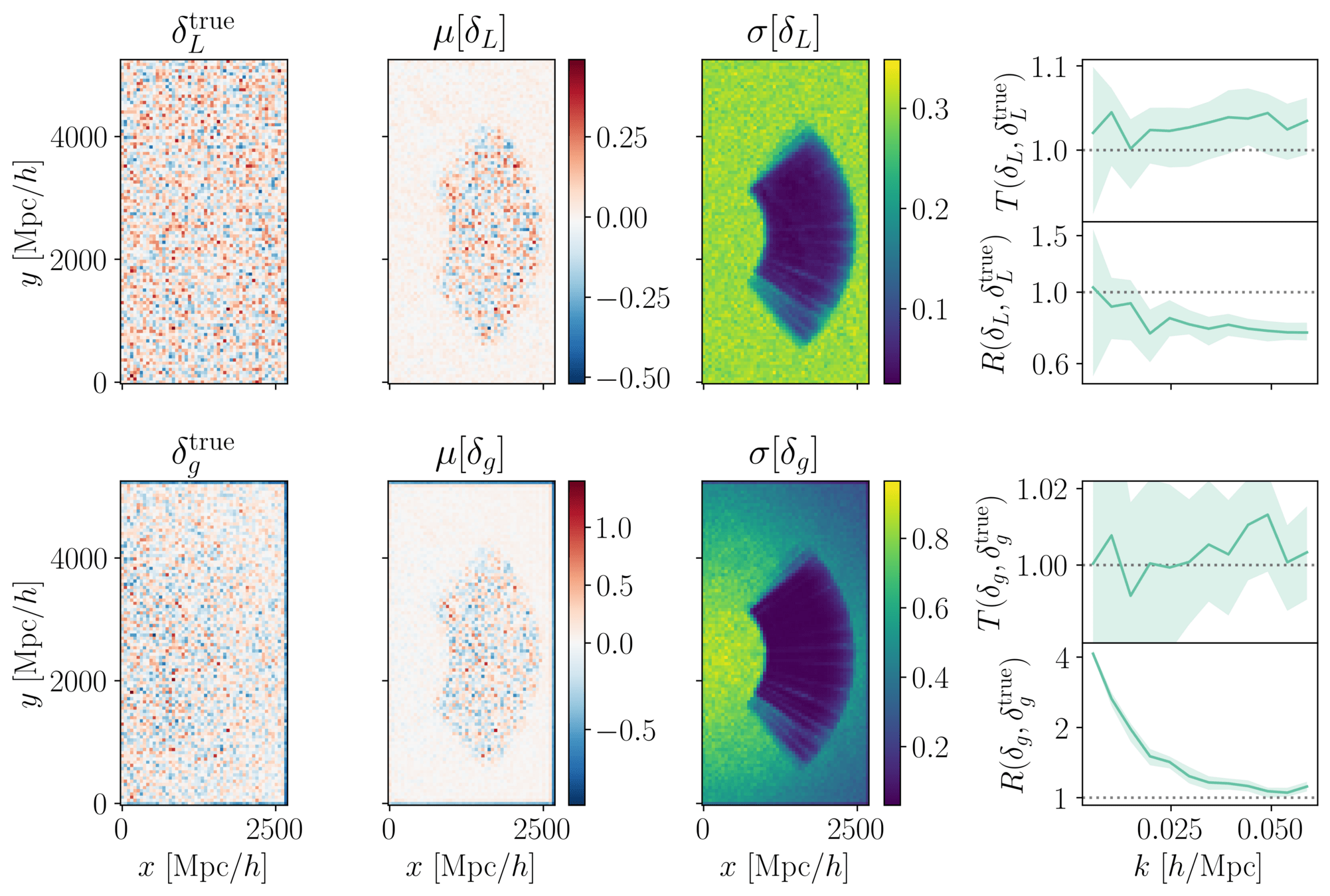
\(k_\mathrm{Nyq} \approx 0.04\, h/\mathrm{Mpc}\)
Example on LRG SGC footprint
Thank you!
2026Durham
By hsimonfroy