Introduction to Snakemake
Köster lab
University of Duisburg-Essen
2026
- check computational validity
- apply same analysis to new data
- check methodological validity
- understand analysis
Data analysis
Reproducibility
Transparency
- modify analysis
- extend analysis
Adaptability
>1.6 million downloads since 2015
>3000 citations
>14 citations per week in 2024


dataset
results
dataset
dataset
dataset
dataset
dataset
Define workflows
in terms of rules
Define workflows
in terms of rules
rule mytask:
    input:
        "path/to/{dataset}.txt"
    output:
        "result/{dataset}.txt"
    script:
        "scripts/myscript.R"


rule myfiltration:
     input:
        "result/{dataset}.txt"
     output:
        "result/{dataset}.filtered.txt"
     shell:
        "mycommand {input} > {output}"


rule aggregate:
    input:
        "results/dataset1.filtered.txt",
        "results/dataset2.filtered.txt"
    output:
        "plots/myplot.pdf"
    script:
        "scripts/myplot.R"
Define workflows
in terms of rules
Define workflows
in terms of rules
rule mytask:
    input:
        "data/{sample}.txt"
    output:
        "result/{sample}.txt"
    shell:
        "some-tool {input} > {output}"
rule name
how to create output from input
define
- input
- output
- log files
- parameters
- resources
rule mytask:
    input:
        "path/to/{dataset}.txt"
    output:
        "result/{dataset}.txt"
    script:
        "scripts/myscript.R"


rule myfiltration:
     input:
        "result/{dataset}.txt"
     output:
        "result/{dataset}.filtered.txt"
     shell:
        "mycommand {input} > {output}"


rule aggregate:
    input:
        "results/dataset1.filtered.txt",
        "results/dataset2.filtered.txt"
    output:
        "plots/myplot.pdf"
    script:
        "scripts/myplot.R"
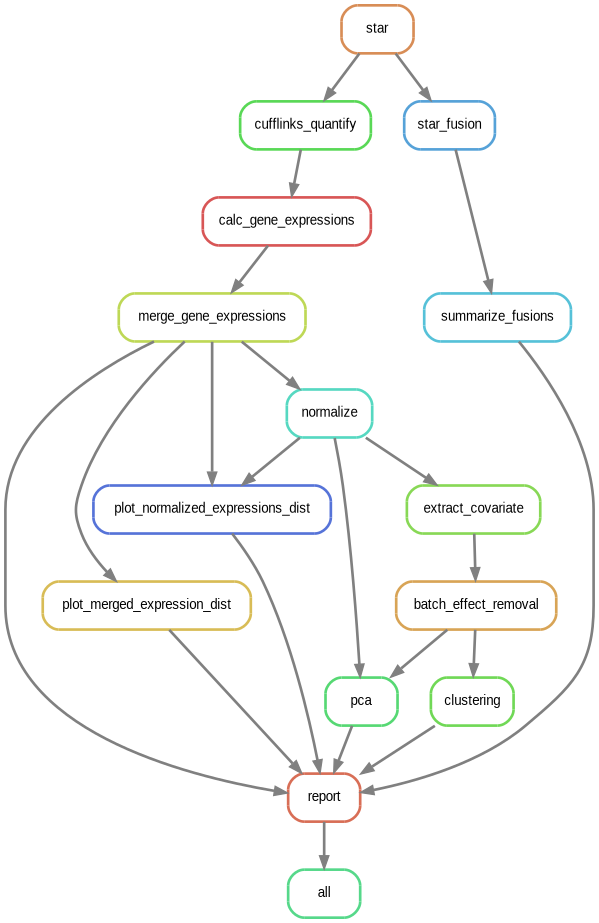
Automatic inference of DAG of jobs
Boilerplate-free integration of scripts
rule mytask:
    input:
        "data/{sample}.txt"
    output:
        "result/{sample}.txt"
    script:
        "scripts/myscript.py"
reusable scripts:
- Python
- R
- Julia
- Rust
- Bash
- Xonsh
- Hy
import pandas as pd

data = pd.read_table(snakemake.input[0])
data = data.sort_values("id")
data.to_csv(snakemake.output[0], sep="\t")
Python:
data <- read.table(snakemake@input[[1]])
data <- data[order(data$id),]
write.table(data, file = snakemake@output[[1]])
Boilerplate-free integration of scripts
R:
import polar as pl

pl.read_csv(&snakemake.input[0])
  .sort()
  .to_csv(&snakemake.output[0])
Rust:
$XONSH_TRACEBACK_LOGFILE = snakemake.log[0]

xsv sort -s id @(snakemake.input[0]) > @(snakemake.output[0])
Xonsh:
(import pandas :as pd)

(setv data (pd.read_table (get snakemake.input 0)))
(setv data (.sort_values data "id"))
(.to_csv data (get snakemake.output 0) :sep "\t")
Hy:
#!/usr/bin/env bash
exec 2> "${snakemake_log[0]}"

xsv sort -s id ${snakemake_input[0]} > ${snakemake_output[0]}
Bash:
Reusable wrappers
rule map_reads:
    input:
        "{sample}.bam"
    output:
        "{sample}.sorted.bam"
    wrapper:
        "0.22.0/bio/samtools/sort"
reuseable wrappers from central repository
Reusable wrappers
\max U_t \cdot 2S \cdot \sum_{j \in J} x_j \cdot p_j
+ 2S \cdot \sum_{j \in J} x_j \cdot (u_{t,j})
+ S \cdot \sum_{f \in F} \gamma_f \cdot S_f\\
+ \sum_{f \in F} \delta_f \cdot S_f
\sum_{j \in J} x_j \cdot u_{r,j} \leq U_r \quad \forall r \in R
\delta_f \leq \frac{\sum_{j \in J} x_j \cdot z_{f,j}}{\sum_{j \in J} z_{f,j}} \quad\forall f \in F
\text{subject to:}
job selection
job resource usage
free resources
job temp file consumption
temp file lifetime fraction
job priority
job thread usage
Scheduling
temp file size
temp file deletion
\gamma_f \leq \delta_f \quad\forall f \in F
\gamma_f \in \{0,1\}
\delta_f \in [0,1]
x_f \in \{0,1\}
DAG partitioning
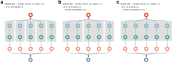
--groups a=g1 b=g1
--groups a=g1 b=g1
--group-components g1=2
--groups a=g1 b=g1
--group-components g1=5
Scalable to any platform


workstation
compute server
cluster
grid computing
cloud computing



rule mytask:
    input:
        "path/to/{dataset}.txt"
    output:
        "result/{dataset}.txt"
    conda:
        "envs/some-tool.yaml"
    shell:
        "some-tool {input} > {output}"
Conda integration
channels:
 - conda-forge
dependencies:
  - some-tool =2.3.1
  - some-lib =1.1.2
Container integration
rule mytask:
    input:
        "path/to/{dataset}.txt"
    output:
        "result/{dataset}.txt"
    container:
        "docker://biocontainers/some-tool:2.3.1"
    shell:
        "some-tool {input} > {output}"
Self-contained HTML reports
Interoperability with other WMS
rule chipseq_pipeline:
    input:
        input="design.csv",
        fasta="data/genome.fasta",
        gtf="data/genome.gtf",
        # any --<argname> pipeline file arguments can be given here as <argname>=<path>
    output:
        report="results/multiqc/broadPeak/multiqc_report.html",
    params:
        pipeline="nf-core/chipseq",
        revision="2.0.0",
        profile=["test", "docker"],
        outdir=subpath(output.report, ancestor=2),
        # any --<argname> pipeline arguments can be given here as <argname>=<value>
    handover: True
    wrapper:
        "v7.2.0/utils/nextflow"
Many more features
- dynamic DAG rewiring
- service jobs (providing sockets, loading databases, or ramdisks)
- semantic helper functions for minimizing boilerplate code
- fallible rules
- caching of shared results across workflows
- transparent handling of remote storage
- semantic helper functions
- access pattern annotation
Extensible architecture

Extensible architecture
Conclusion
Snakemake covers all aspects of fully reproducible, transparent, and adaptable data analysis, offering
- maximum readability
- ad-hoc integration with scripting and high performance languages
- an extensible architecture
- a plethora of advanced features
https://snakemake.github.io


Snakemake workflow catalog
Snakemake-Intro
By Johannes Köster