

















Content ITV PRO
This is Itvedant Content department
Learning Outcome
4
Apply safe error responses without leaking internals.
3
Recognize retryable vs non-retryable errors.
2
Identify when to use HTTPException vs a custom handler.
1
Understand which status code fits each API situation
5
Connect retry and backoff to calling LLM APIs.
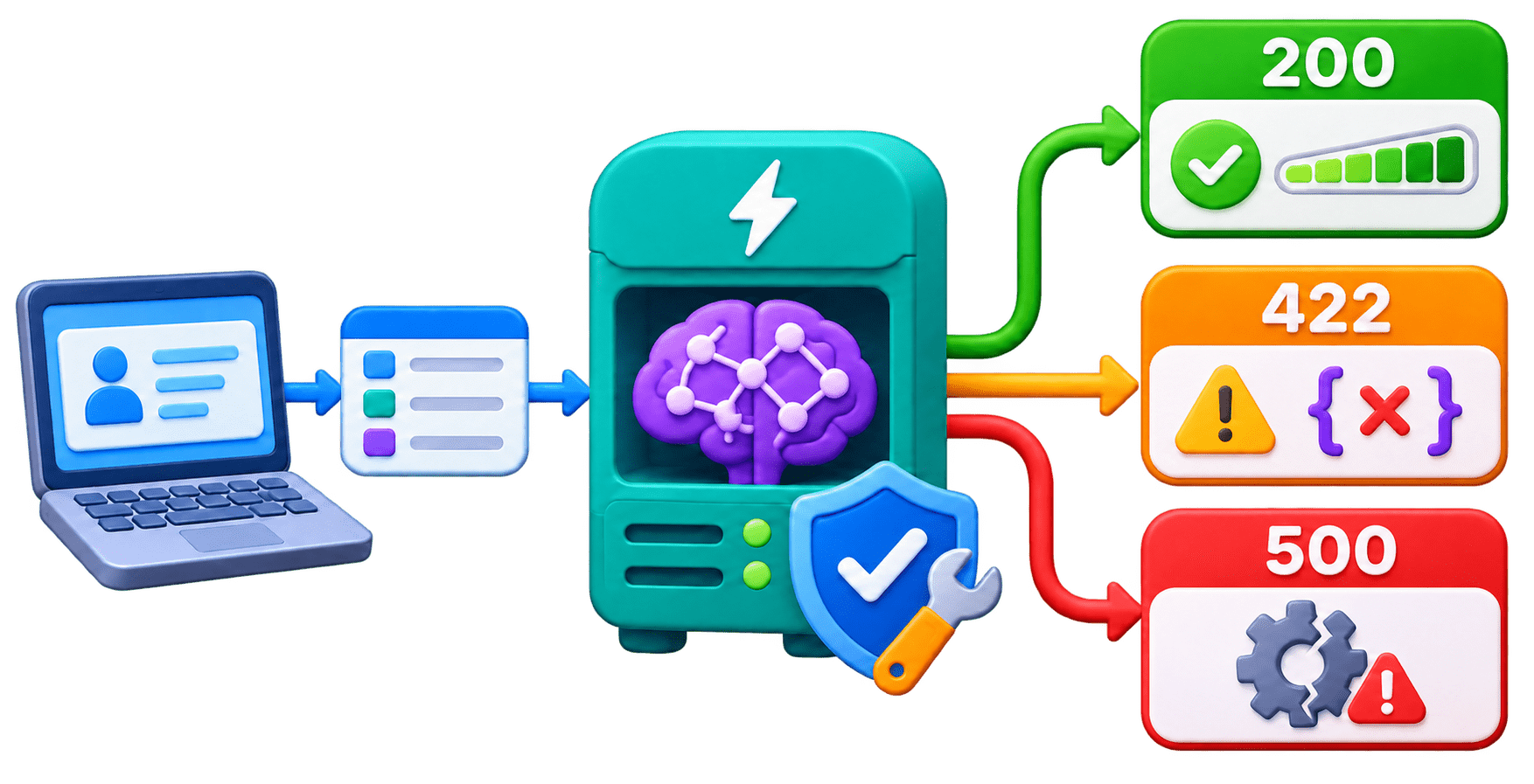
Status Codes: Client Errors (4xx)
400
401
403
404
422
Bad Request
Unauthorized
Forbidden
Not Found
Unprocessable Entity
429
Too Many Requests
Passed the schema but breaks a business rule, e.g., a prediction date in the past.
API key missing, wrong, or expired.
Identified but not allowed, e.g., free-tier key calling a premium model.
Unknown model name or prediction ID.
Failed Pydantic validation; automatic.
Over the request limit for the time window.
4xx = the client must fix the request.
Status Codes: Success and Server Errors (2xx, 5xx)
200 OK
a type only, e.g., tenure_months: int.
201 Created
coupon_code: str | None = None.
500 Internal Server Error
Literal restricts values
to a listed set.
503 Service Unavailable
Running but can't serve right now, e.g., model still loading or maintenance.
Never return 200 with an error inside the body. Clients, monitors, and load balancers judge success by the status code.
Raising Errors with HTTPException
Code
raise HTTPException(status_code=404,
                    detail="Model 'churn-v9' not found")
Detail can be a dict for structure, e.g., {"error": "model_not_found", "available": [...]}. Headers can add Retry-After for 429.
Detect the problem inside the endpoint, e.g., a model name not in the registry.
Raise HTTPException; execution stops immediately.
FastAPI responds with that status and a JSON detail body.
Custom Exceptions and Exception Handlers
Raise them in the logic
Prediction code never mentions status codes.
Code
@app.exception_handler(ModelNotLoadedError)
def model_not_loaded(request, exc):
    return JSONResponse(status_code=503,
                        content={"error": "model_not_loaded"})
Map once with a handler
One function converts the error into a consistent JSONResponse.
Define domain errors
ModelNotLoadedError, FeatureOutOfRangeError describe problems in your app's terms.
Handling Unexpected Errors Safely
Fail fast when the model is missing
Return 503 from /predict and /health, not a confusing 500 on every request.
4
No stack traces to clients
They reveal file paths, library versions, and code structure. Full traceback goes to server logs only.
1
Return a request ID
The client reports it; the team finds the exact log entry instantly.
2
One error format
404, 422, and 500 share the same JSON structure.
3
Retryable vs Non-Retryable Errors (Core Mechanism)
Step 1:
Check the status code familyContent generation and assistance
Step 2 : 400, 401, 403, 404, 422
Don't retry; fix the request first.
Step 3 : 429
Wait for the Retry-After time, then retry.
Step 4: 503 and some 5xx
Retry with backoff: 1 s, 2 s, 4 s, instead of hammering the server.
LLM provider APIs regularly return 429 on rate limits and 5xx (some use 529) when overloaded, so every production GenAI app needs retry with backoff.
HTTPException vs Custom Exception Handler (Comparison)
| Aspect | HTTPException | Custom Exception + Handler |
|---|---|---|
| Where rules live | Directly in the endpoint | Anywhere in business or prediction logic |
| Knows about HTTP? | Yes, status set where raised | No; the handler decides the status |
| Consistency | Depends on each developer | One handler, one format everywhere |
| Reuse outside API | Not suited to scripts or batch jobs | Same logic works in scripts and jobs |
| Typical use | Simple checks, e.g., missing ID in one endpoint | Domain errors, e.g., model not loaded, quota exceeded |
| Analogy | One ATM printing its own message | Bank-wide standard screen for every ATM |
Think About This: Spotting the Difference
A client requests a model name that isn't in the registry
Client asked for something that doesn't exist.
The server restarted and the model is still loading
request is fine; server is temporarily unable.
Too frequent; slow down.
A client sends 300 requests a minute on a 100/minute plan
404
503
429
4xx says you fix it; 5xx says we'll fix it.
Real-World Applications
Load balancers
Route traffic away from instances whose /health returns 503.
Support desks
A user quotes the request_id, and the exact log entry is found in seconds.
Monitoring dashboards
Error rates are counted by status code, so honest codes keep alerts accurate.
GenAI apps
Retry 429 and 5xx from LLM providers with backoff; 401 means fix the API key.
Summary
5
Tracebacks in logs, request ID to client.
4
Retry 429 and 503 with backoff.
3
HTTPException inline; handlers for domain errors.
2
Never return 200 for a failure.
1
4xx: client fixes. 5xx: server fixes.
Quiz
The server just restarted and the model is still loading when a valid prediction request arrives. What should the API return?
A.503 Service Unavailable
B.500 Internal Server Error
C.422 Unprocessable Entity
D.200 OK with {"error": "model loading"}
Quiz-Answer
The server just restarted and the model is still loading when a valid prediction request arrives. What should the API return?
A.503 Service Unavailable
B.500 Internal Server Error
C.422 Unprocessable Entity
D.200 OK with {"error": "model loading"}
By Content ITV